
13-141
201.
Selected balances from a company’s financial statements are shown below. Calculate the
following ratios for 2017:
(a) accounts receivable turnover
(b) inventory turnover
(c) days’ sales uncollected
(d) days’ sales in inventory
(e) profit margin.
(f) return on total assets.
Dec. 31,
2017
Dec. 31,
2016
For the
Year 2017
Accounts
receivable
$27,000
$24,000
Merchandise
inventory
25,000
20,000
Total assets
296,000
244,000
Accounts
payable
26,000
32,000
Salaries
payable
3,000
4,400
Sales (all on
credit)
$312,000
Cost of
goods sold
165,600
Salaries
expense
48,000
Other
expenses
75,000
Net income
24,000
202.
The following selected financial information for a company was reported for the current
year end. Calculate the following company ratios:
(a) Accounts receivable turnover.
(b) Inventory turnover.
(c) Days’ sales uncollected
Accounts receivable, beginning-year
$170,000
Accounts receivable, year-end
190,000
Merchandise inventory, beginning-year
80,000
Merchandise inventory, year-end
60,000
Cost of goods sold
580,000
Credit sales
1,000,000
13-144
203.
Selected current year end financial information for a company is presented below.
Calculate the following company ratios:
(a) Profit margin.
(b) Total asset turnover.
(c) Return on total assets.
(d) Return on common stockholders’ equity (assume the company has no preferred
stock).
Net income
$325,000
Net sales
4,700,000
Total liabilities, beginning-year
550,000
Total liabilities, end-of–year
530,000
Total stockholders’ equity, beginning-
year
760,000
Total stockholders’ equity, end-of–year
745,000
204.
Use the following information from the current year financial statements of a company to
calculate the ratios below:
Total liabilities
Total equity
Total assets
13-145
(a) Current ratio.
(b) Accounts receivable turnover. (Assume the prior year’s accounts receivable balance
was $100,000.)
(c) Days’ sales uncollected.
(d) Inventory turnover. (Assume the prior year’s inventory was $50,200.)
(e) Times interest earned ratio.
(f) Return on common stockholders’ equity. (Assume the prior year’s common stock
balance was $480,000 and the retained earnings balance was $128,000.)
(g) Earnings per share (assuming the corporation has a simple capital structure, with only
common stock outstanding).
(h) Price earnings ratio. (Assume the company’s stock is selling for $26 per share.)
(i) Divided yield ratio. (Assume that the company paid $1.25 per share in cash dividends.)
Income statement data:
Sales (all on credit)
$1,075,000
Cost of goods sold
575,000
Gross profit on sales
$500,000
Operating expenses
305,000
Operating income
$195,000
Interest expense
20,400
Income before taxes
$174,600
Income taxes
74,000
Net income
$100,600
Balance sheet data:
Cash
$38,400
Accounts receivable
120,000
Inventory
56,700
Prepaid Expenses
24,000
Total current assets
$239,100
Total plant assets
708,900
13-146
Total assets
$948,000
Accounts payable
$91,200
Interest payable
4,800
Long-term liabilities
204,000
Total liabilities
$300,000
Common stock, $10 par
480,000
Retained earnings
168,000
Total liabilities and equity
$948,000
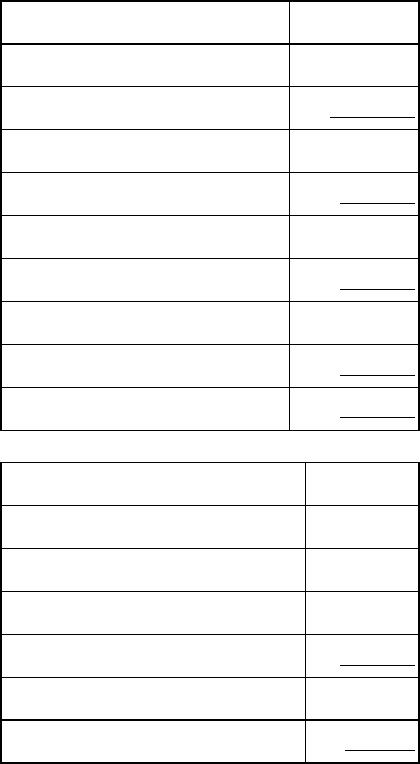
Accounts receivable
Prepaid expenses
Total current assets
Accounts payable
Interest payable
Total current liabilities
13-148
205.
Financial information for Sigma Company is presented below. Calculate the following
ratios for 2017:
(a) Inventory turnover.
(b) Accounts receivable turnover.
(c) Return on total assets.
(d) Times interest earned.
(e) Total asset turnover.
2017
2016
Assets:
Cash
$18,000
$22,000
Marketable securities
25,000
0
Accounts receivable
38,000
42,000
Inventory
61,000
52,000
Prepaid insurance
6,000
9,000
Long-term investments
49,000
20,000
Plant assets, net
218,000
225,000
Total assets
$415,000
$370,000
Net income
$62,250
Sales (all on credit)
305,000
Cost of goods sold
123,000
Interest expense
15,600
Income tax expense
27,000
13-150
206.
The following summaries from the income statements and balance sheets of Kouris
Company and Brittania, Inc. are presented below.
(1) For both companies for 2017, compute the:
(a) Current ratio
(b) Acid-test ratio
(c) Accounts receivable turnover
(d) Inventory turnover
(e) Days’ sales in inventory
(f) Days’ sales uncollected
Which company do you consider to be the better short-term credit risk? Explain.
(2) For both companies for 2017, compute the:
Which company do you consider to have better profitability ratios?
Kouris Company
Consolidated Statement of Income
May 31, 2017
(in millions)
Revenues
$10,697.0
Cost of sales
6,313.6
Gross profit
4,383.4
Operating expenses
3,137.6
Operating income
1,245.8
Interest expense
42.9
Other revenues and expenses
79.9
Income before tax
1,123.0
Income taxes
382.9
13-151
Income before effect of accounting
change
740.1
Cumulative effect of accounting
change, net of tax
266.1
Net income
$474.0
Inventories
Other current assets
Total current assets
Property, plant, and
equipment, net
Total assets
$6,713.9
$6,440.0
Current portion of long-term
13-152