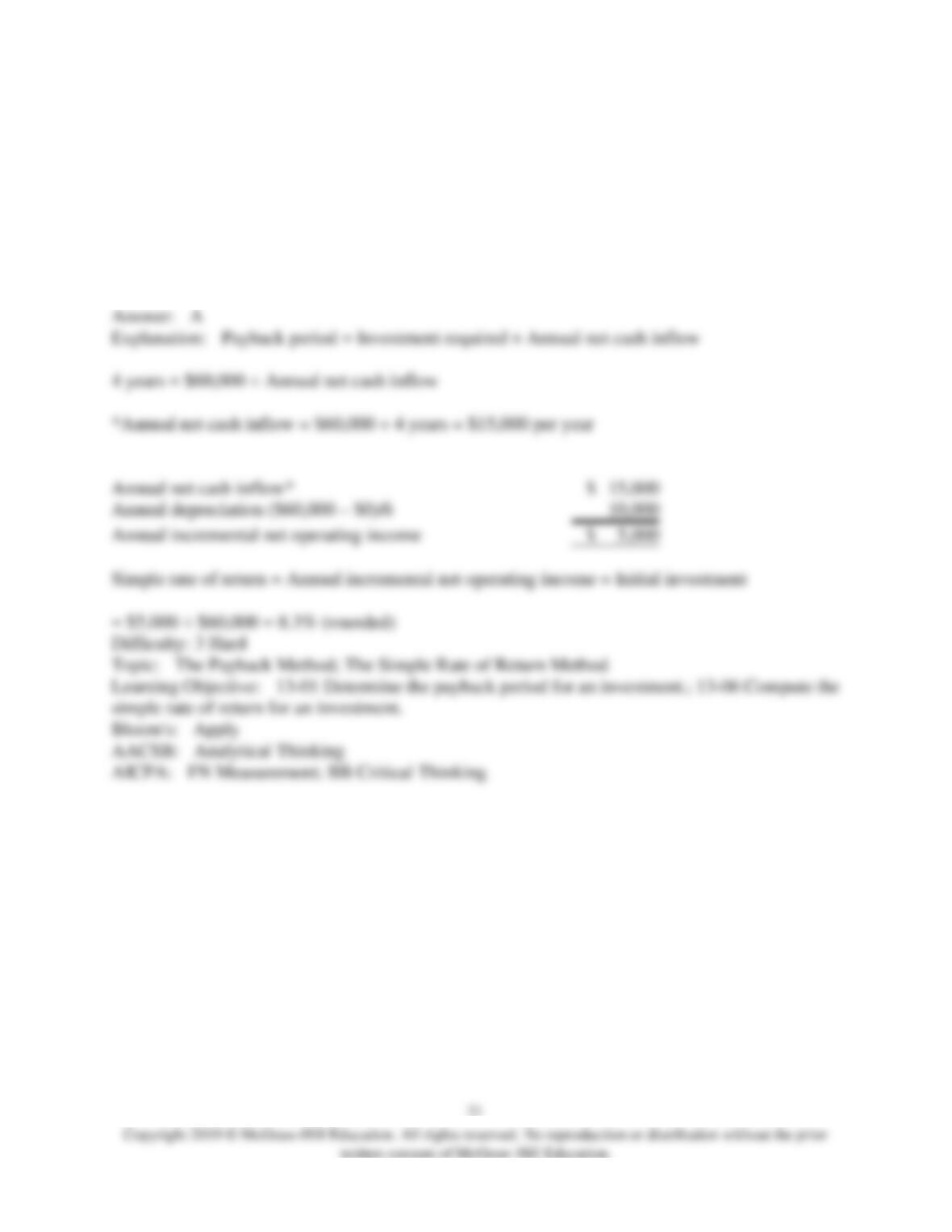
46) Jark Corporation has invested in a machine that cost $60,000, that has a useful life of six years,
and that has no salvage value at the end of its useful life. The machine is being depreciated by the
straight-line method, based on its useful life. It will have a payback period of four years. Given
these data, the simple rate of return on the machine is closest to (Ignore income taxes.):
A) 8.3%
B) 7.2%
C) 9.5%
D) 25%
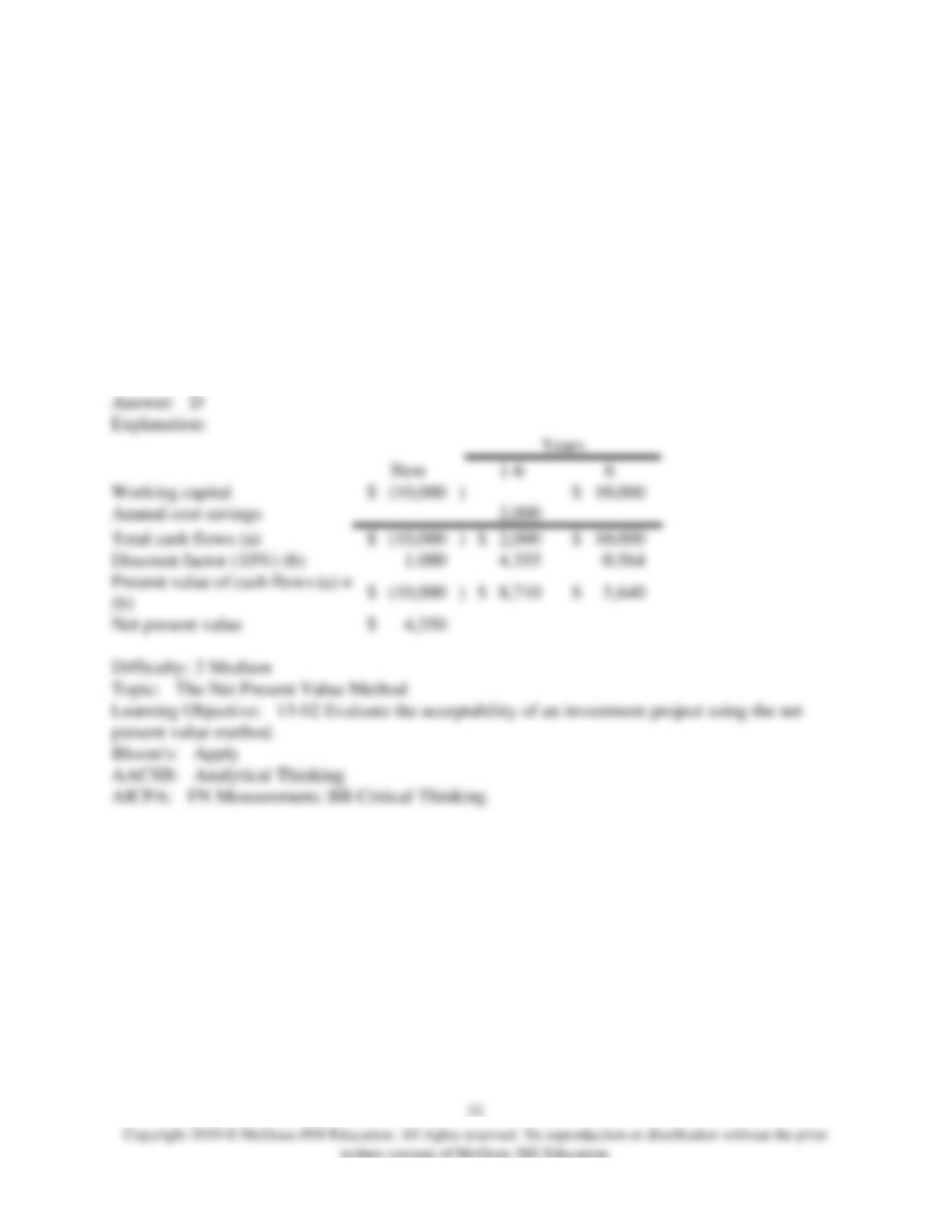
47) Parks Corporation is considering an investment proposal in which a working capital
investment of $10,000 would be required. The investment would provide cash inflows of $2,000
per year for six years. The working capital would be released for use elsewhere when the project is
completed. If the company’s discount rate is 10%, the investment’s net present value is closest to
(Ignore income taxes.):
See separate Exhibit 13B-1 and Exhibit 13B-2, to determine the appropriate discount factor(s)
using the tables provided.
A) $1,290
B) $(1,290)
C) $2,000
D) $4,350
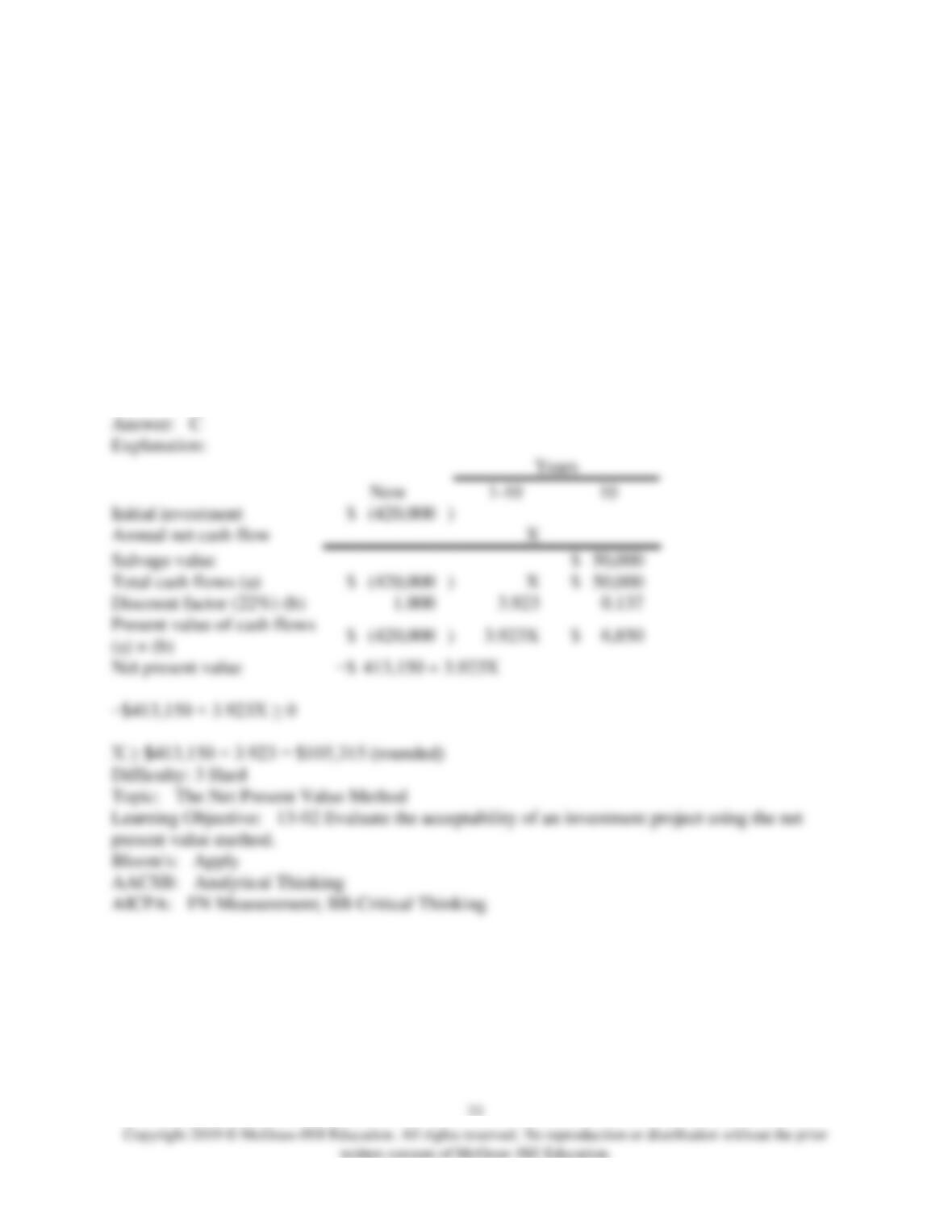
48) In an effort to reduce costs, Pontic Manufacturing Corporation is considering an investment in
equipment that will reduce defects. This equipment will cost $420,000, will have an estimated
useful life of 10 years, and will have an estimated salvage value of $50,000 at the end of 10 years.
The company’s discount rate is 22%. What amount of cost savings will this equipment have to
generate per year in each of the 10 years in order for it to be an acceptable project? (Ignore income
taxes.).
See separate Exhibit 13B-1 and Exhibit 13B-2, to determine the appropriate discount factor(s)
using the tables provided.
A) $50,690 or more
B) $41,315 or more
C) $105,315 or more
D) $94,316 or more
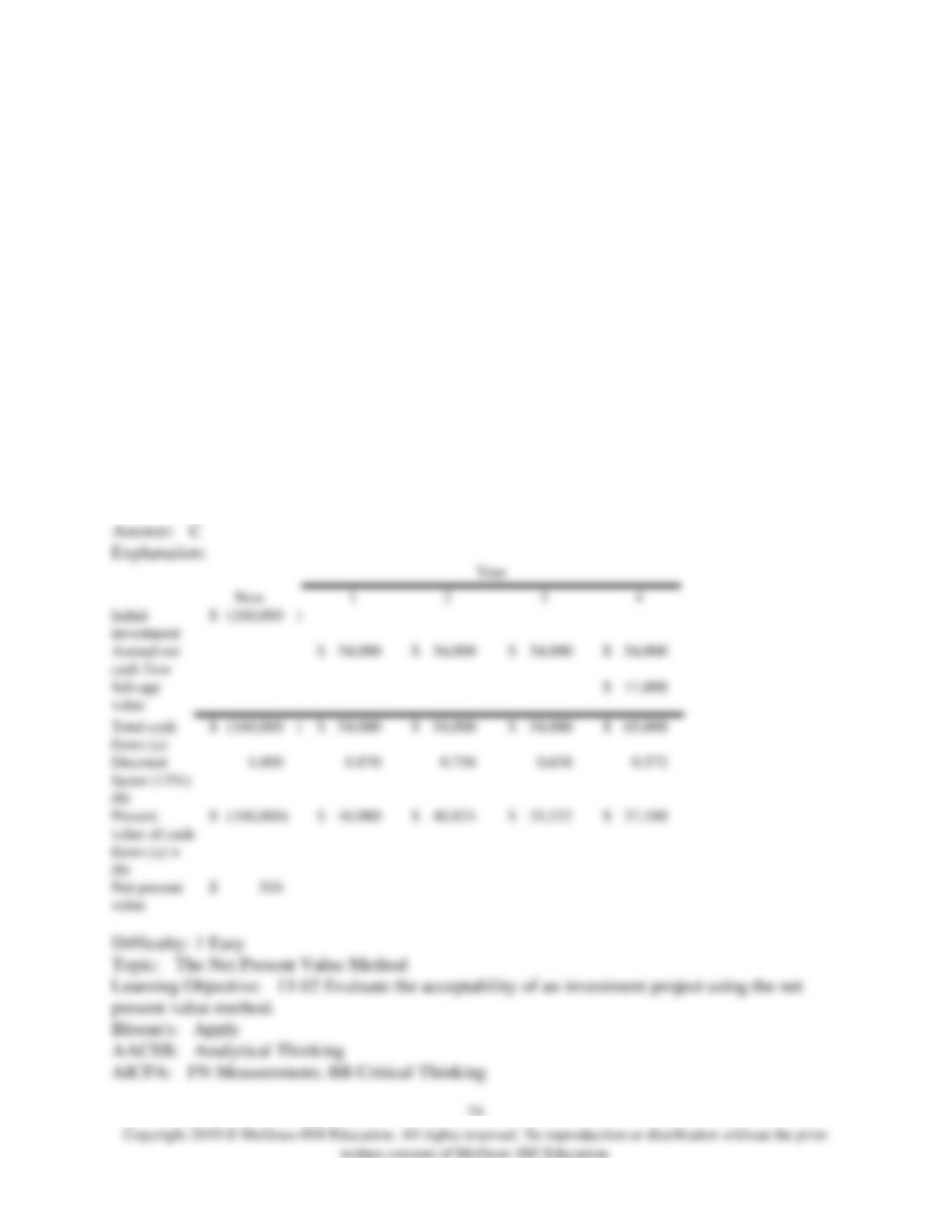
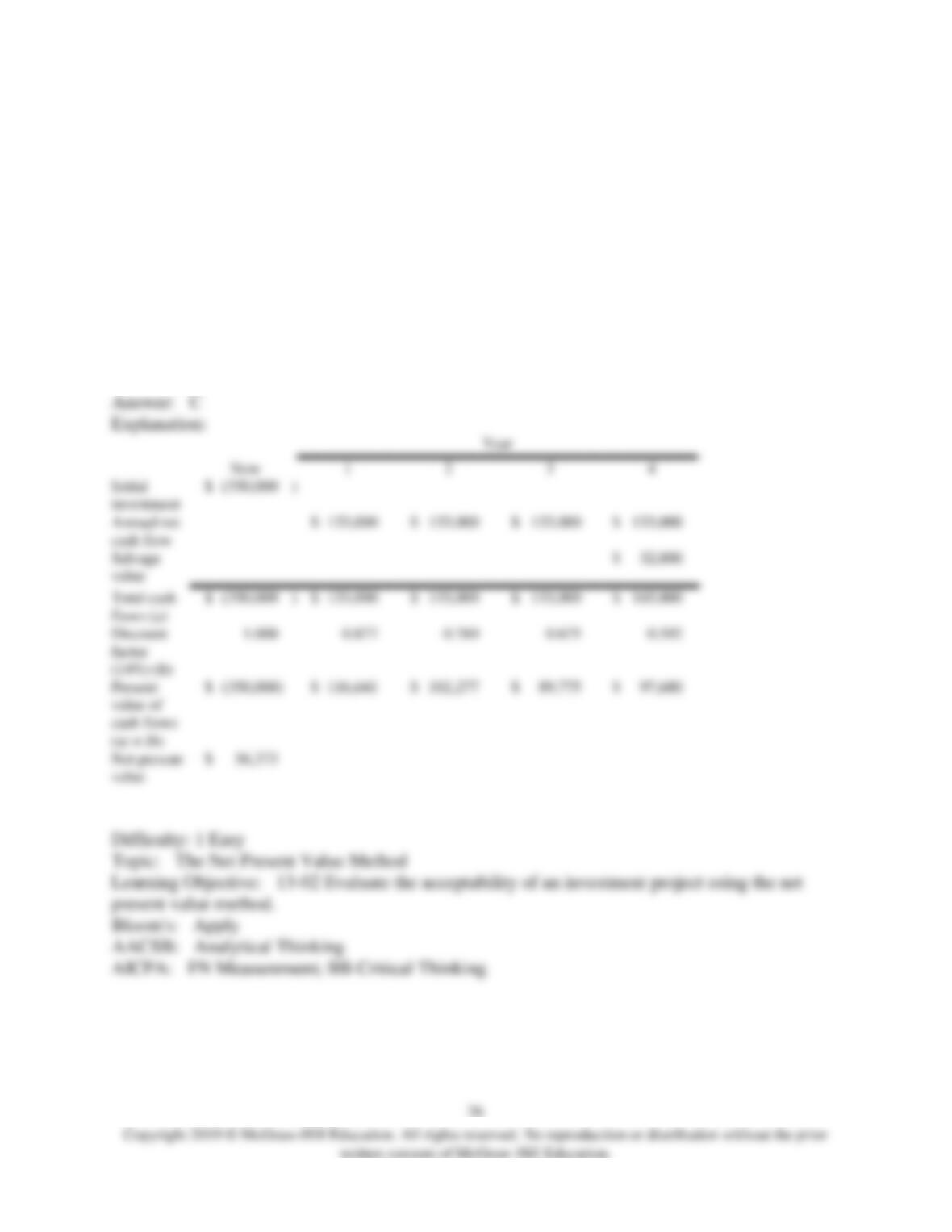
49) Respass Corporation has provided the following data concerning an investment project that it
is considering:
Initial investment
$
160,000
Annual cash flow
$
54,000
per year
Salvage value at the end of the project
$
11,000
Expected life of the project
4
years
Discount rate
15
%
See separate Exhibit 13B-1 and Exhibit 13B-2, to determine the appropriate discount factor(s)
using the tables provided.
The net present value of the project is closest to:
A) $67,000
B) $160,516
C) $516
D) $(5,776)
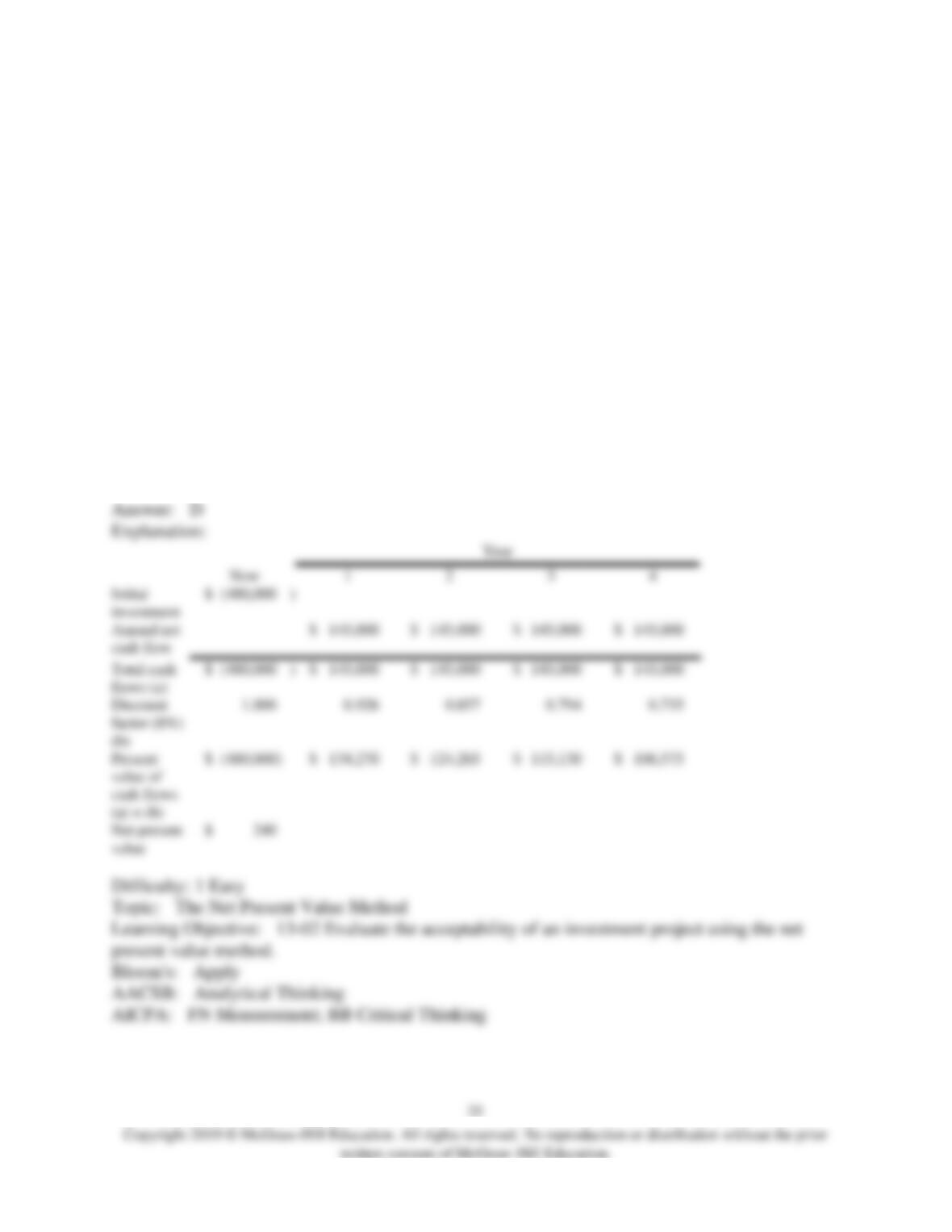
50) Puello Corporation has provided the following data concerning an investment project that it is
considering:
Initial investment
$
480,000
Annual cash flow
$
145,000
per year
See separate Exhibit 13B-1 and Exhibit 13B-2, to determine the appropriate discount factor(s)
using the tables provided.
The life of the project is 4 years. The company’s discount rate is 8%. The net present value of the
project is closest to:
A) $480,000
B) $480,240
C) $100,000
D) $240
51) Haroldsen Corporation is considering a capital budgeting project that would require an initial
investment of $350,000. The investment would generate annual cash inflows of $133,000 for the
life of the project, which is 4 years. At the end of the project, equipment that had been used in the
project could be sold for $32,000. The company’s discount rate is 14%. The net present value of the
project is closest to:
See separate Exhibit 13B-1 and Exhibit 13B-2, to determine the appropriate discount factor(s)
using the tables provided.
A) $214,000
B) $37,429
C) $56,373
D) $406,373
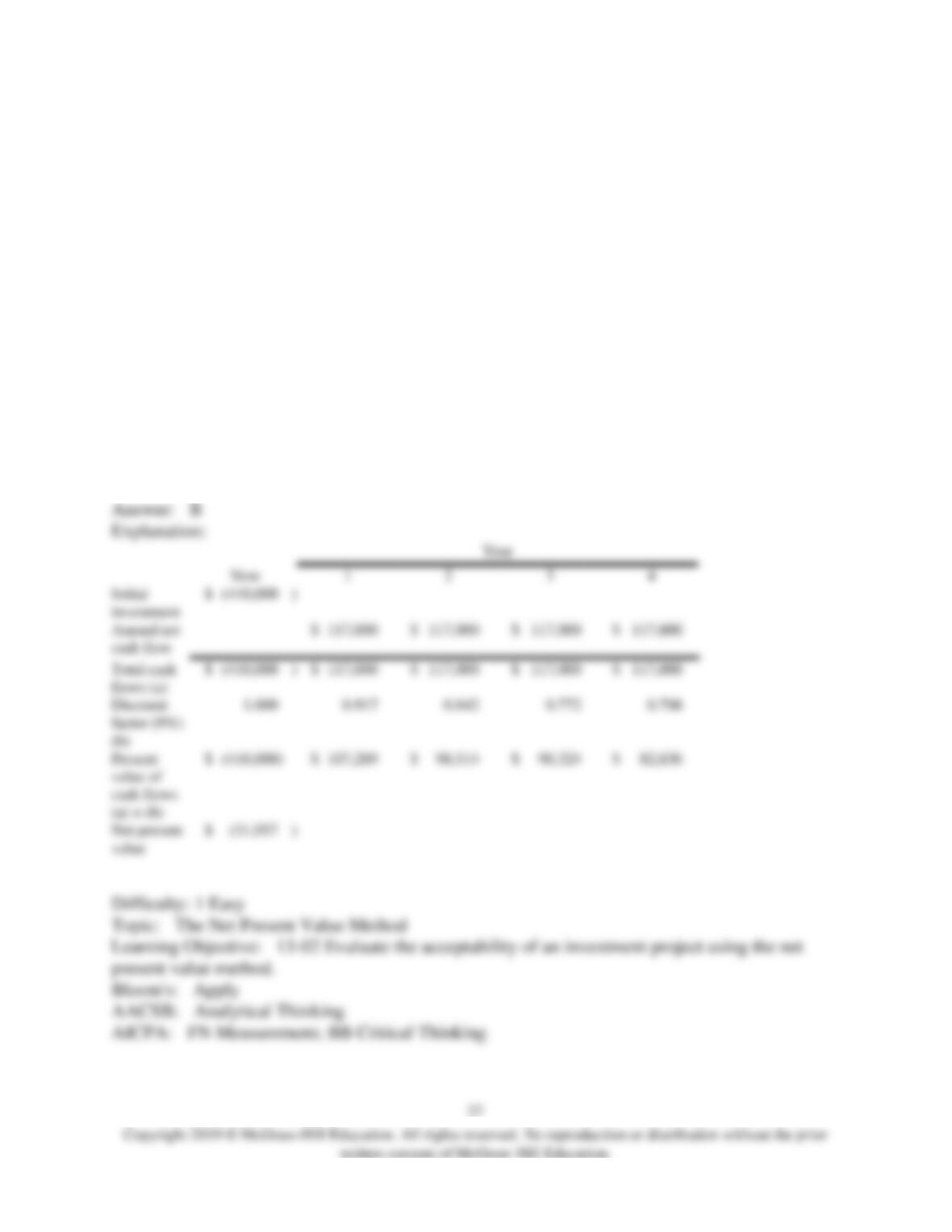
52) Moates Corporation has provided the following data concerning an investment project that it is
considering:
Initial investment
$
410,000
Annual cash flow
$
117,000
per year
Expected life of the project
4
years
Discount rate
9
%
See separate Exhibit 13B-1 and Exhibit 13B-2, to determine the appropriate discount
factor(s) using the tables provided.
The net present value of the project is closest to:
A) $378,963
B) $(31,037)
C) $410,000
D) $58,000

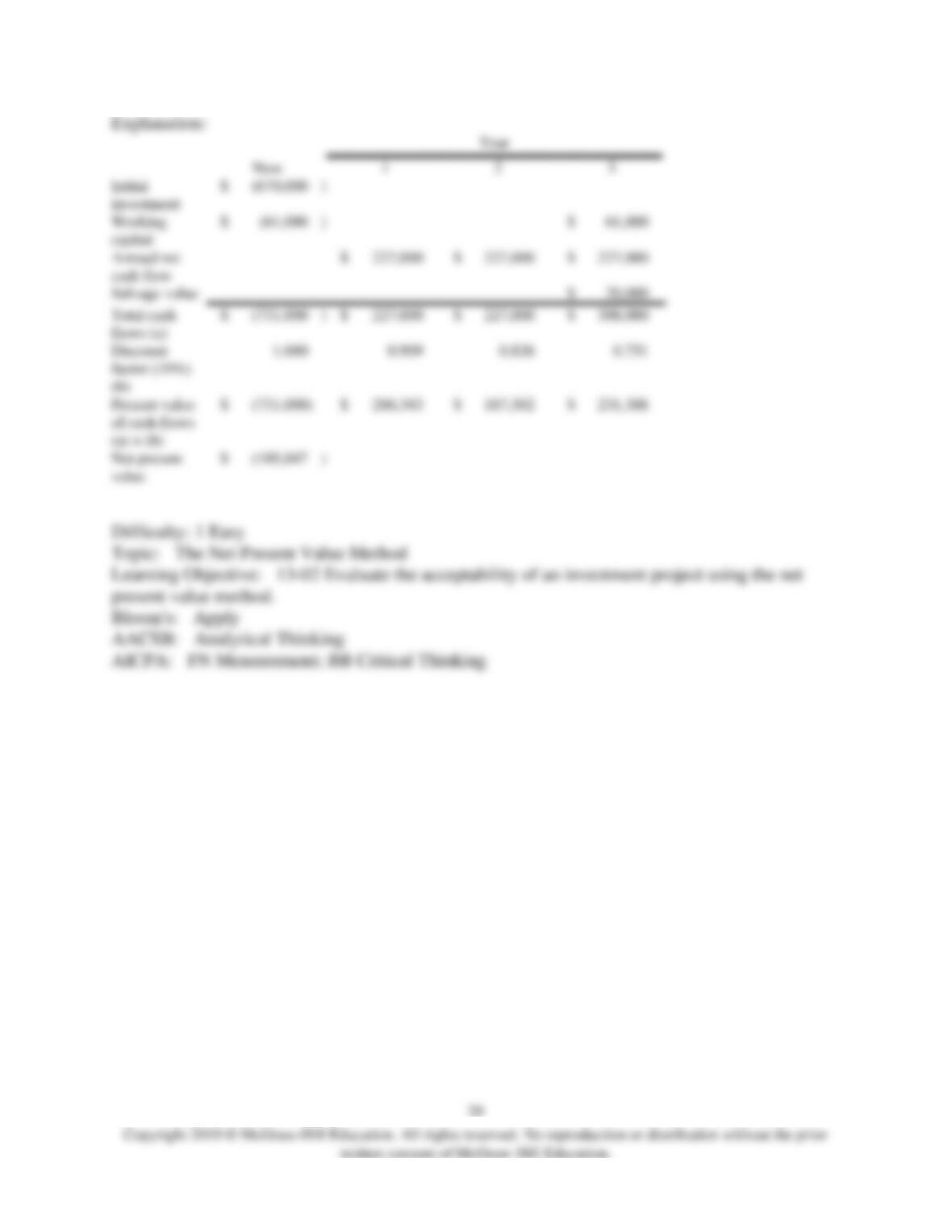
53) Byerly Corporation has provided the following data concerning an investment project that it is
considering:
Initial investment
$
670,000
Working capital
$
61,000
Annual cash flow
$
227,000
per year
Salvage value at the end of the project
$
20,000
Expected life of the project
3
years
Discount rate
10
%
See separate Exhibit 13B-1 and Exhibit 13B-2, to determine the appropriate discount factor(s)
using the tables provided.
The working capital would be released for use elsewhere at the end of the project. The net present
value of the project is closest to:
A) $(151,658)
B) $(105,847)
C) $11,000
D) $(44,847)
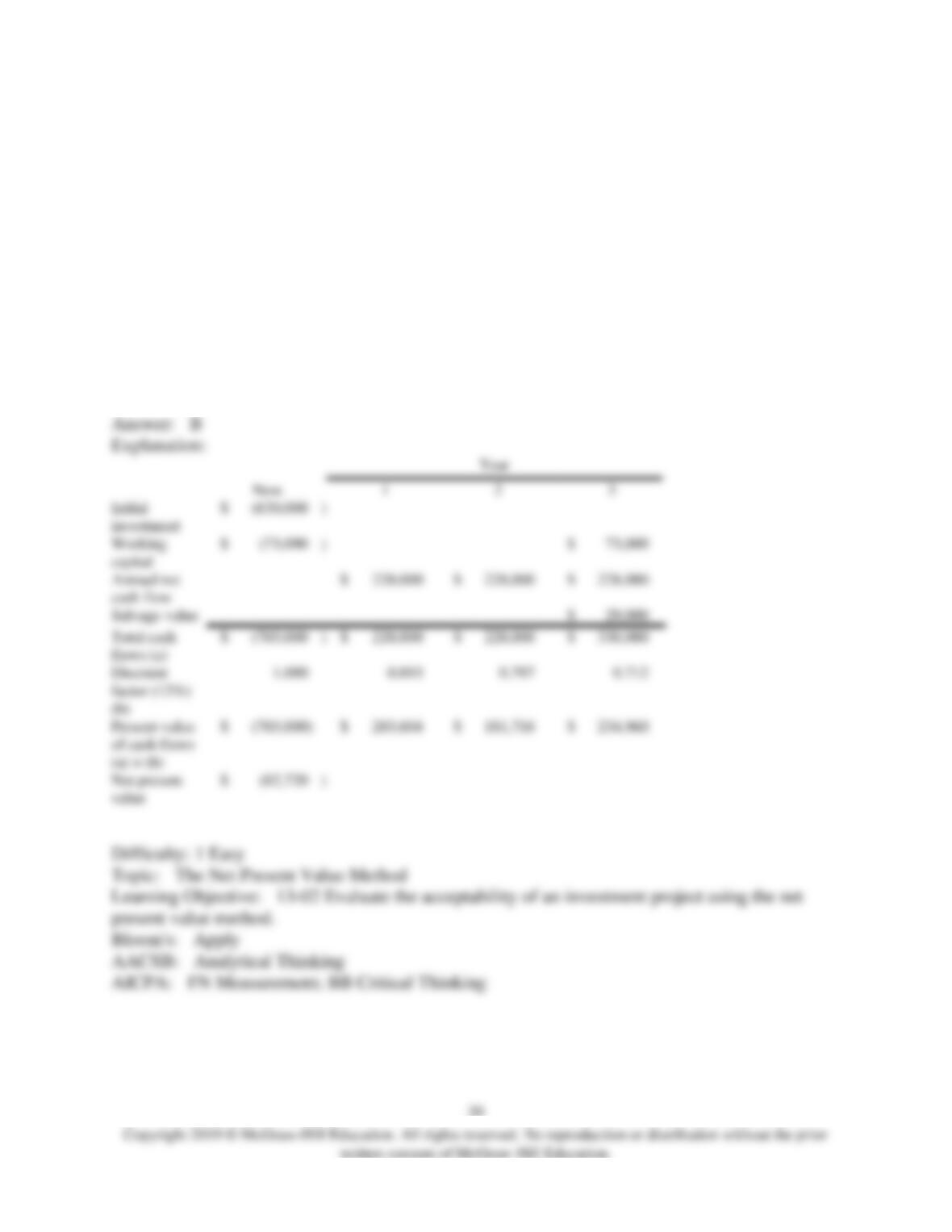
54) Penniston Corporation is considering a capital budgeting project that would require an initial
investment of $630,000 and working capital of $73,000. The working capital would be released for
use elsewhere at the end of the project in 3 years. The investment would generate annual cash
inflows of $228,000 for the life of the project. At the end of the project, equipment that had been
used in the project could be sold for $29,000. The company’s discount rate is 12%. The net present
value of the project is closest to:
See separate Exhibit 13B-1 and Exhibit 13B-2, to determine the appropriate discount factor(s)
using the tables provided.
A) $(134,696)
B) $(82,720)
C) $(9,720)
D) $54,000
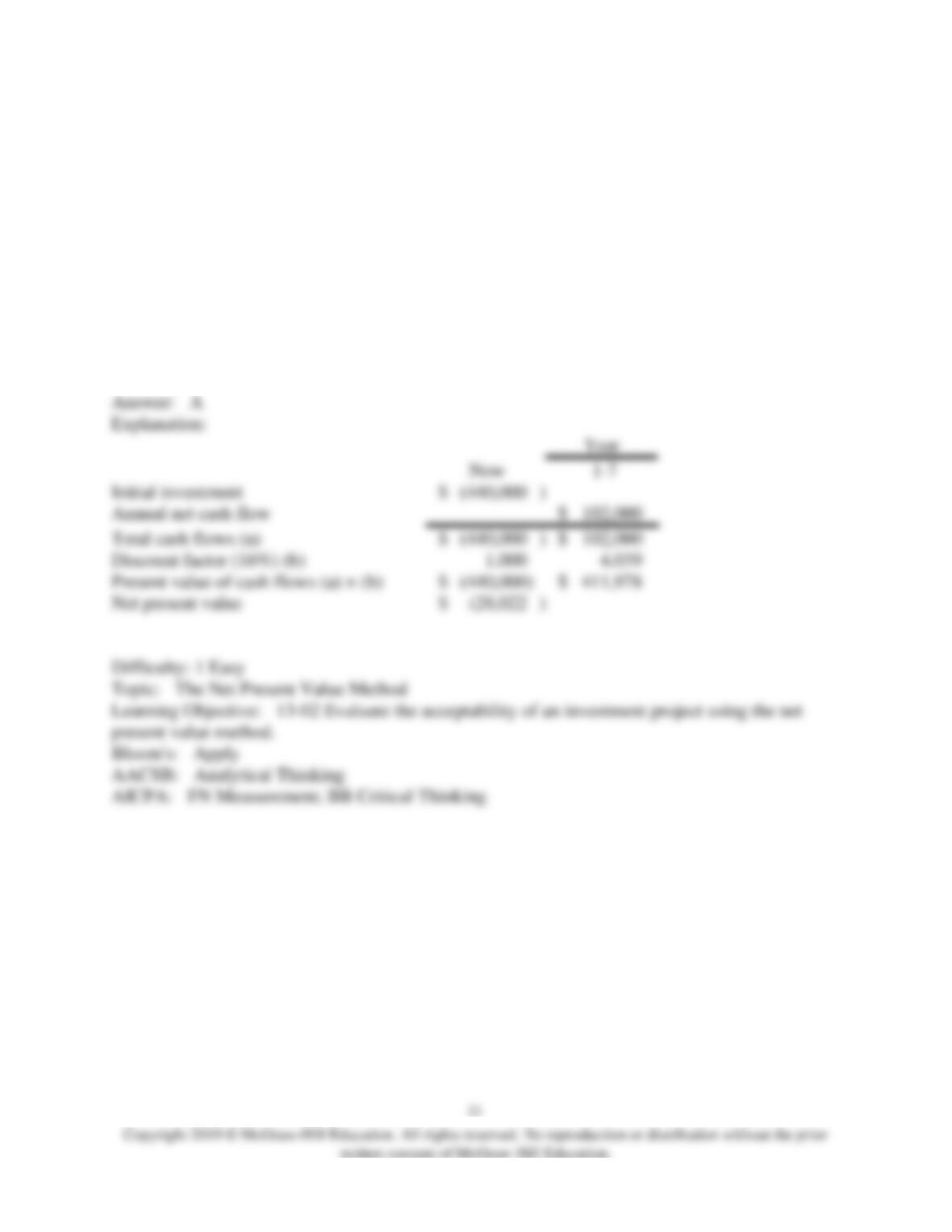
55) The management of Penfold Corporation is considering the purchase of a machine that would
cost $440,000, would last for 7 years, and would have no salvage value. The machine would
reduce labor and other costs by $102,000 per year. The company requires a minimum pretax return
of 16% on all investment projects. The net present value of the proposed project is closest to
(Ignore income taxes.):
See separate Exhibit 13B-1 and Exhibit 13B-2 to determine the appropriate discount factor(s)
using the tables provided.
A) $(28,022)
B) $96,949
C) $(79,196)
D) $274,000
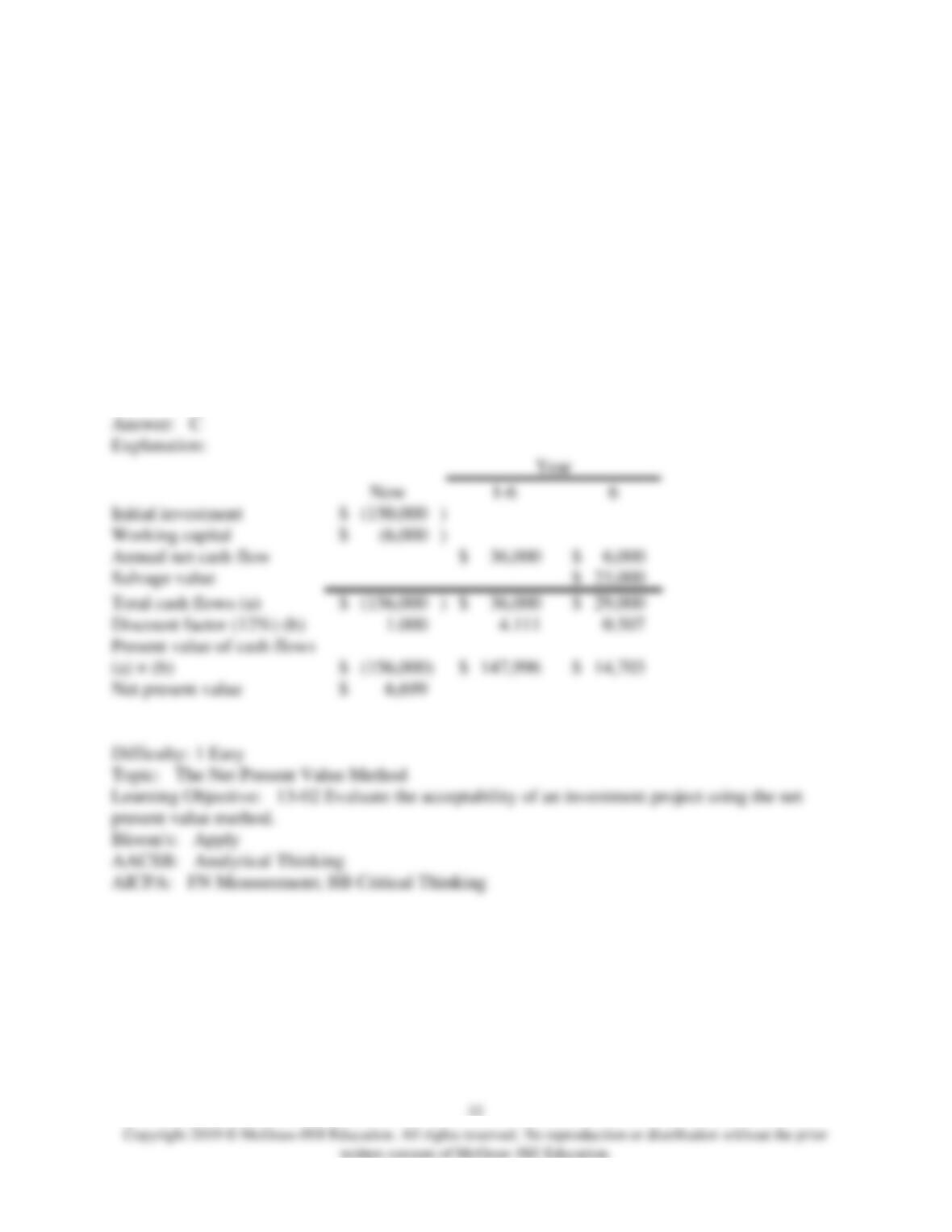
56) Dowlen, Inc., is considering the purchase of a machine that would cost $150,000 and would
last for 6 years. At the end of 6 years, the machine would have a salvage value of $23,000. The
machine would reduce labor and other costs by $36,000 per year. Additional working capital of
$6,000 would be needed immediately. All of this working capital would be recovered at the end of
the life of the machine. The company requires a minimum pretax return of 12% on all investment
projects. The net present value of the proposed project is closest to (Ignore income taxes.):
See separate Exhibit 13B-1 and Exhibit 13B-2, to determine the appropriate discount factor(s)
using the tables provided.
A) $9,657
B) $(2,004)
C) $6,699
D) $13,223
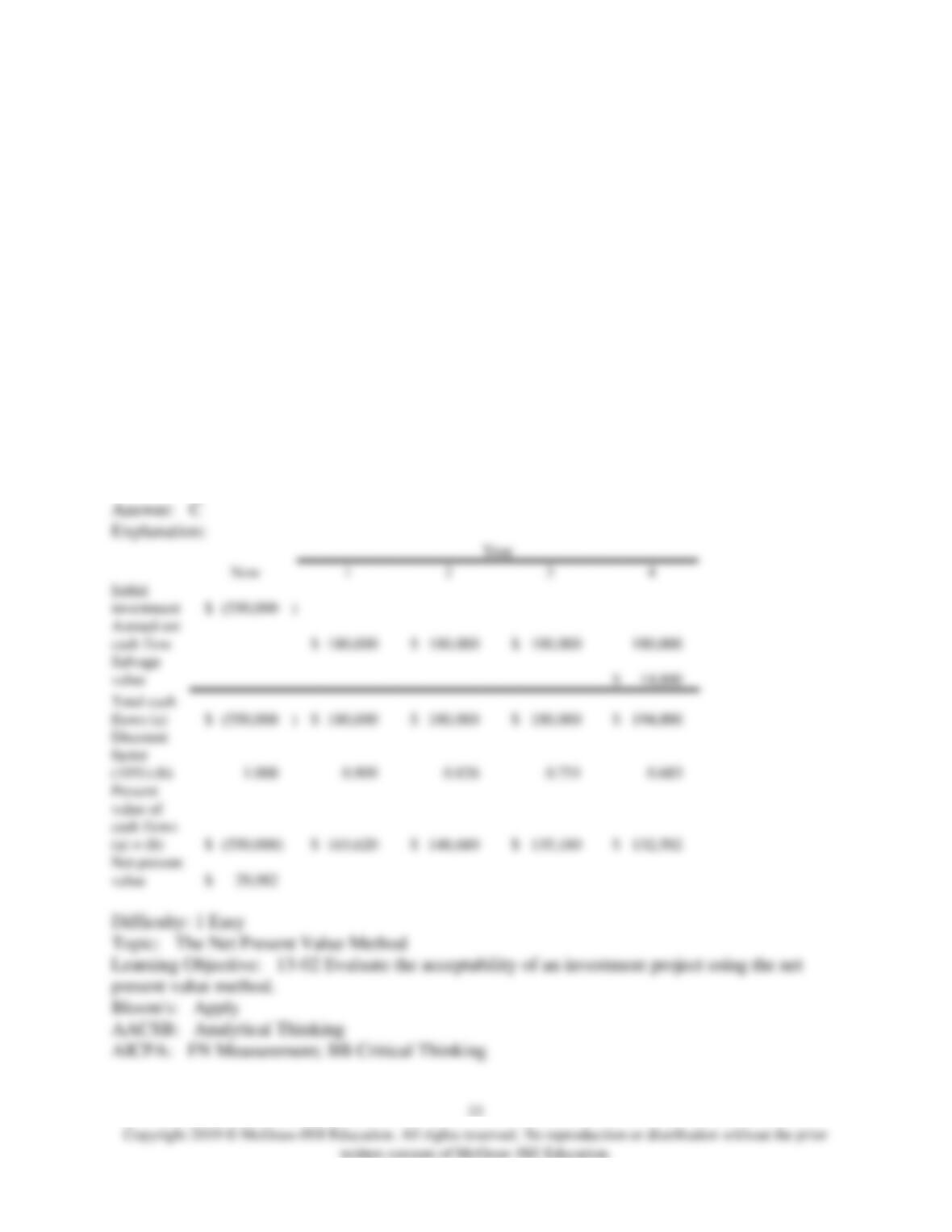
57) Stomberg Corporation has provided the following data concerning an investment project that it
is considering:
Initial investment
$
550,000
Annual cash flow
$
180,000
per year
Salvage value at the end of the project
14,000
See separate Exhibit 13B-1 and Exhibit 13B-2, to determine the appropriate discount factor(s)
using the tables provided.
The life of the project is 4 years. The company’s discount rate is 10%. The net present value of the
project is closest to:
A) $184,000
B) $579,982
C) $29,982
D) $20,420
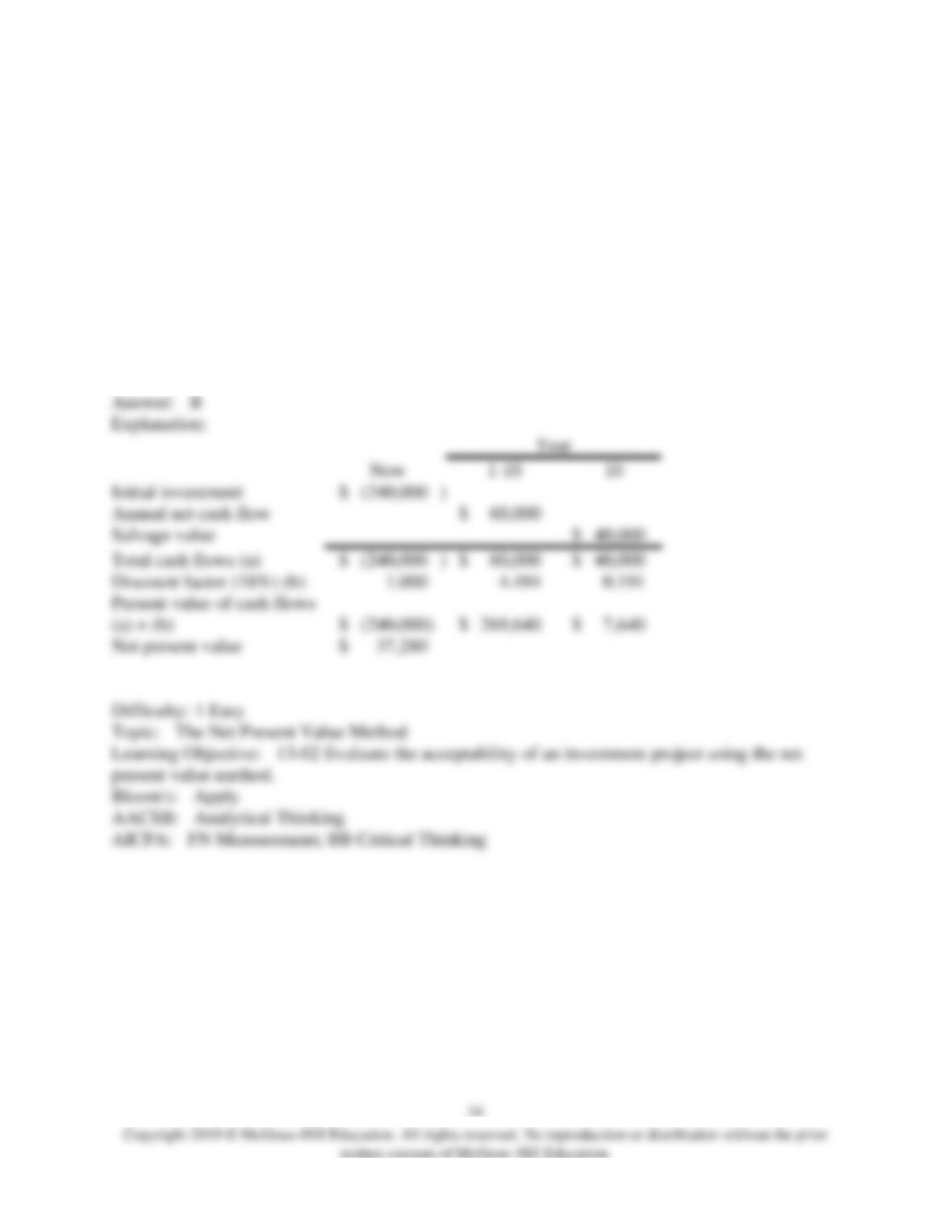
58) Fossa Road Paving Corporation is considering an investment in a curb-forming machine. The
machine will cost $240,000, will last 10 years, and will have a $40,000 salvage value at the end of
10 years. The machine is expected to generate net cash inflows of $60,000 per year in each of the
10 years. Fossa’s discount rate is 18%. The net present value of the proposed investment is closest
to (Ignore income taxes.):
See separate Exhibit 13B-1 and Exhibit 13B-2, to determine the appropriate discount factor(s)
using the tables provided.
A) $5,840
B) $37,280
C) $(48,780)
D) $69,640
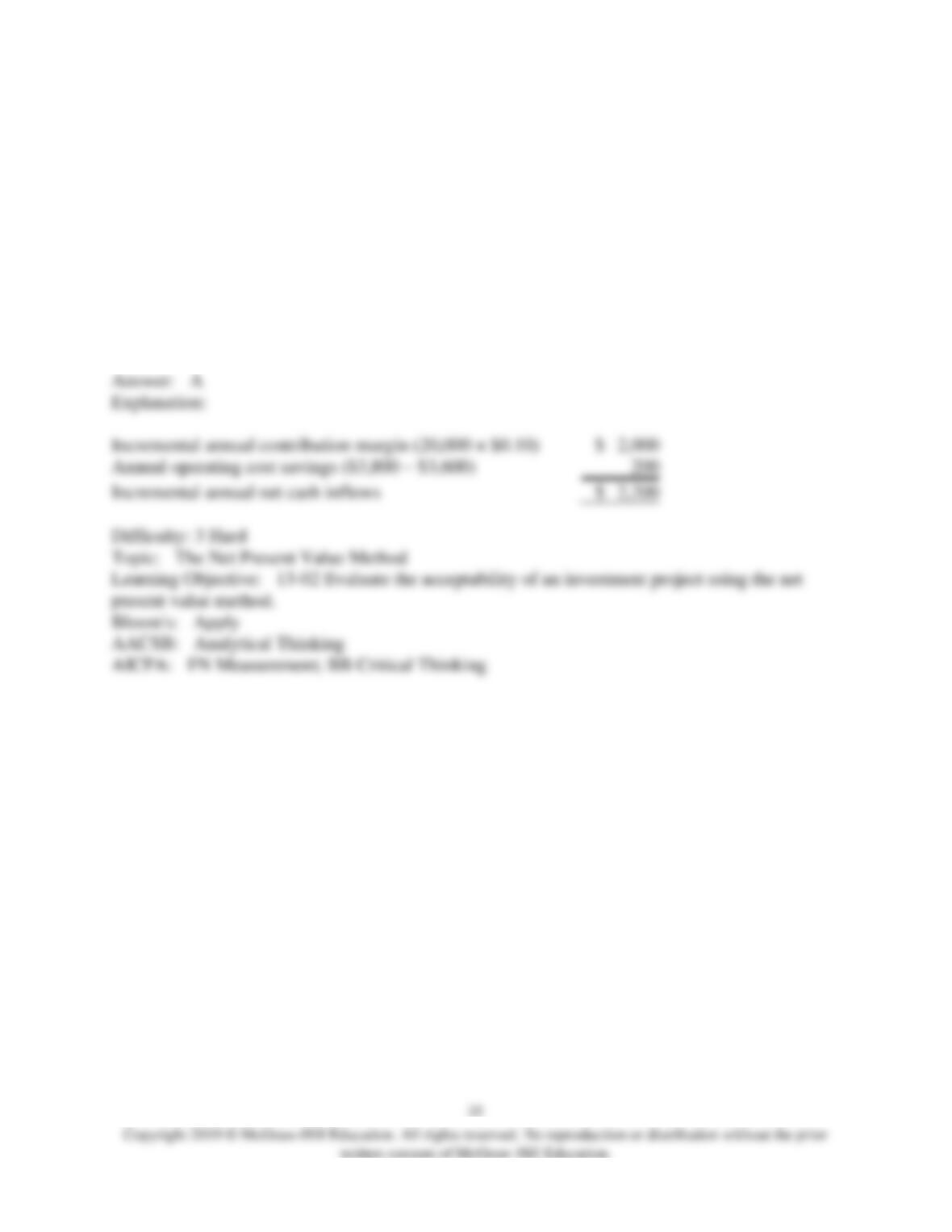
59) Charlie Corporation is considering buying a new donut maker. This machine will replace an
old donut maker that still has a useful life of 6 years. The new machine will cost $3,600 a year to
operate, as opposed to the old machine, which costs $3,800 per year to operate. Also, because of
increased capacity, an additional 20,000 donuts a year can be produced. The company makes a
contribution margin of $0.10 per donut. The old machine can be sold for $7,000 and the new
machine costs $30,000. The incremental annual net cash inflows provided by the new machine
would be (Ignore income taxes.):
A) $2,200
B) $200
C) $2,000
D) $5,000
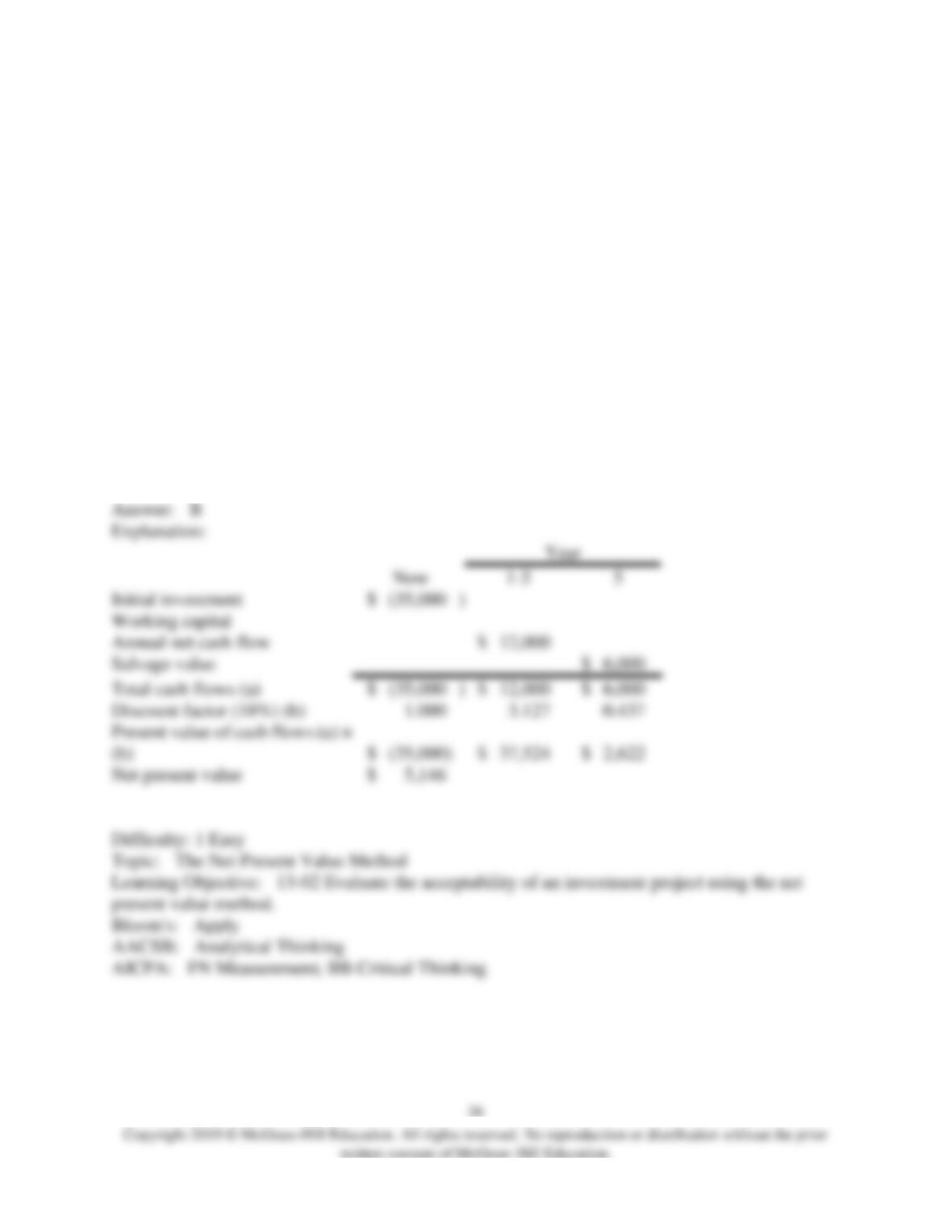
60) The following data pertain to an investment proposal (Ignore income taxes.):
Cost of the investment
$
35,000
Annual cost savings
$
12,000
Estimated salvage value
$
6,000
Life of the project
5
years
Discount rate
18
%
See separate Exhibit 13B-1 and Exhibit 13B-2, to determine the appropriate discount factor(s)
using the tables provided.
The net present value of the proposed investment is closest to:
A) $2,622
B) $5,146
C) $2,524
D) $31,000
1-5
Initial investment
$
Working capital
Annual net cash flow
$
Salvage value
$
6,000
Total cash flows (a)
$
$
$
6,000
Discount factor (18%) (b)
0.437
(b)
$
)
$
$
2,622
Net present value
$
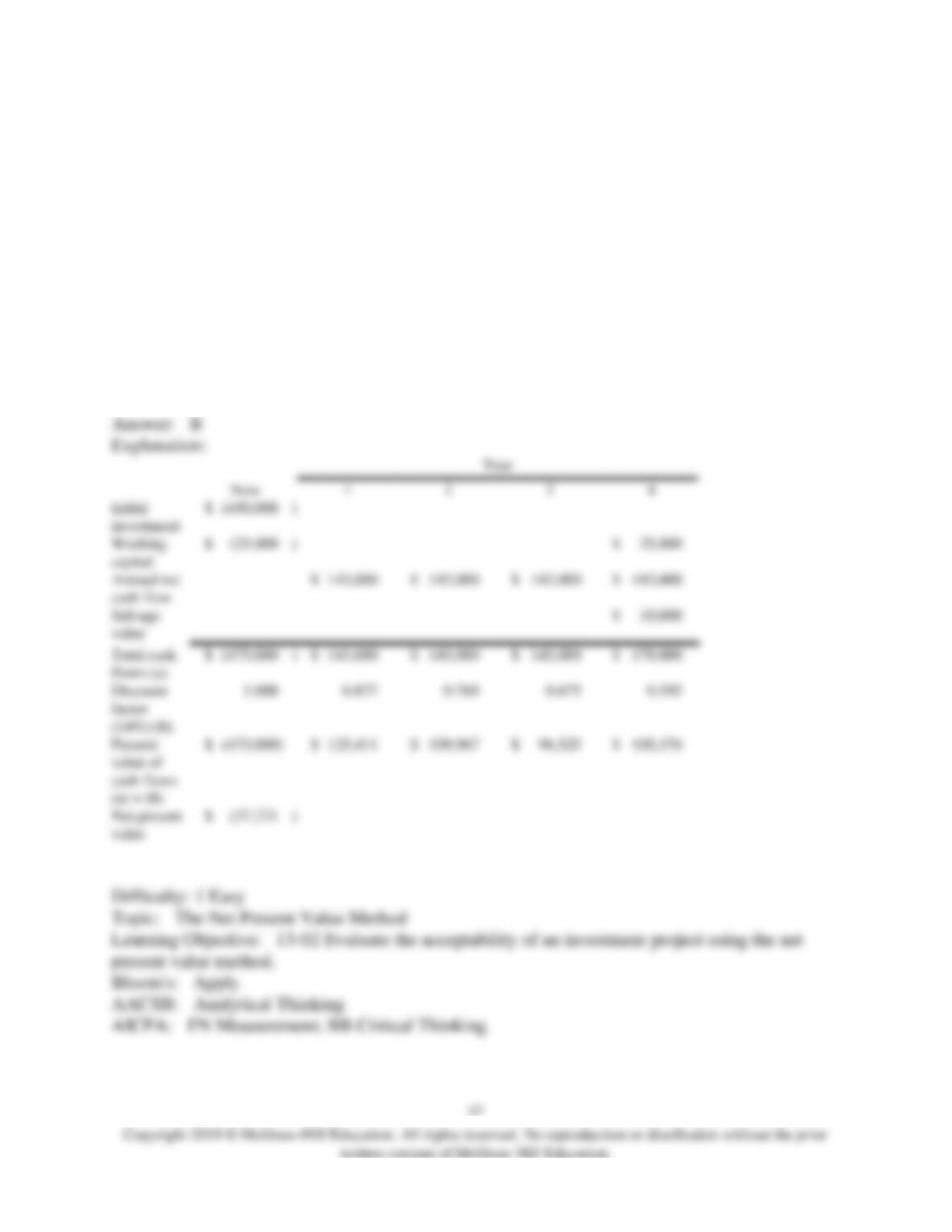
61) Kanzler Corporation is considering a capital budgeting project that would require an initial
investment of $450,000 and working capital of $25,000. The working capital would be released for
use elsewhere at the end of the project in 4 years. The investment would generate annual cash
inflows of $143,000 for the life of the project. At the end of the project, equipment that had been
used in the project could be sold for $10,000. The company’s discount rate is 14%. The net present
value of the project is closest to:
See separate Exhibit 13B-1 and Exhibit 13B-2, to determine the appropriate discount factor(s)
using the tables provided.
A) $(27,521)
B) $(37,721)
C) $(52,521)
D) $132,000
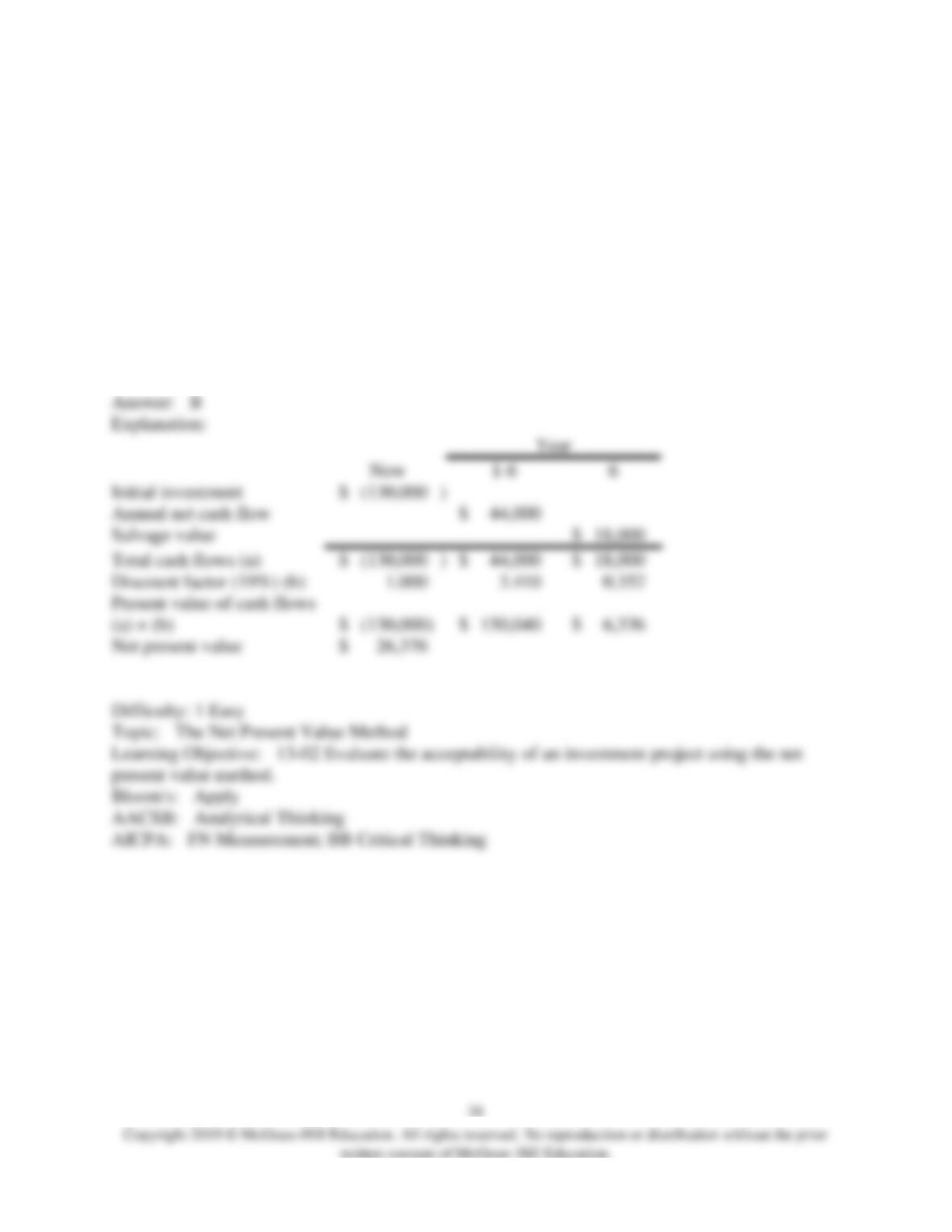
62) Nevland Corporation is considering the purchase of a machine that would cost $130,000 and
would last for 6 years. At the end of 6 years, the machine would have a salvage value of $18,000.
By reducing labor and other operating costs, the machine would provide annual cost savings of
$44,000. The company requires a minimum pretax return of 19% on all investment projects. The
net present value of the proposed project is closest to (Ignore income taxes.):
See separate Exhibit 13B-1 and Exhibit 13B-2, to determine the appropriate discount factor(s)
using the tables provided.
A) $38,040
B) $26,376
C) $74,902
D) $20,040
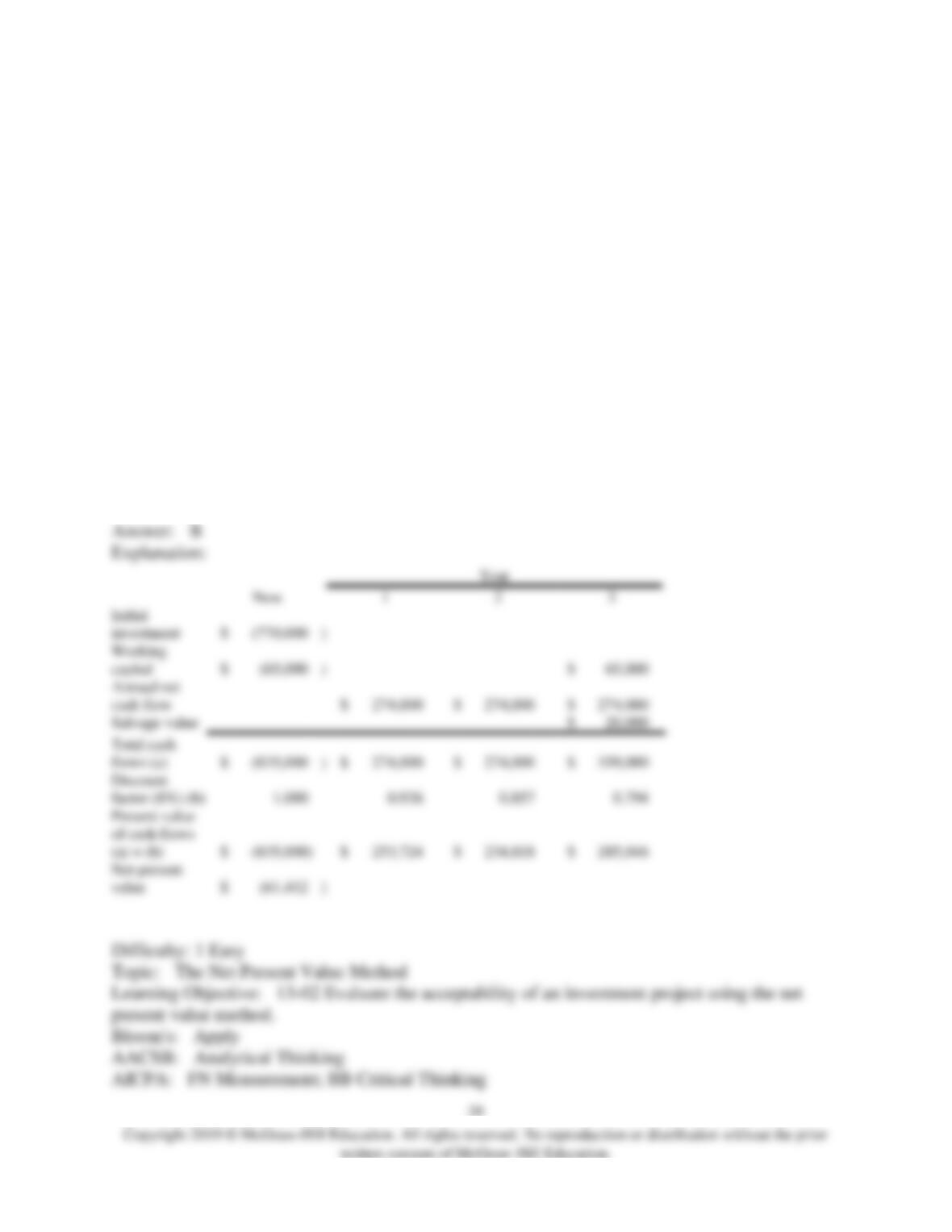
63) Facio Corporation has provided the following data concerning an investment project that it is
considering:
Initial investment
$
770,000
Working capital
$
65,000
Annual cash flow
$
274,000
per year
Salvage value at the end of the project
$
20,000
See separate Exhibit 13B-1 and Exhibit 13B-2, to determine the appropriate discount factor(s)
using the tables provided.
The working capital would be released for use elsewhere at the end of the project in 3 years. The
company’s discount rate is 8%. The net present value of the project is closest to:
A) $(113,022)
B) $(61,412)
C) $3,588
D) $52,000
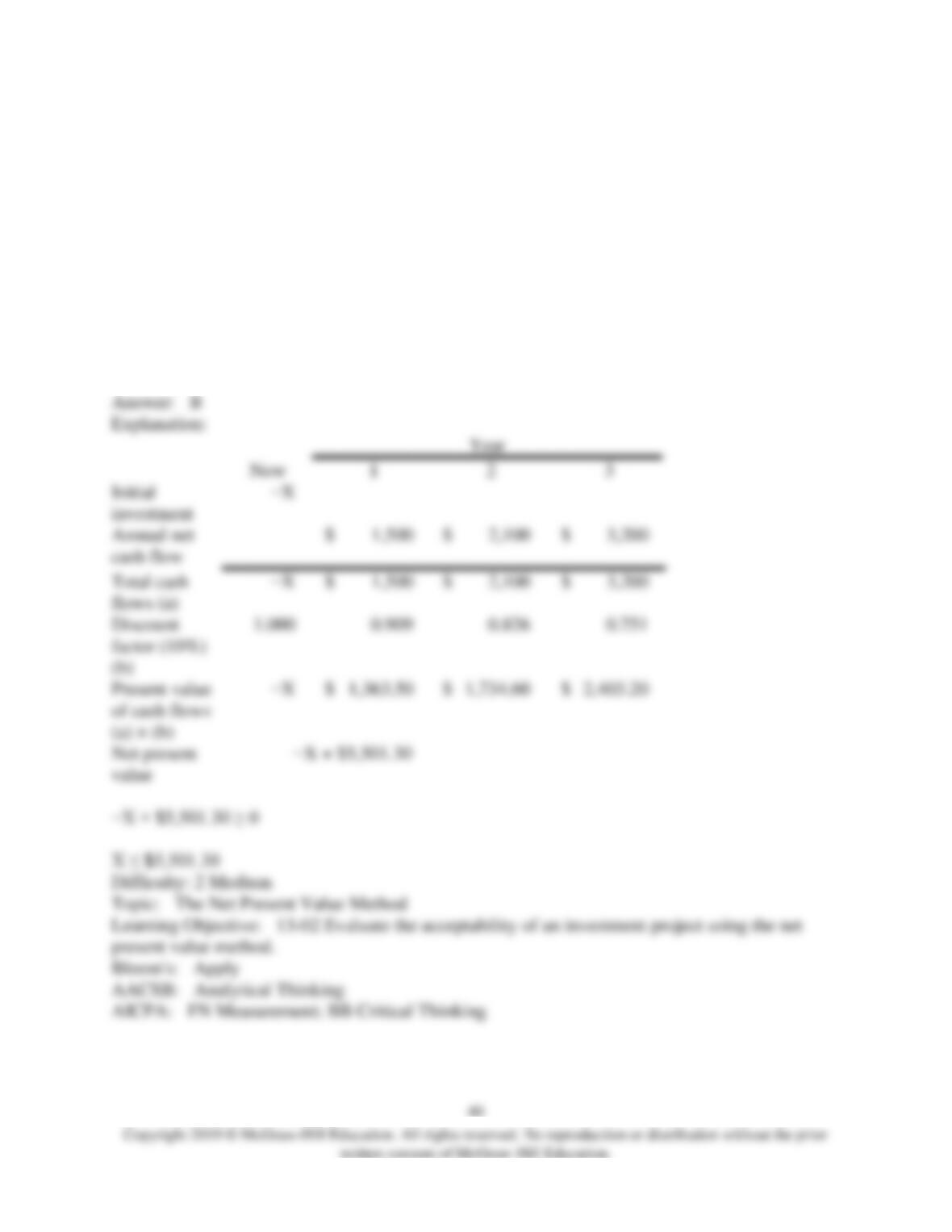
64) Anthony operates a part time auto repair service. He estimates that a new diagnostic computer
system will result in increased cash inflows of $1,500 in Year 1, $2,100 in Year 2, and $3,200 in
Year 3. If Anthony’s required rate of return is 10%, then the most he would be willing to pay for the
new diagnostic computer system would be (Ignore income taxes.):
See separate Exhibit 13B-1 and Exhibit 13B-2, to determine the appropriate discount factor(s)
using the tables provided.
A) $4,599
B) $5,501
C) $5,638
D) $5,107