57) Which of the following is not a current liability?
A) Accounts payable.
B) A note payable due in two years.
C) Accrued interest payable.
D) Sales tax payable.
58) Short-term obligations can be reported as long-term liabilities if:
A) The firm has a long-term line of credit.
B) The firm has tentative plans to issue long-term bonds.
C) The firm intends to and has the ability to refinance as long-term.
D) The firm has the ability to refinance on a long-term basis.
59) Of the following, which typically would not be classified as a current liability?
A) Estimated liability from cash rebate program.
B) A long-term note payable maturing within the coming year.
C) Rent revenue received in advance.
D) A six-month bank loan to be paid with the proceeds from the sale of common stock.
60) Which of the following situations would not require that long-term liabilities be reported as
current liabilities on a classified balance sheet?
A) The long-term debt is callable by the creditor.
B) The creditor has the right to demand payment due to a contractual violation.
C) The long-term debt matures within the upcoming year.
D) The company intended to refinance the debt and did so prior to issuance of the financial
statements.
61) A long-term liability should be reported as a current liability in a classified balance sheet if
the long-term debt:
A) Is callable by the creditor.
B) Is secured by adequate collateral.
C) Will be refinanced with stock.
D) Will be refinanced with debt.
62) On December 31, 2018, L Inc. had a $1,500,000 note payable outstanding, due July 31,
2019. L borrowed the money to finance construction of a new plant. L planned to refinance the
note by issuing long-term bonds. Because L temporarily had excess cash, it prepaid $500,000 of
the note on January 23, 2019. In February 2019, L completed a $3,000,000 bond offering. L will
use the bond offering proceeds to repay the note payable at its maturity and to pay construction
costs during 2019. On March 13, 2019, L issued its 2018 financial statements. What amount of
the note payable should L include in the current liabilities section of its December 31, 2018,
balance sheet?
A) $0.
B) $500,000.
C) $1,000,000.
D) $1,500,000.
63) Liabilities payable within the coming year are classified as long-term liabilities if refinancing
is completed before date of issuance of the financial statements under:
A) U.S. GAAP.
B) IFRS.
C) Either U.S. GAAP or IFRS.
D) Neither U.S. GAAP nor IFRS.
64) Kline Company refinanced current debt as long-term debt on January 5, 2019. Kline’s fiscal
year ended on December 31, 2018, and its financial statements will be issued sometime in early
March 2019. Under IFRS, how would Kline classify the debt on its December 31, 2018, balance
sheet?
A) In the “mezzanine” between current and noncurrent liabilities.
B) Kline would not classify the debt as current or noncurrent, but rather would write a disclosure
note explaining the circumstances.
C) As a noncurrent liability.
D) As a current liability.
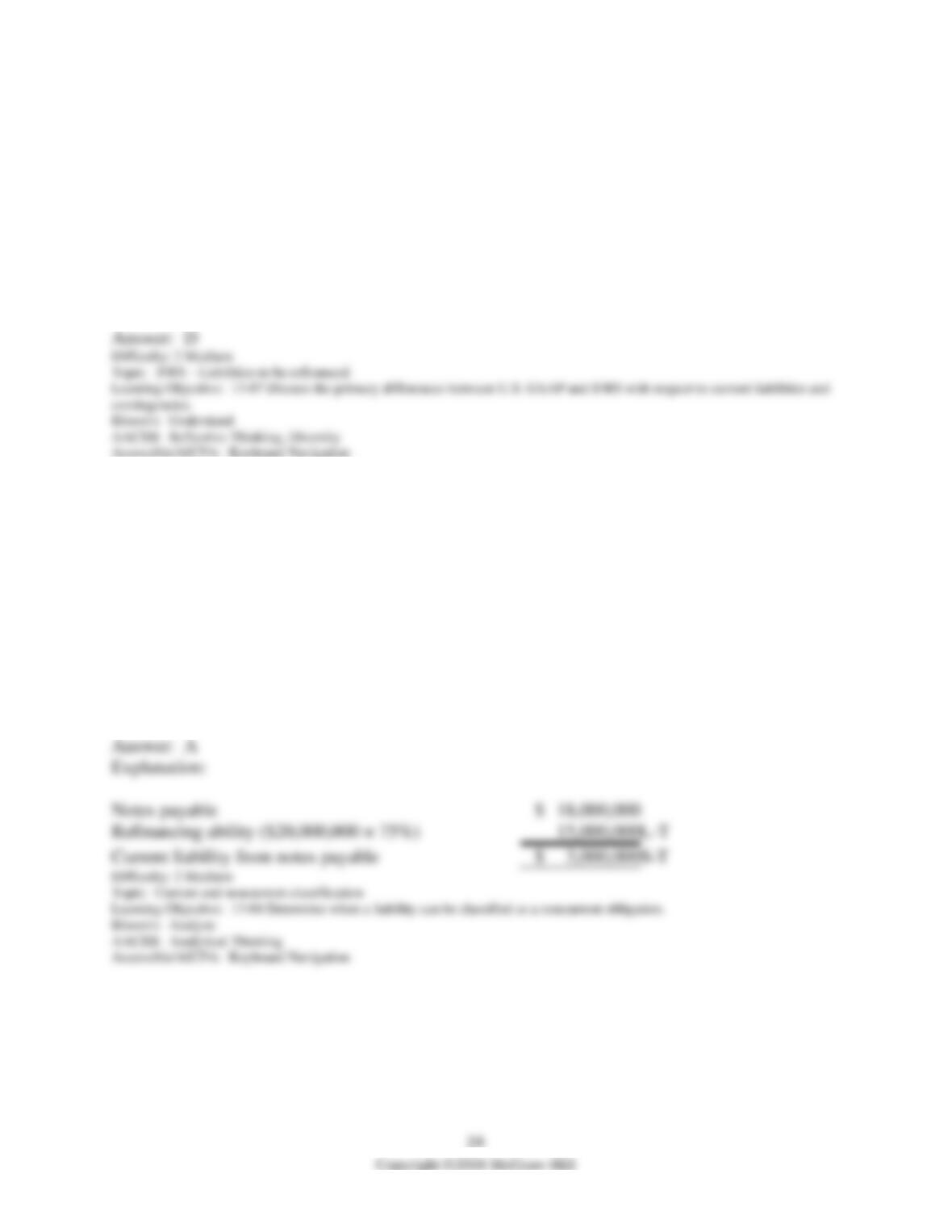
65) Branch Company, a building materials supplier, has $18,000,000 of notes payable due April
12, 2019. At December 31, 2018, Branch signed an agreement with First Bank to borrow up to
$18,000,000 to refinance the notes on a long-term basis. The agreement specified that
borrowings would not exceed 75% of the value of the collateral that Branch provided. At the
date of issue of the December 31, 2018, financial statements, the value of Branch’s collateral was
$20,000,000. On its December 31, 2018, balance sheet, Branch should classify the notes as
follows:
A) $15,000,000 long-term and $3,000,000 current liabilities.
B) $4,500,000 short-term and $13,500,000 current liabilities.
C) $18,000,000 of current liabilities.
D) $18,000,000 of long-term liabilities.
66) Other things being equal, most managers would prefer to report liabilities as noncurrent
rather than current. The logic behind this preference is that the long-term classification permits
the company to report:
A) Higher working capital and a higher inventory turnover.
B) Lower working capital and a higher current ratio.
C) Higher working capital and a higher current ratio.
D) Higher working capital and a lower debt to equity ratio.
67) Financial statement note disclosure is required for material potential losses when the loss is
at least reasonably possible:
A) Only if the amount is known.
B) Only if the amount is known or reasonably estimable.
C) Unless the amount is not reasonably estimable.
D) Even if the amount is not reasonably estimable.
68) Gain contingencies usually are recognized in a company’s income statement when:
A) Realized.
B) The amount can be reasonably estimated.
C) The gain is reasonably possible and the amount can be reasonable estimated.
D) The gain is probable and the amount can be reasonably estimated.
69) Gray Co. estimates it is probable that it will receive a $10,000 gain contingency and pay a
$4,000 loss contingency. After recording the appropriate journal entries to recognize contingent
amounts, Gray Co.’s net assets will:
A) Increase by $10,000.
B) Increase by $6,000.
C) Decrease by $4,000.
D) Not change.
70) A company should accrue a loss contingency only if the likelihood that a liability has been
incurred is:
A) More likely than not and the amount of the loss is known.
B) At least reasonably possible and the amount of the loss is known.
C) At least reasonably possible and the amount of the loss can be reasonably estimated.
D) Probable and the amount of the loss can be reasonably estimated.
71) A loss contingency should be accrued in a company’s financial statements only if the
likelihood that a liability has been incurred is:
A) At least remotely possible and the amount of the loss is known.
B) Reasonably possible and the amount of the loss is known.
C) Reasonably possible and the amount of the loss can be reasonably estimated.
D) Probable and the amount of the loss can be reasonably estimated.
72) A contingent loss should be reported in a disclosure note to the financial statements rather
than being accrued if:
A) The likelihood of a loss is remote.
B) The incurrence of a loss is reasonably possible.
C) The incurrence of a loss is more likely than not.
D) The likelihood of a loss is probable.
73) Which of the following is a contingency that should be accrued?
A) The company is being sued and a loss is reasonably possible and reasonably estimable.
B) The company deducts life insurance premiums from employees’ paychecks.
C) The company offers a two-year warranty and the expenses can be reasonably estimated.
D) It is probable that the company will receive $100,000 in settlement of a lawsuit.
74) Paul Company issues a product recall due to an apparently preexisting and material defect
discovered after the end of its fiscal year. Financial statements have not yet been issued. The
action required of Paul Company for this reasonably estimable contingency for the year just
ended is:
A) To disclose it in a note to the financial statements.
B) To accrue a long-term liability.
C) To accrue the liability and explain it in a note to the financial statements.
D) To do nothing relative to the contingency.
75) Accounting for costs of incentive programs for customer purchases:
A) Requires probability estimation.
B) Follows the matching principle.
C) Is a loss contingency situation.
D) All of these answer choices are correct.
76) Providing a monetary rebate program for purchasing a product:
A) Is accounted for similarly to product warranties.
B) Creates an expense for the seller in the period of sale.
C) Creates a contingent liability for the seller at the time of sale.
D) All these answer choices are correct.
77) An extended warranty typically results in the seller:
A) Accruing an expense for anticipated warranty costs at the time the warranty is sold.
B) Estimating the contingent liability associated with the warranty at the time the warranty is
sold.
C) Recognizing revenue over the life of the extended warranty.
D) Refunding warranty payments upon expiration of the warranty.
78) A quality-assurance warranty typically results in the seller:
A) Accruing an expense for anticipated warranty costs at the time the warrantied product is sold.
B) Recognizing an asset for accrued warranty costs which is amortized over the life of the
warranty.
C) Recognizing revenue over the life of the extended warranty.
D) Refunding warranty payments upon expiration of the warranty.
79) Which of the following is true about the initial journal entry used to record quality-assurance
warranties?
Recognize a
contingent liability
Recognize
deferred revenue
a.
No
No
b.
No
Yes
c.
Yes
No
d.
Yes
Yes
A) Option A
B) Option B
C) Option C
D) Option D
80) Which of the following is true about the initial journal entry used to record extended
warranties?
Recognize a
contingent liability
Recognize
deferred revenue
a.
No
No
b.
No
Yes
c.
Yes
No
d.
Yes
Yes
A) Option A
B) Option B
C) Option C
D) Option D
81) Blue Co. can estimate the amount of loss that will occur if a foreign government expropriates
some of the company’s assets in that country. If the likelihood of expropriation is remote, a loss
contingency should be:
A) Disclosed but not accrued as a liability.
B) Disclosed and accrued as a liability.
C) Accrued as liability but not disclosed.
D) Neither accrued as a liability nor disclosed.
82) Orange Co. can estimate the amount of loss that will occur if a foreign government
expropriates some of the company’s assets in that country. If expropriation is reasonably
possible, a loss contingency should be:
A) Disclosed but not accrued as a liability.
B) Disclosed and accrued as a liability.
C) Accrued as liability but not disclosed.
D) Neither accrued as a liability nor disclosed.
83) Red Co. can estimate the amount of loss that will occur if a foreign government expropriates
some of the company’s assets in that country. If expropriation is probable, a loss contingency
should be:
A) Disclosed but not accrued as a liability.
B) Disclosed and accrued as a liability.
C) Accrued as liability but not disclosed.
D) Neither accrued as a liability nor disclosed.
84) Z Co. filed suit against W Inc. in 2018 seeking damages for patent infringement. At
December 31, 2018, legal counsel for Z believed that it was probable that Z would be successful
against W for an estimated amount in the range of $30 million to $60 million, with each amount
in that range considered equally likely. Z was awarded $40 million in April 2019. Z should
report this award in its 2018 financial statements, issued in March 2019 as:
A) A receivable and deferred revenue of $40 million.
B) A receivable and revenue of $40 million.
C) A disclosure of a gain contingency of $40 million.
D) A disclosure of a gain contingency of an undetermined amount in the range of $30 million to
$60 million.
85) When a material gain contingency is probable and the amount of gain can be reasonably
estimated, the gain should be:
A) Reported in the income statement and disclosed.
B) Offset against shareholders’ equity.
C) Disclosed but not recognized in the income statement.
D) Neither recognized in the income statement nor disclosed.
86) Which of the following is a contingency that would most likely require accrual?
A) Potential claims on extended warranties.
B) Customer premium offers.
C) Potential liability on a product where none have yet been sold.
D) Sales tax payable.
87) A customer of RoughEdge Sharpeners alleges that RoughEdge’s new razor sharpener had a
defect that resulted in serious injury to the customer. RoughEdge believes the customer has a
51% chance of winning the case, and that if the customer wins the case, there is a range of losses
of between $1,000,000 and $3,000,000 in which any number is equally likely to occur. Under
U.S. GAAP, RoughEdge should accrue a liability in the amount of:
A) $0.
B) $1,000,000.
C) $2,000,000.
D) $3,000,000.
88) A customer of Razor Sharpeners alleges that Razor’s new razor sharpener had a defect that
resulted in serious injury to the customer. Razor believes the customer has a 51% chance of
winning the case, and that if the customer wins the case, there is a range of losses of between
$1,000,000 and $3,000,000 in which any number is equally likely to occur. Under IFRS, Razor
should accrue a liability in the amount of:
A) $0.
B) $1,000,000.
C) $2,000,000.
D) $3,000,000.
89) Volt Electronics sells equipment that includes a three-year warranty. Repairs under the
warranty are performed by an independent service company under contract with Volt. Based on
prior experience, warranty costs are estimated to be $25 per item sold. Volt should recognize
these warranty costs:
A) When the equipment is sold.
B) When the repairs are performed.
C) When payments are made to the service firm.
D) Evenly over the life of the warranty.
90) As part of a promotion campaign, Funzy Cereal includes one coupon in each issue of various
national magazines and offers a toy car in exchange for $1.00 and three coupons. The cars cost
Funzy $1.50 each. Experience indicates that 4% of the coupons eventually will be redeemed.
During the last month of 2018, the first month of the offer, 12 million coupons were distributed
and 240,000 million of the coupons were redeemed. What amount should Funzy report as a
promotional expense for coupons on its December 31, 2018, income statement?
A) $0.
B) $40,000.
C) $80,000.
D) $120,000.
91) At the beginning of 2018, Angel Corporation began offering a two-year warranty on its
products. The warranty program was expected to cost Angel 4% of net sales. Net sales made
under warranty in 2018 were $180 million. Fifteen percent of the units sold were returned in
2018 and repaired or replaced at a cost of $5.3 million. The amount of warranty expense on
Angel’s 2018 income statement is:
A) $5.3 million.
B) $7.2 million.
C) $10.6 million.
D) $27.0 million.
92) During 2018, Deluxe Leather Goods issued 800,000 coupons which entitles the customer to a
$5.00 cash refund when the coupon is submitted at the time of any future purchase. Deluxe
estimates that 70% of the coupons will be redeemed. 350,000 coupons had been processed
during 2018. At December 31, 2018, Deluxe should report a liability for unredeemed coupons of:
A) $560,000.
B) $1,050,000.
C) $1,225,000.
D) $1,750,000.
93) In 2018, Holyoak Inc. offers a coupon for $20 off qualifying purchases of its new line of
products. Holyoak sold 10,000 of these products during the year. By year-end of 2018, 7,100 had
been redeemed and the $20 reduction of purchase price provided to customers. Holyoak’s
historical experience with such coupons indicates that 85% of customers use the coupon.
What is the expense that Holyoak should report for its promotional coupons in its 2018 income
statement?
A) $142,000.
B) $152,000.
C) $170,000.
D) $200,000.
94) In 2018, Holyoak Inc. offers a coupon for $20 off qualifying purchases of its new line of
products. Holyoak sold 10,000 of these products during the year. By year-end of 2018, 7,100 had
been redeemed and the $20 reduction of purchase price provided to customers. Holyoak’s
historical experience with such coupons indicates that 85% of customers use the coupon.
What is the promotional coupon liability that Holyoak should report in its December 31, 2018,
balance sheet?
A) $20,000.
B) $28,000.
C) $18,000.
D) $19,000.
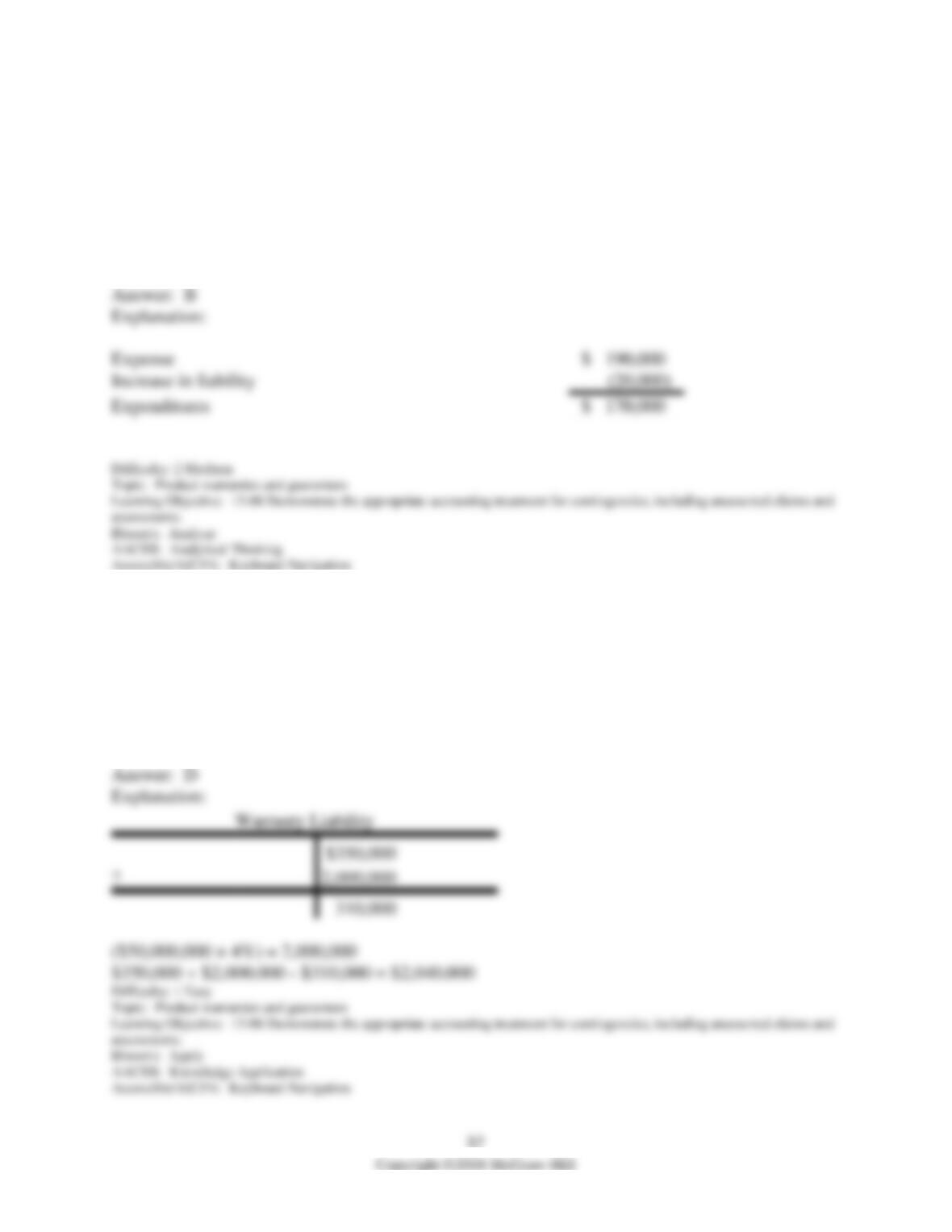
95) In the current year, Hanna Company reported quality-assurance warranty expense of
$190,000 and the warranty liability account increased by $20,000. What were warranty
expenditures during the year?
A) $190,000.
B) $170,000.
C) $210,000.
D) $0.
96) Panther Co. had a quality-assurance warranty liability of $350,000 at the beginning of 2018
and $310,000 at the end of 2018. Warranty expense is based on 4% of sales, which were $50
million for the year. What were the warranty expenditures for 2018?
A) $0.
B) $1,960,000.
C) $2,000,000.
D) $2,040,000.
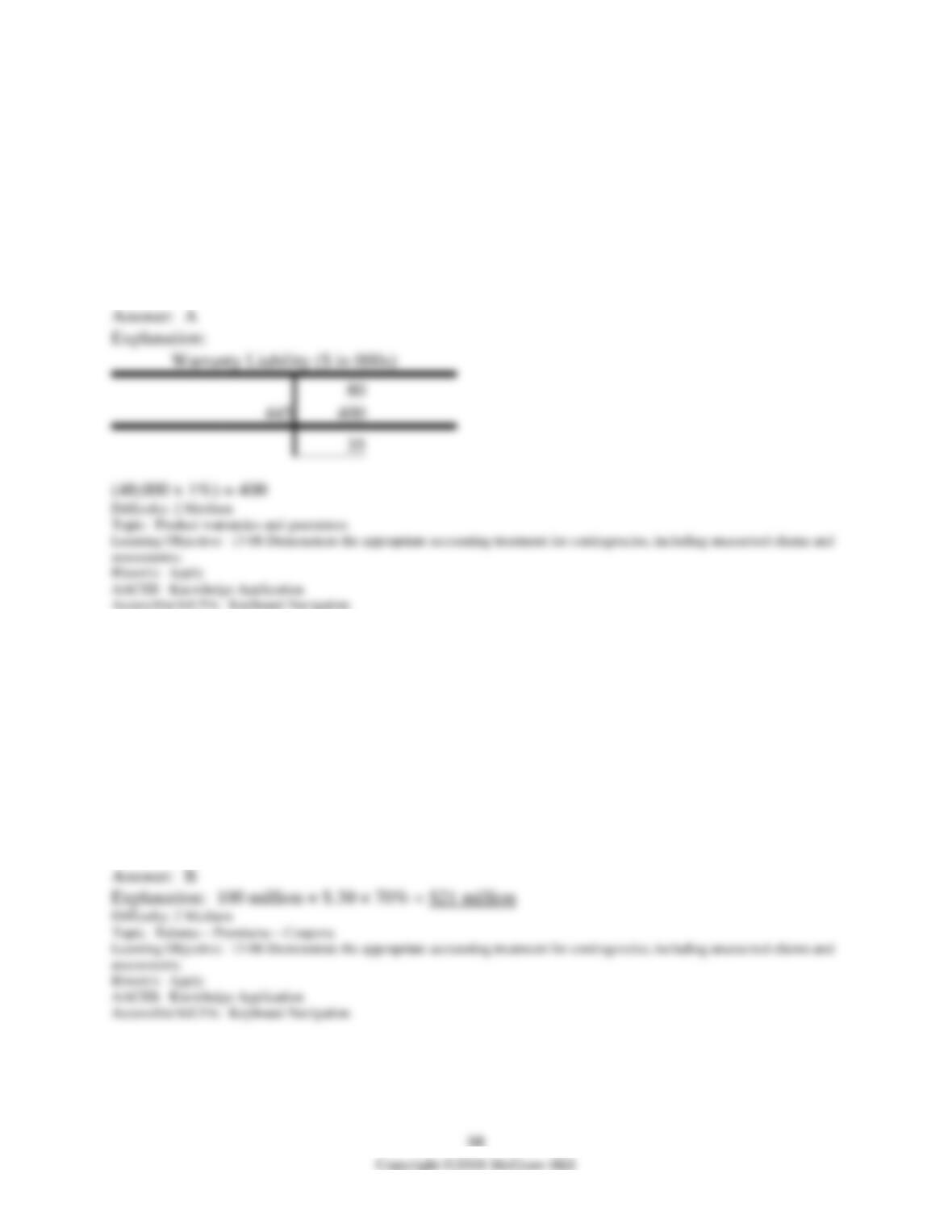
97) Carpenter Inc. had a balance of $80,000 in its quality-assurance warranty liability account as
of December 31, 2017. In 2018, Carpenter’s warranty expenditures were $445,000. Its warranty
expense is calculated as 1% of sales. Sales in 2018 were $40 million. What was the balance in
the warranty liability account as of December 31, 2018?
A) $35,000.
B) $425,000.
C) $125,000.
D) $480,000.
98) General Product Inc. distributed 100 million coupons in 2018. The coupons are redeemable
for 30 cents each. General anticipates that 70% of the coupons will be redeemed. The coupons
expire on December 31, 2019. There were 45 million coupons redeemed in 2018 and 30 million
redeemed in 2019.
What was General’s coupon promotion expense in 2018?
A) $30.0 million.
B) $21.0 million.
C) $13.5 million.
D) $7.5 million.
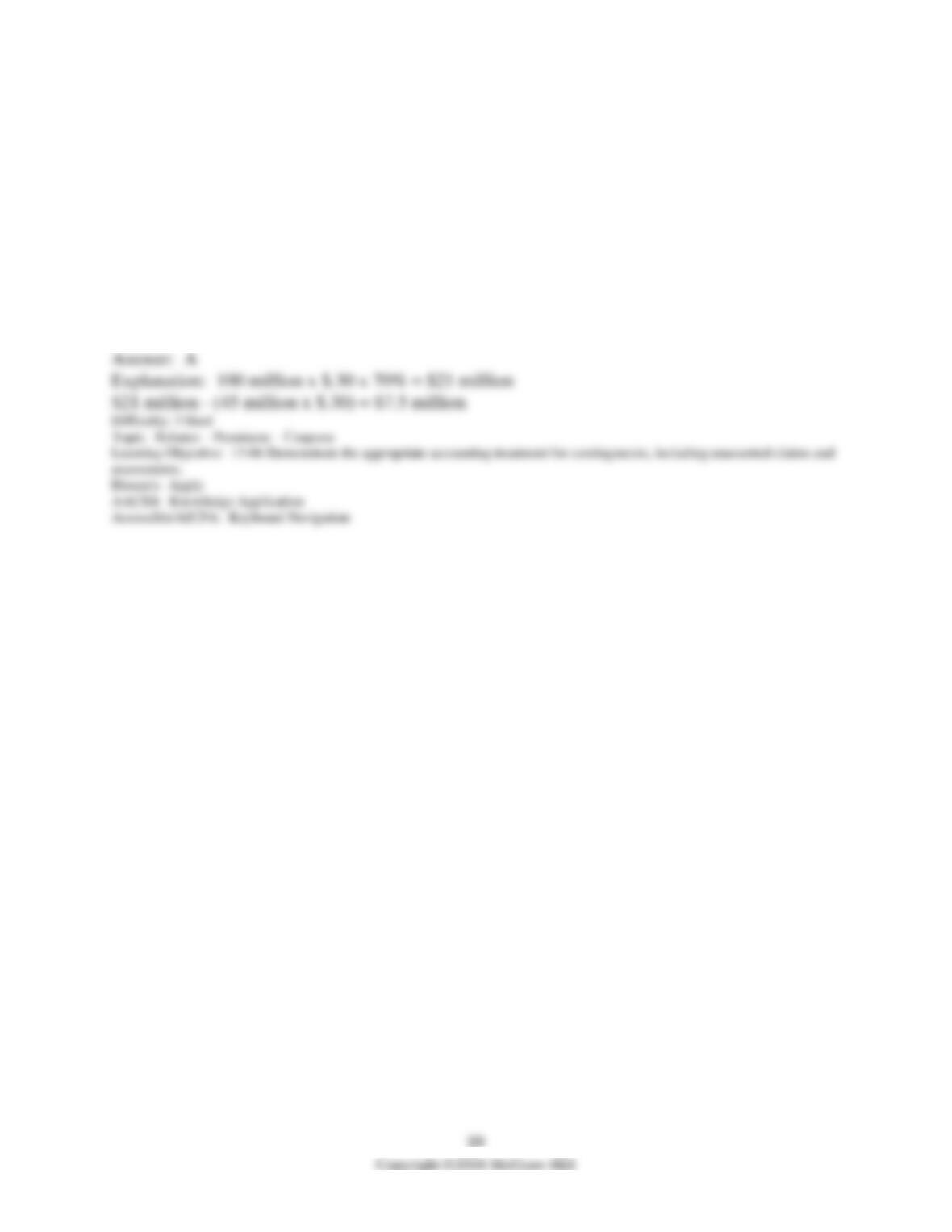
99) General Product Inc. distributed 100 million coupons in 2018. The coupons are redeemable
for 30 cents each. General anticipates that 70% of the coupons will be redeemed. The coupons
expire on December 31, 2019. There were 45 million coupons redeemed in 2018 and 30 million
redeemed in 2019.
What was General’s coupon liability as of December 31, 2018?
A) $7.5 million.
B) $13.5 million.
C) $16.5 million.
D) $21.0 million.
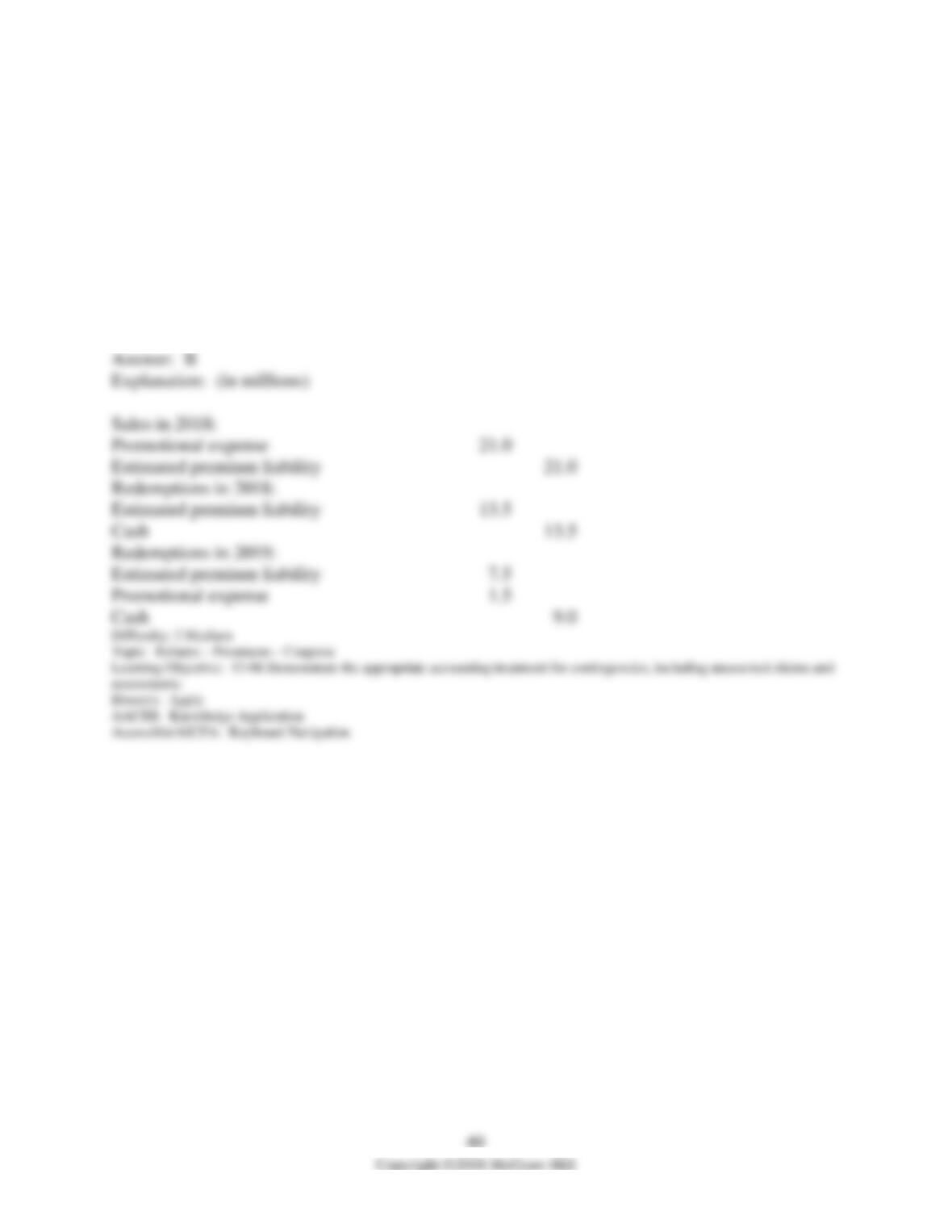
100) General Product Inc. distributed 100 million coupons in 2018. The coupons are redeemable
for 30 cents each. General anticipates that 70% of the coupons will be redeemed. The coupons
expire on December 31, 2019. There were 45 million coupons redeemed in 2018 and 30 million
redeemed in 2019.
What was General’s coupon promotional expense in 2019?
A) Zero, since all the expense should be reflected in 2018.
B) $1.5 million.
C) $7.5 million.
D) $9.0 million.