Managerial Accounting, 16e (Garrison)
Chapter 13: Capital Budgeting Decisions
1) In the payback method, depreciation is added back to net operating income when computing the
annual net cash flow.
2) When a company is cash poor, a project with a short payback period but a low rate of return may
be preferred to a project with a long payback period and a high rate of return.
3) A shorter payback period does not necessarily mean that one investment is more desirable than
another.
4) In calculating the payback period where new equipment is replacing old equipment, any salvage
value to be received on disposal of the old equipment should be deducted from the cost of the new
equipment.
5) The payback method is most appropriate for projects whose cash flows do not extend far into
the future.
6) The required rate of return is the maximum rate of return that an investment project must yield
to the acceptable.
7) The cost of capital is the average rate of return that the company earns on its investments.
8) Discounted cash flow techniques automatically take into account recovery of the initial
investment.
9) When discounted cash flow methods of capital budgeting are used, the working capital required
for a project is ordinarily counted as a cash outflow at the beginning of the project and as a cash
inflow at the end of the project.
10) The net present value method assumes that cash flows from a project are immediately
reinvested at a rate of return equal to the internal rate of return.
11) Neither the net present value method nor the internal rate of return method can be used as a
screening tool in capital budgeting decisions.
12) If the internal rate of return is less than the required rate of return for a project, then the net
present value of that project is positive.
13) An investment project with a project profitability index of 0.04 has an internal rate of return
that is less than the discount rate.
14) The internal rate of return is the rate of return of an investment project over its useful life.
15) When the net cash inflow is the same every year for a project after the initial investment, the
internal rate of return of a project can be determined by dividing the initial investment required in
the project by the annual net cash inflow. This computation yields a factor that can be looked up in
a table of present values of annuities to find the internal rate of return.
16) The internal rate of return is computed by finding the discount rate that equates the present
value of a project’s cash outflows with the present value of its cash inflows.
17) The internal rate of return method assumes that the cash flows generated by the project are
immediately reinvested elsewhere at a rate of return that equals the company’s cost of capital.
18) An increase in the expected salvage value at the end of a capital budgeting project will increase
the internal rate of return for that project.
19) The minimum required rate of return is the discount rate that makes the net present value of the
project equal to zero.
20) The salvage value of new equipment should not be considered when using the internal rate of
return method to evaluate a project.
21) If the salvage value of equipment at the end of a project is highly uncertain, the salvage value
should be ignored in capital budgeting decisions.
22) In preference decisions, the profitability index and internal rate of return methods will rank
projects in the same order of preference.
23) When the internal rate of return method is used to rank investment proposals, the higher the
internal rate of return, the more desirable the investment.
24) If investment funds are limited, the net present value of one project should not be compared
directly to the net present value of another project unless the initial investments in these projects
are equal.
25) In calculating the “investment required” for the project profitability index, the amount invested
should not be reduced by any salvage recovered from the sale of old equipment.
26) When computing the project profitability index of an investment project, the investment
required should exclude any investment made in working capital at the beginning of the project.
27) The simple rate of return focuses on cash flows rather than on accounting net operating
income.
28) The simple rate of return is computed by dividing the annual net operating income generated
by a project by the initial investment in the project.
29) Amster Corporation has not yet decided on the required rate of return to use in its capital
budgeting. This lack of information will prevent Amster from calculating a project’s:
Payback
Net Present Value
Internal Rate of Return
A)
No
No
No
B)
Yes
Yes
Yes
C)
No
Yes
Yes
D)
No
Yes
No
A) Choice A
B) Choice B
C) Choice C
D) Choice D
30) Rennin Dairy Corporation is considering a plant expansion decision that has an estimated
useful life of 20 years. This project has an internal rate of return of 15% and a payback period of
9.6 years. How would a decrease in the expected salvage value from this project in 20 years affect
the following for this project?
Internal Rate of Return
Payback Period
A)
Decrease
Decrease
B)
No effect
Decrease
C)
Decrease
No effect
D)
Increase
No effect
E)
No effect
No effect
A) Choice A
B) Choice B
C) Choice C
D) Choice D
E) Choice E
31) The project profitability index and the internal rate of return:
A) will always result in the same preference ranking for investment projects.
B) will sometimes result in different preference rankings for investment projects.
C) are less dependable than the payback method in ranking investment projects.
D) are less dependable than net present value in ranking investment projects.
32) Some investment projects require that a company increase its working capital. Under the net
present value method, the investment and eventual recovery of working capital should be treated
as:
A) an initial cash outflow.
B) a future cash inflow.
C) both an initial cash outflow and a future cash inflow.
D) irrelevant to the net present value analysis.
33) A company has unlimited funds to invest at its discount rate. The company should invest in all
projects having:
A) an internal rate of return greater than zero.
B) a net present value greater than zero.
C) a simple rate of return greater than the discount rate.
D) a payback period less than the project’s estimated life.
34) If the net present value of a project is zero based on a discount rate of 16%, then the internal
rate of return is:
A) equal to 16%.
B) less than 16%.
C) greater than 16%.
D) cannot be determined from this data.
35) The assumption that the cash flows from an investment project are reinvested at the company’s
discount rate applies to:
A) both the internal rate of return and the net present value methods.
B) only the internal rate of return method.
C) only the net present value method.
D) neither the internal rate of return nor net present value methods.
36) The internal rate of return method assumes that a project’s cash flows are reinvested at the:
A) internal rate of return.
B) simple rate of return.
C) required rate of return.
D) payback rate of return.
37) A preference decision in capital budgeting:
A) is concerned with whether a project clears the minimum required rate of return hurdle.
B) comes before the screening decision.
C) is concerned with determining which of several acceptable alternatives is best.
D) involves using market research to determine customers’ preferences.
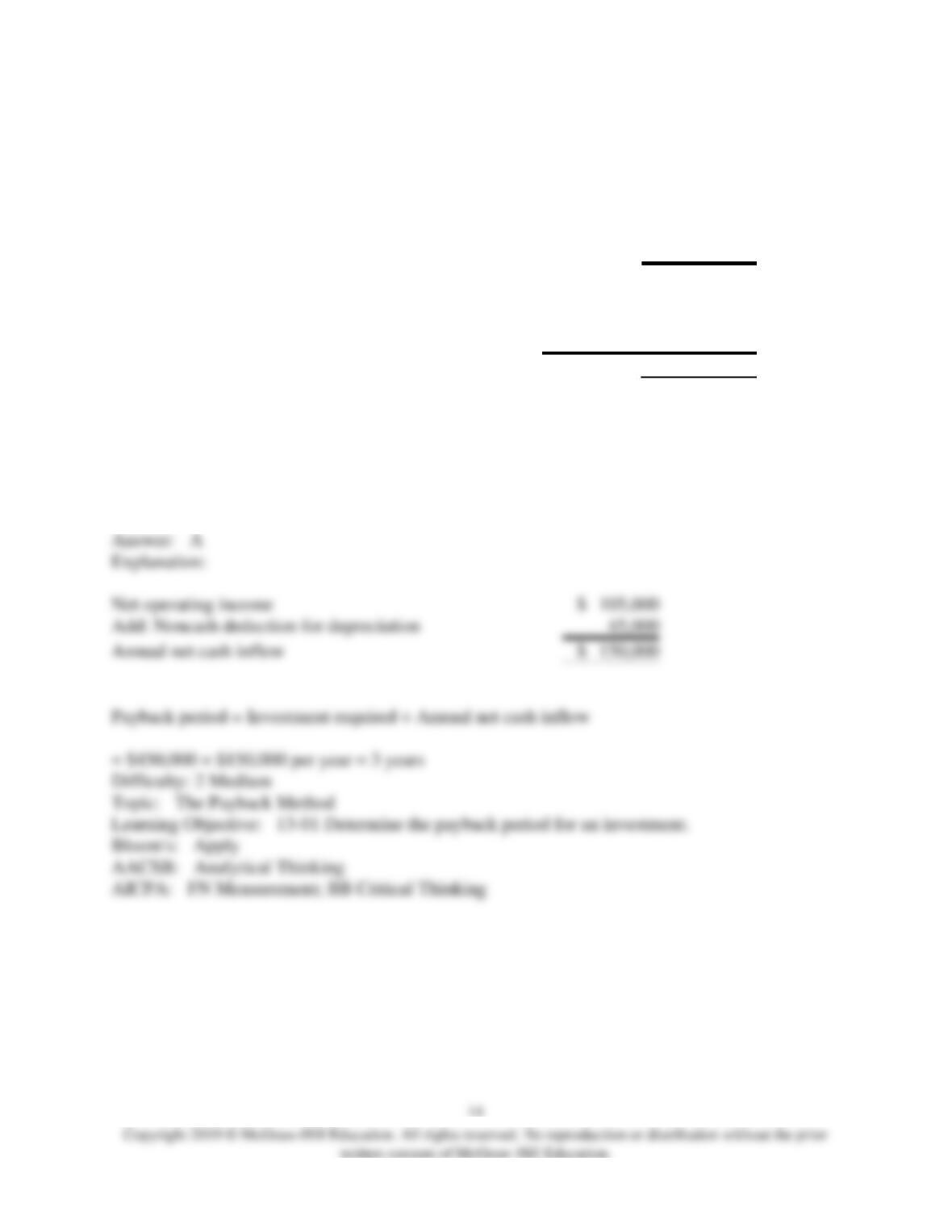
38) Jarvey Corporation is studying a project that would have a ten-year life and would require a
$450,000 investment in equipment which has no salvage value. The project would provide net
operating income each year as follows for the life of the project (Ignore income taxes.):
Sales
$
500,000
Less cash variable expenses
200,000
Contribution margin
300,000
Less fixed expenses:
Fixed cash expenses
$
150,000
Depreciation expenses
45,000
195,000
Net operating income
$
105,000
The company’s required rate of return is 12%. The payback period for this project is closest to:
A) 3 years
B) 2 years
C) 4.28 years
D) 9 years
Net operating income
$
Add: Noncash deduction for depreciation
Annual net cash inflow
$
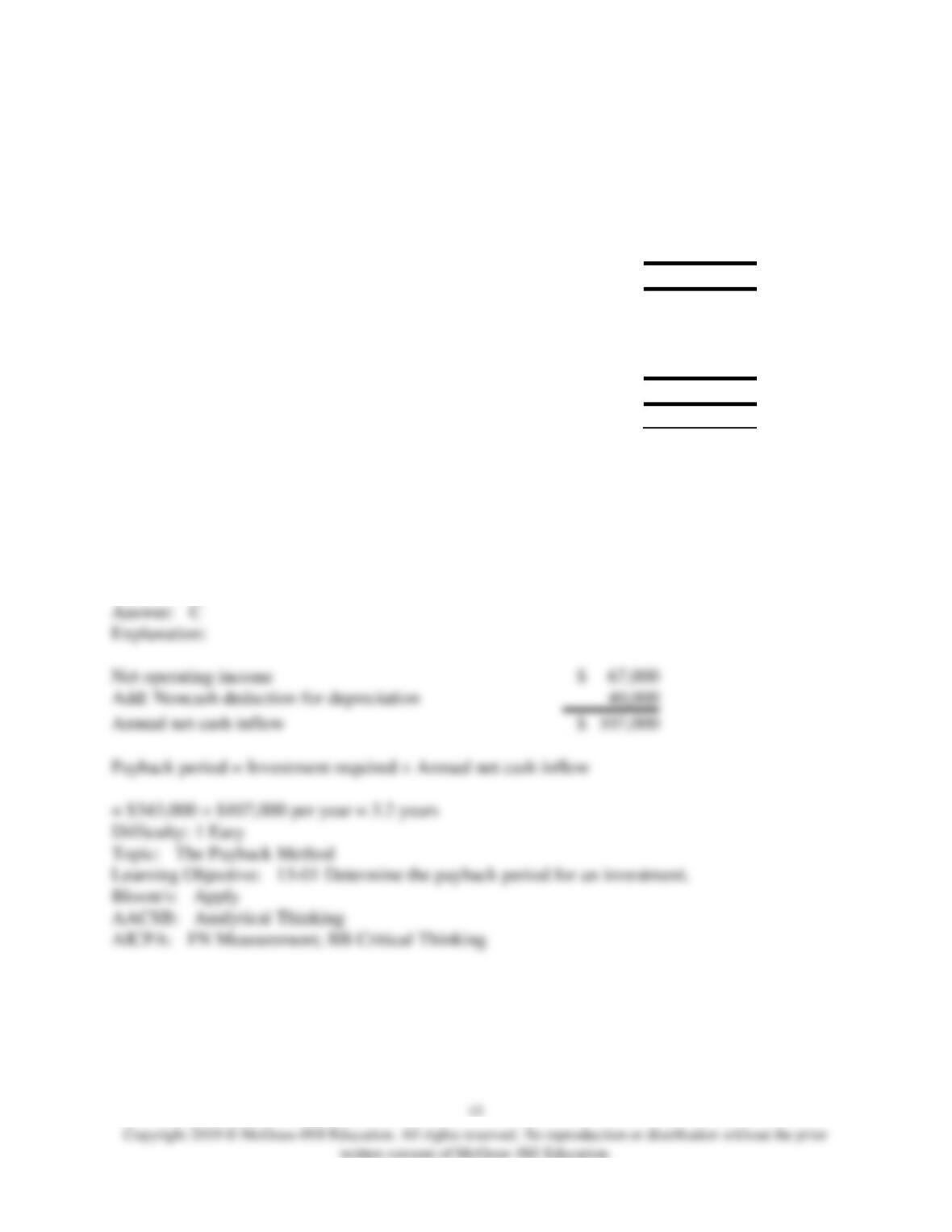
39) Olinick Corporation is considering a project that would require an investment of $343,000 and
would last for 8 years. The incremental annual revenues and expenses generated by the project
during those 8 years would be as follows (Ignore income taxes.):
Sales
$
227,000
Variable expenses
52,000
Contribution margin
175,000
Fixed expenses:
Salaries
27,000
Rents
41,000
Depreciation
40,000
Total fixed expenses
108,000
Net operating income
$
67,000
The scrap value of the project’s assets at the end of the project would be $23,000. The cash inflows
occur evenly throughout the year. The payback period of the project is closest to:
A) 3.0 years
B) 5.1 years
C) 3.2 years
D) 4.8 years
Net operating income
$
Add: Noncash deduction for depreciation
Annual net cash inflow
$
107,000
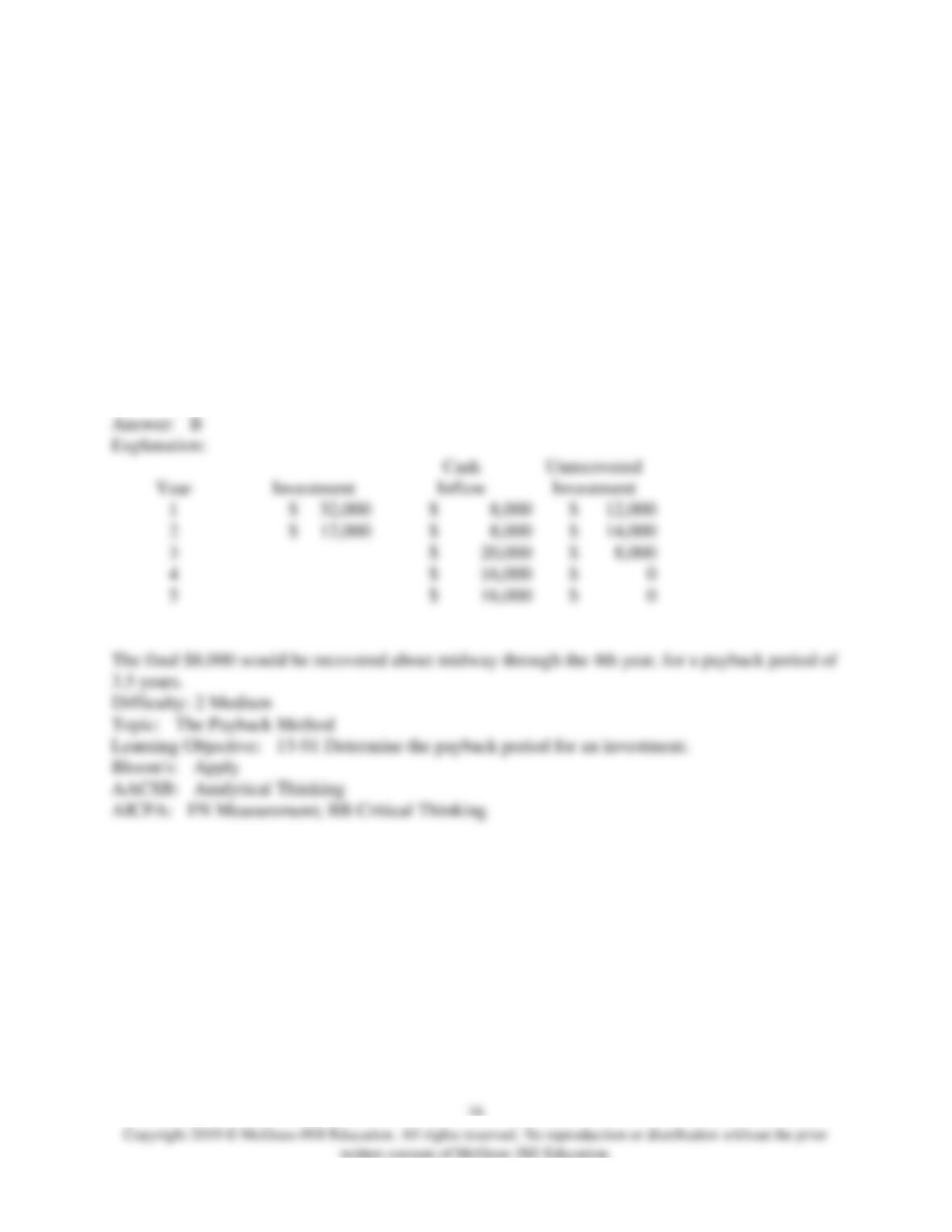
40) The Zingstad Corporation is considering an investment with the following data (Ignore income
taxes.):
Year 1
Year 2
Year 3
Year 4
Year 5
Investment
$
32,000
$
12,000
Cash inflow
$
8,000
$
8,000
$
20,000
$
16,000
$
16,000
Cash inflows occur evenly throughout the year. The payback period for this investment is:
A) 3.0 years
B) 3.5 years
C) 4.0 years
D) 4.5 years
41) The management of Lanzilotta Corporation is considering a project that would require an
investment of $263,000 and would last for 8 years. The annual net operating income from the
project would be $66,000, which includes depreciation of $31,000. The scrap value of the project’s
assets at the end of the project would be $15,000. The cash inflows occur evenly throughout the
year. The payback period of the project is closest to (Ignore income taxes.):
A) 3.8 years
B) 2.6 years
C) 2.7 years
D) 4.0 years
42) A company with $500,000 in operating assets is considering the purchase of a machine that
costs $60,000 and which is expected to reduce operating costs by $15,000 each year. These
reductions in cost occur evenly throughout the year. The payback period for this machine in years
is closest to (Ignore income taxes.):
A) 0.25 years
B) 8.3 years
C) 4 years
D) 33.3 years
43) Buy-Rite Pharmacy has purchased a small auto for delivering prescriptions. The auto was
purchased for $24,000 and will have a 6-year useful life and a $6,000 salvage value. Delivering
prescriptions (which the pharmacy has never done before) should increase gross revenues by at
least $28,000 per year. The cost of these prescriptions to the pharmacy will be about $22,000 per
year. The pharmacy depreciates all assets using the straight-line method. The payback period for
the auto is closest to (Ignore income taxes.):
A) 2 years
B) 1.8 years
C) 4 years
D) 1.2 years
44) An investment project requires an initial investment of $100,000. The project is expected to
generate net cash inflows of $28,000 per year for the next five years. These cash inflows occur
evenly throughout the year. Assuming a 12% discount rate, the project’s payback period is (Ignore
income taxes.):
A) 0.28 years
B) 3.36 years
C) 3.57 years
D) 1.40 years
45) Ataxia Fitness Center is considering an investment in some additional weight training
equipment. The equipment has an estimated useful life of 10 years with no salvage value at the end
of the 10 years. Ataxia’s internal rate of return on this equipment is 8%. Ataxia’s discount rate is
also 8%. The payback period on this equipment is closest to (Ignore income taxes.):
See separate Exhibit 13B-1 and Exhibit 13B-2, to determine the appropriate discount factor(s)
using the tables provided.
A) 10 years
B) 6.71 years
C) 5 years
D) 7.81 years