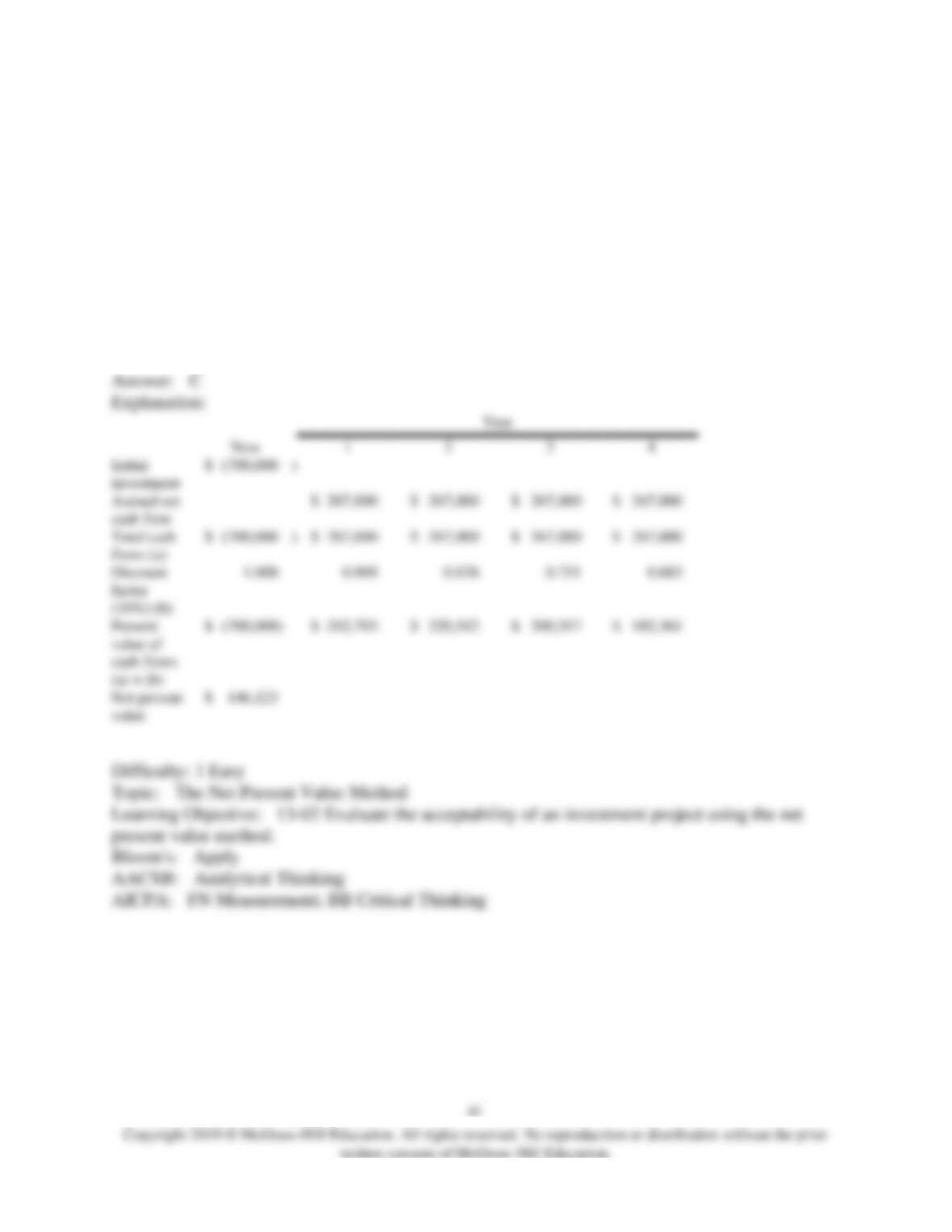
65) Goergen Corporation is considering a capital budgeting project that would require an initial
investment of $700,000. The investment would generate annual cash inflows of $267,000 for the
life of the project, which is 4 years. The company’s discount rate is 10%. The net present value of
the project is closest to:
See separate Exhibit 13B-1 and Exhibit 13B-2, to determine the appropriate discount factor(s)
using the tables provided.
A) $368,000
B) $846,123
C) $146,123
D) $700,000
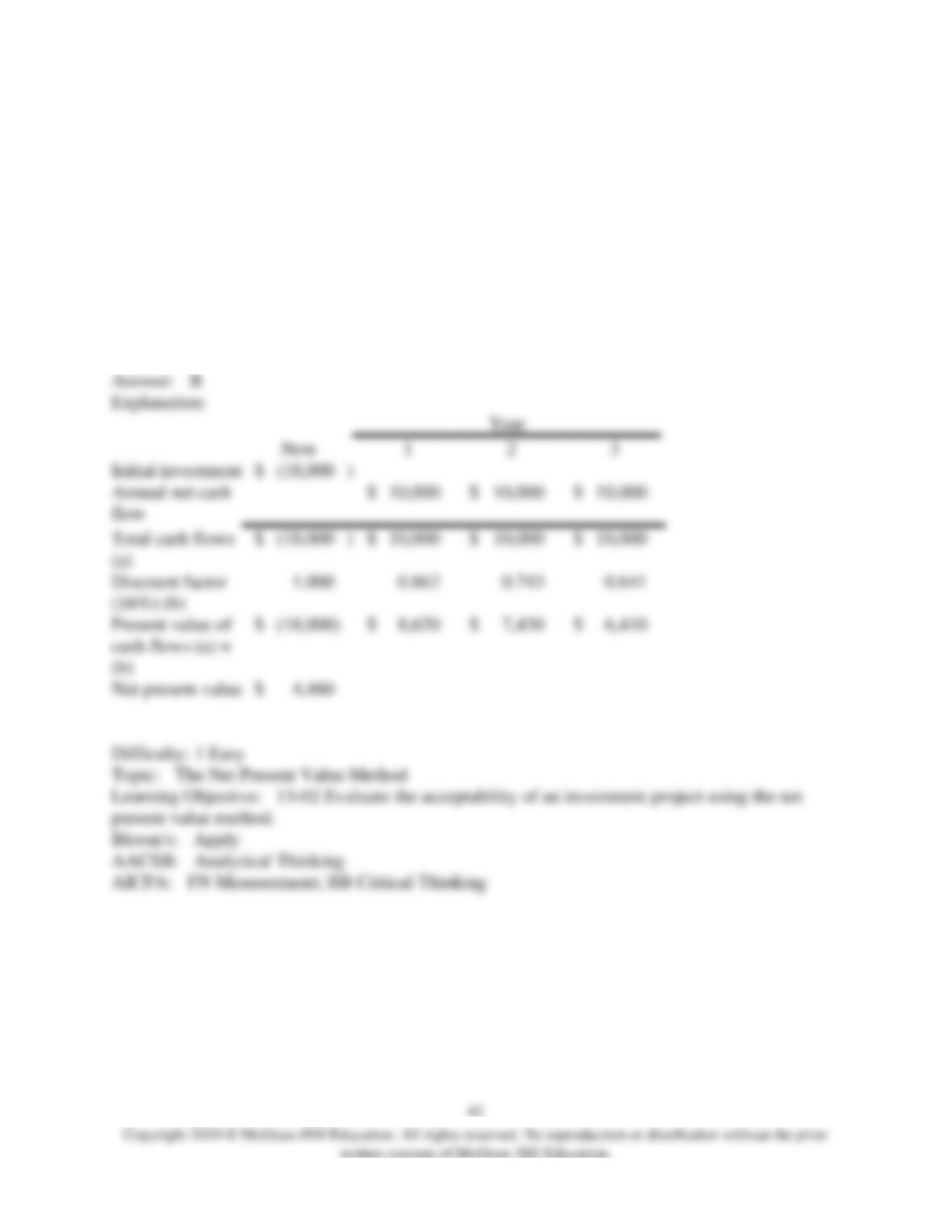
66) Whitton Corporation uses a discount rate of 16%. The company has an opportunity to buy a
machine now for $18,000 that will yield cash inflows of $10,000 per year for each of the next three
years. The machine would have no salvage value. The net present value of this machine is closest
to (Ignore income taxes.):
See separate Exhibit 13B-1 and Exhibit 13B-2, to determine the appropriate discount factor(s)
using the tables provided.
A) $22,460
B) $4,460
C) $(9,980)
D) $12,000
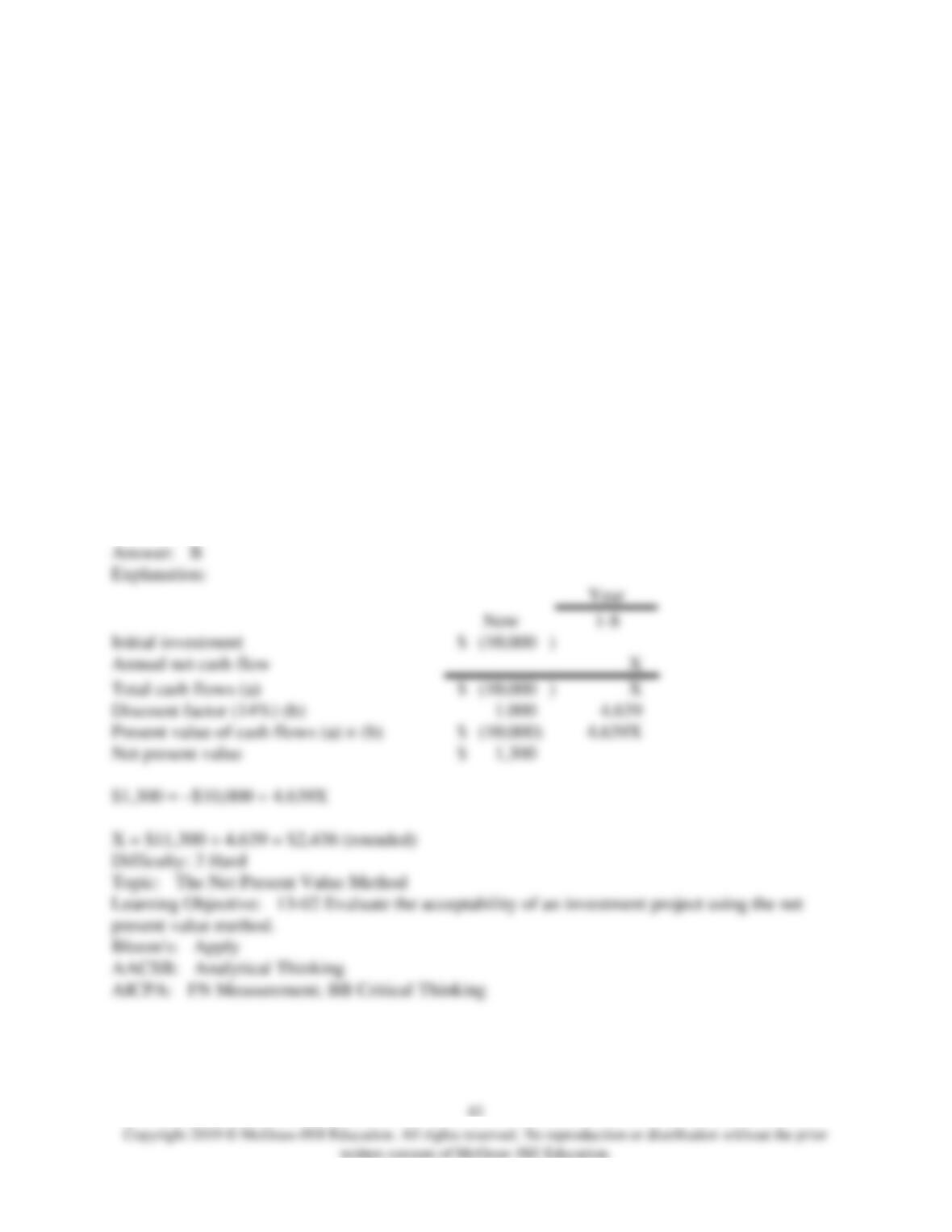
67) A company has provided the following data concerning a proposed project (Ignore income
taxes.):
Initial investment
$
10,000
Annual cost savings
$
?
Salvage value
$
0
Life of the project
8
years
Discount rate
14
%
Net present value
$
1,300
See separate Exhibit 13B-1 and Exhibit 13B-2, to determine the appropriate discount factor(s)
using the tables provided.
The annual cost savings must be closest to:
A) $4,024
B) $2,436
C) $1,875
D) $3,704
Initial investment
Annual net cash flow
Total cash flows (a)
Discount factor (14%) (b)
Present value of cash flows (a) × (b)
)
Net present value
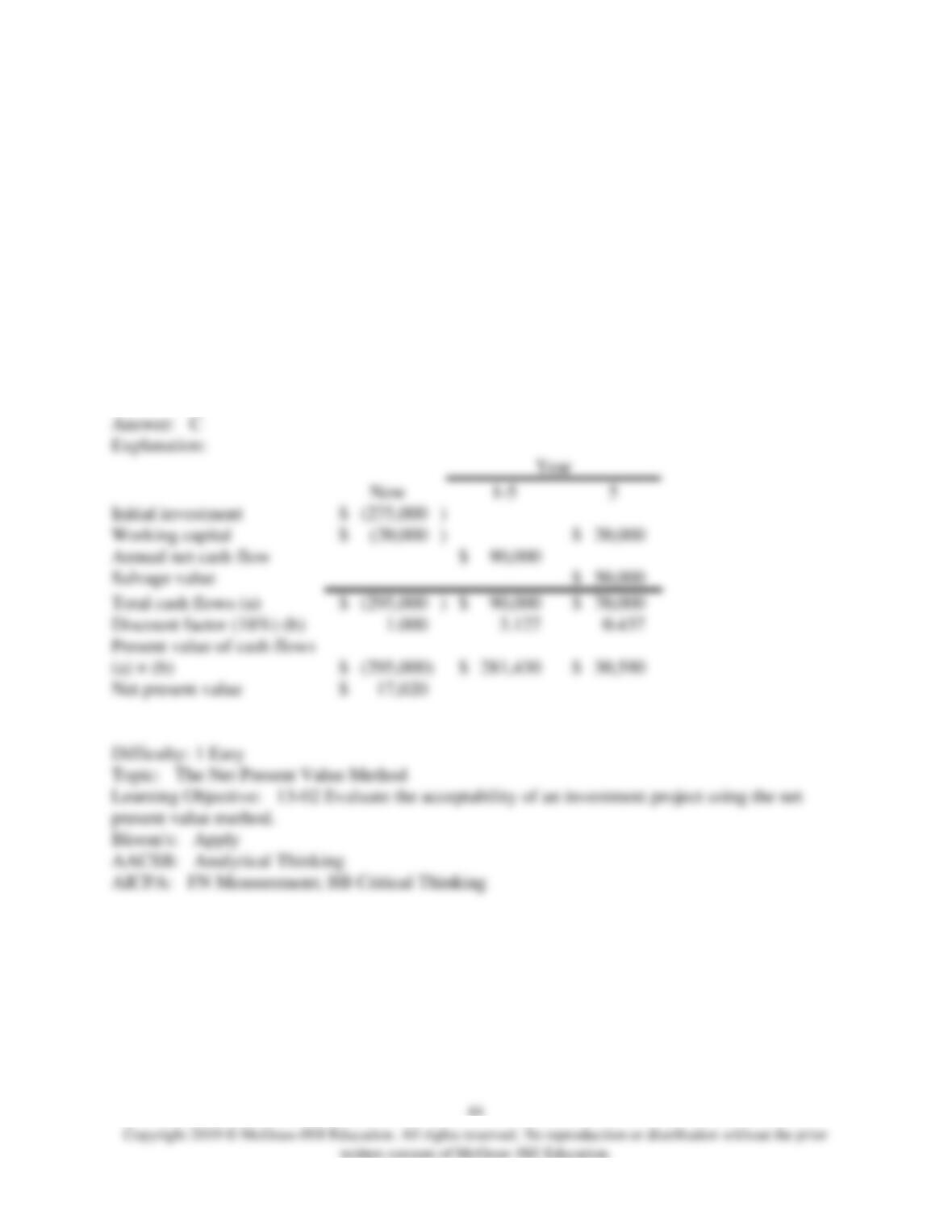
68) Orbit Airlines is considering the purchase of a new $275,000 maintenance hangar. The new
hangar has an estimated useful life of 5 years with an expected salvage value of $50,000. The new
hangar is expected to generate cost savings of $90,000 per year in each of the 5 years. A $20,000
increase in working capital will also be needed for this new hangar. The working capital will be
released at the end of the 5 years. Orbit’s discount rate is 18%. What is the net present value of the
new hangar? (Ignore income taxes.)
See separate Exhibit 13B-1 and Exhibit 13B-2, to determine the appropriate discount factor(s)
using the tables provided.
A) $8,280
B) $9,440
C) $17,020
D) $28,280

69) Basey Corporation has provided the following data concerning an investment project that it is
considering:
Initial investment
$
510,000
Working capital
$
30,000
Annual cash flow
$
173,000
per year
Salvage value at the end of the project
$
12,000
Expected life of the project
4
years
Discount rate
15
%
See separate Exhibit 13B-1 and Exhibit 13B-2, to determine the appropriate discount
factor(s) using the tables provided.
The working capital would be released for use elsewhere at the end of the project. The net present
value of the project is closest to:
A) $(9,048)
B) $(39,048)
C) $(21,888)
D) $194,000

70) Cannula Vending Corporation is expanding operations and needs to purchase additional
vending machines. There are currently two companies, Viscera, Inc. and Gullet International, that
produce and sell machines that will do the job. Information related to the specifications of each
company’s machine are as follows (Ignore income taxes.):
Viscera
Gullet
Purchase price per machine
$
18,000
$
24,000
Useful life of machine
5
years
5
years
Expected salvage value of machine in 5 years
$
2,000
$
5,000
Estimated annual operating cost per machine
$
4,000
$
3,000
See separate Exhibit 13B-1 and Exhibit 13B-2, to determine the appropriate discount factor(s)
using the tables provided.
Cannula’s discount rate is 18%. Cannula uses the straight-line method of depreciation. Using net
present value analysis, which company’s machine should Cannula purchase and what is the
approximate difference between the net present values of the competing company’s machines?
A) Gullet, $127
B) Viscera, $1,562
C) Viscera, $1,749
D) Viscera, $3,438

71) Basta Corporation has provided the following data concerning an investment project that it is
considering:
Initial investment
$
780,000
Working capital
$
94,000
Annual cash flow
$
268,000
per year
Salvage value at the end of the project
$
26,000
See separate Exhibit 13B-1 and Exhibit 13B-2, to determine the appropriate discount
factor(s) using the tables provided.
The working capital would be released for use elsewhere at the end of the project in 4 years. The
company’s discount rate is 8%. The net present value of the project is closest to:
A) $101,816
B) $126,726
C) $32,726
D) $318,000
72) Congener Beverage Corporation is considering an investment in a project that has an internal
rate of return of 20%. The only cash outflow for this project is the initial investment. The project is
estimated to have an 8 year life and no salvage value. Cash inflows from this project are expected
to be $100,000 per year in each of the 8 years. Congener’s discount rate is 16%. What is the net
present value of this project? (Ignore income taxes.)
See separate Exhibit 13B-1 and Exhibit 13B-2, to determine the appropriate discount factor(s)
using the tables provided.
A) $5,215
B) $15,464
C) $50,700
D) $55,831
73) Highpoint, Inc., is considering investing in automated equipment with a ten-year useful life.
Managers at Highpoint have estimated the cash flows associated with the tangible costs and
benefits of automation, but have been unable to estimate the cash flows associated with the
intangible benefits. Using the company’s 12% required rate of return, the net present value of the
cash flows associated with just the tangible costs and benefits is a negative $282,500. How large
would the annual net cash inflows from the intangible benefits have to be to make this a financially
acceptable investment? (Ignore income taxes.)
See separate Exhibit 13B-1 and Exhibit 13B-2, to determine the appropriate discount factor(s)
using the tables provided.
A) $20,000
B) $28,250
C) $35,000
D) $50,000
74) Crockin Corporation is considering a machine that will save $9,000 a year in cash operating
costs each year for the next six years. At the end of six years it would have no salvage value. If this
machine costs $33,165 now, the machine’s internal rate of return is closest to (Ignore income
taxes.):
See separate Exhibit 13B-1 and Exhibit 13B-2, to determine the appropriate discount factor(s)
using the tables provided.
A) 16%
B) 17%
C) 18%
D) 19%
75) The following data pertain to an investment project (Ignore income taxes.):
Investment required
$
34,055
Annual savings
$
5,000
Life of the project
15
years
See separate Exhibit 13B-1 and Exhibit 13B-2, to determine the appropriate discount factor(s)
using the tables provided.
The internal rate of return is closest to:
A) 12%
B) 14%
C) 10%
D) 8%
76) Heap Corporation is considering an investment in a project that will have a two year life. The
project will provide a 10% internal rate of return, and is expected to have a $40,000 cash inflow the
first year and a $50,000 cash inflow in the second year. What investment is required in the project?
(Ignore income taxes.)
See separate Exhibit 13B-1 and Exhibit 13B-2, to determine the appropriate discount factor(s)
using the tables provided.
A) $74,340
B) $77,660
C) $81,810
D) $90,000
77) Bau Long-Haul, Inc., is considering the purchase of a tractor-trailer that would cost $281,656,
would have a useful life of 7 years, and would have no salvage value. The tractor-trailer would be
used in the company’s hauling business, resulting in additional net cash inflows of $76,000 per
year. The internal rate of return on the investment in the tractor-trailer is closest to (Ignore income
taxes.):
See separate Exhibit 13B-1 and Exhibit 13B-2, to determine the appropriate discount factor(s)
using the tables provided.
A) 19%
B) 18%
C) 21%
D) 16%
78) Welch Corporation is planning an investment with the following characteristics (Ignore
income taxes.):
Useful life
6
years
Yearly net cash inflow
$
45,000
Salvage value
$
0
Internal rate of return
18
%
Required rate of return
14
%
See separate Exhibit 13B-1 and Exhibit 13B-2, to determine the appropriate discount
factor(s) using the tables provided.
The initial cost of the equipment is closest to:
A) $157,410
B) $175,005
C) $235,890
D) Cannot be determined from the given information.
79) Golab Roofing is considering the purchase of a crane that would cost $69,846, would have a
useful life of 6 years, and would have no salvage value. The use of the crane would result in labor
savings of $21,000 per year. The internal rate of return on the investment in the crane is closest to
(Ignore income taxes.):
See separate Exhibit 13B-1 and Exhibit 13B-2, to determine the appropriate discount factor(s)
using the tables provided.
A) 18%
B) 20%
C) 19%
D) 17%
80) Laws Corporation is considering the purchase of a machine costing $16,000. Estimated cash
savings from using the new machine are $4,120 per year. The machine will have no salvage value
at the end of its useful life of six years and the required rate of return for Laws Corporation is 12%.
The machine’s internal rate of return is closest to (Ignore income taxes.):
See separate Exhibit 13B-1 and Exhibit 13B-2, to determine the appropriate discount factor(s)
using the tables provided.
A) 12%
B) 14%
C) 16%
D) 18%
81) Given the following data (Ignore income taxes.):
Cost of equipment
$
48,680
Annual cash inflows
$
10,000
Internal rate of return
10
%
See separate Exhibit 13B-1 and Exhibit 13B-2, to determine the appropriate discount factor(s)
using the tables provided.
The life of the equipment must be:
A) It is impossible to determine from the data given
B) 5 years
C) 6 years
D) 7 years