70. A gain contingency that is reasonably possible and for which the amount can be reasonably estimated
should be
71. Short-term debt expected to be refinanced
72. On December 31, 2010, the Williams Company had the following liabilities:
Trade accounts payable
$140,000
11% note payable, maturing in equal installments of $30,000
per year on December 30 through 2013
90,000
12% note payable, issued October 15, 2010, maturing
February 15, 2011
70,000
On December 31, Williams signed a binding agreement with its bank to refinance the 12% note through February 14, 2013, at a variable interest rate.
What is the amount of Williams’ current liabilities on December 31, 2010?
73. Gain contingencies should
74. Which of the following statements concerning contingencies is true?
75. Cooper’s inventory has been financed 100% with a long-term note. The note is coming due in 2011. Cooper
has received a commitment from a new lender that permits five-year refinancing of debt up to an amount equal
to 50% of inventory, which is expected to range between $9,000 and $15,000 in 2011. At December 31, 2010,
how much of the company’s currently maturing note payable can be classified as long-term debt?
76. Blocker, Inc. had $10,000 of notes coming due on January 10, 2011. On January 5, 2011, the company used
$2,000 of excess cash to pay off part of the note. On January 8, 2011, a refinancing was completed. The $2,000
payment was refunded and added back to the note balance, and the note was extended for another two years. On
the December 31, 2010 balance sheet, how much of the $10,000 note should be shown as current?
77. Which of the following statements is true?
78. Which of the following would not be an acceptable method of presenting current liabilities on the balance
sheet?
79. When a contingency must be accrued under IFRS, the charge is referred to as
80. In considering contingencies, IFRS and GAAP define the term “probable” as
81. When selecting within a range of outcome estimates for probable contingencies, the requirements of IFRS
and GAAP, respectively, are to accrue what amount in the range?
IFRS
GAAP
I.
minimum
minimum
II.
midpoint
minimum
III.
minimum
midpoint
IV.
midpoint
midpoint
82. On January 1, 2011, Morrison, Inc. bought some equipment by signing a non-interest-bearing note for
$160,000. The note is to be paid in four equal annual $40,000 payments, beginning on December 31, 2011.
Current interest rates were 8%. Actuarial information for 8%, 4 periods follows:
Amount of 1
1.360
Present value of 1
0.735
Amount of annuity of 1
4.506
Present value of annuity of 1
3.312
Required:
Prepare the journal entries necessary on January 1, 2011, and December 31, 2011.
1/1/2011
Equipment ($40,000 ´ 3.312)
132,480
Discount on Note Payable
27,520
Note Payable
Note Payable
40,000
Cash
40,000
Interest Expense
10,598
Discount on Note Payable ($132,480 ´ .08)
10,598
83. NTS Services employs 50 workers who are each paid $800 per week. NTS allows each employee two weeks
of paid vacation per year. In addition, the company allows each employee one week of paid sick leave per year.
No employees used vacation days or sick leave in the first quarter. In April, a total of two weeks of vacation and
one week of sick leave were used by various employees.
Required:
a.
Prepare the journal entry to record NTS’s quarterly liability for compensated absences on March 31. (Ignore payroll taxes.)
b.
Prepare the April 30 journal entry to record the payment of four weeks of payroll, which includes the employee use of compensated
absences. (Ignore payroll taxes.)
84. Claremore Company instituted a vacation and sick pay policy on January 1, 2010. Thirty employees,
averaging $100 per day per employee, were covered under the plan. The policy allows each employee five days
of sick pay and twelve days of vacation pay per year. The sick pay accumulates up to a ten-day maximum.
Vacation pay accumulates without a maximum. The sick pay vests, but vacation pay does not. A total of 400
days of sick and vacation days were taken during 2010.
Required:
Prepare the December 31, 2010 year-end accrual for compensated absences.
Salaries
11,000
{[(17 days ´ 30 employees) – 400 days] ´ $100}
11,000
Future Absences (3/12 ´ 50 ´ 3 ´ $800)
30,000
Salaries Expense
157,600
Liability for Employees’ Compensation for
Future Absences [(2 + 1) ´ $800]
2,400
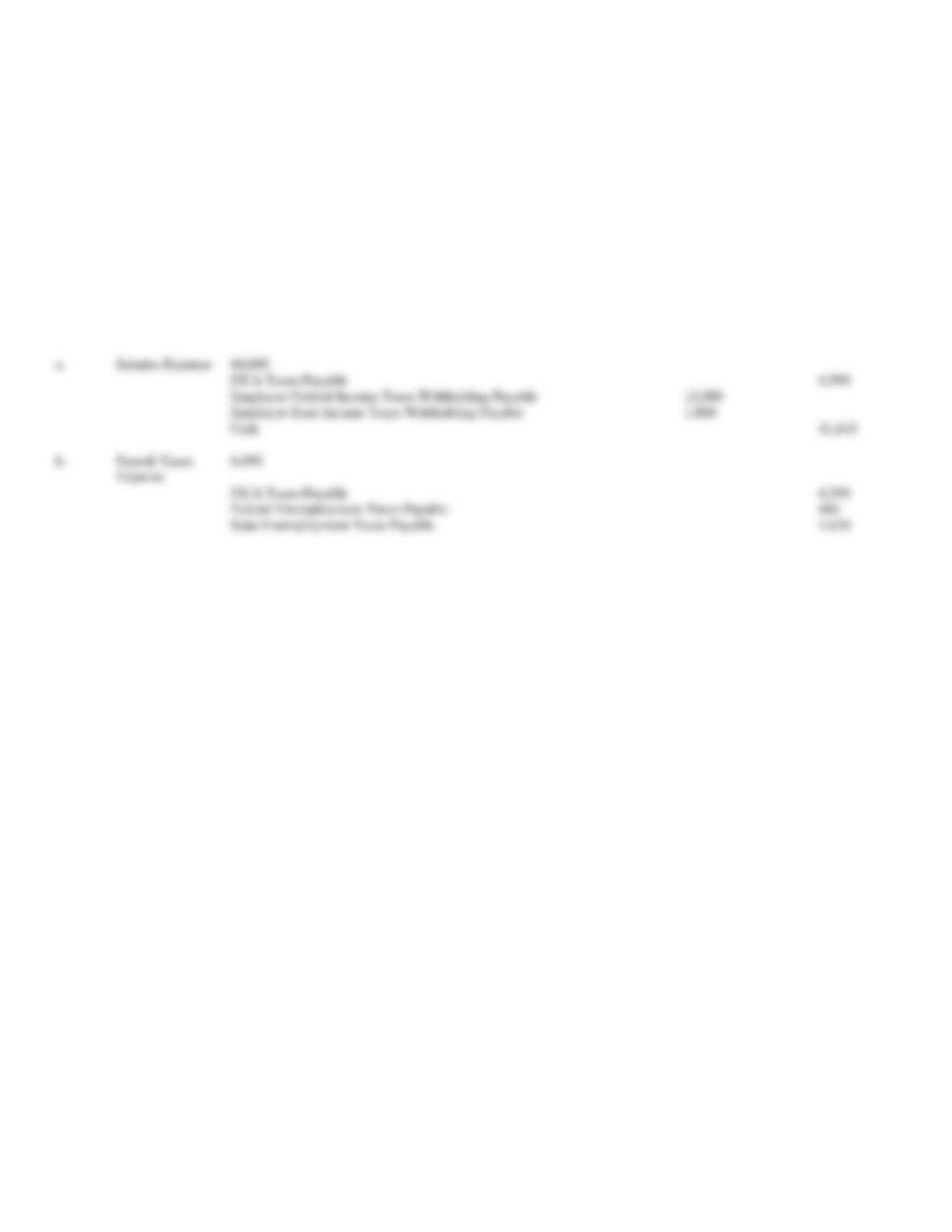
85. Marshall Co. employs a staff of 30 at a total monthly gross pay of $60,000. The company withholds federal
income tax at 20% and state income tax at 3% for all employees. In addition, the following tax rates apply:
FICA tax, 7.65%; federal unemployment tax, 0.8%; state unemployment tax, 2.7%.
Required:
a.
Prepare the journal entry to record salaries and employee withholding items for the month of January.
b.
Prepare the journal entry to record employer payroll taxes for the month of January.
86. The sales manager of the Winfred Company receives an annual bonus of 10% of net income after bonus and
taxes. In 2010, Winfred’s income, before bonus and taxes, was $400,000. The effective tax rate is 30%.
Required:
a.
Compute the sales manager’s bonus and the income tax expense for the Winfred Company.
b.
Why does Winfred compute the sales manager bonus after taxes and the bonus?
a.
Salaries Expense
60,000
Employee Federal Income Taxes Withholding Payable
12,000
Employee State Income Taxes Withholding Payable
1,800
Cash
FICA Taxes Payable
State Unemployment Taxes Payable
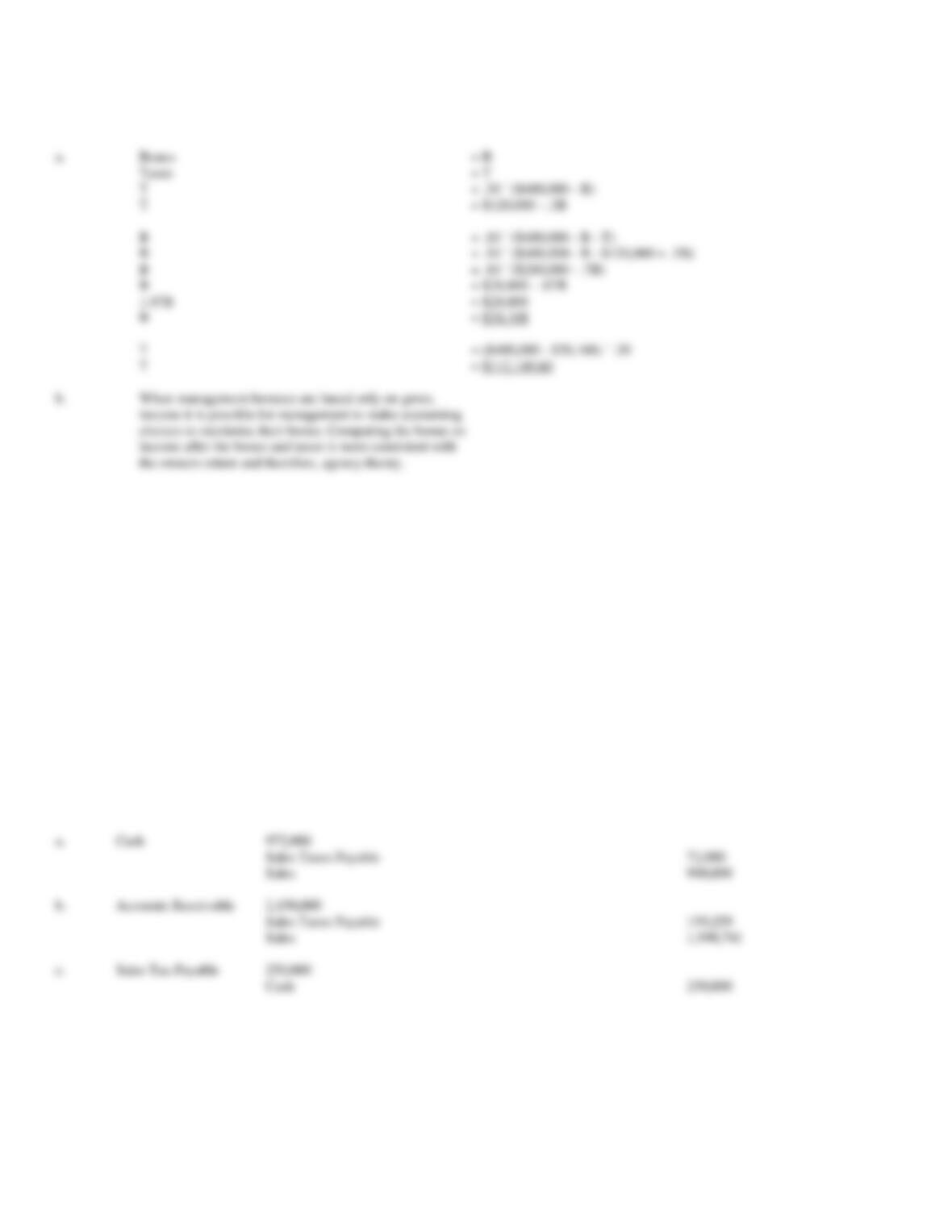
87. Mansour Company makes sales on which an 8% sales tax is assessed. The following summary transactions
were made during 2010:
a.
Cash sales of $900,000, excluding sales taxes.
b.
Credit sales of $2,150,000, including sales taxes.
c.
Sales taxes of $250,000 were paid to the state.
Required:
Prepare journal entries to record the preceding transactions. (Round to the nearest whole number.)
a.
Cash
972,000
Sales Taxes Payable
72,000
Sales Taxes Payable
159,259
c.
Sales Tax Payable
250,000
Cash
250,000
a.
Bonus
Taxes
T
B
B
B
1.07B
B
T
T

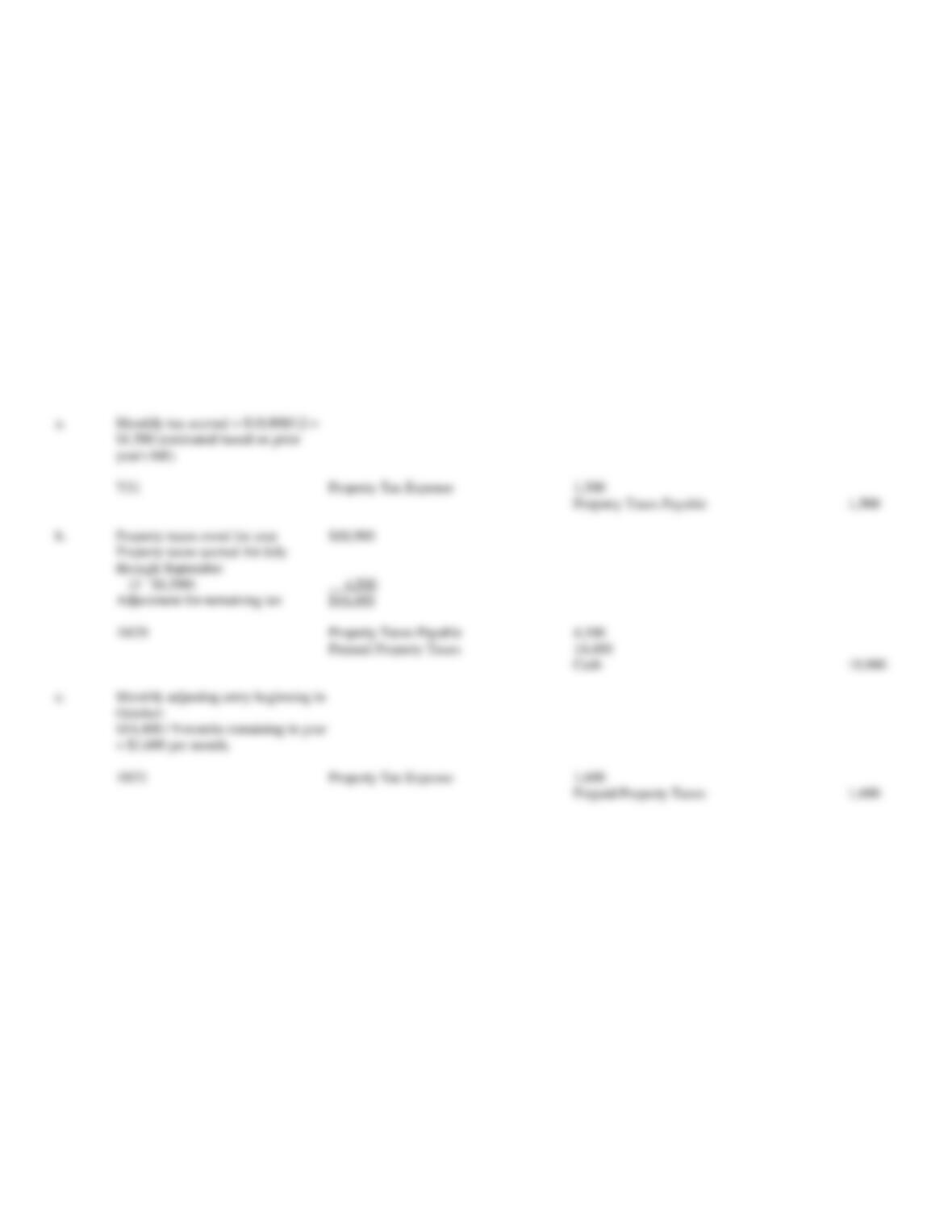
88. Mr. Mario, the plant supervisor of Super Brothers Corp., is allowed a bonus of 4% of income after bonus
and tax. For 2010, the tax rate is 30% and income before bonus and tax amounts to $1,200,000.
Required:
Compute the amount of Mr. Mario’s 2010 bonus.
89. Hair Affairs reports the following payroll information for May, 2010:
Type of
Gross
Federal Income
Savings Bonds
Salary
Pay
Tax Withheld
Withheld
Sales
$10,000
$2,200
$200
Office
3,000
600
300
$13,000
$2,800
$500
Tax rate information follows:
FICA
7.0%
Federal unemployment
0.8%
State employment
5.4%
Assume that all wages are subject to all payroll taxes.
Required:
Prepare the journal entries to record the payment of the May, 2010, payroll and the payroll taxes imposed on the employer.
Sales Salaries Expense
10,000
Office Salaries Expense
3,000
FICA Taxes Payable
Employee Federal Income Taxes Withholding Payable
2,800
Savings Bonds Withholding Payable
Cash
8,790
Payroll Taxes Expense
1,716
Federal Unemployment Taxes Payable
B
= Bonus
T
= Tax
B
= .04 ($1,200,000 – B – T)
T
= .30 ($1,200,000 – B)
B
= .04 [$1,200,000 – B – .30 ($1,200,000 – B)]
B
= .04 ($1,200,000 – B – $360,000 + .3B)
B
= .04 ($840,000 – .7B)
1.028B
= $33,600
B
= $32,684.82
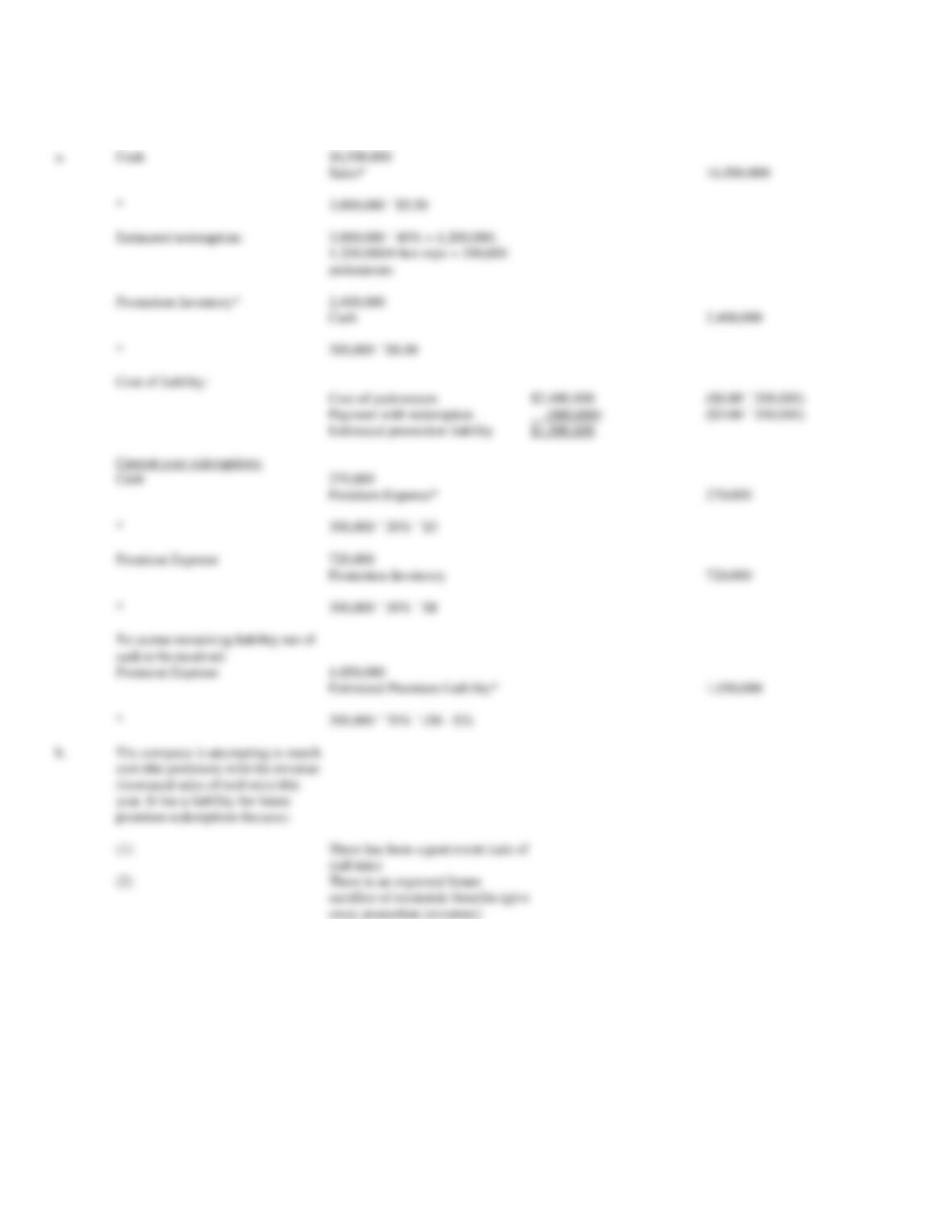
90. Splendor Company is located in a town that assesses property for tax purposes on July 1 for the period July
1 to June 30. The tax rate is not determined until October 10, and the tax bills are mailed October 20 with
payment due by December 31. For the prior fiscal year, the Splendor Company paid $18,000. The tax bill for
the current fiscal year (July 1, 2010-June 30, 2011) is received on October 23, and property taxes have
increased to $18,900. The company pays this amount on October 29.
Required:
a.
Record the monthly property tax accrual recorded in July of 2010.
b.
Record the payment of the taxes on October 29.
c.
Record the monthly adjusting entry on October 31.
91. Sunshine Snack Corp. sells Healthy-Cholesterol trail mix for $5.50 a box. By including a coupon for a
pedometer, the company hopes to increase sales. If customers redeem four box tops with the coupon, they can
obtain a pedometer for $3.00 plus $1 for shipping and handling. The pedometers will cost Sunshine $8.00 a
piece. Sunshine estimates that the promotion will be popular; 3,000,000 boxes of trail mix will be sold in 2010,
and 40% of the coupons will be redeemed during the promotional period. Of the total coupons expected to be
redeemed, 70% of the coupons will be redeemed in 2011.
Required:
a.
Prepare journal entries in support of this year’s transactions.
b.
What is the rationale for the entries recorded?
year’s bill)
7/31
Property Tax Expense
1,500
Property Taxes Payable
b.
Property taxes owed for year
$18,900
(3 ´ $1,500)
4,500
Adjustment for remaining tax
$14,400
10/29
Property Taxes Payable
4,500
Prepaid Property Taxes
14,400
Cash
10/31
Property Tax Expense
1,600
Prepaid Property Taxes
92. Ingram, Inc., places a coupon in each box of its product. Customers may send in ten coupons and $3, and
the company will send them a CD. Sufficient CDs were purchased at $5 apiece. A certain number of boxes of
product were sold in 2010. It was estimated that a total of 5% of the coupons will be redeemed. In 2010, 18,000
coupons were redeemed. Mailing costs were $0.40 per CD. At December 31, 2010, the following adjusting
entry was made to record the estimated liability for premium outstanding:
Premium
Expense
10,800
Estimated Premium Claims Outstanding
10,800
Required:
Compute the number of boxes of product sold by Ingram in 2010.
93. The Admiral Company began operations on January 1, 2010. The company estimated that $0.10 of warranty
costs will be incurred for each $1 of sales. In 2010, Admiral’s sales were $400,000, and payments arising out of
warranty obligations were $18,000.
Required:
a.
Prepare the 2010 journal entry(ies) for warranty expense and payments using the modified cash basis.
b.
Prepare the 2010 journal entry(ies) for warranty expense and payments using the expense warranty accrual method.
c.
Prepare the 2010 journal entries for sales and warranties using the sales warranty accrual method.
Warranty Expense
18,000
Cash
b.
Warranty Expense
40,000
Estimated Liability under Warranties
40,000
Estimated Liability under Warranties
18,000
Cash
Cash or Accounts Receivable
400,000
Sales
Unearned Warranty Revenue
Warranty Expense
18,000
Cash
$5.00 – $3.00 + $0.40
= $2.40
$10,800 ¸ 2.40
4,500 ´ 10
= 45,000 coupons yet to be redeemed
45,000 + 18,000
= 63,000 total coupons to be redeemed
= 63,000
94. Holder, Inc. sells a certain machine for $25,000. Included in this price is an implied service contract of
$750. Forty machines were sold in 2010. Warranty claims incurred during 2010 amounted to $11,000. The
company uses the sales warranty accrual method.
Required:
Prepare all 2010 journal entries required by the information above.
95. Adamson sells a product with a four-year warranty. Warranty costs are estimated as a percentage of sales as
follows:
Year of sale
1%
Year after sale
1%
Two years after sale
1%
Three years after sale
4%
Additional data:
Warranty
Year
Sales
Expenditures
2009
$50,000
$ 600
2010
60,000
800
2011
40,000
900
2012
70,000
2,500
Required:
a.
If the modified cash method is in use, what would be warranty expense for 2011?
b.
If the expense warranty accrual method is in use, what would be warranty expense for 2011?
c.
If the expense warranty accrual method is in use, what amount of liability for warranties would be disclosed on the balance sheet on
December 31, 2012?
a.
$900
b.
.07 ´ $40,000 = $2,800
Cash (or Accounts Receivable)
1,000,000
Sales (40 ´ $24,250)
970,000
Unearned Warranty Revenue (40 ´ $750)
30,000
Warranty Expense
11,000
Cash
11,000
Unearned Warranty Revenue
11,000
Warranty Revenue
11,000

96. Assume that a company has the following situations existing at its year-end:
____
a.
Refundable deposits received from customers.
____
b.
Dividends in arrears on its cumulative preferred stock.
____
c.
Unearned interest included in the face amount of a note receivable.
____
d.
Estimated property taxes prior to receiving the tax bill.
____
e.
Future warranty costs, but the company uses the modified cash basis.
____
f.
A declared property dividend.
____
g.
Sick pay benefits that accumulate, but do not vest.
____
h.
Current portion of a long-term lease obligation that comes due next year.
____
i.
Current portion of a serial bond payable being paid from a sinking fund.
____
j.
Short-term debt that is being refinanced on a long-term basis.
____
k.
Derivative financial instruments that represent fair-value obligations
Required:
Use “yes,” “no,” or “optional” to indicate whether each situation should or should not be classified as a current liability or if accrual is optional.
97. Listed below are several types of contingencies for the Kauffman Company:
a.
The company has signed as a guarantor of a loan that one of its key suppliers has taken out with a local bank. The probability of the
supplier defaulting on the note is remote.
b.
The company is suing another firm for trademark infringement, and the probability of winning the case is excellent. The amount of any
award can be reasonably estimated.
c.
The company has a significant distribution center in another country where it is reasonably possible that the warehouse will be
expropriated. The amount of the loss can be reliably estimated.
d.
The company has a manufacturing plant in California near a major earthquake fault line. The company has no earthquake insurance, and
it is reasonably possible that a quake will occur. The amount of any loss can be reasonably estimated.
e.
The company is involved in another lawsuit where it is reasonably possible that the company will be found at fault, but the amount of
the loss cannot be reasonably estimated.
a.
Yes
Yes
k.
Yes
b.
g.
Optional
c.
h.
Yes
d.
Yes
i.
j.
Required:
Indicate whether the Kauffman Company should make an accrual, a footnote disclosure, or neither of these for each contingency.
98. The following information is given for Pacific Airlines:
·
Pacific had $10,000 of notes coming due on January 30, 2010. On January 4, 2010, the company used $3,000 of excess cash to pay off
part of the note. On January 29, 2010, a refinancing of the entire $10,000 was completed. The $3,000 was replaced and the rest of the
notes were extended for another two years.
·
Pacific has negotiated a long-term refinancing contract permitting refinancing of up to 60% of accounts receivable balances. Accounts
receivable were expected to range between $12,000 and $16,000 the following year.
·
Pacific also has negotiated a new long-term refinancing contract permitting refinancing up to 40% of inventory, which is expected to
range between $65,000 and $75,000 next year.
Required:
a.
On the December 31, 2009 balance sheet, how much of the $10,000 note should be shown as short-term?
b.
How much of Pacific’s currently maturing note of $20,000 related to the accounts receivable refinancing contract can be classified as
long-term debt at the end of 2009?
c.
Compute the amount of the company’s currently maturing note payable of $40,000 related to refinancing inventory that must be
classified as short-term debt on December 31, 2009.
a.
$3,000
$12,000 ´ .60 = $7,200
c.
$40,000 – ($65,000 ´ 0.40) = $14,000
a.
Disclosure
Disclosure
c.
Disclosure
e.
Disclosure
99. As a tutor for beginning accounting students, you are reviewing the first balance sheet of one of your
students. You make the comment that current liabilities can be classified into three groups and your student
does not believe you.
Required:
Write a brief note that identifies the three groups, including an explanation of the nature of the accounts
included in each group.
100. List and describe the three conditions which must be present for an item to be classified as a liability.
101. Discuss how current GAAP requirements concerning accounting for compensated absences vary for
vacation pay and sick pay.
102. Explain the deficiencies in accounting for warranty costs under the modified cash basis.
103. A client is involved in several different law suits that are all pending at the end of its fiscal year. The
controller wants to know if the cases must be accrued in the accounts, disclosed in the footnotes, or neither of
these.
Required:
Write an explanation of the criteria used to determine whether an accrual or a disclosure is required for loss and
gain contingencies.
104. Under what conditions can a short-term obligation be classified as a long-term liability?
105. IFRS accounting for contingencies differs from U.S. GAAP in several details. Briefly describe three of
those differences.
Four differences are: