Chapter 13
99. Which of the following is true of foreign trade zones?
a. These are areas that are physically outside U.S. soil but are considered to be inside U.S. commerce.
b. Goods entering foreign trade zones are subject to duty until they leave the zones.
c. Federal government has made it mandatory for U.S. companies to set up manufacturing plants within the foreign
trade zones.
d. Companies that have set up manufacturing plants within the foreign trade zones are free from paying duty on
defective materials.
100. Learner Company operates a petrochemical plant located in a foreign trade zone and imports chemicals that
experience substantial evaporation loss during processing for use in production. It imported $200,000 of crude oil for use
in chemical production. About 25% of the oil is lost through evaporation during production. Duty is assessed at 8% of
cost, and carrying cost is 10% per year.
Learner sells the finished product 6 months later. What is the amount of duty paid and carrying costs incurred by Learner?
a. $16,800
b. $25,000
c. $12,000
d. $1,900
Chapter 13
101. Elite Corp. builds a manufacturing plant in a foreign trade zone. Materials costing $2,000,000 each month are
imported. Duty is assessed at 6% of cost. About 14% of the materials are defective and disposed of as waste. What is the
savings to the company of locating inside a foreign trade zone?
a. $25,600 per month
b. $16,800 per month
c. $12,400 per month
d. $22,200 per month
102. Which of the following represents an advantage of setting up a manufacturing plant in a foreign trade zone?
a. A company that has set up a manufacturing plant in a foreign trade zone is free from paying U.S. income taxes.
b. Goods sold in a foreign trade zone are exempt from paying duty.
c. Goods imported into a foreign trade zone are duty-free until they leave the zone for sale in the United States.
d. A company that has set up a manufacturing plant in a foreign trade zone is free from paying duty on inventory
included in finished products.
103. Which of the following is true of a joint venture?
a. A joint venture is a type of partnership in which investors co-own the enterprise.
b. A joint venture occurs when a company chooses to purchase an existing foreign company, making the purchased
company a wholly owned subsidiary of the parent.
c. A joint venture results from the payment by a company for a business function formerly done in house.
Chapter 13
d. A U.S. firm is not allowed to enter into a joint venture with a foreign firm.
104. Which of the following is true of accounting risk?
a. Accounting risk refers to the possibility that a firm’s present value of future cash flows will be affected
by exchange rate fluctuations.
b. Accounting risk is the degree to which a firm’s financial statements are exposed to exchange rate fluctuation.
c. Accounting risk is synonymous with transaction risk.
d. Accounting risk refers to the possibility that future cash transactions will be affected by changing exchange rates.
105. Which of the following is true of economic risk?
a. It is the degree to which a firm’s financial statements are exposed to exchange rate fluctuation.
b. It refers to the possibility that future cash transactions will be affected by changing exchange rates.
c. It refers to the possibility that a firm’s present value of future cash flows will be affected by exchange rate
fluctuations.
d. It is synonymous with translation risk.
Chapter 13
106. Changes in the spot rates can:
a. affect the value of a company’s future cash transactions, posing transaction risk.
b. affect a firm’s present value of future cash flows, posing economic risk.
c. impose accounting risk on a firm.
d. impose translation risk on a firm.
107. When U.S. dollar strengthen relative to Japanese yen, it reflects that:
a. U.S. dollar have depreciated against Japanese yen.
b. U.S. dollar have same purchasing power as Japanese yen.
c. U.S. dollar can buy fewer Japanese yen.
d. U.S. dollar can buy more Japanese yen.
108. When U.S. dollars weaken relative to euros, it reflects that:
a. U.S. dollars have appreciated against euros.
b. U.S. dollars have same purchasing power as euros.
c. U.S. dollars can buy fewer euros.
d. U.S. dollars can buy more euros.
Chapter 13
109. On February 1, Synergy Import-Export Company sells merchandise to Japanese firms costing 90,000 yen. Payment
will be made in Japanese yen on May 1. The exchange rates of yen for $1 were as follows:
February 1 $1 = ¥111.23
May 1 $1 = ¥109.25
Calculate the receivable in dollars on February 1. (Note: Round answer to the nearest cent.)
On February 1, Synergy Import-Export Company sells merchandise to Mexican firms costing 90,000 pesos. Payment will
be made in pesos, on May 1. The exchange rates of pesos for $1 were as follows:
February 1 $1 = 10.9 pesos
May 1 $1 = 11.4 pesos
Calculate the receivable in dollars on February 1. (Note: Round answer to the nearest dollar.)
a. $560.24
b. $809.13
c. $800.05
d. $900.67
110. On February 1, Synergy Import-Export Company sells merchandise to Japanese firms costing 90,000 yen. Payment
will be made in Japanese yen on May 1. The exchange rates of yen for $1 were as follows:
February 1 $1 = ¥111.23
May 1 $1 = ¥109.25
Calculate the dollar value of the amount paid in yen on May 1. (Note: Round answer to the nearest cent.)
a. $823.80
b. $857.33
c. $900.26
d. $500.34
Chapter 13
111. Which of the following is true of an exchange gain?
a. An exchange gain is a gain on the exchange of one currency for another due to appreciation of the home currency.
b. An exchange gain is a gain on the exchange of one currency for another due to appreciation of the foreign
currency.
c. An exchange gain results from the simultaneous currency appreciation of two countries engaging in trade
activities.
d. An exchange gain results from the simultaneous currency depreciation of two trading countries engaging in trade
activities.
112. Which of the following is true of an exchange loss?
a. It is a loss on the exchange of one currency for another due to depreciation of the home currency.
b. It is a loss on the exchange of one currency for another due to depreciation of the foreign currency.
c. An exchange loss occurs when the currency of the home country strengthens relative to the foreign country’s
currency.
d. An exchange loss is not a practical scenario.
113. Multinational companies with subsidiaries in both high- and low-tax countries may use transfer pricing to:
a. shift costs to high-tax countries and to shift revenues to low-tax countries.
b. shift revenues to high-tax countries and to shift costs to low-tax countries.
Chapter 13
c. shift costs and revenues to high-tax countries.
d. shift costs and revenues to low-tax countries.
114. Which of the following is true of forensic accounting?
a. It is an approach designed to combine an organization’s annual report with its sustainability report to form one
combined report for all stakeholders, including investors.
b. It is the application of accounting knowledge in legal or other cases to help resolve different types of disputes.
c. It is an approach designed to support and encourage lean manufacturing.
d. Average costing and the expanded use of nonfinancial measures for operational control are typical forensic
accounting approaches.
115. Over half the cases of fraud are discovered through:
a. tips and by accident.
b. internal audits and external audits.
c. internal controls and external audits.
d. internal audits and internal controls.
116. _____ is a premier credential for a forensic accountant.
a. Certified Public Accountant
b. Certified Financial Analyst
c. Certified Management Accountant
d. Certified Fraud Examiner
117. The application of accounting knowledge in legal or other cases to help resolve different types of disputes is:
a. lean accounting.
b. forensic accounting.
c. features and characteristics accounting.
d. integrated accounting.
118. Which of the following is true of the fraud triangle?
a. The fraud triangle explains the factors causing someone to commit fraud.
b. The fraud triangle explains that only a perceived unshareable financial need can encourage individuals to commit
frauds.
c. The fraud triangle explains that only an ability to rationalize the commission of fraud can encourage individuals to
commit frauds.
d. The fraud triangle explains how stellar employees prevent the occurrence of fraud in a company.
Chapter 13
119. Planet Motors manufactures general and special purpose industrial motors. Planet’s management is worried about
increasing competition in its industry as a global industrial motor manufacturer has recently shown a keen interest in
entering the same customer market as served by Planet. The management is most concerned about the fact that it may lose
a significant amount of sales revenue should this competitor make an entry into Planet’s market. A description of Planet’s
top risk, an inherent risk assessment, three risk response alternatives, and a residual risk assessment for each response
alternative is provided in the chart given below.
Inherent Risk Risk Response Residual Risk
Risk Likelihood Impact
(on lost revenues) Alternatives Likelihood Impact
(on lost revenues)
A global industrial motor manufacturer has recently shown a keen interest in entering the same customer market served
by Planet; it may significantly impact Planet’s annual sales revenue. 50% $76,000,000 A—Sign long-
term sales contracts with its three biggest customers before the competitor enters the market 25% $66,000,000
B—Invest in a new quality program with the aim of significantly
increasing the performance and quality of its motors so that the new entrant could not match with its quality 40%
$15,000,000
C—Take no action in response to this new threat 50%
$76,000,000
It is estimated by Planet’s management that that the incremental cost of implementing risk response A is $15,000,000 and
the incremental cost of implementing risk response B is $14,000,000.
Required:
A.) Calculate the inherent risk for Planet Motors.
B.) Calculate the residual risk for Planet Motors associated with each of the three risk response alternatives A, B, and C.
Chapter 13
120. Planet Motors manufactures general and special purpose industrial motors. Planet’s management is worried about
increasing competition in its industry as a global industrial motor manufacturer has recently shown a keen interest in
entering the same customer market as served by Planet. The management is most concerned about the fact that it may lose
a significant amount of sales revenue should this competitor make an entry into Planet’s market. A description of Planet’s
top risk, an inherent risk assessment, three risk response alternatives, and a residual risk assessment for each response
alternative is provided in the chart given below.
Inherent Risk Risk Response Residual Risk
Risk Likelihood Impact
(on lost revenues) Alternatives Likelihood Impact
(on lost revenues)
A global industrial motor manufacturer has recently shown a keen interest in entering the same customer market served
by Planet; it may significantly impact Planet’s annual sales revenue. 50% $76,000,000 A—Sign long-
term sales contracts with its three biggest customers before the competitor enters the market 25% $66,000,000
B—Invest in a new quality program with the aim of significantly
increasing the performance and quality of its motors so that the new entrant could not match with its quality 40%
$15,000,000
C—Take no action in response to this possible new threat 50%
$76,000,000
It is estimated by Planet’s management that the incremental cost of implementing risk response A is $15,000,000 and the
incremental cost of implementing risk response B is $14,000,000.
Required:
A) Calculate the benefit for Planet Motors associated with each of the three risk response alternatives A, B, and C.
B) Calculate the net benefit for Planet Motors associated with each of the three risk response alternatives A, B, and C.
C) Using net benefit as the criterion, which risk response should Planet Motors choose to implement?
Chapter 13
121. Elite Company had total sales of $20,000,000 for the year ending December 31, 20X1. Elite’s costs of quality are as
follows:
Discounts due to defects $250,000
Scrap 600,000
Quality engineering 150,000
Retesting 45,000
Vendor certification 20,000
Quality training 16,000
Product acceptance 250,000
Materials inspection 100,000
Marketing research 15,000
Product liability 600,000
Required:
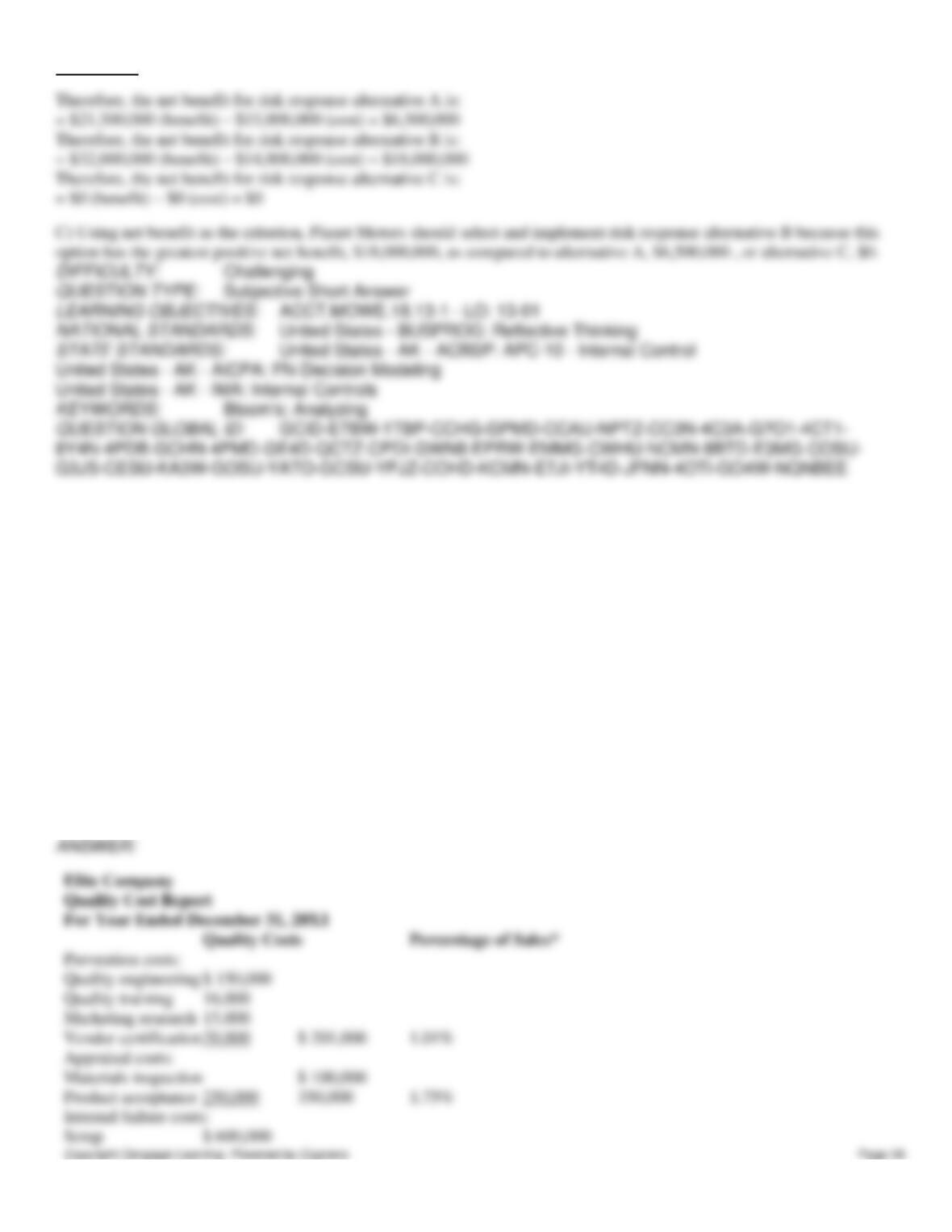
Prepare a quality cost report, classifying costs by category and expressing each category as a percentage of sales. What
message does the cost report provide? (Note: Round computations to two decimal places.)
Chapter 13
122. The actual quality costs of Elite Company, for the fiscal years ended December 31, 20X1 and 20X2, are given below.
20X1 20X2
Prevention costs:
Quality engineering $150,000 $172,500
Quality training 16,000 18,400
Marketing research 15,000 17,250
Vendor certification 20,000 23,000
Appraisal costs:
Materials inspection 100,000 116,000
Product acceptance 250,000 295,000
Internal failure costs:
Scrap 600,000 525,000
Retesting 45,000 40,000
External failure costs:
Discounts due to defects 250,000 220,000
Product liability 600,000 900,000
At the end of 20X1, Elite’s management decided to increase its investment in control costs by 15% for each category’s
items with the expectation that failure costs would decrease by 15% for each item of the failure categories. Sales were
reported to be $20,000,000 for both 20X1 and 20X2.
Required:
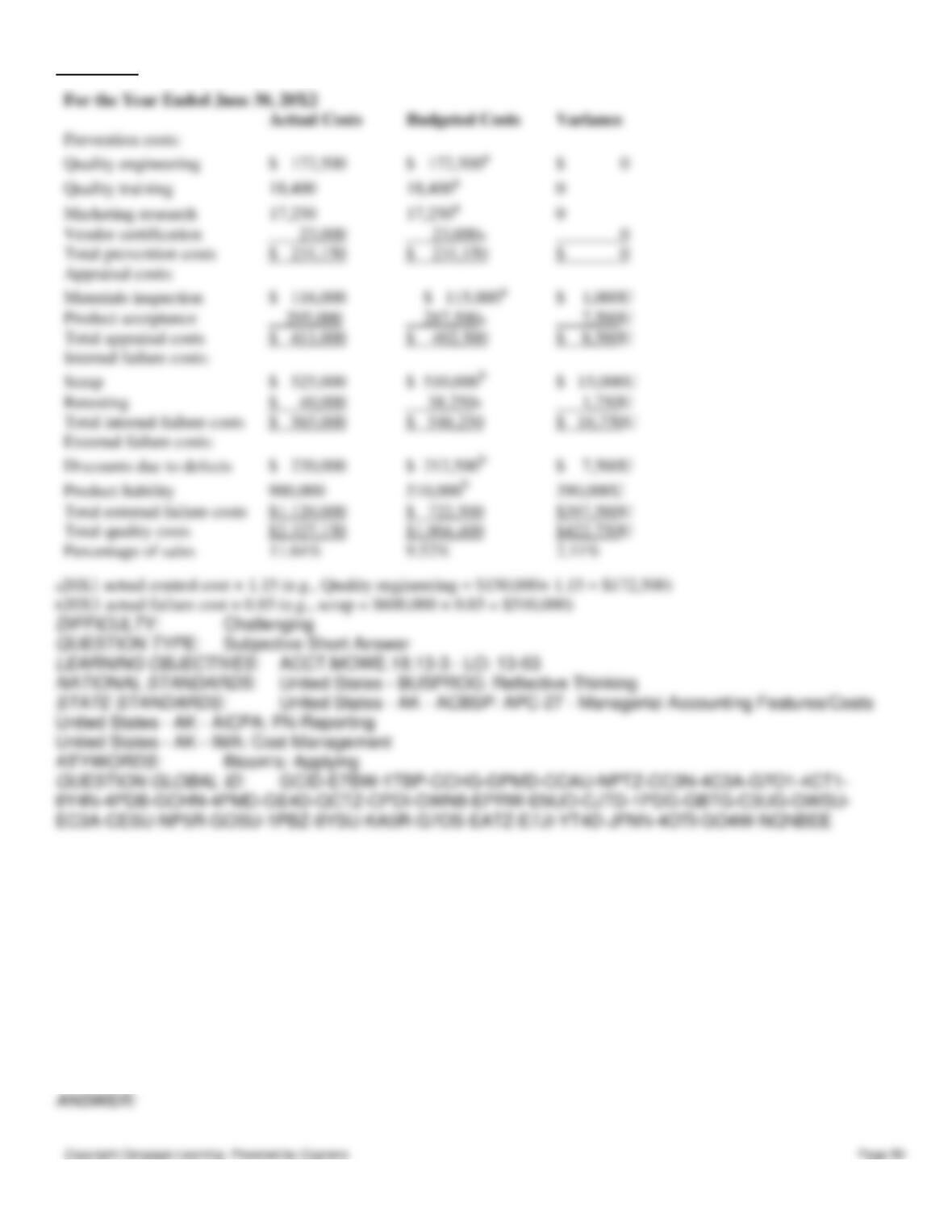
Calculate the budgeted costs for 20X2, and prepare an interim quality performance report.
Chapter 13
123. A manufacturing cell within a value stream is structured with four processes and associated unit processing times,
which are as follows:
Cutting: 10 minutes
Drilling and insertion: 6 minutes
Assembly: 6 minutes
Finishing: 5 minutes
Required:
A) How many units can the cell produce per hour on a continuous running basis (production rate)?
B) If the processing time of cutting is reduced from 10 to 6 minutes, what is the production rate now, and how long will it
take to produce a batch of 30 units?
Chapter 13
124. Assume that a value stream in Learner Corp. has two products with material costs of $45,000 and $85,000 for a given
week. The conversion costs for the week are $355,000. The units produced for the first product are 19,000 with 18,000
shipped to customers. For the second product, 41,000 units were produced and shipped.
Required:
Calculate the cost per unit for the first product. (Note: Round answer to two decimal places.)
125. A petrochemical plant is located in a foreign trade zone and imports volatile materials for use in production. It
imported $600,000 of crude oil for use in chemical production. About 20% of the oil is lost through evaporation during
production. Duty is assessed at 9% of cost, and carrying cost is 11% per year. After purchasing the material and
processing it, the company sells the finished product 6 months later.
Required:
A) Calculate the amount of duty paid and carrying costs incurred by the plant.
B) Assuming that the plant is located just outside the foreign trade zone, calculate the amount of duty paid and carrying
costs incurred by the plant.
Chapter 13
Chapter 13
126. The possibility that future cash transactions will be affected by changing exchange rates
127. Uses a single rate to assign conversion costs and approximates a comprehensive ABC system based in duration
drivers
128. Costs incurred because products and services fail to conform to requirements where lack of conformity is discovered
prior to external sale
129. The external verification that an independent party provides concerning the content of a corporate sustainability
report and/or the process used in preparing a corporate sustainability report
130. The benefit of the risk response minus the cost of risk response
131. Wrongful or criminal deception intended to result in financial or personal gain
Chapter 13
132. Costs incurred when products and services fail to conform to requirements or satisfy customer needs after being
delivered to customers
133. Costs incurred when products and services do not conform to specifications and this nonconformance is detected
before the bad products or services are shipped or delivered to outside parties
134. Costs incurred to prevent poor quality in the products or services being produced
135. Costs incurred to determine whether products and services are conforming to their requirements