101
122) Lambert Manufacturing has $100,000 to invest in either Project A or Project B. The
following data are available on these projects (Ignore income taxes.):
Project A
Project B
Cost of equipment needed now
$
100,000
$
60,000
Working capital investment needed now
–
$
40,000
Annual cash operating inflows
$
40,000
$
35,000
Salvage value of equipment in 6 years
$
10,000
–
See separate Exhibit 13B-1 and Exhibit 13B-2, to determine the appropriate discount factor(s)
using the tables provided.
Both projects will have a useful life of 6 years and the total cost approach to net present value
analysis. At the end of 6 years, the working capital investment will be released for use elsewhere.
Lambert’s required rate of return is 14%.
The net present value of Project B is:
A) $90,355
B) $76,115
C) $36,115
D) $54,355
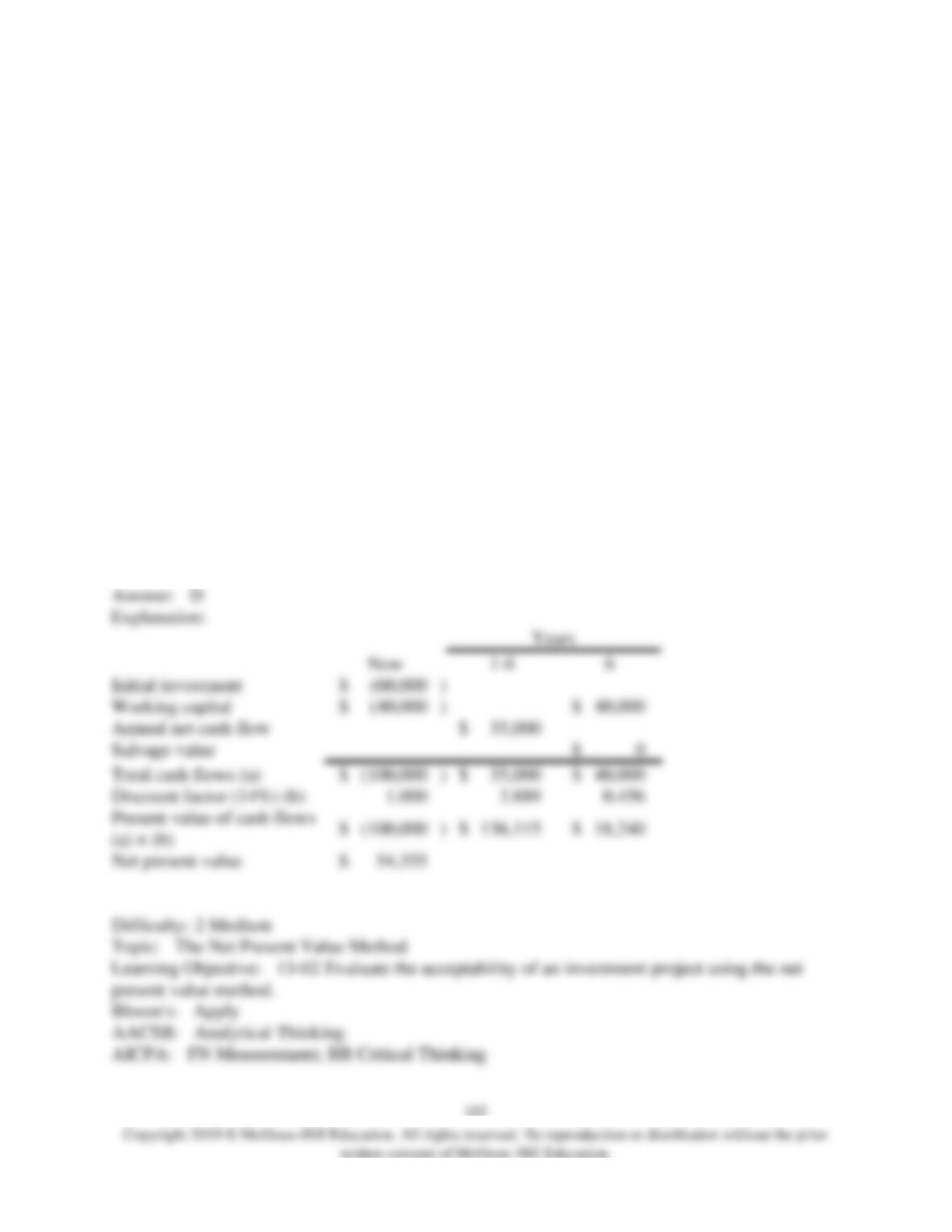
Initial investment
$
(60,000
)
Working capital
$
(40,000
)
$
40,000
Annual net cash flow
$
35,000
Salvage value
$
Total cash flows (a)
$
(100,000
)
$
35,000
$
40,000
Discount factor (14%) (b)
0.456
(a) × (b)
Net present value
$
54,355
123) Lambert Manufacturing has $120,000 to invest in either Project A or Project B. The
following data are available on these projects (Ignore income taxes.):
Project A
Project B
Cost of equipment needed now
$
120,000
$
70,000
Working capital investment needed now
–
$
50,000
Annual net operating cash inflows
$
50,000
$
45,000
Salvage value of equipment in 6 years
$
15,000
–
See separate Exhibit 13B-1 and Exhibit 13B-2, to determine the appropriate discount factor(s)
using the tables provided.
Both projects have a useful life of 6 years. At the end of 6 years, the working capital investment
will be released for use elsewhere. Lambert’s discount rate is 14%.
The net present value of Project A is closest to:
A) $82,241
B) $67,610
C) $74,450
D) $81,290
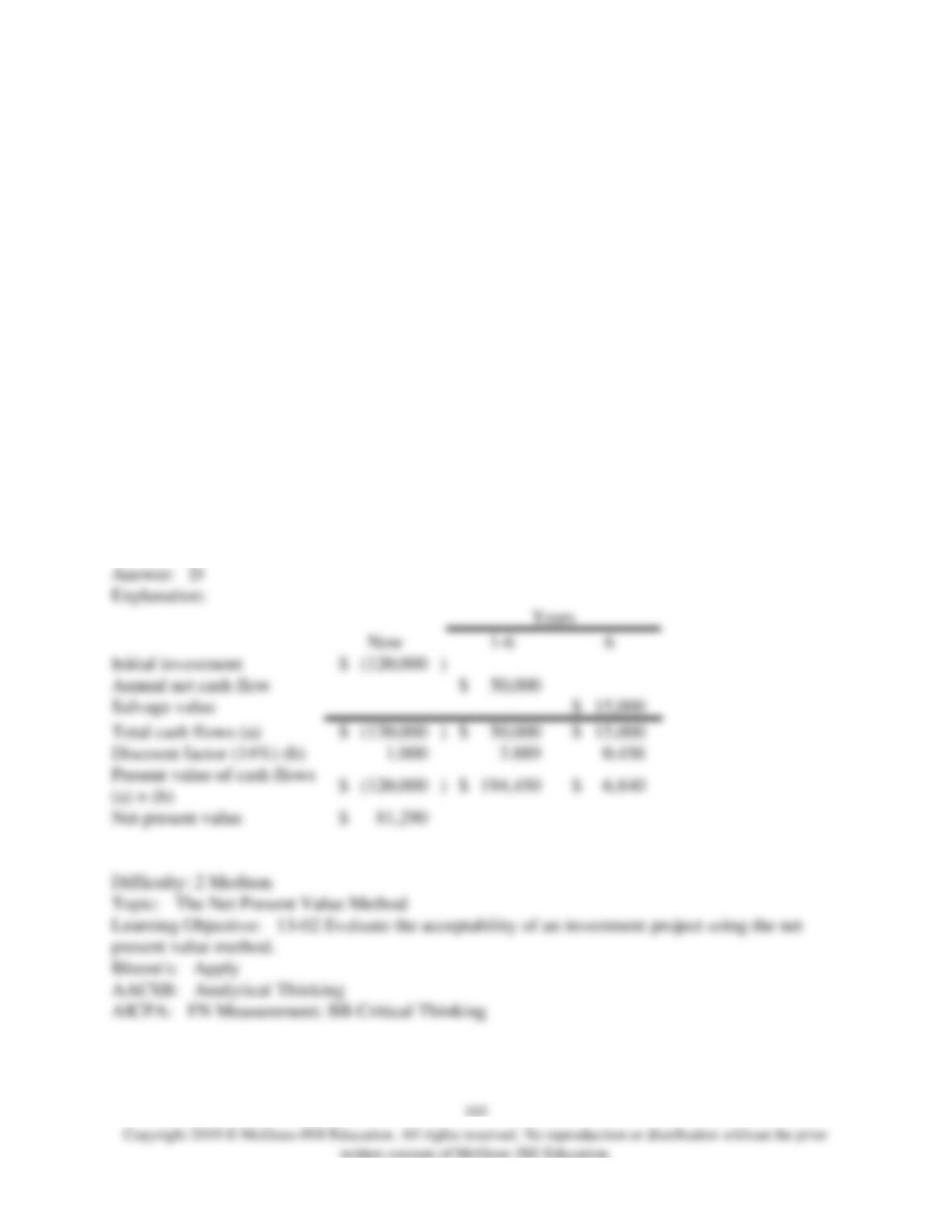
Initial investment
$
(120,000
)
Annual net cash flow
$
50,000
Salvage value
$
15,000
Total cash flows (a)
$
(120,000
)
$
50,000
$
15,000
Discount factor (14%) (b)
0.456
(a) × (b)
Net present value
$
81,290
124) Lambert Manufacturing has $120,000 to invest in either Project A or Project B. The
following data are available on these projects (Ignore income taxes.):
Project A
Project B
Cost of equipment needed now
$
120,000
$
70,000
Working capital investment needed now
–
$
50,000
Annual net operating cash inflows
$
50,000
$
45,000
Salvage value of equipment in 6 years
$
15,000
–
See separate Exhibit 13B-1 and Exhibit 13B-2, to determine the appropriate discount factor(s)
using the tables provided.
Both projects have a useful life of 6 years. At the end of 6 years, the working capital investment
will be released for use elsewhere. Lambert’s discount rate is 14%.
The net present value of Project B is closest to:
A) $77,805
B) $127,805
C) $55,005
D) $105,005
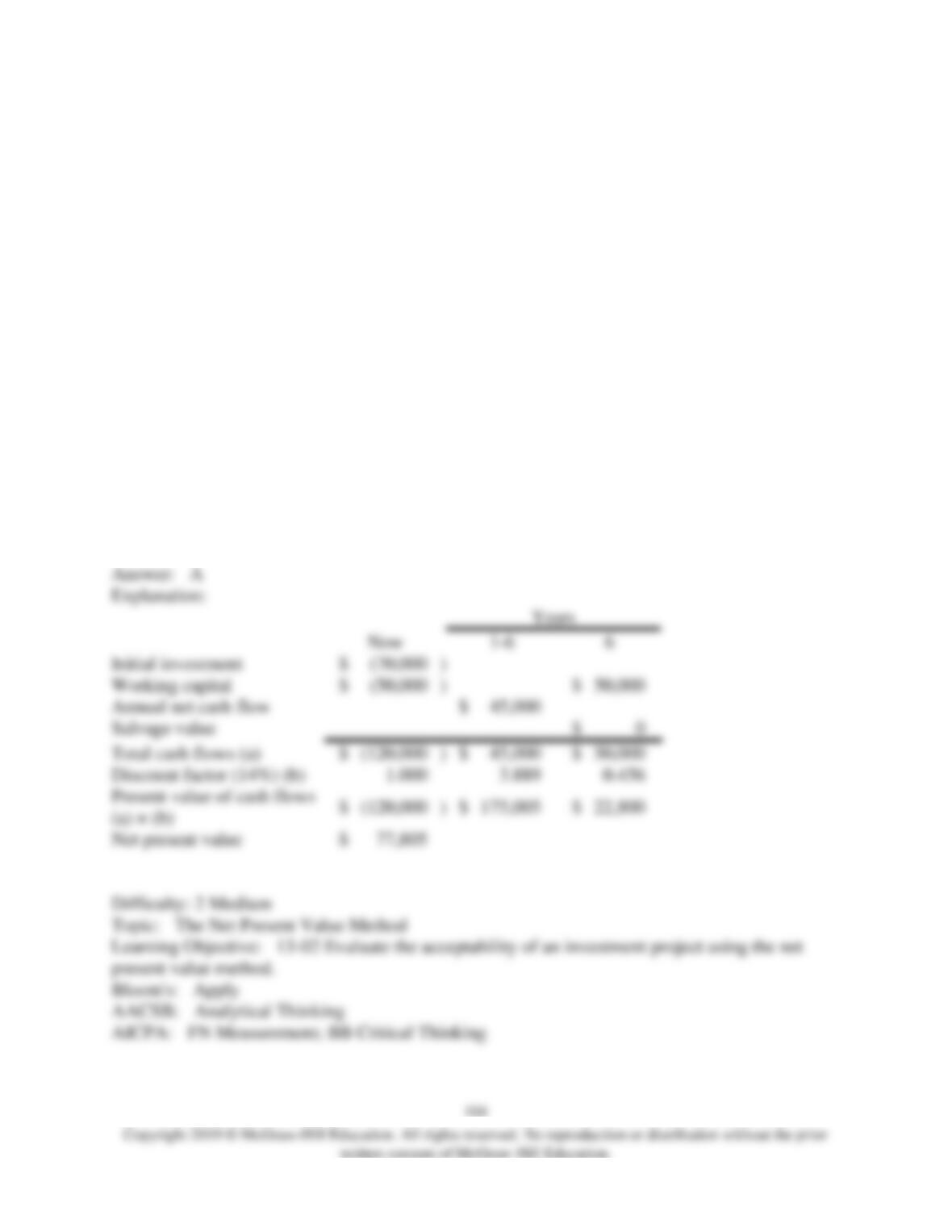
Initial investment
$
(70,000
)
Working capital
$
(50,000
)
$
50,000
Annual net cash flow
$
45,000
Salvage value
$
Total cash flows (a)
$
(120,000
)
$
45,000
$
50,000
Discount factor (14%) (b)
0.456
(a) × (b)
Net present value
$
77,805
125) Becker Billing Systems, Inc., has an antiquated high-capacity printer that needs to be
upgraded. The system either can be overhauled or replaced with a new system. The following data
have been gathered concerning these two alternatives (Ignore income taxes.):
Overhaul Present
System
Purchase New
System
Purchase cost when new
$
300,000
$
400,000
Accumulated depreciation
$
220,000
–
Overhaul costs needed now
$
250,000
–
Annual cash operating costs
$
120,000
$
90,000
Salvage value now
$
90,000
–
Salvage value in ten years
$
30,000
$
80,000
Working capital required
–
$
50,000
See separate Exhibit 13B-1 and Exhibit 13B-2, to determine the appropriate discount factor(s)
using the tables provided.
The company uses a 10% discount rate and the total-cost approach to capital budgeting analysis.
The working capital required under the new system would be released for use elsewhere at the
conclusion of the project. Both alternatives are expected to have a useful life of ten years.
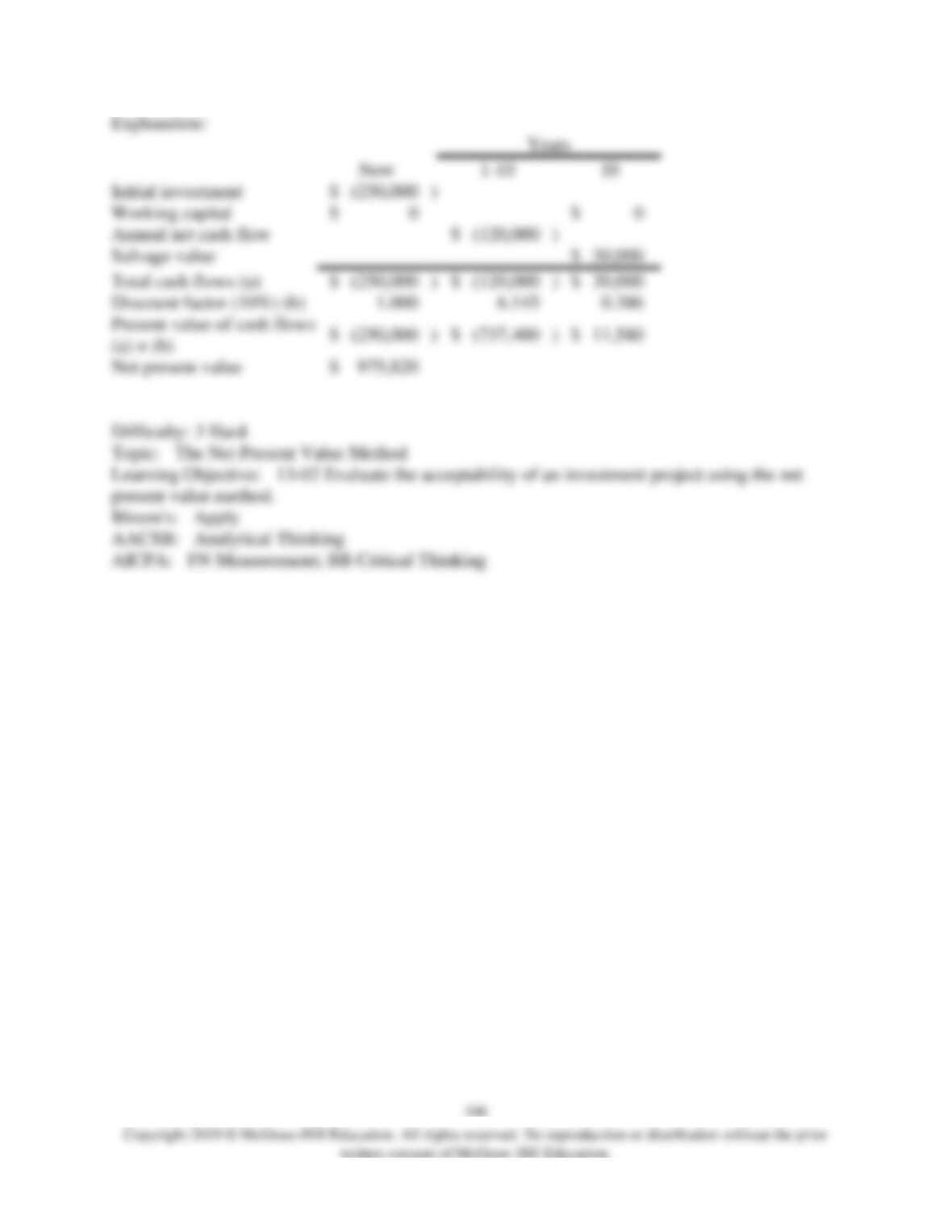
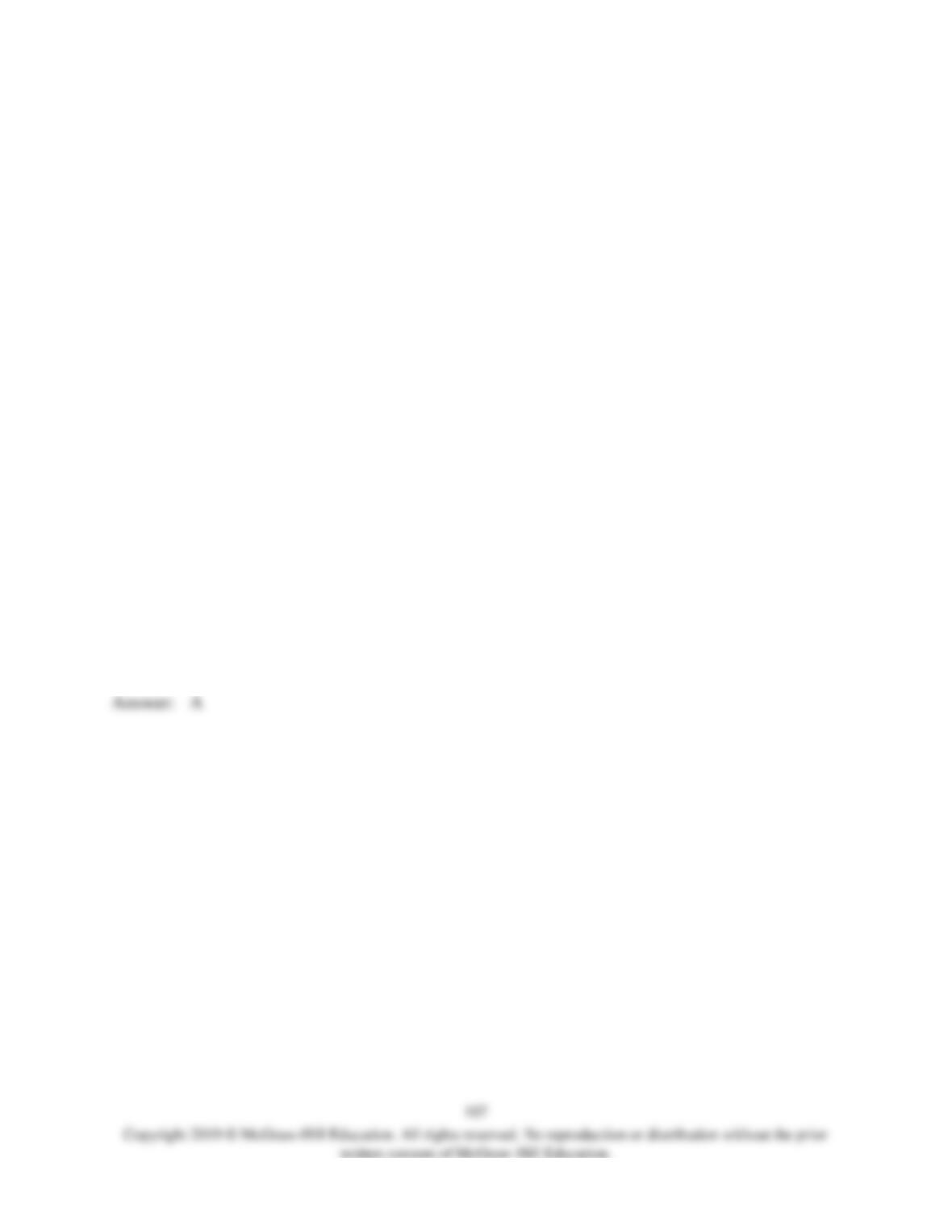
The net present value of the overhaul alternative is closest to:
A) $(750,300)
B) $(725,800)
C) $(975,800)
D) $(987,400)
126) Becker Billing Systems, Inc., has an antiquated high-capacity printer that needs to be
upgraded. The system either can be overhauled or replaced with a new system. The following data
have been gathered concerning these two alternatives (Ignore income taxes.):
Overhaul Present
System
Purchase New
System
Purchase cost when new
$
300,000
$
400,000
Accumulated depreciation
$
220,000
–
Overhaul costs needed now
$
250,000
–
Annual cash operating costs
$
120,000
$
90,000
Salvage value now
$
90,000
–
Salvage value in ten years
$
30,000
$
80,000
Working capital required
–
$
50,000
See separate Exhibit 13B-1 and Exhibit 13B-2, to determine the appropriate discount factor(s)
using the tables provided.
The company uses a 10% discount rate and the total-cost approach to capital budgeting analysis.
The working capital required under the new system would be released for use elsewhere at the
conclusion of the project. Both alternatives are expected to have a useful life of ten years.
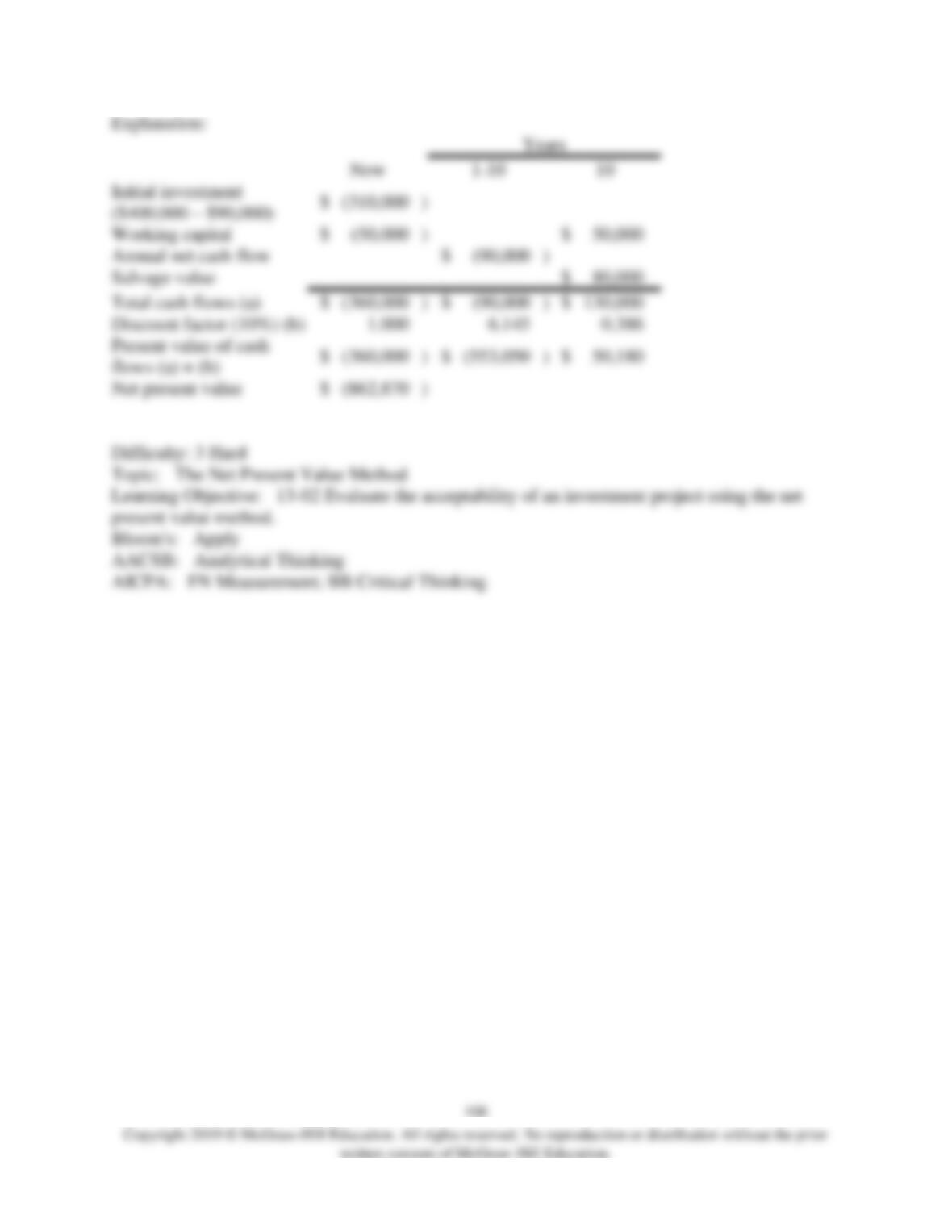
The net present value of the new system alternative is closest to:
A) $(862,900)
B) $(552,900)
C) $(758,400)
D) $(987,400)
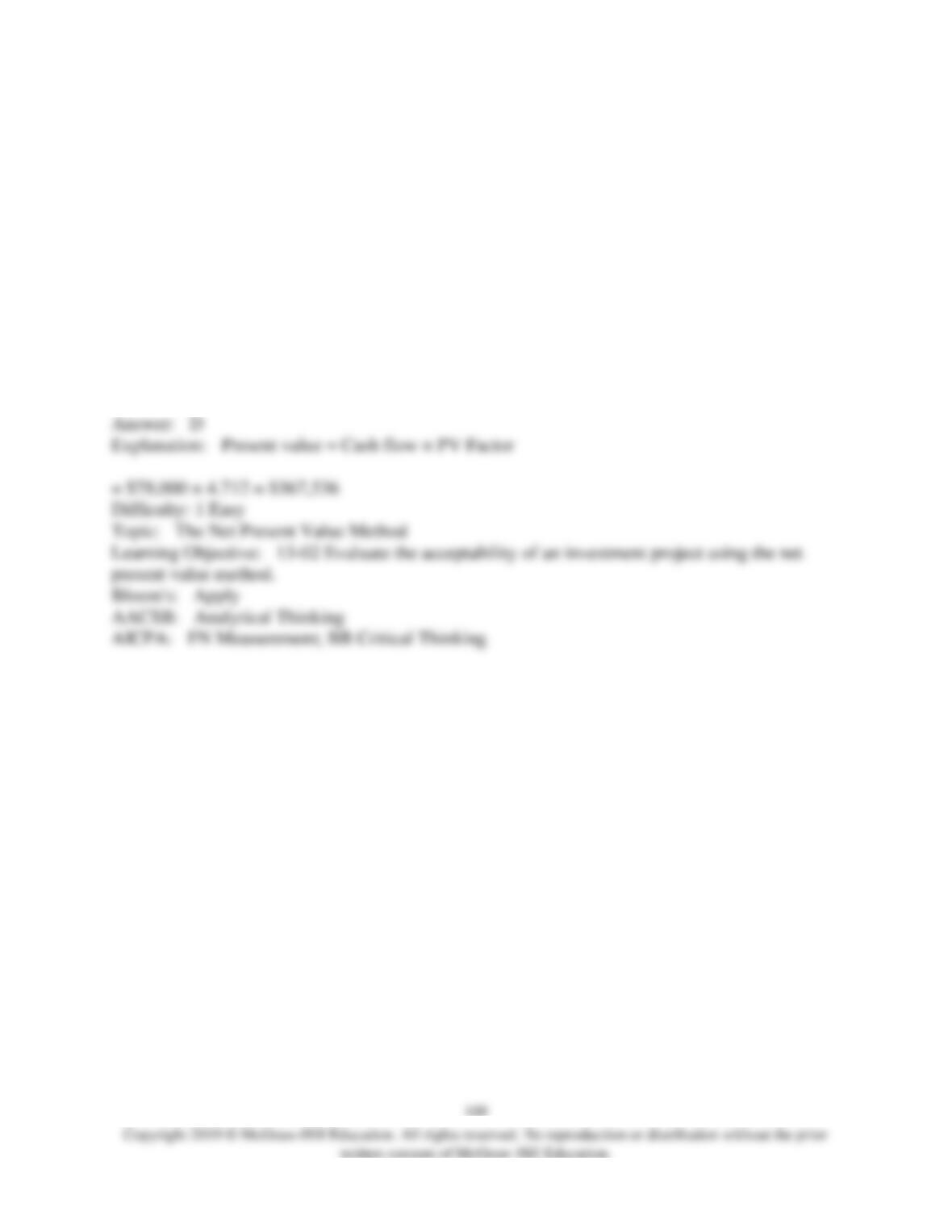
127) The management of Opray Corporation is considering the purchase of a machine that would
cost $360,000, would last for 7 years, and would have no salvage value. The machine would
reduce labor and other costs by $78,000 per year. The company requires a minimum pretax return
of 11% on all investment projects. (Ignore income taxes.)
See separate Exhibit 13B-1 and Exhibit 13B-2, to determine the appropriate discount factor(s)
using the tables provided.
The present value of the annual cost savings of $78,000 is closest to:
A) $763,064
B) $177,027
C) $546,000
D) $367,536
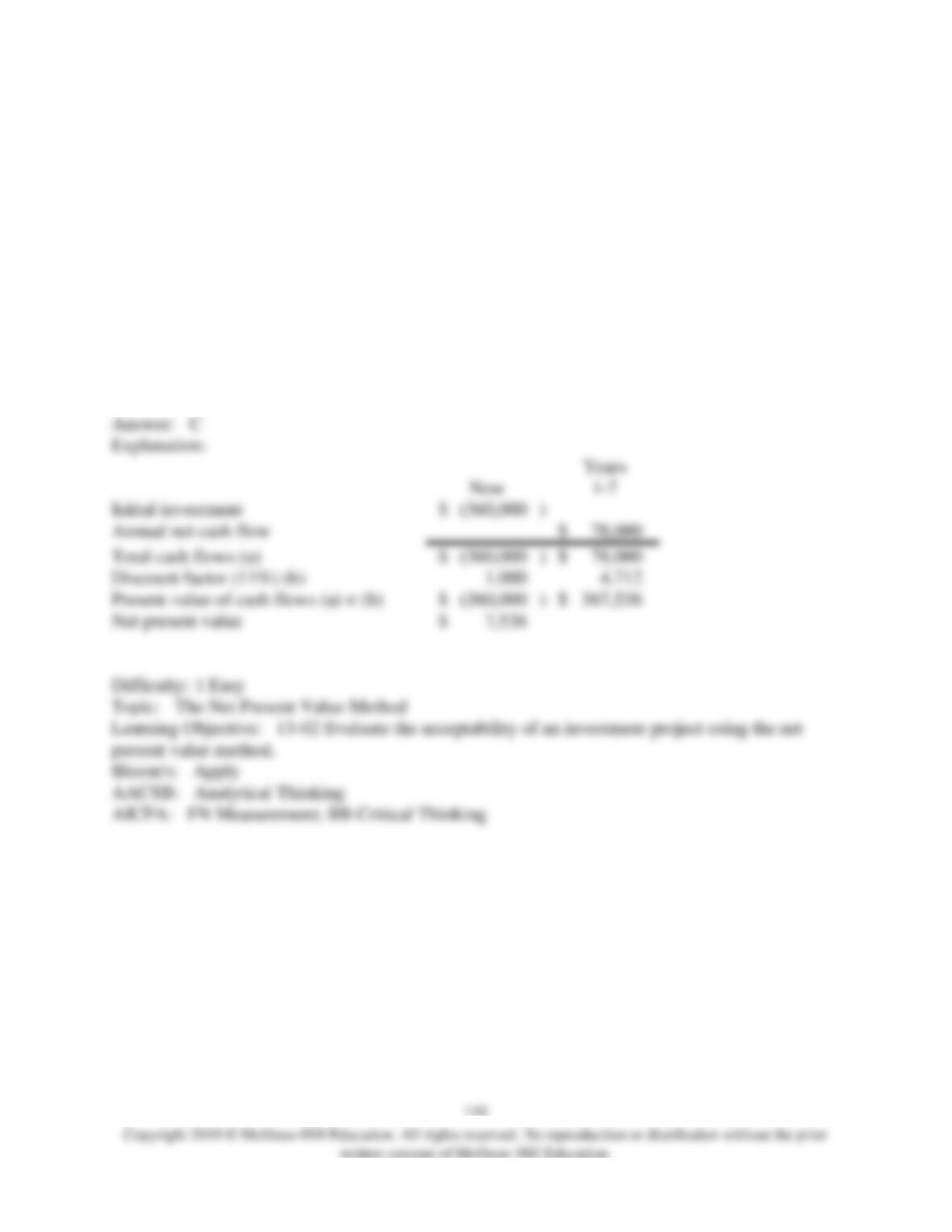
128) The management of Opray Corporation is considering the purchase of a machine that would
cost $360,000, would last for 7 years, and would have no salvage value. The machine would
reduce labor and other costs by $78,000 per year. The company requires a minimum pretax return
of 11% on all investment projects. (Ignore income taxes.)
See separate Exhibit 13B-1 and Exhibit 13B-2, to determine the appropriate discount factor(s)
using the tables provided.
The net present value of the proposed project is closest to:
A) $15,646
B) $89,588
C) $7,536
D) $186,000
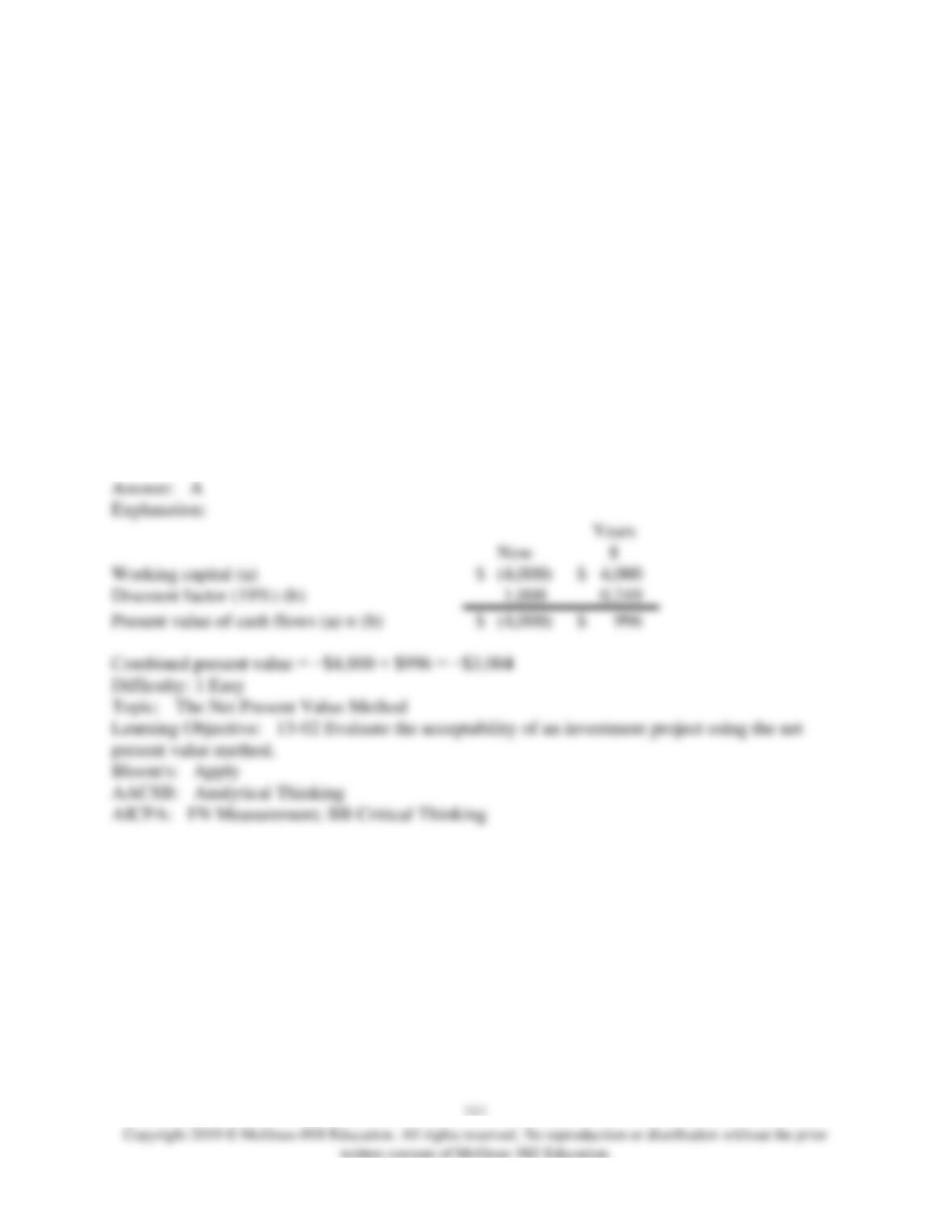
129) Paragas, Inc., is considering the purchase of a machine that would cost $370,000 and would
last for 8 years. At the end of 8 years, the machine would have a salvage value of $52,000. The
machine would reduce labor and other costs by $96,000 per year. Additional working capital of
$4,000 would be needed immediately. All of this working capital would be recovered at the end of
the life of the machine. The company requires a minimum pretax return of 19% on all investment
projects. (Ignore income taxes.)
See separate Exhibit 13B-1 and Exhibit 13B-2, to determine the appropriate discount factor(s)
using the tables provided.
The combined present value of the working capital needed at the beginning of the project and the
working capital released at the end of the project is closest to:
A) $(3,004)
B) $0
C) $(12,080)
D) $11,816
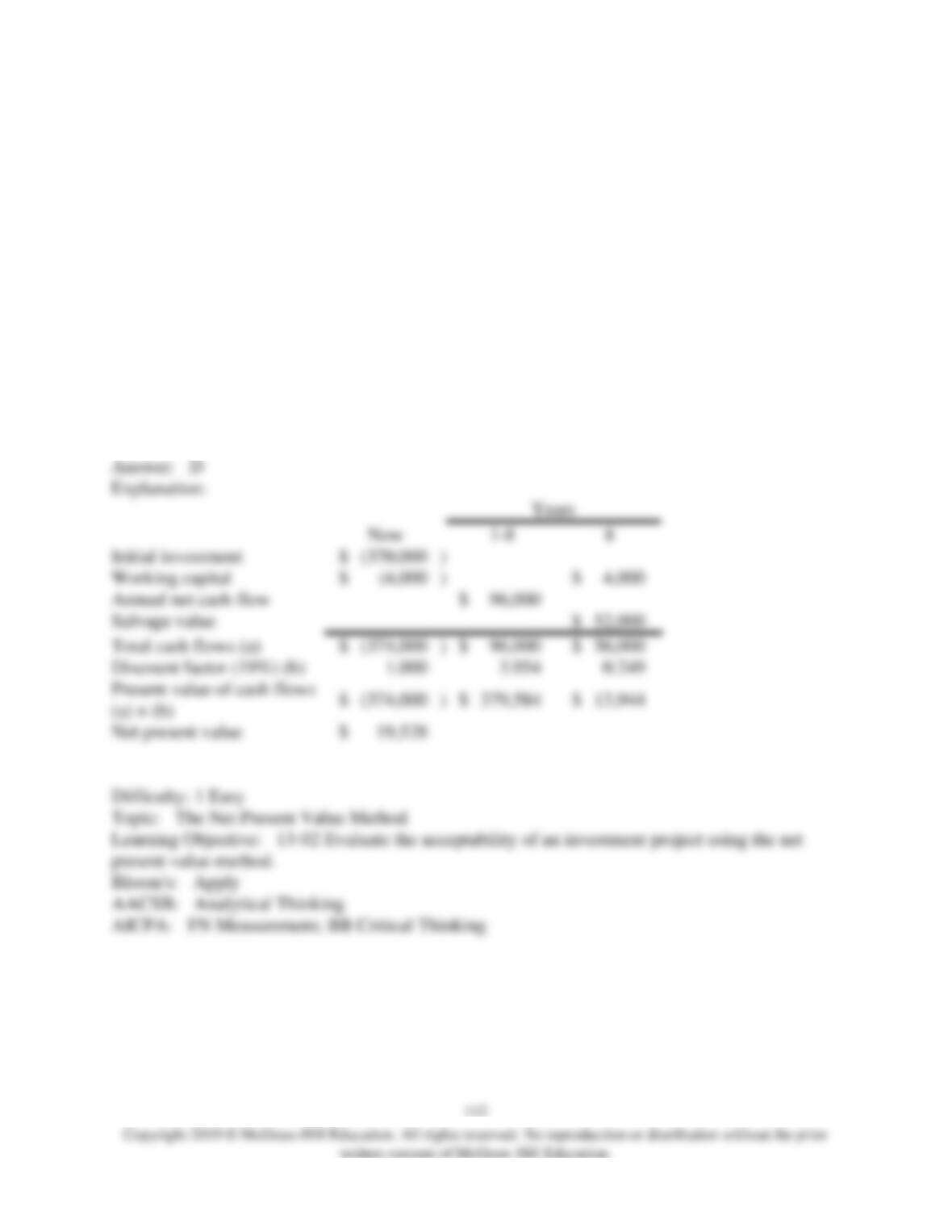
130) Paragas, Inc., is considering the purchase of a machine that would cost $370,000 and would
last for 8 years. At the end of 8 years, the machine would have a salvage value of $52,000. The
machine would reduce labor and other costs by $96,000 per year. Additional working capital of
$4,000 would be needed immediately. All of this working capital would be recovered at the end of
the life of the machine. The company requires a minimum pretax return of 19% on all investment
projects. (Ignore income taxes.)
See separate Exhibit 13B-1 and Exhibit 13B-2, to determine the appropriate discount factor(s)
using the tables provided.
The net present value of the proposed project is closest to:
A) $9,584
B) $78,530
C) $22,532
D) $19,528
131) Almendarez Corporation is considering the purchase of a machine that would cost $320,000
and would last for 7 years. At the end of 7 years, the machine would have a salvage value of
$51,000. By reducing labor and other operating costs, the machine would provide annual cost
savings of $72,000. The company requires a minimum pretax return of 18% on all investment
projects. (Ignore income taxes.)
See separate Exhibit 13B-1 and Exhibit 13B-2, to determine the appropriate discount factor(s)
using the tables provided.
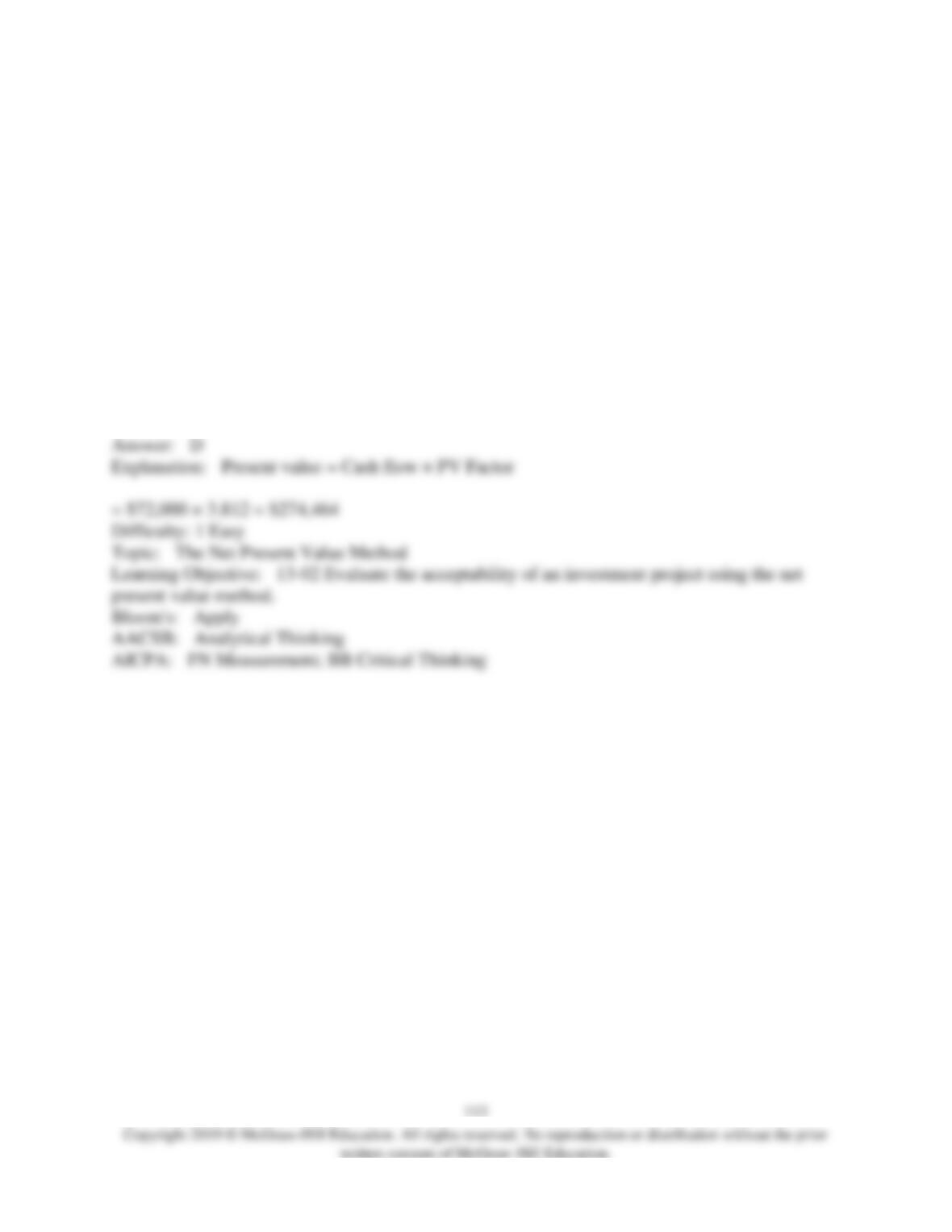
The present value of the annual cost savings of $72,000 is closest to:
A) $22,608
B) $874,298
C) $504,000
D) $274,464
132) Almendarez Corporation is considering the purchase of a machine that would cost $320,000
and would last for 7 years. At the end of 7 years, the machine would have a salvage value of
$51,000. By reducing labor and other operating costs, the machine would provide annual cost
savings of $72,000. The company requires a minimum pretax return of 18% on all investment
projects. (Ignore income taxes.)
See separate Exhibit 13B-1 and Exhibit 13B-2, to determine the appropriate discount factor(s)
using the tables provided.
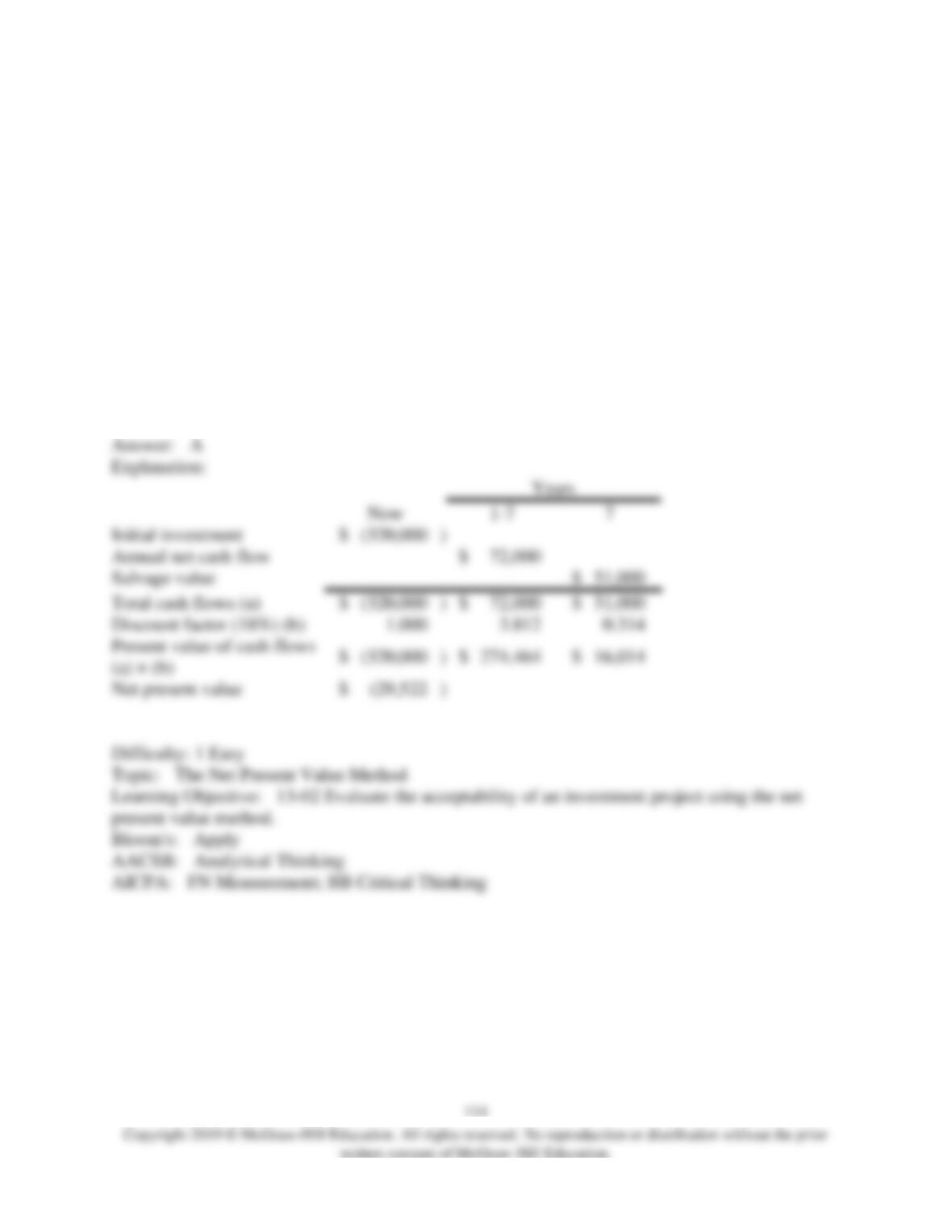
The net present value of the proposed project is closest to:
A) $(29,522)
B) $(45,536)
C) $5,464
D) $(94,042)
133) Treads Corporation is considering the purchase of a new machine to replace an old machine
that is currently being used. The old machine is fully depreciated but can be used by the
corporation for five more years. If Treads decides to buy the new machine, the old machine can be
sold for $60,000. The old machine would have no salvage value in five years.
The new machine would be purchased for $1,000,000 in cash. The new machine has an expected
useful life of five years with no salvage value. Due to the increased efficiency of the new machine,
the company would benefit from annual cash savings of $300,000.
Treads Corporation uses a discount rate of 12%. (Ignore income taxes.)
See separate Exhibit 13B-1 and Exhibit 13B-2, to determine the appropriate discount factor(s)
using the tables provided.
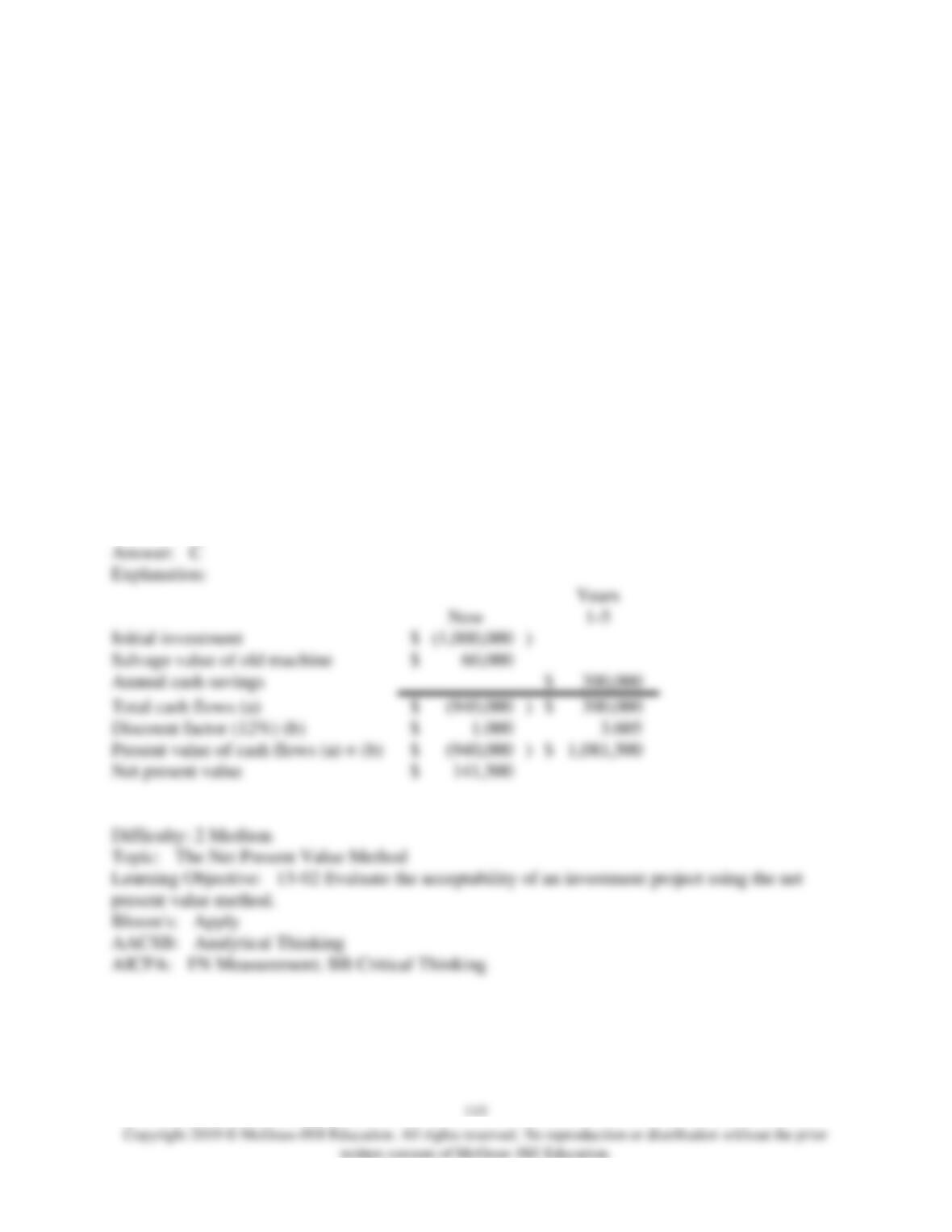
The net present value of the project is closest to:
A) $171,000
B) $136,400
C) $141,500
D) $560,000
134) Treads Corporation is considering the purchase of a new machine to replace an old machine
that is currently being used. The old machine is fully depreciated but can be used by the
corporation for five more years. If Treads decides to buy the new machine, the old machine can be
sold for $60,000. The old machine would have no salvage value in five years.
The new machine would be purchased for $1,000,000 in cash. The new machine has an expected
useful life of five years with no salvage value. Due to the increased efficiency of the new machine,
the company would benefit from annual cash savings of $300,000.
Treads Corporation uses a discount rate of 12%. (Ignore income taxes.)
See separate Exhibit 13B-1 and Exhibit 13B-2, to determine the appropriate discount factor(s)
using the tables provided.
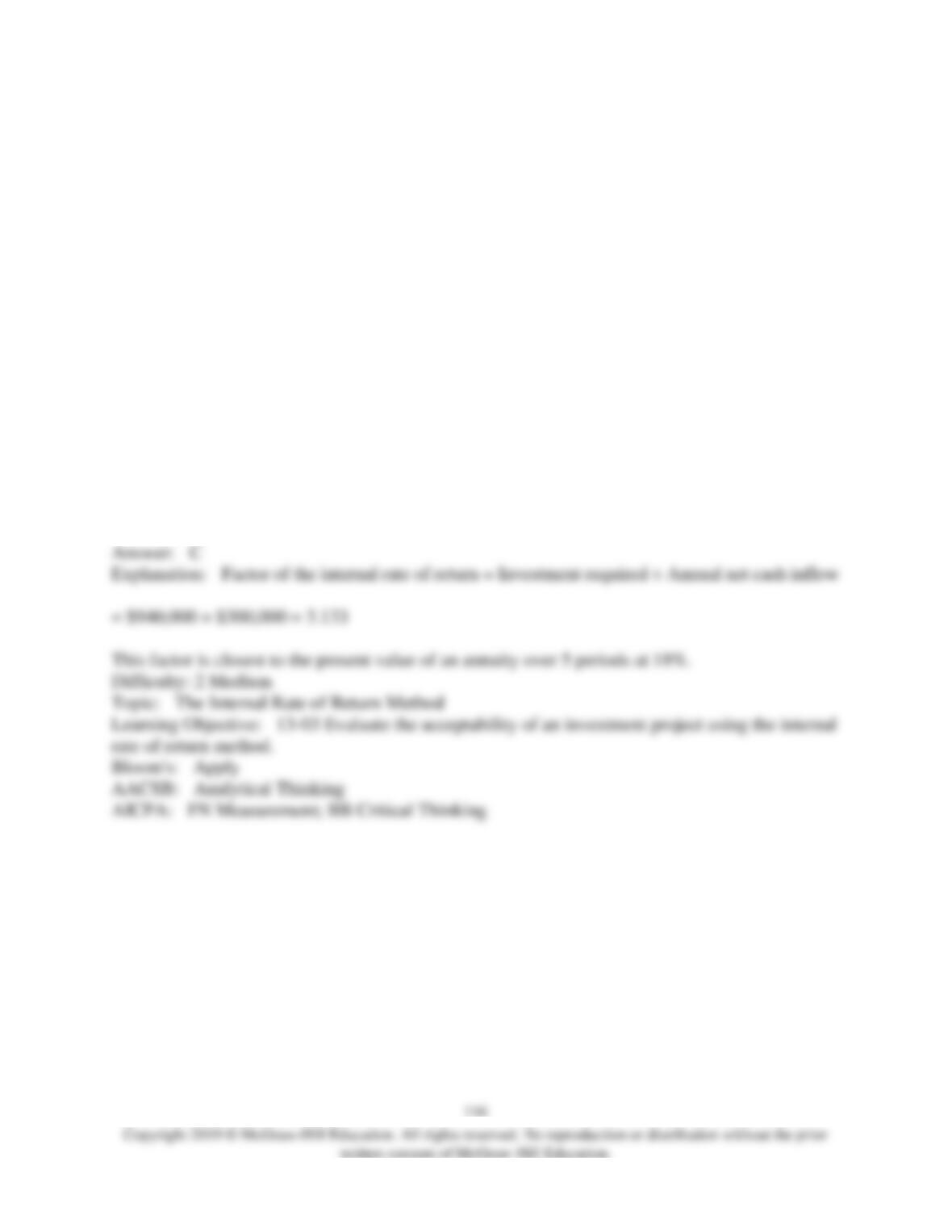
The internal rate of return of the project is closest to:
A) 14%
B) 16%
C) 18%
D) 20%
135) Jojola Corporation is investigating buying a small used aircraft for the use of its executives.
The aircraft would have a useful life of 5 years. The company uses a discount rate of 13% in its
capital budgeting. The net present value of the initial investment and the annual operating cash
cost is –$439,238. Management is having difficulty estimating the annual benefit of having the
aircraft and estimating the salvage value of the aircraft. (Ignore income taxes.)
See separate Exhibit 13B-1 and Exhibit 13B-2, to determine the appropriate discount factor(s)
using the tables provided.
Ignoring the annual benefit, to the nearest whole dollar how large would the salvage value of the
aircraft have to be to make the investment in the aircraft financially attractive?
A) $57,101
B) $439,238
C) $3,378,754
D) $808,910
136) Jojola Corporation is investigating buying a small used aircraft for the use of its executives.
The aircraft would have a useful life of 5 years. The company uses a discount rate of 13% in its
capital budgeting. The net present value of the initial investment and the annual operating cash
cost is –$439,238. Management is having difficulty estimating the annual benefit of having the
aircraft and estimating the salvage value of the aircraft. (Ignore income taxes.)
See separate Exhibit 13B-1 and Exhibit 13B-2, to determine the appropriate discount factor(s)
using the tables provided.
Ignoring any salvage value, to the nearest whole dollar how large would the annual benefit have to
be to make the investment in the aircraft financially attractive?
A) $439,238
B) $124,890
C) $87,848
D) $57,101
137) Cabe Corporation uses a discount rate of 18% in its capital budgeting. Partial analysis of an
investment in automated equipment with a useful life of 7 years has thus far yielded a net present
value of –$155,606. This analysis did not include any estimates of the intangible benefits of
automating this process nor did it include any estimate of the salvage value of the equipment.
(Ignore income taxes.)
See separate Exhibit 13B-1 and Exhibit 13B-2, to determine the appropriate discount factor(s)
using the tables provided.
Ignoring any salvage value, to the nearest whole dollar how large would the additional cash flow
per year from the intangible benefits have to be to make the investment in the automated
equipment financially attractive?
A) $40,820
B) $22,229
C) $28,009
D) $155,606
138) Cabe Corporation uses a discount rate of 18% in its capital budgeting. Partial analysis of an
investment in automated equipment with a useful life of 7 years has thus far yielded a net present
value of –$155,606. This analysis did not include any estimates of the intangible benefits of
automating this process nor did it include any estimate of the salvage value of the equipment.
(Ignore income taxes.)
See separate Exhibit 13B-1 and Exhibit 13B-2, to determine the appropriate discount factor(s)
using the tables provided.
Ignoring any cash flows from intangible benefits, to the nearest whole dollar how large would the
salvage value of the automated equipment have to be to make the investment in the automated
equipment financially attractive?
A) $495,561
B) $28,009
C) $155,606
D) $864,478