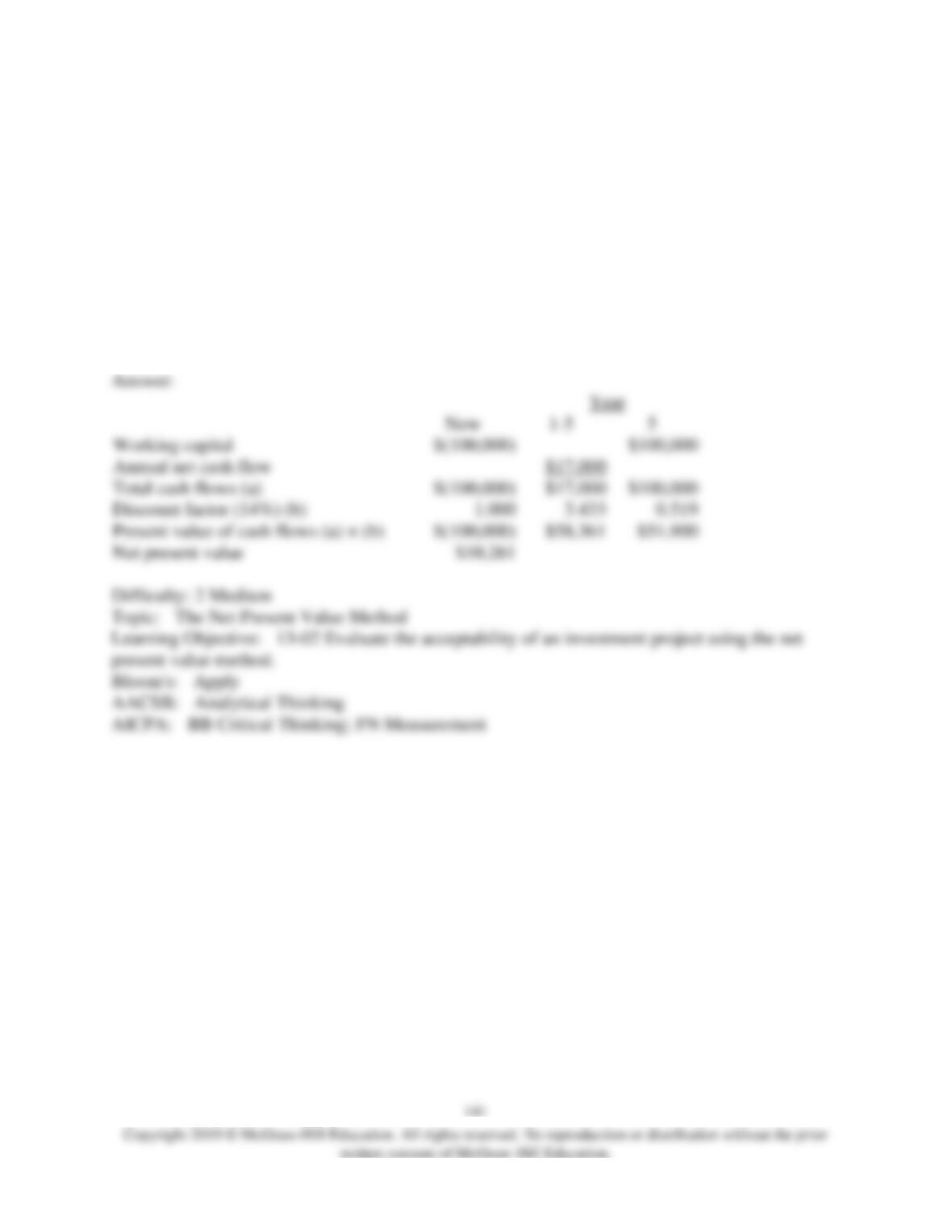
157) Bradley Corporation’s required rate of return is 14%. The company has an opportunity to be
the exclusive distributor of a very popular consumer item. No new equipment would be needed,
but the company would have to use one-fourth of the space in a warehouse it owns. The warehouse
cost $200,000 new. The warehouse is currently half-empty and there are no other plans to use the
empty space. In addition, the company would have to invest $100,000 in working capital to carry
inventories and accounts receivable for the new product line. The company would have the
distributorship for only 5 years. The distributorship would generate a $17,000 annual net cash
inflow.
Required:
What is the net present value of the project?
158) Gallatin, Inc., has assembled the estimates shown below relating to a proposed new product.
These estimates are based on a 5-year project life, at the end of which the new equipment would be
sold, working capital would revert to other uses in the company, and the product would be
discontinued. Gallatin uses a discount rate of 10%. (Ignore income taxes.)
Annual cash sales
$
450,000
Annual out-of-pocket cash expenses
$
340,000
Annual depreciation on new equipment
$
52,000
Initial cost of new equipment
$
300,000
Salvage value of equipment in 5 years
$
50,000
Working capital requirement
$
60,000
See separate Exhibit 13B-1 and Exhibit 13B-2, to determine the appropriate discount factor(s)
using the tables provided.
Required:
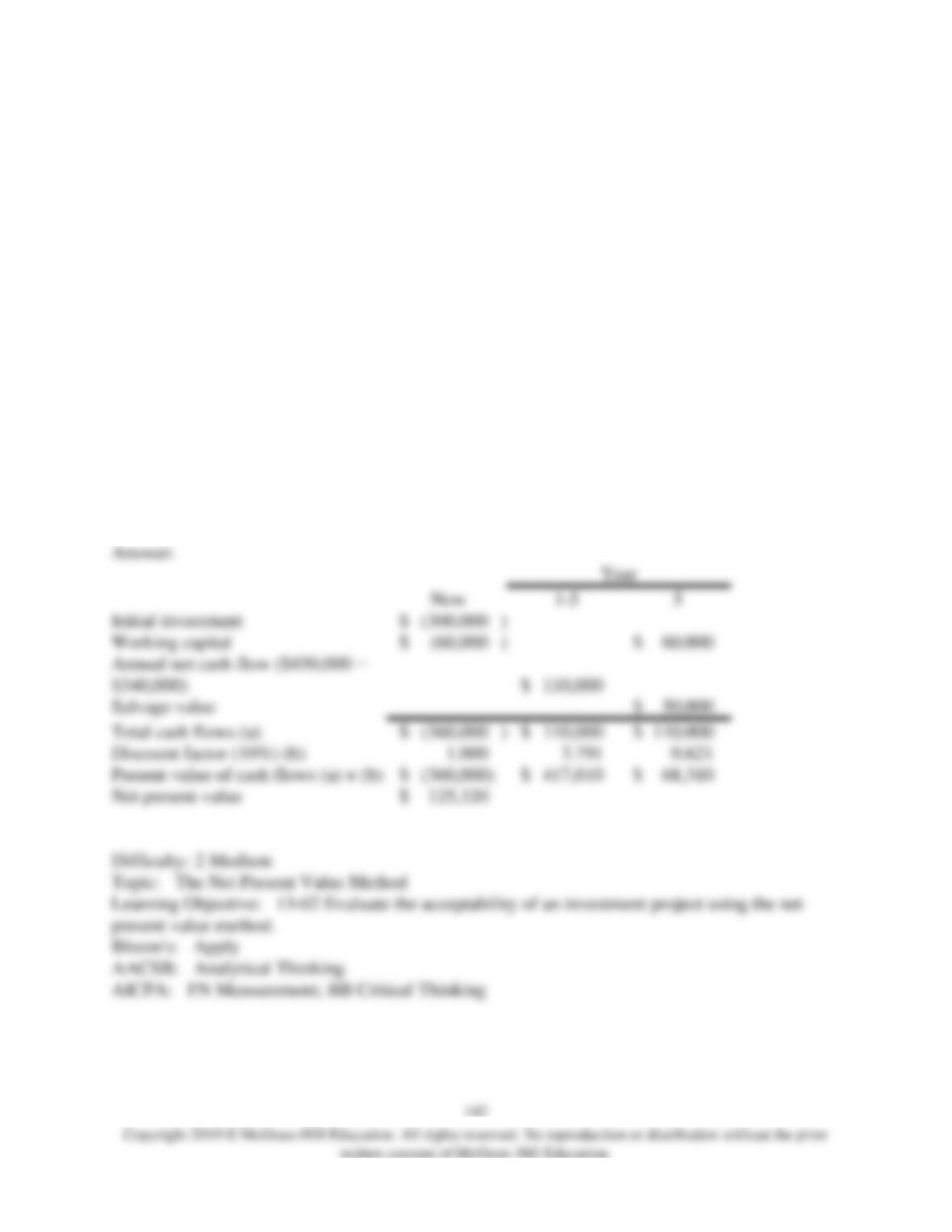
Compute the net present value of the new product.
Initial investment
Working capital
60,000
$340,000)
Salvage value
50,000
Total cash flows (a)
Discount factor (10%) (b)
1.000
0.621
Present value of cash flows (a) × (b)
)
68,310
Net present value
125,320
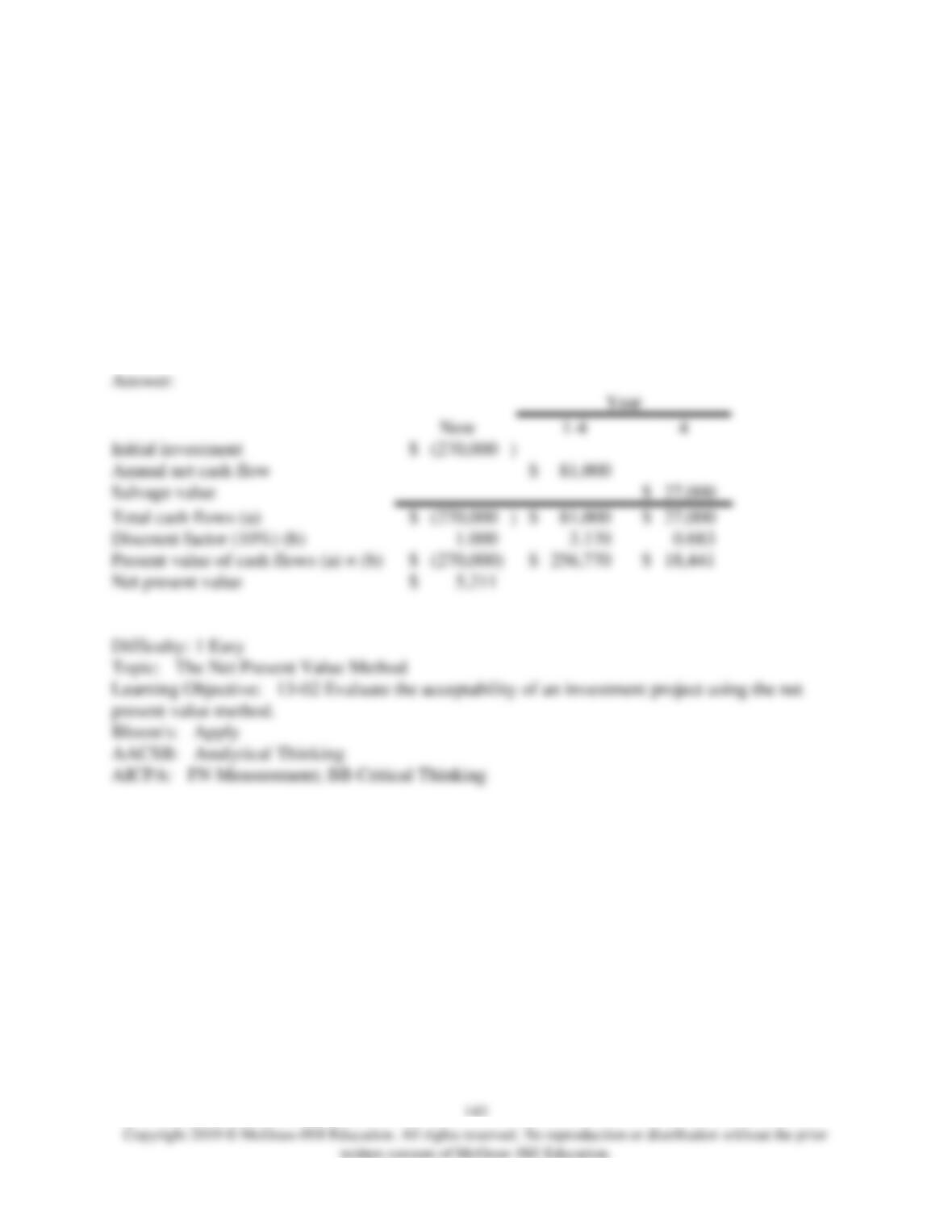
159) Strausberg Inc. is considering investing in a project that would require an initial investment of
$270,000. The life of the project would be 4 years. The annual net cash inflows from the project
would be $81,000. The salvage value of the assets at the end of the project would be $27,000. The
company uses a discount rate of 10%. (Ignore income taxes.)
See separate Exhibit 13B-1 and Exhibit 13B-2, to determine the appropriate discount factor(s)
using the tables provided.
Required:
Compute the net present value of the project.
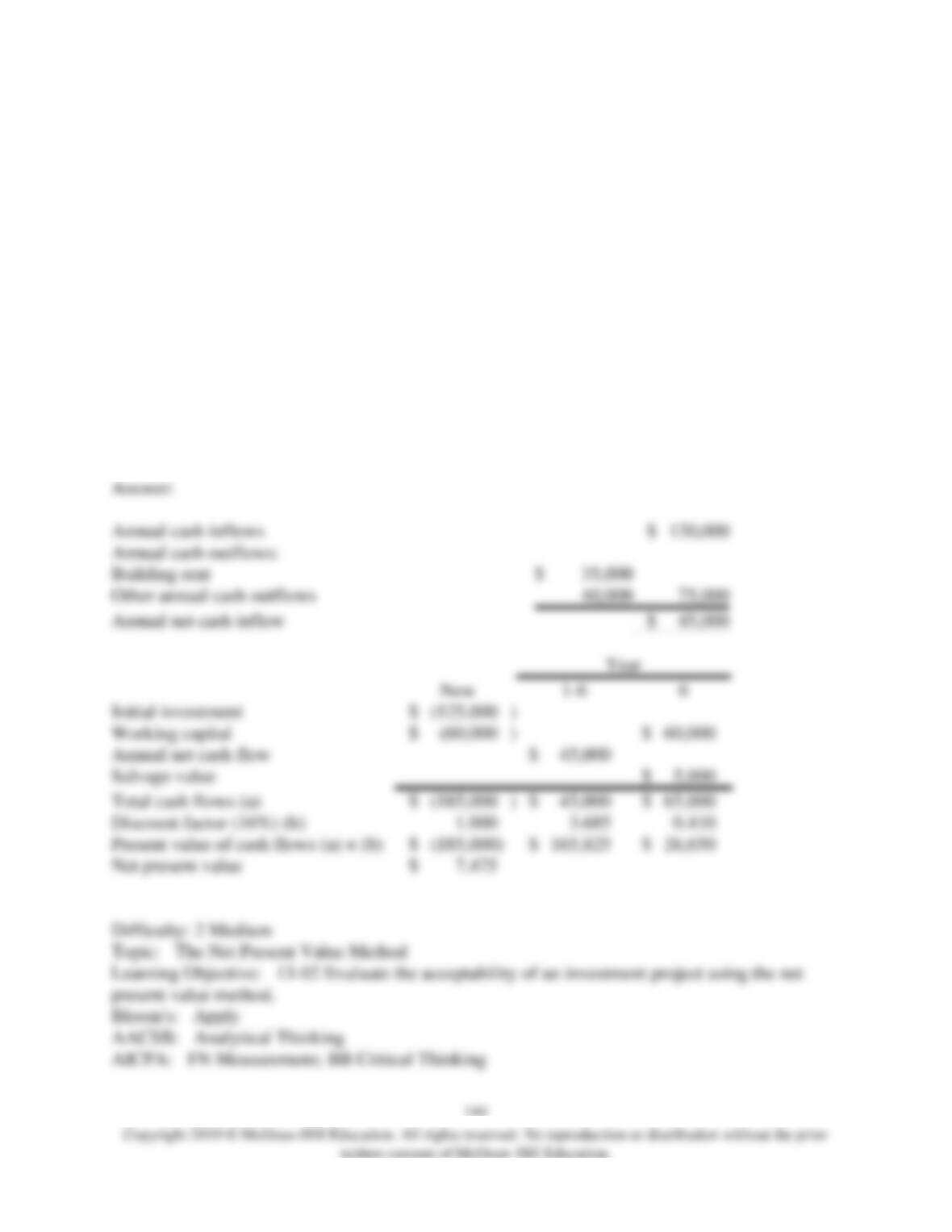
160) Jim Bingham is considering starting a small catering business. He would invest $125,000 to
purchase a delivery van and various equipment and another $60,000 for inventories and other
working capital needs. Rent for the building used by the business will be $35,000 per year. In
addition to the building rent, annual cash outflow for operating costs will amount to $40,000. The
annual cash inflow from the business will amount to $120,000. Jim wants to operate the catering
business for only six years. He estimates that the equipment could be sold at that time for 4% of its
original cost. Jim uses a 16% discount rate. All cash flows, except for the initial investment, would
occur at the ends of the years. The investment in working capital would be returned at the end of
the six years. (Ignore income taxes.)
See separate Exhibit 13B-1 and Exhibit 13B-2, to determine the appropriate discount factor(s)
using the tables provided.
Required:
Compute the net present value of this investment.
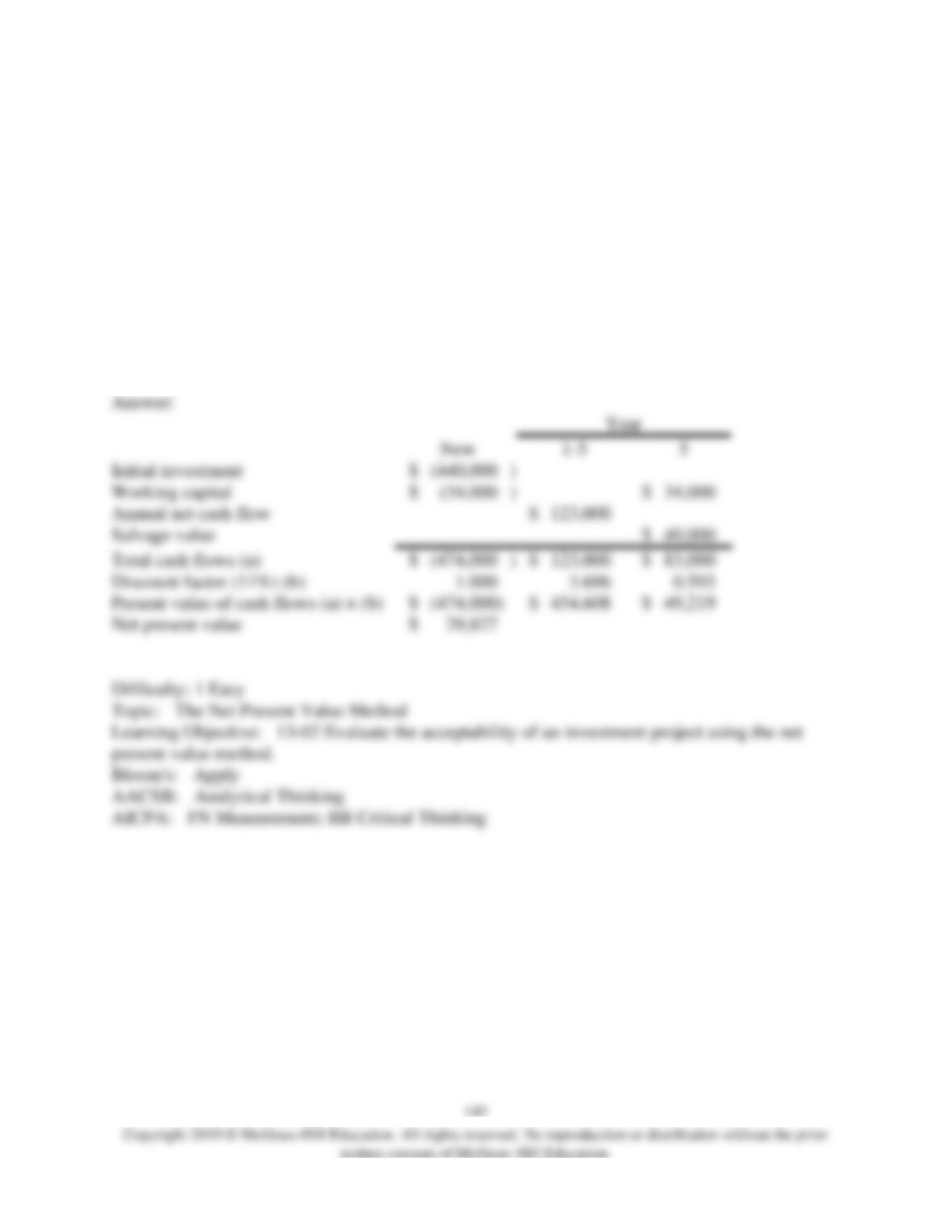
161) Mattice Corporation is considering investing $440,000 in a project. The life of the project
would be 5 years. The project would require additional working capital of $34,000, which would
be released for use elsewhere at the end of the project. The annual net cash inflows would be
$123,000. The salvage value of the assets used in the project would be $49,000. The company uses
a discount rate of 11%. (Ignore income taxes.)
See separate Exhibit 13B-1 and Exhibit 13B-2, to determine the appropriate discount factor(s)
using the tables provided.
Required:
Compute the net present value of the project.

146
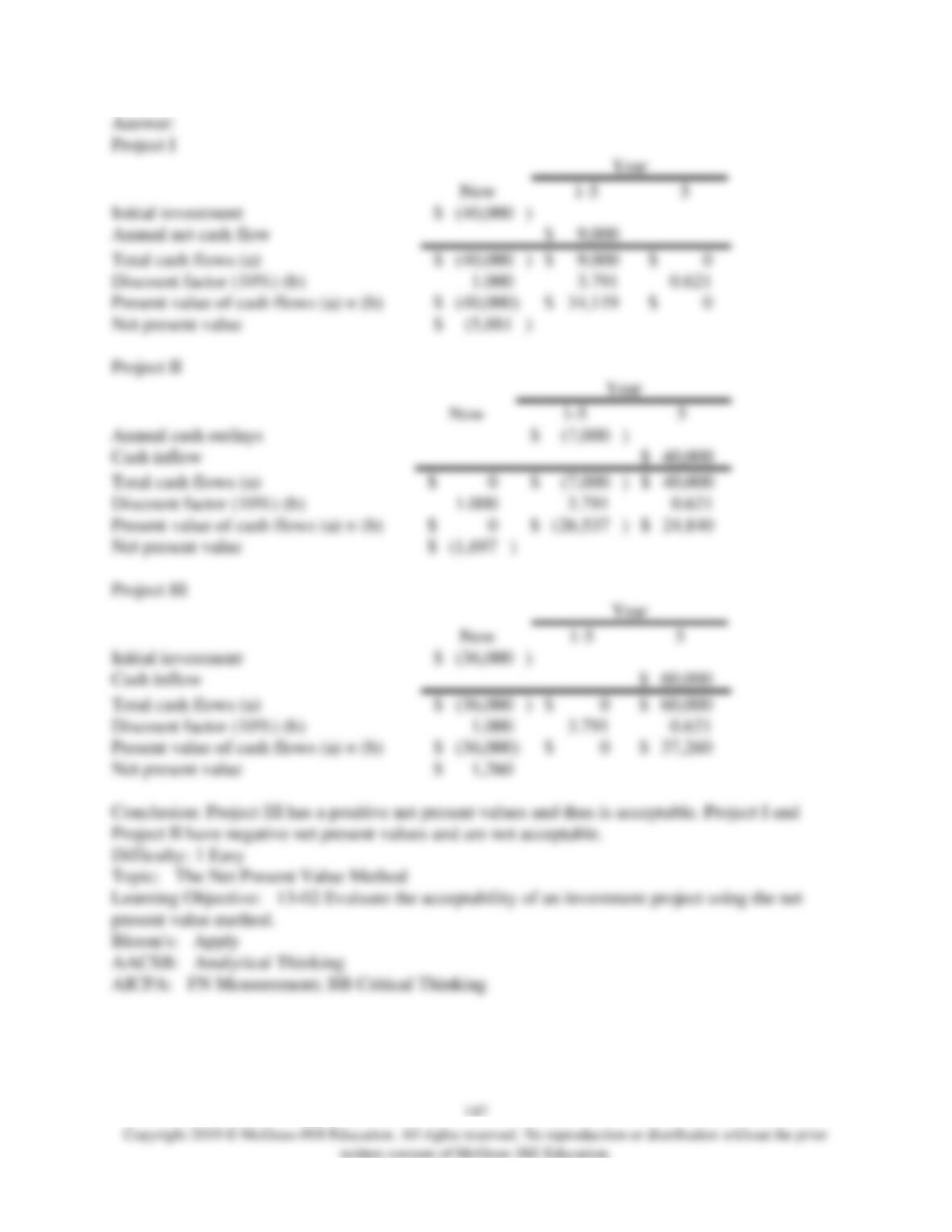
162) Consider the following three investment opportunities:
Project I would require an immediate cash outlay of $40,000 and would result in cash savings of
$9,000 each year for 5 years.
Project II would require cash outlays of $7,000 per year and would provide a cash inflow of
$40,000 at the end of 5 years.
Project III would require a cash outlay of $36,000 now and would provide a cash inflow of
$60,000 at the end of 5 years. (Ignore income taxes.)
See separate Exhibit 13B-1 and Exhibit 13B-2, to determine the appropriate discount factor(s)
using the tables provided.
Required:
The discount rate is 10%. Use the net present value method to determine which, if any, of the three
projects is acceptable.
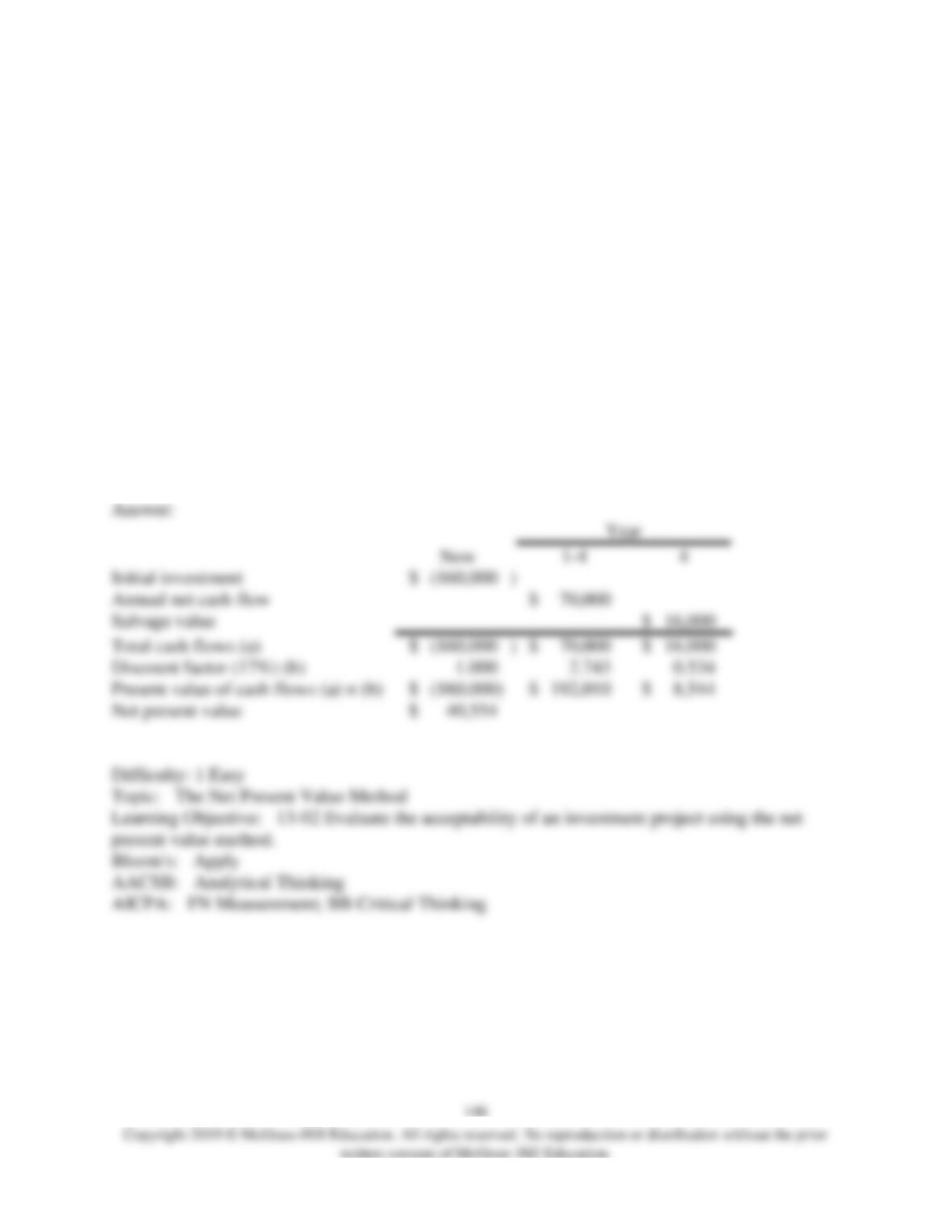
163) Cooney Inc. has provided the following data concerning a proposed investment project
(Ignore income taxes.):
Initial investment
$
160,000
Life of the project
4
years
Annual net cash inflows
$
70,000
Salvage value
$
16,000
The company uses a discount rate of 17%.
See separate Exhibit 13B-1 and Exhibit 13B-2, to determine the appropriate discount factor(s)
using the tables provided.
Required:
Compute the net present value of the project.
Now
Initial investment
(160,000
)
Annual net cash flow
$
70,000
Salvage value
16,000
Discount factor (17%) (b)
0.534
Present value of cash flows (a) × (b)
(160,000
)
$
192,010
8,544
Net present value
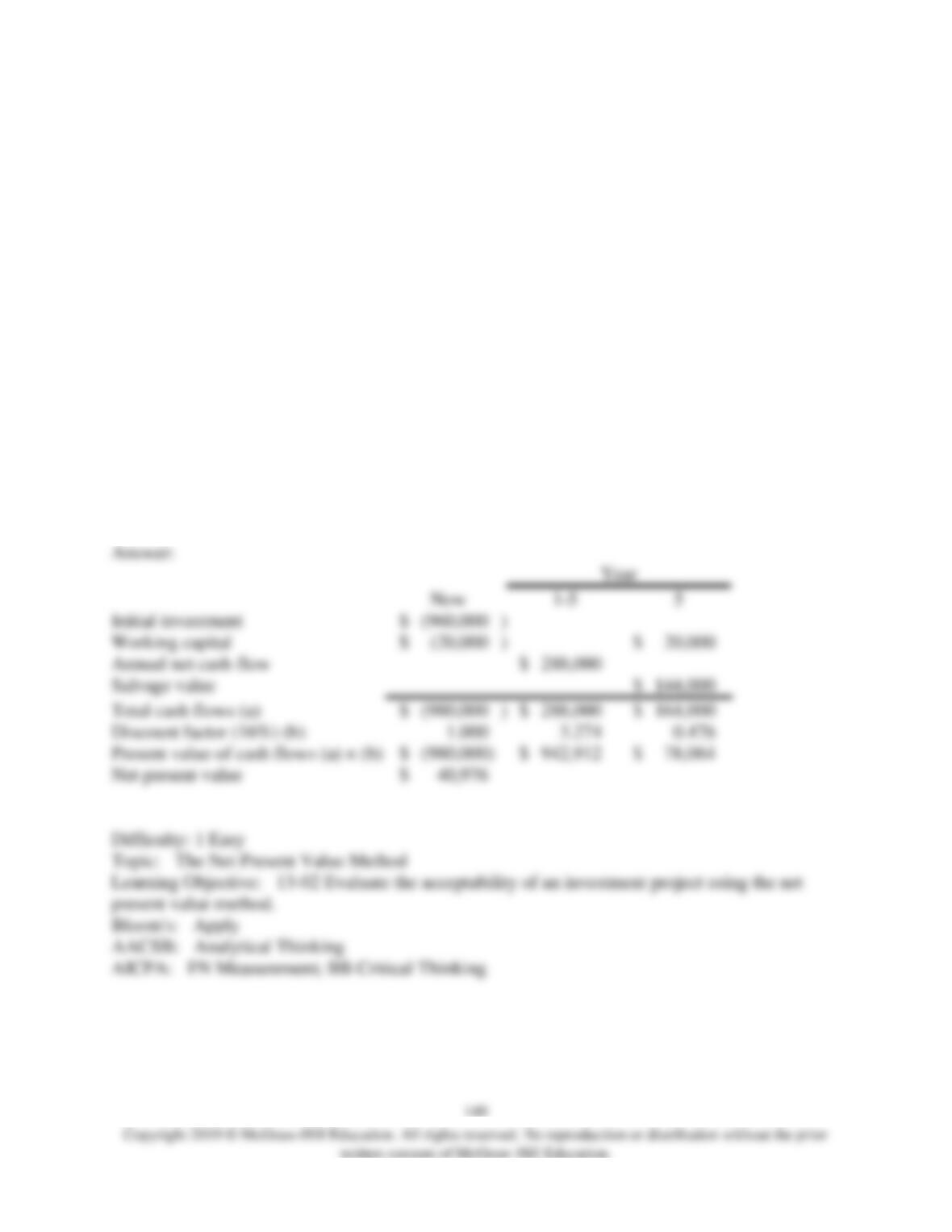
164) Tiff Corporation has provided the following data concerning a proposed investment project
(Ignore income taxes.):
Initial investment
$
960,000
Life of the project
5
years
Working capital required
$
20,000
Annual net cash inflows
$
288,000
Salvage value
$
144,000
The company uses a discount rate of 16%. The working capital would be released at the end of the
project.
See separate Exhibit 13B-1 and Exhibit 13B-2, to determine the appropriate discount factor(s)
using the tables provided.
Required:
Compute the net present value of the project.
Now
Initial investment
(960,000
)
Working capital
(20,000
)
20,000
Annual net cash flow
$
288,000
Salvage value
144,000
Total cash flows (a)
(980,000
)
$
288,000
164,000
Discount factor (16%) (b)
Present value of cash flows (a) × (b)
(980,000
)
$
942,912
78,064
Net present value
165) Maxcy Limos, Inc., is considering the purchase of a limousine that would cost $187,335,
would have a useful life of 9 years, and would have no salvage value. The limousine would bring
in cash inflows of $45,000 per year in excess of its cash operating costs. (Ignore income taxes.)
See separate Exhibit 13B-1 and Exhibit 13B-2, to determine the appropriate discount factor(s)
using the tables provided.
Required:
Determine the internal rate of return on the investment in the new limousine.
166) HI Corporation is considering the purchase of a machine that promises to reduce operating
costs by the same amount for every year of its 5-year useful life. The machine will cost $205,980
and has no salvage value. The machine has a 14% internal rate of return. (Ignore income taxes.)
See separate Exhibit 13B-1 and Exhibit 13B-2, to determine the appropriate discount factor(s)
using the tables provided.
Required:
What are the annual cost savings promised by the machine?
167) The management of Zachery Corporation is considering the purchase of a automated molding
machine that would cost $203,255, would have a useful life of 5 years, and would have no salvage
value. The automated molding machine would result in cash savings of $65,000 per year due to
lower labor and other costs. (Ignore income taxes.)
See separate Exhibit 13B-1 and Exhibit 13B-2, to determine the appropriate discount factor(s)
using the tables provided.
Required:
Determine the internal rate of return on the investment in the new automated molding machine.