ANSWERS TO CASE STUDIES AND EXAMINATION QUESTIONS
Millichamp and Taylor, Auditing, 10th edition
© Cengage Learning 2012
71
Chapter 13
Case Study 2
Lecturers using this material as a core text should be encouraged to try this
exercise as a group exercise.
The answer given (hopefully!) contains all the material weaknesses in the
system but students may, creatively, find others not mentioned. Lecturers
should evaluate these on their merits
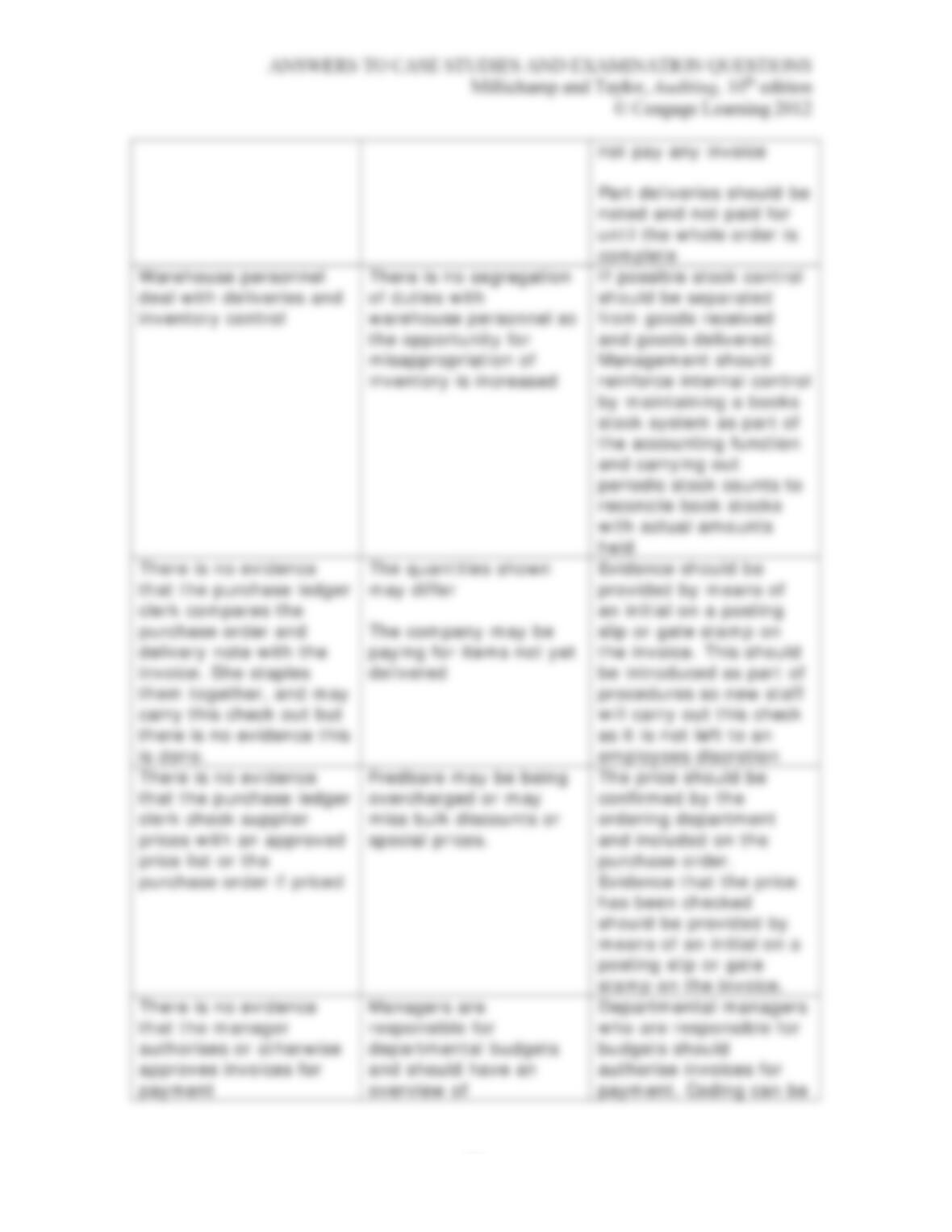
Major weaknesses are:
Weakness Implication Recommendation
72

73
expenditure. Providing
order limits are
observed (see above)
they can exercise this
by approving invoices
for payment. Simply
being used as a coding
clerk is a waste of
management time.
carried out by the
accounts department
The purchase ledger is
updated monthly. This does not give
managers an up to date
position of the spend
with any particular
supplier except after a
month end, nor
presumably is the
nominal ledger updated
so the costs figures in
the nominal ledger are
always lagging behind
actual expenditure
The ledgers should be
updated as purchase
invoices are batched for
entry into the system,
at the least on a weekly
basis.

74
There is no evidence
that hours worked are
authorised
The company could be
paying for hours not
worked
Clock cards should be
authorised by
departmental
supervisors or
managers before being
passed to the wages
department
There is no evidence of
supervision when
employees clock on
Staff may clock in each
other or cover for late
or absent employees.
The company will pay
for hours not worked
Clocking in by staff
should be observed by a
supervisor or manager
each day
Examination Questions
1.(Note – this is an abbreviated answer)
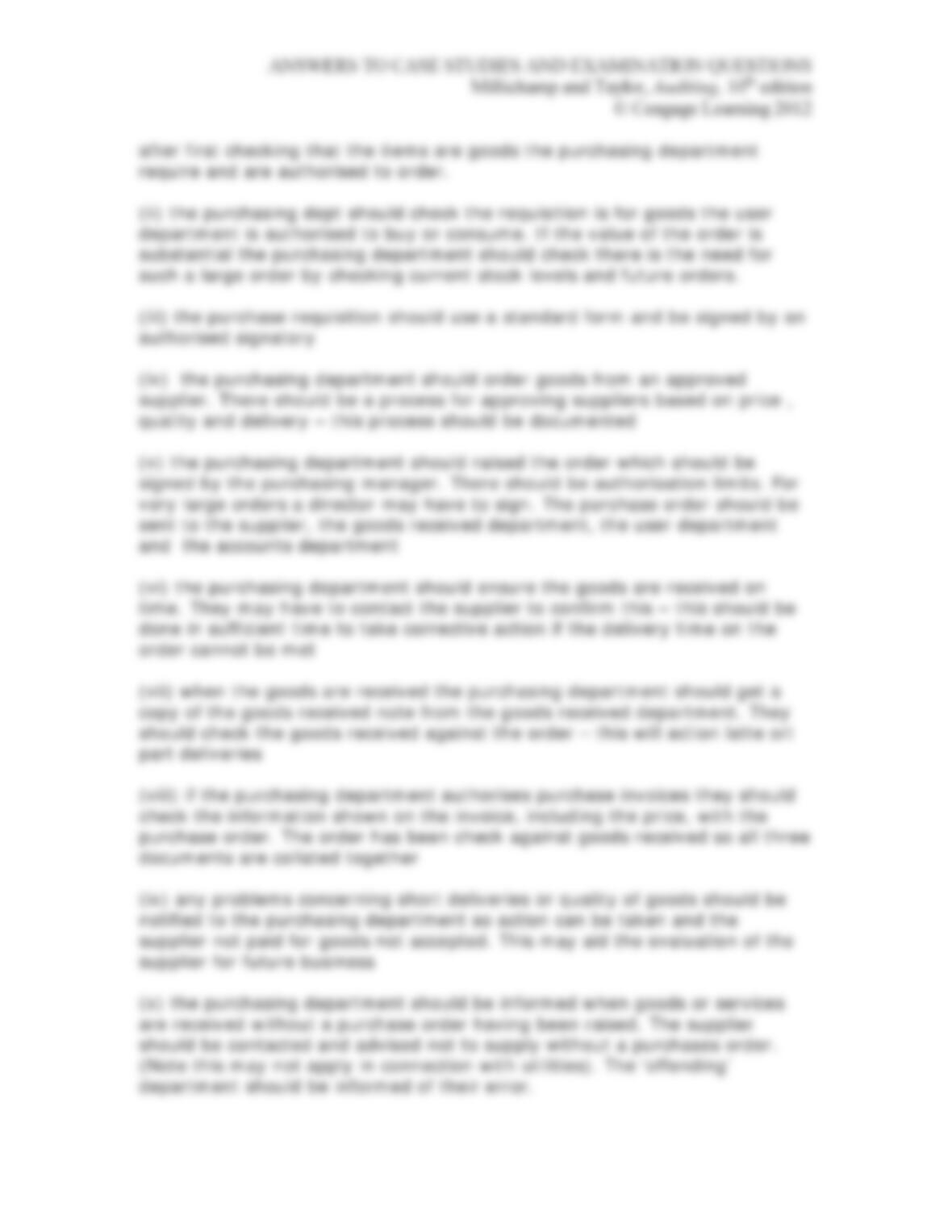
The controls the purchasing department should exercise over ordering and
control over receipt of goods and services should include
75
76
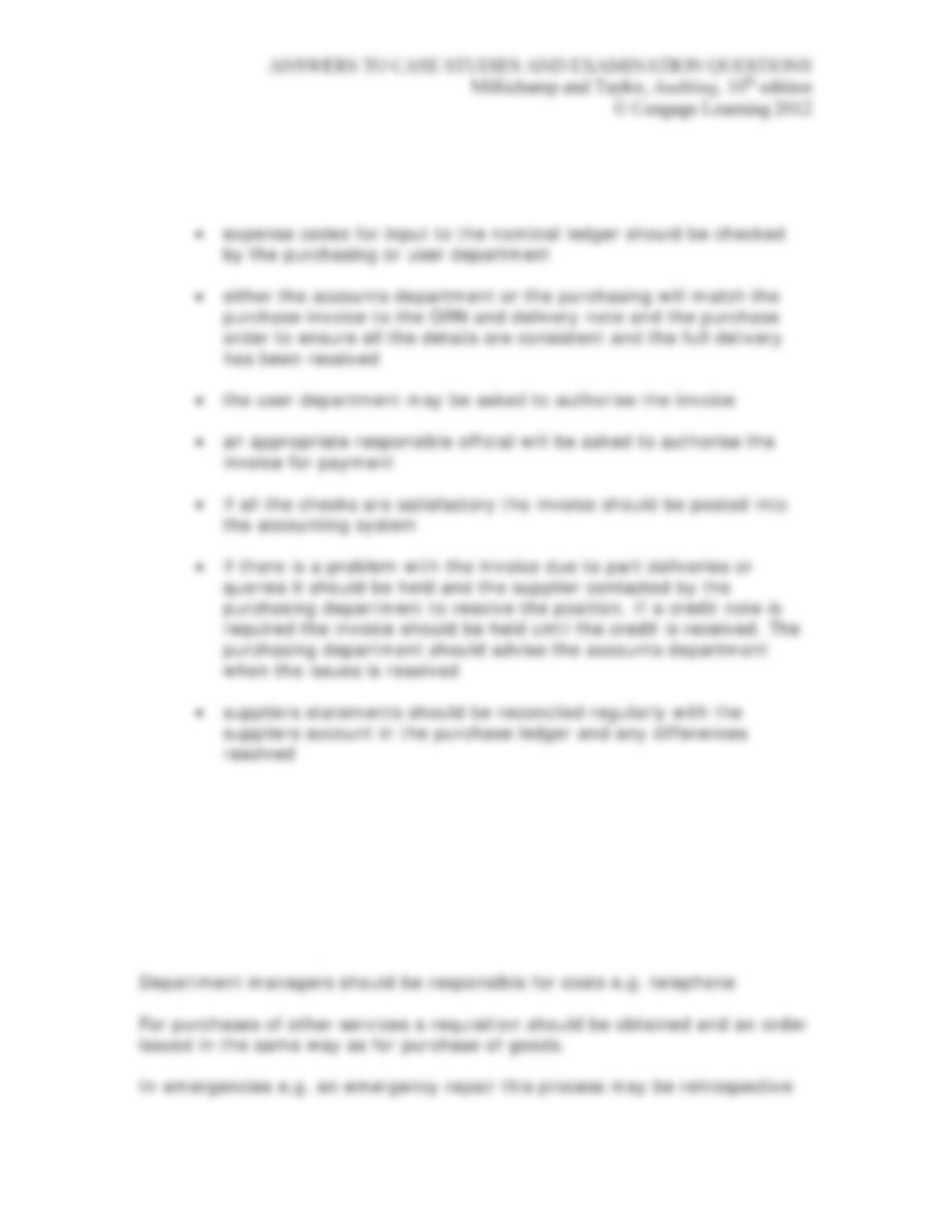
(b) procedures for checking a purchase invoice before processing include
xall incoming invoices should be recorded
(c) frequently procedures over services are less strong and less effective
than those over receiving goods.
For some types of expense e.g. utilities control may be exercised by
comparison with budgets costs or costs from previous periods and with prices
charged by alternative suppliers. In many cases e.g. electricity, water, gas,
usages are measured and the company should keep their own record of
readings for matching with invoices.
77
2. (a)
Auditors’ responsibility
xObtain an understanding of the system of control,
Directors’ responsibility
Implement control systems suitable for the size of the business to provide
reasonable assurance on the achievement of the entity’s objectives with
regard to the reliability of financial reporting, effectiveness and efficiency of
operations and compliance with applicable laws and regulations.
Directors are also responsible for monitoring the operation of internal control
systems.
Part (b)
xUse of computer controls to:
xconfirm the sequence of numbering on time logs and invoices
to identify missing numbers
78
Part (c)
xOn a sample basis match time log details to entries in the debtors
ledger via invoices
xOn a sample basis vouch entries in the receivables ledger back to
xInvestigate credit balances
(ICAEW)