Chapter 13—Current Liabilities and Contingencies Key
1. All of the following are examples of legal liabilities except
2. Under current standards of the FASB, liabilities include
3. On the balance sheet, liabilities are generally classified as
4. Which of the following statements is true?
5. Which is not a characteristic of a liability?
6. Which of the following statements does not describe an essential characteristic of a liability?
7. Which of the following is a legal liability?
8. Which of the following is the most appropriate way to display liabilities on the balance sheet?
9. Which of the following statements is true?
10. Which of the following statements regarding the gross and net methods for recording trade accounts payable
is true?
11. Current liabilities are obligations whose liquidation is reasonably expected to require the use of existing
current assets or the creation of other current liabilities within
12. The operating cycle is typically defined as the time it requires to convert
13. With regard to liabilities, liquidity refers to
14. Management of current liabilities arises, in part, because of a concern over
15. Conceptually, all liabilities should be reported on the balance sheet at
16. On December 1, 2010, Young Co. borrowed money at the bank by signing a 90-day non-interest-bearing
note for $24,000 that was discounted at 8%. Which of the following entries is correct?
17. On December 1, 2010, Brothers, Inc. borrowed money at the bank by signing a 90-day non-interest-bearing
note for $40,000 that was discounted at 12%. Which of the following entries is not correct?
18. Which of the following statements is not true?
19. Discount on Notes Payable should be classified as a
20. Which of the following statements is true?
21. On January 1, 2010, the Long Company signed a six-month, non-interest-bearing note payable for $160,000
and received $152,800 from Friendly Bank. On January 31, 2010, what amount should Long record for interest
expense, and what is the net carrying value of the note?
22. The Lawrence Company records its trade accounts payable net of any cash discounts. At the end of 2010,
Lawrence had a balance of $300,000 in its trade accounts payable account before any adjustments related to the
following items:
1.
Goods shipped to Lawrence FOB shipping point were in transit on December 31. The invoice price of the goods was $50,000, with a
2% discount allowed for prompt payment.
2.
Goods shipped to Lawrence FOB destination on December 29 arrived on January 2, 2011. The invoice price of the goods was $8,000,
with a 4% discount allowed for payment within 20 days.
3.
On December 10, Lawrence had recorded a shipment received. The recorded invoice price was $24,750, net, with a 1% discount
allowed for payment within 14 days. At the end of the year, payment had not been made.
At what amount should Lawrence report trade accounts payable on its December 31, 2010 balance sheet?
23. Which of the following dividends are not considered current liabilities when declared?
24. Which of the following statements regarding the gross and net methods for trade accounts payable is not
true?
25. Sick pay benefits that are related to an employee’s services already rendered, whose payment is probable
and the amount reasonably estimated, must be accrued and recognized as a current liability if the obligation
relates to rights that
Accumulate
Vest
I.
No
No
II.
No
Yes
III.
Yes
No
IV.
Yes
Yes
26. Unearned or deferred revenue can occur when
27. Analysts use the quick ratio (also known as the acid test ratio) and the current ratio. The use of both ratios
has become common because
28. Carl’s Video includes the amount of sales taxes collected directly in the price charged for merchandise, and
the total amount is credited to Sales. During January, Sales was credited for $239,680. The January 31 adjusting
entry to account for a 7% state sales tax should be
29. According to current GAAP, which of the following is not a condition suggesting that an accrual for
vacation pay be made?
30. GAAP relating to compensated absences
31. Which payroll tax is imposed on both the employee and the employer?
32. Baker, a branch manager, is allowed a bonus of 10% of income after bonus and tax. If the tax rate is 30%
and income before bonus and tax is $200,000, what is Mr. Baker’s bonus?
33. Miller Company provides a bonus compensation plan under which key employees receive bonuses equal to
10% of Miller’s income after deducting income taxes but before deducting the bonus. If income before income
tax and the bonus is $400,000 and the income tax rate is 30%, the bonuses should total
34. Voluntary payroll deductions may include all of the following except
35. All of the following payroll taxes are levied against the employer except
36. The Ancira Company closed its books annually on December 31, while the city in which it is located has a
fiscal year beginning on April 1 and ending on March 31. Taxes on property are assessed on April 1 of each
year. Property taxes in the amount of $360,000 and $400,000 were assessed on April 1, 2010 and 2011,
respectively. For the year ended December 31, 2011, the Ancira Company would report property tax expense
of
37. Which of the following is the best rationale for the recommended method of accounting for property taxes?
38. Bonita places a coupon in each box of its product. Customers may send in five coupons and $3, and the
company will send them a recipe book. Sufficient books were purchased at a cost of $5 each. A total of 400,000
boxes of product were sold in 2010. It was estimated that 6% of the coupons would be redeemed. During 2010,
8,000 coupons were redeemed. Which entry should be made at December 31, 2010?
39. Consolidated Business Services introduced a new machine on January 1, 2010. The machine carried a
two-year warranty against defects. The estimated warranty costs related to dollar sales were 3% in the year of
sale and 5% in the year after sale. Additional information follows:
Actual Warranty
Year
Sales
Expenditures
2010
$50,000
$ 900
2011
80,000
4,200
If the expense warranty accrual method is used, what amount relating to warranties should be reflected on the December 31, 2011, balance sheet?
40. Which journal entry would probably be made if the modified cash basis of accounting for warranties is in
use for a sale made in 2010?
42. Prince sells a certain product for $20,000. Included in this price is an implied service contract of $800. Fifty
machines were sold in 2010. Warranty expense incurred during 2010 amounted to $25,000. The company uses
the sales warranty accrual method. Which entry would probably not be made in 2010?
43. Exhibit 13-1
The Jung Company includes a premium in each box of its cereal. For four premiums plus $2.00, customers are
entitled to a plastic doll that costs Jung $4.50 each. Jung expects 60% of the premiums to be redeemed. In 2010,
Jung sold 500,000 boxes of cereal and distributed 25,000 dolls.
Refer to Exhibit 13-1. What is Jung’s estimated liability for unredeemed premiums on December 31, 2010?
44. Exhibit 13-1
The Jung Company includes a premium in each box of its cereal. For four premiums plus $2.00, customers are
entitled to a plastic doll that costs Jung $4.50 each. Jung expects 60% of the premiums to be redeemed. In 2010,
Jung sold 500,000 boxes of cereal and distributed 25,000 dolls.
Refer to Exhibit 13-1. What is Jung’s premium expense for 2010?
45. Which of the following is the best rationale for the recommended method of accounting for advertising
cost?
46. Exhibit 13-2
In 2010, the Markel Company sold 14,000 washing machines. Markel estimated that 12% of the machines
would require repairs under the two-year warranty at an average cost of $50. During 2010, Markel had an actual
outlay of $48,000 for repairs under warranty. Markel uses the expense warranty accrual method.
Refer to Exhibit 13-2. At what amount should the company record warranty expense for 2010?
47. Exhibit 13-2
In 2010, the Markel Company sold 14,000 washing machines. Markel estimated that 12% of the machines
would require repairs under the two-year warranty at an average cost of $50. During 2010, Markel had an actual
outlay of $48,000 for repairs under warranty. Markel uses the expense warranty accrual method.
Refer to Exhibit 13-2. What amount should the company report for estimated liability under warranties at the
end of 2010?
48. Exhibit 13-3
Paul Company includes three coupons in each package of crackers it sells. In exchange for 20 coupons, a
customer will receive a cheese plate. Paul estimates that 30% of the coupons will be redeemed. In 2010, Paul
sold 4,000,000 boxes of crackers and purchased 150,000 cheese plates at $2.50 each. During the year, 970,000
coupons were redeemed.
Refer to Exhibit 13-3. What amount should Paul record as premium expense for 2010?
49. Exhibit 13-3
Paul Company includes three coupons in each package of crackers it sells. In exchange for 20 coupons, a
customer will receive a cheese plate. Paul estimates that 30% of the coupons will be redeemed. In 2010, Paul
sold 4,000,000 boxes of crackers and purchased 150,000 cheese plates at $2.50 each. During the year, 970,000
coupons were redeemed.
Refer to Exhibit 13-3. What amount should Paul report as estimated premium claims outstanding at December
31, 2010?
50. Liabilities whose amounts must be estimated are disclosed in financial statements by
51. Battlecreek Breakfast places a coupon in each box of its cereal product. Customers may send in five
coupons and $3, and the company will send them a recipe book. Sufficient books were purchased at a cost of $5
each. A total of 500,000 boxes of product were sold in 2010. It was estimated that 4% of the coupons would be
redeemed. During 2010, 9,000 coupons were redeemed. What is Battlecreek’s premium expense for 2010?
52. Walter Corp. introduced a new machine on January 1, 2010. The machine carried a two-year warranty
against defects. The estimated warranty costs related to dollar sales were 3% in the year of sale and 5% in the
year after sale. Additional information follows:
Actual Warranty
Year
Sales
Expenditures
2010
$40,000
$ 600
2011
60,000
2,200
If the expense warranty accrual method is used, what amount relating to warranty expense should be reflected on the December 31, 2011 income
statement?
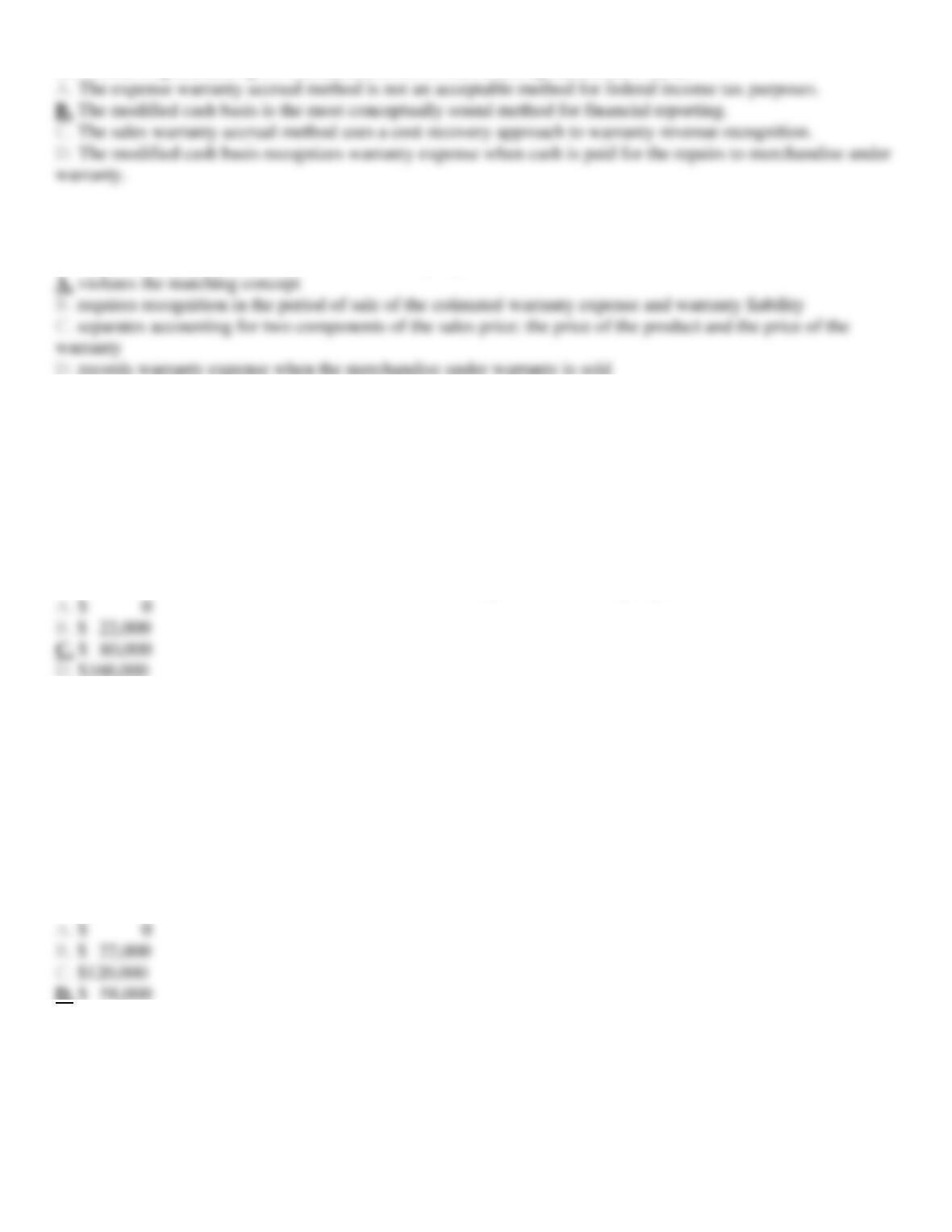
53. Concerning accounting for warranties, which of the following statements is false?
54. The modified cash basis to determine warranty expense
55. Exhibit 13-4
During 2010, the Alexandra Company began selling a new type of machine that carries a two-year warranty
against all defects. Based on past industry and company experience, estimated warranty costs should total
$2,000 per machine sold. During 2010, sales and actual warranty expenditures were $2,000,000 (40 machines)
and $22,000, respectively.
Refer to Exhibit 13-4. What amount should Alexandra report as its warranty expense for 2010?
56. Exhibit 13-4
During 2010, the Alexandra Company began selling a new type of machine that carries a two-year warranty
against all defects. Based on past industry and company experience, estimated warranty costs should total
$2,000 per machine sold. During 2010, sales and actual warranty expenditures were $2,000,000 (40 machines)
and $22,000, respectively.
Refer to Exhibit 13-4. What amount should Alexandra report as its estimated warranty liability at December
31, 2010?

57. Exhibit 13-5
Tractor Company estimates its annual warranty expense at 4% of annual net sales. The following information
relates to the calendar year 2010:
Net
sales
$3,000,000
Estimat
ed
liability
under
warrant
ies:
January 1, 2010
100,000
December 31, 2010, after year-end adjustment
80,000
Refer to Exhibit 13-5. The amount of warranty expense for 2010 is
58. Exhibit 13-5
Tractor Company estimates its annual warranty expense at 4% of annual net sales. The following information
relates to the calendar year 2010:
Net sales
$3,000,000
Estimated liability under
warranties:
January 1, 2010
100,000
December 31, 2010, after year-end adjustment
80,000
Refer to Exhibit 13-5. The amount of expenditures for warranty costs for 2010 is
59. The Chipo Company includes one coupon having no expiration date with its deluxe snack pack. Upon return
of 10 coupons, Chipo will send a silver chip clip, which costs Chipo $1.50 each. Past experience indicates that
30% of coupons issued will be redeemed. Chipo began this promotion in 2010 and sold 1,000,000 deluxe snack
packs. During 2010, 90,000 coupons were received and 9,000 chip clips were distributed to customers. The
December 31, 2010 balance sheet should include a liability for coupons outstanding of
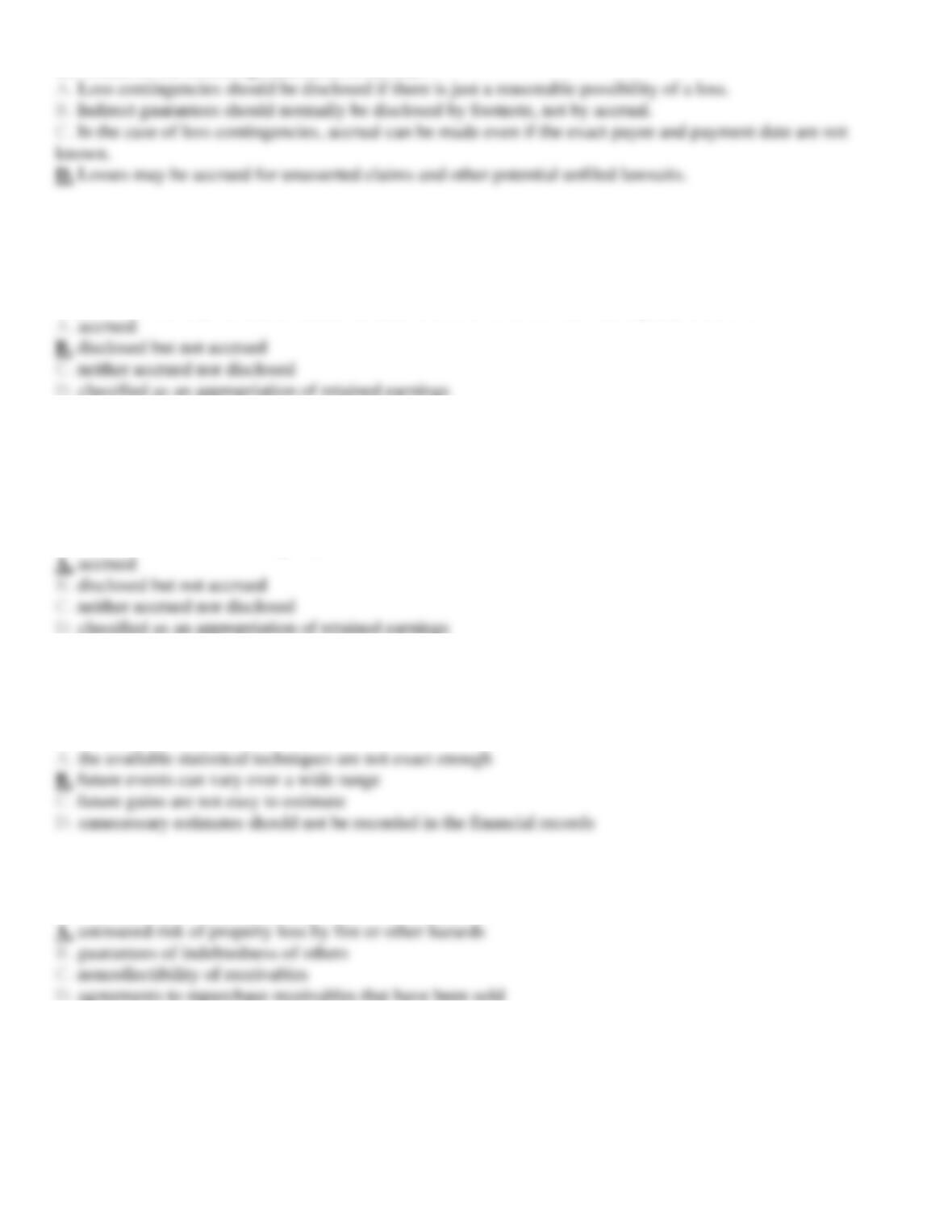
60. Which of the following statements is not true?
61. Existing claims related to product warranties and litigation as of December 31, 2010, indicate that it is
probable that a liability has been incurred. However, as of December 31, 2010, the amount of the obligation
cannot be reasonably estimated. Based on these facts, an estimated loss contingency should be
62. Existing claims related to product warranties and litigation as of December 31, 2010, indicate that it is
probable that a liability has been incurred. However, as of December 31, 2010, the exact amount of the
obligation cannot be reasonably estimated, but a range of possible amounts has been determined. Based on these
facts, an estimated loss contingency should be
63. FASB established the use of the terms “probable,” “reasonably possible,” and “remote.” It adopted these
terms because
64. Which of the following contingencies is usually not accrued in the accounts?
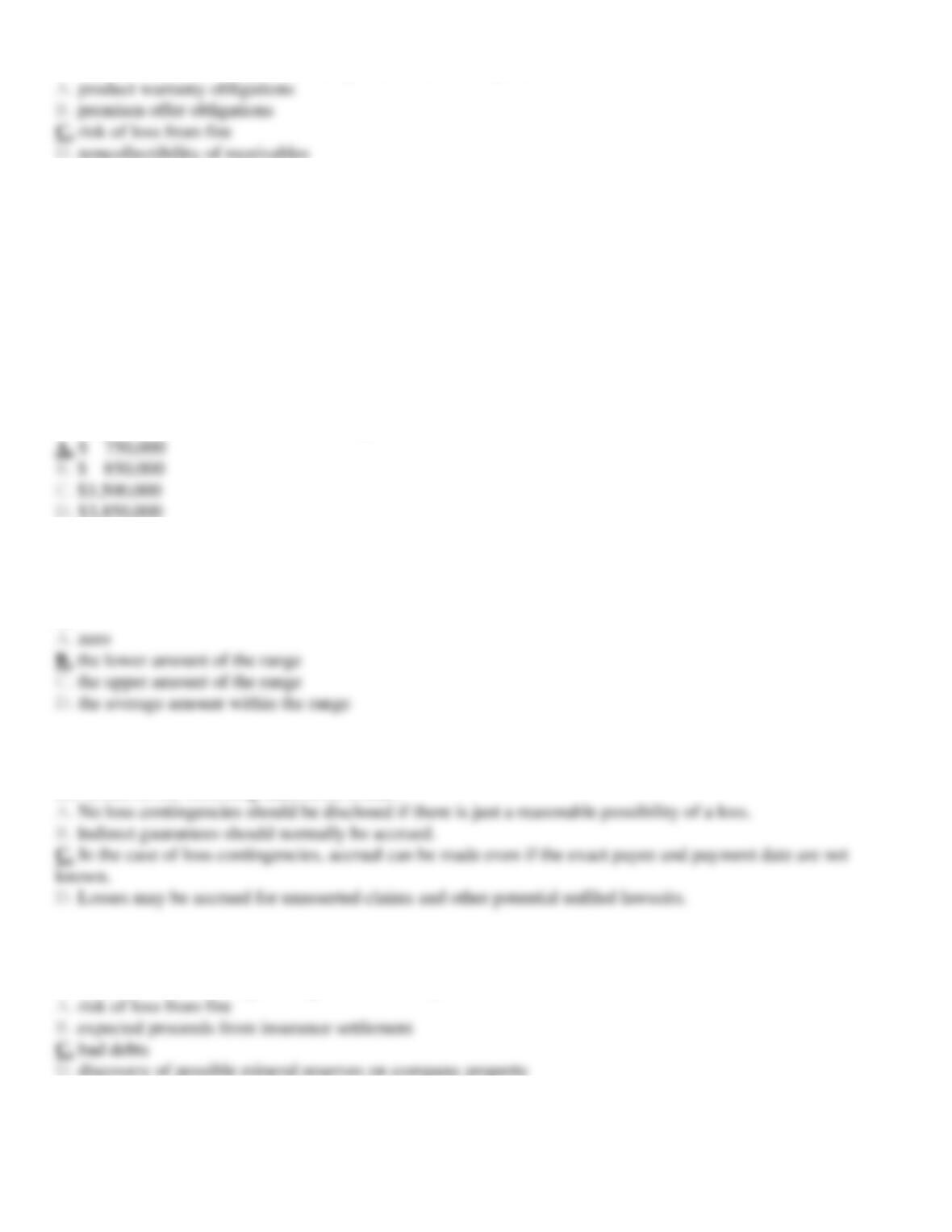
65. Which of the following loss contingencies is not usually accrued?
66. The Peters Company is affected by the following contingencies at the end of 2010:
1.
Expropriation of Peters’ foreign assets, valued at $3,000,000, appears reasonably possible.
2.
Peters’ legal counsel has concluded that it is probable that the company will be required to pay damages of $500,000 in a lawsuit.
3.
It appears remotely possible that a major customer will be unable to repay Peters on a note receivable for $100,000.
4.
Peters’ controller estimates that $250,000 of the company’s pledged receivables are likely to be uncollectible, and the lender will require
Peters to honor the amounts.
What total amount should Peters accrue for loss contingencies in 2010?
67. A probable loss contingency is reasonably estimated within a range of possible amounts. No amount within
the range is a better estimate than any other amount within the range. The amount that should be accrued should
be
68. Which of the following statements is true?
69. Which of the following contingencies is usually accrued?