97) Jackson Company has developed the following sales projections for the calendar year:
May $ 100,000
June 120,000
July 140,000
August 160,000
September 150,000
October 130,000
Normal cash collection experience has been that 50% of sales is collected during the month of
sale and 45% in the month following the sale. The remaining 5% of sales are never collected.
Jackson’s budgeted cash collections for the third calendar quarter are: (CMA adapted)
A) $450,000.
B) $440,000.
C) $414,000.
D) $360,000.
98) A company is preparing its cash budget for the coming month. All sales are on account.
Given the following:
Beginning Balances Budget
Amounts
Cash $ 50,000
Accounts Receivable 180,000
Sales $ 800,000
Cash disbursements 780,000
Depreciation 25,000
Ending accounts receivable balance 210,000
What is the expected cash balance of the company at the end of the coming month? (CIA
adapted)
A) $15,000.
B) $40,000.
C) $45,000.
D) $70,000.
99) A company is formulating its plans for the coming year, including the preparation of its cash
budget. Historically, the company’s sales are 30% cash. The remaining sales are on credit with
the following collection pattern:
Collections on Account Percentage
In the month of sale 40 %
In the month following the sale 58 %
Uncollectible 2 %
Sales for the first 5 months of the coming year are forecast as follows:
January $ 3,500,000
February 3,800,000
March 3,600,000
April 4,000,000
May 4,200,000
For the month of April, the total cash receipts from sales and collections on accounts would be:
(CIA adapted)
A) $3,729,968.
B) $3,781,600.
C) $4,025,200.
D) $4,408,000.
100) Shown below is the sales forecast for Kalin Inc. for the first four months of the coming
year.
Jan Feb Mar Apr
Cash sales $ 15,000 $ 24,000 $ 18,000 $ 14,000
Credit sales $ 100,000 $ 120,000 $ 90,000 $ 70,000
On average, 50% of credit sales are paid for in the month of the sale, 30% in the month
following sale, and the remainder are paid two months after the month of the sale. Assuming
there are no bad debts, the expected cash inflow in March is: (CMA adapted)
A) $138,000.
B) $122,000.
C) $119,000.
D) $108,000.
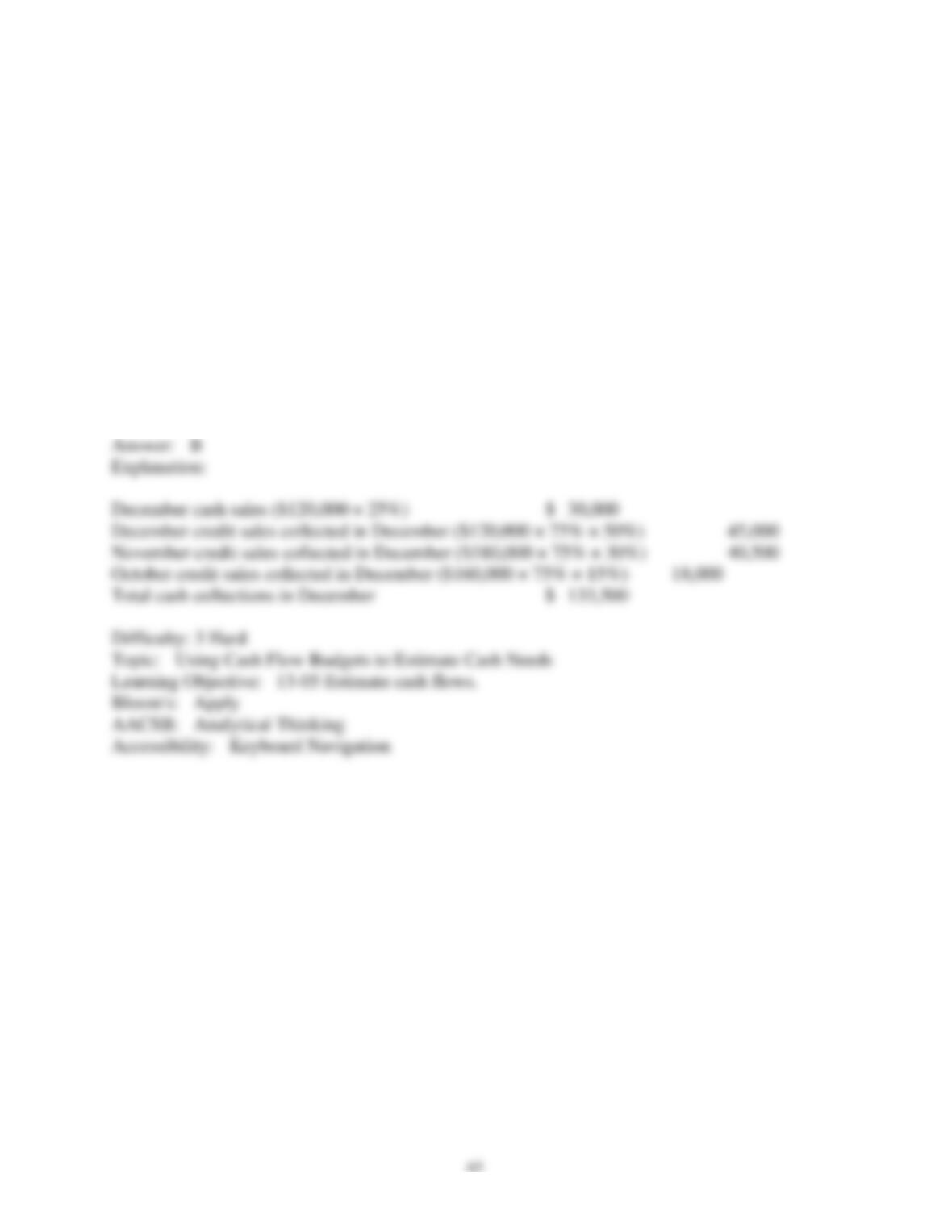
101) Budgeted sales in Washburn Company over the next four months are given below:
September October November December
Budgeted sales $100,000 $160,000 $180,000 $120,000
Twenty-five percent of the company’s sales are for cash and 75% are on account. Collections for
sales on account follow a stable pattern as follows: 50% of a month’s credit sales are collected in
the month of sale, 30% are collected in the month following sale, and 15% are collected in the
second month following sale. The remainder is uncollectible. Given these data, cash collections
for December should be:
A) $138,000.
B) $133,500.
C) $120,000.
D) $103,500.
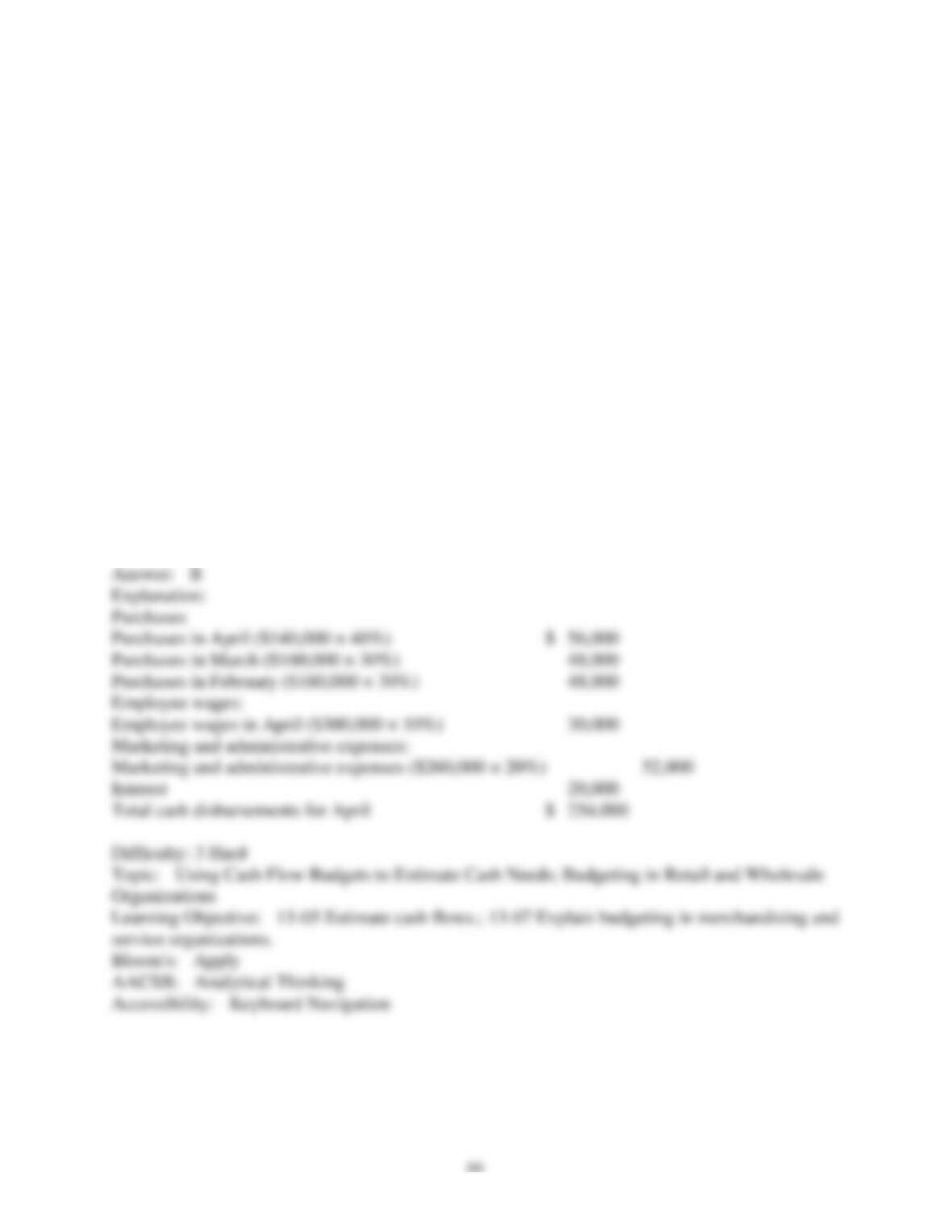
102) The following data have been taken from the budget reports of Kenyon Company, a
merchandising company.
Purchases Sales
January $ 160,000 $ 100,000
February $ 160,000 $ 200,000
March $ 160,000 $ 240,000
April $ 140,000 $ 300,000
May $ 140,000 $ 260,000
June $ 120,000 $ 240,000
Forty percent of purchases are paid for in cash at the time of purchase, and 30% are paid for in
each of the next two months. Purchases for the previous November and December were
$150,000 per month. Employee wages are 10% of sales for the month in which the sales occur.
Marketing and administrative expenses are 20% of the following month’s sales. (July sales are
budgeted to be $220,000.) Interest payments of $20,000 are paid quarterly in January and April.
Kenyon’s cash disbursements for the month of April would be: (CMA adapted)
A) $140,000.
B) $254,000.
C) $200,000.
D) $248,000.
103) Budgeted Balance sheets combine all of the following except:
A) an estimate of financial position at the beginning of the budget period.
B) the estimated results of operations for the period (from the income statements).
C) estimated changes in assets and liabilities.
D) an examination of all revenues, costs, and other transactions in terms of their effects on cash.
104) Serene Corporation, an auto parts retailer, had 17,000 units of brake calipers on hand at the
end of 2019. The company’s inventory policy is to maintain an ending inventory equal to 15% of
the current year’s sales. During 2020, Serene sold 210,000 units of calipers. How many units did
Serene purchase in 2020?
A) 224,500.
B) 210,000.
C) 196,150.
D) 194,700.
105) Virginia Company, a merchandising firm, operated five sales offices last year at a total cost
of $500,000, of which $70,000 represented fixed costs. Virginia has determined that total costs
are significantly influenced by the number of sales offices operated. Last year’s costs and number
of sales offices can be used as the basis for predicting annual costs. What would be the budgeted
cost for the coming year if Virginia were to operate seven sales offices? (CPA adapted)
A) $700,000.
B) $672,000.
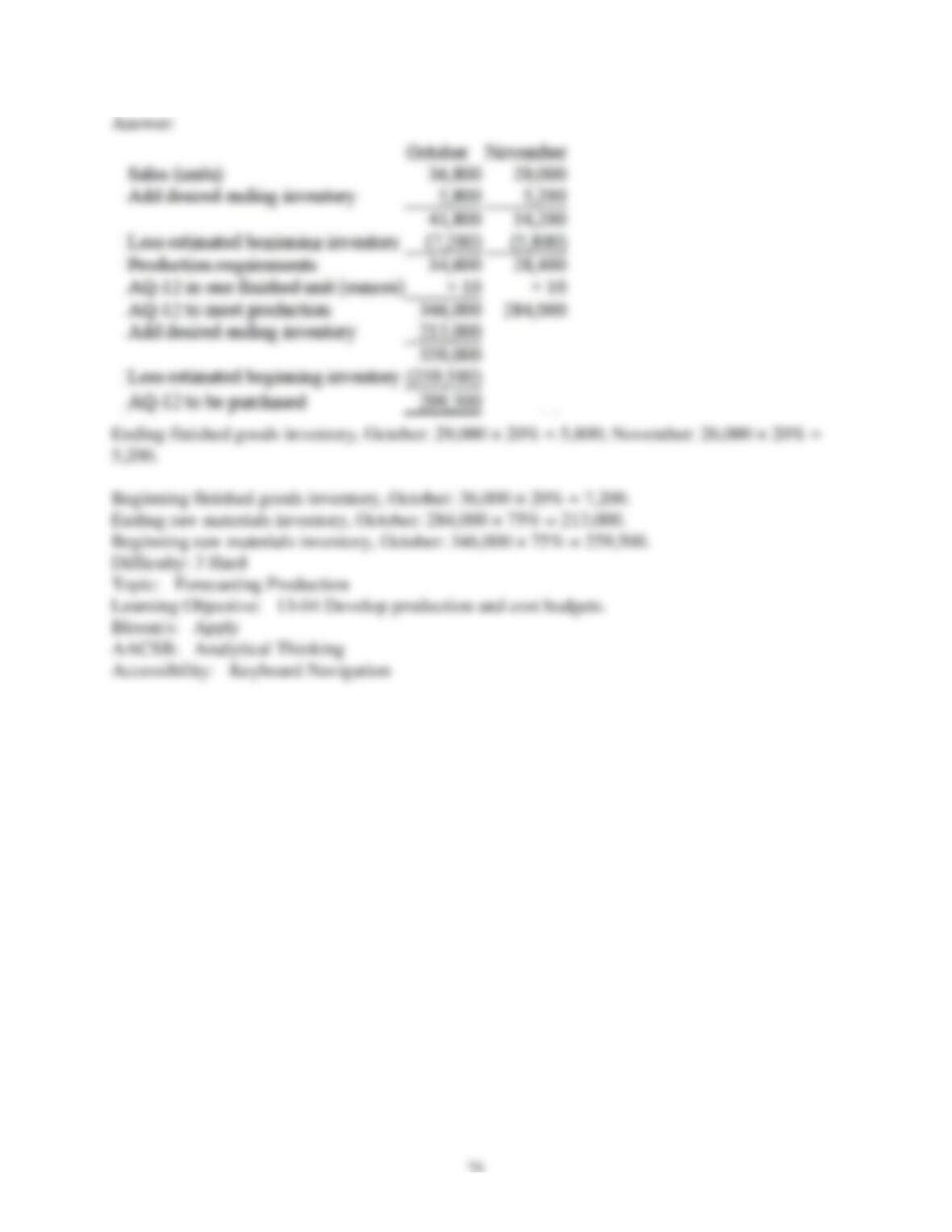
C) $602,000.
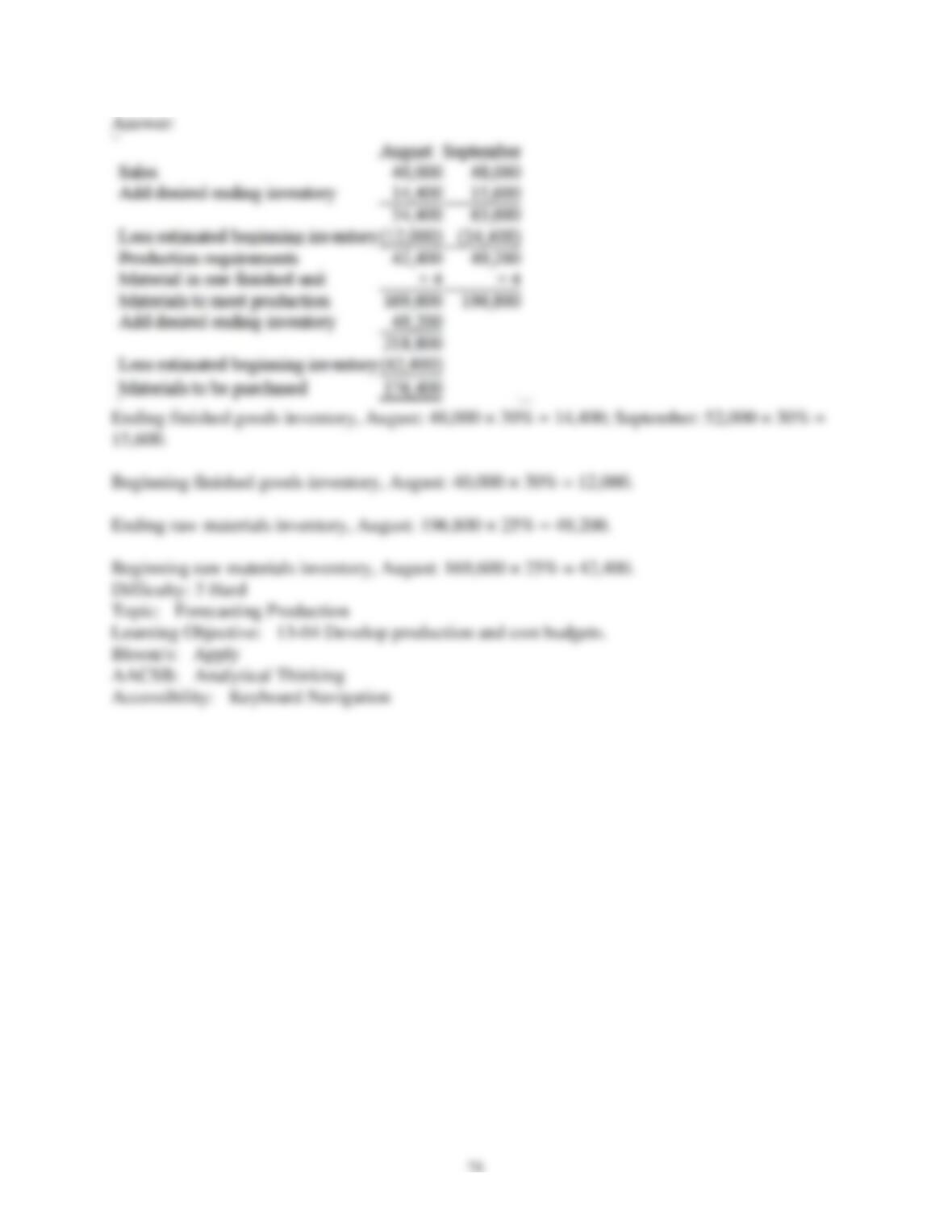
D) $586,000.
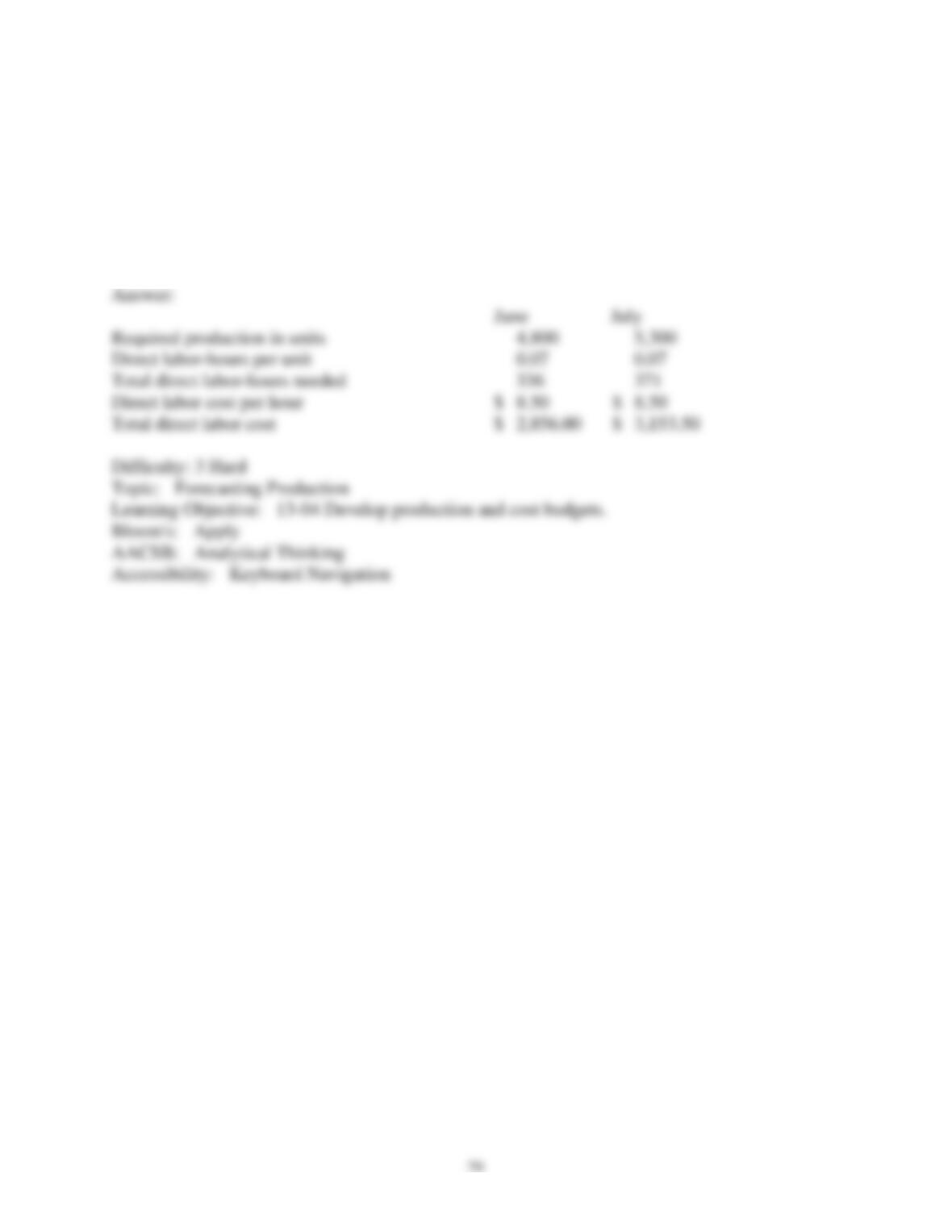
106) Which of the following budgets is not required in a wholesale organization?
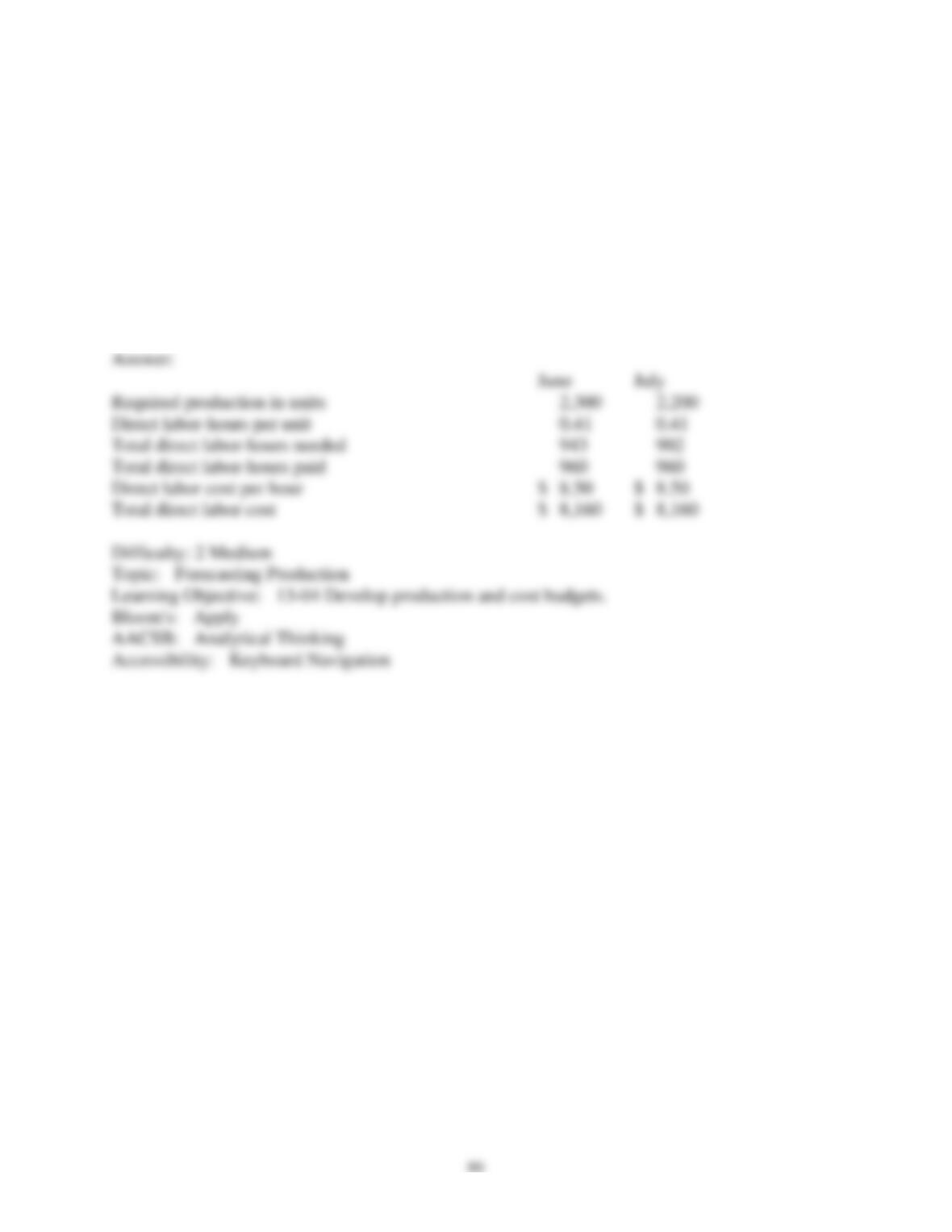
A) Cash.
B) Sales.
C) Production.
D) Cost of goods sold.
107) Which of the following budgets is not required in a service organization?
A) Cash.
B) Sales.
C) Labor.
D) Cost of goods sold.
108) Which of the following statements is true regarding ethical issues accompanying
budgeting?
A) Conflicts of interest do not arise when employees are asked for input to help establish a
budget.
B) Easy target incentives are eliminated through budgeting.
C) The conflicts of biased budgeting can be avoided in a decentralized firm.
D) If budget targets are difficult to meet, employees could turn to fraudulent financial reporting.
109) Sensitivity analysis can best be used in the budgeting process to:
A) explore the uncertainty surrounding their estimates.
B) remove the subjective nature from the budgeting process.
C) answer “what-if” questions regarding key projections.
D) consider alternatives and options in the budgeting process.
71
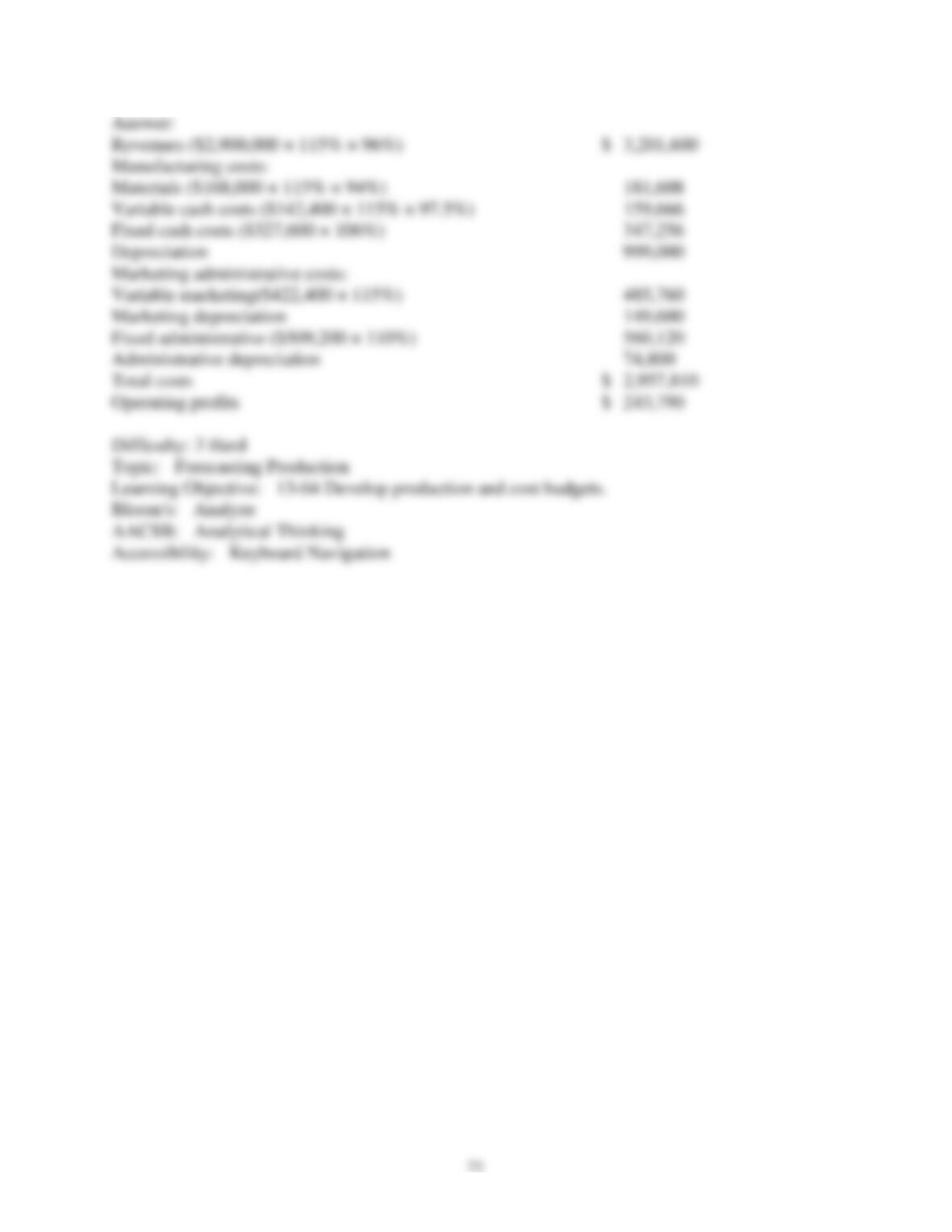
110) Dalley Inc. has the following information for its first year of operations:
Revenues (200,000 units) $ 2,900,000
Manufacturing costs:
Materials $ 168,000
Variable cash costs 142,400
Fixed cash costs 327,600
Depreciation (fixed) 999,000
Marketing & administrative costs:
Marketing (variable) 422,400
Marketing depreciation 149,600
Administrative (fixed) 509,200
Administrative depreciation 74,800
Total costs $ 2,793,000
Operating profits $ 107,000
All depreciation charges are fixed and are expected to remain the same for year 2. Sales volume
is expected to increase by 15%, but sales prices are expected to fall by 4%. Material costs per
unit are expected to decrease by 6%. Other unit variable manufacturing costs are expected to
decrease by 2.5% per unit. Fixed manufacturing costs (other than depreciation) are expected to
increase by 6%.
Variable marketing costs per unit will remain constant. Administrative costs (other than
depreciation) are expected to increase by 10%.
Assume there are no inventories. Dalley operates on a cash basis.
Required:
Prepare a budgeted income statement for year 2.
73
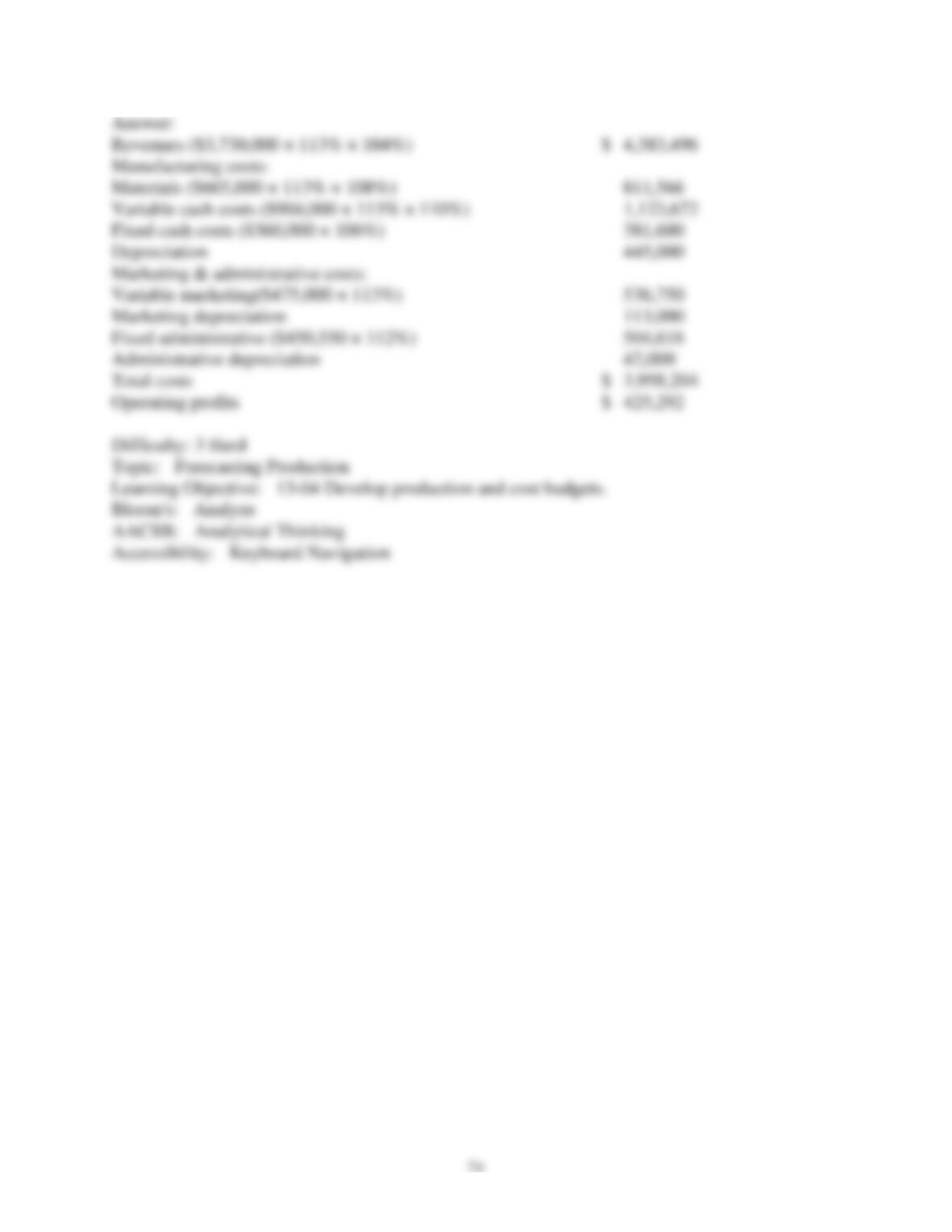
111) Oregon Inc. has the following information for its first year of operations:
Revenues (250,000 units) $ 3,730,000
Manufacturing costs:
Materials $ 665,000
Variable cash costs 904,000
Fixed cash costs 360,000
Depreciation (fixed) 445,000
Marketing & administrative costs:
Marketing (variable) 475,000
Marketing depreciation 113,000
Administrative (fixed) 450,550
Administrative depreciation 42,000
Total costs $ 3,454,550
Operating profits $ 275,450
All depreciation charges are fixed and are expected to remain the same for year 2. Sales volume
is expected to increase by 13%, and sales prices are expected to increase by 4%. Material costs
per unit are expected to increase by 8%. Other unit variable manufacturing costs are expected to
increase by 10% per unit. Fixed manufacturing costs (other than depreciation) are expected to
increase by 6%.
Variable marketing costs per unit will remain constant. Administrative costs (other than
depreciation) are expected to increase by 12%.
Assume there are no inventories. Oregon operates on a cash basis.
Required:
Prepare a budgeted income statement for year 2.
75
112) A sales budget is given below for one of the products manufactured by Trumpet, Ltd.
Month Sales Budget in Units
July 28,000
August 30,000
September 34,000
October 36,000
November 29,000
December 26,000
The inventory of finished goods at the end of each month must be equal to 20% of the next
month’s sales. On June 30, the finished goods inventory totaled 6,800 units.
Each unit of product requires ten ounces of a special chemical known as AQ-12. Sometimes the
chemical is in short supply; for this reason, the company has a policy of maintaining an
inventory at the end of each month equal to 75% of the next month’s production needs. This
requirement was met on July 1 of the current year
Required:
Prepare a budget showing the quantity of AQ-12 to be purchased for October.
77
113) A sales budget is given below for one of the products manufactured by Reyes, Ltd.
Month Sales Budget in Units
July 36,000
August 40,000
September 48,000
October 52,000
November 38,000
December 31,000
The inventory of finished goods at the end of each month must be equal to 30% of the next
month’s sales. On June 30, the finished goods inventory totaled 16,800 units.
Each unit of product requires four pounds of material. The company has a policy of maintaining
a material inventory at the end of each month equal to 25% of the next month’s production needs.
This requirement was met on July 1 of the current year.
Required:
Prepare a budget showing the quantity of material to be purchased for August.
114) Flores Corporation is working on its direct labor budget for the next two months. Each unit
of output requires 0.07 direct labor-hours. The direct labor rate is $8.50 per direct labor-hour.
The production budget calls for producing 4,800 units in June and 5,300 units in July.
Required:
Construct the direct labor budget for the next two months, assuming that the direct labor work
force is fully adjusted to the total direct labor-hours needed each month.
115) Arctic Corporation is working on its direct labor budget for the next two months. Each unit
of output requires 0.41 direct labor-hours. The direct labor rate is $8.50 per direct labor-hour.
The production budget calls for producing 2,300 units in August and 2,200 units in September.
The company guarantees its direct labor workers a 40-hour paid work week. With the number of
workers currently employed, that means that the company is committed to paying its direct labor
work force for at least 960 hours in total each month even if there is not enough work to keep
them busy.
Required:
Construct the direct labor budget for the next two months.