Chapter 13 – Investment Centers and Transfer Pricing
13–52
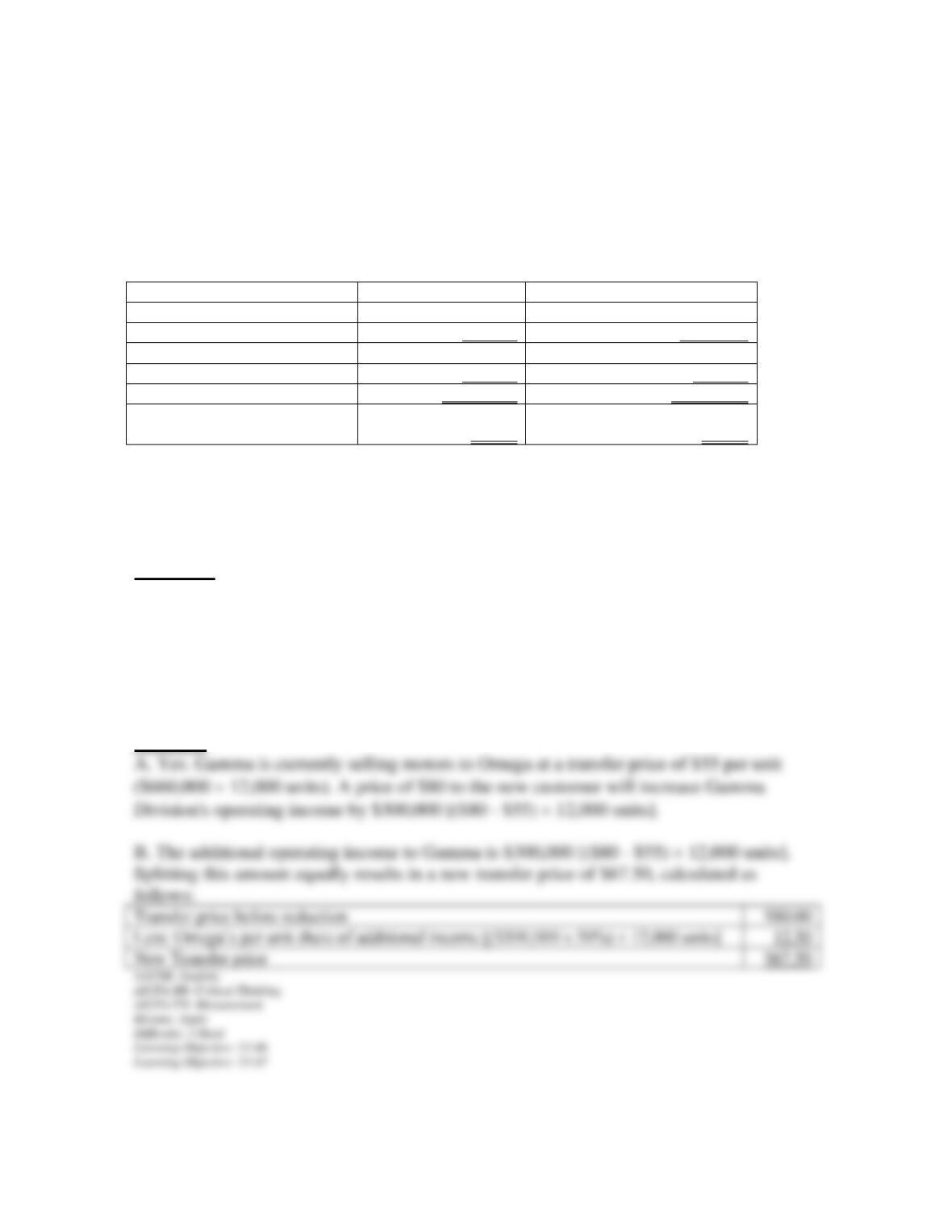
98. Gamma Division of Fava Corporation produces electric motors, 20% of which are sold to
Fava’s Omega Division and 80% to outside customers. Fava treats its divisions as profit
centers and allows division managers to choose whether to sell to or buy from internal
divisions. Corporate policy requires that all interdivisional sales and purchases be transferred
at variable cost. Gamma Division’s estimated sales and standard cost data for the year ended
December 31, based on a capacity of 60,000 units, are as follows:
Omega
Outsiders
Sales
$660,000
$5,760,000
Less: Variable costs
660,000
2,640,000
Contribution margin
$ —–
$3,120,000
Less: Fixed costs
175,000
900,000
Operating income (loss)
$(175,000)
$2,220,000
Unit sales
12,000
48,000
Gamma has an opportunity to sell the 12,000 units shown above to an outside customer at $80
per unit. Omega can purchase the units it needs from an outside supplier for $92 each.
Required:
A. Assuming that Gamma desires to maximize operating income, should it take on the new
customer and discontinue sales to Omega? Why? (Note: Answer this question from Gamma’s
perspective.)
B. Assume that Fava allows division managers to negotiate transfer prices. The managers
agreed on a tentative price of $80 per unit, to be reduced by an equal sharing of the additional
Gamma income that results from the sale to Omega of 12,000 motors at $80 per unit. On the
basis of this information, compute the company’s new transfer price.
Solution:
Transfer price before reduction
New Transfer price
13–53
99. Sierra Corporation is a multi-divisional company whose managers have been delegated
full profit responsibility and complete autonomy to accept or reject transfers from other
divisions. Division X produces 2,000 units of a subassembly that has a ready market. One of
these subassemblies is currently used by Division Y for each final product manufactured, the
latter of which is sold to outsiders for $1,600. Y’s sales during the current period amounted to
2,000 completed units. Division X charges Division Y the $1,100 market price for the
subassembly; Division Y has additional variable costs of $600 per unit. Variable costs for
Division X are $850 per unit. The manager of Division Y feels that X should transfer the
subassembly at a lower price because Y is currently unable to make a profit.
Required:
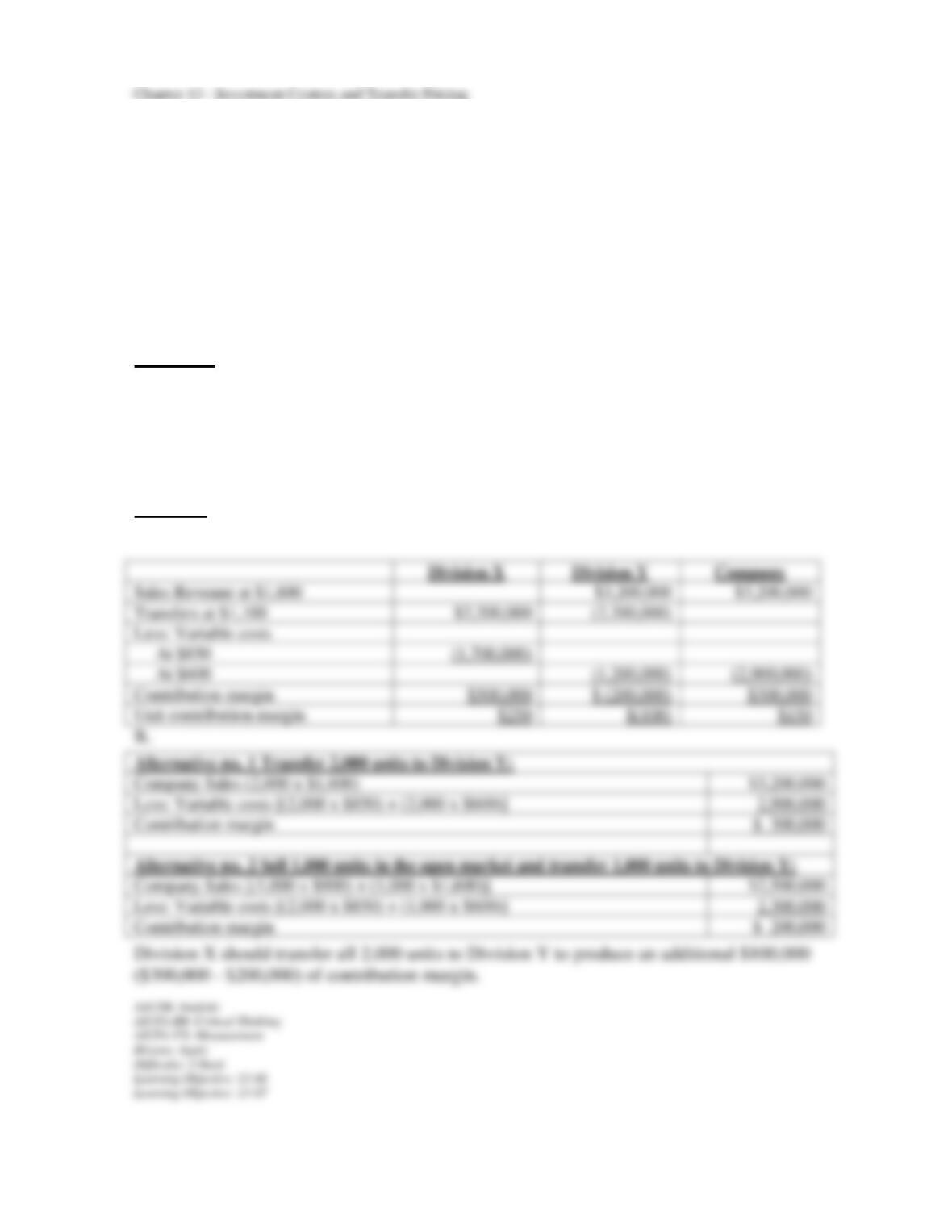
A. Calculate the contribution margins (total dollars and per unit) of Divisions X and Y, as
well as the company as a whole, if transfers are made at market price.
B. Assume that conditions have changed and X can sell only 1,000 units in the market at $900
per unit. From the company’s perspective, should X transfer all 2,000 units to Y or sell 1,000
in the market and transfer the remainder? Note: Y’s sales would decrease to 1,000 units if the
latter alternative is pursued.
Solution:
A.
13–54
100. Tyke Corporation has two divisions: Springfield and Chicago. Springfield currently sells
a condenser to manufacturers of cooling systems for $520 per unit. Variable costs amount to
$380, and demand for this product currently exceeds the division’s ability to supply the
marketplace. Tyke is considering another use for the condenser, namely, integration into an
enhanced refrigeration system that would be made by Chicago. Related information about the
enhanced system follows:
Selling price of refrigeration system: $1,285
Additional variable manufacturing costs required: $820
Transfer price of condenser: $490
Top management is anxious to introduce the enhanced system; however, unless the transfer is
made, an introduction will not be possible because of the difficulty of obtaining condensers in
the quality and quantity desired. The company uses responsibility accounting and ROI when
measuring divisional performance, and awards bonuses to divisional management.
Required:
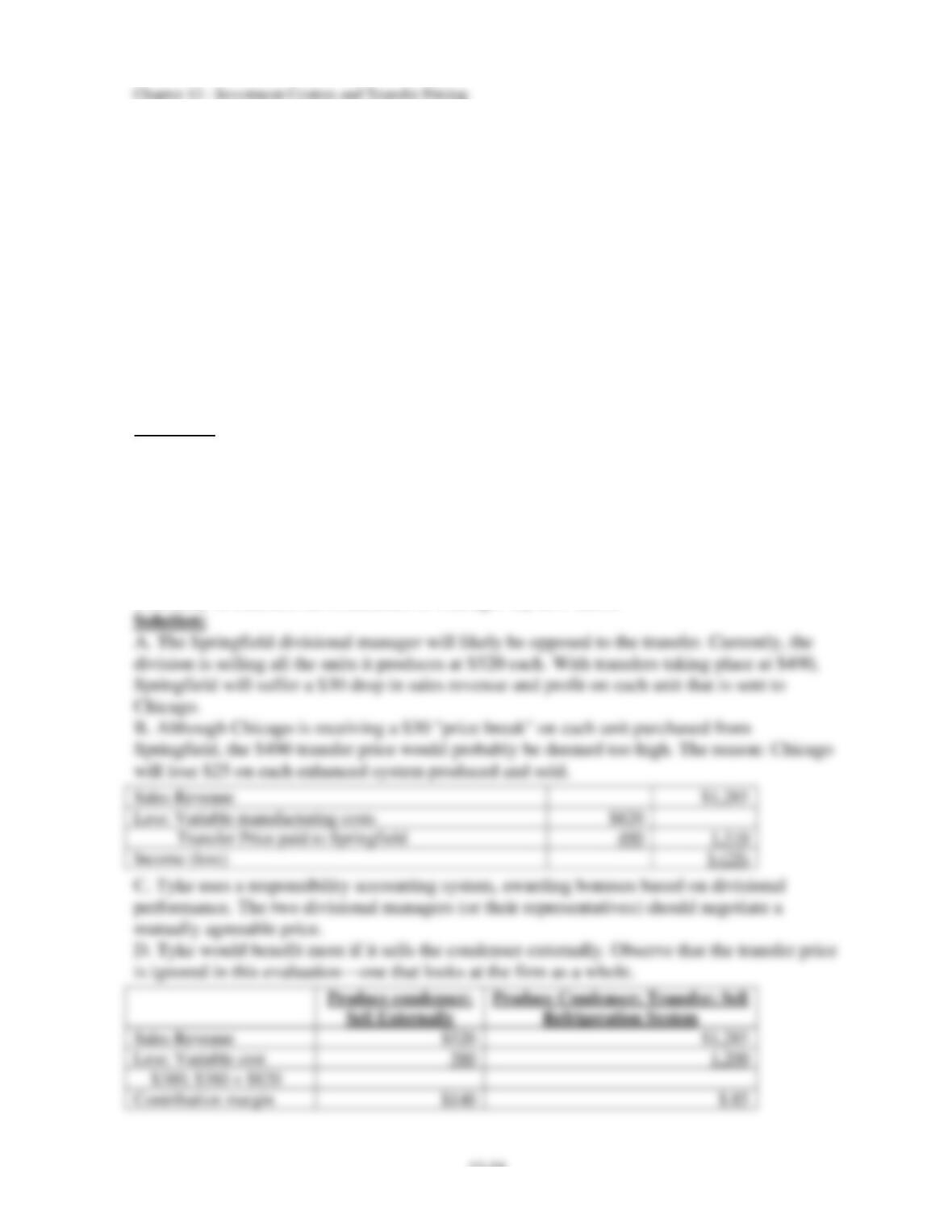
A. How would Springfield’s divisional manager likely react to the decision to transfer
condensers to Chicago? Show computations to support your answer.
B. How would Chicago’s divisional management likely react to the $490 transfer price? Show
computations to support your answer.
C. Assume that a lower transfer price is desired. What parties should be involved in setting
the new price?
D. From a contribution margin perspective, does Tyke benefit more if it sells the condensers
externally or transfers the condensers to Chicago? By how much?

13–55
101. Valient, Inc. has a Pennsylvania-based division that produces electronic components,
with a very strong domestic market for circuit no. 222. The variable production cost is $140,
and the division can sell its entire output for $190. Valient is subject to a 30% income tax rate.
Alternatively, the Pennsylvania division can ship the circuit to a division that is located in
Mississippi, to be used in the manufacture of a global positioning system (GPS). Information
about the global positioning system and Mississippi’s costs follow.
Selling price: $380
Circuit shipping and handling fees to Mississippi: $10
Labor, overhead, and additional material costs of GPS: $120
Required:
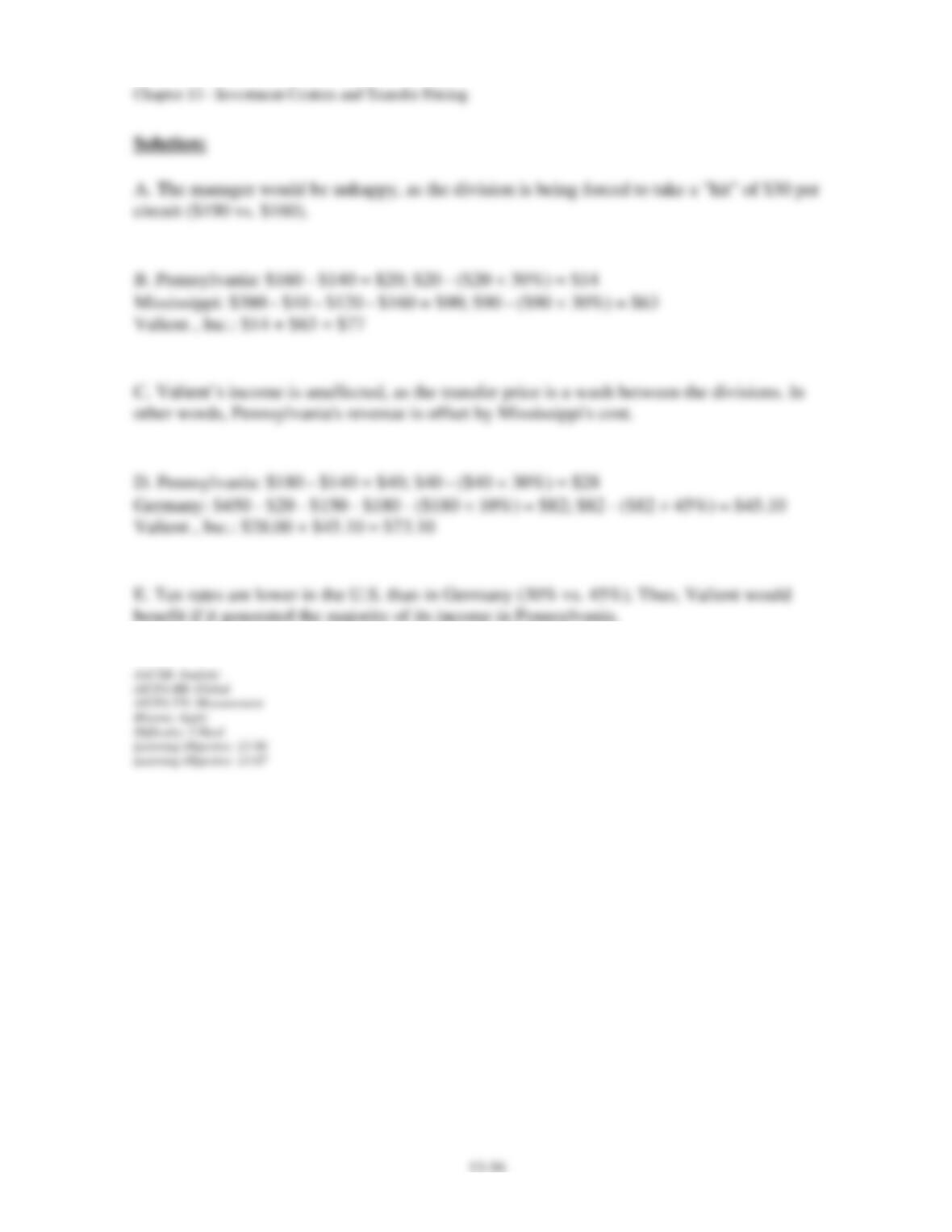
A. Assume that the transfer price for the circuit was $160. How would Pennsylvania’s
divisional manager likely react to a corporate decision to transfer the circuits to Mississippi?
Why?
B. Calculate Pennsylvania income, Mississippi income, and income for the company as a
whole if the transfer took place at $160 per circuit.
C. Assuming that transfers took place at a price higher than $160, would the revised price
increase, decrease, or have no effect on Valient’s income? Briefly explain.
D. Assume that Valient moved its GPS production facility to a division located in Germany,
which is subject to a 45% tax rate. The transfer took place at $180. Shipping fees (absorbed
by the overseas division) doubled to $20; the German division paid an import duty equal to
10% of the transfer price; and labor, overhead, and additional material costs were $150 per
GPS. If the German selling price of the GPS amounted to $450, calculate Pennsylvania
income, German income, and income for Valient as a whole.
E. Suppose that U.S. and German tax authorities allowed some discretion in how transfer
prices were set. Given the difference in tax rates, should Valient attempt to generate the
majority of its income in Pennsylvania or Germany? Why?
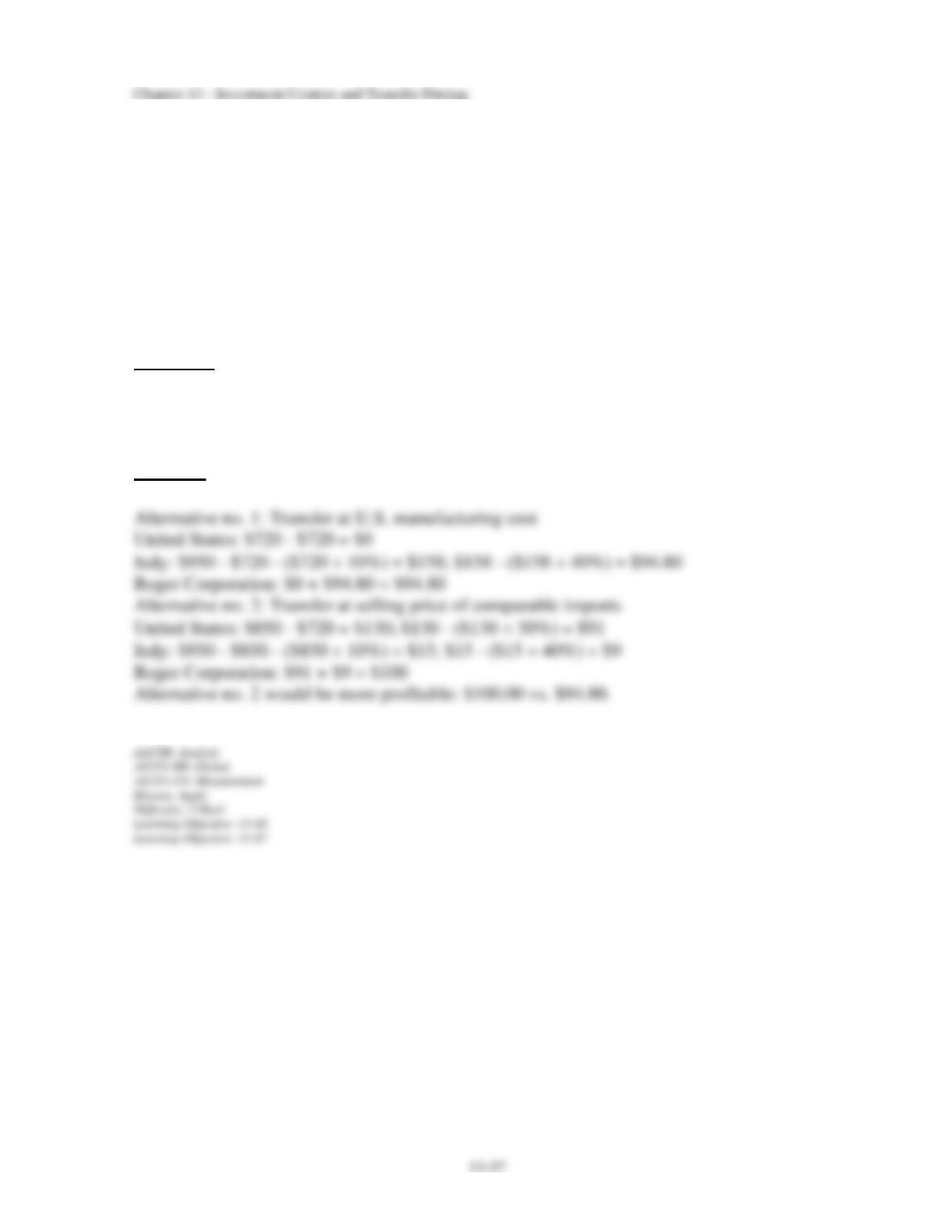
102. Roger Corporation produces goods in the United States, to be sold by a separate division
located in Italy. More specifically, the Italian division imports units of product X34 from the
U.S. and sells them for $950 each. (Imports of similar goods sell for $850.) The Italian
division is subject to a 40% tax rate whereas the U.S. tax rate is only 30%. The manufacturing
cost of product X34 in the United States is $720. Furthermore, there is a 10% import duty
computed on the transfer price that will be paid by the Italian division and is deductible when
computing Italian income. Tax laws of the two countries allow transfer prices to be set at U.S.
manufacturing cost or the selling prices of comparable imports in Italy.
Required:
Analyze the profitability of the U.S. division, the Italian division, and Roger as a whole to
determine if the overall corporation would be better off if transfers took place at (1) U.S.
manufacturing cost or (2) the selling price of comparable imports.
Solution:

13–58
103. Carson, Inc., which produces electronic parts in the United States, has a very strong local
market for part no. 54. The variable production cost is $40, and the company can sell its entire
supply domestically for $110. The U.S. tax rate is 30%.
Alternatively, Carson can ship the part to a division that is located in Switzerland, to be used
in a product that the Swiss division will distribute throughout Europe. Information about the
Swiss product and the division’s operating environment follows:
Selling price of final product: $400
Shipping fees to import part no. 54: $20
Labor, overhead, and additional material costs of final product: $230
Import duties levied on part no. 54 (to be paid by the Swiss division): 10% of transfer
price
Swiss tax rate: 40%
Based on U.S. and Swiss tax laws, the company has established a transfer price for part no. 54
equal to the U.S. market price. Assume that the Swiss division can obtain part no. 54 in
Switzerland for $125.
Required:
A. If you were the head of the Swiss division, would you be better off financially to conduct
business with your U.S. division or buy part no. 54 locally? Why? Show computations.
B. Carson’s accounting department has figured that the company will make $66.40 for each
unit transferred and used in the Swiss division’s product. Rather than proceed with a transfer,
would Carson be better off to sell its goods domestically and allow the Swiss division to
acquire part no. 54 in Switzerland? Show computations for both U.S. and Swiss operations to
support your answer.
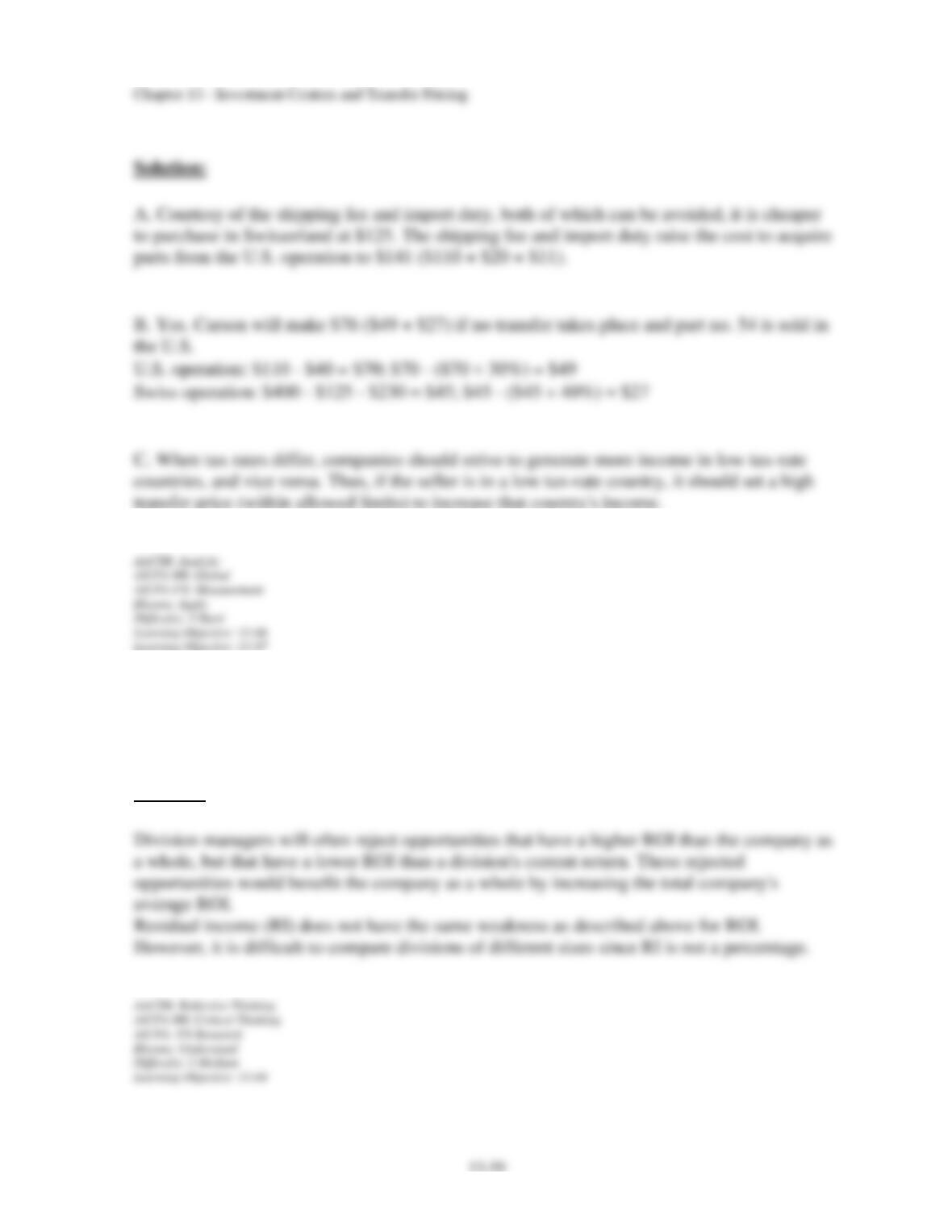
C. Generally speaking, when tax rates differ between countries, what income strategy should
a company use in setting its transfer prices? If the seller is in a low tax-rate country, what type
of price should it set? Why?
104. Return on investment (ROI) and residual income (RI) are popular measures of divisional
performance. Like any measure, there are disadvantages or weaknesses that are an inherent
part of these tools. Briefly discuss a major weakness associated with each tool.
Solution:
105. Return on investment (ROI) is a very popular tool to evaluate performance. The
measurement of ROI is dependent, in part, on whether fixed assets are valued at acquisition
cost or net book value.
List several advantages of acquisition cost and net book value as ways to value long-lived
assets.
Solution:
106. One element of the general transfer-pricing rule is opportunity cost. Briefly define the
term “opportunity cost” and then explain how it is computed for (1) companies that have
excess capacity and (2) companies that have no excess capacity.
Solution:
107. Although the general rule for transfer prices is the outlay cost plus opportunity cost,
many companies instead use negotiated prices to price their goods and services. When are
negotiated transfer prices used? Are such prices consistent or inconsistent with responsibility
accounting? Explain.
Solution:
108. What are the three objectives of internal controls in preventing suboptimal decisions and
the costs of undermining divisional autonomy?.
Solution: