43) At March 31, 2014, the Park Place Company shows the following data on their balance sheet:
Stockholders’ equity
Common stock, $1 par, 1,000,000 shares
authorized,
$120,000
120,000 shares issued, 110,000 shares
outstanding
Paid-in capital in excess of par
2,470,000
Retained earnings
5,440,000
Treasury stock, 10,000 shares at $25
(250,000)
Total stockholder’s equity
$7,780,000
Assume that Park Place sells 900 shares of treasury stock at $32 per share. What will the total equity be after this
transaction?
A) $7,751,200
B) $7,808,800
C) $7,780,900
D) $7,730,000
44) Which of the following is a common reason for companies to retire preferred stock?
A) To stop paying out dividends to preferred shareholders
B) To make a profit on the retirement of preferred stock
C) To reward the preferred shareholders
D) To increase stockholders’ equity
45) If a company retires preferred stock, which of the following is TRUE?
A) Total equity will decrease.
B) Total equity will increase.
C) The company can record a gain or loss on retirement of stock.
D) The number of outstanding shares will go up.
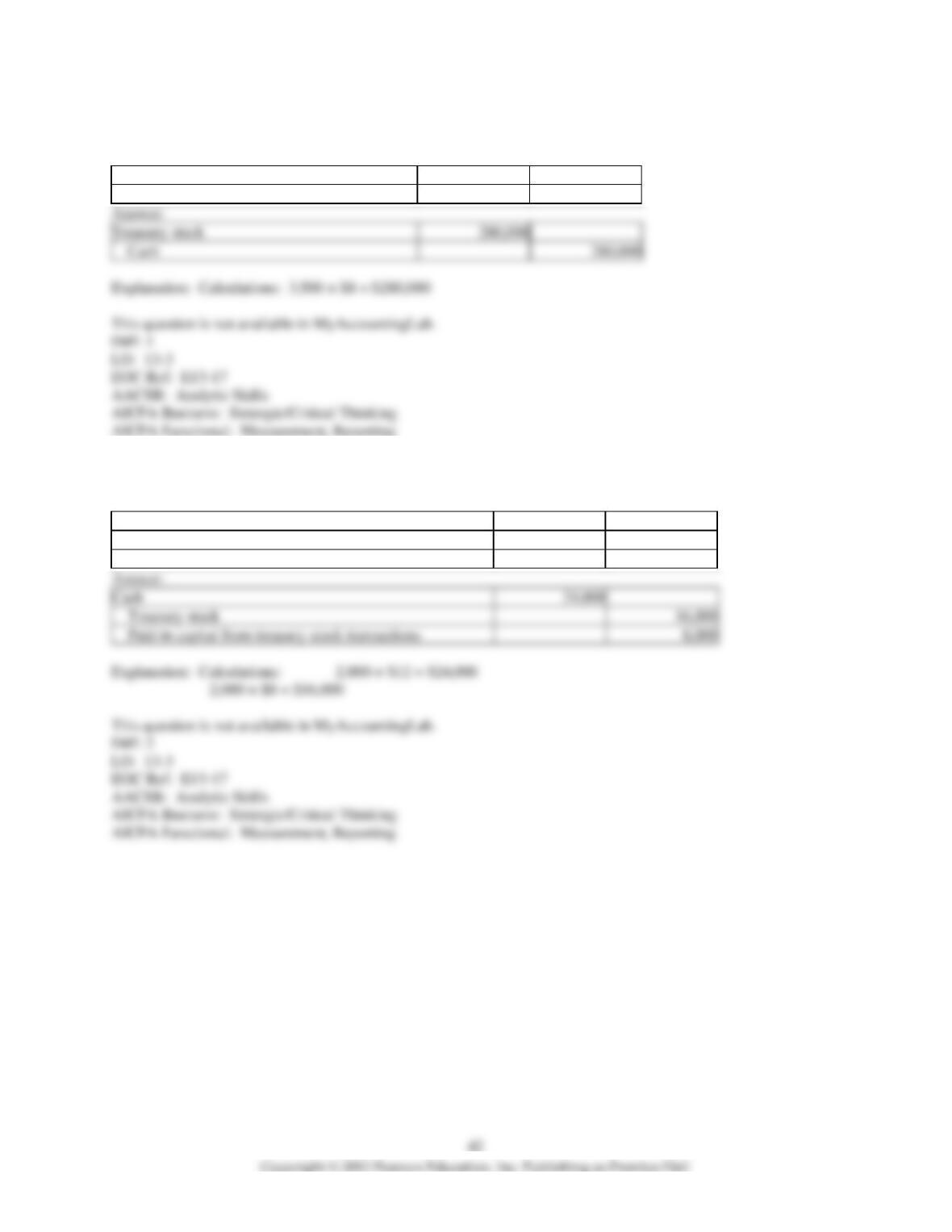
46) Rakish Co. purchases 3,500 shares of the company’s $6 par common stock for $8/share. Journalize the
transaction.
Treasury stock
47) Rakish Co. purchases 3,500 shares of the company’s $6 par value common stock for $8 per share. It later sells
2,000 shares for $12 per share. Please provide the journal entry for the sale of the treasury stock.
Cash
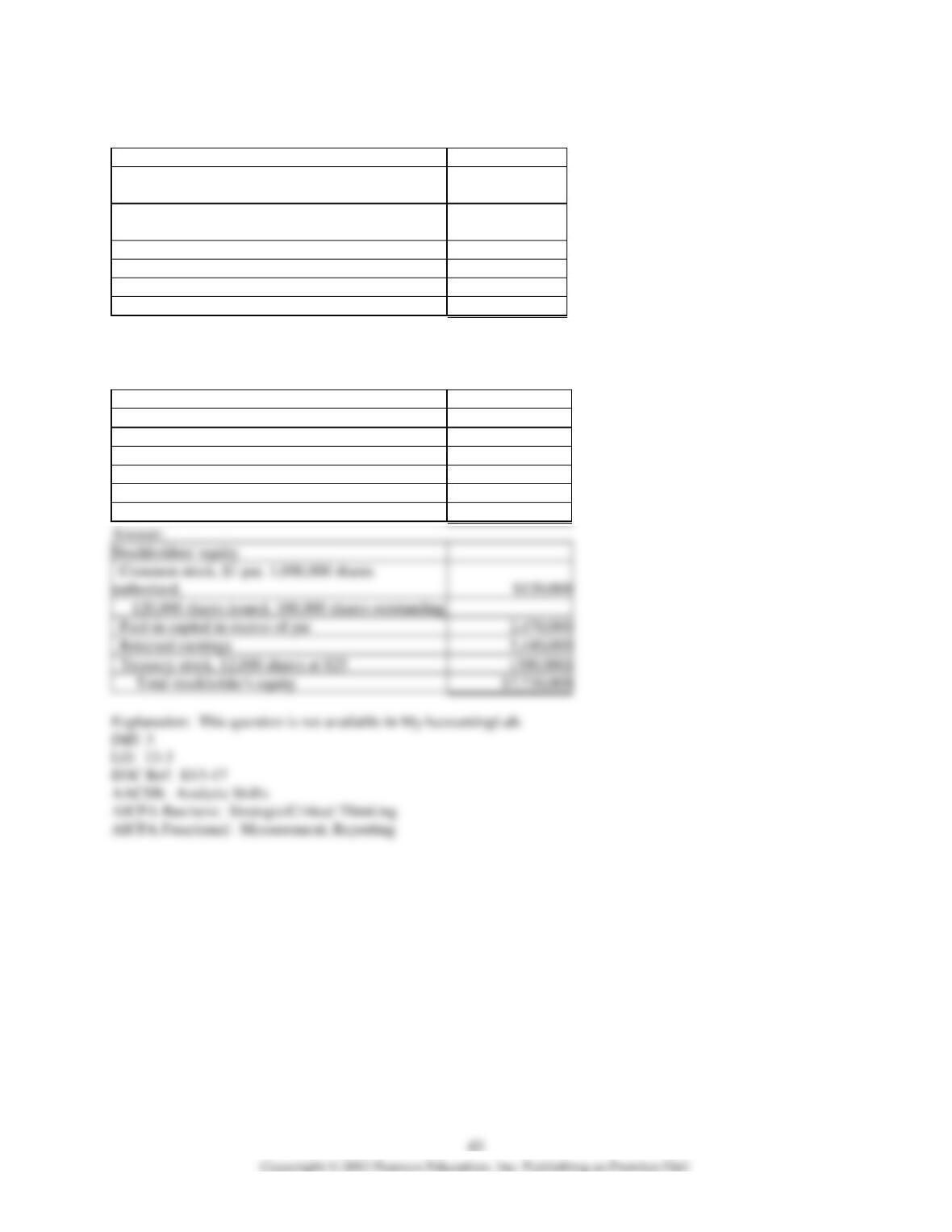
48) At March 31, 2014, the Park Place Company shows the following data on their balance sheet:
Stockholders’ equity
Common stock, $1 par, 1,000,000 shares
authorized,
$120,000
120,000 shares issued, 110,000 shares
outstanding
Paid-in capital in excess of par
2,470,000
Retained earnings
5,440,000
Treasury stock, 10,000 shares at $25
(250,000)
Total stockholder’s equity
$7,780,000
Assume Park Place purchases an additional 2,000 shares of treasury stock at $25 per share. Please
restate the equity section of the balance sheet to properly reflect the transaction.
Stockholders’ equity
Stockholders’ equity
authorized,
120,000 shares issued, 108,000 shares outstanding
Paid-in capital in excess of par
Treasury stock, 12,000 shares at $25
Total stockholder’s equity
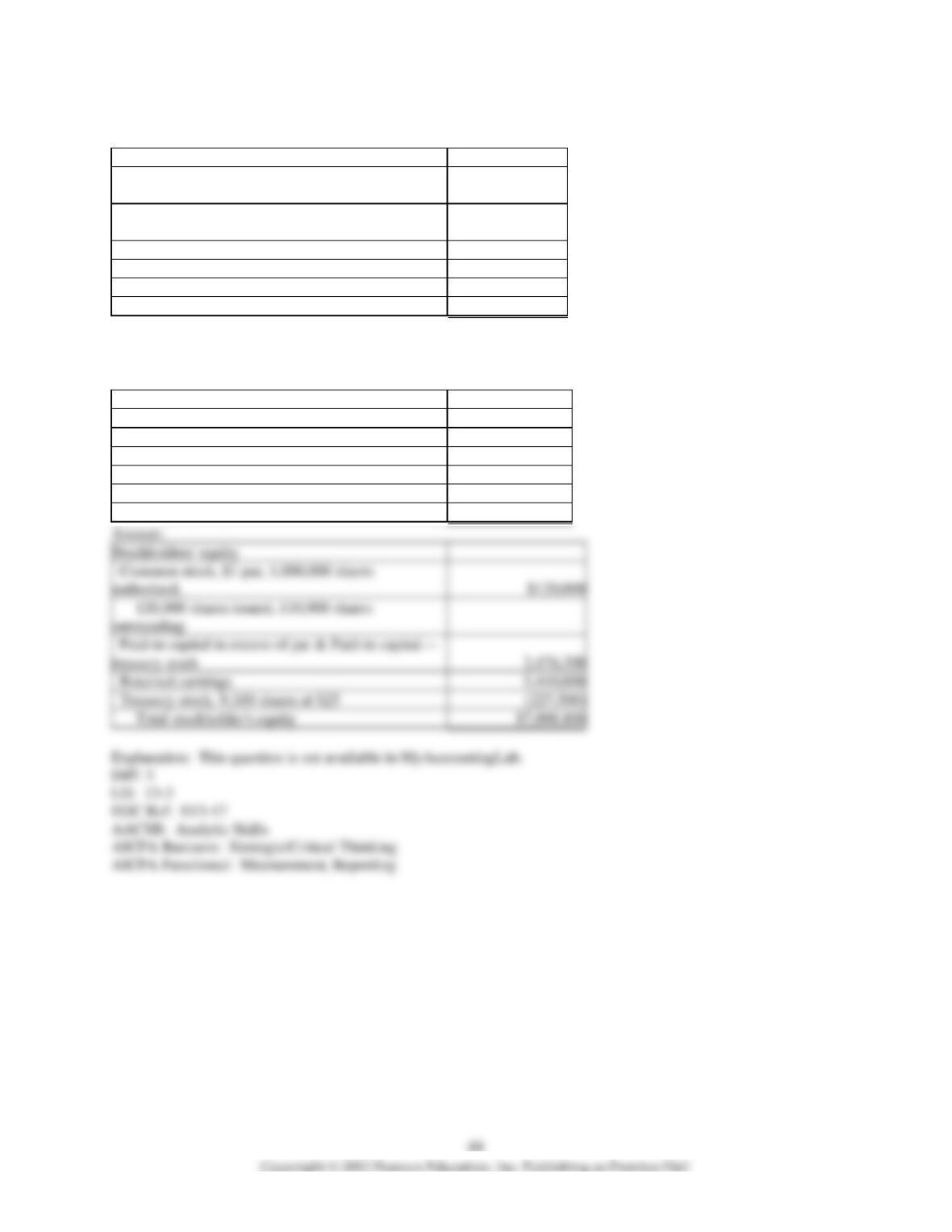
49) At March 31, 2014, the Park Place Company shows the following data on their balance sheet:
Stockholders’ equity
Common stock, $1 par, 1,000,000 shares
authorized,
$120,000
120,000 shares issued, 110,000 shares
outstanding
Paid-in capital in excess of par
2,470,000
Retained earnings
5,440,000
Treasury stock, 10,000 shares at $25
(250,000)
Total stockholder’s equity
$7,780,000
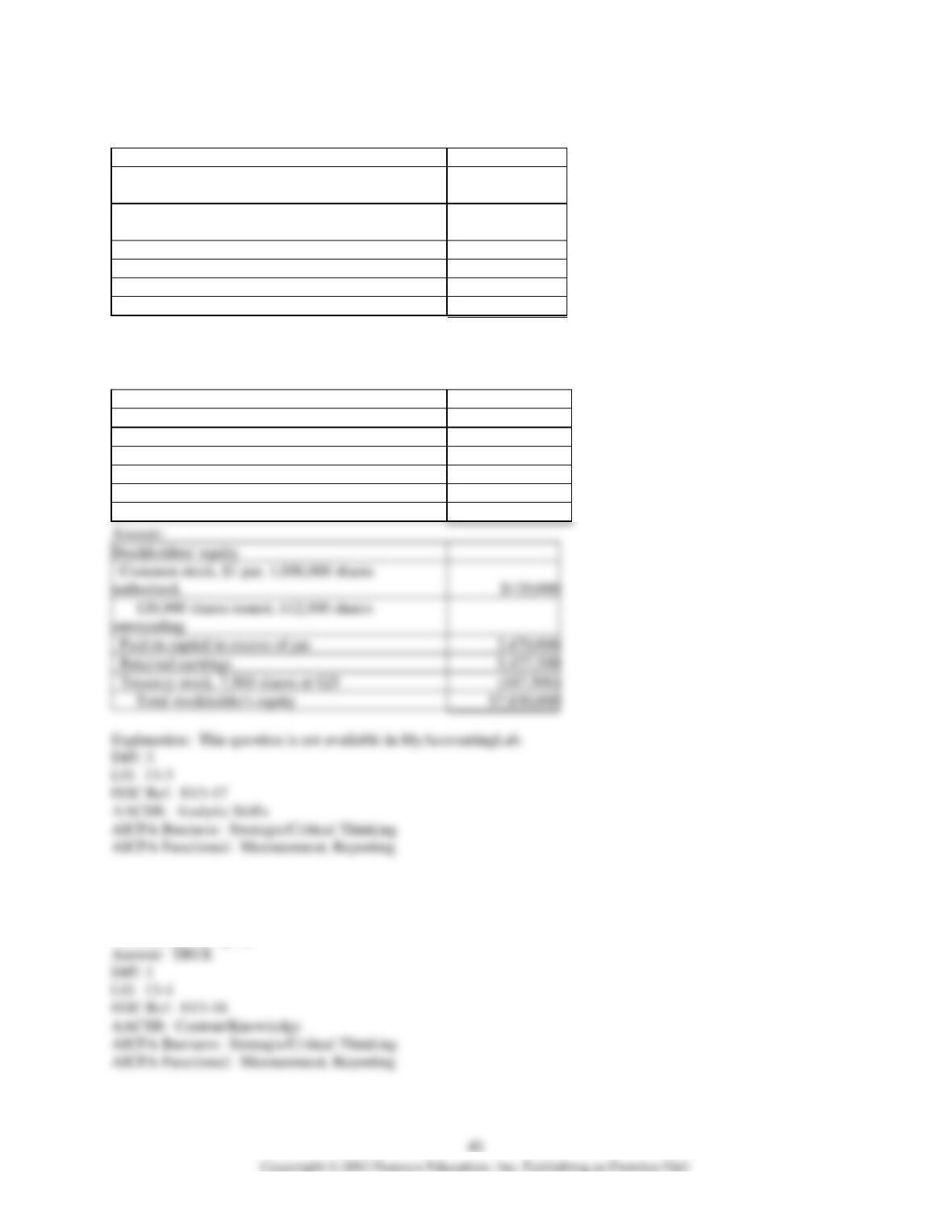
Assume that Park Place sells 900 shares of treasury stock at $32 per share. Please restate the equity section of the
balance sheet to reflect that transaction.
Stockholders’ equity
Stockholders’ equity
authorized,
120,000 shares issued, 110,900 shares
outstanding
treasury stock
Retained earnings
Treasury stock, 9,100 shares at $25
Total stockholder’s equity
50) At March 31, 2014, the Park Place Company shows the following data on their balance sheet:
Stockholders’ equity
Common stock, $1 par, 1,000,000 shares
authorized,
$120,000
120,000 shares issued, 110,000 shares
outstanding
Paid-in capital in excess of par
2,470,000
Retained earnings
5,440,000
Treasury stock, 10,000 shares at $25
(250,000)
Total stockholder’s equity
$7,780,000
Assume that Park Place sells 2,500 shares of treasury stock at $20 per share. Please restate the equity section of the
balance sheet to reflect that transaction.
Stockholders’ equity
Stockholders’ equity
authorized,
120,000 shares issued, 112,500 shares
outstanding
Retained earnings
Treasury stock, 7,500 shares at $25
Total stockholder’s equity
Learning Objective 13-4
1) Lenders may restrict the amount of treasury stock a corporation may purchase in order to ensure a minimum level
of stockholders’ equity.
2) Companies usually report their retained earnings restrictions on the balance sheet.
3) If a company wanted to put a limit on cash dividends to ensure they would have enough retained earnings for a
specific project intended to expand and grow the company, the appropriation of a portion of retained earnings would
be a good strategy.
4) If a company’s lenders wanted to ensure that the company maintained adequate levels of equity to pay back their
loans, a good strategy would be to impose restrictions on dividend payments and purchases of treasury stock.
5) The entry to record an appropriation of retained earnings requires a debit to Retained earnings and a credit to
Cash.
6) Which of the following statements is TRUE?
A) Restrictions on retained earnings require adjusting journal entries.
B) Restrictions on retained earnings are usually reported in the notes to the financial statements.
C) Restrictions on retained earnings are disclosed on the income statement.
D) Restrictions on retained earnings are designed to maximize dividends paid to shareholders.
7) Which of the following would be a reason for a company to restrict its cash dividends or treasury stock
purchases?
A) Because the company needs treasury stock to offer as performance incentives to upper management
B) In order to give shareholders stock dividends
C) Due to the desire of shareholders to retain the company’s earnings for future growth and capital expenditures
D) Due to requirements of lenders or creditors that companies maintain enough equity to meet their obligations
8) Which of the following BEST describes restrictions on cash dividends and treasury stock purchases?
A) Restrictions on cash payments that are made to ensure higher reported profits
B) Limits required by lenders or creditors to ensure that the company maintains adequate levels of equity
C) Restrictions on payments made by the shareholders to lower federal income tax expense
D) Limits that are established to boost sales revenues
9) Which of the following BEST describes the appropriation of retained earnings?
A) Earmarking certain amounts for specific business purposes, such as for growth or expansion projects
B) Restricting cash dividends or treasury stock purchases so that the company maintains adequate levels of equity
C) Designating certain amounts of retained earnings for cash dividends to be paid out to shareholders
D) Limiting company transactions in order to boost earnings and profits
10) Which of the following would be a reason for a company to appropriate a portion of retained earnings?
A) To ensure that the business does not take on too much debt
B) To increase the amount of earnings available for dividends
C) To help the company control levels of operating expenses
D) To limit the amount of retained earnings available for dividends, in order to retain sufficient funds for growth
11) Which of the following statements is TRUE?
A) Appropriations of retained earnings require journal entries, but restrictions on retained earnings do not.
B) No journal entries are needed to either appropriate or restrict retained earnings.
C) Both appropriations and restrictions of retained earnings require journal entries.
D) Restrictions on retained earnings must be journalized, but appropriations do not need to be journalized.
Learning Objective 13-5
1) Gains and losses from the disposal of old plant and equipment are reported as other gains or losses in the multi–
step income statement.
2) The sale or other disposition of a segment of a business is recorded as an extraordinary gain or loss.
3) Public companies are required to publish financial statements, but privately held companies are generally not
required to do so.
4) Prior period adjustments are shown as an adjustment to the beginning balance of Retained earnings, as reported
on the statement of retained earnings.
5) Comprehensive income is the company’s change in total stockholders’ equity from all sources other than its
owners, and sometimes includes items not found on the income statement.
6) Certain types of transactions, other than dividend payments, that are NOT included in the income statement, but
have an effect on retained earnings would be treated as part of comprehensive income.
7) Comprehensive income is equal to the net income of a company, excluding the effects of discontinued operations
and extraordinary items.
8) RT Corp. shows a loss from flooding of $235,000 for the year. Flooding is not uncommon in the area, and so this
loss will be included in operating income.
9) Companies are NOT allowed to combine the income statement and the statement of retained earnings, but must
show them as two separate reports.
10) Which of the following BEST describes operating income?
A) The gains and losses from transactions that are not part of the normal operations of the business
B) The income or loss from segments of the business that have been sold or terminated
C) The income or loss generated from unusual or infrequent events
D) The income or loss generated from the normal operations of the business
11) Which of the following best describes other gains (losses) on the income statement?
A) The gains and losses from transactions that are not part of the normal operations of the business
B) The income or loss from segments of the business that have been sold or terminated
C) The income or loss generated from unusual and infrequent events
D) The income or loss generated from the normal operations of the business
12) Which of the following best describes extraordinary items on the income statement?
A) The gains and losses from transactions that are not part of the normal operations of the business
B) The income or loss from segments of the business that have been sold or terminated
C) The income or loss generated from unusual and infrequent events
D) The income or loss generated from the normal operations of the business
13) Which of the following best describes discontinued operations on the income statement?
A) The gains and losses from transactions that are not part of the normal operations of the business
B) The income or loss from segments of the business that have been sold or terminated
C) The income or loss generated from unusual or infrequent events
D) The income or loss generated from the normal operations of the business
14) For the year 2013, Foxmore Company reports the following items as part of their financial results:
Sales revenues from regular business operations
$3,000,000
Cost of goods sold
900,000
Operating expenses from their regular business operations
600,000
Gain on disposal of several items of property, plant & equipment
15,000
Income tax expense on continuing operations
330,000
Loss on the termination of a discontinued business segment, net of
tax
120,000
Losses on damage caused by earthquake, net of tax
280,000
How much is total operating income (loss)?
A) $1,065,000
B) $1,500,000
C) $1,515,000
D) $1,185,500
15) For the year 2013, Foxmore Company reports the following items as part of their financial results:
Sales revenues from regular business operations
$3,000,000
Cost of goods sold
900,000
Operating expenses from their regular business operations
600,000
Gain on disposal of several items of property, plant & equipment
15,000
Income tax expense on continuing operations
330,000
Loss on the termination of a discontinued business segment, net of
tax
120,000
Losses on damage caused by earthquake, net of tax
280,000
How much is the income (loss) from continuing operations, before tax?
A) $1,065,000
B) $1,500,000
C) $1,515,000
D) $1,185,500
16) For the year 2013, Foxmore Company reports the following items as part of their financial results:
Sales revenues from regular business operations
$3,000,000
Cost of goods sold
900,000
Operating expenses from their regular business operations
600,000
Gain on disposal of several items of property, plant & equipment
15,000
Income tax expense on continuing operations
330,000
Loss on the termination of a discontinued business segment, net of
tax
120,000
Losses on damage caused by earthquake, net of tax
280,000
How much is the income (loss) from continuing operations, after tax?
A) $1,065,000
B) $1,500,000
C) $1,515,000
D) $1,185,000
17) For the year 2013, Foxmore Company reports the following items as part of their financial results:
Sales revenues from regular business operations
$3,000,000
Cost of goods sold
900,000
Operating expenses from their regular business operations
600,000
Gain on disposal of several items of property, plant & equipment
15,000
Income tax expense on continuing operations
330,000
Loss on the termination of a discontinued business segment, net of
tax
120,000
Losses on damage caused by earthquake, net of tax
280,000
How much is the income (loss) before extraordinary items?
A) $1,065,000
B) $1,500,000
C) $1,515,000
D) $1,185,000