Chapter 13 – Investment Centers and Transfer Pricing
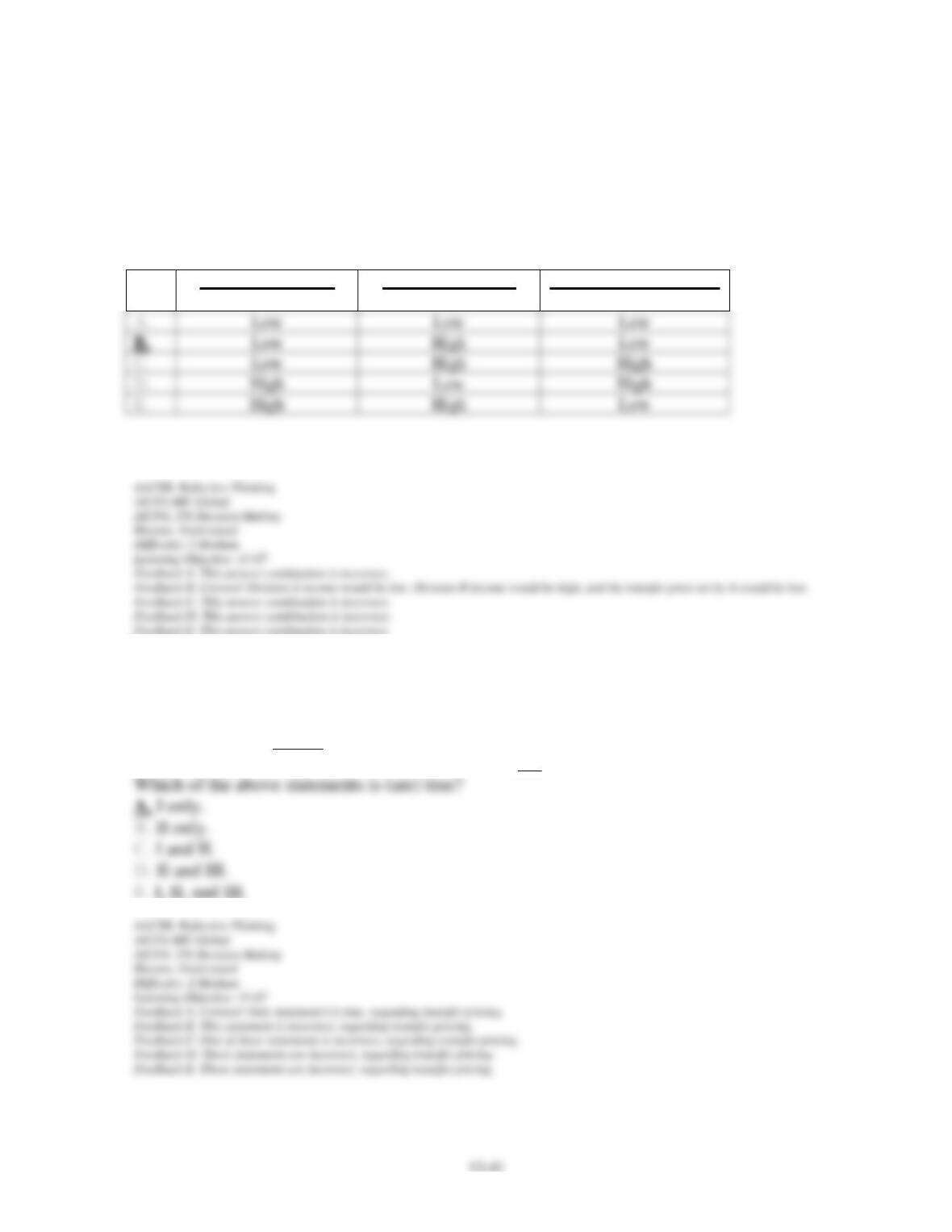
85. Division A transfers a profitable subassembly to Division B, where it is assembled into a
final product. A is located in a European country that has a high tax rate; B is located in an
Asian country that has a low tax rate. Ideally, (1) what type of before-tax income should each
division report from the transfer and (2) what type of transfer price should Division A set for
the subassembly?
Division A Income
Division B Income
Transfer Price set by A
86. Consider the following statements about transfer pricing:
I. Income taxes and import duties are an important consideration when setting a transfer price
for companies that pursue international commerce.
II. Transfer prices cannot be used by organizations in the service industry.
III. Transfer prices are totally cost-based in nature, not market-based.
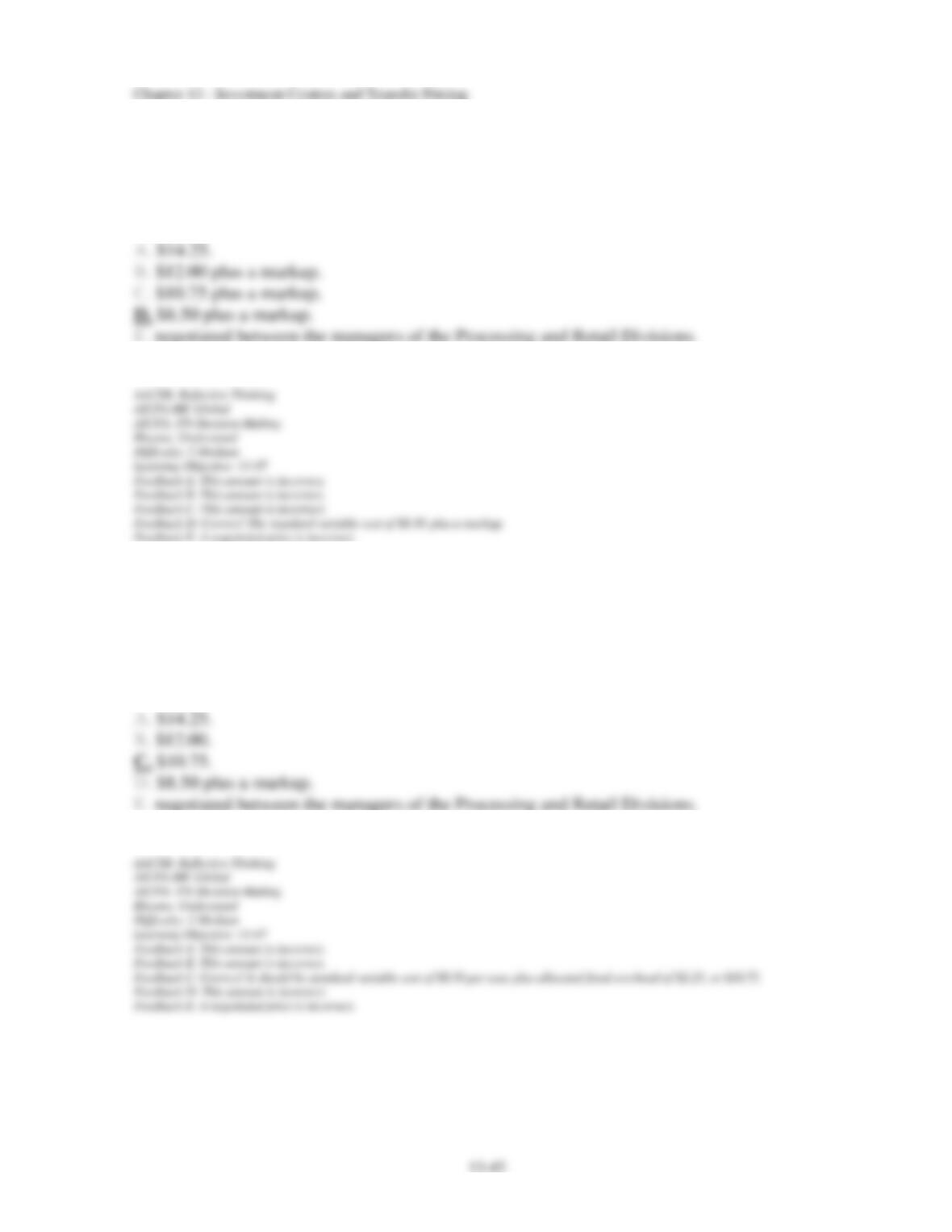
87. Overton Company uses cost-based transfer pricing. Its Food Processing Division has a
standard variable cost of $8.50 per case and allocated fixed overhead of $2.25. The Processing
Division, which has excess capacity, sells its output to external customers for $12.00 per case.
If Overton uses variable costs as its base, the transfer price charged to its Retail Division
should be:
88. Overton Company uses cost-based transfer pricing. Its Food Processing Division has a
standard variable cost of $8.50 per case and allocated fixed overhead of $2.25. The Processing
Division, which has excess capacity, sells its output to external customers for $12.00 per case.
If Overton uses full (or absorption) cost as its base, the transfer price charged to its Retail
Division should be:
Chapter 13 – Investment Centers and Transfer Pricing
Essay Questions
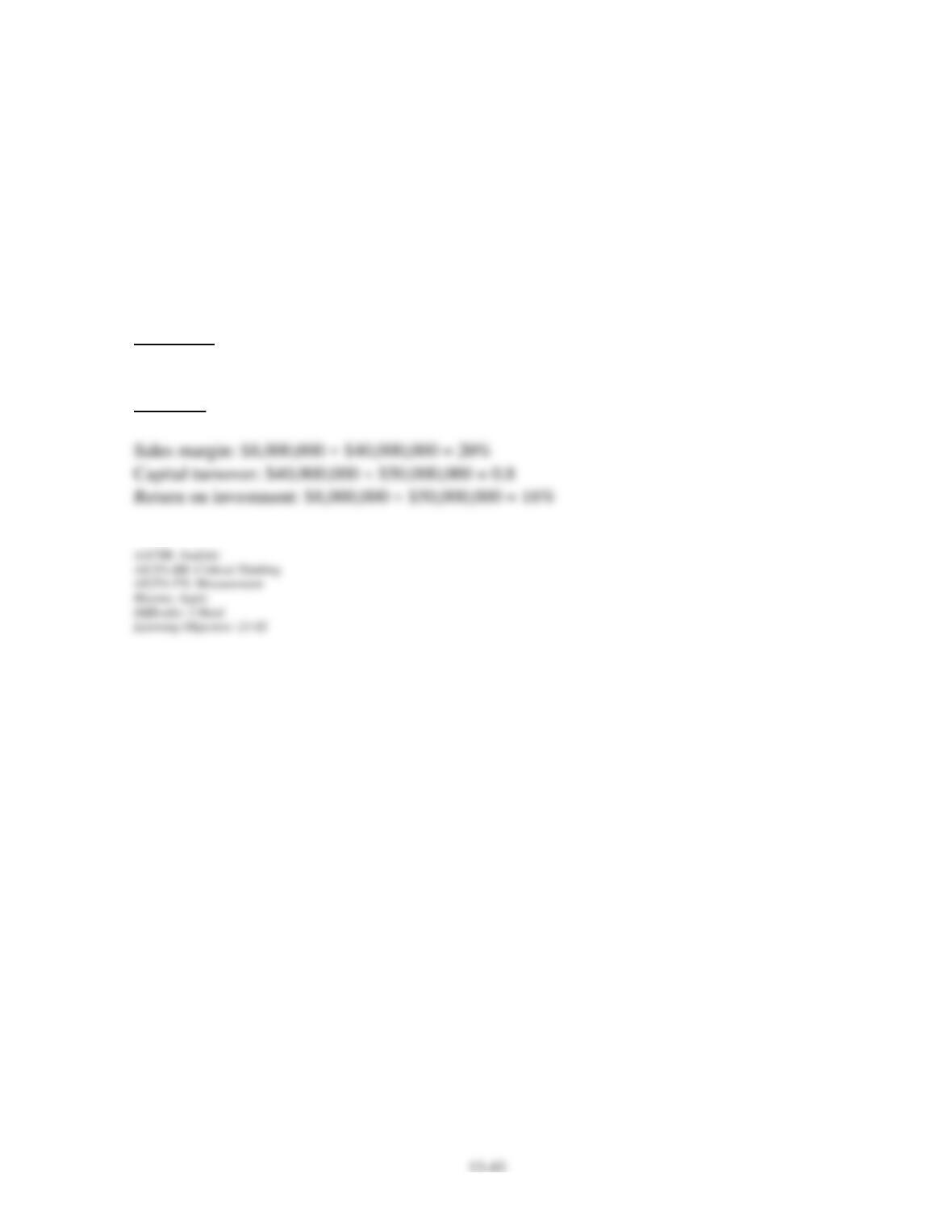
89. The following data pertain to Caldron Corporation:
Income $8,000,000
Sales revenue 40,000,000
Average invested capital 50,000,000
Required:
Calculate Caldron Corporation’s sales margin, capital turnover, and return on investment.
Solution:
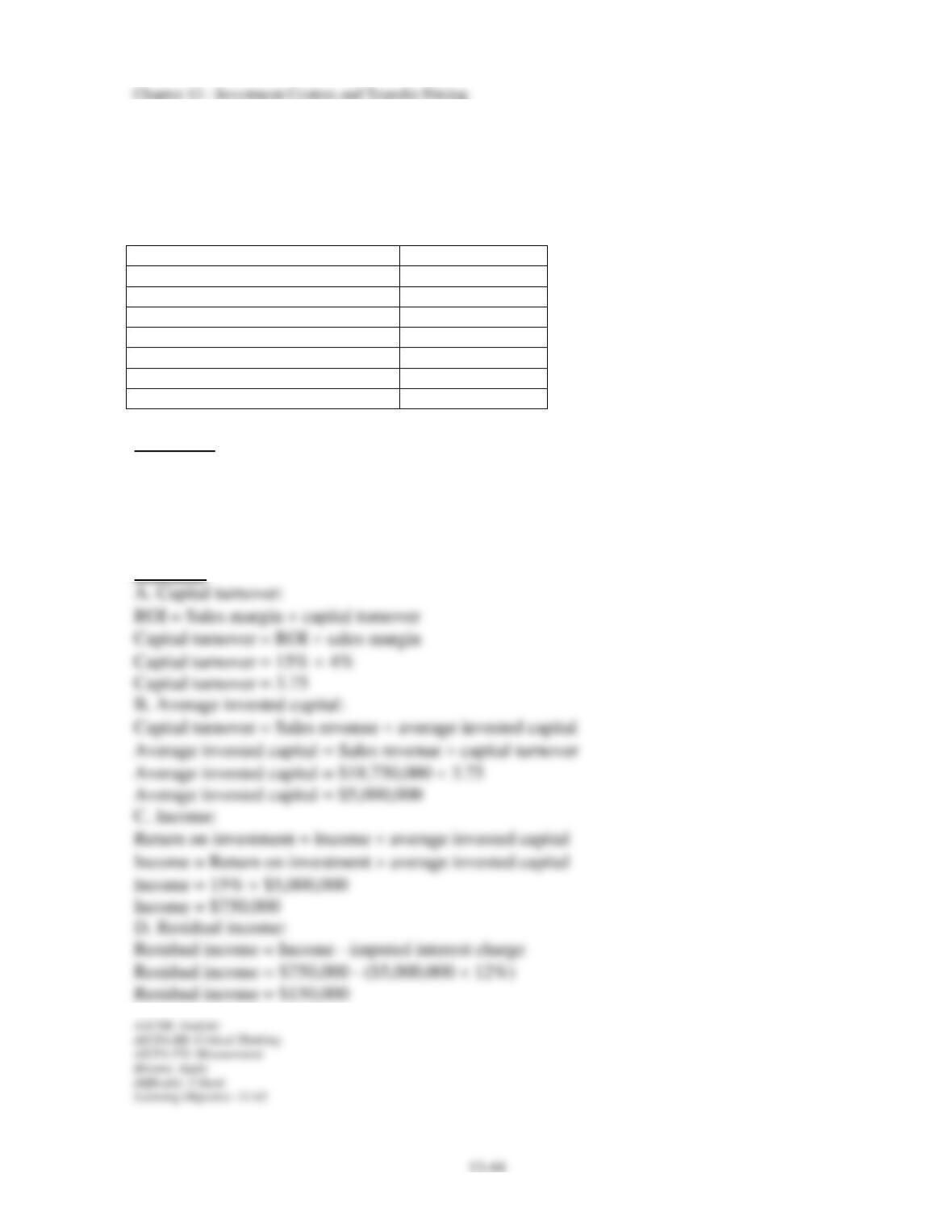
90. Consider the following data of Twisted Corporation’s Northern Division:
Sales revenue
$18,750,000
Capital turnover
?
Average invested capital
?
Sales margin
4%
Income
?
Return on investment
15%
Residual income
?
Twisted’s imputed interest rate
12%
Required:
A. Calculate Northern’s capital turnover.
B. Calculate Northern’s average invested capital.
C. Calculate Northern’s income.
D. Calculate residual income.
Solution:
91. Ragtime Division, which is part of Conquer Enterprises, recently reported a sales margin
of 30% and an ROI of 21%.
Required:
A. Briefly define sales margin, capital turnover, and return on investment.
B. Assume that Ragtime has residual income of $220,000 and that Conquer uses an imputed
interest rate of 10%. Compute Ragtime’s capital turnover and invested capital.
C. In answering this question, ignore the assumptions stated in requirement “B,” and your
answer. Instead, assume that Ragtime’s invested capital amounted to $2,500,000. On the basis
of this information, calculate income and sales revenue.
Solution:
92. The following data pertain to Darwin Industries:
Interest rate on debt capital: 9%
Cost of equity capital: 12%
Before-tax operating income: $35 million
Market value of debt capital: $60 million
Market value of equity capital: $120 million
Total assets: $150 million
Income tax rate: 30%
Total current liabilities: $15 million
Required:
A. Compute Darwin’s weighted-average cost of capital.
B. Compute Darwin’s economic value added.
C. Briefly explain the meaning of economic value added.
Solution:
93. The following data pertain to Napal Company for 20×1:
Sales revenue $1,000,000
Cost of goods sold 550,000
Operating expenses 400,000
Average invested capital 500,000
Required:
A. Calculate the company’s sales margin, capital turnover, and return on investment for 20×1.
B. If the sales and average invested capital remain the same, to what level would total costs
and expenses have to be reduced in 20×2 to achieve a 15% return on investment?
C. Assume that costs and expenses are reduced, as calculated in requirement “B.” Calculate
the firm’s new sales margin.
D. Suggest two possible actions that will improve the company’s capital turnover.
Solution:
A.
94. The following data pertain to the Ouster Division of Klandestine Company:
Divisional contribution margin
$700,000
Profit margin controllable by the divisional manager
320,000
Profit margin traceable to the division
294,400
Average asset investment
1,280,000
The company uses responsibility accounting concepts when evaluating performance; Ouster’s
division manager is contemplating the following three investments. He can invest up to
$400,000.
No. 1
No. 2
No. 3
Cost
$250,000
$300,000
$400,000
Expected income
50,000
54,000
96,000
Required:
A. Calculate the ROIs of the three investments.
B. What is the division manager’s current ROI, computed by using responsibility accounting
concepts?
C. Which of the three investments would be selected if the manager’s focus is on Ouster’s
divisional performance, as judged by ROI? Why?
D. If Klandestine has an imputed interest charge of 22%, compute the residual income of
investment no. 3. If Ouster’s Division manager is evaluated by residual income, is this
investment attractive from Ouster’s perspective? From Klandestine’s perspective? Why?
Solution:
13–49
95. Compuwork Corporation is organized in three separate divisions. The three divisional
managers are evaluated at year-end, and bonuses are awarded based on ROI. Last year, the
overall company produced a 12% return on its investment.
Managers of Compuwork’s Iowa Division recently studied an investment opportunity that
would assist in the division’s future growth. Relevant data follow.
Iowa Division
Investment Opportunity
Income
$12,800,000
$4,200,000
Invested capital
80,000,000
30,000,000
Required:
A. Compute the current ROI of the Iowa Division and the division’s ROI if the investment
opportunity is pursued.
B. What is the likely reaction of divisional management toward the acquisition? Why?
C. What is the likely reaction of Compuwork’s corporate management toward the investment?
Why?
D. Assume that Compuwork uses residual income to evaluate performance and desires an
11% minimum return on invested capital. Compute the current residual income of the Iowa
Division and the division’s residual income if the investment is made. Will divisional
management likely change its attitude toward the acquisition? Why?
Solution:
Current residual income of Iowa Division:
Divisional income
Less: Imputed interest charge ($80,000,000 x 11%)
Residual income
Residual income if investment is made:
Divisional income ($12,800,000 + $4,200,000)
Less: Imputed interest charge [($80,000,000 + $30,000,000 x 11%)]
Residual income
96. Arlene Clanston, general manager of the Northwest Division of Blanton Enterprises, has
significant authority over pricing decisions as well as programs that involve cost
reduction/control. The data that follow relate to upcoming divisional operations:
Average invested capital: $15,000,000
Annual fixed costs: $3,900,000
Variable cost per unit: $80
Number of units expected to be sold: 120,000
Required:
A. Top management will promote Clanston if she can earn a 14% return on investment for the
year. What unit selling price should she establish to get her promotion?
B. Independent of part “A,” assume the unit selling price is $132 and that Blanton has a 16%
imputed interest charge. Top management will promote Clanston to corporate headquarters if
her division can generate $200,000 of residual income. If Clanston desires to move to
corporate, what must the division do to the amount of annual fixed costs incurred? Show your
calculations.
Solution:
97. Neosho Corporation’s Gauge Division manufactures and sells product no. 24, which is
used in refrigeration systems. Per-unit variable manufacturing and selling costs amount to $23
and $7, respectively. The Division can sell this item to external domestic customers for $40
or, alternatively, transfer the product to the company’s Refrigeration Division. Refrigeration is
currently purchasing a similar unit from Taiwan for $36. Assume use of the general transfer-
pricing rule.
Required:
A. What is the most that the Refrigeration Division would be willing to pay the Gauge
Division for one unit?
B. If Gauge had excess capacity, what transfer price would the Division’s management set?
C. If Gauge had no excess capacity, what transfer price would the Division’s management set?
D. Repeat part “C,” assuming that Gauge was able to reduce the variable cost of internal
transfers by $5 per unit.
Solution: