70) The number of units required for production is equal to:
A) budgeted sales plus units in the beginning inventory minus the units in the ending inventory.
B) budgeted sales plus units in the ending inventory minus the units in the beginning inventory.
C) budgeted sales plus the units in the ending inventory.
D) budgeted sales minus the units in the beginning inventory.
71) The amount of materials to be purchased during the budget period is equal to budgeted:
A) total production needs plus units in the beginning materials inventory minus the units in the
ending materials inventory.
B) total production needs plus units in the ending materials inventory minus the units in the
beginning materials inventory.
C) units to be produced plus units in the beginning materials inventory minus the units in the
ending materials inventory.
D) units to be produced plus units in the ending materials inventory minus the units in the
beginning materials inventory.
72) Which of the following budgets does not require the production budget?
A) Direct materials.
B) Direct labor.
C) Manufacturing overhead.
D) Marketing and administrative expenses.
73) The manufacturing overhead budget requires that costs be separated into their fixed and
variable components. Another budget that has this requirement is the:
A) direct labor.
B) direct materials.
C) cost of goods sold.
D) marketing and administrative expenses.
74) Which of the following statements does not reflect a difficulty in preparing the marketing
and administrative budget?
A) Managers have discretion about how much money is spent.
B) Managers have discretion about the timing of when money is spent.
C) Marketing and administrative expenses are made up of fixed and variable items.
D) Marketing and administrative expenses normally have a one-year time horizon.
75) Which of the following types of accounts would not be included on a budgeted balance
sheet?
A) Cash.
B) Assets.
C) Liabilities.
D) Revenues.
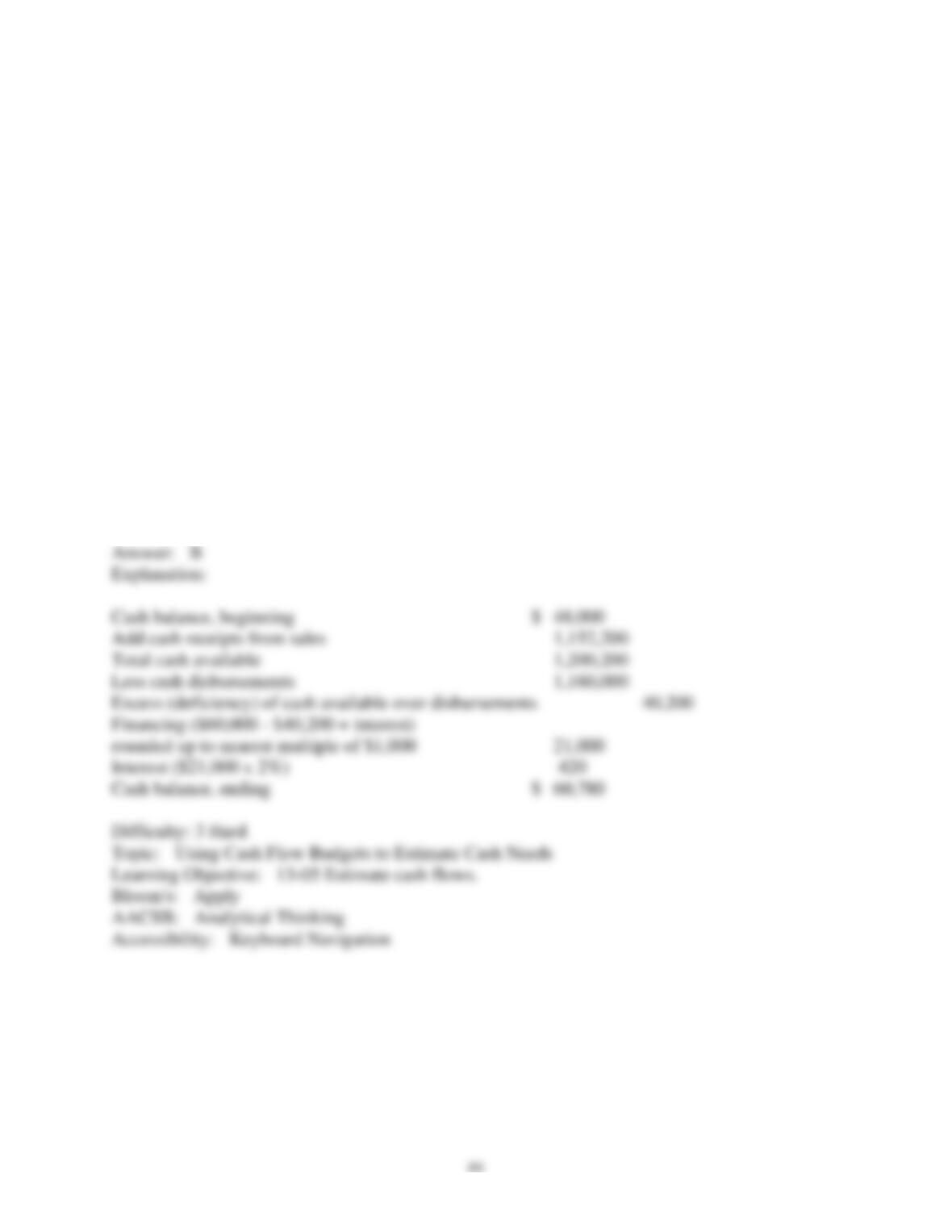
76) The Arkansas Company makes and sells a product called Product K. Each unit of Product K
sells for $24 and has a unit variable cost of $18. The company has the following budgeted data
for November:
∙ Sales of $1,152,200, all in cash.
∙ A cash balance on November 1 of $48,000.
∙ Cash disbursements (other than interest) during November of $1,160,000.
∙ A minimum cash balance on November 30 of $60,000.
If necessary, the company will borrow cash from a bank. The borrowing will be in multiples of
$1,000 and will bear interest at 2% per month. All borrowing will take place at the beginning of
the month. The November interest will be paid in cash during November.
The amount of cash needed to be borrowed on November 1 to cover all cash disbursements and
to obtain the desired November 30 cash balance is:
A) $20,000.
B) $21,000.
C) $37,000.
D) $38,000.
77) Riff, Inc. is working on its cash budget for June. The budgeted beginning cash balance is
$16,000. Budgeted cash receipts total $188,000 and budgeted cash disbursements total $187,000.
The desired ending cash balance is $40,000. The excess (deficiency) of cash available over
disbursements for June will be:
A) $15,000.
B) $1,000.
C) $17,000.
D) $204,000.
78) Center Company makes collections on sales according to the following schedule:
30% in the month of sale
60% in the month following sale
8% in the second month following sale
The following sales are expected:
Expected Sales
January $ 100,000
February $ 120,000
March $ 110,000
Cash collections in March should be budgeted to be:
A) $110,000.
B) $110,800.
C) $105,000.
D) $113,000.
79) Ari, Inc. is working on its cash budget for December. The budgeted beginning cash balance
is $14,000. Budgeted cash receipts total $127,000 and budgeted cash disbursements total
$126,000. The desired ending cash balance is $40,000. Any borrowing is in multiples of $1,000
and interest is paid in the month following the borrowing.
To attain its desired ending cash balance for December, the company needs to borrow:
A) $25,000.
B) $0.
C) $55,000.
D) $40,000.
80) Which one of the following budgets would be the last one prepared in the master budget
preparation process?
A) Manufacturing overhead budget.
B) Cost of goods sold budget.
C) Marketing cost budget.
D) Cash budget.
81) Cash disbursements would not include payments for:
A) dividends.
B) income taxes.
C) accounts receivable.
D) capital budget expenditures.
82) Tennison Corporation had the following transactions in its first year of operations:
Sales (90% collected in year) $ 1,500,000
Bad debt write-offs 60,000
Disbursements for production costs
and other expenses 1,200,000
Disbursements for income taxes 90,000
Purchases of fixed assets 400,000
Depreciation of fixed assets 80,000
Proceeds from issuance of common stock 500,000
Proceeds from short-term borrowings 100,000
Payments on short-term borrowings 50,000
What is the cash balance at year-end?
A) $150,000.
B) $170,000.
C) $210,000.
D) $280,000.
83) The Model Company is to begin operations in April. It has budgeted April sales of $30,000,
May sales of $34,000, June sales of $40,000, July sales of $42,000, and August sales of $38,000.
Note that 10% of each month’s sales is expected to represent cash sales; 75% of the balance is
expected to be collected in the month following the sale, 17% the second month, 6% the third
month, and the balance is expected to be uncollectible.
What is the amount of cash to be collected in the month of July?
A) $34,022.
B) $38,022.
C) $42,000.
D) $37,580.
84) The Model Company is to begin operations in April. It has budgeted April sales of $30,000,
May sales of $34,000, June sales of $40,000, July sales of $42,000, and August sales of $38,000.
Note that 10% of each month’s sales is expected to represent cash sales; 75% of the balance is
expected to be collected in the month following the sale, 17% the second month, 6% the third
month, and the balance is expected to be uncollectible.
What is the amount of cash to be collected in the month of August?
A) $40,106.
B) $40,340.
C) $38,036.
D) $44,140.
85) The Model Company is to begin operations in April. It has budgeted April sales of $30,000,
May sales of $34,000, June sales of $40,000, July sales of $42,000, and August sales of $38,000.
Note that 10% of each month’s sales is expected to represent cash sales; 75% of the balance is
expected to be collected in the month following the sale, 17% the second month, 6% the third
month, and the balance is expected to be uncollectible.
The Model Company is considering charging 1 1/2% on any balance that is not collected in the
month following the month of sale. This charge would also change the collection percentages to
15% cash sales, 80% of the balance collected in the month following the sale, 16% the second
month, and 3% the third month. This stricter credit policy will reduce the estimated sales budgets
by 7% each month. Under this stricter credit policy, what is the amount of cash to be collected in
July? Round all calculations to the nearest whole dollar.
A) $39,199.
B) $35,312.
C) $38,193.
D) $36,242.
86) Page Company makes 30% of its sales for cash and 70% on account. 60% of the credit sales
are collected in the month of sale, 25% in the month following sale, and 12% in the second
month following sale. The remainder is uncollectible. The following information has been
gathered for the current year:
Month 1 2 3 4
Total sales $60,000 $70,000 $50,000 $30,000
Total cash receipts in Month 4 will be:
A) $38,000.
B) $47,900.
C) $27,230.
D) $36,230.
52
87) Page Company makes 30% of its sales for cash and 70% on account. 60% of the credit sales
are collected in the month of sale, 25% in the month following sale, and 12% in the second
month following sale. The remainder is uncollectible. The following information has been
gathered for Page’s first year of operations:
Month 1 2 3 4
Total sales $60,000 $70,000 $50,000 $30,000
Total cash receipts in Month 3 will be:
A) $52,200.
B) $53,290.
C) $50,000.
D) $51,510.
88) The Beatrice Manufacturing Company increased its merchandise inventory by $17,000 over
the year. The company also granted its customers more liberal credit terms which increased the
accounts receivable by $37,500. Sales were $975,000 and the accounts payable decreased by
$27,500. The gross profit on sales is 45%. Marketing and administrative expenses were
$145,000; this included depreciation expense of $4,000. What were the cash disbursements for
the year?
A) $721,750.
B) $706,500.
C) $689,500.
D) $599,750.
89) The Express Company is preparing its cash budget for the month of June. The following
information is available concerning its inventories:
Inventories at beginning of June $ 67,500
Estimated purchases of June 330,000
Estimated cost of goods sold for June 337,500
Estimated payments in June for purchases in May 56,250
Estimated payments in June for purchases prior to May 15,000
Estimated payments in June for purchases in June 80 %
What are the estimated cash disbursements for inventories in June?
A) $264,000.
B) $320,250.
C) $335,250.
D) $341,250.
90) The Overland Company is preparing its cash budget for the month of June. The following
information is available concerning its accounts receivable:
Estimated credit sales for June $ 300,000
Actual credit sales for May 225,000
Estimated collections in June for credit sales in June 25 %
Estimated collections in June for credit sales in May 65 %
Estimated collections in June for credit sales prior to May $ 18,000
Estimated write-offs in June for uncollectible credit sales 12,000
Estimated provision for bad debts in June for credit sales in June 10,000
What are the estimated cash receipts from accounts receivable collections in June?
A) $221,250.
B) $227,250.
C) $229,250.
D) $239,250.
91) The Kansas Company is preparing a cash budget for the month of July. The following
information on accounts receivable collections is available from Kansas’ past collection
experience:
Percent of current month’s sales collected this month 15 %
Percent of prior month’s sales collected this month 72 %
Percent of sales two months prior to current month collected this month 6 %
Percent of sales three months prior to current month collected this month 3 %
The remaining 4% are not collected and are written off as bad debts.
Credit sales to date are as follows:
July (estimated) $ 150,000
June $ 135,000
May $ 120,000
April $ 145,000
What are the estimated collections in July?
A) $125,250.
B) $131,250.
C) $133,250.
D) $137,250.
92) Kevin Montgomery Retail seeks your assistance to develop cash and other budget
information for May, June, and July. At April 30, the company had cash of $5,500, accounts
receivable of $437,000, inventories of $446,250, and accounts payable of $133,055. The budget
is to be based on the following assumptions:
SALES:
Each month’s sales are billed on the last day of the month. Customers are allowed a 3% discount
if payment is made within 10 days after the billing date. Receivables are recorded in the accounts
at their gross amounts (not net of discounts). 55% of the billings are collected within the
discount period; 30% are collected by the end of the month; 9% are collected by the end of the
second month; and 6% turn out to be uncollectible.
PURCHASES:
The marketing, general, and administrative expenses and 60% of all purchases of merchandise
are paid in the month purchased, with the remainder of merchandise purchases paid in the
following month. The number of units in each month’s ending inventory is equal to 125% of the
next month’s sales (units). The cost of each unit of inventory is $30. Marketing, general, and
administrative expenses, of which $3,000 is depreciation, are equal to 15% of the current month’s
sales.
Actual and projected sales are as shown below:
Dollars Units
March $ 472,000 11,800
April $ 484,000 12,100
May $ 476,000 11,900
June $ 456,000 11,400
July $ 480,000 12,000
August $ 480,000 12,200
What are the budgeted merchandise purchases (in dollars) for May?
A) $338,250.
B) $355,500.
C) $357,000.
D) $375,750.
93) Kevin Montgomery Retail seeks your assistance to develop cash and other budget
information for May, June, and July. At April 30, the company had cash of $5,500, accounts
receivable of $437,000, inventories of $446,250, and accounts payable of $133,055. The budget
is to be based on the following assumptions:
SALES:
Each month’s sales are billed on the last day of the month. Customers are allowed a 3% discount
if payment is made within 10 days after the billing date. Receivables are recorded in the accounts
at their gross amounts (not net of discounts). 55% of the billings are collected within the
discount period; 30% are collected by the end of the month; 9% are collected by the end of the
second month; and 6% turn out to be uncollectible.
PURCHASES:
The marketing, general, and administrative expenses and 60% of all purchases of merchandise
are paid in the month purchased, with the remainder of merchandise purchases paid in the
following month. The number of units in each month’s ending inventory is equal to 125% of the
next month’s sales (units). The cost of each unit of inventory is $30. Marketing, general, and
administrative expenses, of which $3,000 is depreciation, are equal to 15% of the current month’s
sales.
Actual and projected sales are as shown below:
Dollars Units
March $ 472,000 11,800
April $ 484,000 12,100
May $ 476,000 11,900
June $ 456,000 11,400
July $ 480,000 12,000
August $ 480,000 12,200
What are the budgeted merchandise purchases (in dollars) for June?
A) $319,500.
B) $342,000.
C) $364,500.
D) $375,000.
58
94) Kevin Montgomery Retail seeks your assistance to develop cash and other budget
information for May, June, and July. At April 30, the company had cash of $5,500, accounts
receivable of $437,000, inventories of $446,250, and accounts payable of $133,055. The budget
is to be based on the following assumptions:
SALES:
Each month’s sales are billed on the last day of the month. Customers are allowed a 3% discount
if payment is made within 10 days after the billing date. Receivables are recorded in the accounts
at their gross amounts (not net of discounts). 55% of the billings are collected within the
discount period; 30% are collected by the end of the month; 9% are collected by the end of the
second month; and 6% turn out to be uncollectible.
PURCHASES:
The marketing, general, and administrative expenses and 60% of all purchases of merchandise
are paid in the month purchased, with the remainder of merchandise purchases paid in the
following month. The number of units in each month’s ending inventory is equal to 125% of the
next month’s sales (units). The cost of each unit of inventory is $30. Marketing, general, and
administrative expenses, of which $3,000 is depreciation, are equal to 15% of the current month’s
sales.
Actual and projected sales are as shown below:
Dollars Units
March $ 472,000 11,800
April $ 484,000 12,100
May $ 476,000 11,900
June $ 456,000 11,400
July $ 480,000 12,000
August $ 480,000 12,200
What are the budgeted cash disbursements during the month of June?
A) $407,520.
B) $419,400.
C) $421,950.
D) $434,280.
95) Kevin Montgomery Retail seeks your assistance to develop cash and other budget
information for May, June, and July. At April 30, the company had cash of $5,500, accounts
receivable of $437,000, inventories of $446,250, and accounts payable of $133,055. The budget
is to be based on the following assumptions:
SALES:
Each month’s sales are billed on the last day of the month. Customers are allowed a 3% discount
if payment is made within 10 days after the billing date. Receivables are recorded in the accounts
at their gross amounts (not net of discounts). 55% of the billings are collected within the
discount period; 30% are collected by the end of the month; 9% are collected by the end of the
second month; and 6% turn out to be uncollectible.
PURCHASES:
The marketing, general, and administrative expenses and 60% of all purchases of merchandise
are paid in the month purchased, with the remainder of merchandise purchases paid in the
following month. The number of units in each month’s ending inventory is equal to 125% of the
next month’s units of sales. The cost of each unit of inventory is $30. Marketing, general, and
administrative expenses, of which $3,000 is depreciation, are equal to 15% of the current month’s
sales.
Actual and projected sales are as shown below:
Dollars Units
March $ 472,000 11,800
April $ 484,000 12,100
May $ 476,000 11,900
June $ 456,000 11,400
July $ 480,000 12,000
August $ 480,000 12,200
What are the budgeted cash collections during the month of May?
A) $445,894.
B) $453,880.
C) $472,114.
D) $474,934.
96) Kevin Montgomery Retail seeks your assistance to develop cash and other budget
information for May, June, and July. At April 30, the company had cash of $5,500, accounts
receivable of $437,000, inventories of $446,250, and accounts payable of $133,055. The budget
is to be based on the following assumptions:
SALES:
Each month’s sales are billed on the last day of the month. Customers are allowed a 3% discount
if payment is made within 10 days after the billing date. Receivables are recorded in the accounts
at their gross amounts (not net of discounts). 55% of the billings are collected within the
discount period; 30% are collected by the end of the month; 9% are collected by the end of the
second month; and 6% turn out to be uncollectible.
PURCHASES:
The marketing, general, and administrative expenses and 60% of all purchases of merchandise
are paid in the month purchased, with the remainder of merchandise purchases paid in the
following month. The number of units in each month’s ending inventory is equal to 125% of the
next month’s units of sales. The cost of each unit of inventory is $30. Marketing, general, and
administrative expenses, of which $3,000 is depreciation, are equal to 15% of the current month’s
sales.
Actual and projected sales are as shown below:
Dollars Units
March $ 472,000 11,800
April $ 484,000 12,100
May $ 476,000 11,900
June $ 456,000 11,400
July $ 480,000 12,000
August $ 480,000 12,200
What are the budgeted number of inventory units that need to be purchased in July?
A) 11,750.
B) 15,000.
C) 12,250.
D) 12,000.