106. ______________________________ is a process by which an organization pays for a purchase on the
basis of the receipt of the goods.
107. ______________________________ systems are B2B systems that combine e-invoicing and e-payment
processes to send invoices to electronic invoices to customers and to receive electronic payments.
108. The control plan ______________________________ requires that the authority for recording a vendor
invoice come from the purchase order and receiving report created by entities other than the entity that records
the vendor invoice.
109. To ensure that a vendor invoice is recorded accurately and that items on the invoice were ordered and
received requires that we ______________________________.
110. To ensure that only authorized payments are made, there should be ______________________________
whereby the accounts payable records on which the payment is based should created by an entity other than the
entity that executes the payment.
111. The control plan ______________________________ matches records of cash disbursements to bank
records to ensure that all disbursements actually made by the bank were authorized and accurate.

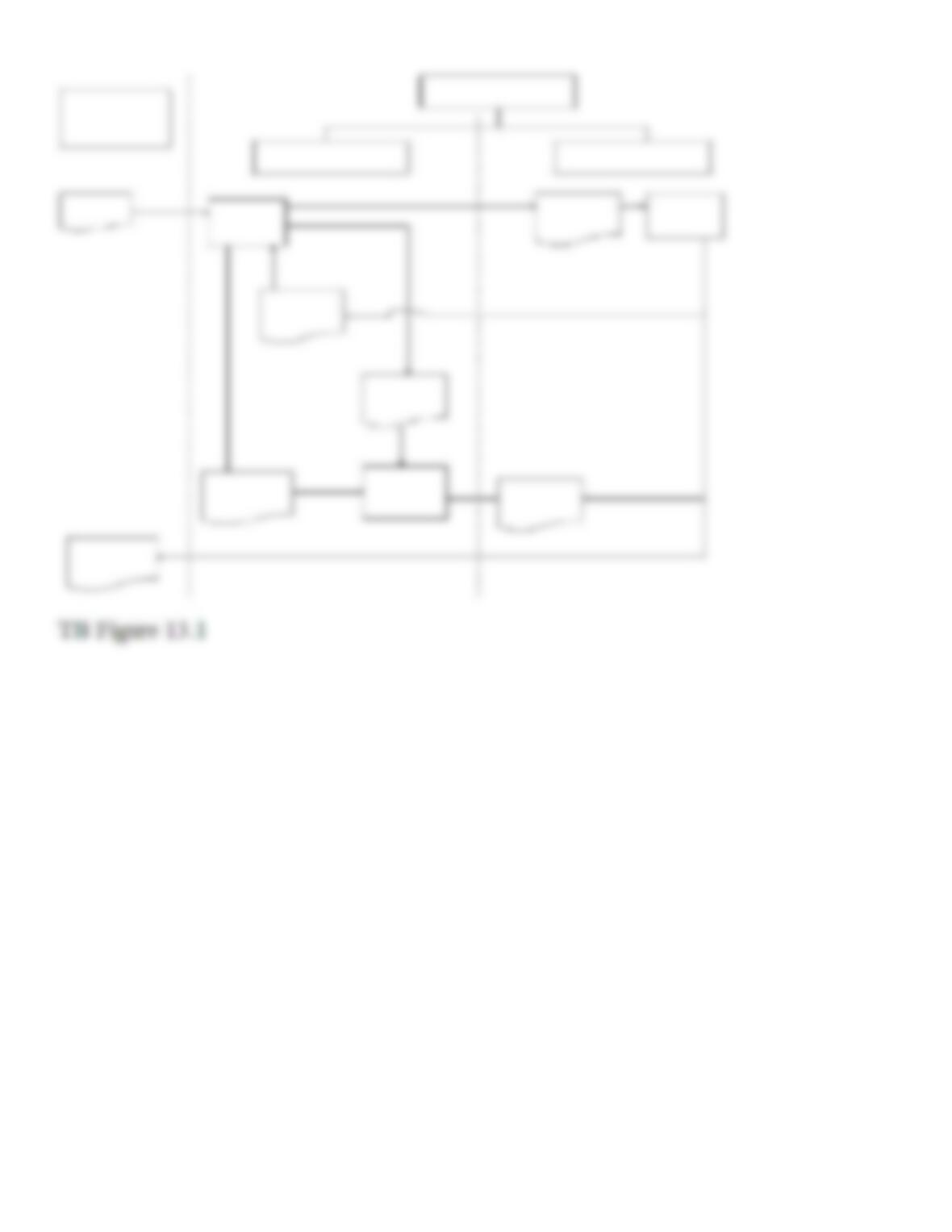
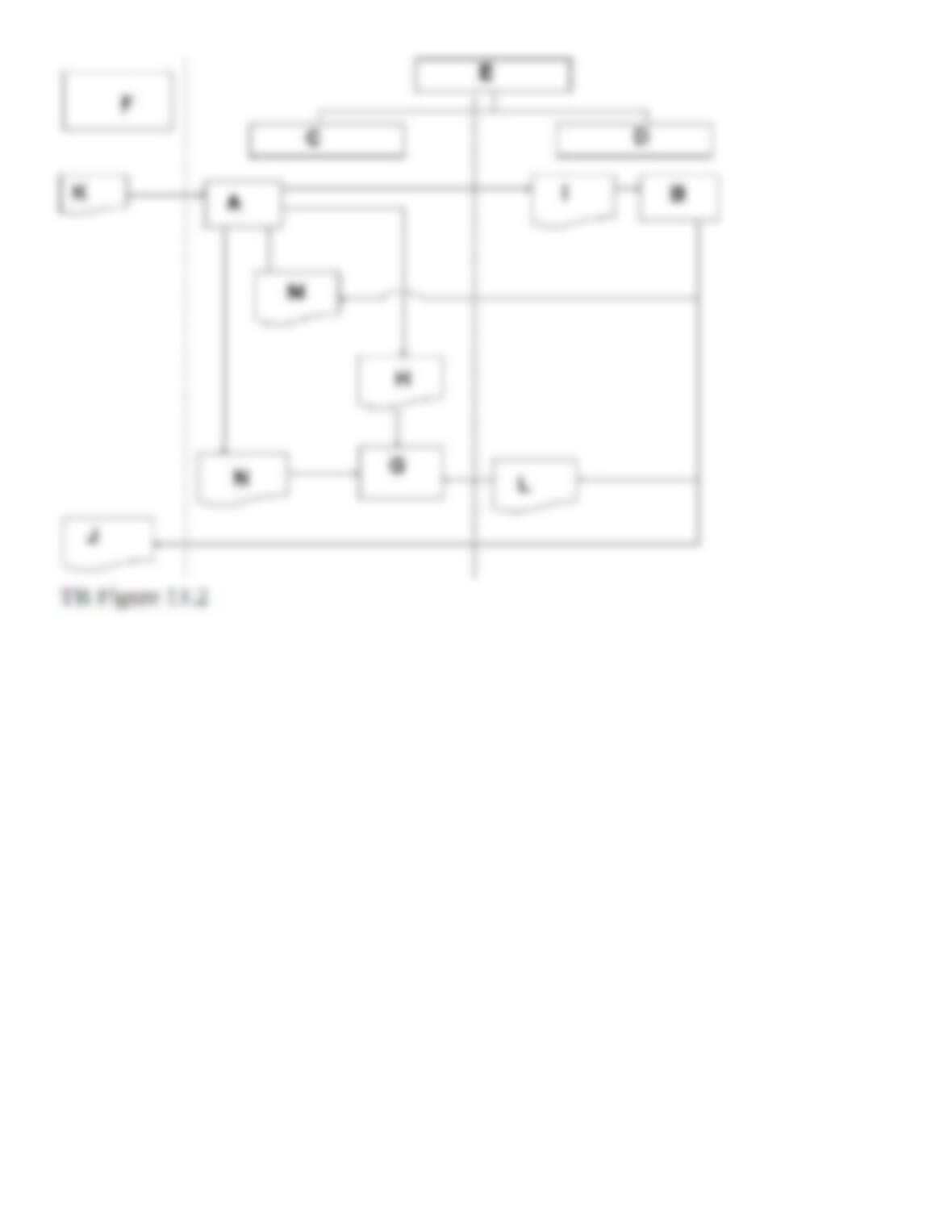
112. The figure below shows a portion of the horizontal perspective of an accounts payable/cash disbursements
(AP/CD) process. The following functional titles (for the AP/CD process organizational structures and the
entities with which the AP/CD process interacts) and information flows, depicted as documents, generated or
captured by the AP/CD process, have been omitted.
Functional
titles (for
the
AP/CD
structures
and
entities
with
which the
process
interacts)
A.
Accounts payable
E.
VP Finance
B.
Cashier
F.
Vendor
C.
Controller
G.
General ledger
D.
Treasurer
Informatio
n flows
(depicted
as
document
s)
H.
Payment request notice sent from accounts payable to general ledger
I.
Payment request (voucher) sent from accounts payable to cashier
J.
Payment (check) sent to vendor by cashier
K.
Invoice sent to accounts payable from vendor
L.
Payment notice sent from cashier to general ledger
M.
Payment notice sent from cashier to accounts payable
N.
Accounts payable invoice notice sent from accounts payable to general ledger
Required:
Complete TB Figure 13.1 by inserting the letter corresponding to the:
(a)
functional titles into the boxes
(b)
information flow descriptions in the document symbols
113. Below is a narrative of the “Establish payable” portion (bubble 1.0) of the AP/CD process described in
Chapter 13.
Narrative Description
The first step in establishing the payable involves validating the vendor invoice. This process is triggered by
receipt of the vendor invoice. Process 1.1 comprises a number of steps. First, the vendor invoice is matched
against vendor master data to determine that the invoice is from an authorized vendor. Next, the vendor invoice
is compared against the PO data (see the flow PO accounts payable notification) to make sure that there is a PO
(i.e., there is an authorized purchase) and that the invoiced items, quantities, and prices conform to the PO.
Then, the invoice is matched against the receiving report data to determine that the items and quantities have
been received. Finally, the invoice is further validated by checking for accuracy of terms, computed discounts,
extensions, and total amount due. Note that the vendor master data is updated at this point to reflect purchase
history data.
If the data items do not agree, the invoice is rejected, and follow-up procedures are initiated (see the reject stub
emanating from bubble 1.1). If the data items agree, the invoice is approved, and the validated invoice is sent on
to the next step to be used to record the payable. Bubble 1.2 depicts the process of recording the payable in the
purchase events data and accounts payable master data. A payable is recognized and recorded by:
·
Creating a record in the purchase events data store.
·
Creating a record in the accounts payable master data to reflect an open invoice¾a payment due to a vendor.
·
Updating the inventory master data for the cost of the items received.
·
Notifying the general ledger of the amount of the payable that was recorded (see the data flow “GL payable update”).
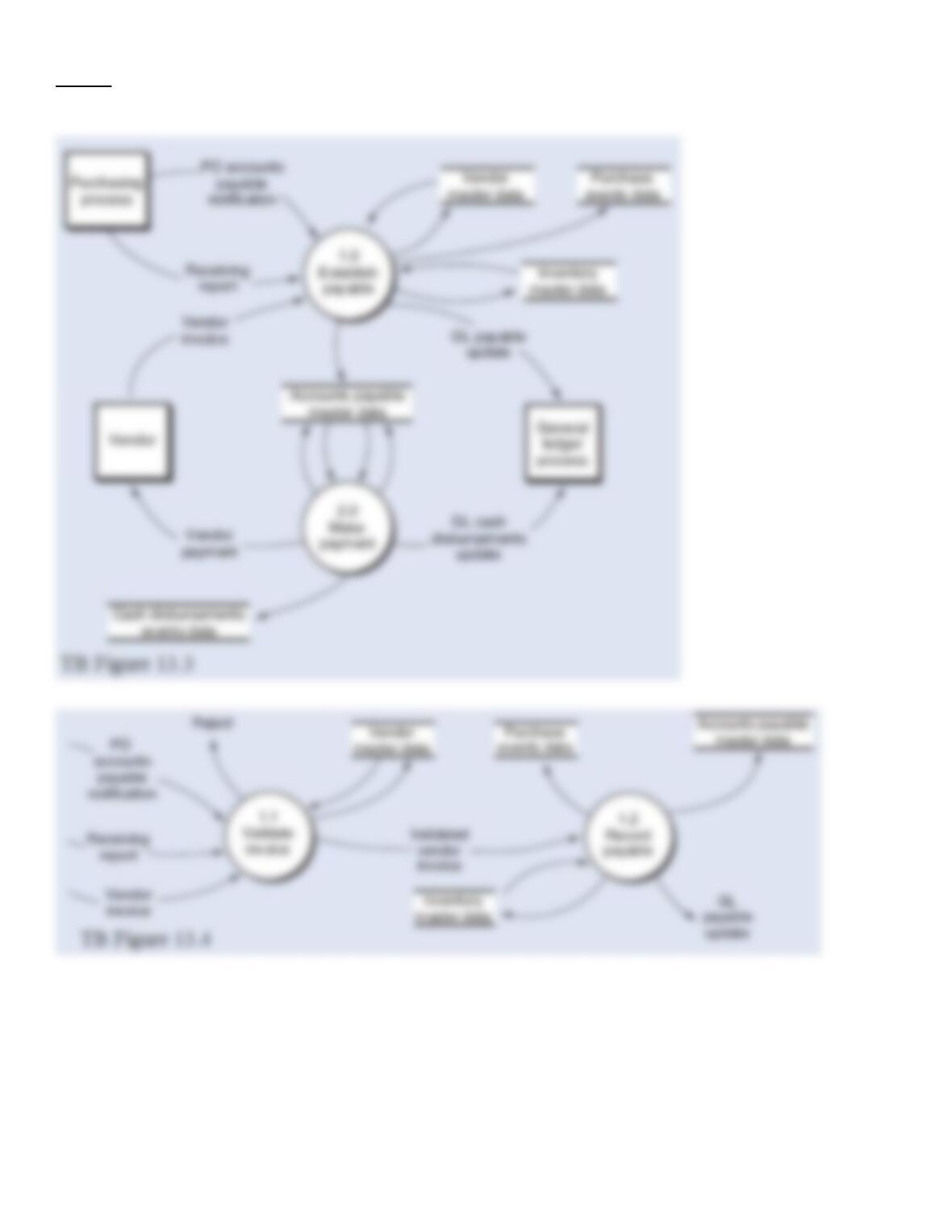
Required:
From the DFD (TB Figure 13.3) and the narrative description above, explode bubble 1.0 into a lower-level diagram showing the details of that
process.
114. Below is a narrative for the “Make payment” portion (bubble 2.0) of the accounts payable/cash
disbursements process described in Chapter 13.
Narrative Description
The payment process begins with the periodic preparation of a list of payments that might be made at this time
(bubble 2.1). The selection of items for this list is based on payment due dates and terms that may indicate a
discount can be taken for a payment at this time. The proposed list is reviewed and amended (bubble 2.2) to add
additional invoices that are not due for payment yet but that can be consolidated with other payments being
made to a vendor. Proposed payments may be removed from the list if there are insufficient funds or if
payments to a vendor are on hold.
Bubble 2.3 depicts the process of preparing the disbursement, which is equal to the amount of the invoice less
any discount taken. The payment is recorded by:
·
Marking the invoice as paid on the accounts payable master data.
·
Making an entry in the cash disbursements event data store.
·
Sending payment data to the general ledger where an entry is made to reflect the payment.
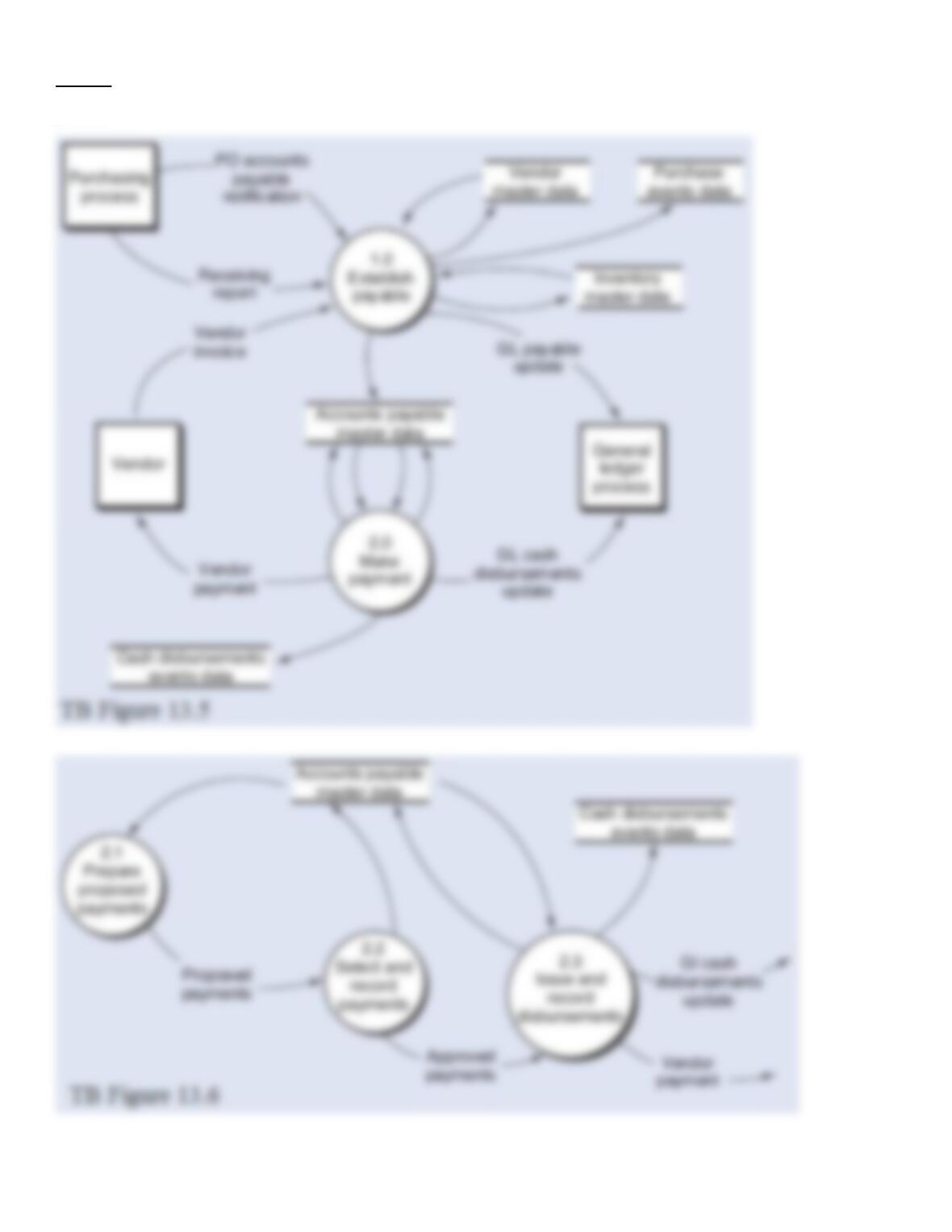
Required:
From the DFD (TB Figure 13.5) and the narrative description above, explode bubble 2.0 into a lower-level diagram showing the details of that
process.
115. Below is a narrative for the “Make payment” portion (bubble 2.0) of the accounts payable/cash
disbursements process described in Chapter 13.
Narrative Description
The payment process begins with the periodic preparation of a list of payments that might be made at this time
(bubble 2.1). The selection of items for this list is based on payment due dates and terms that may indicate a
discount can be taken for a payment at this time. The proposed list is reviewed and amended (bubble 2.2) to add
additional invoices that are not due for payment yet but that can be consolidated with other payments being
made to a vendor. Proposed payments may be removed from the list if there are insufficient funds or if
payments to a vendor are on hold.
Bubble 2.3 depicts the process of preparing the disbursement, which is equal to the amount of the invoice less
any discount taken. The payment is recorded by:
·
Marking the invoice as paid on the accounts payable master data.
·
Making an entry in the cash disbursements event data store.
·
Sending payment data to the general ledger where an entry is made to reflect the payment.
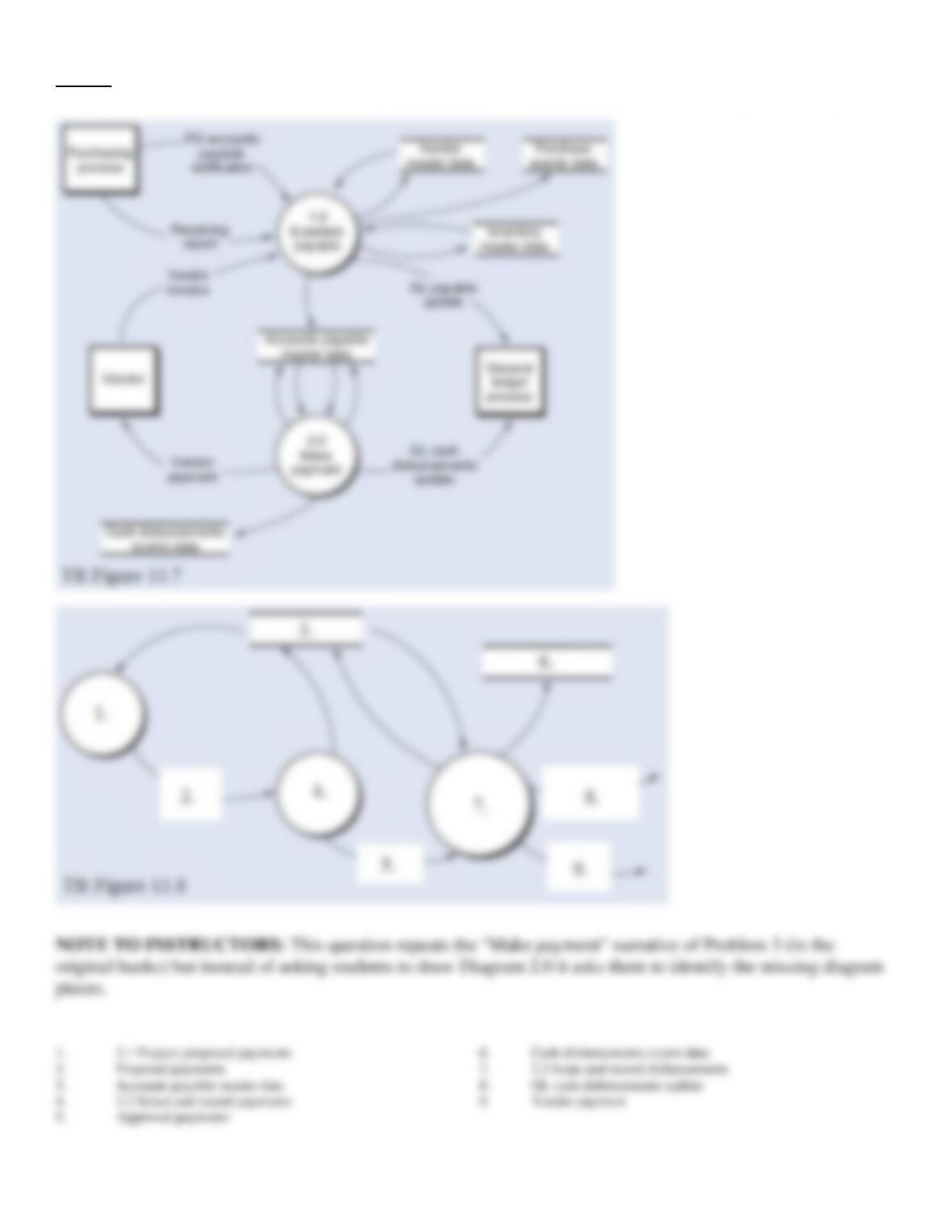
Required:
Using the DFD in TB Figure 13.7 and the narrative description above, identify the words that belong in items 1 to 9 of Diagram 2.0 (TB Figure 13.8).
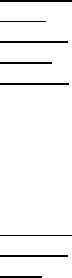
116. TB Figure 13.9 is the control matrix for the accounts payable/cash disbursements process presented in
Chapter 13, but with certain items omitted. In the matrix, each omission is indicated by a box. Jumbled lists of
the omitted items are as follows:
Omitted
from
Control
Goals
Columns
1.
Cash, Accounts payable master data
5.
Vendor invoice inputs
2.
Ensure security of resources
6.
Ensure effectiveness of operations
3.
Payment inputs
7.
Ensure efficient employment of resources
4.
Accounts payable master data
8.
Accounts payable master data
Omitted
Control
Plans
9.
Tickler file of open purchase orders and receiving reports
10.
Independent authorization to make payment
11.
Tickler file of payments due
12.
Digital signatures
13.
Independent validation of vendor invoices
14.
Reconcile bank account
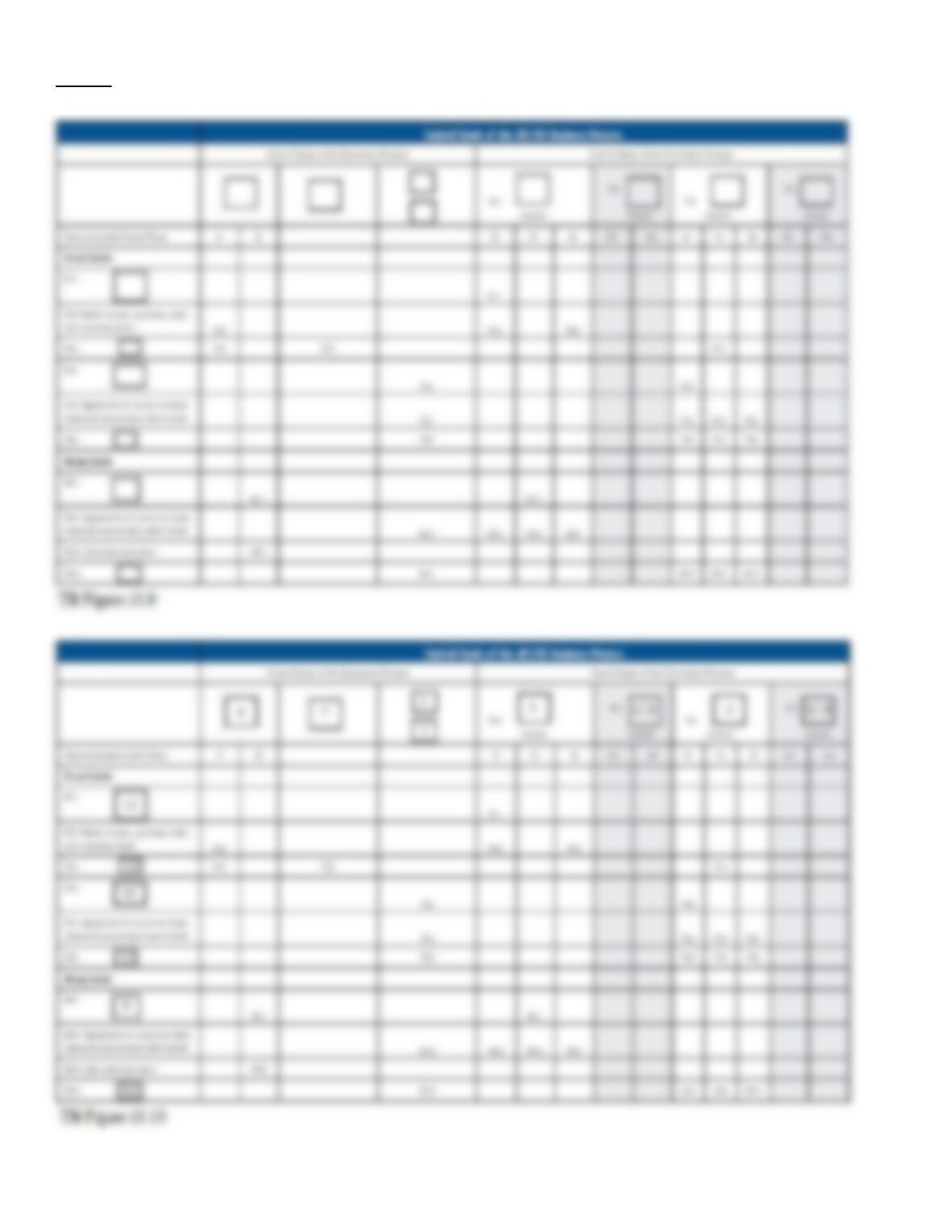
Required:
Complete the matrix in parts 1 and 2 of TB Figure 13.9 below by placing one of the numbers, 1 through 14 from the above lists, in each empty box.
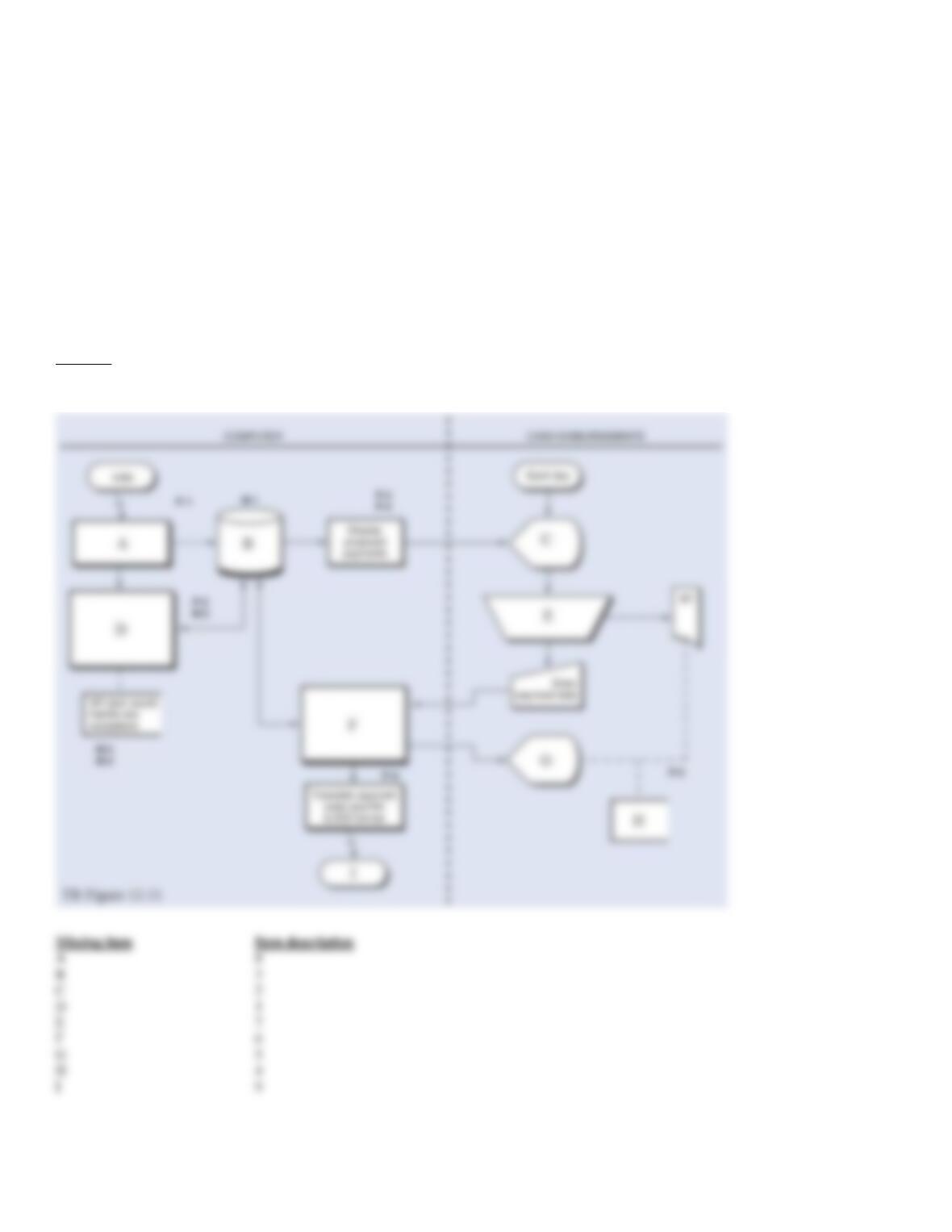
117. The flowchart below is the accounts payable/cash disbursements process presented in Chapter 13, but with
certain items omitted. In the flowchart, each omission is indicated by a capital letter (A through I). Jumbled lists
of the omitted items are as follows:
1.
Compare incoming invoices to PO and receiving report data and record AP and GL data
2.
Display of proposed payments
3.
Enterprise database
4.
Exception routine not shown
5.
Payment totals
6.
Prepare payment order and RA, update AP and GL data for payment, display payment totals
7.
Select payments, calculate batch totals
8.
Translate from EDI and record incoming invoices
9.
VAN
Required:
Complete the flowchart TB Figure 13.11 by placing one of the numbers, 1 through 9 from the above lists, to match the letters showing the missing
items.
A
8
B
3
C
2
D
1
E
7
F
6
G
5

118. The following is a list of 10 control plans.
Control
Plans
A.
Independent validation of vendor invoices
F.
Match invoices, POs, and receiving reports
B.
Tickler file of payments due
G.
Reconcile input-output batch totals
C.
Preformatted screens
H.
Digital signatures
D.
Tickler file of open POs and receiving reports
I.
Independent authorization to make payment
E.
Cash planning report
J.
Reconcile bank account
Required:
Listed below are ten system failures that indicate weaknesses in control. On the answer line to the left of each description, insert the capital letter
(from the list above) of the best control plan to address the system deficiency described. A letter should be used only once.
1.
There is often an inadequate amount of cash on hand to make required payments. Some discounts are lost and vendor
relations are negatively impacted.
2.
Some vendor invoices are not received and input in a timely manner. Some discounts are lost.
3.
Data fields must be manually entered and users can customize the input fields as needed. The data entry process is,
therefore, slow and error prone.
4.
Payables are not tracked by due date and discounts are often missed.
5.
The VAN does not know that the sender of a message has the authority to send it.
6.
Overpayments are made to the vendor because invoices are for quantities and prices other than what was ordered and
received.
7.
Invoices are recorded for items that were never ordered.
8.
Invoices are paid even though there is no invoice on the accounts payable master data.
9.
The totals calculated for payments before the input do not match those produced after the updates have been made.
10.
Unauthorized and incorrect disbursements have been recorded.
System
Failure
Answer
1.
E
2.
D
3.
C
4.
B
5.
H
6.
F
7.
A
8.
I
9.
G
10.
J