4 Learning Objective 13-4
1) On the statement of cash flows of a healthy company, Net cash provided by operating activities is
generally less than net income.
2) If the sale of plant assets is a company’s major source of cash, it may be a sign of financial difficulty.
3) On the statement of cash flows of a healthy company, Net cash provided by operating activities
generally exceeds net income because depreciation expense is added back to net income.
4) Analysts may find the statement of cash flows as helpful for spotting weakness as for gauging success.
5) In the statement of cash flows, purchases of plant assets are considered to be investing activities.
6) In the statement of cash flows, more purchases of long-term assets than sales of long-term assets are
considered a sign of a healthy company.
7) Analyzing the statement of cash flows may help investors and analysts determine the financial health
of a company. Which of the following signs below is NOT an indicator of a financially healthy company?
A) The company’s operations are a major source (not a use) of cash.
B) The company’s operations result in Net cash used by operating activities.
C) The company’s investing activities include more purchases than sales of long-term assets.
D) The company’s financing activities are not dominated by borrowing.
8) Horizontal analysis is performed on information from:
A) only the income statement.
B) only the balance sheet.
C) only the statement of cash flows.
D) the income statement, the balance sheet, and the statement of cash flows.
9) On a statement of cash flows of a healthy company, net income would ordinarily be:
A) less than depreciation expense.
B) more than depreciation expense.
C) greater than Net cash provided by operating activities.
D) less than Net cash provided by operating activities.
10) On a statement of cash flows (indirect method), which item is reported as a line item under cash from
operating activities?
A) sale of securities
B) purchase of fixed assets
C) purchase of securities
D) amortization expense
11) On a statement of cash flows, which is considered an investing activity?
A) depreciation expense
B) increase in inventory
C) sale of securities
D) repayment of debt
12) Sales of plant assets for several years, which represent a major source of cash, is a sign of:
A) a struggling company.
B) reinvestment in the company.
C) a shortage of cash.
D) A and C.
13) The Statement of Cash Flows for Brown Equipment Company shows purchases of plant assets of
$155,000 for 2017 and $118,000 for 2018. The percent of change from 2017 to 2018 is ________.
A) (31.4%)
B) (23.9%)
C) (76.1%)
D) $37,000.
14) On a statement of cash flows, repayment of long-term debt is considered:
A) an operating activity.
B) an investing activity.
C) a financing activity.
D) a noncash investing and financing activity.
15) On a statement of cash flows, which of the following is a sign of a healthy company?
A) Investing activities include more sales of long-term assets than purchases.
B) Financing activities are dominated by borrowing.
C) Operating activities are the major source of cash.
D) Net cash provided by operating activities is less than net income.
16) Which of the following statements is CORRECT?
A) A shortage of cash could cause a company to face bankruptcy, but lots of cash will ensure success.
B) When analyzing the Statement of Cash Flows, investors should ignore signals of cash flow distress
because the company can show improvements in future periods.
C) If the Statement of Cash Flows shows that current assets are increasing far more than current
liabilities, the company may have trouble collecting receivables or selling inventory.
D) A sign of a healthy company is that financing activities are dominated by borrowing.
17) On a statement of cash flows, which is NOT considered a financing activity?
A) paid income taxes
B) proceeds from long-term debt
C) repayment of long-term debt
D) paid dividends
18) Cash flow signs of a healthy company do NOT include:
A) net cash provided by operating activities exceeds net income
B) operating activities represent the major source of cash
C) investing activities include more purchases than sales of long-term assets
D) borrowing $100 million and repaying $15 million
19) An example of a company with cash flow problems is:
A) a company sold property, plant and equipment for $160 million and purchased property, plant and
equipment for $80 million.
B) a company borrowed $1 million with long-term bonds payable and paid $1 million on long-term notes
payable.
C) a company sold property, plant and equipment for $5 million and purchased property, plant and
equipment for $25 million.
D) net cash provided by operating activities is $10 million and net income is $6 million.
20) A company reports the following information from the statement of cash flows:
Net cash provided by operating activities
$50 million
Net income
20 million
Net cash provided by investing activities
400 million
Net cash used by financing activities
(30 million)
Which line item provides a signal that the company may have cash flow problems?
A) net cash provided by operating activities
B) net income
C) net cash provided by investing activities
D) net cash used by financing activities
21) A company reports the following information from the statement of cash flows:
Net cash provided by operating activities
$2 million
Net income
$11 million
Net cash used by investing activities
($2 million)
Net cash used by financing activities
($1 million)
Which line item provides a signal that the company may have cash flow problems?
A) net cash provided by operating activities
B) net income
C) net cash used by investing activities
D) net cash used by financing activities
5 Learning Objective 13-5
1) A firm’s ability to pay current liabilities can be evaluated using the quick ratio and the current ratio.
2) A company’s debt ratio is computed as total assets minus total liabilities divided by total assets.
3) The quick ratio reflects the company’s percentage of total assets financed with debt.
4) A high inventory turnover may indicate that a company is experiencing difficulty selling its inventory.
5) In general, the larger the working capital, the better the ability to pay debts.
6) Cash, short-term investments and net current receivables are all components of the numerator of the
quick ratio.
7) Inventory turnover is calculated by dividing the cost of goods sold by the average inventory.
8) Ratios that test liquidity include all of the following EXCEPT:
A) acid-test ratio.
B) current ratio.
C) return on assets.
D) inventory turnover.
9) To compute the gross (profit) margin percentage, divide:
A) sales by cost of goods sold.
B) gross (profit) margin by net sales.
C) net income by stockholders’ equity.
D) operating income by net sales.
10) A measure of a company’s ability to collect cash from credit customers is the:
A) accounts receivable turnover.
B) days’ payable outstanding.
C) inventory turnover.
D) cash conversion cycle.
11) Carey’s Department Store had net sales of $20 million and cost of goods sold of $13 million for the
year. The beginning inventory for the year was $4 million. The ending inventory for the year was $6
million. What was the days’ inventory outstanding? (Round any intermediary calculations to two
decimal places and your final answer to the nearest day.)
A) 28 days
B) 91 days
C) 140 days
D) 61 days
12) Marie’s Clothing Store had an accounts receivable balance of $440,000 at the beginning of the year and
a year-end balance of $600,000. Net credit sales for the year totaled $3,600,000. The average collection
period of the receivables was: (Round any intermediary calculations to two decimal places and your final
answer to the nearest day.)
A) 45 days.
B) 61 days.
C) 53 days.
D) 8 days.
13) The ratio that provides an estimate of the number of days, on average, that it takes for customers to
pay their accounts is the:
A) days’ sales in receivables
B) current ratio.
C) accounts receivable turnover.
D) acid-test ratio.
14) The ratio that measures a company‘s success in using its assets to earn income for the persons who
finance the business is the:
A) leverage.
B) rate of return on total assets.
C) debt ratio.
D) times-interest-earned ratio.
15) The ratio that measures the number of times that operating income can cover interest expense is the:
A) leverage.
B) rate of return on total assets.
C) debt ratio.
D) times-interest-earned ratio.
16) The amount of a company’s net income earned for each share of its outstanding common stock is
termed the:
A) return on equity.
B) price/earnings ratio.
C) earnings per share.
D) dividend yield.
17) XYZ Company has an inventory turnover of 20 times per year. The industry average is 5.0 times per
year. What does a high inventory turnover mean?
A) The company has too much inventory on hand.
B) The company may have obsolete inventory on hand.
C) The company may not be keeping enough inventory on hand which can lead to lost sales.
D) The company is having a difficult time selling the inventory.
18) American Furniture Company has an accounts receivable turnover ratio of 20 while the industry
average is 10. What can be said about American Furniture Company’s accounts receivable turnover ratio?
A) American Furniture Company collects accounts receivable slower than the industry average.
B) American Furniture Company collects accounts receivable faster than the industry average.
C) American Furniture Company may have a credit policy that is too lenient in granting credit to new
customers.
D) American Furniture Company may have a lax credit department.
19) What is accounts payable turnover?
A) A ratio calculated as Purchases divided by ending balance in Accounts Payable.
B) A ratio calculated as Cost of Goods Sold divided by average Accounts Payable.
C) A ratio calculated as Purchases divided by average Accounts Payable.
D) B and C.
20) How is the cash conversion cycle computed?
A) days’ inventory outstanding + days’ sales outstanding – days’ payable outstanding.
B) days’ inventory outstanding – days’ sales outstanding – days’ payable outstanding.
C) days’ inventory outstanding – days’ sales outstanding + days’ payable outstanding.
D) days’ inventory outstanding + days’ sales outstanding + days’ payable outstanding.
21) What do the price-earnings ratio and dividend yield have in common?
A) Earnings per share is the denominator for both ratios.
B) Earnings per share is the numerators for both ratios.
C) Dividends per share is in both ratios.
D) Market price per share is in both ratios.
22) How is the leverage ratio calculated?
A) total debt divided by total assets
B) total assets divided by total debt
C) average total assets divided by average common stockholders’ equity
D) average total debt divided by average total assets
23) The leverage ratio measures:
A) the impact of equity financing on a company’s profitability.
B) the impact of debt financing on a company’s profitability.
C) the impact of leverage on a company’s financial position.
D) the impact of equity financing on a company’s financial position.
24) The leverage ratio is a component of:
A) return on assets under DuPont analysis.
B) return on equity under DuPont analysis.
C) return on sales under DuPont analysis.
D) total asset turnover under DuPont analysis.
25) A company has return on assets of -8%. Return on sales are –6%. The leverage ratio is 2.0. Following
DuPont analysis, what is return on equity?
A) –6%
B) –8%
C) –16%
D) –28%
26) A company has return on assets of 10%. Return on sales are 5%. The leverage ratio is 4.0. Following
DuPont analysis, what is return on equity?
A) 5%
B) 10%
C) 40%
D) 20%
27) Which of the following statements about financial ratios is FALSE?
A) When calculating return on assets, preferred dividends are subtracted from net income.
B) When calculating return on equity, preferred dividends are subtracted from net income.
C) When calculating the price-earnings ratio, preferred dividends are subtracted from market price per
share.
D) When calculating earnings per share, preferred dividends are subtracted from net income.
34
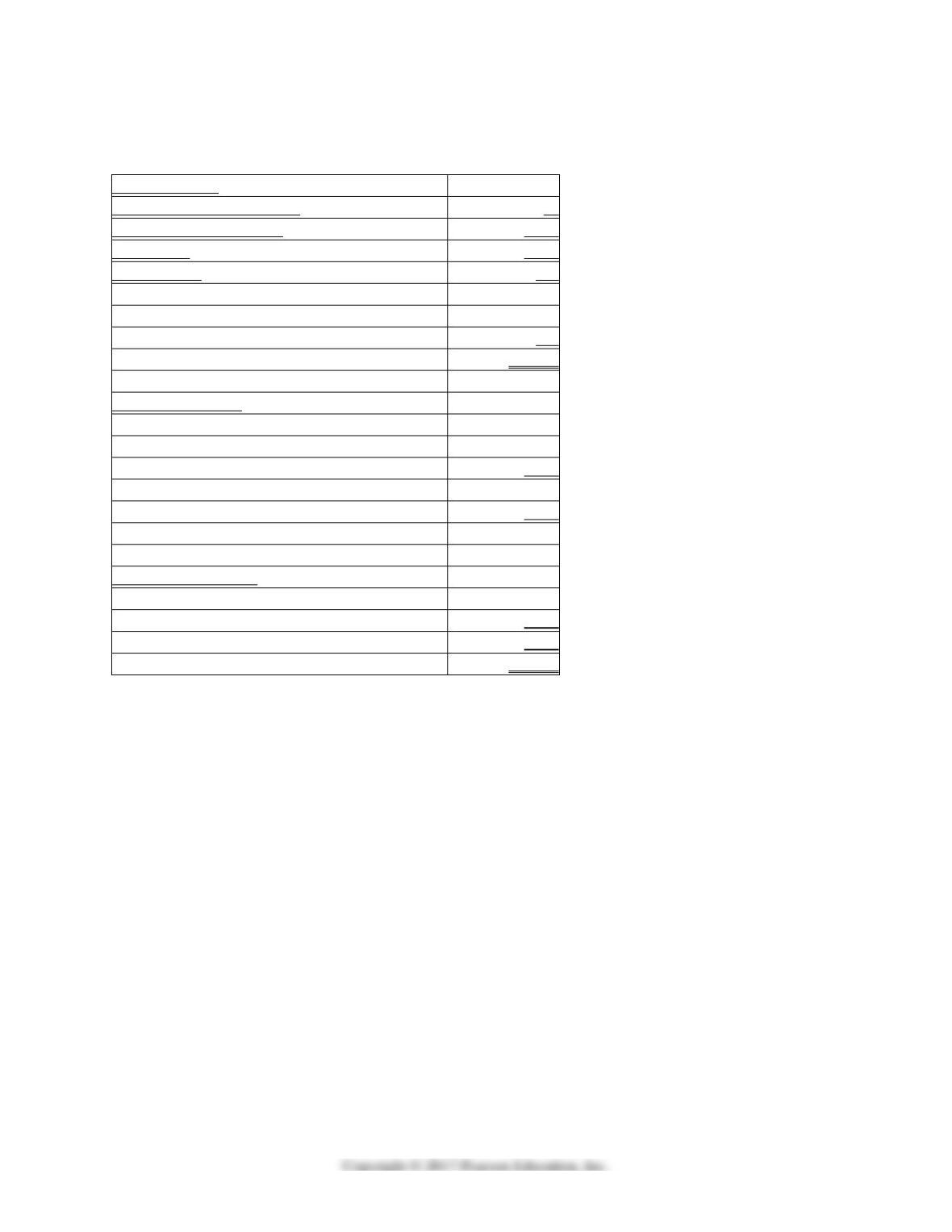
28) The balance sheet at December 31, 2017 for Zumba Company follows:
in thousands of dollars, unless otherwise specified
Current Assets:
Cash and Cash Equivalents
$2
Accounts Receivable, net
4,800
Inventories
2,200
Prepaid Rent
898
Total Current Assets
$7,900
Land, buildings and equipment, net
7,400
Investments
500
Total assets
$15,800
Current Liabilities:
Accounts Payable
$500
Current Portion Long-Term Debt
2,500
Accrued Salaries Payable
1,000
Total Current Liabilities
4,000
Long-Term Debt
8,000
Total Liabilities
12,000
Stockholders’ Equity:
Common Stock
2,800
Retained Earnings
1,000
Total Stockholders’ Equity
3,800
Total Liabilities and Stockholders’ Equity
$15,800
Additional information follows:
1. Net income for the year ended December 31, 2017 is $2,020.
2. Cost of goods sold for the year ended December 31, 2017 is $4,400.
3. Inventory on January 1, 2017 is $1,800.
4. Accounts Receivable, net on January 1, 2017 are $4,400.
5. Total assets on January 1, 2017 are $20,000.
6. Net credit sales for the year ended December 31, 2017 are $14,600.
7. Net income before interest and taxes for the year ended December 31, 2017 is $4,800.
8. Interest expense for the year ended December 31, 2017 is $550.
9. Total stockholders’ equity on January 1, 2017 is $3,500.
Compute the following ratios:
1. Current ratio
2. Quick ratio
3. Accounts receivable turnover
4. Days’ inventory outstanding
5. Times interest earned
6. Return on assets
7. Return on equity
6 Learning Objective 13-6
1) Economic value added (EVA®) can be computed as net income before taxes minus interest expense
minus capital charge.
2) The cost of capital is a weighted average of the returns demanded by the company’s stockholders and
lenders.
3) Usually new companies have a lower cost of capital.
4) If a corporation’s economic value added (EVA®) is negative, stockholders will probably be pleased
with the company’s management and want to buy additional shares of stock.
5) A positive economic value added (EVA®) suggests an increase in stockholders’ wealth.
6) An efficient capital market is one in which market prices are above stated cost.
7) In an efficient market, an investor’s search for “underpriced” stock will be unsuccessful unless the
investor has knowledge of relevant private information.
8) If days’ sales in receivables are growing faster than for other companies in the industry, a cash shortage
may be looming.
9) If a company’s debt ratio is much higher than the industry average, the company should be able to pay
its debts in tough times.
10) Financial analysis helps mainly to identify the risks of various stocks and then to remove those risks.
11) The cost of capital is defined as the:
A) sum of liabilities and stockholders’ equity accounts.
B) weighted average of the returns demanded by the company’s stockholders and lenders.
C) rate of return demanded by stockholders times the rate of return demanded by lenders.
D) rate of return demanded by the stockholders divided by the rate of return demanded by lenders.
12) Economic value added (EVA®) is computed as:
A) net income before taxes + long-term debt + interest expense.
B) net income before taxes + interest expense – capital charge.
C) net income before taxes – interest expense + capital charge.
D) net income before taxes – long-term debt + interest expense.
13) If economic value added (EVA®) is negative:
A) stockholders’ wealth has decreased.
B) stockholders’ wealth has increased.
C) stockholders’ wealth has stayed the same.
D) stockholders’ earnings per share have increased.
14) The cost of capital for a start-up company:
A) is lower because the new company is untested.
B) depends only on the market rate of interest.
C) depends only on the state of the economy.
D) is higher for the new company because it is more risky than an established company.
15) Net cash provided by operating activities that is consistently lower than net income may imply that:
A) a dividend has not been issued in a long time.
B) the common stock should be split.
C) the company may be facing a cash shortage.
D) working capital has decreased.
16) The capital charge in EVA® is computed as:
A) Cost of capital – Notes payable – Current maturities of long-term debt – Long-term debt – Stockholders’
equity.
B) (Notes payable, beginning balance + Current maturities of long-term debt, beginning balance + Long–
term debt, beginning balance + Stockholders’ equity, beginning balance) × Cost of capital.
C) Cost of capital + Current maturities of long-term debt + Loans payable + Long-term debt +
Stockholders’ equity.
D) (Notes payable + Current maturities of long-term debt + Long-term debt + Stockholders’ equity) ÷ Cost
of capital.
17) Red flags in financial statement analysis can include all of the following EXCEPT:
A) a debt ratio higher than average.
B) a slowdown in inventory turnover.
C) days’ sales in receivables increasing.
D) Net cash provided by operating activities exceeds net income.
18) Which of the following statements is INCORRECT?
A) Different companies tailor the EVA® computations to meet their own needs.
B) It can be argued that the stock market is inefficient because stock prices cannot reflect all publicly
accessible data.
C) Market efficiency has implications for management action and for investor decisions.
D) Investors seek to manage risk, diversify investments, and minimize transaction costs.