Fundamentals of Cost Accounting, 6e (Lanen)
Chapter 13 Planning and Budgeting
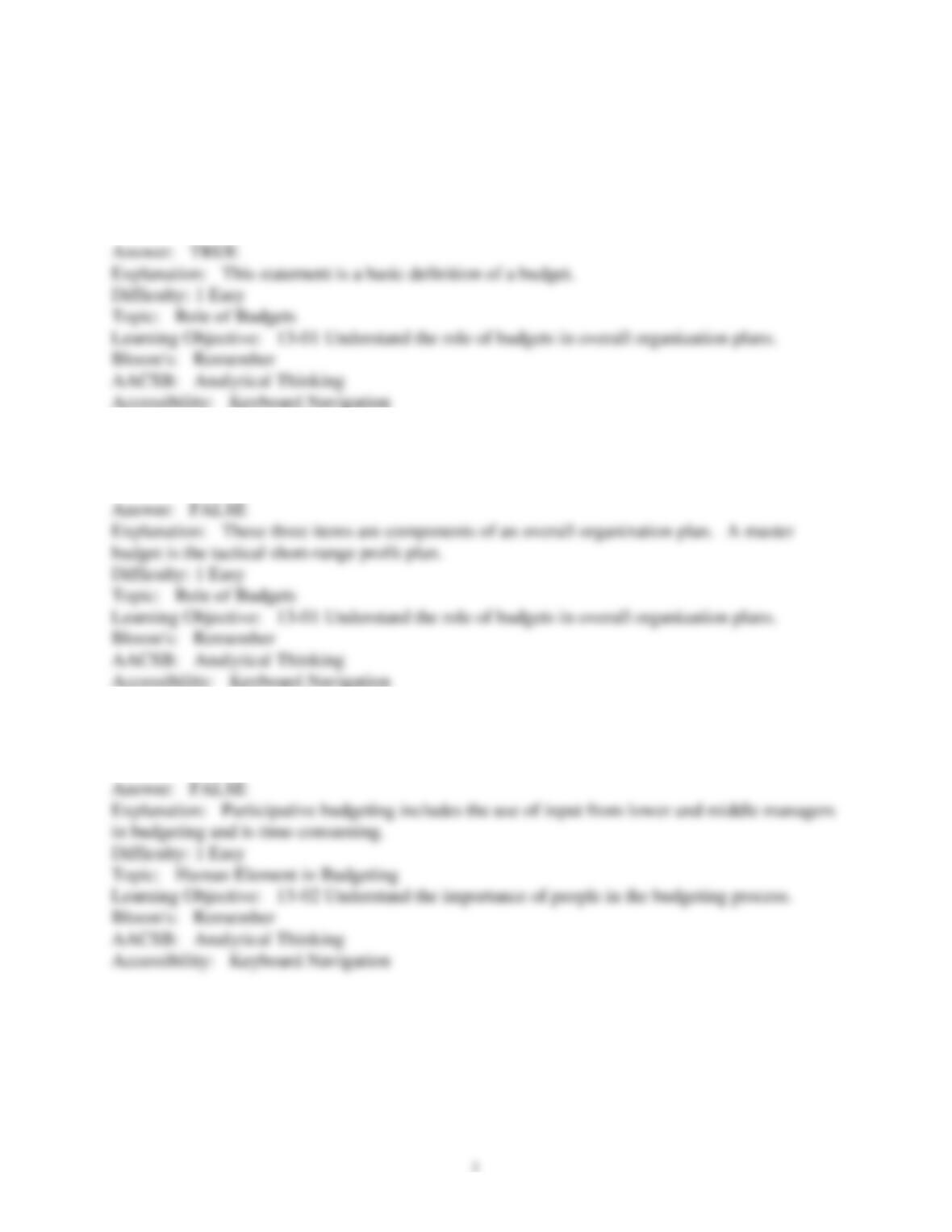
1) A budget is the plan, stated in financial terms, of how an organization expects to carry out its
activities and meet its goals.
2) A master budget consists of (a) organizational goals, (b) strategic long-range profit plan, and
(c) tactical short-range profit plan.
3) Participative budgeting streamlines the budgeting process by reducing budget development
time.
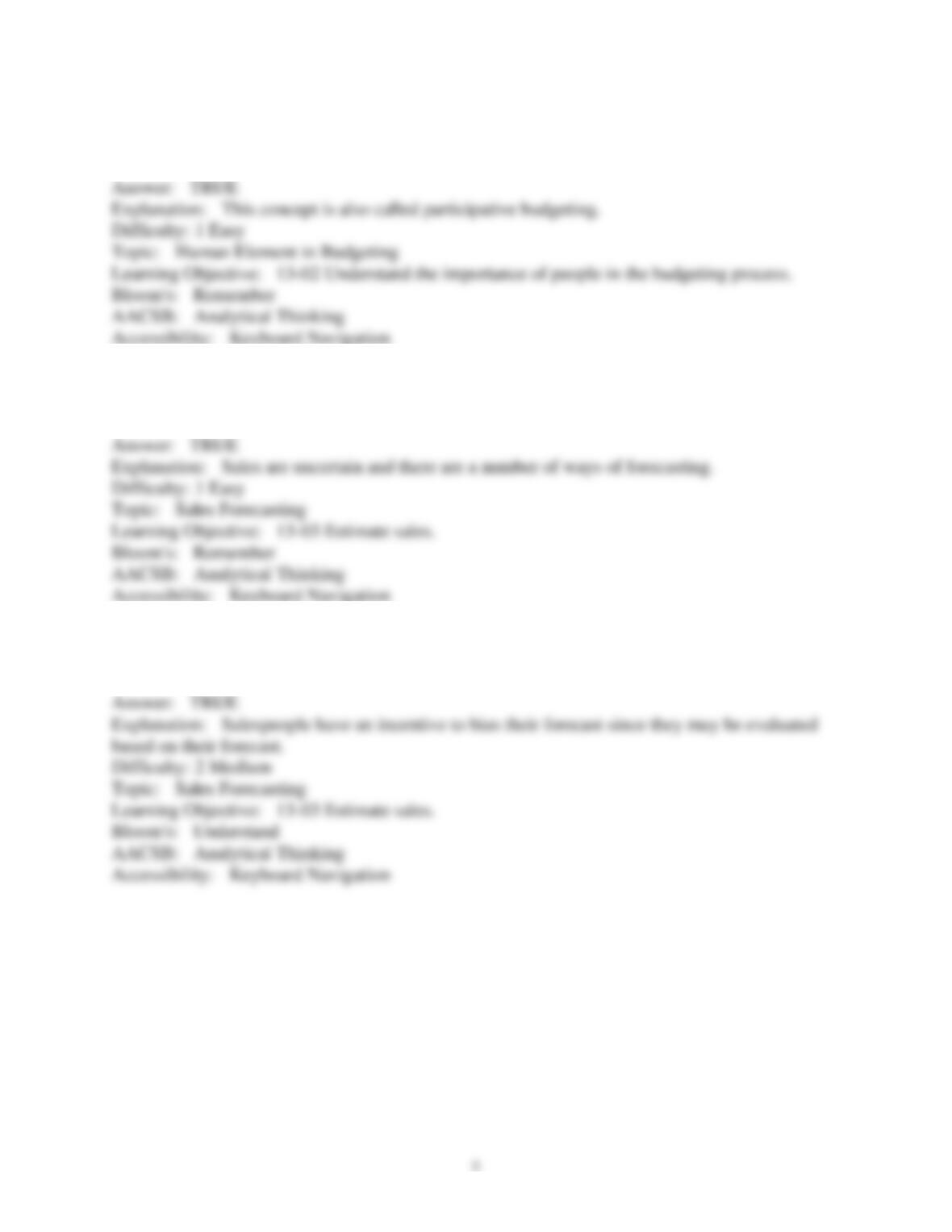
4) Individual managers’ beliefs and expectations are incorporated into the budgeting process
using grass roots budgeting procedures.
5) Sales projections are often the most difficult part of the budgeting process because it involves
a considerable amount of subjectivity.
6) An organization’s sales staff is more likely to provide a lower sales forecast than a forecast
provided by market researchers.
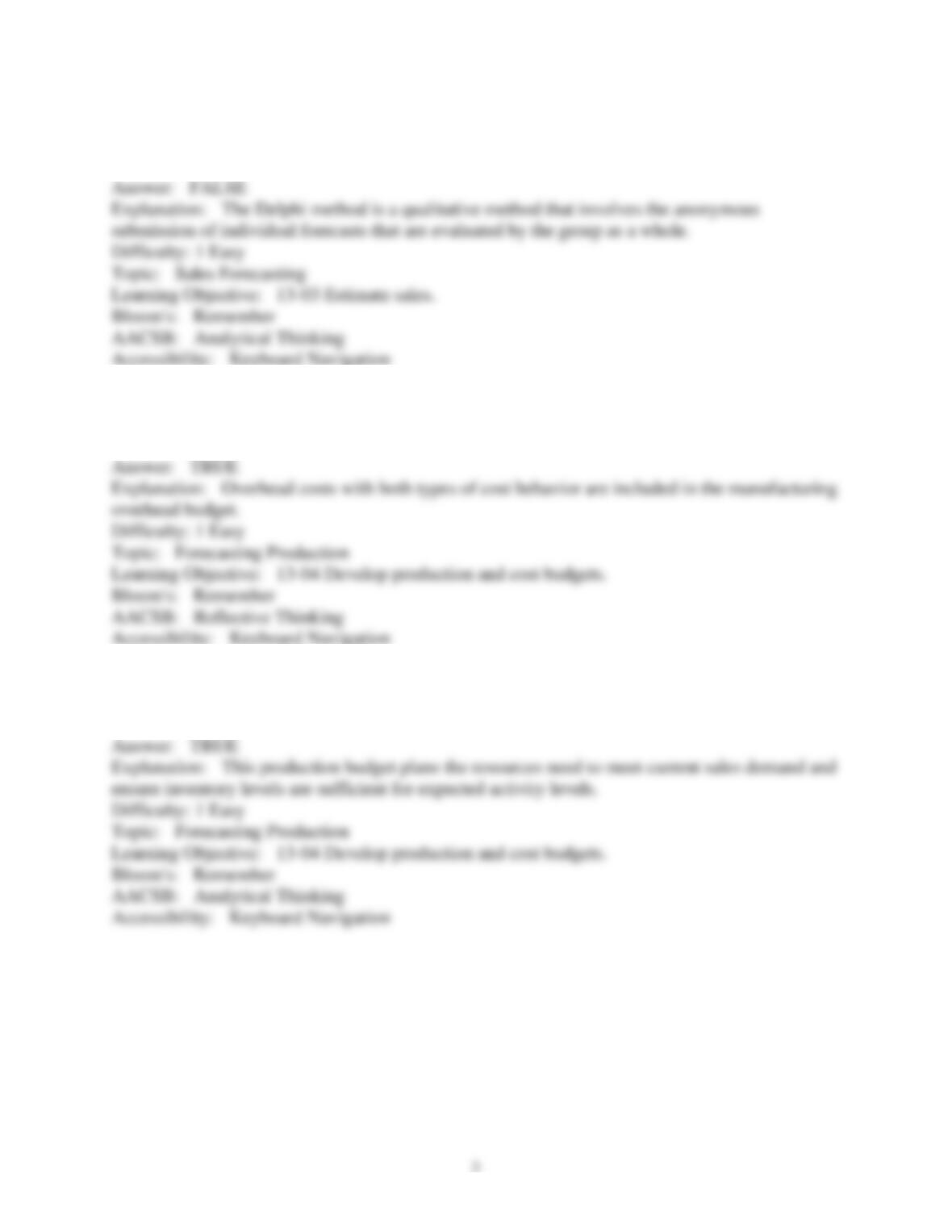
7) The Delphi technique uses highly sophisticated computerized time series analysis to reduce
the subjectivity surrounding the sales forecast.
8) Both variable and fixed manufacturing overhead costs are included in the manufacturing
overhead budget.
9) The production budget allows management to plan for the resources needed to meet the
current sales demand and ensure that inventory levels are sufficient for future sales.
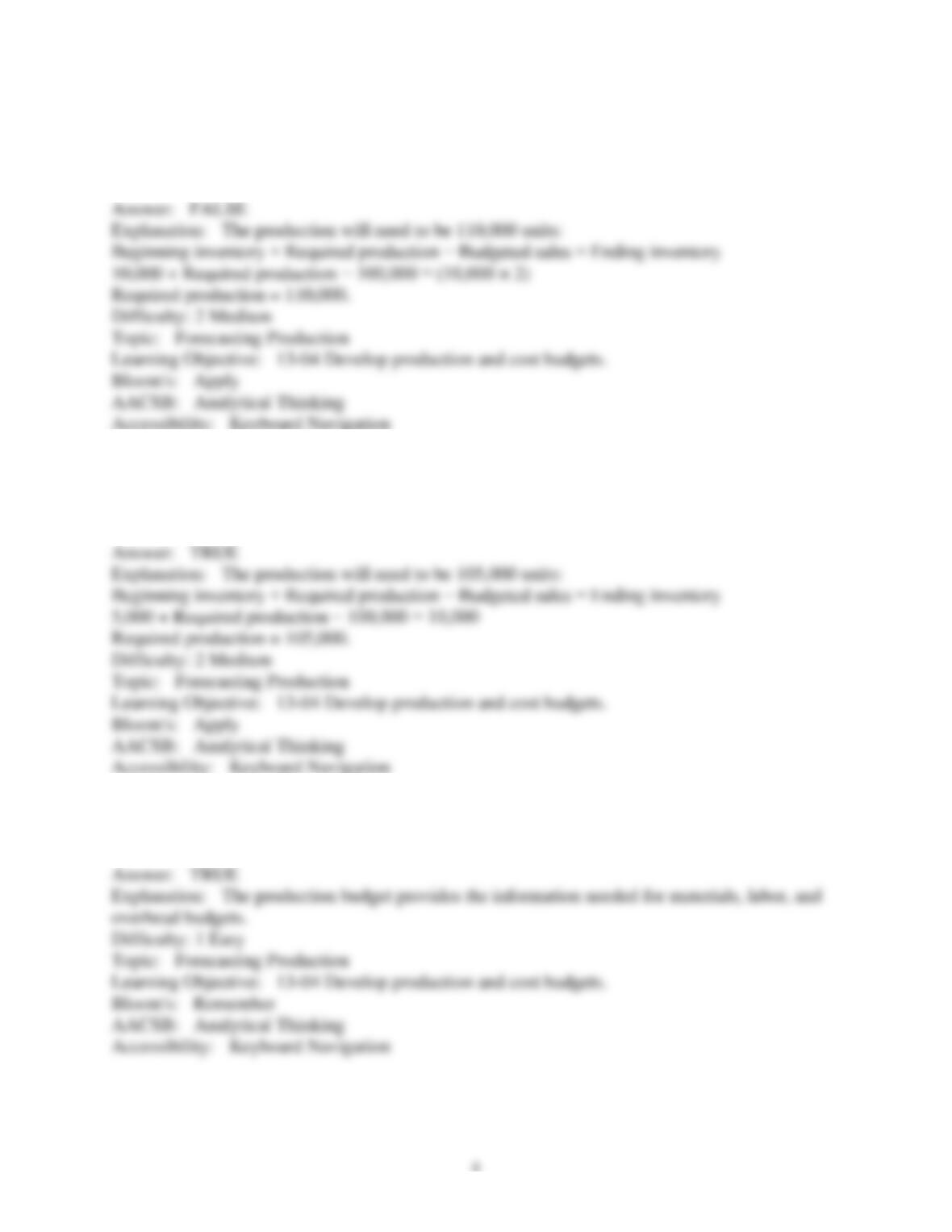
10) Denton Company has 10,000 units on hand at the beginning of the year and plans to sell
100,000 units during the year. If the ending inventory needs to be twice the beginning inventory,
Denton will need to produce 90,000 units during the year.
11) Denton Company wants to have 10,000 units on hand at the end of the year after marketing
100,000 units during the year. If the beginning inventory is 5,000 units, Denton needs to produce
105,000 units during the year.
12) The production budget must be prepared before the direct materials, direct labor, and
overhead budgets can be prepared.
13) Estimates for direct labor costs can be obtained from the engineering and production
management.
14) Bottlenecks in the production process can be discovered by the budgeting process before
they occur.
15) In effect, the cash budget simply restates the budgeted income statement to the cash basis.
16) The cash budget is normally prepared before the budgeted income statement.
17) When assembling the master budget, the budgeted balance sheet is the last budget prepared
in the process.
18) The sales budget drives the rest of the budgeting process for both manufacturers and
merchandisers.
19) A production budget is not needed for a service organization.
20) Ethical conflicts can occur in the budgeting process because managers supply information
for the budgets that are then used to evaluate their performance.
21) The use of sensitivity analysis techniques allows managers to ask “what-if” questions
regarding budget assumptions and estimates.
22) Sensitivity analysis is more likely to be used for sales forecasts than for fixed overhead costs.
23) The major objectives of any budget system are to: (CIA adapted)
A) define responsibility centers, provide a framework for performance evaluation, and promote
communication and coordination among organization segments.
B) define responsibility centers, facilitate the fixing of blame for missed budget predictions, and
ensure goal congruence between superiors and subordinates.
C) foster the planning of operations, provide a framework for performance evaluation, and
promote communication and coordination among organization segments.
D) foster the planning of operations, facilitate the fixing of blame for missed budget predictions,
and ensure goal congruence between superiors and subordinates.
24) Which of the following statements is (are) true regarding the master budget?
(A) A master budget consists of (a) organizational goals, (b) strategic long-range profit plan, and
(c) tactical short-range profit plan.
(B) A master budget consists of only a budgeted (a) income statement, (b) balance sheet, and (c)
stockholders’ equity statement.
A) Only A is true.
B) Only B is true.
C) Both of these are true.
D) None of these is true.
25) Establishing organizational goals as a management function is more important:
A) at top management levels.
B) at lower management levels.
C) at middle management levels.
D) for staff functions than line functions.
26) Which of the following terms is not an alternative for a master budget?
A) Budget plan.
B) Static budget.
C) Profit plan.
D) Planning budget.
27) A master budget:
A) indicates costs of the organization only for the coming year.
B) indicates sales of the organization only for the coming year.
C) indicates sales, production, and costs of the organization for the coming year.
D) indicates sales and production but does not address costs of the organization for the coming
year.
28) Which of the following is not a component of an overall organization plan for an
organization?
A) Organization goals.
B) Strategic long-range profit plan.
C) Tactical short-range profit plan.
D) Profit plans of competitors.
29) Which of the following is not a benefit of budgeting?
A) It reduces the need for tracking actual cost activity.
B) It sets benchmarks for evaluation performance.
C) It uncovers potential bottlenecks.
D) It formalizes a manager’s planning efforts.
30) Which of the following statements is (are) true regarding the benefits associated with
participative budgeting?
(A) Goal congruence by divisions means top management need not be concerned with overall
profitability.
(B) Employee motivation and acceptance of goals is enhanced.
A) Only A is true.
B) Only B is true.
C) Both of these are true.
D) None of these is true.
31) Oklahoma Telephone Company has been forced by competition to put much more emphasis
on planning and controlling its costs. Accordingly, the company’s controller has suggested
initiating a formal budgeting process. Which of the following steps will not help the company
gain maximum acceptance by employees of the proposed budgeting system? (CMA adapted)
A) Implementing the change quickly.
B) Including in departmental responsibility reports only those items that are under the
department manager’s control.
C) Demonstrating top management support for the budgeting program.
D) Ensuring that favorable deviations of actual results from the budget, as well as unfavorable
deviations, are discussed with the responsible managers.
32) Which of the following statements is not correct?
A) The sales budget is the starting point in preparing the master budget.
B) The sales budget is constructed by multiplying the expected sales in units by the sales price.
C) Using methods such as trend analysis and the Delphi technique can help reduce subjectivity in
forecasting sales.
D) The cash budget must be prepared prior to the sales budget because managers want to know
the expected cash collections on sales made to customers in prior periods before projecting sales
for the current period.
33) In general, the first budget prepared is the:
A) production budget.
B) direct labor budget.
C) sales budget.
D) overhead budget.
34) In developing a master budget for a manufacturing company, which one of the following
items should be done first?
A) Development of a sales budget.
B) Development of the capital budget.
C) Determination of manufacturing capacity.
D) Determination of the advertising budget.
35) The forecasting method in which individual forecasts of group members are submitted
anonymously and evaluated by the group as a whole is called:
A) trend analysis.
B) econometric models.
C) the Delphi technique.
D) regression analysis.
36) The Variable Speed Company manufactures a line of high quality tools. The company sold
1,000,000 hammers at a price of $4 per unit last year. The company estimates that this volume
represents a 20% share of the current hammers market. The market is expected to increase by
5%. Marketing specialists have determined that, as a result of a new advertising campaign and
packaging, the company will increase its share of this larger market to 24%. Due to changes in
prices, the new price for the hammer will be $4.30 per unit. This new price is expected to be in
line with the competition and have no effect on the volume estimates. What are the estimated
sales revenues in the coming year?
A) $5,040,000.
B) $5,160,000.
C) $5,418,000.
D) $5,689,000.
37) The statistical method of forecasting that relies heavily on regression models is called:
A) econometric models.
B) Delphi technique.
C) scattergraph method.
D) participative budgeting.
38) Acutron is a large securities dealer. Last year, the company made 120,000 trades with an
average commission of $120. Because of the general economic climate, Acutron expects trade
volume to decline by 20%. Fortunately, the average commission per trade is likely to increase by
10% because trades are expected to be large in the coming year. What are the estimated
commission’s revenues for Acutron in the coming year?
A) $11,520,000.
B) $12,672,000.
C) $15,552,000.
D) $15,840,000.
39) Adair Credit, Inc. has $35.0 million in consumer loans with an average interest rate of
12.0%. The company has $30.0 million in home equity loans with an average interest rate of
8.0%, and owns $5.0 million in corporate securities with an average interest rate of 6%. Next
year, consumer loans are estimated to increase to $40.0 million because of a rate decrease to
10.0%, while home equity loans are estimated to increase to $32.0 million at an average interest
rate of 6.5%. Unfortunately, the investment in corporate securities is estimated to decrease by
20% and the average interest rate is estimated to be 9.0%. What is Adair’s estimated change in
revenues next year?
A) $460,000 decrease.
B) $460,000 increase.
C) $700,000 increase.
D) $700,000 decrease.
40) The master budget process usually begins with the: (CMA adapted)
A) production budget.
B) operating budget.
C) financial budget.
D) sales budget.
41) A company has the following annual budget data:
Beginning finished goods inventory 40,000 units
Sales 70,000 units
Ending finished goods inventory 30,000 units
Direct materials $ 10 per unit
Direct labor $ 20 per unit
Variable factory overhead $ 5 per unit
Selling costs $ 2 per unit
Fixed factory overhead $ 80,000
What are total budgeted production costs for the year? (CIA adapted)
A) $2,100,000.
B) $2,180,000.
C) $2,240,000.
D) $2,320,000.
42) Rerun Manufacturing Company is in the process of preparing its 2020 budget and is
anticipating the following changes:
30% increase in the number of units sold.
20% increase in the direct material unit cost.
15% increase in the direct labor cost per unit.
10% increase in the manufacturing overhead cost per unit.
14% increase in the sales price.
7% increase in the administrative expenses.
Rerun does not keep any units in inventory.
The composition of the cost of finished products during 2019 for direct materials, direct labor,
and factory overhead, respectively, was in the ratio of 3:2:1. The condensed income statement
for 2019 is as follows:
Sales (30,000 units) $ 450,000
Less sales returns 13,500
Net sales 436,500
Cost of goods sold 306,000
Gross profit $ 130,500
Selling expenses $ 60,000
Admin.expenses 30,000 90,000
Net income $ 40,500
What are estimated net sales for 2020, assuming the sales return/gross sales relationship remains
constant?
A) $646,893.
B) $585,000.
C) $571,500.
D) $567,450.
43) Rerun Manufacturing Company is in the process of preparing its 2020 budget and is
anticipating the following changes:
30% increase in the number of units sold.
20% increase in the direct material unit cost.
15% increase in the direct labor cost per unit.
10% increase in the manufacturing overhead cost per unit.
14% increase in the sales price.
7% increase in the administrative expenses.
Rerun does not keep any units in inventory.
The composition of the cost of finished products during 2019 for materials, direct labor, and
factory overhead, respectively, was in the ratio of 3:2:1. The condensed income statement for
2019 is as follows:
Sales (30,000 units) $ 450,000
Less sales returns 13,500
Net sales 436,500
Cost of goods sold 306,000
Gross profit $ 130,500
Selling expenses $ 60,000
Admin.expenses 30,000 90,000
Net income $ 40,500
What is the estimated cost of goods sold for 2020 assuming the number of units sold does not
change?
A) $464,100
B) $402,900
C) $397,800
D) $357,000
44) Trevor Company expects sales of Product W to be 60,000 units in April, 75,000 units in
May, and 70,000 units in June. The company desires that the inventory on hand at the end of
each month be equal to 40% of the next month’s expected unit sales. Due to excessive production
during March, on March 31 there were 25,000 units of Product W in the ending inventory. Given
this information, Trevor Company’s production of Product W for the month of April should be:
A) 60,000 units.
B) 65,000 units.
C) 75,000 units.
D) 66,000 units.
45) Vermicelli Company plans to sell 200,000 units of finished product in July and anticipates a
growth rate in sales of 5% per month. The desired monthly ending inventory in units of finished
product is 80% of the next month’s estimated sales. There are 150,000 finished units in inventory
on June 30.
Vermicelli Company’s production requirement in units of finished product for the three-month
period ending September 30 is: (CMA adapted)
A) 712,025 units.
B) 630,500 units.
C) 664,000 units.
D) 665,720 units.