Accounting, 9e (Horngren)
Chapter 13 Corporations: Effects on Retained Earnings and the Income Statement
Learning Objective 13-1
1) Stock dividends have no effect on assets or liabilities.
2) Cash dividends affect only stockholders’ equity accounts.
3) Stock dividends are distributed to stockholders in proportion to the number of shares each stockholder already
owns.
4) The declaration of a stock dividend creates a liability for the corporation.
5) On June 30, 2014, Stephans Company showed the following data on the equity section of their balance sheet:
Stockholders’ equity
Common stock, $1 par
100,000 shares authorized
$40,000
40,000 shares issued
Paid-in capital in excess of par
260,000
Retained earnings
940,000
Total stockholder’s equity
$1,240,000
On July 1, 2014, Stephans distributed a 5% stock dividend. The market value of the stock at that time was $13 per
share. Following this transaction, the total shareholders’ equity would go down by $26,000.
6) On June 30, 2014, Stephans Company showed the following data on the equity section of their balance sheet:
Stockholders’ equity
Common stock, $1 par
100,000 shares authorized
$40,000
40,000 shares issued
Paid-in capital in excess of par
260,000
Retained earnings
940,000
Total stockholder’s equity
$1,240,000
On July 1, 2014, Stephans distributed a 5% stock dividend. The market value of the stock at that time was $13 per
share. Following this transaction, the number of shares authorized would stay the same, but the number of shares
issued would go up by 5%.
7) On March 1, 2013, Parkinson Company originally issued 10,000 shares of common stock at $4.00 per share. The
stock had a par value of $0.01 per share. On March 1, 2012, Parkinson distributed a 12% stock dividend; the market
price at that time had dropped to $3.75 per share. Parkinson must record a loss of $300.
8) Qdot International originally issued common stock at a price of $20 per share. A year later, they distributed a
10% stock dividend to shareholders. At the time of the stock dividend, the share price had gone up to $24 per share.
Under the rules of GAAP for stock dividends, Qdot will record neither a gain nor a loss on the stock dividend,
despite the fact that the share price went up.
9) The account to be debited when a stock dividend is declared and distributed on the same date would be:
A) Common stock.
B) Retained earnings.
C) Dividends.
D) Paid-in capital in excess of par.
10) Which of the following is NOT true of stock dividends?
A) Stock dividends have no effect on assets or liabilities.
B) Stock dividends increase dividends payable and reduce cash.
C) Stock dividends affect only stockholder‘s equity accounts.
D) Stock dividends have no effect on total stockholders’ equity.
11) Which of the following will happen to a stockholder’s percentage ownership in the stock of a corporation when
the corporation declares a stock dividend?
A) The stockholder’s percentage ownership decreases.
B) The stockholder’s percentage ownership can increase or decrease.
C) The stockholder’s percentage ownership increases.
D) The stockholder’s percentage ownership stays the same.
12) Which of the following occurs when a corporation distributes a stock dividend?
A) Total liabilities increase.
B) Stockholders’ equity increases.
C) Total assets decrease.
D) Stockholders’ equity remains unchanged.
13) Which of the following occurs when a corporation’s board of directors distributes a 10% stock dividend?
A) Retained earnings will be credited for the new shares times the current market value of the stock.
B) Retained earnings will be debited for the new shares times the current market value of the stock.
C) Retained earnings will be debited for the new shares times the par value of the stock.
D) Retained earnings will be credited for the new shares times the par value of the stock.
14) The entry to record a stock dividend depends on its size. Which of the following percentages is the upper limit
for a stock dividend to be classified as a small stock dividend?
A) 20%
B) 10%
C) 15%
D) 25%
15) Stock dividends are declared by the:
A) chief financial officer of the company.
B) board of directors of the company.
C) chief executive officer of the company.
D) stockholders of the company.
16) A company originally issued 10,000 shares of $5 par value common stock at $7 per share. The board of
directors declares a 10% stock dividend when the market price of the stock is $9 a share. Which of the following is
included in the entry to record the stock dividend?
A) Retained earnings is debited for $9,000.
B) Retained earnings is credited for $9,000.
C) Retained earnings is debited for $5,000.
D) Common stock is credited for $9,000.
17) A company originally issued 10,000 shares of $5 par value common stock at $9 per share. The board of
directors declares an 8% stock dividend when the market price of the stock is $10 a share. Which of the following is
included in the entry to record the stock dividend?
A) Retained earnings is debited for $4,000.
B) Common stock is credited for $7,200.
C) Common stock is credited for $8,000.
D) Retained earnings is debited for $8,000.
18) A corporation reported the following equity section on its current balance sheet. The common stock is currently
selling for $12.00 per share.
Common stock, $5 par, 100,000 shares authorized,
50,000 shares issued
$250,000
Paid in capital in excess of par—common
150,000
Retained earnings
300,000
Total stockholders’ equity
$700,000
Which of the following would be included in the entry to record a 10% stock dividend?
A) Common stock would be credited for $25,000.
B) Common stock would be debited for $25,000.
C) Paid-in capital in excess of par—common is debited for $35,000.
D) Retained earnings would be credited for $60,000.
19) Gordon Corporation reported the following equity section on its current balance sheet. The common stock is
currently selling for $11.50 per share.
Common stock, $5 par, 100,000 shares authorized, 40,000 shares
issued
$200,000
Paid in capital in excess of par—common
120,000
Retained earnings
290,000
Total stockholders’ equity
$610,000
What would be the Total stockholders’ equity after a 10% common stock dividend?
A) $656,000
B) $320,000
C) $610,000
D) $366,000
20) Gordon Corporation reported the following equity section on its current balance sheet. The common stock is
currently selling for $11.50 per share.
Common stock, $5 par, 100,000 shares authorized, 40,000 shares
issued
$200,000
Paid in capital in excess of par—common
120,000
Retained earnings
290,000
Total stockholders’ equity
$610,000
What would be the balance in the Common stock account after the issuance of a 10% stock dividend?
A) $200,000
B) $246,000
C) $220,000
D) $226,000
21) Landess Corporation currently has 120,000 shares outstanding of $1 par value common stock. The stock was
originally issued for $12 per share. On March 15, the board of directors declares a 10% stock dividend when the
stock is selling for $16 per share. Which of the following is the correct journal entry to record this transaction?
A) Debit Common stock $12,000, debit Paid-in capital $180,000 and credit Retained earnings $192,000.
B) Debit Retained earnings $192,000 and credit Common stock $192,000.
C) Debit Retained earnings $192,000, credit Common stock $12,000 and credit Paid-in capital $180,000.
D) Debit Paid-in capital $192,000 and credit Retained earnings $192,000.
22) Happy Holiday, Inc. has 100,000 shares of common stock issued and outstanding, with a par value of $0.01 per
share. They distributed a 15% common stock dividend; market value is $12 per share. Which of the following is the
correct journal entry to record the transaction?
A) Debit Retained earnings $180,000 and credit Paid-in capital $180,000.
B) Debit Retained earnings $180,000, credit Common stock $150 and credit Paid–in capital $179,850.
C) Debit Retained earnings $180,000 and credit Cash $180,000.
D) Debit Common stock $150, debit Paid-in capital $179,850 and credit Retained earnings $180,000.
23) On December 1, 2014, Arbor Company had 20,000 shares of $1 par value common stock issued and
outstanding. The next day they distributed a 50% stock dividend. The market value of the stock on that date was $9
per share. Please provide the journal entry for the transaction. Which of the following is the correct journal entry to
record this transaction?
A) Debit Retained earnings $90,000 and credit Cash $90,000.
B) Debit Retained earnings $90,000, credit Common stock $10,000 and credit Paid-in capital $80,000.
C) Debit Common stock $10,000 and credit Retained earnings $10,000.
D) Debit Retained earnings $10,000 and credit Common stock $10,000.
24) On June 30, 2013, Stephans Company showed the following data on the equity section of their balance sheet:
Stockholders’ equity
Common stock, $1 par
100,000 shares authorized
$40,000
40,000 shares issued
Paid-in capital in excess of par
260,000
Retained earnings
940,000
Total stockholder’s equity
$1,240,000
On July 1, 2013, Stephans distributed a 5% stock dividend. The market value of the stock at that time was $13 per
share. Following this transaction, what would be the new balance in the Common stock account?
A) $42,000
B) $26,000
C) $66,000
D) $246,000
25) On June 30, 2013, Stephans Company showed the following data on the equity section of their balance sheet:
Stockholders’ equity
Common stock, $1 par
100,000 shares authorized
$40,000
40,000 shares issued
Paid-in capital in excess of par
260,000
Retained earnings
940,000
Total stockholder’s equity
$1,240,000
On July 1, 2013, Stephans distributed a 5% stock dividend. The market value of the stock at that time was $13 per
share. Following this transaction, what would be the new number of shares issued shown on the balance sheet?
A) 26,000
B) 66,000
C) 42,000
D) 105,000
26) On June 30, 2013, Stephans Company showed the following data on the equity section of their balance sheet:
Stockholders’ equity
Common stock, $1 par
100,000 shares authorized
$40,000
40,000 shares issued
Paid-in capital in excess of par
260,000
Retained earnings
940,000
Total stockholder’s equity
$1,240,000
On July 1, 2013, Stephans distributed a 5% stock dividend. The market value of the stock at that time was $13 per
share. Following this transaction, what would be the new balance in Paid-in capital in excess of par?
A) $286,000
B) $284,000
C) $260,000
D) $234,000
27) On June 30, 2013, Stephans Company showed the following data on the equity section of their balance sheet:
Stockholders’ equity
Common stock, $1 par
100,000 shares authorized
$40,000
40,000 shares issued
Paid-in capital in excess of par
260,000
Retained earnings
940,000
Total stockholder’s equity
$1,240,000
On July 1, 2013, Stephans distributed a 5% stock dividend. The market value of the stock at that time was $13 per
share. Following this transaction, how much would the total stockholders’ equity be?
A) $1,240,000
B) $1,500,000
C) $1,260,000
D) $1,214,000
28) On June 30, 2013, Stephans Company showed the following data on the equity section of their balance sheet:
Stockholders’ equity
Common stock, $1 par
100,000 shares authorized
$40,000
40,000 shares issued
Paid-in capital in excess of par
260,000
Retained earnings
940,000
Total stockholder’s equity
$1,240,000
On July 1, 2013, Stephans distributed a 5% stock dividend. The market value of the stock at that time was $13 per
share. Following this transaction, what would the new balance in Retained earnings be?
A) $916,000
B) $942,000
C) $966,000
D) $914,000
29) On March 1, 2014, Parkinson Company originally issued 10,000 shares of common stock at $4.00 per share.
The stock had a par value of $0.01 per share. On March 1, 2015, Parkinson distributed a 12% stock dividend; the
market price at that time had dropped to $3.75 per share. Which of the following statements is TRUE?
A) Parkinson will record a loss of $300 on the transaction.
B) Parkinson will record a gain of $300 on the transaction.
C) Parkinson will record neither a gain nor a loss on the transaction.
D) Parkinson will record sales revenues of $4,500 for the stock issued.
30) Qdot International originally issued 50,000 shares of common stock at a price of $20 per share. A year later,
they distributed a 10% stock dividend to shareholders. At the time of the stock dividend, the share price had gone
up to $24 per share. Which of the following statements is TRUE?
A) Qdot will record sales revenues of $120,000.
B) Qdot will record a loss of $20,000.
C) Qdot will record a gain of $20,000.
D) Qdot will record neither a gain nor a loss.
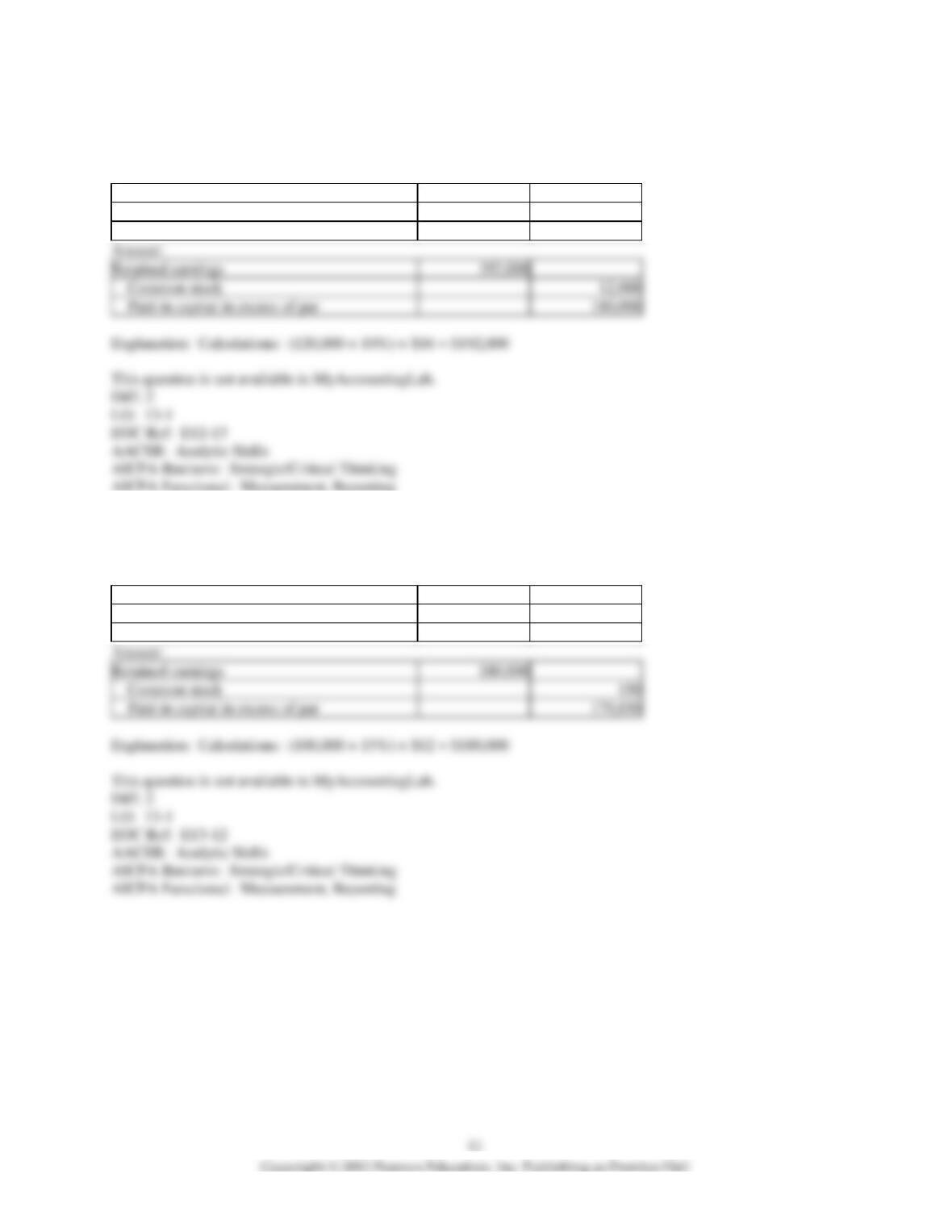
31) Landess Corporation currently has 120,000 shares outstanding of $1 par value common stock. The stock was
originally issued for $12 per share. On March 15, the board of directors declares a 10% stock dividend when the
stock is selling for $16 per share. Prepare the journal entry to record the stock dividend.
Retained earnings
32) Happy Holiday, Inc. has 100,000 shares of common stock issued and outstanding, with a par value of $0.01 per
share. They distributed a 15% common stock dividend; market value is $12 per share. Please provide the journal
entry to record this transaction.
Retained earnings
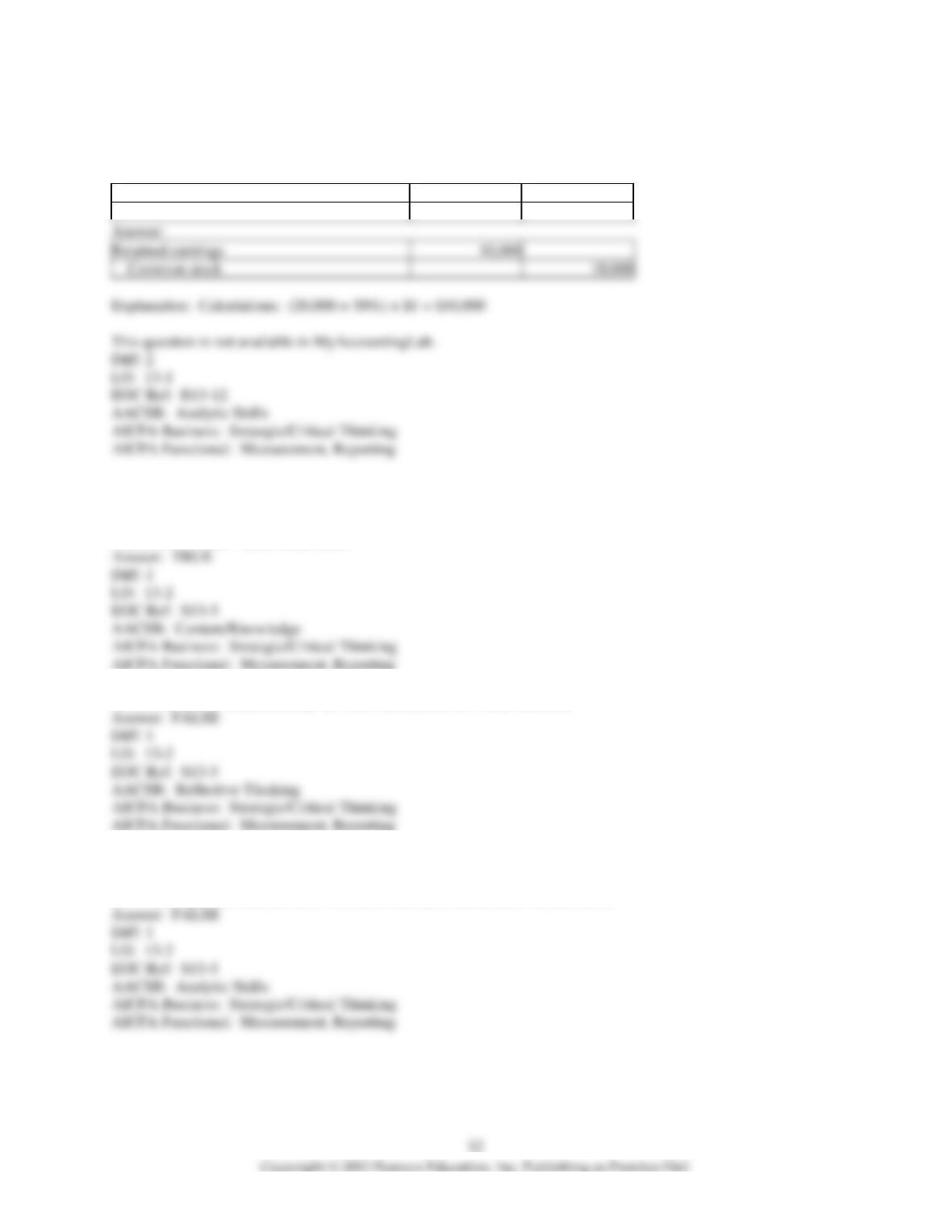
33) On December 1, 2013, Arbor Company had 20,000 shares of $1 par value common stock issued and
outstanding. The next day they distributed a 50% stock dividend. The market value of the stock on that date was $9
per share. Please provide the journal entry for the transaction.
Retained earnings
Learning Objective 13-2
1) A stock split is an increase in the number of issued and outstanding shares of stock, coupled with a proportionate
reduction in the par value of the stock.
2) A stock split is fundamentally the same transaction as a stock dividend.
3) Preferred Products started business on March 1, 2012, and issued 100,000 shares of $2 par value common stock at
a market price of $50 per share. One year later, the share price had soared to $120. If Preferred Products does a 3–
for-1 stock split, the balance sheet will show that there are 200,000 shares issued.
4) Preferred Products started business on March 1, 2012, and issued 100,000 shares of $2 par value common stock at
a market price of $50 per share. One year later, the share price had soared to $120. If Preferred Products does a 3–
for-1 stock split, the balance sheet will show common stock with a par value of $0.67 per share.
5) If a company does not have enough cash to pay out regular dividends, but still wishes to give the shareholders
something that they would consider of value, the company should consider doing a stock split.
6) If a company’s share price is getting so high that the company thinks it might inhibit some investors from buying
stock, it should consider doing a stock split.
7) Preferred Products started business on March 1, 2012, and issued 100,000 shares of $2 par value common stock at
a market price of $50 per share. One year later, the share price had soared to $120. If Preferred Products does a 3–
for-1 stock split, the market value of the stock will drop to $60 per share.
8) Which of the following is a reason why a company would do a stock split?
A) To defend against a hostile takeover
B) To generate additional sales revenues
C) To reduce the market price at which the stock is trading
D) To provide the shareholders with something of value, when the company cannot afford a cash dividend
9) Which of the following occurs due to a 4-for-1 stock split?
A) The par value of each share of common stock is 25% of the par value before the split.
B) The par value of each share of common stock is 200% of the par value before the split.
C) The par value of each share of common stock remains the same as before the split.
D) The par value of each share of common stock is 400% of the par value before the split.
10) Which of the following statements is TRUE?
A) Both a stock dividend and a stock split increase the balance in the common stock account.
B) Both a stock dividend and a stock split reduce retained earnings.
C) Neither a stock dividend nor a stock split will result in net gains or losses.
D) A stock split increases the par value of the stock.
11) Which of the following would be included in the entry to record a 2-for-1 stock split?
A) There is no journal entry to record a stock split.
B) Common stock would be credited.
C) Retained earnings would be credited.
D) Retained earnings would be debited.
12) Which of the following would have the same effect on the number of shares issued and outstanding as a 2–for-1
stock split?
A) A 20% stock dividend
B) A 200% stock dividend
C) A 100% stock dividend
D) A 120% stock dividend
13) Which of the following occurs when the board of directors declares a 2-for-1 stock split on 20,000 outstanding
shares of $15 par common stock?
A) The par value of the stock remains the same.
B) The par value of the stock increases to $30 per share.
C) Outstanding shares decrease to 10,000.
D) Outstanding shares increase to 40,000.
14) Which of the following is a TRUE statement?
A) A stock split will increase total stockholders’ equity, but a stock dividend will not.
B) Neither a stock split nor a stock dividend will increase total stockholders’ equity.
C) A stock dividend will increase total stockholders’ equity, but a stock split will not.
D) A stock split will decrease retained earnings, but a stock dividend will not.
15) Which of the following occurs when a 2-for-1 stock split is declared?
A) The balance in common stock remains the same.
B) The balance in common stock is reduced to half the original amount.
C) The balance in common stock doubles.
D) The balance in paid-in capital doubles.
16) Gordon Corporation reported the following equity section on its current balance sheet. The common stock is
currently selling for $11.50 per share.
Common stock, $5 par, 100,000 shares authorized, 40,000 shares
issued
$200,000
Paid in capital in excess of par—common
120,000
Retained earnings
290,000
Total stockholders’ equity
$610,000
What will the total number of shares issued be after the declaration of a 10% stock dividend?
A) 20,000 common shares
B) 44,000 common shares
C) 40,000 common shares
D) 4,000 common shares
17) Gordon Corporation reported the following equity section on its current balance sheet. The common stock is
currently selling for $11.50 per share.
Common stock, $5 par, 100,000 shares authorized, 40,000 shares
issued
$200,000
Paid in capital in excess of par—common
120,000
Retained earnings
290,000
Total stockholders’ equity
$610,000
Which of the following would be TRUE if the company issued a 2-for-1 stock split?
A) Retained earnings would be decreased by $460,000.
B) Common stock would be increased by $200,000.
C) Paid-in capital in excess of par would be increased by $260,000.
D) None of the account balances would change.
18) Gordon Corporation reported the following equity section on its current balance sheet. The common stock is
currently selling for $11.50 per share.
Common stock, $5 par, 100,000 shares authorized, 40,000 shares
issued
$200,000
Paid in capital in excess of par—common
120,000
Retained earnings
290,000
Total stockholders’ equity
$610,000
What would the balance in Paid-in capital in excess of par be after a 2-for-1 stock split?
A) $580,000
B) $460,000
C) $380,000
D) $120,000
19) Gordon Corporation reported the following equity section on its current balance sheet. The common stock is
currently selling for $11.50 per share.
Common stock, $5 par, 100,000 shares authorized, 40,000 shares
issued
$200,000
Paid in capital in excess of par—common
120,000
Retained earnings
290,000
Total stockholders’ equity
$610,000
After a 2-for-1 stock split, what would the number of shares issued be?
A) 40,000
B) 80,000
C) 60,000
D) 120,000
20) Which of the following is a TRUE statement?
A) Both a stock split and a stock dividend will decrease total assets.
B) Both a stock split and a stock dividend will increase total liabilities.
C) A stock split will increase total assets, but a stock dividend will not.
D) Neither a stock split nor a stock dividend will affect total assets or total liabilities.
21) Which of the following does NOT require a formal journal entry?
A) Cash dividend
B) Stock dividend
C) Stock split
D) Issuance of new shares
22) Apira has 2,000 shares of common stock outstanding. A stockholder has 100 shares. If Apira distributes a 20%
stock dividend, how many shares of Apira will the stockholder have?
A) 120
B) 105
C) 100
D) 20
23) ABC has 45,000 shares of $10 par common stock outstanding. They offer a stock split of 4-for-1. The effect of
the split will be:
A) par stays at $10; total shares go to 11,250.
B) par drops to $5; total shares stay at 45,000.
C) par drops to $2.50; total shares go to 180,000.
D) par goes to $40; total shares go to 180,000.
24) A 3-for-1 stock split will:
A) triple the par value and drop the number of outstanding shares by one-third.
B) have no effect on the par value, but will affect the number of outstanding shares.
C) have no effect on the number of outstanding shares, but will affect par value.
D) cut the par value by one-third and triple the number of outstanding shares.
25) On January 1, 2013, Parquet Sales issued 40,000 shares of common stock at a price of $22 per share. The stock
has a par value of $1.00 per share. In mid-2014, due to dramatic increases in profits, the stock reached a market
value of $90 per share. The board of directors approved a 2-for-1 stock split. After the stock split, what will the
balance sheet show as the number of shares issued?
A) 40,000
B) 80,000
C) 60,000
D) 44,000
26) On January 1, 2013, Parquet Sales issued 40,000 shares of common stock at a price of $22 per share. The stock
has a par value of $1.00 per share. In mid-2014, due to dramatic increases in profits, the stock reached a market
value of $90 per share. The board of directors approved a 2-for-1 stock split. After the stock split, what will the
balance sheet show as the par value of common stock?
A) $2.00
B) $1.50
C) $1.00
D) $0.50
27) On January 1, 2013, Parquet Sales issued 40,000 shares of common stock at a price of $22 per share. The stock
has a par value of $1.00 per share. In mid-2014, due to dramatic increases in profits, the stock reached a market
value of $90 per share. The board of directors approved a 2-for-1 stock split. After the stock split, what will the
market value of the stock be?
A) $45.00 per share
B) $44.00 per share
C) $135.00 per share
D) $0.50 per share
28) Which of the following actions will increase the balance in the Common stock account?
A) Cash dividend
B) Stock split
C) Stock dividend
D) Purchase of treasury stock
29) Which of the following actions could increase the balance in the Paid-in capital in excess of par account?
A) Cash dividend
B) Stock split
C) Stock dividend
D) Purchase of treasury stock
30) Which of the following will decrease the balance in Retained earnings?
A) Repayment of bond principal
B) Stock split
C) Stock dividend
D) Purchase of treasury stock