Version 1 1
Student name:__________
TRUE/FALSE – Write ‘T’ if the statement is true and ‘F’ if the statement is false.
1) A state has the obligation to monitor and regulate a not-for-profit (NFP) organization
because it granted the NFP tax-exempt status through the not-for-profit corporation laws.
⊚ true
⊚ false
2) The federal government’s primary objective in regulating not-for-profit organizations
through the income tax laws is to limit the number of exempt organizations that operate at any
one point in time.
⊚ true
⊚ false
3) Not-for-profit corporations cannot lobby or attempt to influence legislation or politicians.
⊚ true
⊚ false
4) The not-for-profit organization applying for tax-exempt status determines the appropriate
subsection under IRC Sec. 501 for which it wants to be considered and the Internal Revenue
Service then approves or denies the application.
⊚ true
⊚ false
5) The unrelated business income tax could be a significant cost and therefore should be of
concern to tax-exempt organizations.
⊚ true
⊚ false
6) Intermediate sanctions can be imposed by the Internal Revenue Service, in addition to
revoking the tax-exempt status for organizations that confer excessive economic benefits on
officers of the organization.
⊚ true
⊚ false
Version 1 2
7) If a tax-exempt organization dissolves and goes out of business, it must distribute its
assets to another tax-exempt organization or a governmental entity.
⊚ true
⊚ false
8) Board members of a not-for-profit organization have a fiduciary responsibility to provide
fiscal guidance and ongoing governance over the not-for-profit organization to ensure that its
exempt mission is carried out as described in the incorporating documents and exempt
application.
⊚ true
⊚ false
9) All officers of a not-for-profit organization have the same responsibilities to the
organization and its constituents.
⊚ true
⊚ false
10) Not-for-profit organizations are so diverse in nature that it is not feasible to find
benchmarks with which to compare their financial and operating performance.
⊚ true
⊚ false
11) Not-for-profit organizations risk loss of their tax-exempt status if they participate in a
political campaign on behalf of a candidate for public office.
⊚ true
⊚ false
12) “Excess benefit transactions” are those in which persons who have substantial influence
over the not-for-profit organization engage in transactions that result in economic benefits to
them that are excessive, such as unreasonable compensation, sale of assets at bargain prices, and
lease arrangements.
⊚ true
⊚ false
Version 1 3
13) One of the limitations of financial ratio analysis for not-for-profit organizations is that
donors may incorrectly assume that there are federal or state laws that govern the percentage of
annual revenues that a charity must spend on its programs.
⊚ true
⊚ false
14) The ratio unrestricted net assets as a percent of operating expenses is helpful in
determining if the not-for-profit organization can cover its debt service expense.
⊚ true
⊚ false
15) A 501(c)(3) organization must provide donors with a written disclosure for all donations
received.
⊚ true
⊚ false
16) Only 501(c)(3) organizations receiving at least 50 percent of their support from the public
at large rather than a few individual donors can be considered public charities.
⊚ true
⊚ false
17) Political parties and campaign committees can qualify for tax-exempt status.
⊚ true
⊚ false
18) All not-for-profit organizations are required to file some type of Form 990 with the
Internal Revenue Service.
⊚ true
⊚ false
19) Unrelated business income tax is reported on the Form 990.
Version 1 4
⊚ true
⊚ false
20) The Charleston Principles provide guidance to state governments in setting registration
requirements for not-for-profits wanting to raise funds online.
⊚ true
⊚ false
21) A not-for-profit typically has gross receipts of $4,500 or less each year. According to the
IRS it would not have to file with the IRS to be considered tax-exempt under Sec. 501(c)(3).
⊚ true
⊚ false
22) A large not-for-profit organization expended $1,250,000 in direct lobbying during the
current year. As long as the $1,250,000 did not exceed 2 percent of the organization’s gross
receipts, the amount is allowable according to the Internal Revenue Code.
⊚ true
⊚ false
23) Income a not-for-profit organization earns from a rental property on which it has a
mortgage is potentially subject to unrelated business income tax.
⊚ true
⊚ false
24) A disqualified person is a person who has violated and been sanctioned under the Internal
Revenue Code.
⊚ true
⊚ false
25) The program expense efficiency ratio is helpful in assessing whether a not-for-profit is
using its resources to accomplish its mission or goals.
⊚ true
⊚ false
Version 1 5
26) The lack of defined ownership for not-for-profit organizations creates control and
reporting problems for not-for-profit managers.
⊚ true
⊚ false
27) The success of a not-for-profit organization is measured primarily by the amount of
profits generated by the organization’s activities.
⊚ true
⊚ false
28) Not-for-profit organizations are required to file audited financial statements with all
states in which they solicit contributions.
⊚ true
⊚ false
29) Not-for-profit organizations must take the form of a directorship in which the board is
self-perpetuating (i.e., it elects itself).
⊚ true
⊚ false
MULTIPLE CHOICE – Choose the one alternative that best completes the statement or
answers the question.
30) Which of the following is an advantage of a not-for-profit board establishing an audit
committee?
A) Is able to assist the board in reviewing the compensation paid to the senior
executives.
B) It can help the board fulfill its oversight responsibilities by working directly with the
public accounting firm.
C) It helps the board develop a succession plan for the CEO.
D) It can assist the board in reviewing the budget for the next fiscal year.
31) Which of the following is not a true statement about tax-exempt organizations?
Version 1 6
A) They must be organized to serve the charitable needs of the public at large.
B) They must first become a not-for-profit corporation or charitable trust.
C) They are permitted to perform some political lobbying if guidelines are met.
D) Their unrelated business income is taxed at corporate income tax rates.
32) A nongovernmental tax-exempt organization must complete a Form 990 and send it to
the Internal Revenue Service:
A) Only if they have unrelated business income.
B) If they are not a religious organization, and have gross receipts of $5,000 or more
each year.
C) If they have gross receipts of $1,000 or more each year.
D) Only if they are a private foundation, not a public charity.
33) Which of the following not-for-profit organizations is most likely to be tax-exempt under
IRC Sec. 501(c)(3)?
A) Beta Kappa Alpha Sorority.
B) Peaceful Dreams Cemetery Association.
C) Regional Association of Tree Trimmers.
D) Survivors of Breast Cancer Club.
34) Which of the following is a reason why a not-for-profit organization might fail to qualify
for tax-exempt status?
A) It is operated primarily for the benefit of its members.
B) Its officers are paid excessive wages.
C) Its primary purpose is to promote the election of a senate candidate.
D) It has unrelated business income.
35) The Internal Revenue Service may impose intermediate sanctions on all of the following
transactions between a not-for-profit organization and its executive officer except:
Version 1 7
A) Excessive compensation.
B) The not-for-profit organization paying more than the fair rental value for property
owned by the officer.
C) A bargain on the sale of assets.
D) Fringe benefits comparable to those given to all employees.
36) The income most likely to be considered unrelated business income of a human service
organization that provides immunizations to children in the community is:
A) Rental of extra space in thedebt-financed building.
B) Sale of sweatshirts with the organization’s logo on it at a price above cost at the
annual fundraiser.
C) Interest and dividend income on investments.
D) Gain on the sale of equipment no longer needed by the organization.
37) The term that means information skewed toward a particular belief with a tendency to
have little or no factual basis is:
A) Political influence.
B) Legislation.
C) Propaganda.
D) Lobbying.
38) A tax-exempt organization that receives its support primarily from a large number of
individuals or corporations and a relatively small amount from investment income is called a:
A) Public charity.
B) Private foundation.
C) Public foundation.
D) Voluntary health and welfare organization.
39) Public disclosure rules require that a tax-exempt not-for-profit organization:
Version 1 8
A) Make available a copy of its Form 990 to the public for a period of up to three years.
B) Post a copy of its articles of incorporation and by-laws on its website.
C) Provide a copy of the minutes to all board meetings to any person who requests the
minutes within 90 days of the board meeting.
D) Make available a copy of its Form 990-T, but not its Form 990, to the public for a
period of up to two years.
40) The organization Shelter the Needy is completing its Form 990 and it is trying to
determine if it has unrelated business income on which it must pay taxes. Which of the following
would be subject to unrelated business income taxes?
A) The Shelter sold art work it had received as a donation.
B) Volunteers raised several thousand dollars in a marathon sponsored for the benefit of
the Shelter.
C) The Shelter earned revenues from the self-service laundry facilities it provides for
the benefit of tenants of its low-income temporary housing facilities.
D) None of the items listed would be subject to unrelated business income taxes.
41) A good measure that can be used to help assess whether a not-for-profit organization is
spending too much on overhead, such as general and administrative expenses, is:
A) Percentage of unrestricted net assets to operating expenses.
B) Current ratio.
C) Total revenues divided by total expenses.
D) Percentage of program expenses to total expenses.
42) A good measure of whether a not-for-profit organization is a “going concern” and can
sustain its operations into the future is:
A) Total revenues divided by assets.
B) Percentage of unrestricted net assets to average monthly operating expenses.
C) Percentage of program expenses to total expenses.
D) Fund-raising expenses as a percentage of public support.
Version 1 9
43) A good measure of whether a not-for-profit organization is “liquid” and can meet its
short-term obligations is:
A) Percentage of program expenses to total expenses.
B) Total revenues divided by total expenses.
C) Current assets divided by current liabilities.
D) Percentage of unrestricted net assets to operating expenses.
44) A good measure of whether a not-for-profit organization is efficient in its fund-raising
efforts is:
A) Fund-raising expenses as a percentage of public support.
B) The ratio of program expenses to number of clients served.
C) Total revenues divided by total expenses.
D) Percentage of program expenses to total expenses.
45) All of the following organizations may be not-for-profit except:
A) Colleges and universities.
B) Hospitals.
C) Privately held partnerships.
D) Human service organizations.
46) A good measure of whether a not-for-profit organization is highly leveraged is:
A) Percentage of unrestricted net assets to average monthly operating expenses.
B) The ratio of debt to net assets.
C) Total revenues divided by total expenses.
D) Percentage of program expenses to total expenses.
47) The local Kennel Club is a not-for-profit organization with gross receipts of $43,500 for
the current tax year. Under the Internal Revenue Service Code, the Kennel Club would be
required to file which of the following forms for the tax year?
Version 1 10
A) Form 990-N.
B) Form 990-EZ.
C) Form 990-PF.
D) Since its gross receipts are less than $50,000 it need not file with the Internal
Revenue Service.
48) The Form 990 consists of 12 parts (core form) and several schedules. Which of the
following would not be included as one of the parts of the core form of the Form 990?
A) Statement of program service accomplishments.
B) Management analysis of the financial condition of the organization.
C) Balance sheet.
D) A checklist of required schedules.
49) Which of the following is the incorporating document of a not-for-profit organization that
describes the purpose or mission of the organization?
A) By-laws.
B) IRS Form 1023 request for tax-exempt status.
C) Articles of incorporation.
D) Charter.
50) A not-for-profit organization is granted its legal status by which of the following?
A) Federal government.
B) State government.
C) The city or county in which it resides.
D) The courts.
51) Which of the following would not be required under not-for-profit incorporation laws?
Version 1 11
A) Appointment of a board of directors.
B) Establishment of by-laws.
C) A clearly stated purpose for the organization.
D) Application for 501(c)(3) status.
52) Which of the following defines an appeal to the public to take action on a legislative
matter?
A) Grass-roots lobbying.
B) Propaganda.
C) Lobbying.
D) Political influence.
53) Not-for-profit organizations can take which of the following organizational forms?
A) Nongovernmental.
B) Governmental.
C) Business.
D) Both governmental and nongovernmental are acceptable organizational forms.
54) An individual can generally receive a tax deduction for contributions to which type of
not-for-profit organization?
A) 501(c)(1) organization.
B) 501(c)(3) organization.
C) 527 organization.
D) Any not-for-profit organization granted tax exemption by the IRS.
Version 1 12
ESSAY. Write your answer in the space provided or on a separate sheet of paper.
55) The following are key terms that relate to regulatory and taxation issues of not-for-profit
organizations:
A.Unrelated business income
B.Public charity
C.Charitable solicitation
D.Lobbying
E.Debt financed income
F.Private foundation
G.Propaganda
For each of the following definitions, indicate the key term from the list above that best
matches by placing the appropriate letter in the blank space next to the definition.
_____ 1. A not-for-profit exempt under IRC Sec. 501(c)(3) that receives most of its support
from a small number of donors or investment income rather than from the public at large.
_____ 2. A direct request for credit or financial assistance that will be used for the 501(c)(3)’s
mission.
_____ 3. Information that is skewed toward a particular belief with little basis in fact.
_____ 4. Gross income from an unrelated trade or business regularly carried on by a tax-exempt
organization.
_____ 5. Contacting elected officials to encourage specific legislative action.
Version 1 13
56) The following are types of ratios described that can be used to assess the financial
performance of not-for-profit organizations:
A.Liquidity
B.Going concern
C.Program expense efficiency
D.Debt coverage
E.Leverage
F.Fund-raising efficiency
G.Investment performance
For each of the following performance indicators, indicate the type of ratio from the list above
that best matches by placing the appropriate letter in the blank space next to the phrase.
_____ 1. Are earnings on investments on target?
_____ 2. Is the cost of raising contributions at an appropriately small percentage of contributions
received?
_____ 3. Is the organization relying too much on debt to finance operations?
_____ 4. Is an appropriate amount spent on accomplishing the organization’s program goals?
_____ 5. Are revenues sufficient to cover expenses?
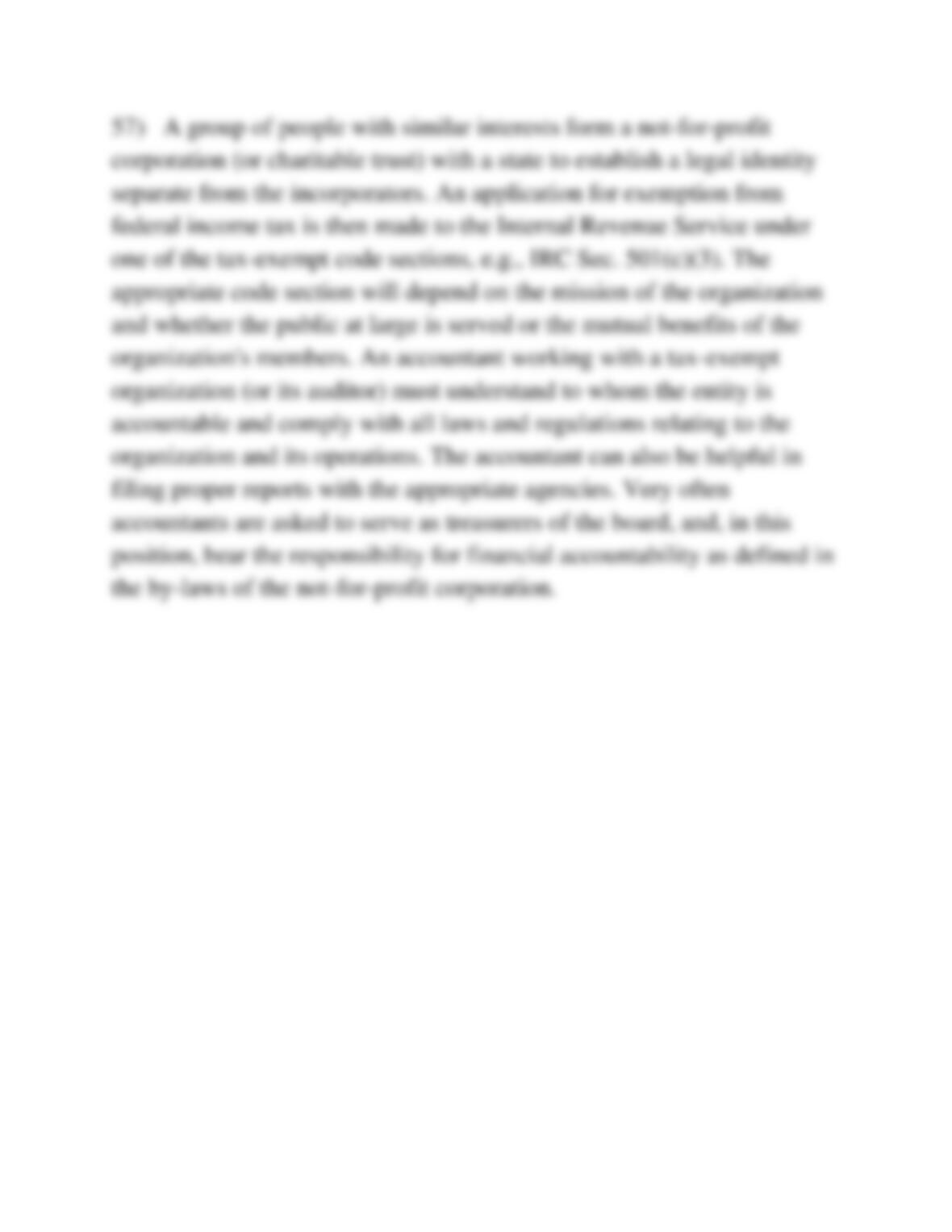
57) Describe the process for becoming a tax-exempt organization. Why do you believe it is
important for an accountant to understand this process?
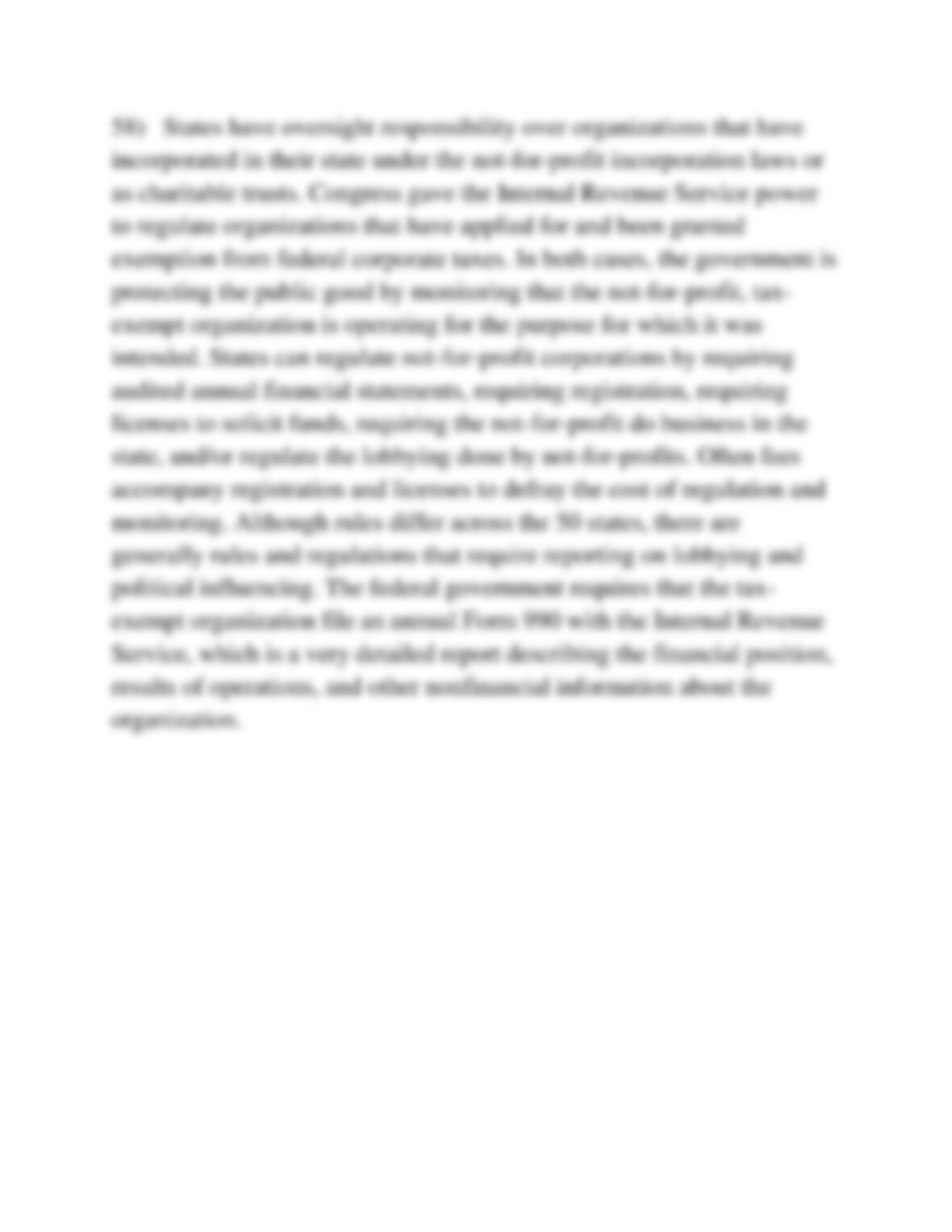
58) Why do states and the federal government exercise oversight responsibility over not-for-
profit, tax-exempt corporations? How do states and the federal government differ in the way they
exercise this responsibility?
Version 1 14
59) Your client is a nongovernmental not-for-profit museum that operates a gift shop.
Explain the unrelated business income tax to your client and suggest ways to avoid this tax.
60) Explain the purpose of “intermediate sanctions”.
61) Describe the difficulty in comparing the financial performance of a not-for-profit
organization to other similar organizations. What benchmarks are available to assist in this task?
Version 1 15
Answer Key
Test name: chapter 13
Version 1 16
Version 1 17
Version 1 18
Version 1 19
Version 1 20