52) Secore Robotics Corporation has developed a new robot—model TR-53—that has been
designed to outperform a competitor’s best-selling robot. The competitor’s product has a useful
life of 20,000 hours of service, has operating costs that average $1.30 per hour, and sells for
$109,000. In contrast, model TR-53 has a useful life of 100,000 hours of service and its
operating cost is $0.80 per hour. Secore has not yet established a selling price for model TR-53.
From a value-based pricing standpoint what is the reference value that Secore should consider
when pricing model TR-53?
A) $189,000
B) $135,000
C) $545,000
D) $109,000
53) Chasin Industries Inc. has developed a new robot, model JB-32, that is designed to offer
superior performance to a comparable robot sold by Chasin’s main competitor. The competing
robot sells for $11,000 and needs to be replaced after 1,000 hours of use. It also requires $1,000
of preventive maintenance during its useful life. Model JB-32’s performance capabilities are
similar to the competing product with two important exceptions—it needs to be replaced only
after 2,000 hours of use and it requires $1,000 of preventive maintenance during its useful life.
From a value-based pricing standpoint what is the reference value that Chasin should consider
when pricing model JB-32?
A) $11,000
B) $12,000
C) $22,000
D) $13,000
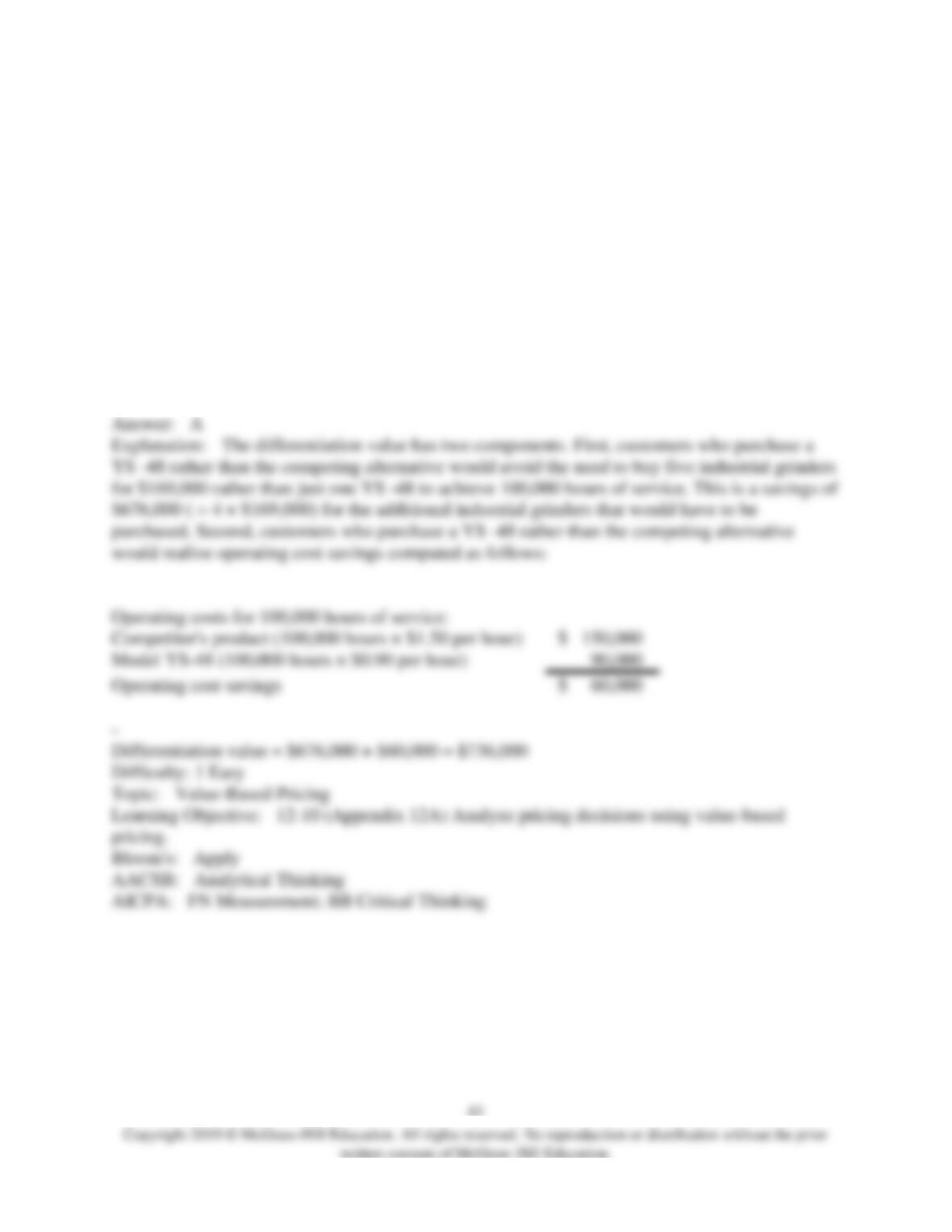
54) Ludy Mechanical Corporation has developed a new industrial grinder—model YS-48—that
has been designed to outperform a competitor’s best-selling industrial grinder. Model YS-48 has
a useful life of 100,000 hours of service and its operating cost is $0.90 per hour. In contrast, the
competitor’s product has a useful life of 20,000 hours of service and has operating costs that
average $1.50 per hour. The competitor’s industrial grinder sells for $169,000. Ludy has not yet
established a selling price for model YS-48.
From a value-based pricing standpoint what is the differentiation value offered by YS-48 relative
to the competitor’s offering for each 100,000 hours of service?
A) $736,000
B) $60,000
C) $199,000
D) $259,000
55) Rapson Pure Water Solutions Corporation has developed a new water purification system—
model EN-78—that has been designed to outperform a competitor’s best-selling water
purification system. Model EN-78 has a useful life of 120,000 hours of service and its operating
cost is $0.70 per hour. In contrast, the competitor’s product has a useful life of 40,000 hours of
service and has operating costs that average $1.20 per hour. The competitor’s water purification
system sells for $149,000. Rapson has not yet established a selling price for model EN-78.
From a value-based pricing standpoint what range of possible prices should Rapson consider
when setting a price for EN-78?
A) $233,000 ≤ Value–based price ≤ $358,000
B) $358,000 ≤ Value–based price ≤ $507,000
C) $149,000 ≤ Value–based price ≤ $507,000
D) $149,000 ≤ Value–based price ≤ $233,000
56) Schimpf Industries Inc. has developed a new grinder, model WC-13, that is designed to offer
superior performance to a comparable grinder sold by Schimpf’s main competitor. The
competing grinder sells for $24,000 and needs to be replaced after 1,000 hours of use. It also
requires $2,000 of preventive maintenance during its useful life. Model WC-13’s performance
capabilities are similar to the competing product with two important exceptions—it needs to be
replaced only after 4,000 hours of use and it requires $5,000 of preventive maintenance during
its useful life.
From a value-based pricing standpoint what range of possible prices should Schimpf consider
when setting a price for model WC-13?
A) $24,000 ≤ Value–based price ≤ $99,000
B) $75,000 ≤ Value–based price ≤ $96,000
C) $24,000 ≤ Value–based price ≤ $96,000
D) $75,000 ≤ Value–based price ≤ $99,000
57) Olivier Industries Inc. has developed a new instrument, model AG-06, that is designed to
offer superior performance to a comparable instrument sold by Olivier’s main competitor. The
competing instrument sells for $74,000 and needs to be replaced after 1,000 hours of use. It also
requires $7,000 of preventive maintenance during its useful life. Model AG-06’s performance
capabilities are similar to the competing product with two important exceptions—it needs to be
replaced only after 4,000 hours of use and it requires $14,000 of preventive maintenance during
its useful life.
From a value-based pricing standpoint what is the differentiation value offered by model AG-06
relative to the competitor’s offering for each 4,000 hours of usage?
A) $296,000
B) $102,000
C) $236,000
D) $14,000
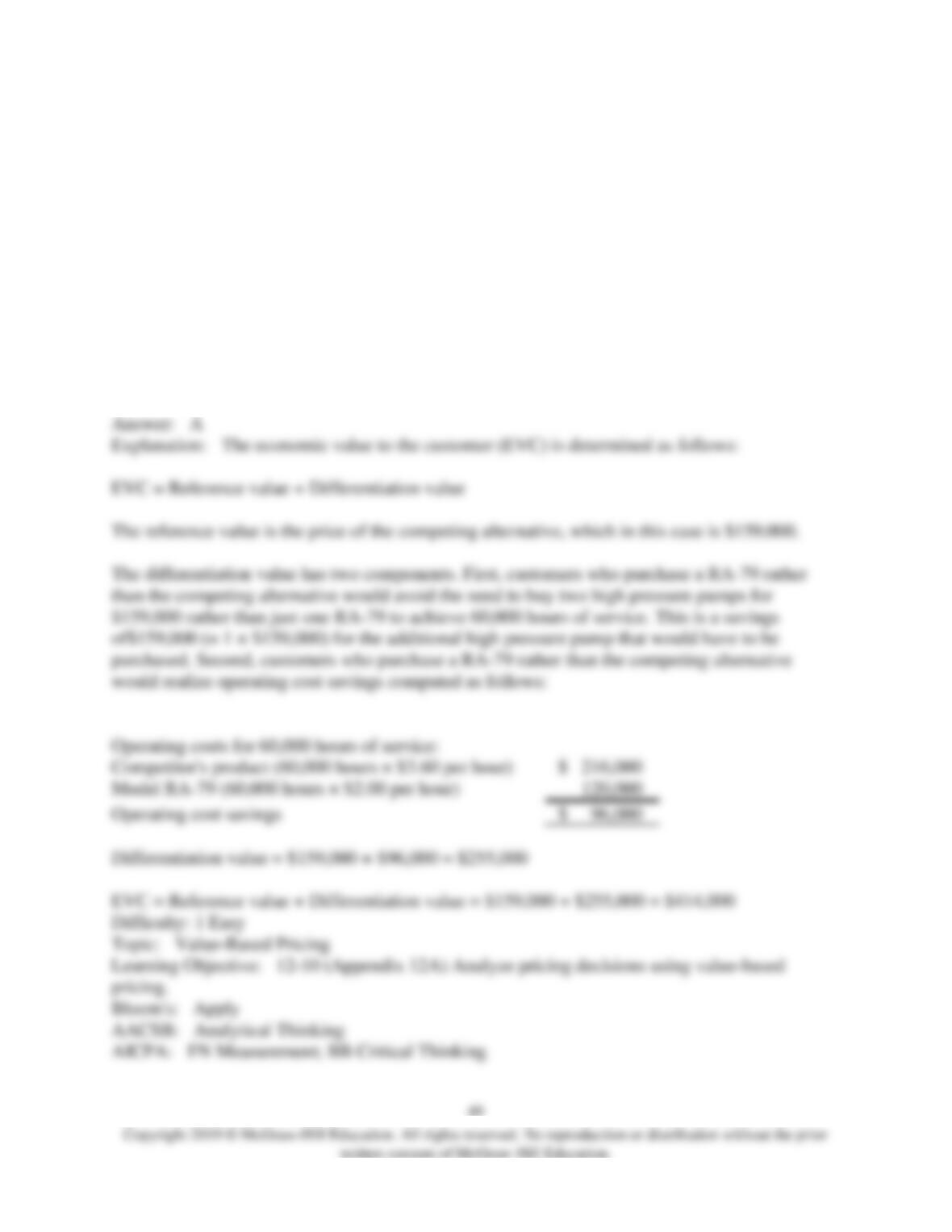
58) Conaghan Avionics Corporation has developed a new high pressure pump—model RA-79—
that has been designed to outperform a competitor’s best-selling high pressure pump. The
competitor’s product has a useful life of 30,000 hours of service, has operating costs that average
$3.60 per hour, and sells for $159,000. In contrast, model RA-79 has a useful life of 60,000
hours of service and its operating cost is $2.00 per hour. Conaghan has not yet established a
selling price for model RA-79.
From a value-based pricing standpoint what is RA-79’s economic value to the customer over its
60,000 hour useful life?
A) $414,000
B) $267,000
C) $255,000
D) $279,000
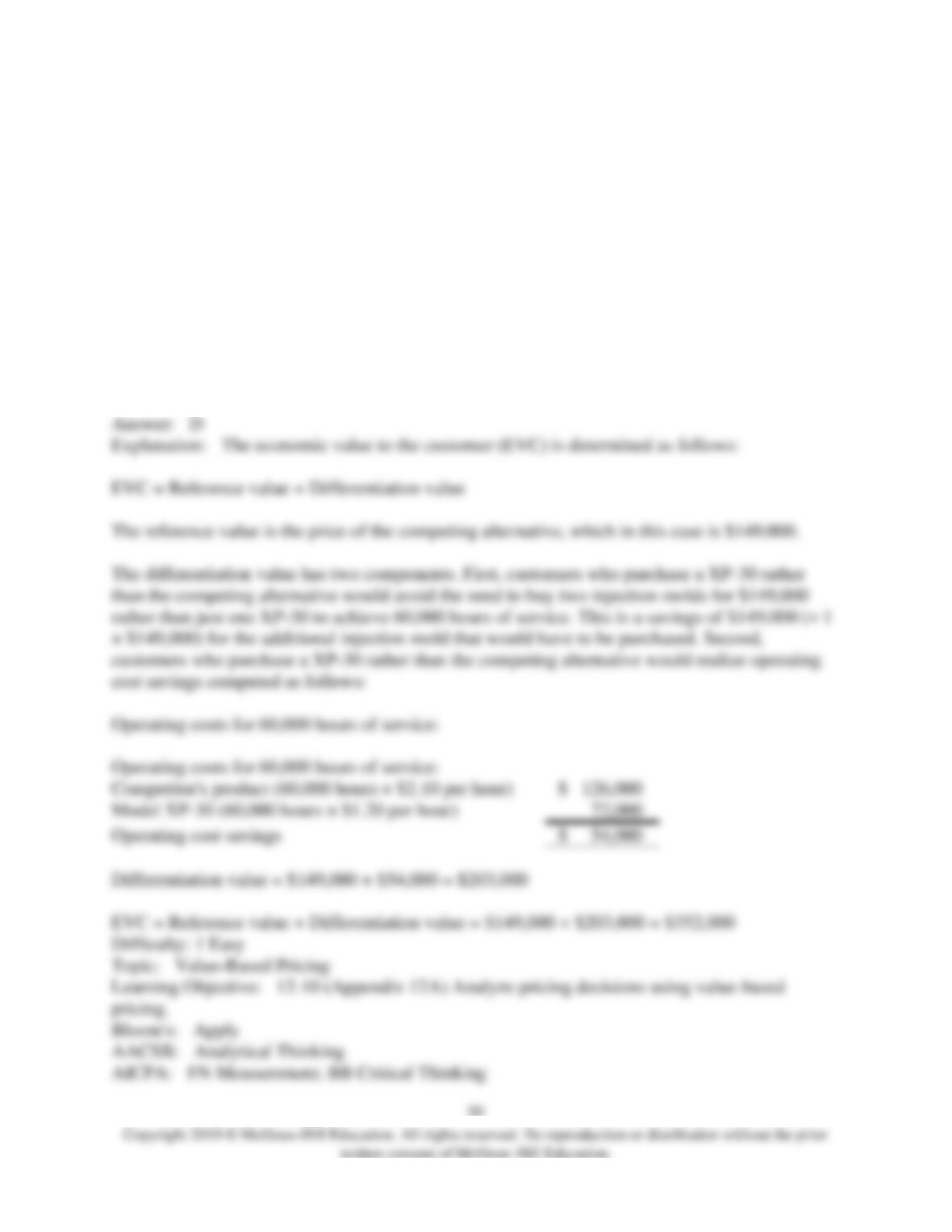
59) Hennig Plastics Equipment Corporation has developed a new injection mold—model XP-
30—that has been designed to outperform a competitor’s best-selling injection mold. Model XP-
30 has a useful life of 60,000 hours of service and its operating cost is $1.20 per hour. In
contrast, the competitor’s product has a useful life of 30,000 hours of service and has operating
costs that average $2.10 per hour. The competitor’s injection mold sells for $149,000. Hennig has
not yet established a selling price for model XP-30.
From a value-based pricing standpoint what is XP-30’s economic value to the customer over its
60,000 hour useful life?
A) $221,000
B) $212,000
C) $203,000
D) $352,000
60) Cables Electronics Corporation has developed a new instrument—model XG-75—that has
been designed to outperform a competitor’s best-selling instrument. Model XG-75 has a useful
life of 40,000 hours of service and its operating cost is $2.80 per hour. In contrast, the
competitor’s product has a useful life of 20,000 hours of service and has operating costs that
average $5.00 per hour. The competitor’s instrument sells for $169,000. Cables has not yet
established a selling price for model XG-75.
From a value-based pricing standpoint what is the reference value that Cables should consider
when pricing model XG-75?
A) $269,000
B) $281,000
C) $338,000
D) $169,000
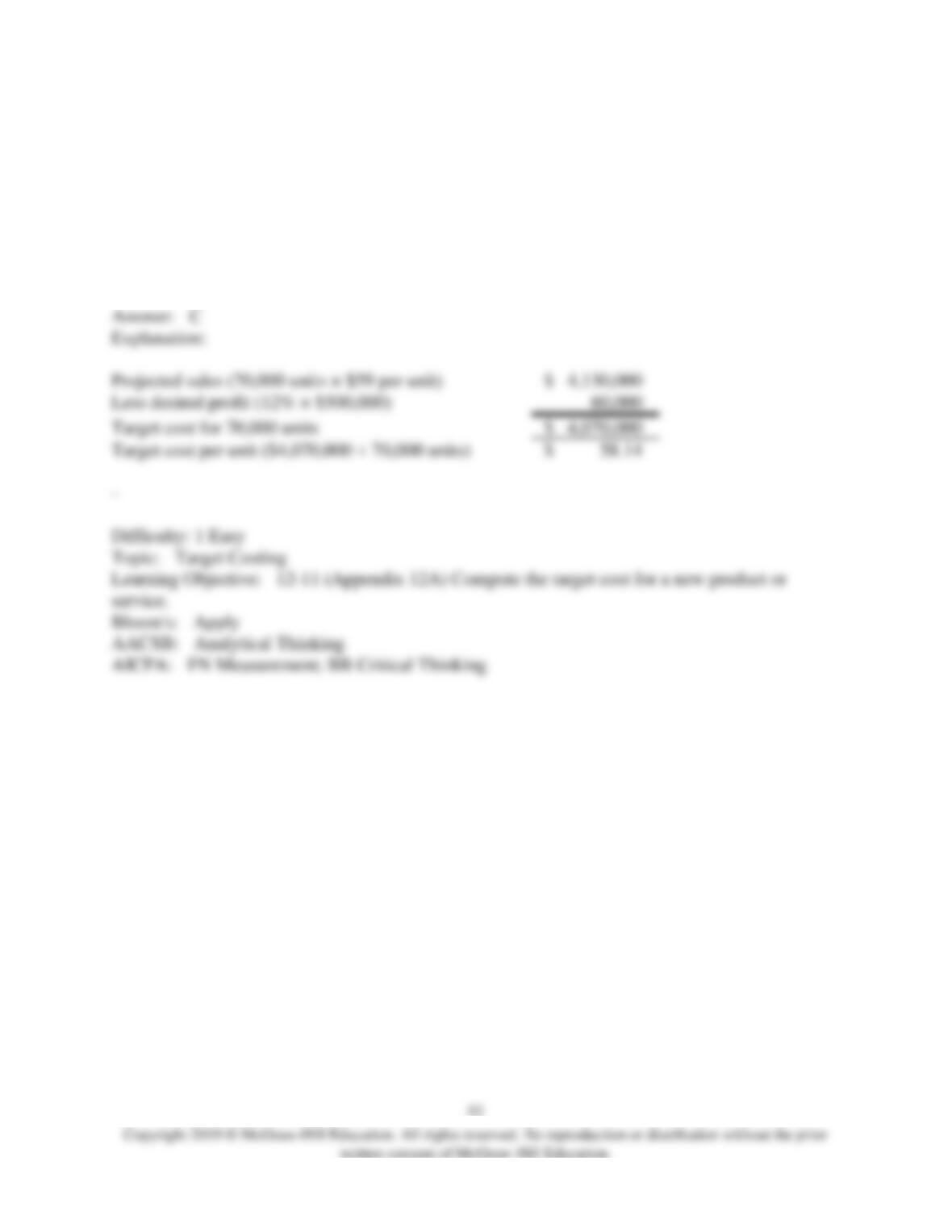
61) A new product, an automated crepe maker, is being introduced at Knutt Corporation. At a
selling price of $59 per unit, management projects sales of 70,000 units. Launching the crepe
maker as a new product would require an investment of $500,000. The desired return on
investment is 12%. The target cost per crepe maker is closest to:
A) $59.00
B) $66.08
C) $58.14
D) $65.12
62) Home Products, Inc., is planning the introduction of a new food dryer. To compete
effectively, the dryer would have to be priced at no more than $40 per unit. An investment of
$600,000 would have to be made in order to produce and sell the new dryer. The company
requires a return on investment of at least 25% on new products. Assuming that the company
expects to produce and sell 30,000 dryers per year, the target cost per dryer would be closest to:
A) $18.00
B) $35.00
C) $20.00
D) $24.67
63) Alway Candy Corporation is implementing a target costing approach for its latest new
product, the “Big Glob” candy bar. The following information relates to the Big Glob:
Target cost per candy bar
$
0.60
Expected annual sales (in units) of candy bars
200,000
Required investment in additional assets
$
100,000
Desired return on investment
20
%
–
Based on this information, what is Alway’s target selling price per bar for the Big Glob?
A) $0.70
B) $0.72
C) $0.75
D) $0.80
unit)
Less desired profit (20% × $100,000)
Target cost for 200,000 units
Target cost per unit
–
64) Timdat Corporation, a manufacturer of moderate-priced time pieces, would like to introduce
a new electronic watch. To compete effectively, the watch could not be priced at more than $30.
The company requires a return on investment of 25% on all new products. The plan is to produce
and sell 40,000 watches each year. This would require a $600,000 investment. The target cost
per watch would be:
A) $10.00
B) $20.00
C) $26.25
D) $45.00
65) The management of Giammarino Corporation is considering introducing a new product—a
compact barbecue. At a selling price of $78 per unit, management projects sales of 10,000 units.
Launching the barbecue as a new product would require an investment of $100,000. The desired
return on investment is 11%. The target cost per barbecue is closest to:
A) $86.58
B) $78.00
C) $76.90
D) $85.36
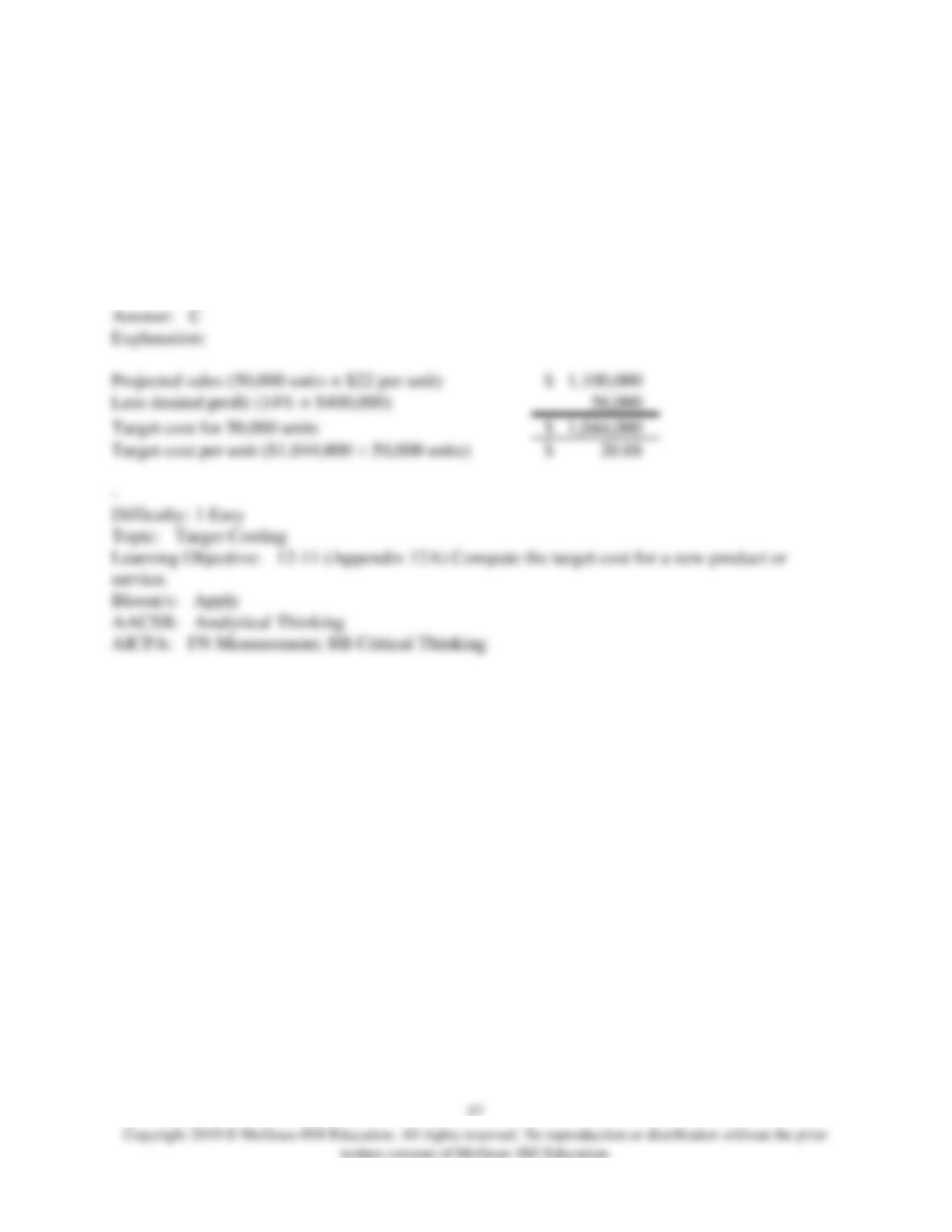
66) Hanisch Corporation would like to use target costing for a new product it is considering
introducing. At a selling price of $22 per unit, management projects sales of 50,000 units. The
new product would require an investment of $400,000. The desired return on investment is 14%.
The target cost per unit is closest to:
A) $22.00
B) $23.80
C) $20.88
D) $25.08
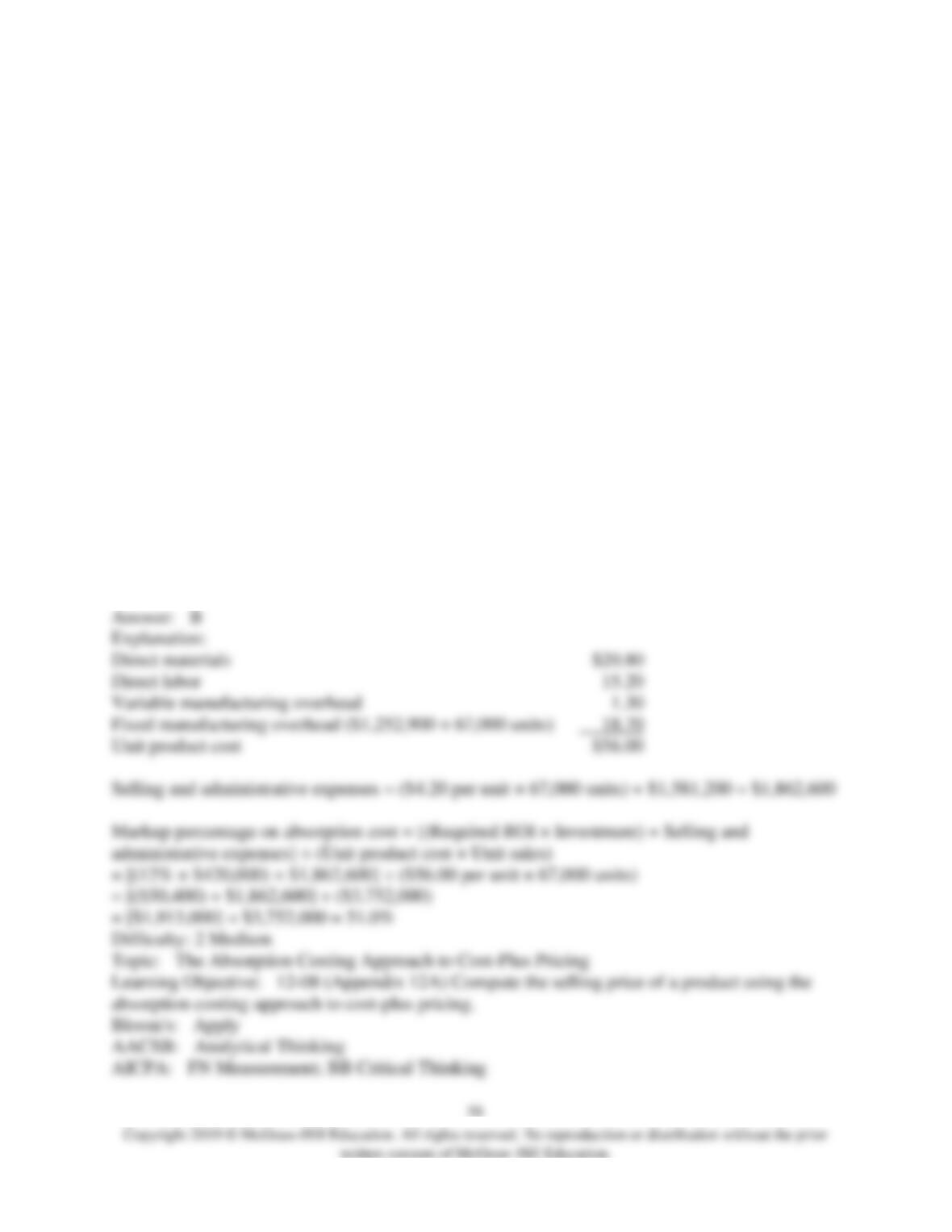
67) Diedrich Corporation makes a product with the following costs:
Per Unit
Per Year
Direct materials
$
20.80
Direct labor
$
15.20
Variable manufacturing overhead
$
1.30
Fixed manufacturing overhead
$
1,252,900
Variable selling and administrative expenses
$
4.20
Fixed selling and administrative expenses
$
1,581,200
–
The company uses the absorption costing approach to cost-plus pricing described in the text. The
pricing calculations are based on budgeted production and sales of 67,000 units per year.
The company has invested $420,000 in this product and expects a return on investment of 12%.
Direct labor is a variable cost in this company.
The markup on absorption cost is closest to:
A) 12.0%
B) 51.0%
C) 49.6%
D) 126.7%
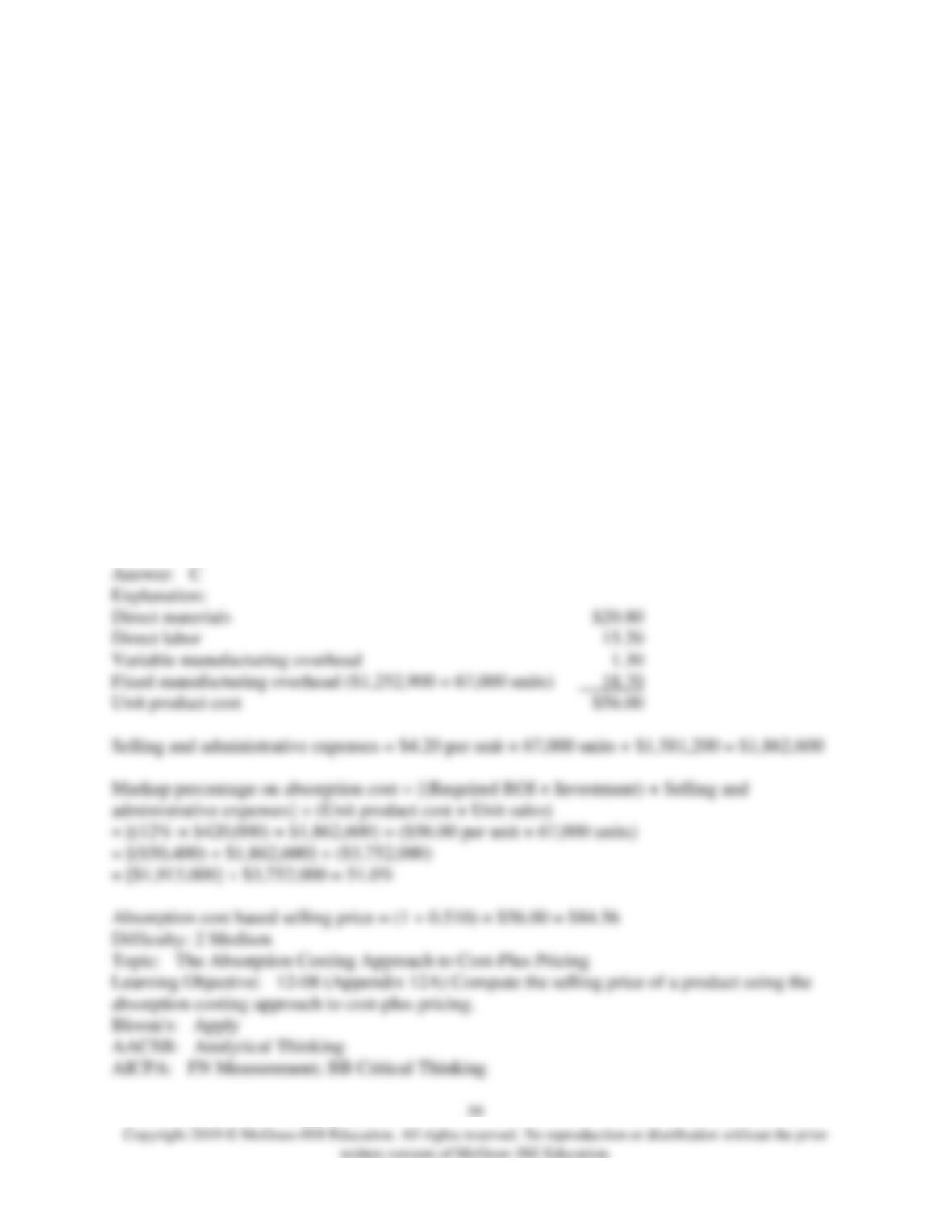
68) Diedrich Corporation makes a product with the following costs:
Per Unit
Per Year
Direct materials
$
20.80
Direct labor
$
15.20
Variable manufacturing overhead
$
1.30
Fixed manufacturing overhead
$
1,252,900
Variable selling and administrative expenses
$
4.20
Fixed selling and administrative expenses
$
1,581,200
The company uses the absorption costing approach to cost-plus pricing described in the text. The
pricing calculations are based on budgeted production and sales of 67,000 units per year.
The company has invested $420,000 in this product and expects a return on investment of 12%.
Direct labor is a variable cost in this company.
The selling price based on the absorption costing approach is closest to:
A) $83.80
B) $56.32
C) $84.56
D) $126.53
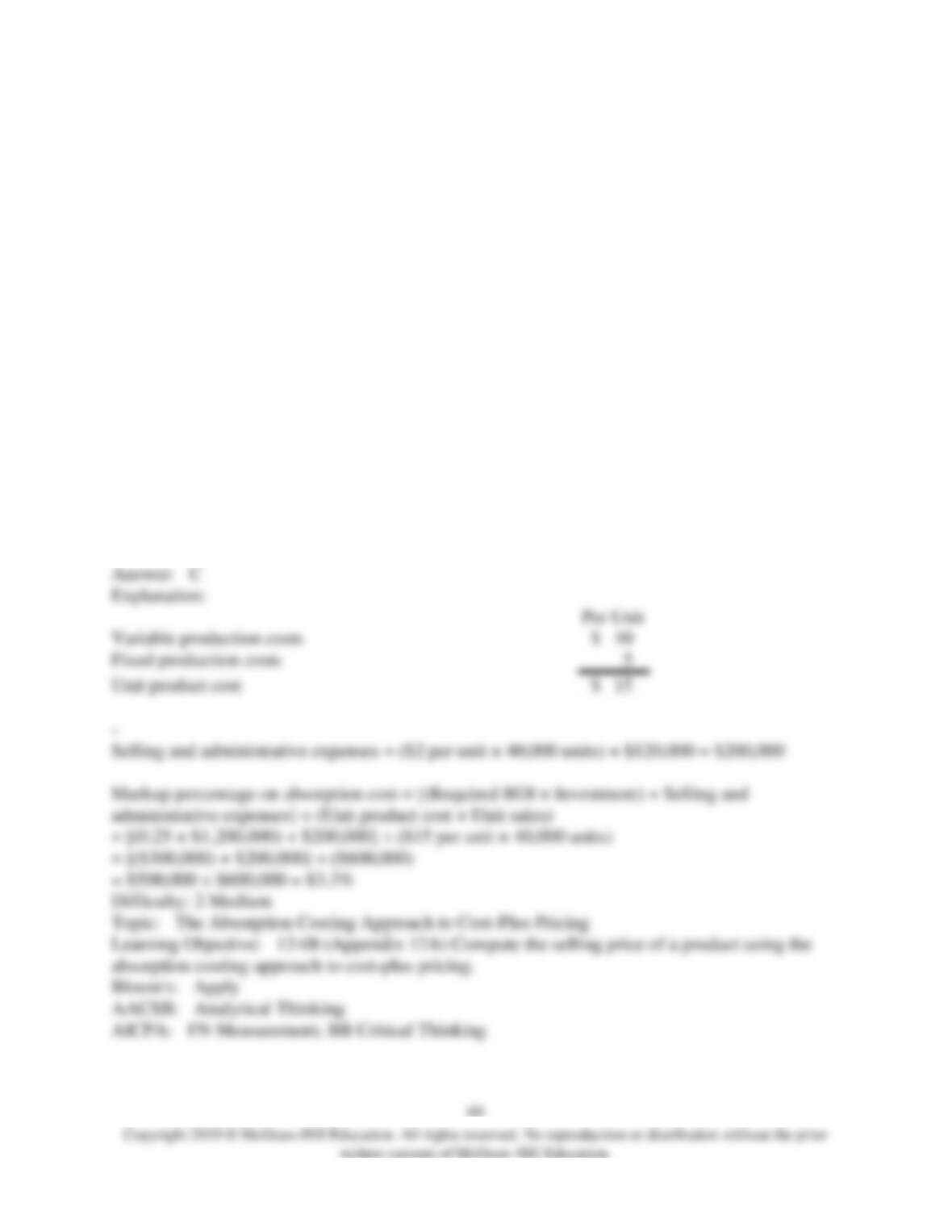
69) Nance Corporation is about to introduce a new product. The following costs would be
incurred if 40,000 units are produced and sold each year:
Per Unit
Total
Variable production costs
$
10
400,000
Fixed production costs
$
5
200,000
Variable selling and administrative costs
$
2
80,000
Fixed selling and administrative costs
$
3
$
120,000
Nance Corporation uses the absorption costing approach to cost-plus pricing as described in the
text.
Assume that the company has not yet determined a markup to use on the new product. The new
product would require an investment of $1,200,000. The company requires a 25% rate of return
on investment in all new products. The markup under the absorption costing approach would be
closest to:
A) 70.0%
B) 50.0%
C) 83.3%
D) 63.3%
Per Unit
Variable production costs
$
10
Fixed production costs
5
Unit product cost
$
15
–