39. Which of the following is an example of a mandatory transfer in college and
university accounting?
a. a transfer to a Plant Fund to set aside amounts that will be used to pay debt service in
accordance with a clause in a bond agreement
b. a transfer to a Plant Fund based on a decision by the Board of Trustees to build a new
school of engineering
c. a transfer to a Plant Fund based on a decision by management to build new box seats in
the football stadium for major donors
d. a reclassification from temporarily restricted to unrestricted net assets
40. Which of the following best describes standards for reporting expenses by function
(such as instruction and research) or by natural classification (such as salaries and
supplies) in the statement of activities prepared by colleges and universities?
a. all expenses must be reported by function on the face of the statement.
b. all expenses must be reported by natural classification on the face of the statement.
c. they may report by either method on the face of the statements; if they report by
natural classification on the face, they must report functional expenses in the notes.
d. colleges and universities may report by either method on the face of the statement.
41. The National Kidney Foundation, a voluntary health and welfare organization, is required
by GAAP to present an additional operating statement—a statement of functional
expenses. What will this statement present?
a. All expenses by function
b. All expenses by function and then by natural or object classification
c. All expenses by function then by funding source, including unrestricted and
temporarily restricted.
d. All expenses by natural or object classification

42. Socialite Lisa King establishes a $4 million irrevocable charitable remainder trust
providing a beneficial interest to the Clinton Metropolitan Opera. A percentage of the fair
value of the trust’s assets go to her husband during his lifetime. The Opera will receive the
remaining assets at her husband’s death. Mrs. King also specifies that the only the revenue
from investing the assets may be used to support the Opera’s programs. The Opera
estimates that the present value of the estimated future benefits it will receive from the
trust is $1.5 million. How should the Opera report this arrangement when it learns of the
trust?
a. It should record nothing now. It should record the fair value of the assets only after
Mr. King dies
b. It should record a $4 million receivable, $1.5 million in permanently restricted support,
and $2.5 million long-term payable to Mr. King.
c. It should disclose the anticipated $1.5 million contribution in the notes to its financial
statements.
d. It should record $1.5 million as contributions receivable and as permanently restricted
support
Problems
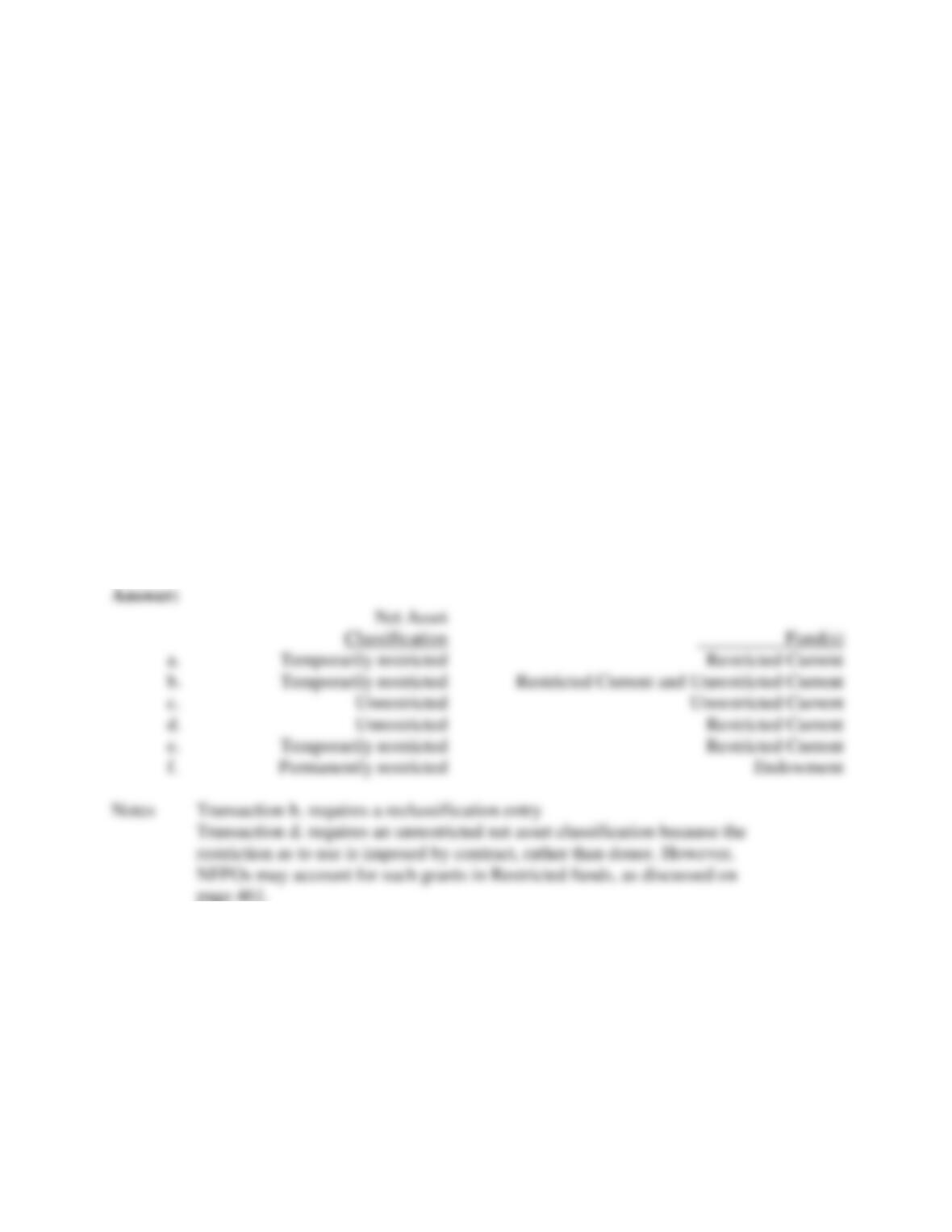
43. (Identifying the net asset classifications and funds used for transactions by NFPOs)
The following transactions pertain to the activities of the Whitt Shakespeare
Company (WSC), a not-for-profit entity. For each transaction, state which
classification of net assets is affected: unrestricted, temporarily restricted, or
permanently restricted. In addition, state the fund in which the transaction would be
recorded, if the entity were using fund accounting. (Transactions may require more
than one net asset classification and more than one fund.)
a. WSC receives a cash donation of $5,000, which must be used for a specific
performance to be attended only by disadvantaged youths.
b. WSC gives the performance referred to in transaction a.
c. WSC conducts its annual fund-raising campaign at the beginning of the year and raises
$50,000 to help meet its regular program and other expenses.
d. The state council on the arts gives WSC a grant of $20,000, to be used only for specific
performances for senior citizens who reside in government-supported housing.
e. Cort Beynon donates $16,000, stipulating that, starting next year, the
resources should be used to help meet its regular program and
administrative expenses, at the rate of $4,000 a year.
f. Jace Beynon donates $20,000, to be placed in a fund that will be maintained
in perpetuity.
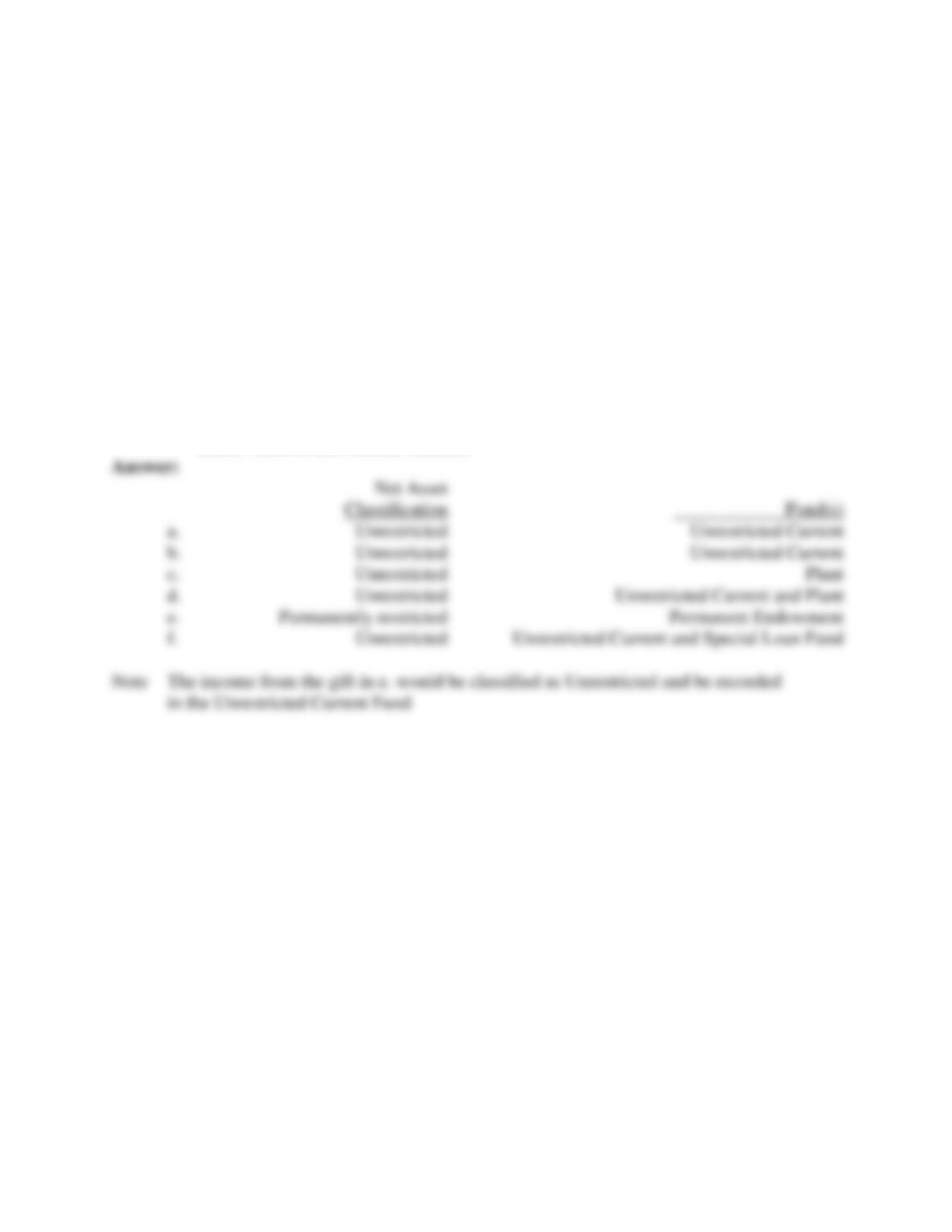
44. (Identifying the net asset classifications and funds used for transactions by NFP
colleges)
The following transactions occurred at a not-for-profit university. For each
transactions, state the appropriate net asset classification and the fund used.
(Transactions may require more than one net asset classification and more than one
fund.)
a. The university paid its regular salaries for instruction and general administration.
b. The university bookstore, an auxiliary enterprise, paid its bi-weekly payroll.
c. The university sold bonds to finance construction of a new academic building.
d. The university made a transfer of funds to pay for the first year’s debt service on the
bonds issued in transaction c.
e. The university received a gift of $1,000,000, to be held in perpetuity, with
the income to be used for any purpose approved by the university trustees.
f. The university trustees set aside $300,000 in a special loan fund to finance
tuition loans to low-income students.
45 (Journal entries to record transactions)
Prepare journal entries to record the following transactions of Weatherford Teen
Foundation, Inc. (WTFI), a not-for-profit entity that provides counseling, training,
and other programs for young people. WTFI accounts for all transactions in a single
fund, recording them so as to identify the three classes of net assets (unrestricted,
temporarily restricted, and permanently restricted) required for financial reporting.
(WTFI initially records all donations with program restrictions as temporarily
restricted until used for the intended purpose.)
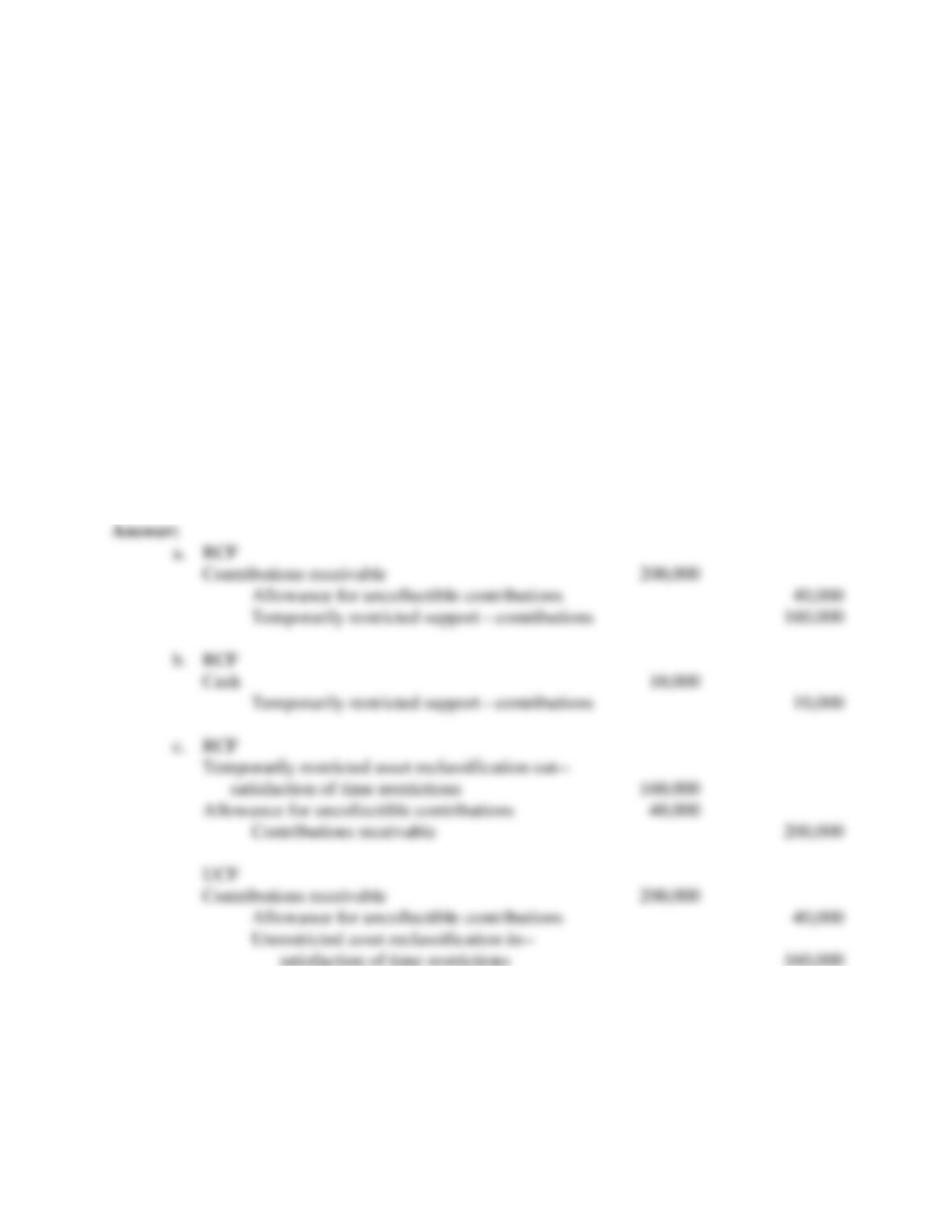
a. WTFI receives pledges of $150,000 to help finance its activities for the year. WTFI
expects that it will ultimately receive 90% of these pledges in cash.
b. During the year, WTFI receives cash of $130,000 against the pledges and writes off
$10,000 of the pledges as uncollectible.
c. WTFI incurs the following program expenses, financed by its unrestricted
revenues:
(1) Counseling programs, $40,000
(2) Training programs, $50,000
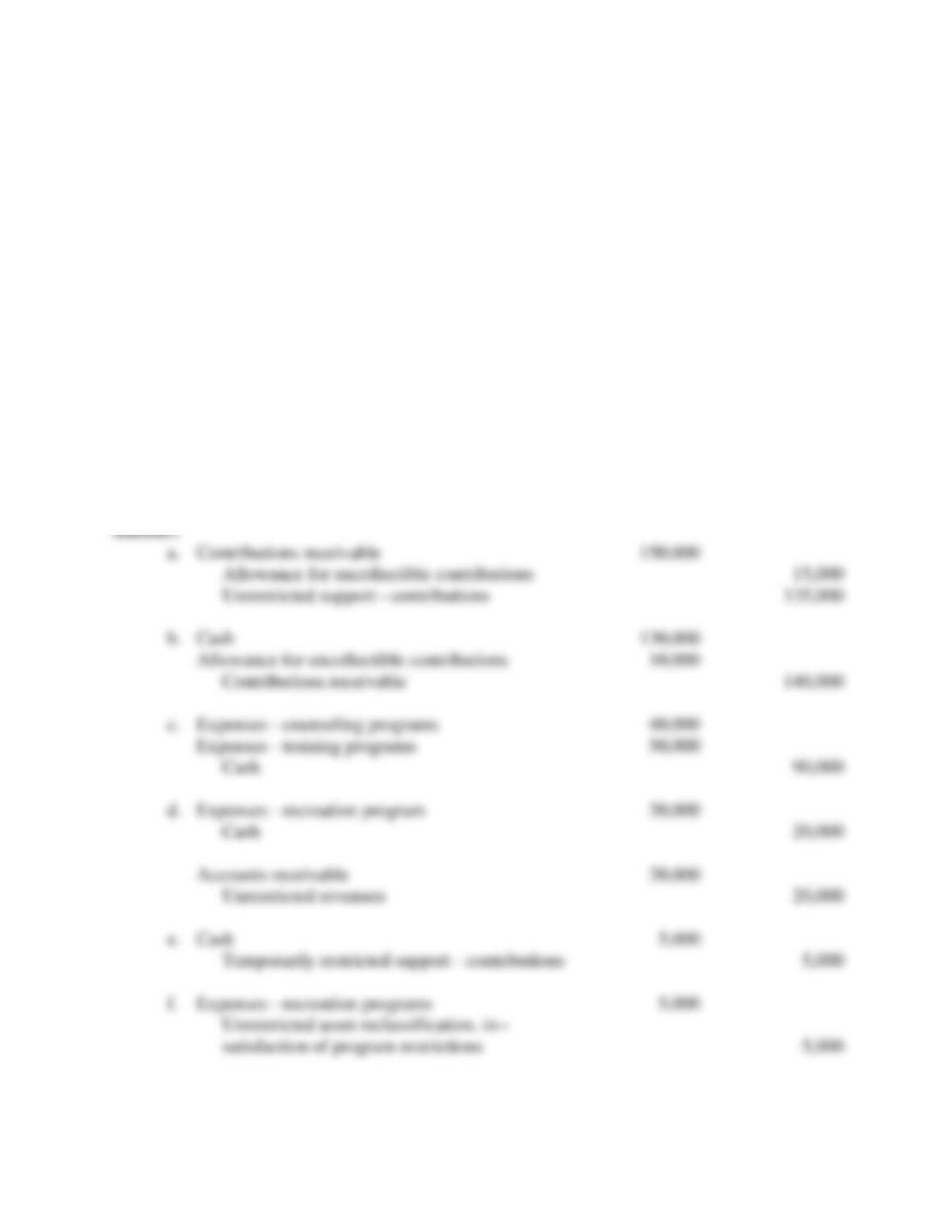
d. WTFI has a contract with the county in which it is located to administer a youth
recreation program. It incurs $20,000 of expenses under the program, and sends an
invoice to the county for that amount.
e. Carole Burgess donates $5,000, stipulating that WTFI must use her gift to
obtain the services of a well-known country singer for a special concert.
f. WTFI gives the concert referred to in e. WTFI pays $5,000 to the country
singer, and charges the expense to Recreation programs.
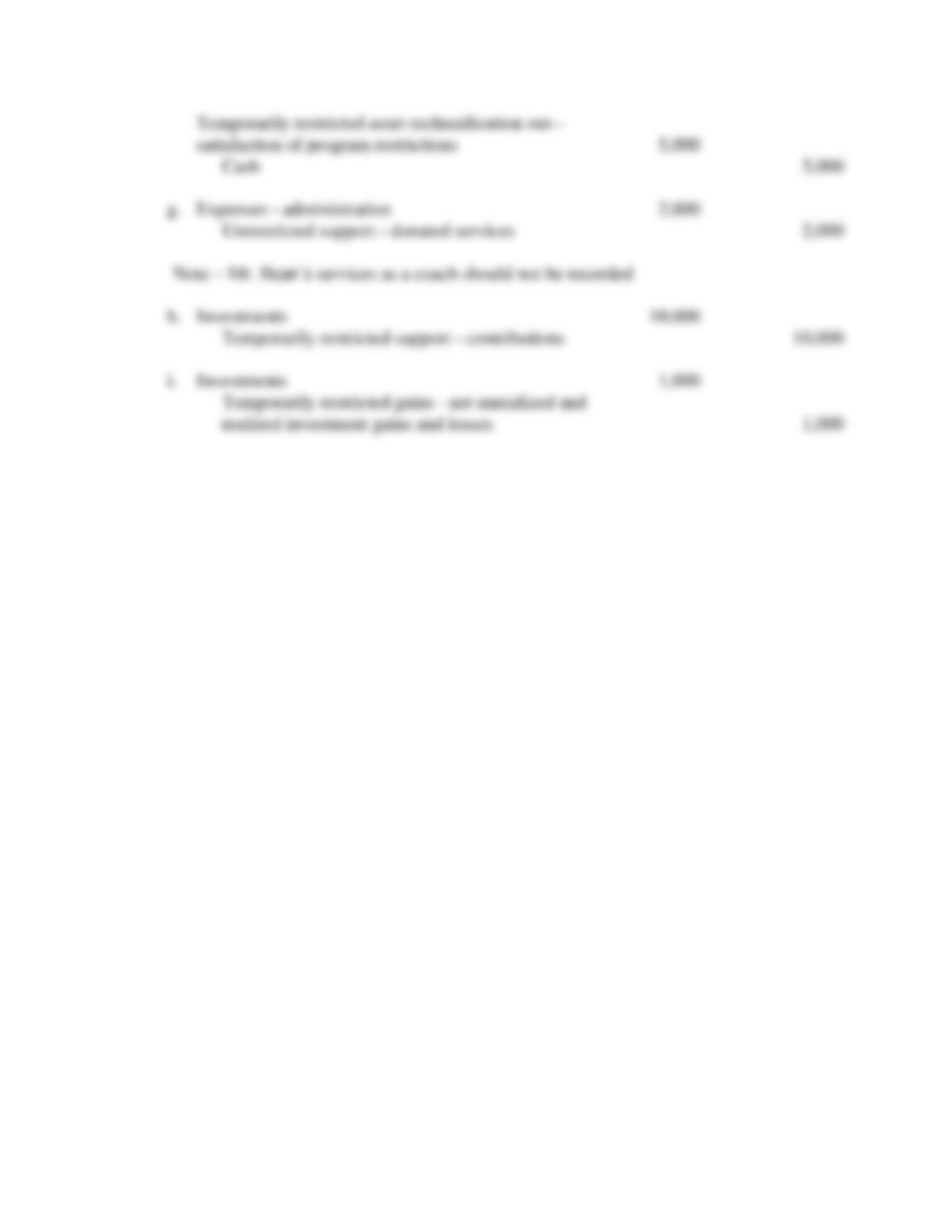
g. David Bean, a local attorney, donates 10 hours of his time to WTFI drawing
up legal contracts. Mr. Bean also donates 20 hours coaching softball for the
youths. He normally charges $200 an hour for his legal services. WTFI
would have hired an attorney and a coach to do this work if Mr. Bean had
not volunteered his time.
h. Mary Catlett donates common stock to WTFI, stipulating that the stock
must be used during WTFI’s next fiscal year for any programs WTFI
wishes to undertake. At the time of the gift, the stock has a fair value of
$10,000.
i. When WTFI closes its books at year-end, the stock gift from Ms. Catlett
has a fair value of $11,000.
46. (Journal entries involving net asset reclassifications)
Prepare journal entries to record the following transactions of Parker County
Outreach (PCO), a not-for-profit entity providing basic services to the poor. Also,
show the fund in which the entry is recorded. PCO uses an unrestricted current
fund (UCF) and a restricted current fund (RCF). In accordance with its accounting
policy, donations with either time or program restrictions are recorded in the RCF.
All expenses, however, are recorded in the UCF. PCO has a December 31 year end.
a. During December, 2012, PCO conducts a fund-raising campaign. Its
campaign literature states that all funds will be used in 2013. PCO receives
pledges totaling $200,000 in December. Past experience indicates it will
collect only 80% of the pledges.
b. On December 15, PCO receives a $10,000 donation from Gary Harmer, who says that
his donation must be used only to provide meals for the elderly poor.
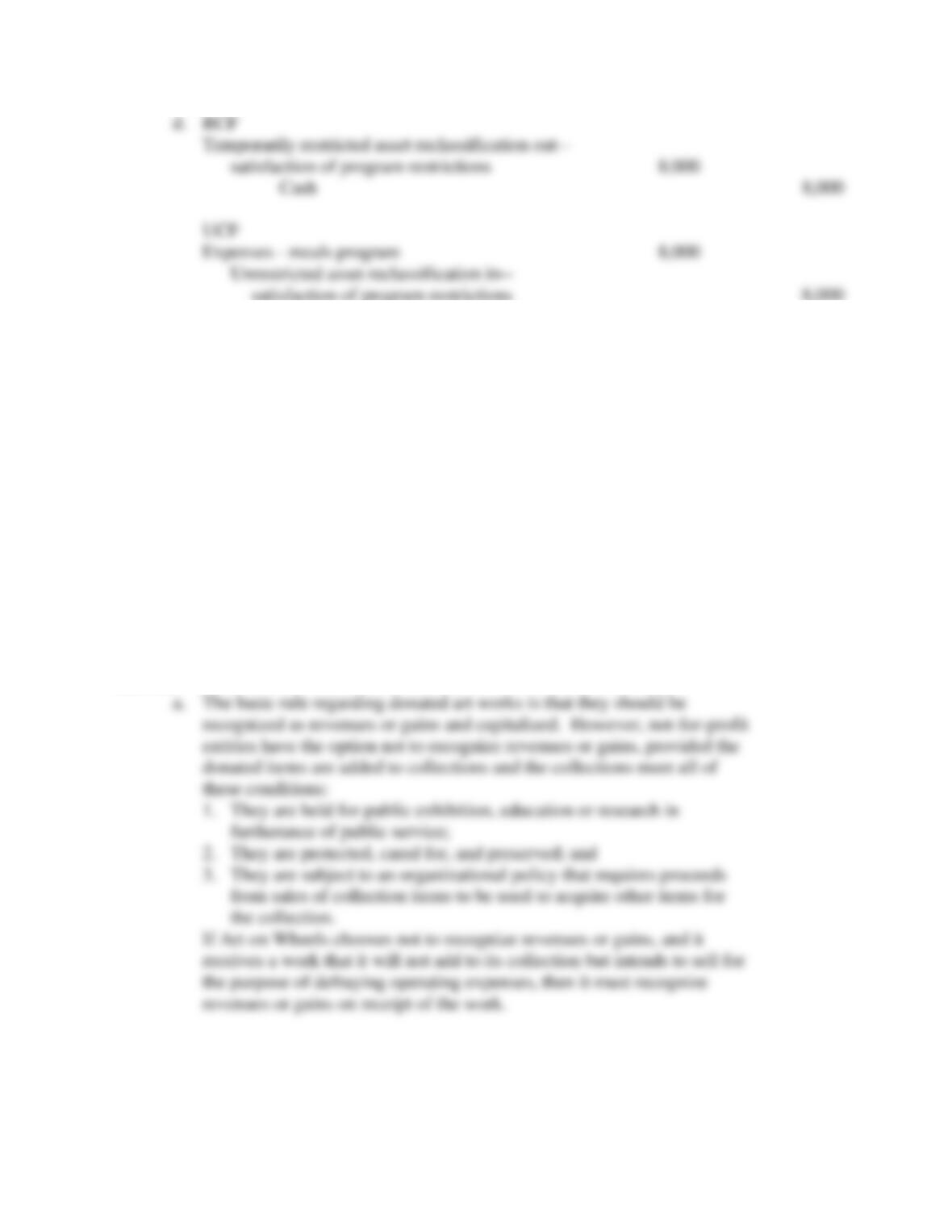
c. On January 2, 2013, PCO makes journal entries to record the satisfaction of the time
restriction resulting from the fund-raising campaign in transaction a.
d. During January, 2013, PCO provides meals for the poor at a cost of $8,000, partially
fulfilling the program restriction contained in the Gary Harmer donation.
47. (Discussion problem – contributions to collections)
Art on Wheels is a newly-formed not-for-profit corporation. Its purpose is to
promulgate public appreciation of 19th century American artists. It plans to solicit
works of art from donors and to display them both in a museum and in a specially
constructed bus that will travel throughout the country. It establishes a written
policy to collect works of art, exhibit them, and protect them from harm. Its policy
also calls for selling donated works of art that do not meet its stated objective of
enhancing appreciation of 19th century American artists. Proceeds from those
sales will be used either to purchase works that meet its objectives or, when
necessary, to defray the expenses of displaying the works.
Required: Discuss the accounting requirements (including available options) for
(a) recognizing revenues and assets resulting from donations of works of art, and
(b) depreciation of art works.
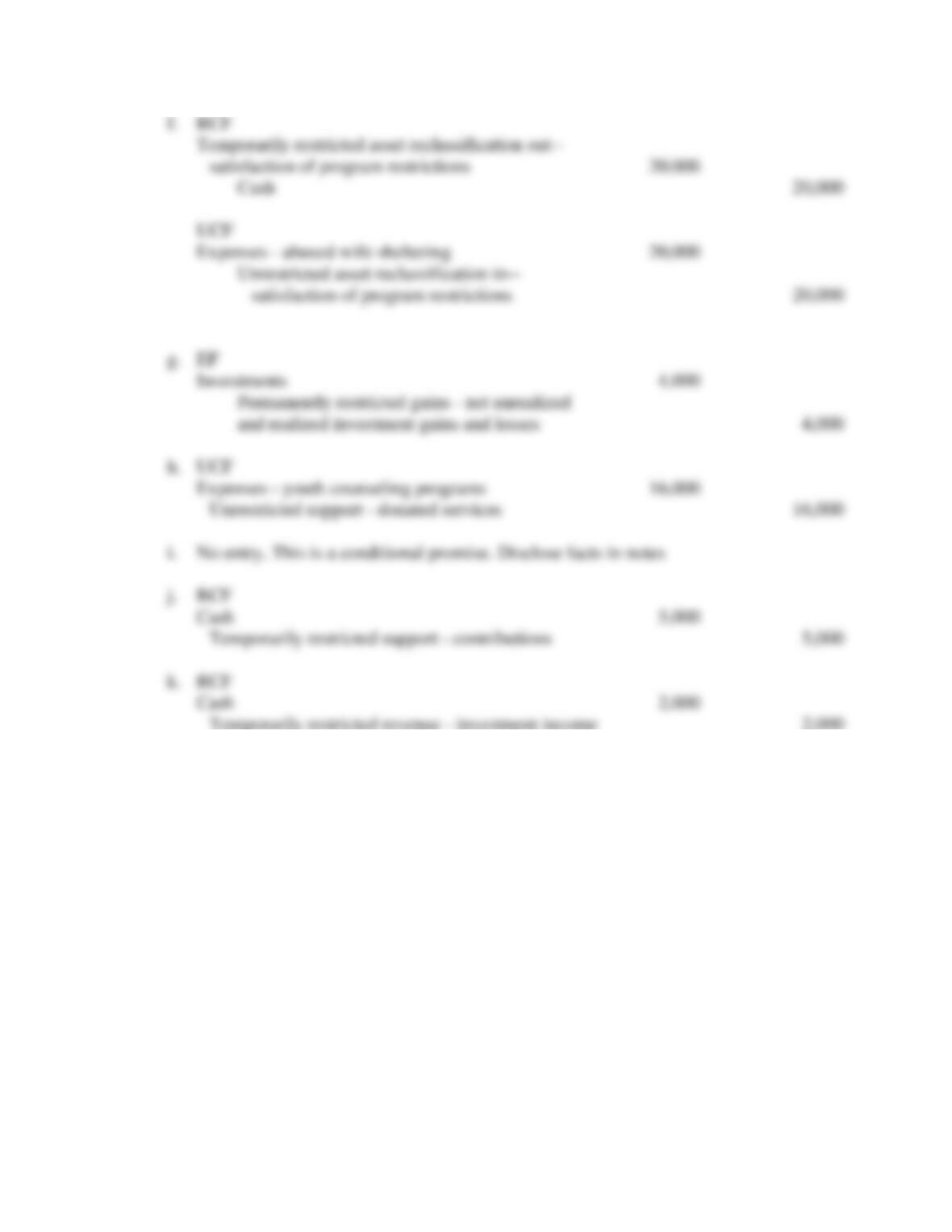
Answer:

48. (Journal entries using funds)
Inner City Compassion, Inc. (ICC) solicits donations to provide shelter and
counseling to abused children and adults. It also sponsors research into the causes
of abuse. To account for its activities, ICC uses an unrestricted current fund (UCF),
a restricted current fund (RCF), an endowment fund (EF), and a land, building, and
equipment fund (LBEF). In accordance with its accounting policies, all program
expenses are recorded in the UCF. Make journal entries to record the following
transactions, and identify the fund in which the entry is recorded.
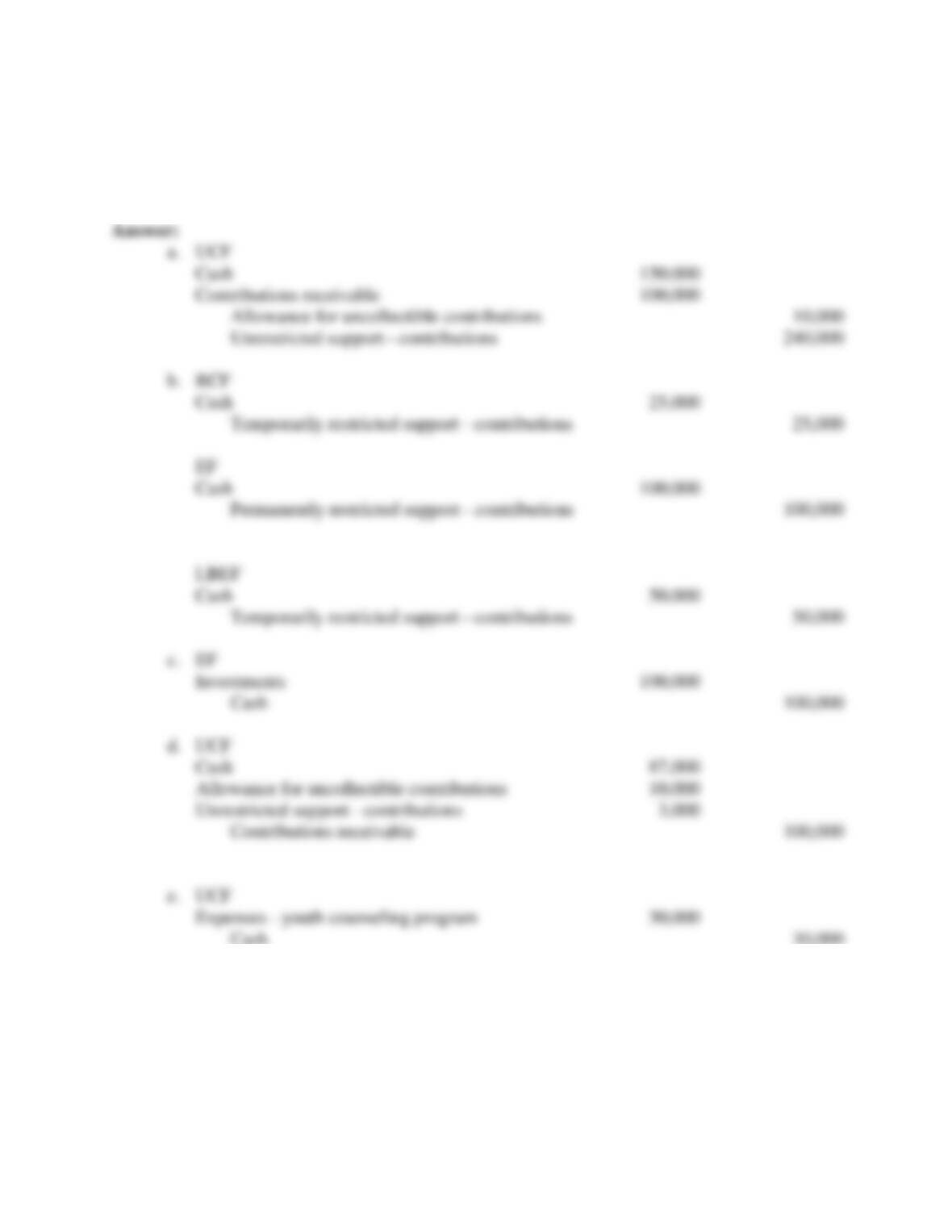
a. ICC receives cash contributions of $150,000 and pledges of $100,000, to be used for
any purpose approved by the trustees. Based on past experience, the trustees expect to
collect 90% of the pledges.
b. ICC receives the following donations in cash, each for certain specific
purposes:
(1) $25,000, which must be used only for sheltering abused wives;
(2) $100,000, the principal of which (and all investment gains or
losses) must be held in perpetuity; and the income must be used
only for research purposes; and
(3) $50,000, which must be used (together with any income its
investment generates) for acquisition of buildings and equipment.
c. ICC invests the $100,000 contribution from transaction b(2) in equity
securities.
d. ICC collects $87,000 in cash from the pledges made in transaction a. and writes off the
remaining $13,000 of pledges as uncollectible.
e. ICC spends $30,000 in cash on the youth counseling program.
f. ICC spends $20,000 of the donation received in b(1) for sheltering abused
wives.
g. At year-end, the $100,000 investment in transaction c. has a fair value of
$104,000.
h. E. Falk, a professional psychiatrist, donates 20 days of her time in
counseling youth under an ICC program. Had she not donated time, ICC
would have spent $800 a day for these services.
i. K. Schermann sends ICC a letter, stating that he will make a cash donation
next year of $25,000, provided ICC raises at least $50,000 in next-year’s
fund-raising campaign.
j. B. Shaw sends ICC $5,000, stipulating that it must be used for next year’s
programs.
k. Dividends of $2,000 are received on the investments in transaction c. [See
also b(2)]