CHAPTER 12
INTANGIBLE ASSETS
IFRS questions are available at the end of this chapter.
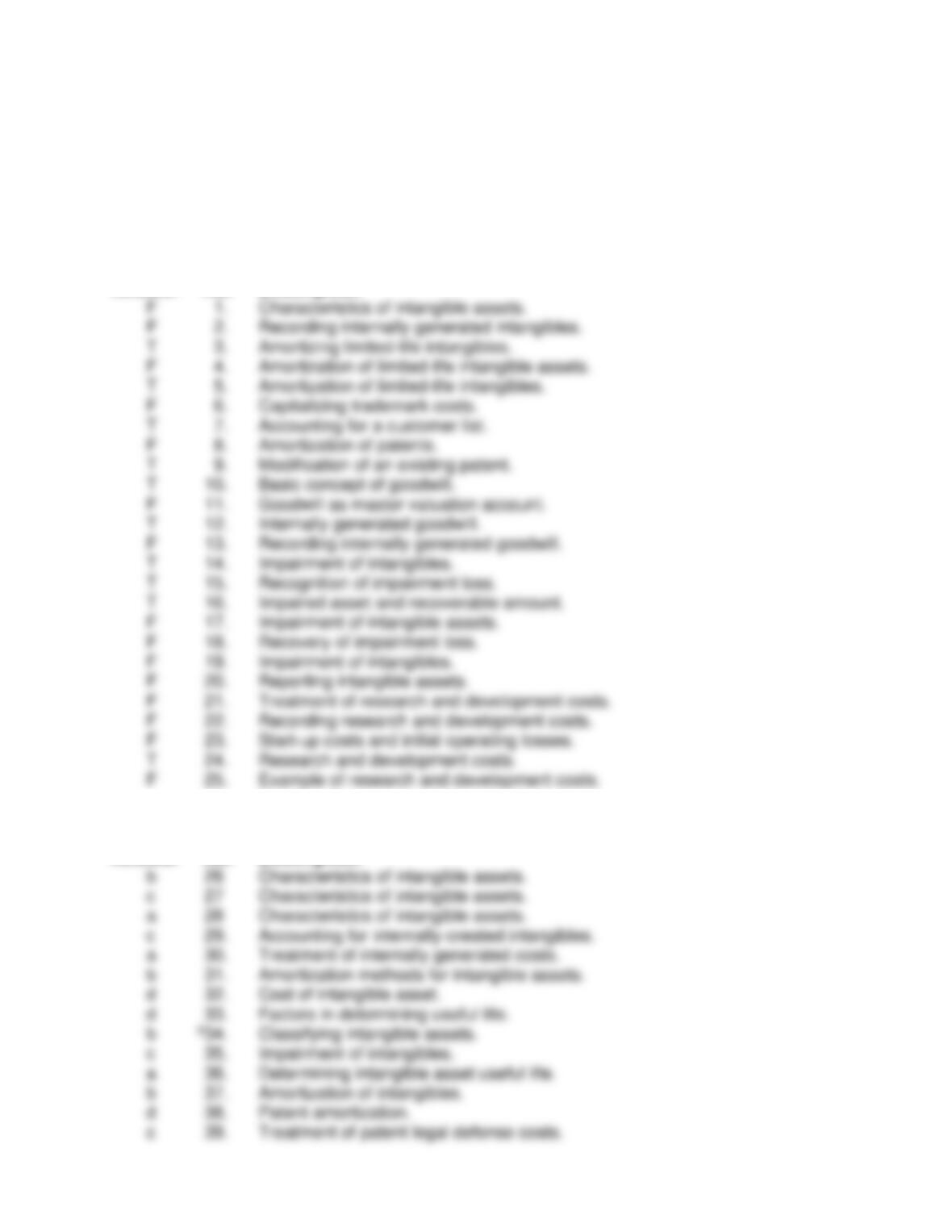
TRUE-FALSE—Conceptual
Answer No. Description
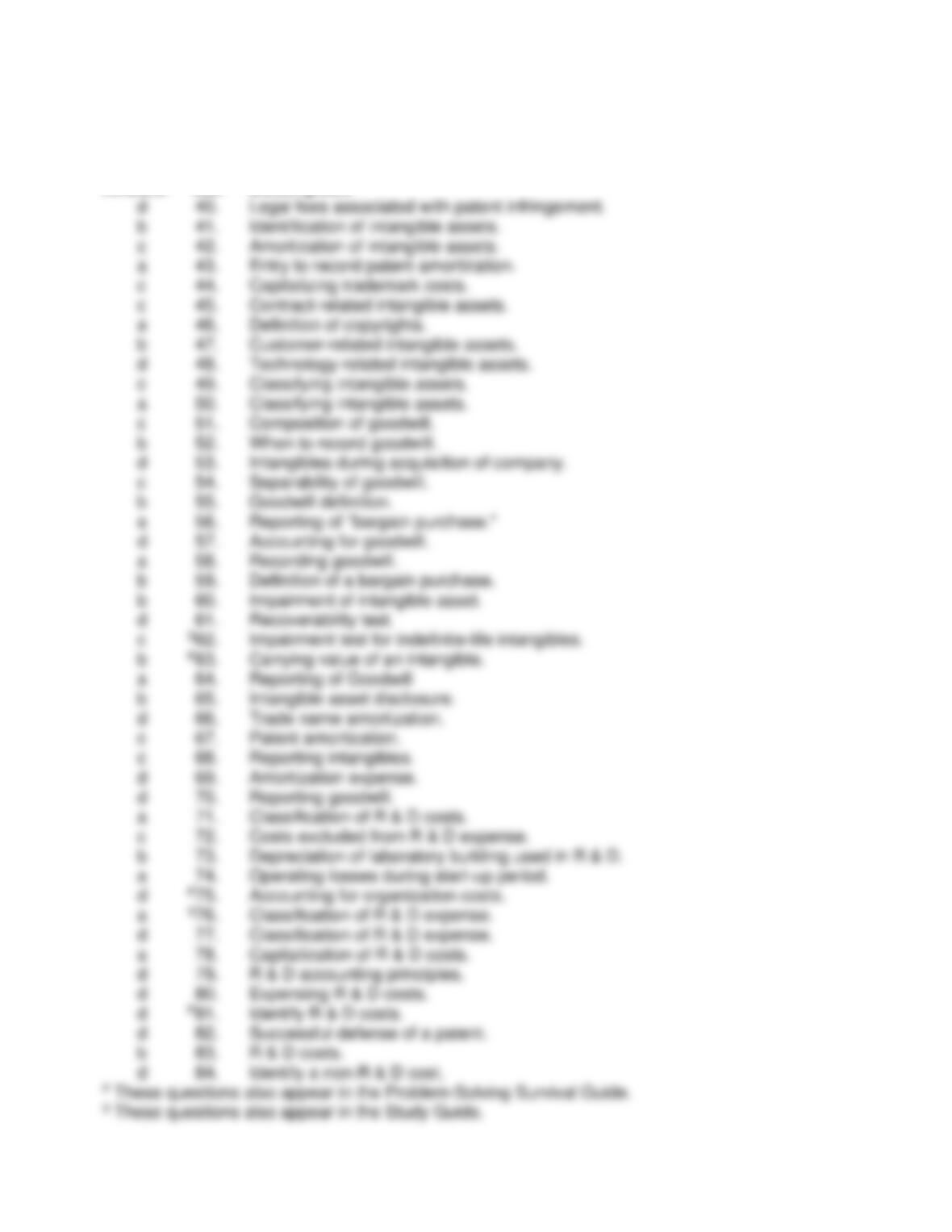
MULTIPLE CHOICE—Conceptual
Answer No. Description
Test Bank for Intermediate Accounting, Seventeenth Edition
12 – 2
MULTIPLE CHOICE—Conceptual (cont.)
Answer No. Description
Intangible Assets
12 – 3
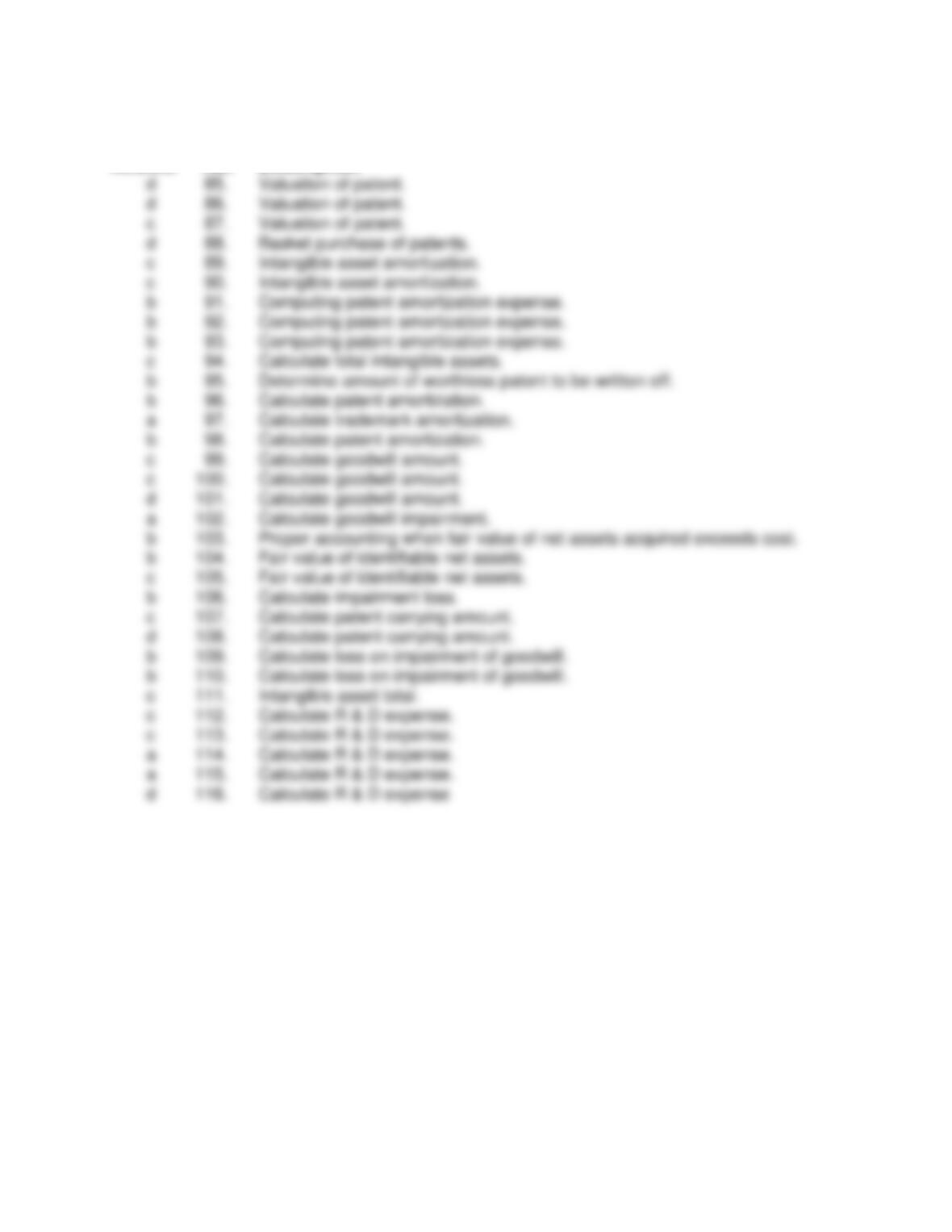
MULTIPLE CHOICE—Computational
Answer No. Description
Test Bank for Intermediate Accounting, Seventeenth Edition
12 – 4
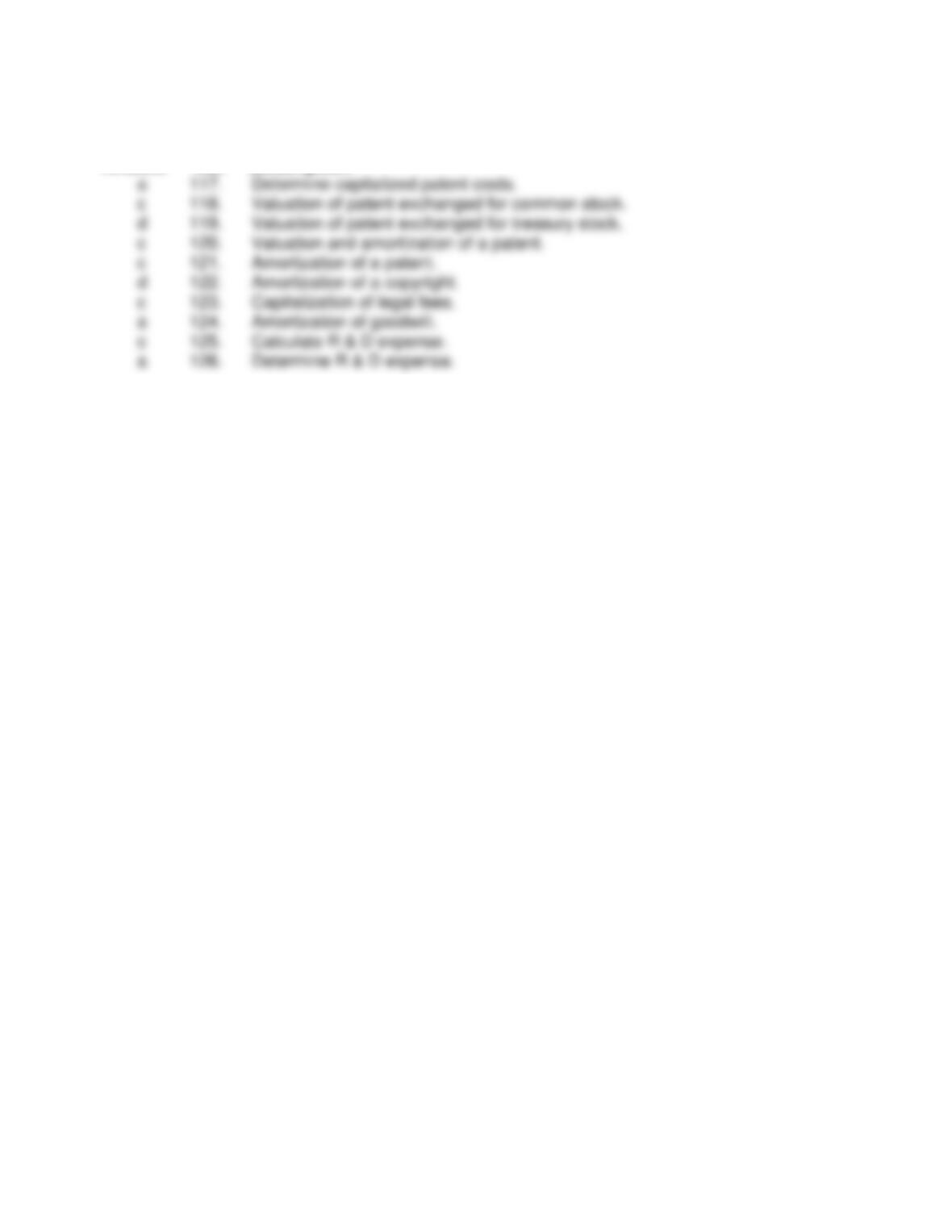
MULTIPLE CHOICE—CPA Adapted
Answer No. Description
BRIEF EXERCISES
Item Description
BE12-127 Amortization of patent.
BE12-128 Calculate patent carrying amount.
BE12-129 Calculate goodwill amount.
BE12-130 Impairment of patent.
BE12-131 Goodwill impairment.
EXERCISES
Item Description
E12-132 Essay – characteristics of intangible assets.
E12-133 Essay – cost of intangibles.
E12-134 Essay – purchased and internally generated intangible assets.
E12-135 Essay – definition of and accounting for intangibles.
E12-136 Essay – costs associated with patents.
E12-137 Essay – intangible asset amortization.
E12-138 Essay – useful life of intangibles.
E12-139 Essay – Intangible assets theory.
E12-140 Entries for amortization and impairment.
E12-141 Identify intangibles.
E12-142 Essay – Goodwill and bargain purchase.
E12-143 Carrying amount of patents.
E12-144 Accounting for patents.
E12-145 Accounting for patents.
E12-146 Intangible assets reporting.
E12-147 Accounting for copyrights.
E12-148 Goodwill computation and impairment.
E12-149 Patent impairment.
E12-150 Essay – goodwill.
E12-151 Essay – impairment.
E12-152 Goodwill impairment.
E12-153 Impairment of copyrights.
E12-154 Essay – R & D costs.
E12-155 Essay – start-up costs.

Intangible Assets
12 – 5
PROBLEMS
Item Description
P12-156 Intangible assets.
P12-157 Goodwill, impairment.
CHAPTER LEARNING OBJECTIVES
1. Discuss the characteristics, valuation, and amortization of intangible assets.
2. Discuss the accounting for various types of intangible assets.
3. Explain the accounting issues for recording goodwill.
4. Identify impairment procedures and presentation requirements for intangible assets.
5. Describe accounting and presentation for research and development and similar costs.
Test Bank for Intermediate Accounting, Seventeenth Edition
12 – 6
SUMMARY OF QUESTIONS BY LEARNING OBJECTIVES AND BLOOM’S TAXONOMY
Item
LO
BT
Item
LO
BT
Item
LO
BT
Item
LO
BT
Item
LO
BT
TRUE-FALSE STATEMENTS
1.
1
K
6.
2
K
11.
3
K
16.
4
C
21.
5
C
2.
1
K
7.
2
K
12.
3
K
17.
4
K
22.
5
K
3.
1
K
8.
2
K
13.
3
K
18.
4
C
23.
5
K
4.
1
K
9.
2
K
14.
4
K
19.
4
K
24.
5
K
5.
1
K
10.
3
K
15.
4
K
20.
4
K
25.
5
K
MULTIPLE CHOICE QUESTIONS
26.
1
K
47.
2
K
68.
4
K
89.
1
AP
110.
4
AP
27.
1
K
48.
2
K
69.
4
C
90.
1
AP
111.
4
AP
28.
1
K
49.
2
C
70.
4
C
91.
1
AP
112.
5
AP
29.
1
K
50.
2
C
71.
5
C
92.
2
AP
113.
5
AP
30.
1
K
51.
3
K
72.
5
C
93.
2
AP
114.
5
AP
31.
1
K
52.
3
K
73.
5
C
94.
2
AP
115.
5
AP
32.
1
K
53.
3
K
74.
5
C
95.
2
AP
116.
5
AP
33.
1
K
54.
3
K
75.
5
C
96.
2
AP
117.
2
AP
34.
1
K
55.
3
K
76.
5
C
97.
2
AP
118.
2
AP
35.
1
K
56.
3
C
77.
5
C
98.
2
AP
119.
2
AP
36.
1
K
57.
3
C
78.
5
C
99.
3
AP
120.
2
AP
37.
1
K
58.
3
C
79.
5
K
100.
3
AP
121.
2
AP
38.
2
K
59.
3
C
80.
5
K
101.
3
AP
122.
2
AP
39.
2
AP
60.
4
C
81.
5
C
102.
4
AP
123.
2
C
40.
2
AP
61.
4
K
82.
5
K
103.
3
AP
124.
3
C
41.
2
K
62.
4
C
83.
5
K
104.
3
AP
125.
5
AP
42.
2
K
63.
4
K
84.
5
C
105.
3
AP
126.
5
AP
43.
2
K
64.
4
K
85.
1
AP
106.
4
AP
44.
2
C
65.
4
K
86.
1
AP
107.
4
AP
45.
2
K
66.
4
K
87.
1
AP
108.
4
AP
46.
2
K
67.
4
K
88.
1
AP
109.
4
AP
BRIEF EXERCISES
127.
2
AP
128.
2
AP
129.
3
AP
130.
4
AP
131.
4
AP
EXERCISES
132.
1
C
137.
1
K
142.
2
K
147.
2, 4
AP
152.
4
AP
133.
1
C
138.
1
K
143.
2
AP
148.
3,4
AP
153.
4
AP
134.
1
C
139.
1
AN
144.
2
AP
149.
4
AP
154.
5
C
135.
1
K
140.
2
AP
145.
2
AP
150.
3
C
155.
5
AN
136.
1
C
141.
2
AP
146.
2, 4
AP
151.
4
AN
PROBLEMS
156.
2, 5
AP
157.
3, 4
AP
Intangible Assets
12 – 7
TRUE-FALSE—Conceptual
1. Intangible assets derive their value from the right (claim) to receive cash in the future.
2. Internally generated intangible assets are initially recorded at fair value.
3. Limited-life intangibles are amortized by systematic charges to expense over their useful
lives.
4. Amortization of limited-life intangible assets should not be affected by expected residual
values.
5. Some intangible assets are not required to be amortized.
6. If a company develops a trademark, it should expense the costs related to attorney fees,
registration fees, and design costs.
7. The cost of acquiring a customer list from another company is recorded as an intangible
asset.
8. The cost of a purchased patent should be amortized over the remaining legal life of the
patent.
9. If a new patent is acquired through modification of an existing patent, the remaining book
value of the original patent may be amortized over the life of the new patent.
10. In a business combination, a company assigns the cost, where possible, to the identifiable
tangible and intangible net assets, with the remainder recorded as goodwill.
11. Goodwill is considered a master valuation account because it measures the value of
specifically identifiable intangible assets.
12. Internally generated goodwill should not be capitalized in the accounts.
Test Bank for Intermediate Accounting, Seventeenth Edition
12 – 8
13. Internally generated goodwill associated with a business may be recorded as an asset
when a firm offer to purchase that business unit has been received.
14. All intangibles are subject to periodic consideration of impairment with corresponding
potential write-downs.
15. If the fair value of an unlimited life intangible other than goodwill is less than its book
value, an impairment loss must be recognized.
16. After an impairment loss is recorded for a limited-life intangible asset, the carrying amout
becomes the basis for the impaired asset and is used to calculate amortization in future
periods.
17. The rules used to account for impairments of limited-life intangible assets are different
from the rules used to account for impairments of plant and equipment.
18. If fair value of an impaired asset recovers after an impairment has been recognized, the
impairment may be reversed in a subsequent period.
19. The same recoverability test that is used for impairments of property, plant, and
equipment is used for impairments of indefinite-life intangibles.
20. Contra accounts must be reported for intangible assets in a manner similar to
accumulated depreciation and property, plant, and equipment.
21. Research and development costs that result in patents may be capitalized to the extent of
the fair value of the patent.
22. Research and development costs are reported as intangible assets if they will provide
economic benefits in future years.
23. GAAP requires start-up costs and initial operating losses during the early years to be
capitalized.
Intangible Assets
12 – 9
24. Material, labor, and overhead costs incurred in developing a new product are to be
expensed as these are development costs.
25. Periodic alterations to existing products are an example of research and development
costs.
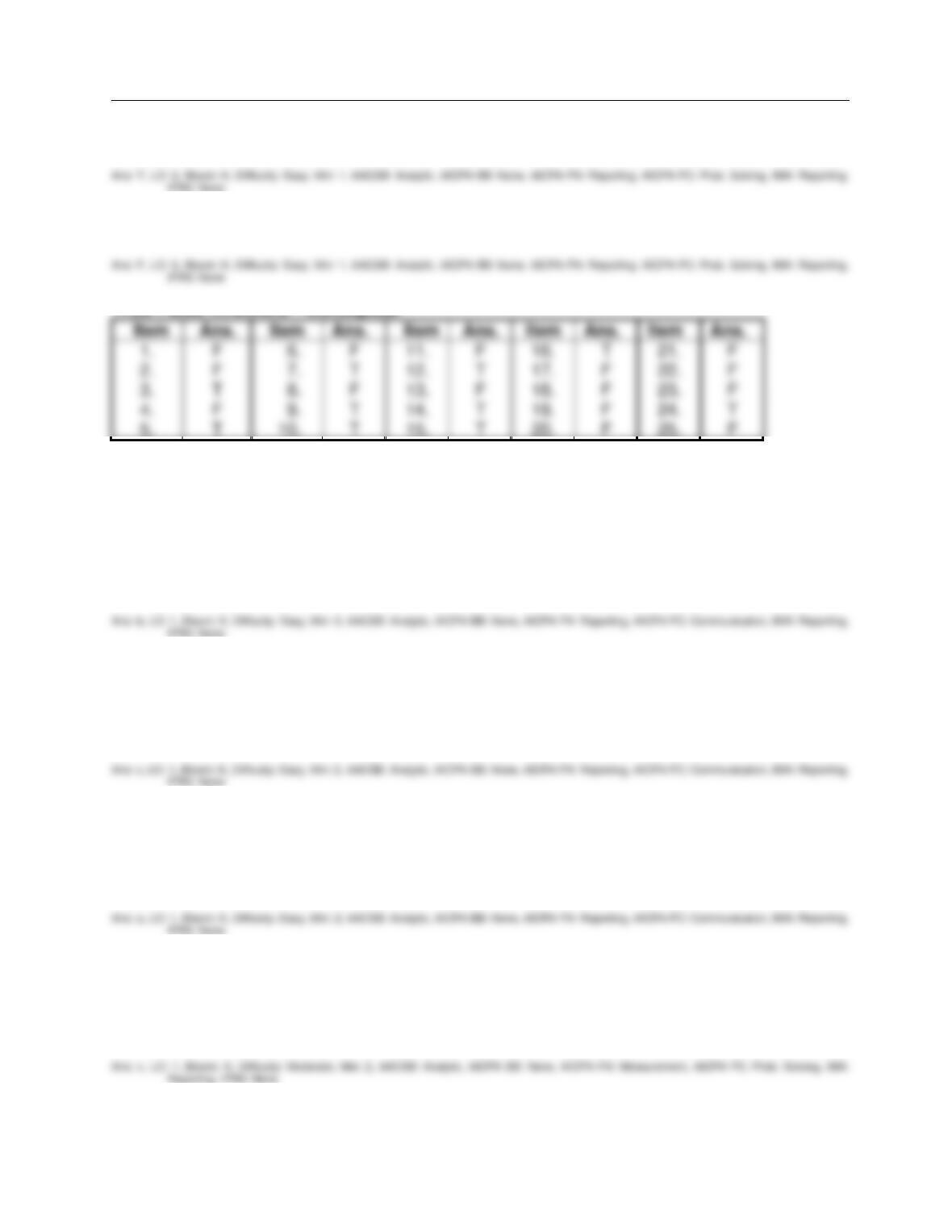
True False Answers—Conceptual
MULTIPLE CHOICE—Conceptual
26. Which of the following does not describe intangible assets?
a. They lack physical existence.
b. They are financial instruments.
c. They provide long-term benefits.
d. They are classified as long-term assets.
27. Which of the following characteristics do intangible assets possess?
a. Physical existence.
b. Claim to a specific amount of cash in the future.
c. Long-lived.
d. Held for resale.
28. Which characteristic is not possessed by intangible assets?
a. Physical existence.
b. Long–lived.
c. Result in future benefits.
d. Expensed over current and/or future years.
29. Costs incurred internally to create intangibles are
a. capitalized.
b. capitalized if they have an indefinite life.
c. expensed as incurred.
d. expensed only if they have a limited life.
Test Bank for Intermediate Accounting, Seventeenth Edition
12 – 10
30. Which of the following costs incurred internally to create an intangible asset is generally
expensed?
a. Research and development costs.
b. Filing costs.
c. Legal costs.
d. All of these answer choices are correct.
31. Which of the following methods of amortization is normally used for intangible assets?
a. Sum-of–the-years’-digits
b. Straight-line
c. Units of production
d. Double-declining-balance
32. The cost of an intangible asset includes all of the following except
a. purchase price.
b. legal fees.
c. other incidental expenses.
d. All of these choices are included.
33. Factors considered in determining an intangible asset’s useful life include all of the
following except
a. the expected use of the asset.
b. any legal or contractual provisions that may limit the useful life.
c. any provisions for renewal or extension of the asset’s legal life.
d. the amortization method used.
34. Under current accounting practice, intangible assets are classified as
a. amortizable or unamortizable.
b. limited-life or indefinite-life.
c. specifically identifiable or goodwill-type.
d. legally restricted or goodwill-type.
35. Companies should test indefinite life intangible assets at least annually for
a. recoverability.
b. amortization.
c. impairment.
d. estimated useful life.
Intangible Assets
12 – 11
S36. One factor that is not considered in determining the useful life of an intangible asset is
a. salvage value.
b. provisions for renewal or extension.
c. legal life.
d. expected actions of competitors.
37. Which intangible assets are amortized?
Limited-Life Indefinite-Life
a. Yes Yes
b. Yes No
c. No Yes
d. No No
38. The cost of successfully defending a patent suit should be
a. charged off in the current period.
b. capitalized and amortized over the legal life of the purchased patent.
c. added to factory overhead and allocated to production of the product.
d. capitalized and amortized over the remaining estimated useful life of the patent.
39. Broadway Corporation was granted a patent on a product on January 1, 2007. To protect
its patent, the corporation purchased on January 1, 2018 a patent on a competing product
which was originally issued on January 10, 2014. Because of its unique plant, Broadway
Corporation does not feel the competing patent can be used in producing the product.
The cost of the competing patent should be
a. amortized over a maximum period of 20 years.
b. amortized over a maximum period of 16 years.
c. amortized over a maximum period of 9 years.
d. expensed in 2018.
40. Wriglee, Inc. went to court this year and successfully defended its patent from
infringement by a competitor. The cost of this defense should be charged to
a. patents and amortized over the legal life of the patent.
b. legal fees and amortized over 5 years or less.
c. expenses of the period.
d. patents and amortized over the remaining useful life of the patent.
41. Which of the following is not an intangible asset?
a. Trade name
b. Research and development costs
c. Franchise
d. Copyrights
Test Bank for Intermediate Accounting, Seventeenth Edition
12 – 12
42. Which of the following intangible assets should not be amortized?
a. Copyrights
b. Customer lists
c. Perpetual franchises
d. All of these intangible assets should be amortized.
43. When a patent is amortized, the credit is usually made to
a. the Patents account.
b. an Accumulated Amortization account.
c. a Deferred Credit account.
d. an expense account.
44. When a company develops a trademark the costs directly related to securing it should
generally be capitalized. Which of the following costs associated with a trademark would
not be capitalized?
a. Attorney fees.
b. Consulting fees.
c. Research and development costs.
d. Design costs.
45. Which of the following is a contract-related intangible assets?
a. Trademark
b. Copyright
c. Franchise
d. Patent
46. The right granted to all authors, painters, musicians, sculptors, and other artists for their
creations and expressions is termed as a
a. copyright
b. trademark
c. patent
d. franchise
47. Which of the following types of intangible assets result from interactions and relationships
with outside parties?
a. Marketing-related intangible assets
b. Customer-related intangible assets
c. Contract-related intangible assets
d. Artistic-related intangible assets
Intangible Assets
12 – 13
48. Which of the following is a type of technology-related intangible asset?
a. Copyright
b. Franchise
c. License
d. Patent
49. Trademarks, newspaper mastheads, and internet domain names are all examples of
a. contract-related intangible assets
b. artistic-related intangible assets
c. marketing-related intangible assets
d. customer-related intangible assets
50. John Thomas has recently entered into an agreement with Longman Inc. Under this
agreement, John will sell its products using the trade name of Longman in a specified
geographical location. What type of intangible asset is this agreement between John
Thomas and Longman Inc.?
a. contract-related intangible assets
b. artistic-related intangible assets
c. marketing-related intangible assets
d. customer-related intangible assets
51. In a business combination, companies record identifiable intangible assets that they can
reliably measure. All other intangible assets, too difficult to identify or measure, are
recorded as
a. other assets.
b. indirect costs.
c. goodwill.
d. direct costs.
52. Goodwill may be recorded when
a. it is identified within a company.
b. one company acquires another in a business combination.
c. the fair value of a company’s assets exceeds their cost.
d. a company has exceptional customer relations.
53. When a new company is acquired, which of these intangible assets, unrecorded on the
acquired company’s books, might be recorded in addition to goodwill?
a. A brand name.
b. A patent.
c. A customer list.
d. All of these answer choices are correct.
Test Bank for Intermediate Accounting, Seventeenth Edition
12 – 14
54. Which of the following intangible assets cannot be sold by a business to raise needed
cash for a capital project?
a. Patent.
b. Copyright.
c. Goodwill.
d. Brand Name.
55. Goodwill
a. represents the purchase price of a business that is about to be sold.
b. is the difference between the fair value of the net tangible and identifiable intangible
assets and the purchase price of the acquired business.
c. generated internally should be capitalized in the year it occurs.
d. is the only account in the financial statements that is based on fair value, all other
accounts are recorded at an amount other than their fair value.
56. Easton Company and Lofton Company were combined as result of a purchase
transaction. Easton was able to acquire Lofton at a bargain price. The sum of the fair
values of identifiable assets acquired less the fair value of liabilities assumed exceeded
the cost of acquiring Easton. Easton will report the excess amount as
a. a gain.
b. part of current income in the year of combination.
c. a deferred credit and amortize it.
d. paid-in capital.
57. Purchased goodwill should
a. be written off as soon as possible against retained earnings.
b. be written off as soon as possible as an extraordinary item.
c. be written off by systematic charges as a regular operating expense over the period
benefited.
d. not be amortized.
58. The intangible asset goodwill may be
a. capitalized only when purchased.
b. capitalized either when purchased or created internally.
c. capitalized only when created internally.
d. written off directly to retained earnings.
59. When the purchaser in a business combination pays less then the fair value of the
identifiable net assets, such a situation is referred to as a:
a. goodwill purchase.
b. bargain purchase.
c. residual purchase.
d. blanket purchase.
Intangible Assets
12 – 15
60. A loss on impairment of an intangible asset is the difference between the asset’s
a. carrying amount and the expected future net cash flows.
b. carrying amount and its fair value.
c. fair value and the expected future net cash flows.
d. book value and its fair value.
61. The recoverability test is used to determine any impairment loss on which of the following
types of intangible assets?
a. Indefinite life intangibles other than goodwill.
b. Indefinite life intangibles.
c. Goodwill.
d. Limited life intangibles.
62. Buerhle Company needs to determine if its indefinite-life intangibles other than goodwill
have been impaired and should be reduced or written off on its balance sheet. The
impairment test(s) to be used is (are)
Recoverability Test Fair Value Test
a. Yes Yes
b. Yes No
c No Yes
d. No No
63. The carrying amount of an intangible is
a. the fair value of the asset at a balance sheet date.
b. the asset’s acquisition cost less the total related amortization recorded to date.
c. equal to the balance of the related accumulated amortization account.
d. the assessed value of the asset for intangible tax purposes.
64. Which of the following intangible assets should be shown as a separate item on the
balance sheet?
a. Goodwill
b. Franchise
c. Patent
d. Trademark
65. The notes to the financial statements should include information about acquired intangible
assets, and aggregate amortization expense for how many succeeding years?
a. 6
b. 5
c. 4
d. 3
Test Bank for Intermediate Accounting, Seventeenth Edition
12 – 16
66. Which of the following is not reported under the “Other Expenses and Losses” section of
the income statement?
a. Goodwill impairment losses.
b. Loss on sale of patent.
c. Patent impairment losses.
d. Trade name amortization expense.
67. The total amount of patent cost amortized to date is usually
a. shown in a separate Accumulated Patent Amortization account which is shown contra
to the Patents account.
b. shown in the current income statement.
c. shown as credits in the Patents account.
d. reported as a contra property, plant and equipment item.
68. Intangible assets are reported on the balance sheet
a. with an accumulated depreciation account.
b. in the property, plant, and equipment section.
c. as a separate classification in the assets section.
d. None of these answer choices are correct.
69. Which of the following is often reported as part of operating expenses?
a. Loss on sale of patent.
b. Impairment losses for intangible assets other than goodwill.
c. Impairment losses on goodwill.
d. Amortization expense.
70. Which of the following is not reported as part of income from continuing operations?
a. Amortization expense.
b. Impairment losses for intangible assets.
c. Research and development costs.
d. Goodwill.
71. Which of the following is considered research and development costs?
a. Planned search or critical investigation aimed at discovery of new knowledge.
b. Research costs incurred under contract with another company.
c. Commissions to sales staff marketing a new product.
d. Cost of marketing research to promote a new product.
Intangible Assets
12 – 17
72. Which of the following costs should be excluded from research and development
expense?
a. Modification of the design of a product
b. Acquisition of R & D equipment for use on a current project only
c. Cost of marketing research for a new product
d. Engineering activity required to advance the design of a product to the manufacturing
stage
73. If a company constructs a laboratory building to be used as a research and development
facility, the cost of the laboratory building is matched against earnings as
a. research and development expense in the period(s) of construction.
b. depreciation expensed as part of research and development costs.
c. depreciation or immediate write–off depending on company policy.
d. an expense at such time as productive research and development has been obtained
from the facility.
74. Operating losses incurred during the start-up years of a new business should be
a. accounted for and reported like the operating losses of any other business.
b. written off directly against retained earnings.
c. capitalized as a deferred charge and amortized over five years.
d. capitalized as an intangible asset and amortized over a period not to exceed 20 years.
75. The costs of organizing a corporation include legal fees, fees paid to the state of
incorporation, fees paid to promoters, and the costs of meetings for organizing the
promoters. These costs are said to benefit the corporation for the entity’s entire life. These
costs should be
a. capitalized and never amortized.
b. capitalized and amortized over 40 years.
c. capitalized and amortized over 5 years.
d. expensed as incurred.
76. Which of the following would not be considered an R & D activity?
a. Adaptation of an existing capability to a particular requirement or customer’s need.
b. Searching for applications of new research findings.
c. Laboratory research aimed at discovery of new knowledge.
d. Conceptual formulation and design of possible product or process alternatives.
77. Which of the following research and development expenditures should be capitalized and
depreciated?
a. Engineering costs incurred to advance the new product to a production stage
b. Cost of marketing research to promote a new product
c. Material, labor, and overhead costs incurred in developing a new product
d. Acquisition of machinery that can also be used for future R&D projects
Test Bank for Intermediate Accounting, Seventeenth Edition
12 – 18
78. Which of the following research and development related costs should be capitalized and
depreciated over current and future periods?
a. Research and development general laboratory building which can be put to alternative
uses in the future
b. Inventory used for a specific research project
c. Administrative salaries allocated to research and development
d. Research findings purchased from another company to aid a particular research
project currently in process
79. Which of the following principles best describes the current method of accounting for
research and development costs?
a. Associating cause and effect
b. Systematic and rational allocation
c. Income tax minimization
d. Immediate recognition as an expense
80. According to a Financial Accounting Standards Board Statement, how are research and
development costs accounted for?
a. They must be capitalized when incurred and then amortized over their estimated
useful lives.
b. They must be expensed in the period incurred.
c. They may be either capitalized or expensed when incurred, depending upon the
materiality of the amounts involved.
d. They must be expensed in the period incurred unless it can be clearly demonstrated
that the expenditure will have alternative future uses or unless contractually
reimbursable.
81. Which of the following would be considered research and development costs?
a. Routine efforts to refine an existing product.
b. Periodic alterations to existing production lines.
c. Marketing research to promote a new product.
d. Construction of prototypes.
82. Which of the following costs should be capitalized in the year incurred?
a. Research and development costs.
b. Costs to internally generate goodwill.
c. Organizational costs.
d. Costs to successfully defend a patent.
Intangible Assets
12 – 19
83. Research and development costs
a. are intangible assets.
b. may result in the development of a patent.
c. are easily identified with specific projects.
d. All of these answer choices are correct.
84. Which of the following is not considered research and development costs?
a. Planned search or critical investigation aimed at discovery of new knowledge.
b. Translation of research findings or other knowledge into a plan or design for a new
product or process.
c. Translation of research findings or other knowledge into a significant improvement of
an existing product.
d. Cost of marketing research to promote a new product.
Multiple Choice Answers—Conceptual
MULTIPLE CHOICE—Computational
85. Lynne Corporation acquired a patent on May 1, 2020. Lynne paid cash of $90,000 to the
seller. Legal fees of $2,000 were paid related to the acquisition. What amount should be
debited to the patent account?
a. $2,000
b. $88,000
c. $90,000
d. $92,000
86. Contreras Corporation acquired a patent on May 1, 2020. Contreras paid cash of $35,000
to the seller. Legal fees of $1,500 were paid related to the acquisition. What amount
should be debited to the patent account?
a. $1,500
b. $33,500
c. $35,000
d. $36,500
Test Bank for Intermediate Accounting, Seventeenth Edition
12 – 20
87. Mini Corp. acquires a patent from Maxi Co. in exchange for 2,500 shares of Mini Corp.’s
$5 par value common stock and $90,000 cash. When the patent was initially issued to
Maxi Co., Mini Corp.’s stock was selling at $7.50 per share. When Mini Corp. acquired the
patent, its stock was selling for $9 a share. Mini Corp. should record the patent at what
amount?
a. $102,500
b. $108,750
c. $112,500
d. $90,000
88. Alonzo Co. acquires 3 patents from Shaq Corp. for a total of $280,000. The patents were
carried on Shaq’s books as follows: Patent AA: $5,000; Patent BB: $2,000; and Patent
CC: $3,000. When Alonzo acquired the patents their fair values were: Patent AA:
$20,000; Patent BB: $240,000; and Patent CC: $60,000. At what amount should Alonzo
record Patent BB?
a. $93,333
b. $186,666
c. $2,000
d. $210,000
89. Jeff Corporation purchased a limited-life intangible asset for $375,000 on May 1, 2019. It
has a useful life of 10 years. What total amount of amortization expense should have
been recorded on the intangible asset by December 31, 2021?
a. $ -0-
b. $75,000
c. $100,000
d. $112,500
90. Rich Corporation purchased a limited-life intangible asset for $450,000 on May 1, 2019. It
has a useful life of 10 years. What total amount of amortization expense should have
been recorded on the intangible asset by December 31, 2021?
a. $ -0-.
b. $90,000
c. $120,000
d. $135,000
91. Thompson Company incurred research and development costs of $100,000 and legal
fees of $40,000 to develop a patent. The patent has a legal life of 20 years and a useful
life of 10 years. What amount should Thompson record as Patent Amortization Expense
in the first year?
a. $ -0-.
b. $ 4,000.
c. $ 7,000.
d. $14,000.