73) Part S51 is used in one of Haberkorn Corporation’s products. The company makes 12,000 units
of this part each year. The company’s Accounting Department reports the following costs of
producing the part at this level of activity:
Per Unit
Direct materials
$
6.30
Direct labor
$
5.70
Variable manufacturing overhead
$
4.80
Supervisor’s salary
$
7.00
Depreciation of special equipment
$
8.60
Allocated general overhead
$
7.20
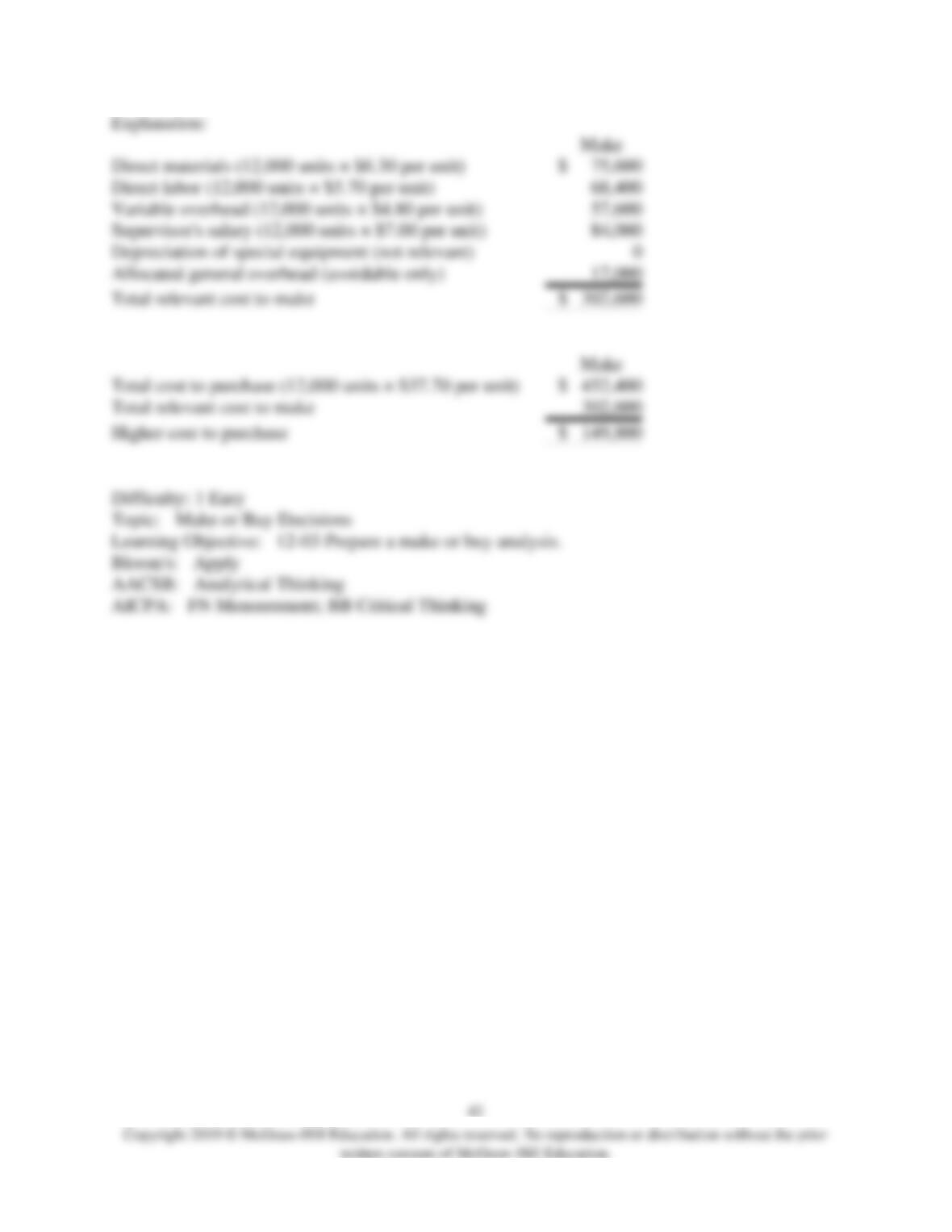
An outside supplier has offered to produce this part and sell it to the company for $37.70 each. If
this offer is accepted, the supervisor’s salary and all of the variable costs, including direct labor,
can be avoided. The special equipment used to make the part was purchased many years ago and
has no salvage value or other use. The allocated general overhead represents fixed costs of the
entire company. If the outside supplier’s offer were accepted, only $17,000 of these allocated
general overhead costs would be avoided.
The annual financial advantage (disadvantage) for the company as a result of buying the part from
the outside supplier would be:
A) ($5,800)
B) ($22,800)
C) ($149,800)
D) ($39,800)
74) Rebelo Corporation is presently making part E07 that is used in one of its products. A total of
17,000 units of this part are produced and used every year. The company’s Accounting Department
reports the following costs of producing the part at this level of activity:
Per Unit
Direct materials
$
3.80
Direct labor
$
3.80
Variable manufacturing overhead
$
1.10
Supervisor’s salary
$
2.50
Depreciation of special equipment
$
1.40
Allocated general overhead
$
8.60
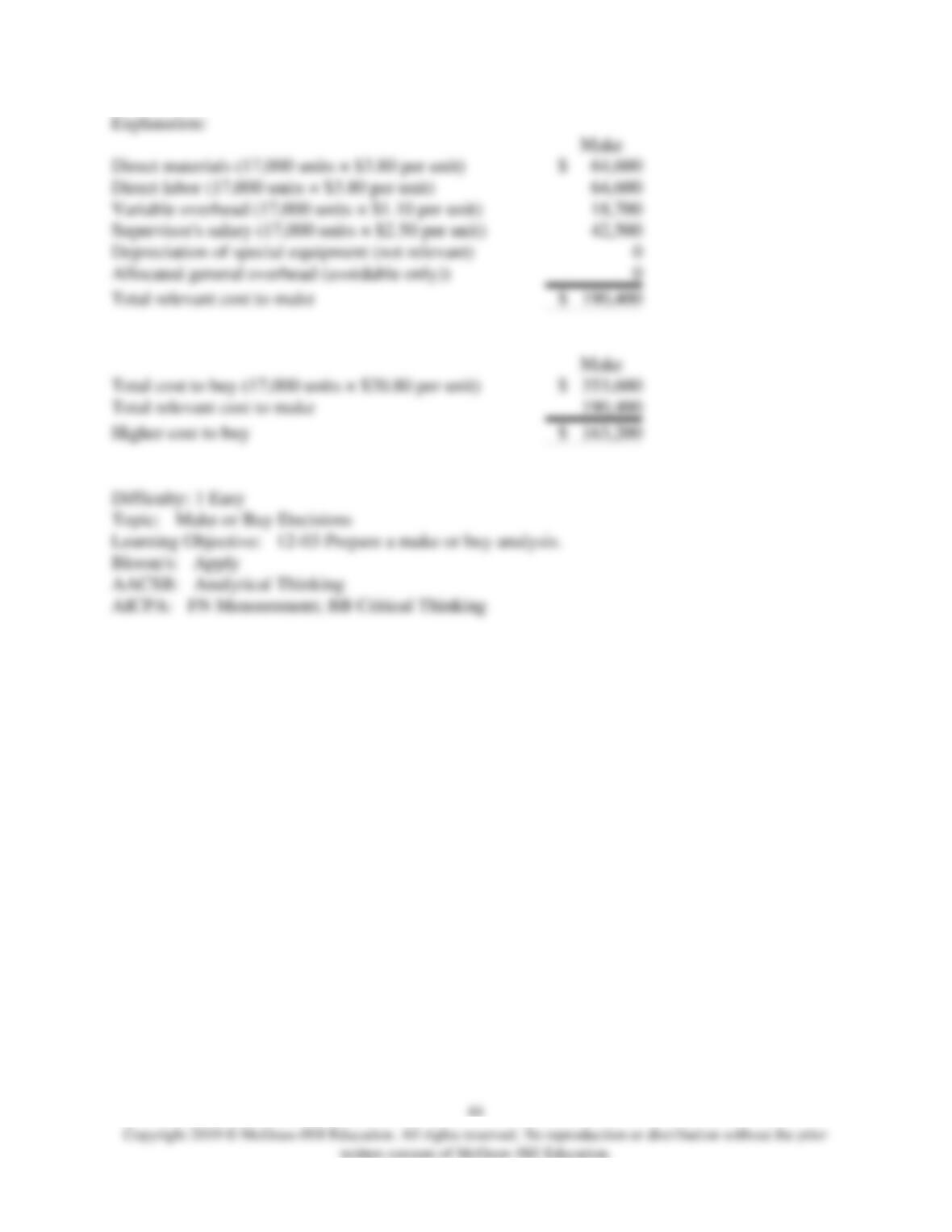
An outside supplier has offered to make and sell the part to the company for $20.80 each. If this
offer is accepted, the supervisor’s salary and all of the variable costs, including direct labor, can be
avoided. The special equipment used to make the part was purchased many years ago and has no
salvage value or other use. The allocated general overhead represents fixed costs of the entire
company, none of which would be avoided if the part were purchased instead of produced
internally. If management decides to buy part E07 from the outside supplier rather than to continue
making the part, what would be the annual impact on the company’s overall net operating income?
A) ($6,800)
B) ($163,200)
C) $163,200
D) $6,800
75) The SP Corporation makes 40,000 motors to be used in the production of its sewing machines.
The average cost per motor at this level of activity is:
Direct materials
$
5.50
Direct labor
$
5.60
Variable manufacturing overhead
$
4.75
Fixed manufacturing overhead
$
4.45
An outside supplier recently began producing a comparable motor that could be used in the sewing
machine. The price offered to SP Corporation for this motor is $18. If SP Corporation decides not
to make the motors, there would be no other use for the production facilities and none of the fixed
manufacturing overhead cost could be avoided. Direct labor is a variable cost in this company. The
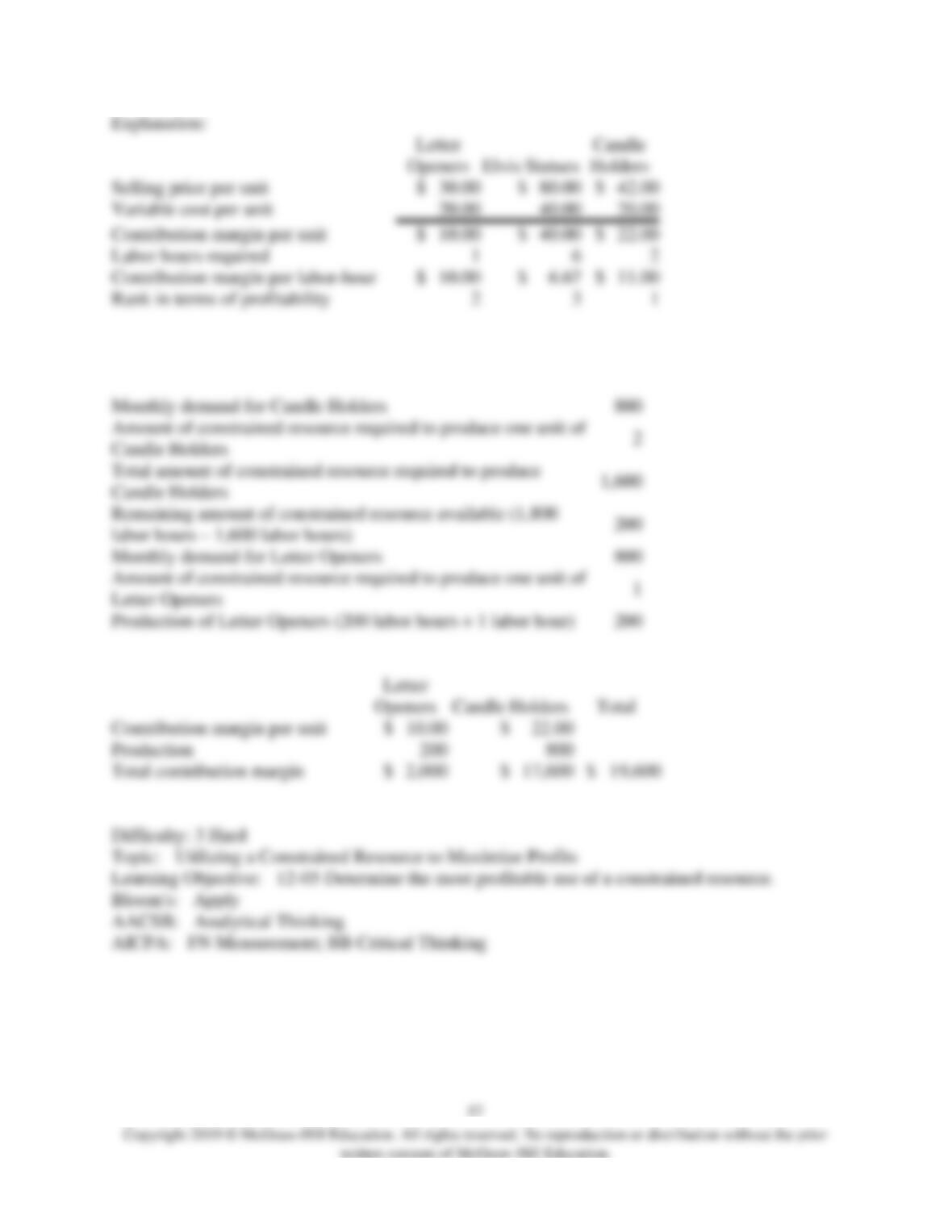
annual financial advantage (disadvantage) for the company as a result of making the motors rather
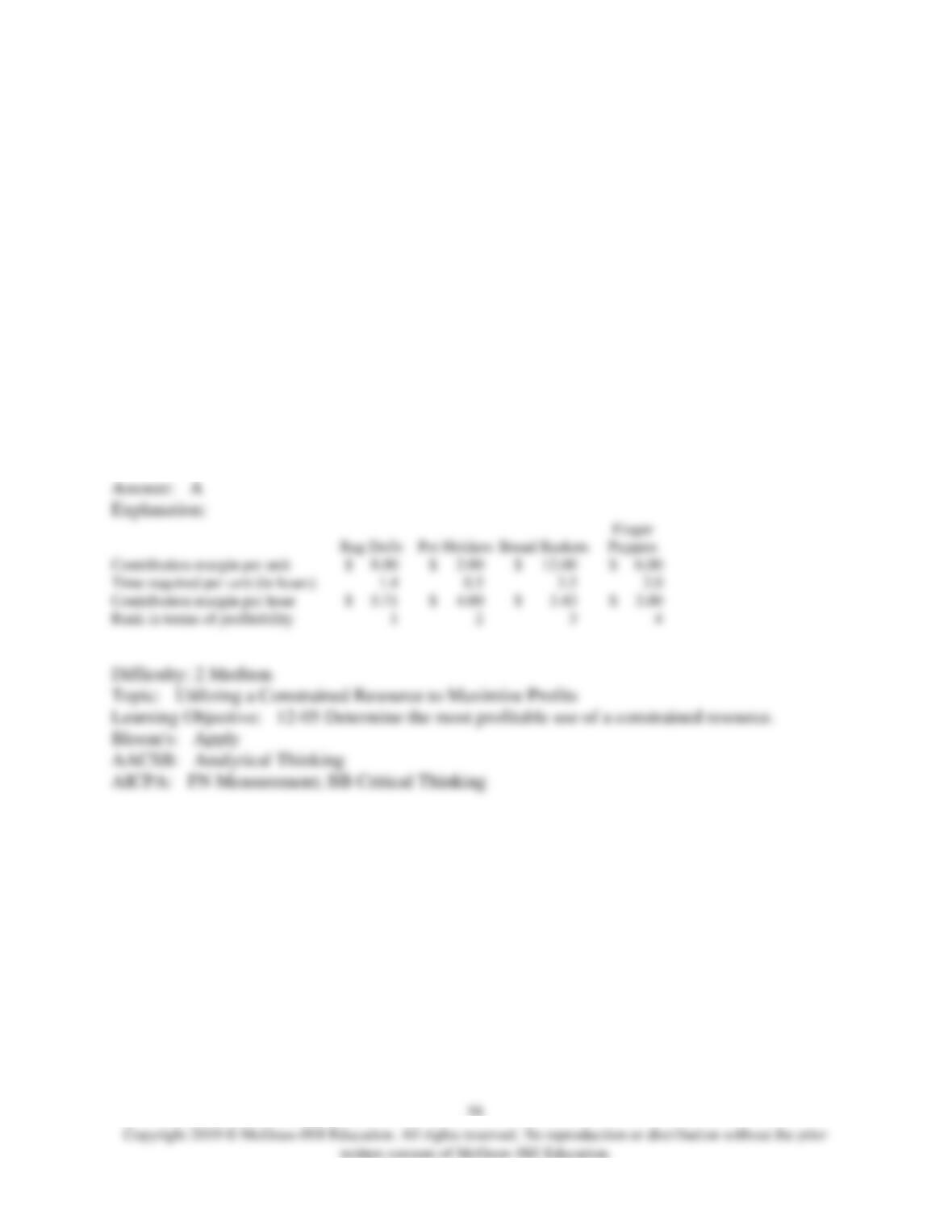
than buying them from the outside supplier would be:
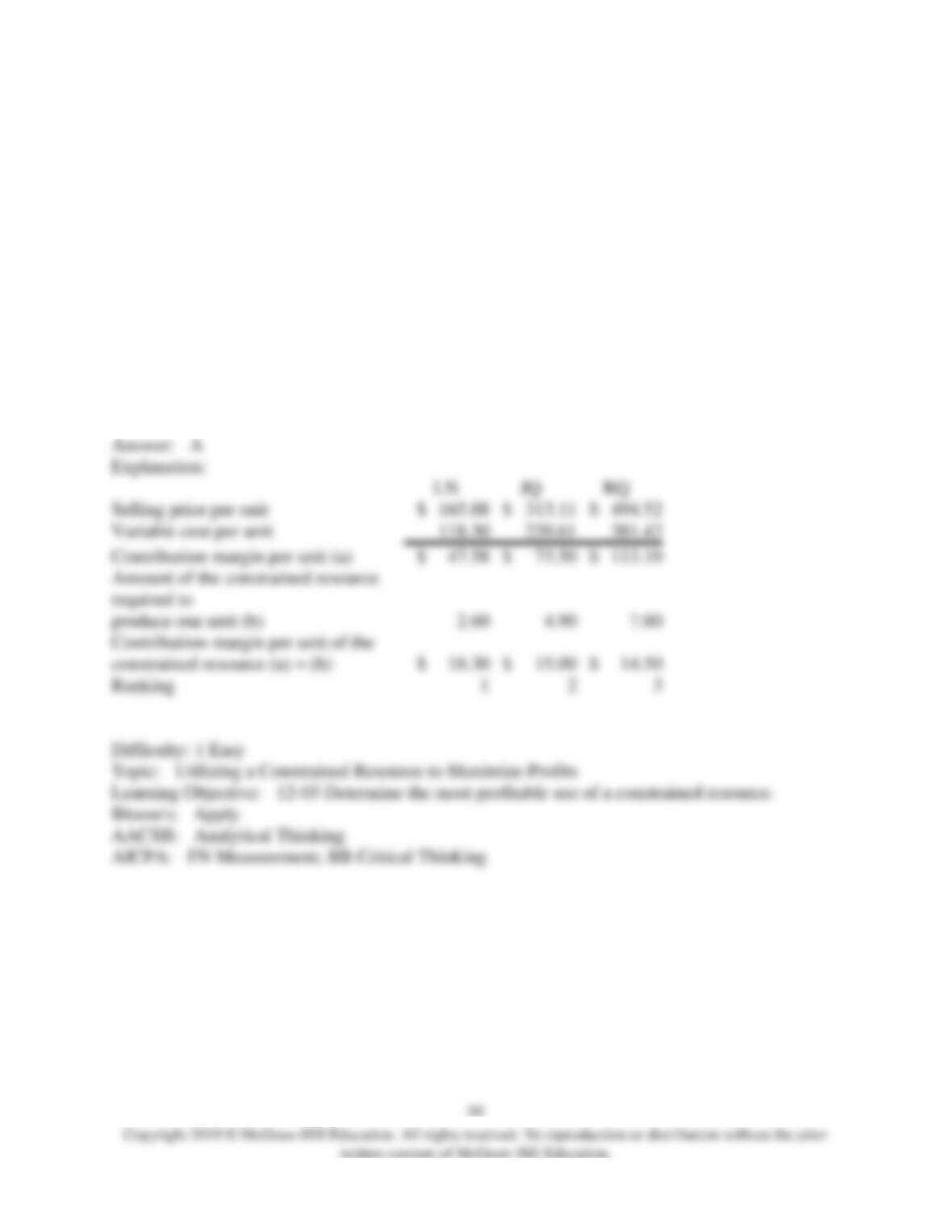
A) $276,000
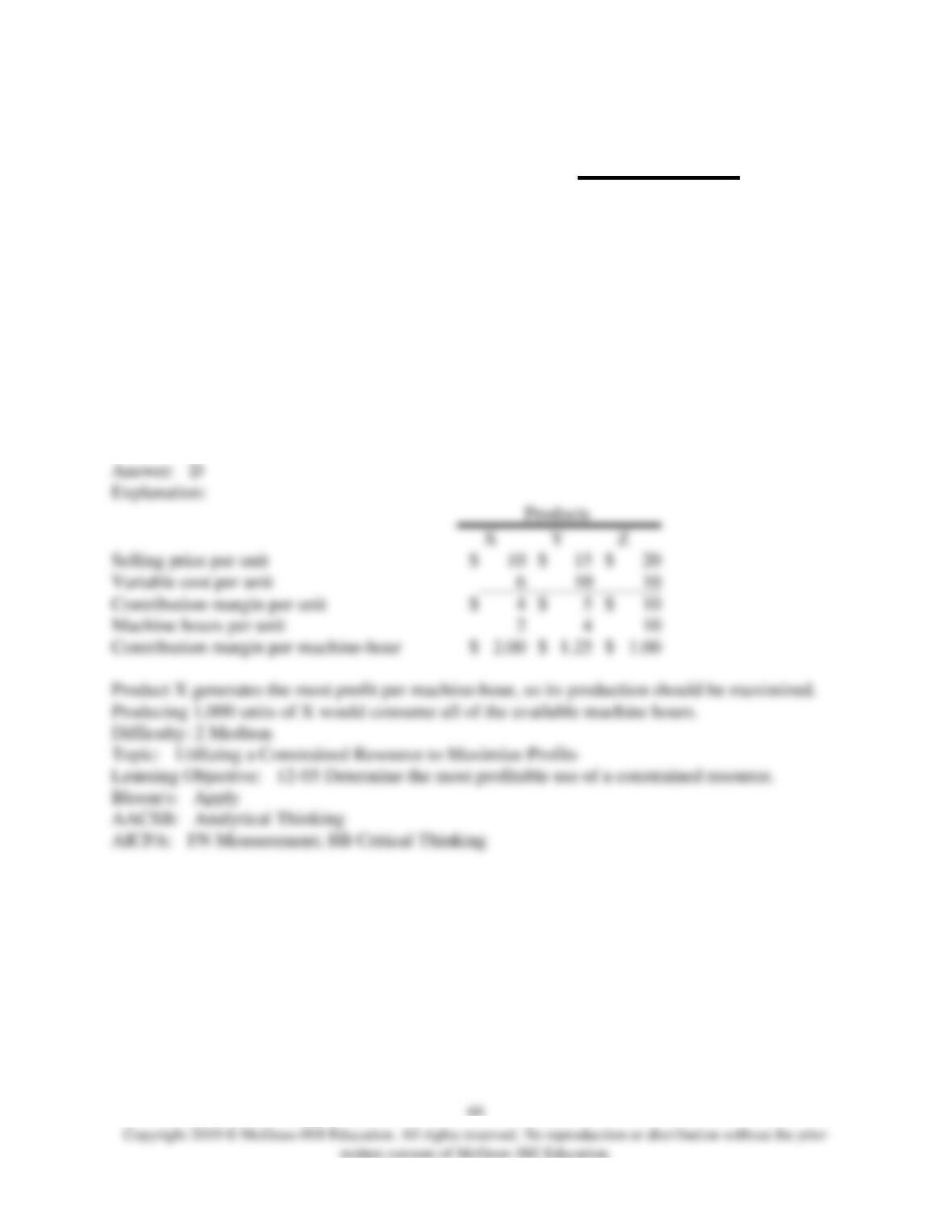
B) $86,000
C) ($92,000)
D) $178,000
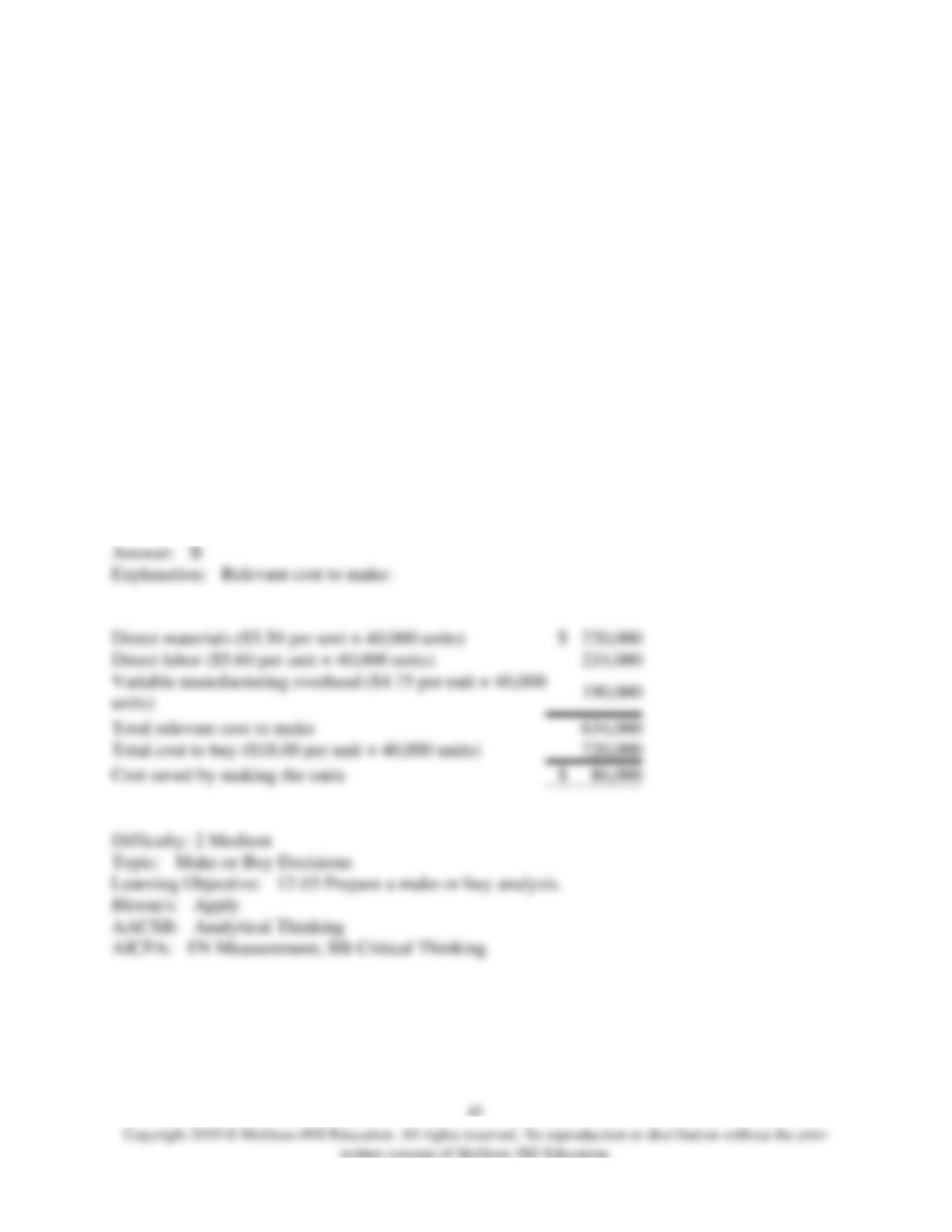
Direct materials ($5.50 per unit × 40,000 units)
220,000
Direct labor ($5.60 per unit × 40,000 units)
224,000
units)
Total relevant cost to make
634,000
Total cost to buy ($18.00 per unit × 40,000 units)
720,000
Cost saved by making the units
76) Part U16 is used by McVean Corporation to make one of its products. A total of 13,000 units of
this part are produced and used every year. The company’s Accounting Department reports the
following costs of producing the part at this level of activity:
Per Unit
Direct materials
$
2.90
Direct labor
$
7.50
Variable manufacturing overhead
$
8.00
Supervisor’s salary
$
3.40
Depreciation of special equipment
$
1.80
Allocated general overhead
$
7.00
An outside supplier has offered to make the part and sell it to the company for $29.80 each. If this
offer is accepted, the supervisor’s salary and all of the variable costs, including the direct labor, can
be avoided. The special equipment used to make the part was purchased many years ago and has
no salvage value or other use. The allocated general overhead represents fixed costs of the entire
company, none of which would be avoided if the part were purchased instead of produced
internally. In addition, the space used to make part U16 could be used to make more of one of the
company’s other products, generating an additional segment margin of $25,000 per year for that
product. The annual financial advantage (disadvantage) for the company as a result of buying part
U16 from the outside supplier should be:
A) $25,000
B) ($79,000)
C) ($35,400)
D) $14,600
77) Sardi Inc. is considering whether to continue to make a component or to buy it from an outside
supplier. The company uses 17,000 of the components each year. The unit product cost of the
component according to the company’s cost accounting system is given as follows:
Direct materials
$
8.20
Direct labor
8.30
Variable manufacturing overhead
1.20
Fixed manufacturing overhead
4.30
Unit product cost
$
22.00
Assume that direct labor is a variable cost. Of the fixed manufacturing overhead, 70% is avoidable
if the component were bought from the outside supplier. In addition, making the component uses 2
minutes on the machine that is the company’s current constraint. If the component were bought,
time would be freed up for use on another product that requires 4 minutes on this machine and that
has a contribution margin of $7.00 per unit.
When deciding whether to make or buy the component, what cost of making the component should
be compared to the price of buying the component?
A) $24.21 per unit
B) $25.50 per unit
C) $20.71 per unit
D) $22.00 per unit
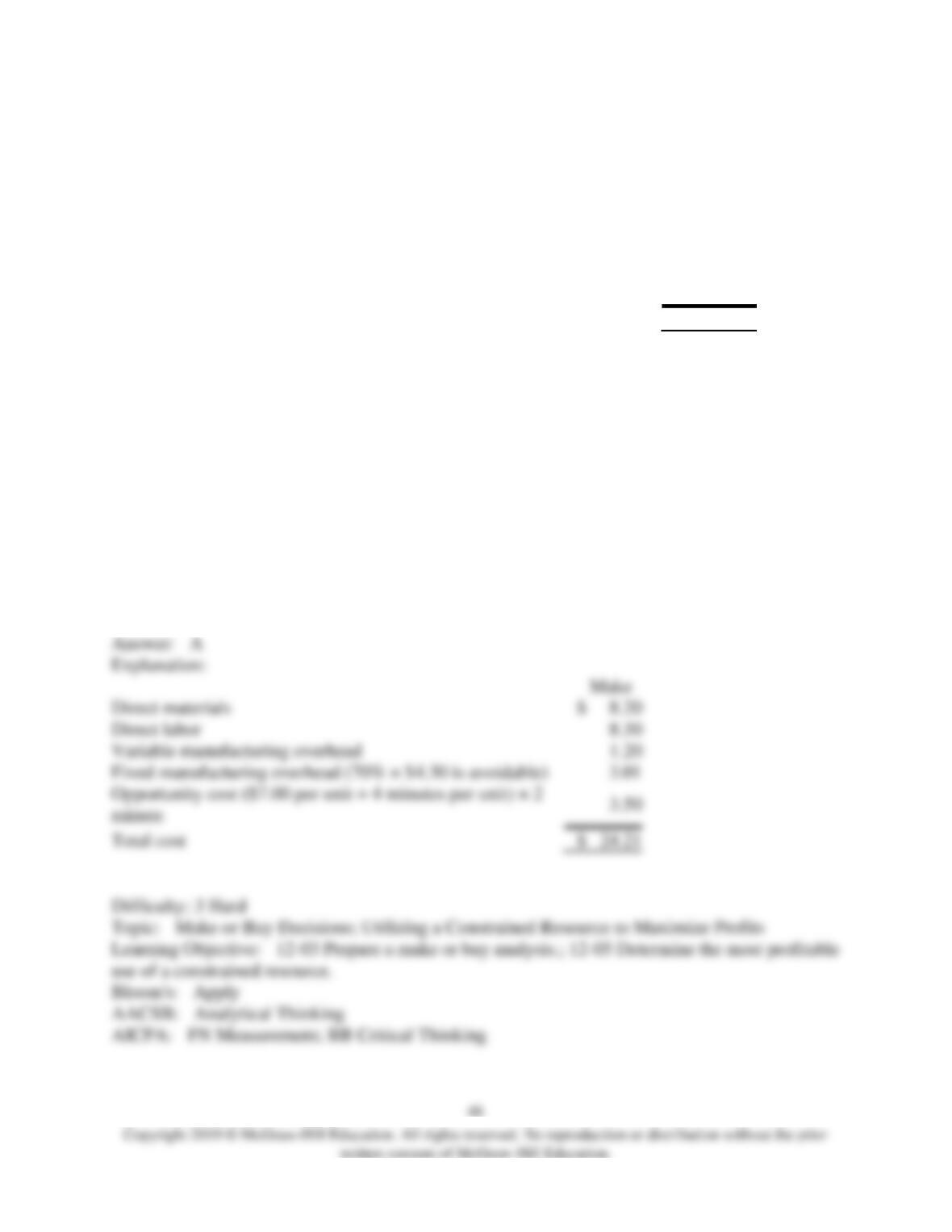
Direct materials
$
8.20
Direct labor
8.30
Variable manufacturing overhead
1.20
Fixed manufacturing overhead (70% × $4.30 is avoidable)
3.01
minute
Total cost
$
24.21
78) Gordon Corporation produces 1,000 units of a part per year which are used in the assembly of
one of its products. The unit cost of producing these parts is:
Variable manufacturing cost
$
15
Fixed manufacturing cost
12
Total manufacturing cost
$
27
The part can be purchased from an outside supplier at $20 per unit. If the part is purchased from the
outside supplier, two thirds of the total fixed costs incurred in producing the part can be avoided.
The annual financial advantage (disadvantage) for the company as a result of buying the part from
the outside supplier would be:
A) $3,000
B) ($1,000)
C) $7,000
D) ($5,000)
Variable manufacturing cost ($15 per unit × 1,000 units)
$
15,000
Fixed manufacturing cost ($12 per unit × 1,000 units) × 2/3
Total relevant cost to make
23,000
Total cost to buy ($20 per unit × 1,000 units)
20,000
Cost saved by buying the units
$
79) Supler Corporation produces a part used in the manufacture of one of its products. The unit
product cost is $18, computed as follows:
Direct materials
$
8
Direct labor
4
Variable manufacturing overhead
1
Fixed manufacturing overhead
5
Unit product cost
$
18
An outside supplier has offered to provide the annual requirement of 4,000 of the parts for only
$14 each. The company estimates that 60% of the fixed manufacturing overhead cost above could
be eliminated if the parts are purchased from the outside supplier. Assume that direct labor is an
avoidable cost in this decision. Based on these data, thefinancial advantage (disadvantage) of
purchasing the parts from the outside supplier would be:
A) ($1) per unit on average
B) $1 per unit on average
C) $2 per unit on average
D) ($4) per unit on average
Direct materials
$
8
Variable manufacturing overhead
1
Avoidable fixed manufacturing overhead (60% × $5)
3
Relevant cost to make
$
16
51
80) CoolAir Corporation manufactures portable window air conditioners. CoolAir has the capacity
to manufacture and sell 80,000 air conditioners each year but is currently only manufacturing and
selling 60,000. The following per unit numbers relate to annual operations at 60,000 units:
Per Unit
Selling price
$
125
Manufacturing costs:
Variable
$
25
Fixed
$
40
Selling and administrative costs:
Variable
$
10
Fixed
$
15
The City of Clearwater would like to purchase 3,000 air conditioners from CoolAir but only if they
can get them for $75 each. Variable selling and administrative costs on this special order will drop
down to $2 per unit. This special order will not affect the 60,000 regular sales and it will not affect
the total fixed costs. The annual financial advantage (disadvantage) for the company as a result of
accepting this special order from the City of Clearwater should be:
A) ($21,000)
B) $24,000
C) $144,000
D) ($129,000)
Incremental revenue (3,000 units × $75 per unit)
225,000
Less incremental costs:
Variable manufacturing cost (3,000 units × $25 per unit)
per unit)
Total incremental cost
Financial advantage (disadvantage)
144,000
81) A customer has requested that Lewelling Corporation fill a special order for 9,000 units of
product S47 for $20.50 a unit. While the product would be modified slightly for the special order,
product S47’s normal unit product cost is $14.40:
Direct materials
$
3.10
Direct labor
1.50
Variable manufacturing overhead
6.40
Fixed manufacturing overhead
3.40
Unit product cost
$
14.40
Assume that direct labor is a variable cost. The special order would have no effect on the
company’s total fixed manufacturing overhead costs. The customer would like modifications made
to product S47 that would increase the variable costs by $5.00 per unit and that would require an
investment of $36,000 in special molds that would have no salvage value. This special order would
have no effect on the company’s other sales. The company has ample spare capacity for producing
the special order. The annual financial advantage (disadvantage) for the company as a result of
accepting this special order should be:
A) $(9,900)
B) $4,500
C) $54,900
D) $(26,100)
Incremental revenue (9,000 units × $20.50 per unit)
Direct materials (9,000 units × $3.10 per unit)
Direct labor (9,000 units × $1.50 per unit)
(9,000 units × ($6.40 per unit + $5.00 per unit))
Special molds
Total incremental cost
Financial advantage (disadvantage)
82) Gallerani Corporation has received a request for a special order of 6,000 units of product A90
for $21.20 each. Product A90’s unit product cost is $16.20, determined as follows:
Direct materials
$
6.10
Direct labor
4.20
Variable manufacturing overhead
2.30
Fixed manufacturing overhead
3.60
Unit product cost
$
16.20
Assume that direct labor is a variable cost. The special order would have no effect on the
company’s total fixed manufacturing overhead costs. The customer would like modifications made
to product A90 that would increase the variable costs by $4.20 per unit and that would require an
investment of $21,000 in special molds that would have no salvage value. This special order would
have no effect on the company’s other sales. The company has ample spare capacity for producing
the special order. The annual financial advantage (disadvantage) for the company as a result of
accepting this special order should be:
A) ($18,600)
B) ($16,200)
C) $30,000
D) $5,400
Incremental revenue (6,000 units × $21.20 per unit)
$
127,200
Less incremental costs:
Direct materials (6,000 units × $6.10 per unit)
Direct labor (6,000 units × $4.20 per unit)
(6,000 units × ($2.30 per unit + $4.20 per unit))
Special molds
Total incremental cost
121,800
Financial advantage (disadvantage)
$
83) Landor Appliance Corporation makes and sells electric fans. Each fan regularly sells for $42.
The following cost data per fan is based on a full capacity of 150,000 fans produced each period.
Direct materials
$
8
Direct labor
$
9
Manufacturing overhead (70% variable and 30% unavoidable fixed)
$
10
A special order has been received by Landor for a sale of 25,000 fans to an overseas customer. The
only selling costs that would be incurred on this order would be $4 per fan for shipping. Landor is
now selling 120,000 fans through regular channels each period. Assume that direct labor is an
avoidable cost in this decision. What should Landor use as a minimum selling price per fan in
negotiating a price for this special order?
A) $28 per fan
B) $27 per fan
C) $31 per fan
D) $24 per fan
Direct materials
$
8
Direct labor
9
Manufacturing overhead (70% of $10)
7
Shipping cost
4
Relevant cost
$
28
84) Banfield Corporation makes three products that use compound W, the current constrained
resource. Data concerning those products appear below:
VP
YI
WX
Selling price per unit
$
248.04
$
230.66
$
505.44
Variable cost per unit
$
190.71
$
172.14
$
388.80
Centiliters of compound W
3.90
3.80
8.10
Rank the products in order of their current profitability from most profitable to least profitable. In
other words, rank the products in the order in which they should be emphasized.
A) WX, VP, YI
B) YI, VP, WX
C) WX, YI, VP
D) VP, WX, YI
Selling price per unit
$
248.04
$
230.66
$
505.44
Variable cost per unit
$
190.71
$
172.14
$
388.80
Contribution margin per unit (a)
$
$
$
116.64
required to produce one unit (b)
3.90
3.80
8.10
constrained resource (a) ÷ (b)
$
$
Ranking
85) Wood Carving Corporation manufactures three products. Because of a recent lack of skilled
wood carvers, the corporation has had a shortage of available labor hours. The following per unit
data relates to the three products of the corporation:
Letter
Openers
Elvis Statues
Candle
Holders
Selling price
$
30
$
80
$
42
Variable cost
$
20
$
40
$
20
Labor hours required
1
6
2
Assume that Wood Carving only has 1,800 labor hours available next month. Also assume that
Wood Carving can only sell 800 units of each product in a given month. What is the maximum
amount of contribution margin that Wood Carving can generate next month given this labor hour
shortage?
A) $12,000
B) $19,000
C) $19,600
D) $19,800
86) Danny Dolittle makes crafts in his spare time and always sells everything he makes at local
craft shows. Danny specializes in four products. Because Danny’s time is limited before the next
craft show, he is trying to decide how to use his time to the best advantage. Information related to
the four products that Danny produces are shown below:
Rag Dolls
Pot Holders
Bread
Baskets
Finger
Puppets
Contribution margin per unit
$
8
$
2
$
12
$
6
Contribution margin ratio
40
%
25
%
32
%
30
%
Time required per unit (in hours)
1.4
0.5
3.5
2.0
Rank the products from the most profitable to the least profitable use of the constrained resource.
A) Rag Dolls, Pot Holders, Bread Baskets, Finger Puppets
B) Rag Dolls, Bread Baskets, Finger Puppets, Pot Holders
C) Pot Holders, Rag Dolls, Finger Puppets, Bread Baskets
D) Bread Baskets, Rag Dolls, Finger Puppets, Pot Holders
87) An automated turning machine is the current constraint at Jordison Corporation. Three
products use this constrained resource. Data concerning those products appear below:
LN
JQ
RQ
Selling price per unit
$
165.88
$
313.11
$
494.52
Variable cost per unit
118.30
239.61
381.42
Minutes on the constraint
2.60
4.90
7.80
Rank the products in order of their current profitability from most profitable to least profitable. In
other words, rank the products in the order in which they should be emphasized.
A) LN, JQ, RQ
B) RQ, LN, JQ
C) RQ, JQ, LN
D) JQ, RQ, LN
LN
JQ
RQ
Selling price per unit
$
165.88
$
313.11
$
494.52
Variable cost per unit
118.30
239.61
381.42
Contribution margin per unit (a)
$
$
$
113.10
produce one unit (b)
2.60
4.90
7.80
$
$
$
Ranking
88) Marley Corporation makes three products (X, Y, & Z) with the following characteristics:
Products
X
Y
Z
Selling price per unit
$
10
$
15
$
20
Variable cost per unit
$
6
$
10
$
10
Machine hours per unit
2
4
10
The company has a capacity of 2,000 machine hours, but there is virtually unlimited demand for
each product. In order to maximize total contribution margin, how many units of each product
should the company produce?
A) 2,000 units of X, 500 units of Y, and 200 units of Z
B) 0 units of X, 0 units of Y, and 200 units of Z
C) 0 units of X, 500 units of Y, and 0 units of Z
D) 1,000 units of X, 0 units of Y, and 0 units of Z
Selling price per unit
$
$
$
Variable cost per unit
Contribution margin per unit
$
$
$
Machine hours per unit