54) Otool Inc. is considering using stocks of an old raw material in a special project. The special
project would require all 240 kilograms of the raw material that are in stock and that originally cost
the company $2,112 in total. If the company were to buy new supplies of this raw material on the
open market, it would cost $9.25 per kilogram. However, the company has no other use for this
raw material and would sell it at the discounted price of $8.35 per kilogram if it were not used in
the special project. The sale of the raw material would involve delivery to the purchaser at a total
cost of $71 for all 240 kilograms. What is the relevant cost of the 240 kilograms of the raw material
when deciding whether to proceed with the special project?
A) $1,933
B) $2,004
C) $2,220
D) $2,112
55) Milford Corporation has in stock 16,100 kilograms of material R that it bought five years ago
for $5.75 per kilogram. This raw material was purchased to use in a product line that has been
discontinued. Material R can be sold as is for scrap for $3.91 per kilogram. An alternative would
be to use material R in one of the company’s current products, S88Y, which currently requires 2
kilograms of a raw material that is available for $7.60 per kilogram. Material R can be modified at
a cost of $0.77 per kilogram so that it can be used as a substitute for this material in the production
of product S88Y. However, after modification, 4 kilograms of material R is required for every unit
of product S88Y that is produced. Milford Corporation has now received a request from a
company that could use material R in its production process. Assuming that Milford Corporation
could use all of its stock of material R to make product S88Y or the company could sell all of its
stock of the material at the current scrap price of $3.91 per kilogram, what is the minimum
acceptable selling price of material R to the company that could use material R in its own
production process?
A) $0.88 per kg
B) $3.03 per kg
C) $4.57 per kg
D) $3.91 per kg
56) Schickel Inc. regularly uses material B39U and currently has in stock 460 liters of the material
for which it paid $3,128 several weeks ago. If this were to be sold as is on the open market as
surplus material, it would fetch $5.95 per liter. New stocks of the material can be purchased on the
open market for $6.45 per liter, but it must be purchased in lots of 1,000 liters. You have been
asked to determine the relevant cost of 760 liters of the material to be used in a job for a customer.
The relevant cost of the 760 liters of material B39U is:
A) $4,902
B) $4,672
C) $4,522
D) $6,450
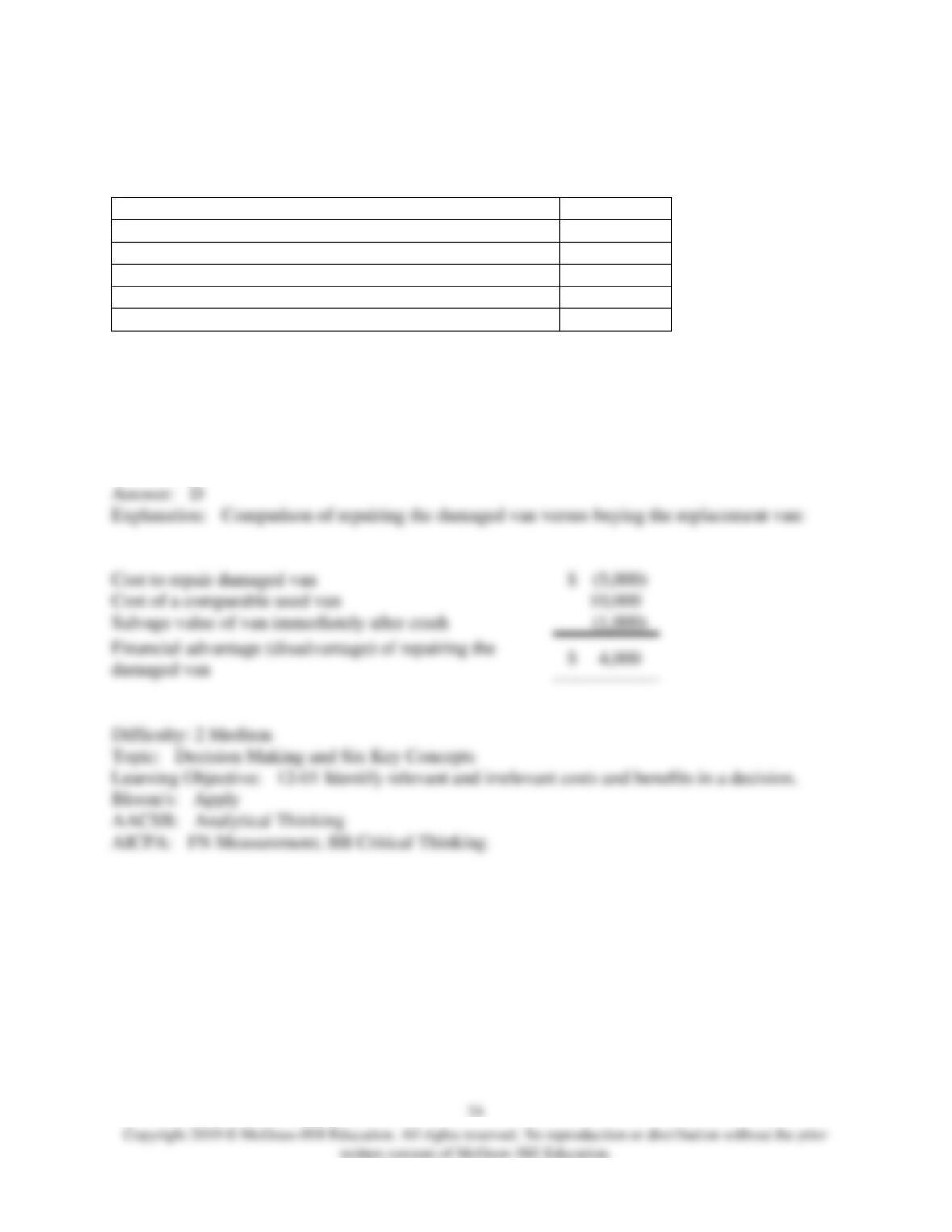
57) One of the employees of Davenport Corporation recently was involved in an accident with one
of the corporation’s delivery vans. The corporation is either going to repair the damaged van or sell
it as is and buy a comparable used van. Information related to this decision is provided below:
Initial cost of the damaged van
$30,000
Accumulated depreciation to date on van
$18,000
Salvage value of van immediately before crash
$9,000
Salvage value of van immediately after crash
$1,000
Cost to repair damaged van
$5,000
Cost of a comparable used van
$10,000
Based on the information above, Davenport would be financially better off:
A) $1,000 by buying the comparable van.
B) $2,000 by buying the comparable van.
C) $2,000 by repairing the damaged van.
D) $4,000 by repairing the damaged van.
Cost to repair damaged van
)
Cost of a comparable used van
Salvage value of van immediately after crash
)
damaged van
58) Winder Corporation is a specialty component manufacturer with idle capacity. Management
would like to use its extra capacity to generate additional profits. A potential customer has offered
to buy 3,000 units of component QEA. Each unit of QEA requires 5 units of material F85 and 5
units of material E71. Data concerning these two materials follow:
Material
Units in
Stock
Original Cost Per
Unit
Current Market
Price Per Unit
Disposal Value Per
Unit
F85
740
$
4.90
$
4.75
$
4.20
E71
13,680
$
5.00
$
4.70
$
3.60
Material F85 is in use in many of the company’s products and is routinely replenished. Material
E71 is no longer used by the company in any of its normal products and existing stocks would not
be replenished once they are used up.
What would be the relevant cost of the materials, in total, for purposes of determining a minimum
acceptable price for the order for product QEA?
A) $126,702
B) $141,750
C) $126,295
D) $145,965
of $4.75 per unit of F85
Relevant cost of E71:
per unit of E71
$4.70 per unit of E71
Relevant cost of materials
59) Lusk Corporation produces and sells 10,000 units of Product X each month. The selling price
of Product X is $40 per unit, and variable expenses are $32 per unit. A study has been made
concerning whether Product X should be discontinued. The study shows that $70,000 of the
$120,000 in monthly fixed expenses charged to Product X would not be avoidable even if the
product was discontinued. If Product X is discontinued, the annual financial advantage
(disadvantage) for the company of eliminating this product should be:
A) ($30,000)
B) $30,000
C) $40,000
D) ($40,000)
60) Product U23N has been considered a drag on profits at Jinkerson Corporation for some time
and management is considering discontinuing the product altogether. Data from the company’s
budget for the upcoming year appear below:
Sales
$730,000
Variable expenses
$350,000
Fixed manufacturing expenses
$234,000
Fixed selling and administrative expenses
$161,000
In the company’s accounting system all fixed expenses of the company are fully allocated to
products. Further investigation has revealed that $144,000 of the fixed manufacturing expenses
and $93,000 of the fixed selling and administrative expenses are avoidable if product U23N is
discontinued. The financial advantage (disadvantage) for the company of eliminating this product
for the upcoming year would be:
A) $15,000
B) $143,000
C) ($143,000)
D) ($15,000)
Sales
Variable expenses
Contribution margin
Traceable fixed expenses:
Fixed manufacturing expenses
Fixed selling and administrative expenses
Segment margin
61) The Cook Corporation has two divisions—East and West. The divisions have the following
revenues and expenses:
East
West
Sales
$
500,000
$
550,000
Variable costs
200,000
275,000
Traceable fixed costs
150,000
180,000
Allocated common corporate costs
135,000
170,000
Net operating income (loss)
$
15,000
$
(75,000
)
The management of Cook is considering the elimination of the West Division. If the West Division
were eliminated, its traceable fixed costs could be avoided. Total common corporate costs would
be unaffected by this decision. Given these data, the elimination of the West Division would result
in an overall company net operating income (loss) of:
A) $15,000
B) ($155,000)
C) ($75,000)
D) ($60,000)
Sales
$
(550,000
)
Contribution margin
(275,000
)
Traceable fixed expenses
180,000
Effect on net operating income
$
)
62) Wallen Corporation is considering eliminating a department that has an annual contribution
margin of $80,000 and $160,000 in annual fixed costs. Of the fixed costs, $90,000 cannot be
avoided. The annual financial advantage (disadvantage) for the company of eliminating this
department would be:
A) $10,000
B) ($10,000)
C) $80,000
D) ($80,000)
63) Fabri Corporation is considering eliminating a department that has an annual contribution
margin of $35,000 and $70,000 in annual fixed costs. Of the fixed costs, $25,000 cannot be
avoided. The annual financial advantage (disadvantage) for the company of eliminating this
department would be:
A) $10,000
B) ($10,000)
C) $35,000
D) ($35,000)
64) The management of Furrow Corporation is considering dropping product L07E. Data from the
company’s budget for the upcoming year appear below:
Sales
$830,000
Variable expenses
$365,000
Fixed manufacturing expenses
$291,000
Fixed selling and administrative expenses
$166,000
In the company’s accounting system all fixed expenses of the company are fully allocated to
products. Further investigation has revealed that $186,000 of the fixed manufacturing expenses
and $106,000 of the fixed selling and administrative expenses are avoidable if product L07E is
discontinued. The financial advantage (disadvantage) for the company of eliminating this product
for the upcoming year would be:
A) $8,000
B) ($173,000)
C) ($8,000)
D) $173,000
Sales
Variable expenses
Contribution margin
Traceable fixed expenses:
Fixed manufacturing expenses
Fixed selling and administrative expenses
Segment margin
65) A study has been conducted to determine if one of the departments in Carry Corporation
should be discontinued. The contribution margin in the department is $80,000 per year. Fixed
expenses charged to the department are $95,000 per year. It is estimated that $50,000 of these fixed
expenses could be eliminated if the department is discontinued. These data indicate that if the
department is discontinued, the yearly financial advantage (disadvantage) for the company would
be:
A) ($15,000)
B) $15,000
C) ($30,000)
D) $30,000
66) A study has been conducted to determine if Product A should be dropped. Sales of the product
total $500,000; variable expenses total $340,000. Fixed expenses charged to the product total
$210,000. The company estimates that $60,000 of these fixed expenses are not avoidable even if
the product is dropped. If Product A is dropped, the annual financial advantage (disadvantage) for
the company of eliminating this product should be:
A) ($10,000)
B) $10,000
C) ($50,000)
D) $50,000
67) Vanik Corporation currently has two divisions which had the following operating results for
last year:
Cork Division
Rubber
Division
Sales
$
600,000
350,000
Variable costs
250,000
220,000
Contribution margin
350,000
130,000
Traceable fixed costs
160,000
110,000
Segment margin
190,000
20,000
Allocated common corporate fixed costs
80,000
45,000
Net operating income (loss)
$
110,000
(25,000
)
Because the Rubber Division sustained a loss, the president of Vanik is considering the elimination
of this division. All of the division’s traceable fixed costs could be avoided if the division was
dropped. None of the allocated common corporate fixed costs could be avoided. If the Rubber
Division was dropped at the beginning of last year, the financial advantage (disadvantage) to the
company for the year would have been:
A) ($20,000)
B) $20,000
C) $25,000
D) ($25,000)
68) The following information relates to next year’s projected operating results of the Children’s
Division of Grunge Clothing Corporation:
Contribution margin
$
200,000
Fixed expenses
500,000
Net operating loss
$
(300,000
)
If the Children’s Division is eliminated, $170,000 of the above fixed expenses could be avoided.
The annual financial advantage (disadvantage) for the company of eliminating this division should
be:
A) ($300,000)
B) $30,000
C) ($30,000)
D) $300,000
Contribution margin
$
200,000
Avoidable fixed expenses
170,000
Segment margin
$
(30,000
)
69) Kahn Corporation (a multi-product company) produces and sells 8,000 units of Product X each
year. Each unit of Product X sells for $10 and has a contribution margin of $6. If Product X is
discontinued, $50,000 of the $60,000 in annual fixed costs charged to Product X could be
eliminated. The annual financial advantage (disadvantage) for the company of eliminating this
product should be:
A) $2,000
B) ($2,000)
C) $12,000
D) ($12,000)

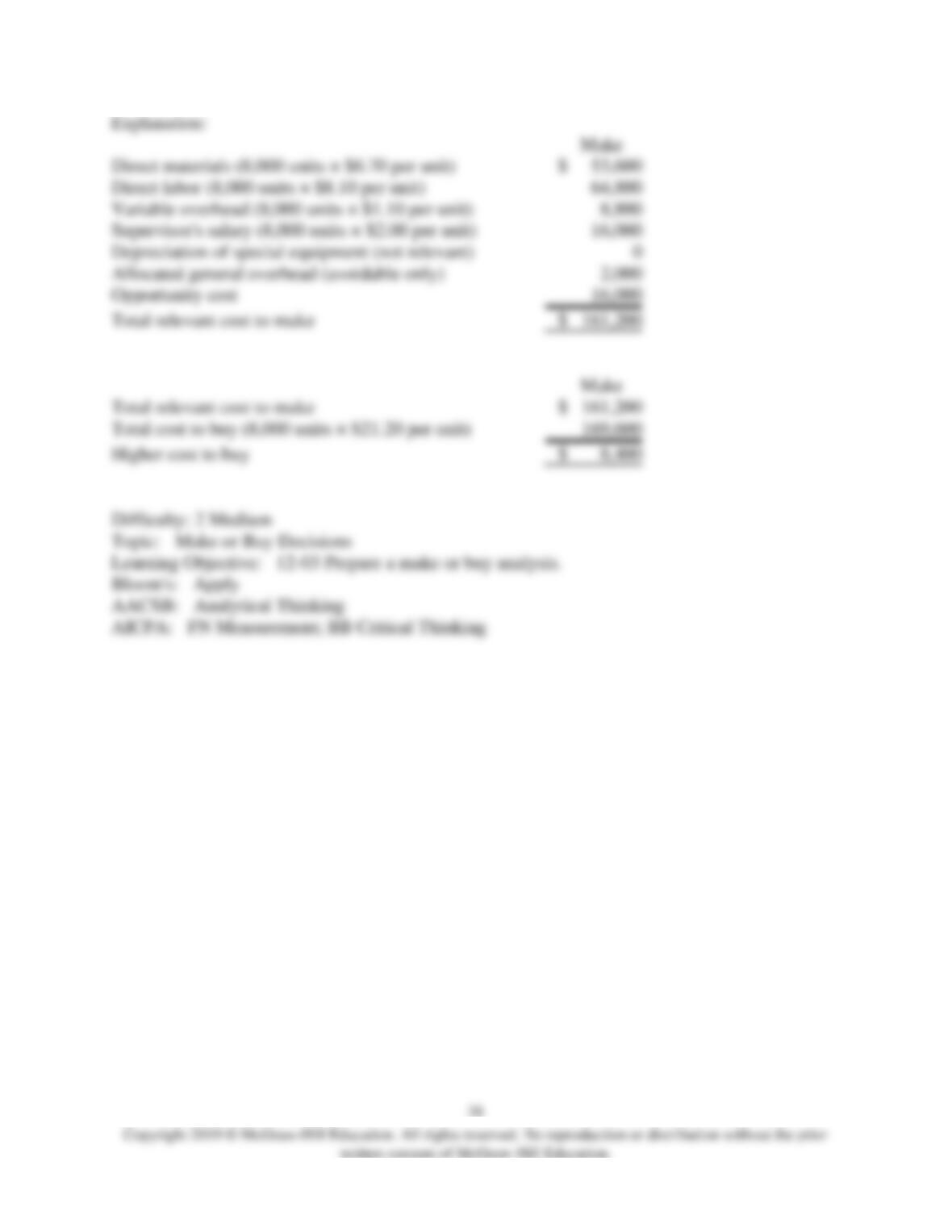
70) Norgaard Corporation makes 8,000 units of part G25 each year. This part is used in one of the
company’s products. The company’s Accounting Department reports the following costs of
producing the part at this level of activity:
Per Unit
Direct materials
$
6.70
Direct labor
$
8.10
Variable manufacturing overhead
$
1.10
Supervisor’s salary
$
2.00
Depreciation of special equipment
$
4.20
Allocated general overhead
$
2.10
An outside supplier has offered to make and sell the part to the company for $21.20 each. If this
offer is accepted, the supervisor’s salary and all of the variable costs, including direct labor, can be
avoided. The special equipment used to make the part was purchased many years ago and has no
salvage value or other use. The allocated general overhead represents fixed costs of the entire
company. If the outside supplier’s offer were accepted, only $2,000 of these allocated general
overhead costs would be avoided. In addition, the space used to produce part G25 would be used to
make more of one of the company’s other products, generating an additional segment margin of
$16,000 per year for that product.
The annual financial advantage (disadvantage) for the company as a result of buying part G25
from the outside supplier should be:
A) ($8,400)
B) $16,000
C) ($8,000)
D) ($40,000)
71) Sharp Corporation produces 8,000 parts each year, which are used in the production of one of
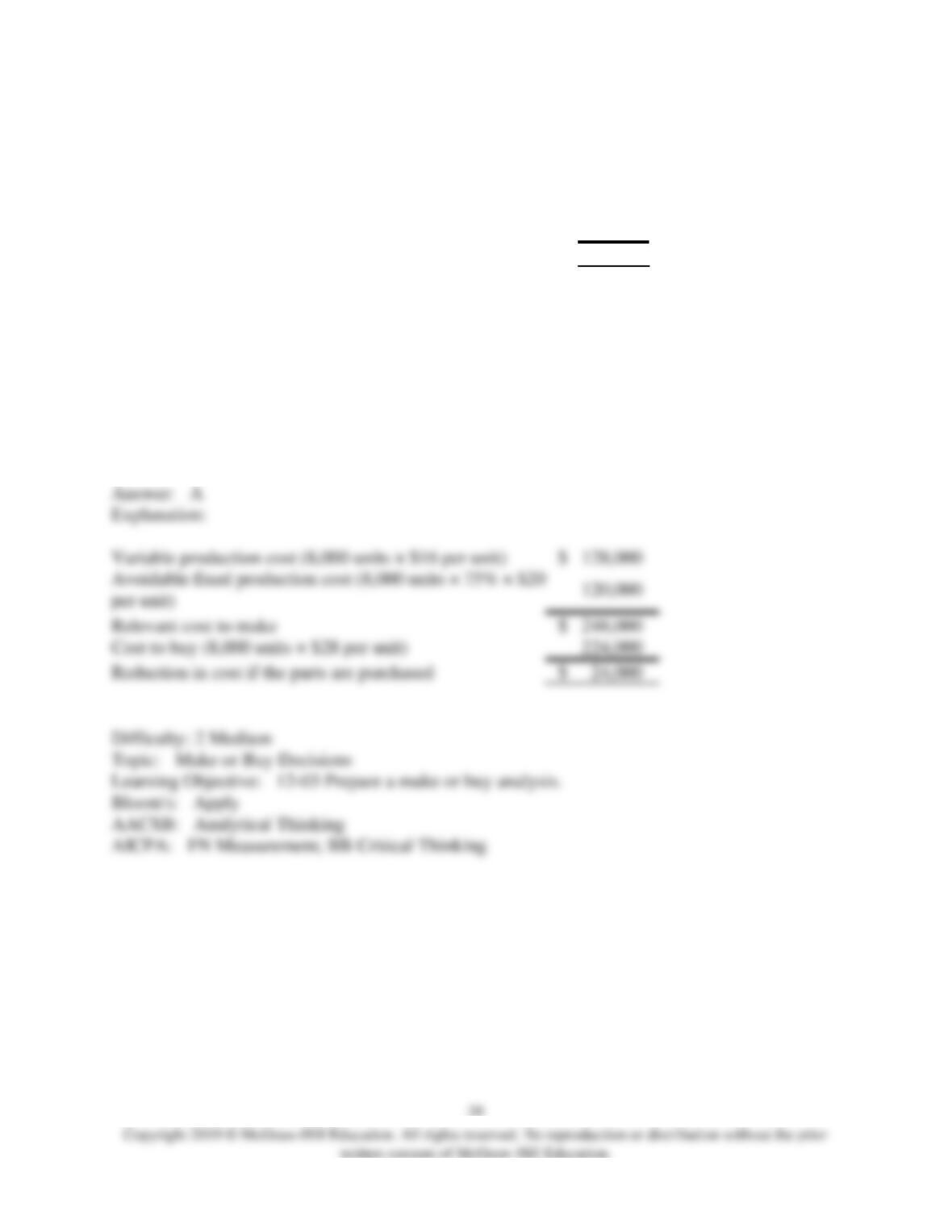
its products. The unit product cost of a part is $36, computed as follows:
Variable production cost
$
16
Fixed production cost
20
Unit product cost
$
36
The parts can be purchased from an outside supplier for only $28 each. The space in which the
parts are now produced would be idle and fixed production costs would be reduced by one-fourth.
Based on these data, the financial advantage (disadvantage) of purchasing the parts from the
outside supplier would be:
A) $24,000
B) ($24,000)
C) $56,000
D) ($56,000)
Variable production cost (8,000 units × $16 per unit)
$
128,000
per unit)
Relevant cost to make
$
248,000
Cost to buy (8,000 units × $28 per unit)
224,000
Reduction in cost if the parts are purchased
$
72) Zouar Computer Corporation currently manufactures the disk drives that it uses in its
computers. The costs to produce 5,000 of these disk drives last year were as follows:
Cost per
drive
Direct materials
$
12
Direct labor
2
Variable manufacturing overhead
5
Fixed manufacturing overhead
7
Total
$
26
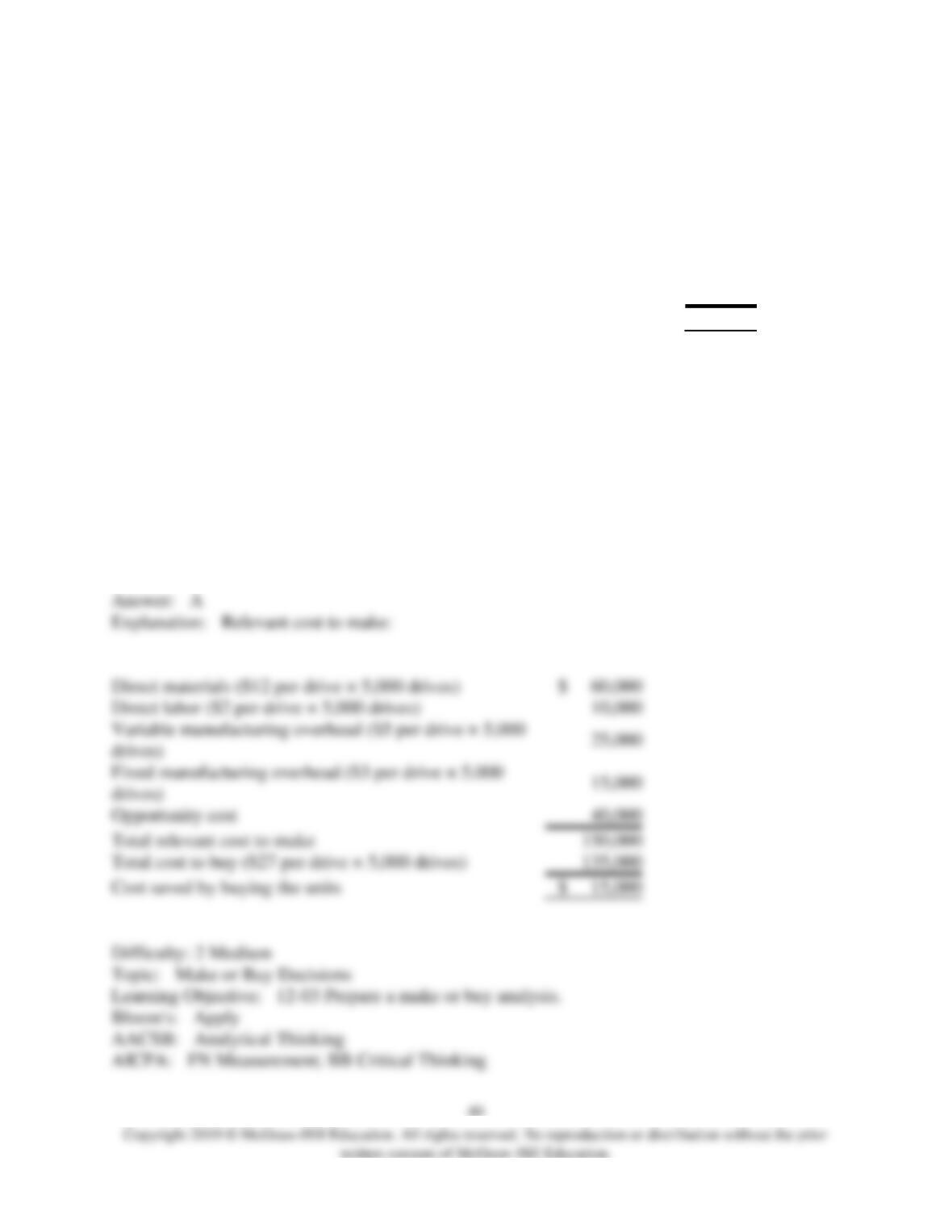
Kidal Electronics has offered to provide Zouar with all of its disk drive needs for $27 per drive. If
Zouar accepts this offer, Zouar will be able to use the freed up space to generate an additional
$40,000 of income each year to produce more of its computer keyboards. Only $3 per drive of the
fixed manufacturing overhead cost above could be avoided. Direct labor is an avoidable cost in
this decision. Based on this information, would Zouar be financially better off making the drives or
buying the drives and by how much?
A) $15,000 better to buy
B) $20,000 better to buy
C) $35,000 better to buy
D) $60,000 better to make
Direct materials ($12 per drive × 5,000 drives)
$
60,000
Direct labor ($2 per drive × 5,000 drives)
10,000
drives)
drives)
Opportunity cost
40,000
Total relevant cost to make
150,000
Total cost to buy ($27 per drive × 5,000 drives)
135,000
Cost saved by buying the units
$
15,000