Test Bank for Intermediate Accounting, Seventeenth Edition
12 – 40
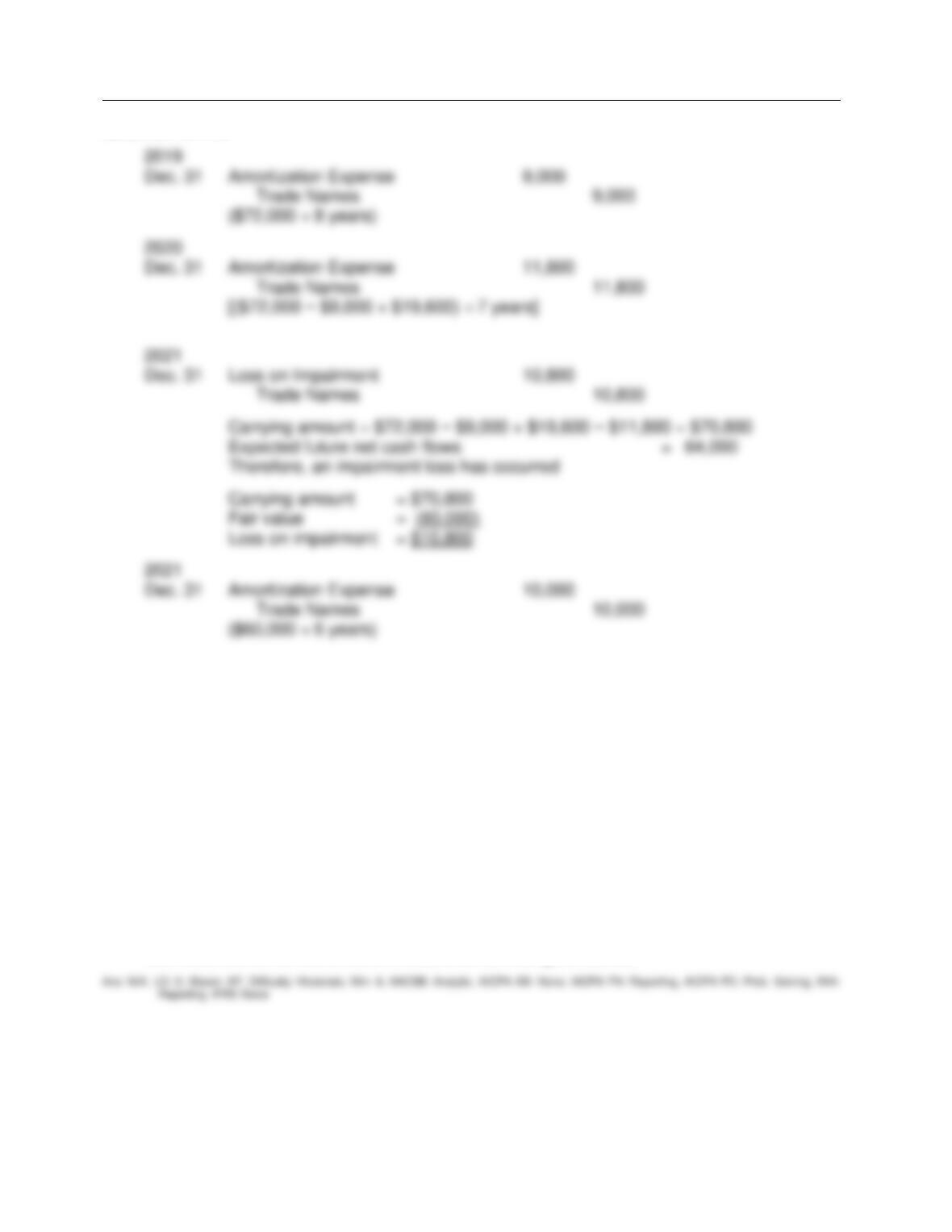
Solution 12-140
Ex. 12-141
Listed below is a selection of accounts found in the general ledger of Marshall Corporation
as of December 31, 2021:
Accounts receivable Research & development costs
Goodwill Internet domain name
Organization costs Initial operating loss
Prepaid insurance Non-competition agreement
Radio broadcasting rights Customer list
Premium on bonds payable Video copyrights
Trade name Notes receivable
Instructions
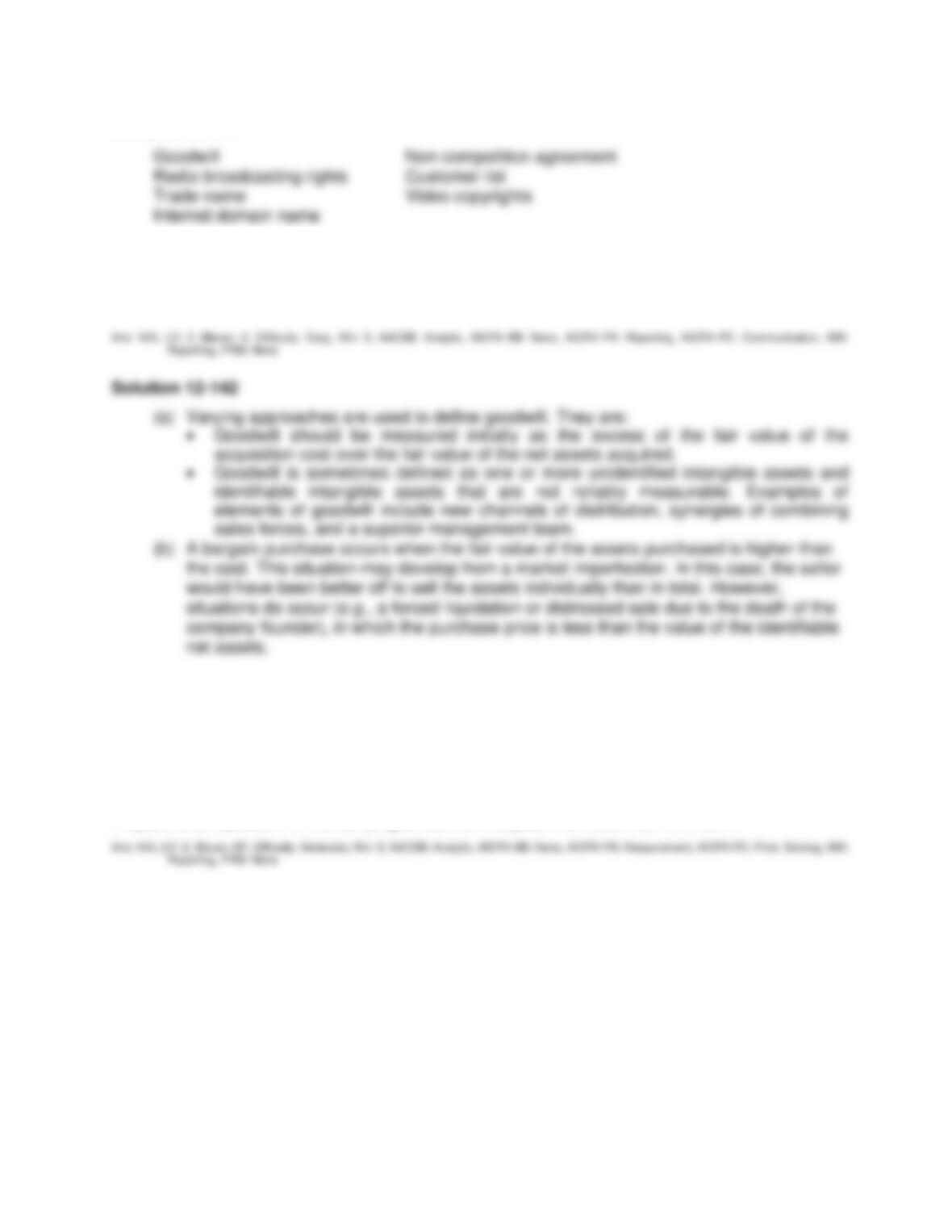
List those accounts that should be classified as intangible assets.
Intangible Assets
12 – 41
Solution 12-141
Ex. 12-142
Define the following terms.
(a) Goodwill (b) Bargain purchase
Ex. 12-143
Sisco Co. purchased a patent from Thornton Co. for $930,000 on July 1, 2018. Expenditures of
$178,500 for successful litigation in defense of the patent were paid on July 1, 2021. Sisco
estimates that the useful life of the patent will be 20 years from the date of acquisition.
Instructions
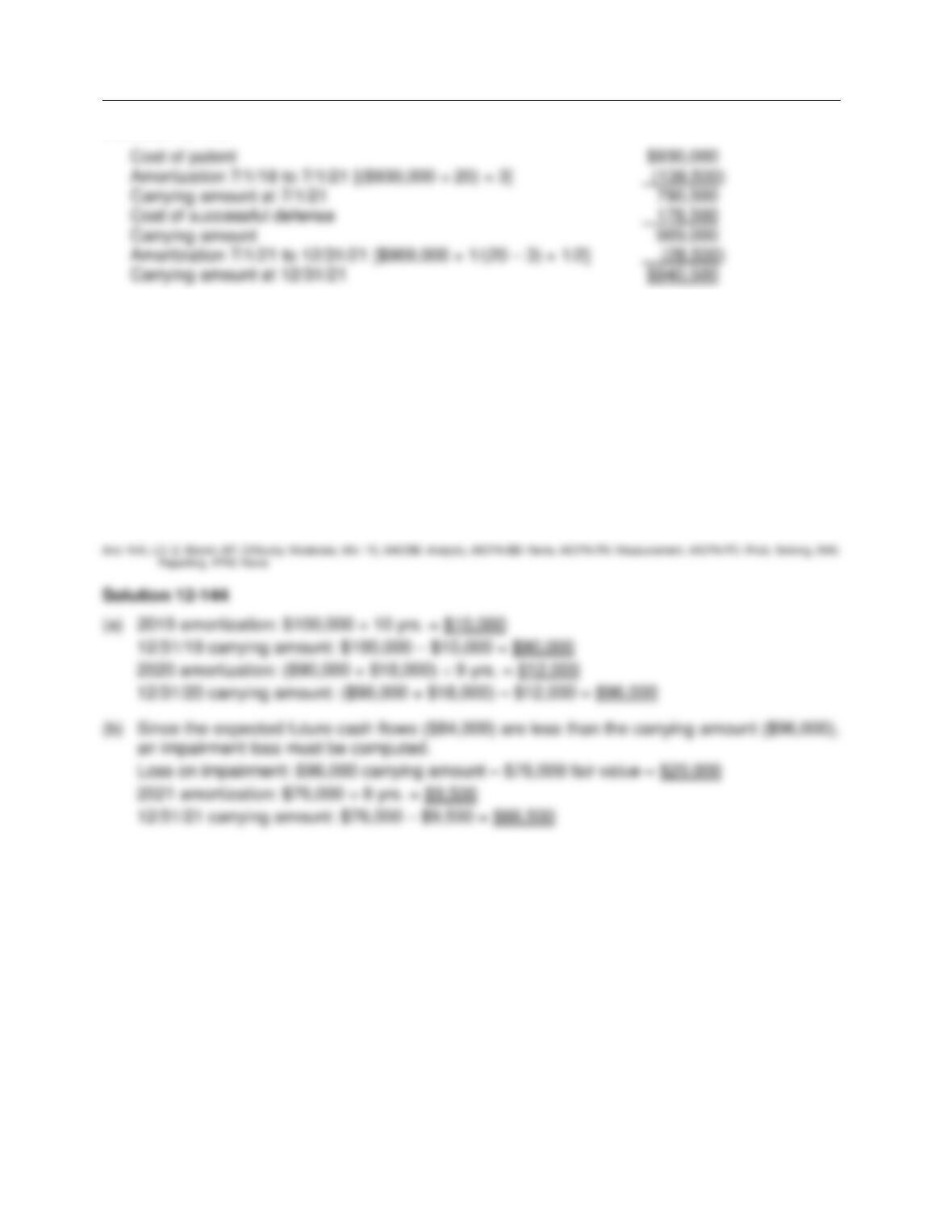
Prepare a computation of the carrying amount of the patent at December 31, 2021.
Test Bank for Intermediate Accounting, Seventeenth Edition
12 – 42
Solution 12-143
Ex. 12-144
In early January 2019, Lerner Corporation applied for a patent, incurring legal costs of $100,000.
In January 2020, Lerner incurred $18,000 of legal fees in a successful defense of its patent.
Instructions
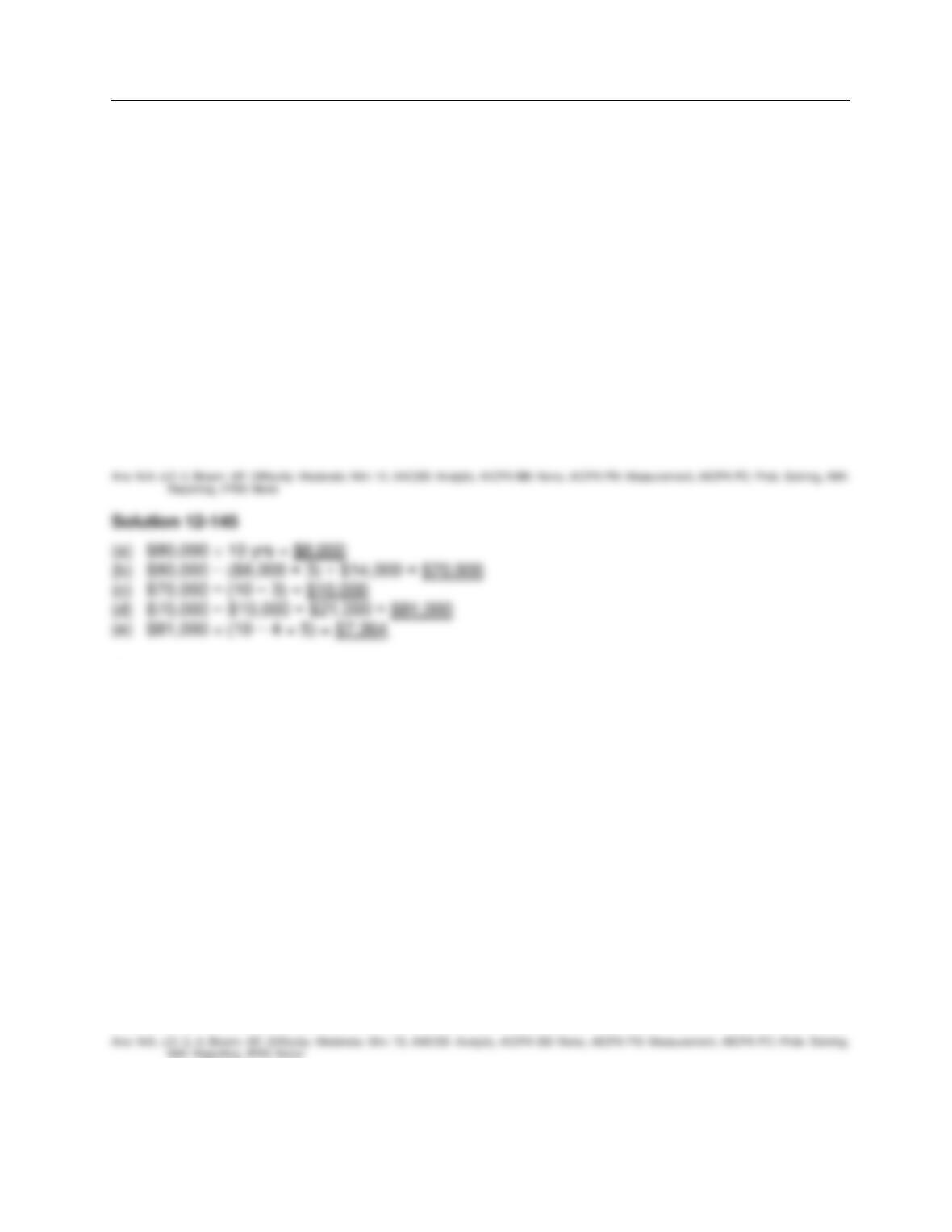
(a) Compute 2019 amortization, 12/31/19 carrying amount, 2020 amortization, and 12/31/20
carrying amount if the company amortizes the patent over 10 years.
(b) Compute the 2021 amortization and the 12/31/21 carrying amount, assuming that at the
beginning of 2021, based on new market research, Lerner determines that the fair value of
the patent is $76,000. Estimated future cash flows from the patent are $84,000 on January
3, 2021.
Intangible Assets
12 – 43
Ex. 12-145
A patent was acquired by Renfro Corporation on January 1, 2017, at a cost of $80,000. The
useful life of the patent was estimated to be 10 years. At the beginning of 2020, Renfro spent
$14,000 in successfully defending an infringement of the patent. At the beginning of 2021, Renfro
purchased a patent for $21,000 that was expected to prolong the life of its original patent for 5
additional years.
Instructions
Calculate the following amounts for Renfro Corporation.
(a) Amortization expense for 2017.
(b) The balance in the Patent account at the beginning of 2020, immediately after the
infringement suit.
(c) Amortization expense for 2020.
(d) The balance in the Patent account at the beginning of 2021, after purchase of the additional
patent.
(e) Amortization expense for 2021.
Ex. 12-146
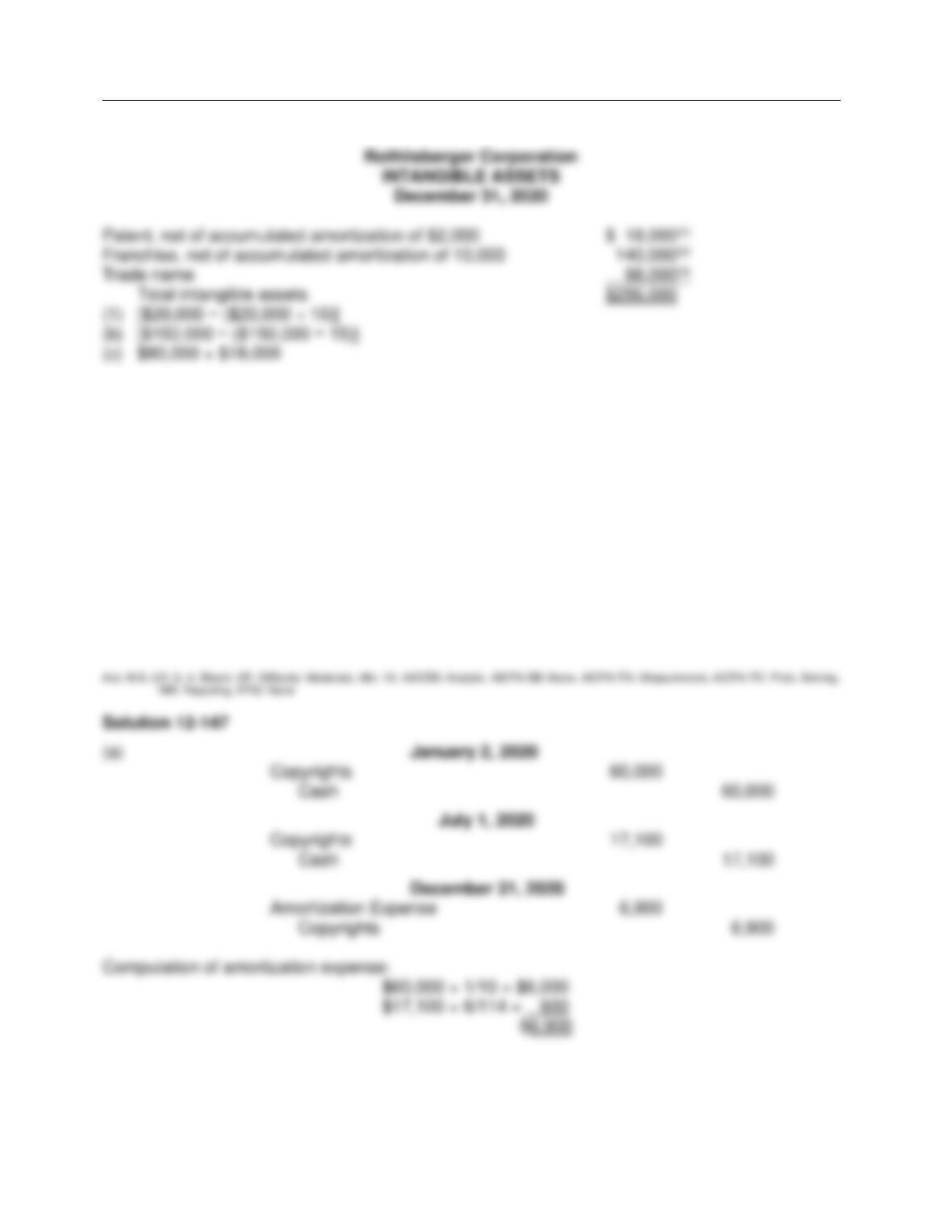
Information concerning Rothlisberger Corporation’s intangible assets follows:
1. Rothlisberger incurred $70,000 of experimental and development costs in its laboratory to
develop a patent which was granted on January 2, 2020. Legal fees associated with
registration of the patent totaled $20,000. Rothlisberger estimates that the useful life of the
patent will be 10 years; the legal life of the patent is 20 years.
2. On January 1 2020, Rothlisberger signed an agreement to operate as a franchisee of Dairy
King, Inc. for an initial franchise fee of $150,000. The agreement provides that the fee is not
refundable and no future services are required of the franchisor. Rothlisberger estimates the
useful life of the franchise to be 15 years.
3. A trade name was purchase from Stine Company for $80,000 on May 1, 2018. Expenditures
for successful litigation in defense of the trade name totaling $18,000 were paid on June 1,
2020. Rothlisberger estimates that the trade name will have an indefinite life.
Instructions
Prepare the intangible asset section of the Rothlisberger’s balance sheet at December 31, 2020.
Test Bank for Intermediate Accounting, Seventeenth Edition
12 – 44
Solution 12-146
Ex. 12-147
The following information is available for Gorman Company.
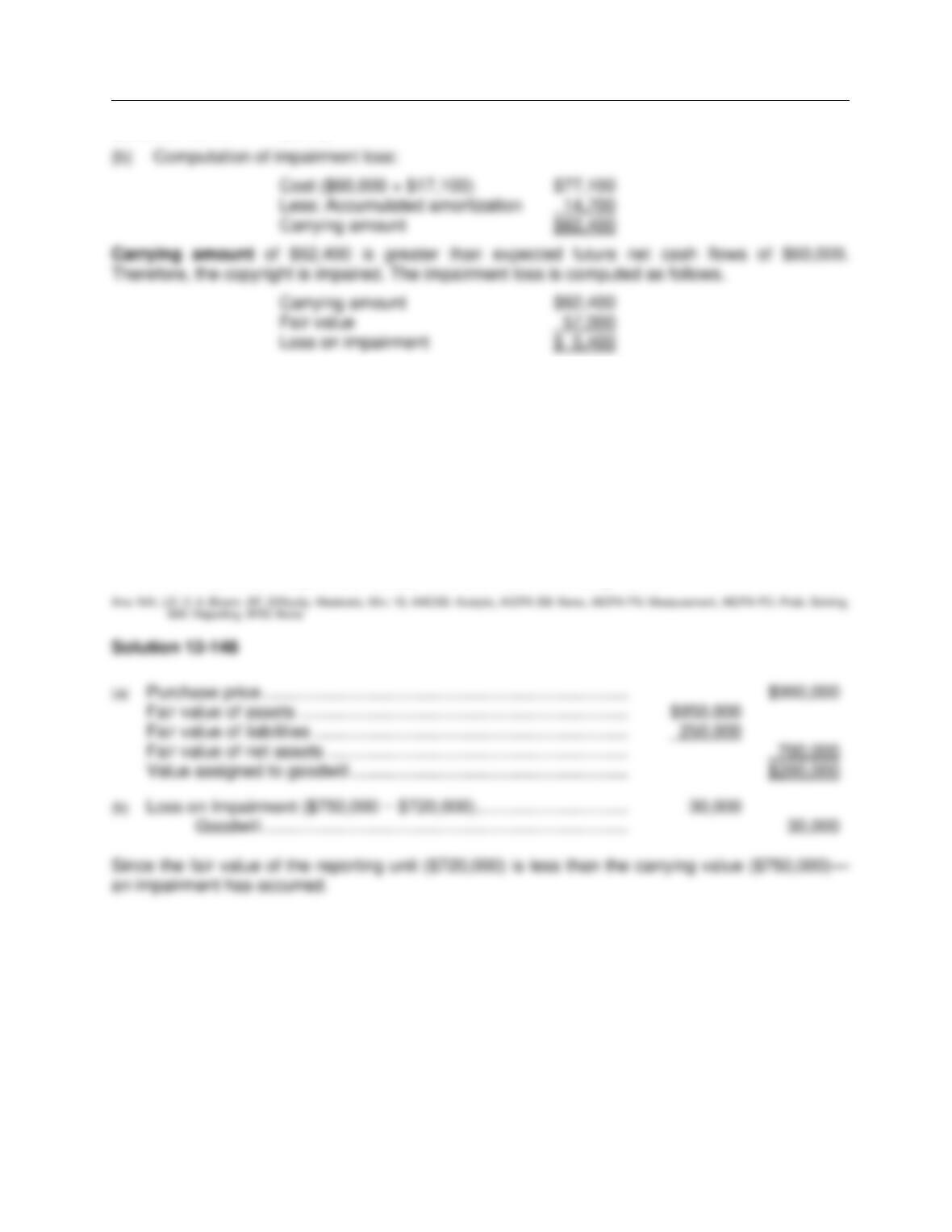
1. Purchased a copyright on January 1, 2020 for $60,000. It is estimated to have a 10-year life.
2. On July 1, 2020, legal fees for successful defense of the copyright purchased on January 1,
2020, were $17,100.
Instructions
(a) Prepare the journal entries to record all the events related to the copyright during 2020.
(b) At December 31, 2021, an impairment test is performed on the copyright purchased in 2020.
It is estimated that the net cash flows to be received from the copyright will be $60,000, and
its fair value is $57,000. The accumulated amortization at the end of 2021 was $14,700.
Compute the amount of impairment, if any, to be recorded on December 31, 2021.
Intangible Assets
12 – 45
Solution 12-147 (cont.)
Ex. 12-148
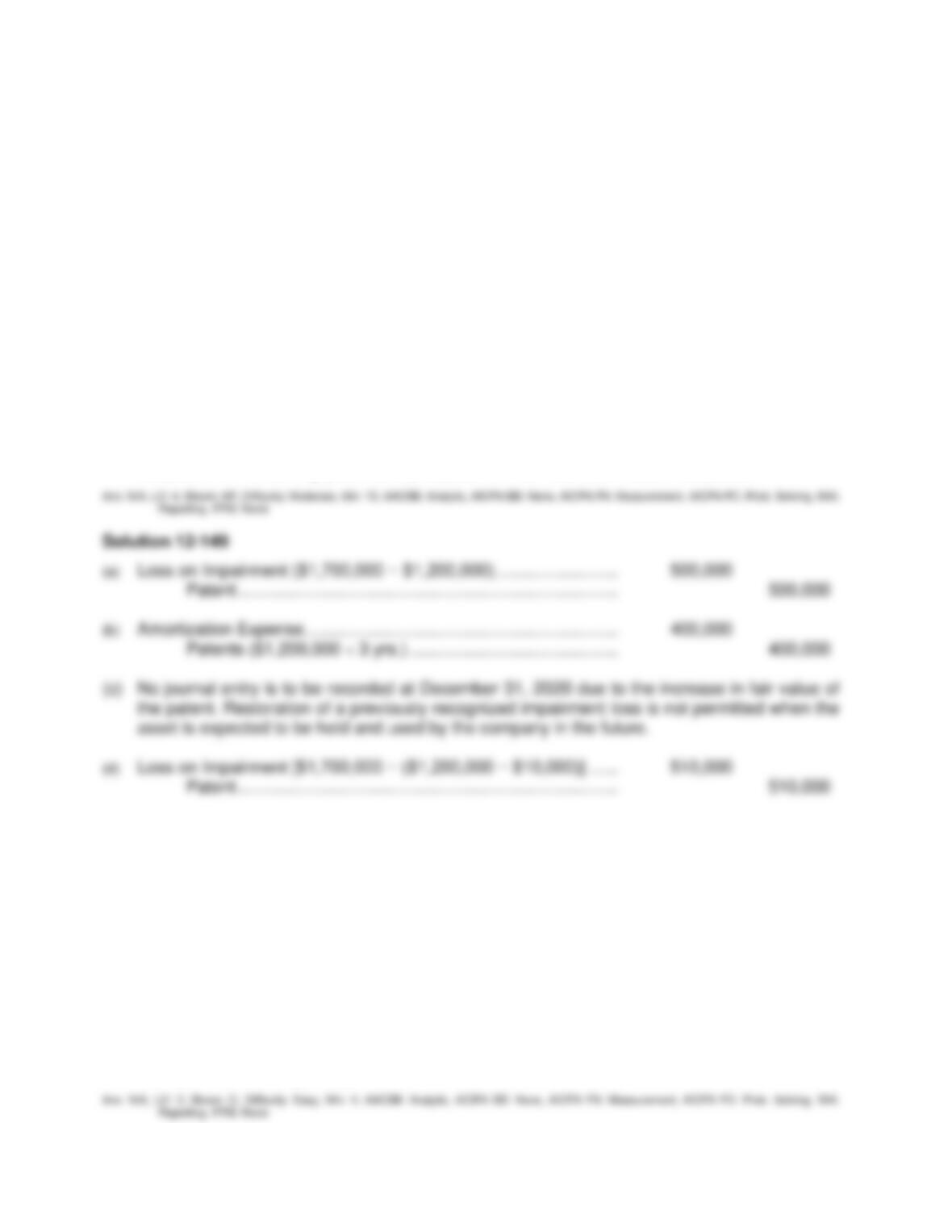
On July 1, 2020, Vinson Corporation acquired Carley Company for $900,000 cash. At the time of
purchase, Carley’s balance sheet showed assets of $775,000 and liabilities of $250,000. The fair
value of Carley’s assets is estimated to be $950,000.
Instructions
(a) Compute the amount of goodwill acquired by Vinson.
(b) On December 31, the fair value of Carley is estimated to be $720,000. The carrying value of
Carley’s net identifiable assets, including the goodwill, at year-end is $750,000. Prepare
Vinson’s journal entry, if necessary, to record impairment of goodwill.
Test Bank for Intermediate Accounting, Seventeenth Edition
12 – 46
Ex. 12-149
The following information relates to a patent owned by Gentry Company:
Cost $3,400,000
Carrying amount 1,700,000
Expected future net cash flow 1,500,000
Fair value 1,200,000
Instructions
(a) Prepare the journal entry (if any) to record the impairment of the asset at December 31,
2019.
(b) Using the same assumption as part (a) above, prepare the journal entry to record
amortization expense for 2020 assuming the asset has a remaining useful life of 3 years at
the beginning of 2020.
(c) Using the same assumption as part (a) above, prepare the journal entry (if any) at December
31, 2020, assuming the fair value of the asset has increased to $1,900,000.
(d) Prepare the journal entry (if any) to record the impairment of the asset at December 31,
2019, assuming Gentry ceased using the patent at the end of 2019 and intends to dispose of
the patent in the coming year. Gentry expects to incur a $10,000 cost of disposal.
Recoverability test: The expected future net cash flows from the asset’s expected disposition is
measured by the asset’s net realizable value which is $1,200,000 less $10,000 equals
$1,190,000. The expected future net cash flows of $1,190,000 is less than the carrying amount of
the asset ($1,700,000); hence the recoverability test indicates that an impairment has occurred.
Impairment loss: The impairment loss ($510,000) is the amount by which the carrying amount of
the asset ($1,700,000) exceeds the asset’s fair value ($1,200,000) reduced by the estimated
disposal cost ($10,000).
Ex. 12-150
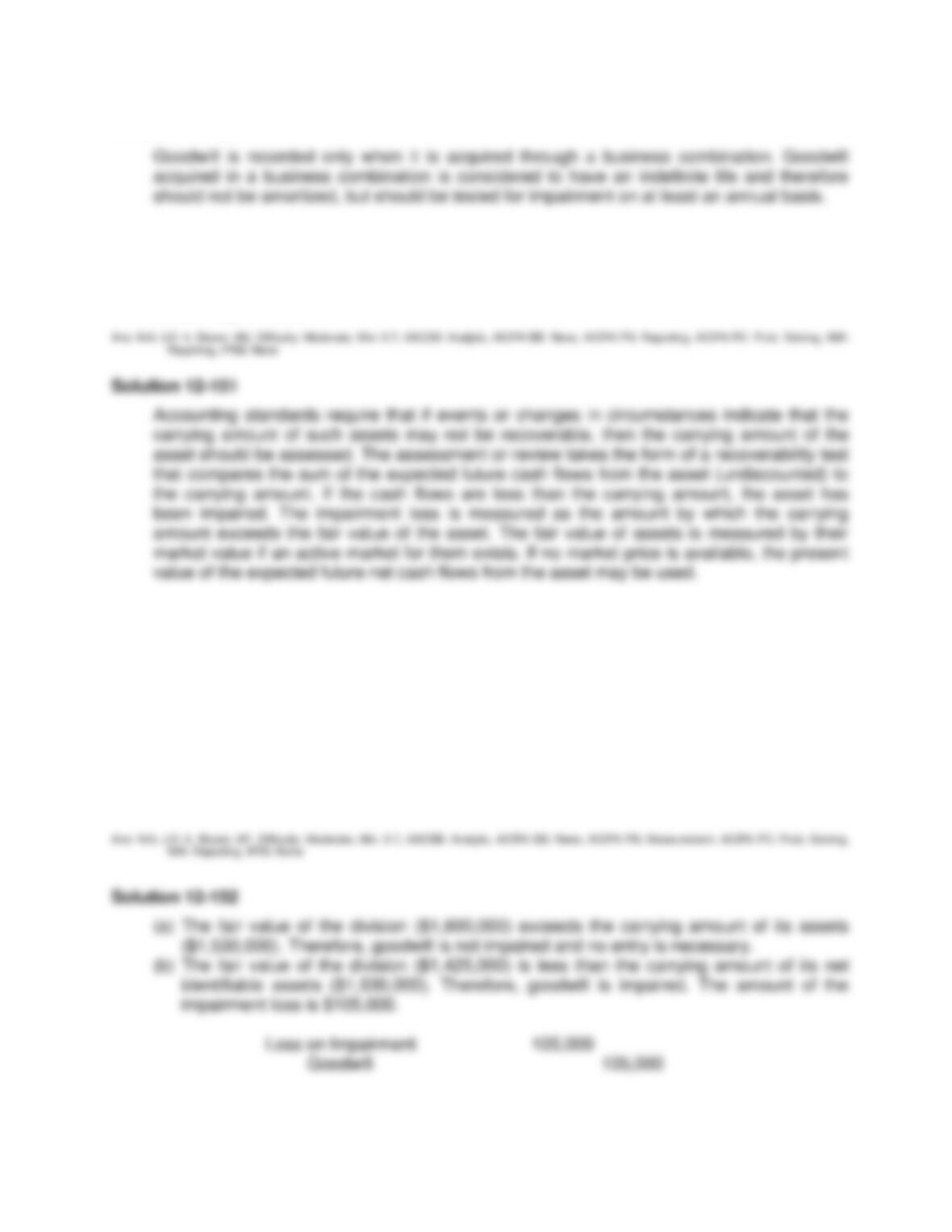
Under what circumstances is it appropriate to record goodwill in the accounts? How should
goodwill, properly recorded on the books, be written off in accordance with generally
accepted accounting principles?
Intangible Assets
12 – 47
Solution 12-150
Ex. 12-151
Fred’s Company is considering the write-off of a limited life intangible asset because of its
lack of profitability. Explain to the management of Fred’s how to determine whether a
writeoff is permitted.
Ex. 12-152
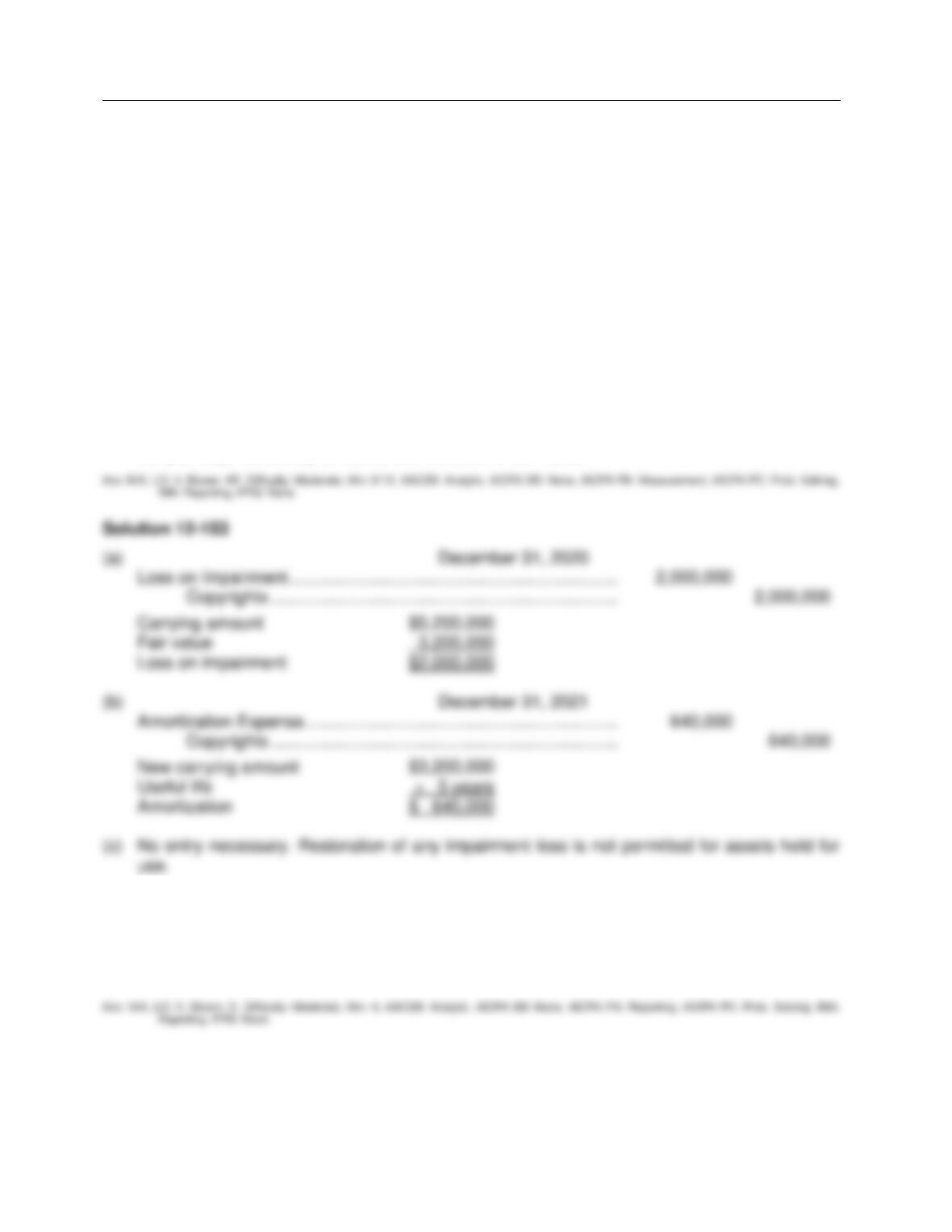
Leon Corp. purchased Spinks Co. 4 years ago and at that time recorded goodwill of
$640,000. The Spinks Division’s net identifiable assets, including goodwill, have a carrying
amount of $1,530,000. The fair value of the division is estimated to be $1,600,000.
Instructions
(a) Explain whether or not Leon Corp. must prepare an entry to record impairment of the
goodwill. Include the entry, if necessary.
(b) Repeat instruction (a) assuming that the fair value of the division is estimated to be
$1,425,000.
Test Bank for Intermediate Accounting, Seventeenth Edition
12 – 48
Ex. 12-153 also delete on page 57&58
Presented below is information related to copyrights owned by Wamser Corporation at December
31, 2020.
Cost $6,000,000
Carrying amount 5,200,000
Expected future net cash flows 4,700,000
Fair value 3,200,000
Assume Wamser will continue to use this asset in the future. As of December 31, 2020, the
copyrights have a remaining useful life of 5 years.
Instructions
(a) Prepare the journal entry (if any) to record the impairment of the asset at December 31,
2020.
(b) Prepare the journal entry to record amortization expense for 2021.
(c) The fair value of the copyright at December 31, 2021 is $2,500,000. Prepare the journal
entry (if any) necessary to record this increase in fair value.
Ex. 12-154
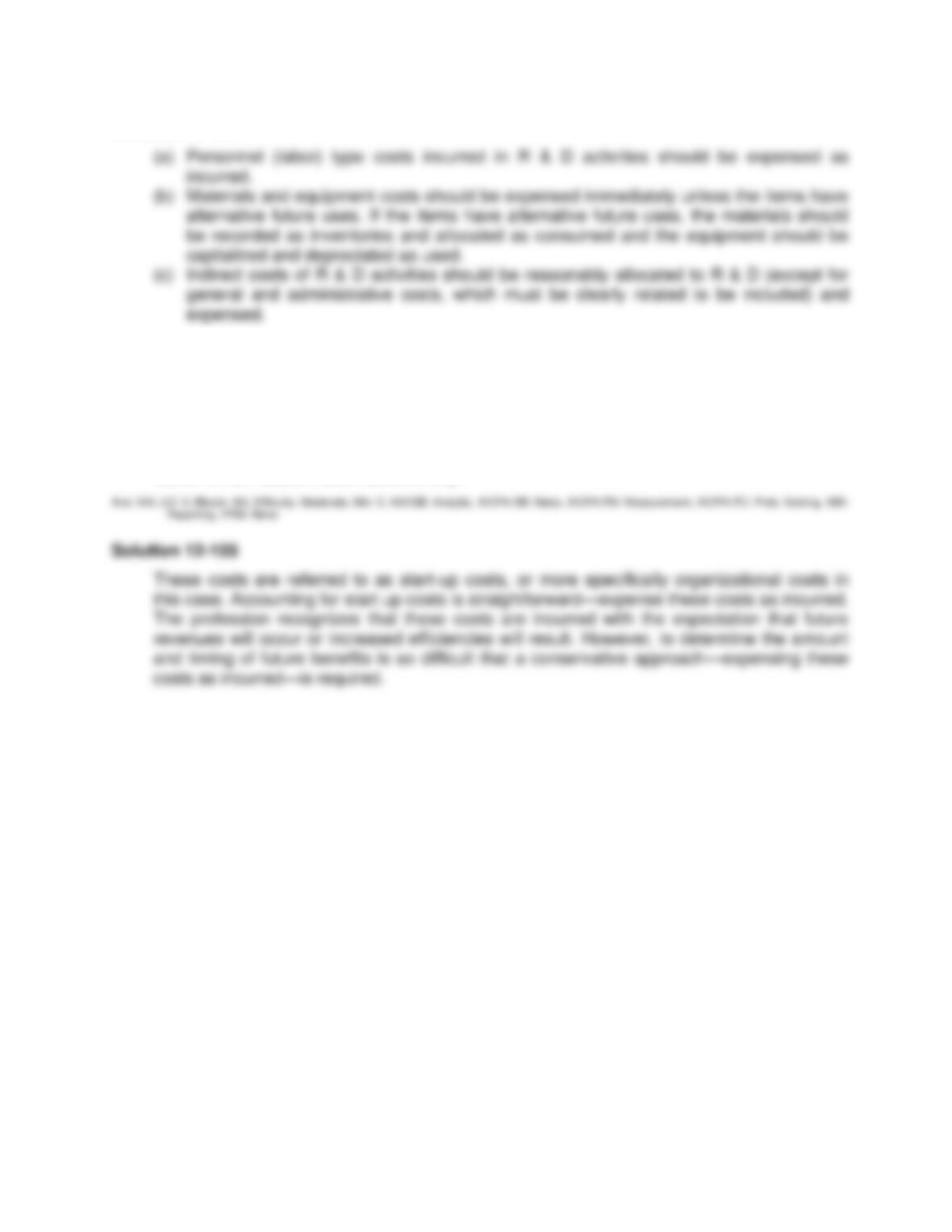
Research and development activities may include (a) personnel costs, (b) materials and
equipment costs, and (c) indirect costs. What is the recommended accounting treatment for
these three types of R&D costs?
Intangible Assets
12 – 49
Solution 12-154
Ex. 12-155
Recently, a group of university students decided to incorporate for the purposes of selling a
process to recycle the waste product from manufacturing cheese. Some of the initial costs
involved were legal fees and office expenses incurred in starting the business, state
incorporation fees, and stamp taxes. One student wishes to charge these costs against
revenue in the current period. Another wishes to defer these costs and amortize them in the
future. Which student is correct and why?

Test Bank for Intermediate Accounting, Seventeenth Edition
12 – 50
PROBLEMS
Pr. 12-156—Intangible assets.
The following transactions involving intangible assets of Minton Corporation occurred on or near
December 31, 2020. Complete the chart below by writing the journal entry (ies) needed at that
date to record the transaction and at December 31, 2021 to record any resultant amortization. If
no entry is required at a particular date, write “none needed.”
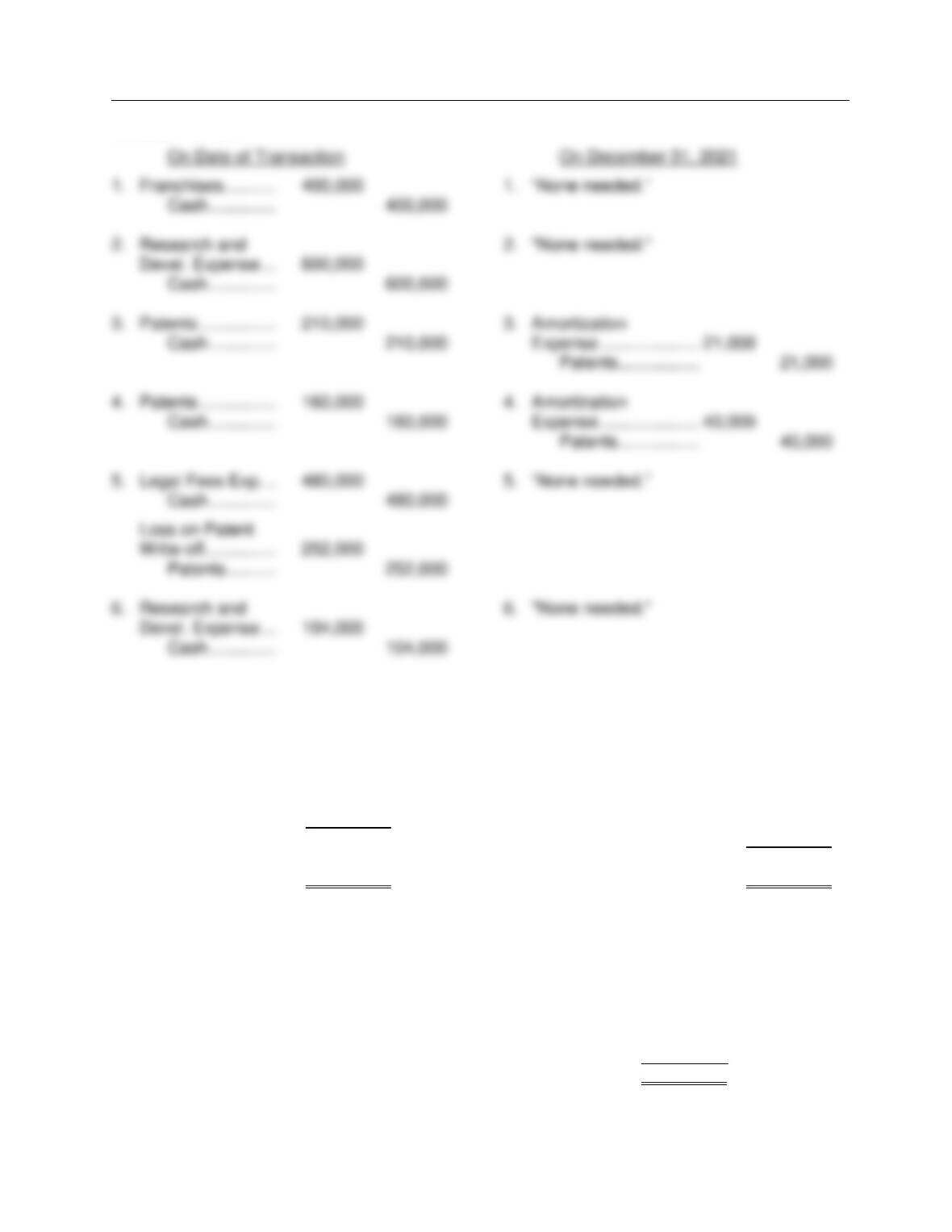
On Date On
of Transaction December 31, 2021
1. Minton paid Grand Company $400,000 for the
exclusive right to market a particular product,
using the Grand name and logo in promotional
material. The franchise runs for as long as
Minton is in business.
2. Minton spent $600,000 developing a new
manufacturing process. It has applied for a
patent, and it believes that its application will be
successful.
3. In January, 2021, Minton’s application for a
patent (#2 above) was granted. Legal and
registration costs incurred were $210,000. The
patent runs for 20 years. The manufacturing
process will be useful to Minton for 10 years.
4. Minton incurred $160,000 in successfully
defending one of its patents in an infringement
suit. The patent expires during December, 2024.
5. Minton incurred $480,000 in an unsuccessful
patent defense. As a result of the adverse
verdict, the patent, with a remaining unamortized
cost of $252,000, is deemed worthless.
6. Minton paid Sneed Laboratories $104,000 for
research and development work performed by
Sneed under contract for Minton. The benefits
are expected to last six years.
Intangible Assets
12 – 51
Solution 12-156
Pr. 12-157—Goodwill, impairment.
On May 31, 2021, Armstrong Company paid $3,500,000 to acquire all of the common stock of
Hall Corporation, which became a division of Armstrong. Hall reported the following balance
sheet at the time of the acquisition:
Current assets $ 900,000 Current liabilities $ 600,000
Noncurrent assets 2,700,000 Long-term liabilities 500,000
Stockholders’ equity 2,500,000
Total liabilities and
Total assets $3,600,000 stockholders’ equity $3,600,000
It was determined at the date of the purchase that the fair value of the identifiable net assets of
Hall was $3,100,000. At December 31, 2021, Hall reports the following balance sheet
information:
Current assets $ 800,000
Noncurrent assets (including goodwill recognized in purchase) 2,400,000
Current liabilities (700,000)
Long-term liabilities (500,000)
Net assets $2,000,000
It is determined that the fair value of the Hall division is $2,200,000.
Test Bank for Intermediate Accounting, Seventeenth Edition
12 – 52
Pr. 12-157 (Cont.)
Instructions
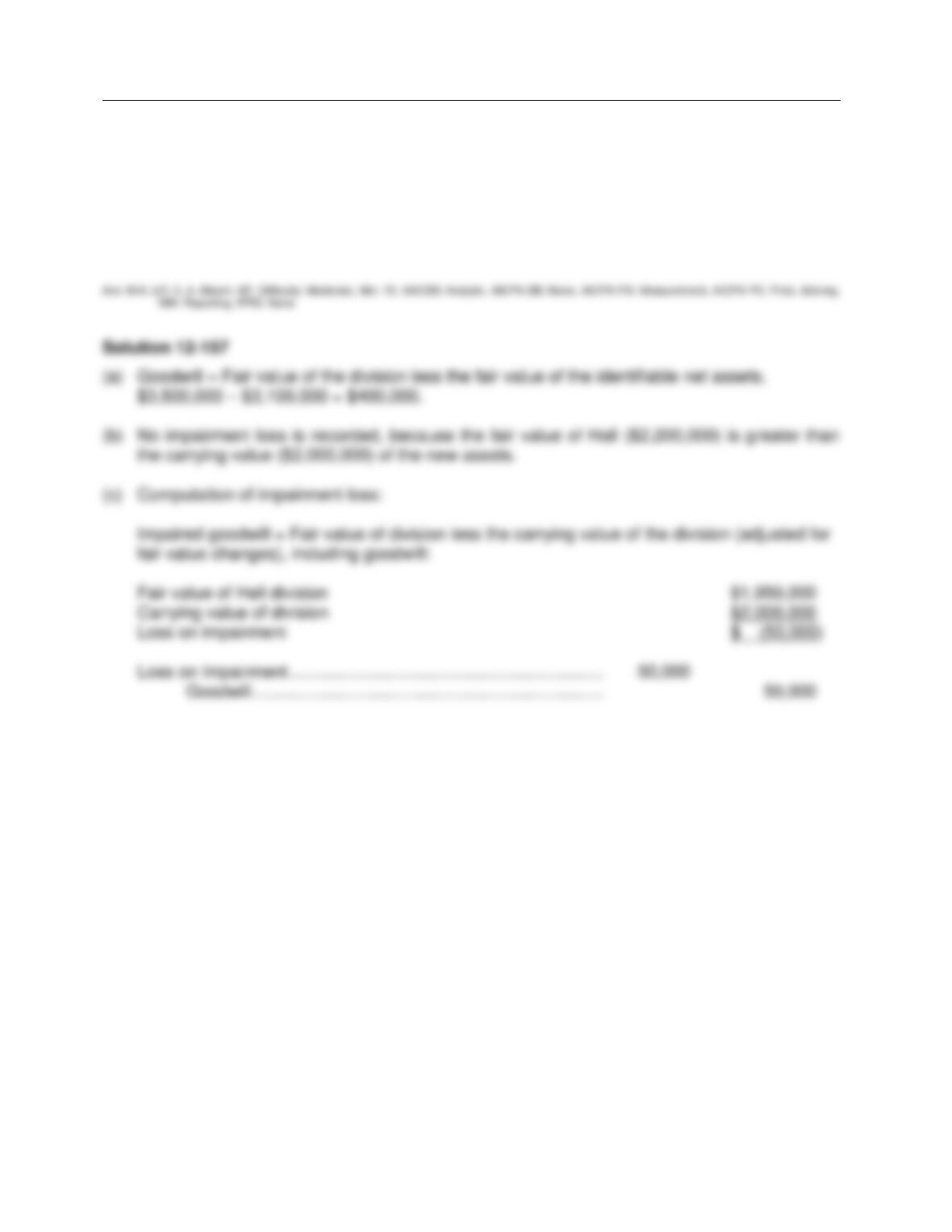
(a) Compute the amount of goodwill recognized, if any, on May 31, 2021.
(b) Determine the impairment loss, if any, to be recorded on December 31, 2021.
(c) Assume that the fair value of the Hall division is $1,950,000 instead of $2,200,000. Prepare
the journal entry to record the impairment loss, if any, on December 31, 2021.
Intangible Assets
12 – 53
IFRS QUESTIONS
True/False Questions
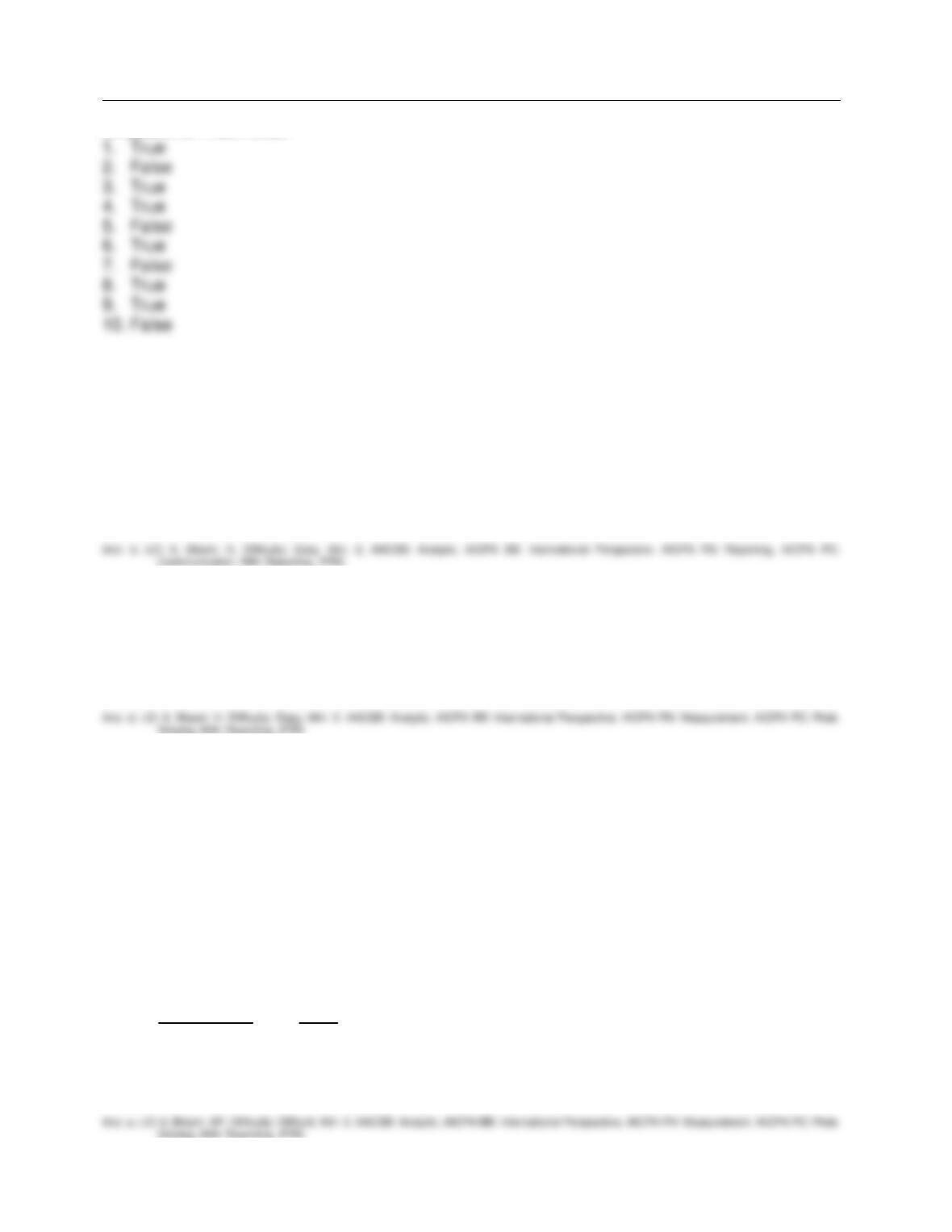
1. As in GAAP, under IFRS the costs associated with research and development are
segregated into two components.
2. Costs in the research phase are expensed under GAAP, but capitalized under IFRS.
3. Costs in the research phase are always expensed under both IFRS and GAAP.
4. IFRS differs from GAAP in the development phase in that IFRS requires that costs are
capitalized once technological feasibility is achieved.
5. The increased acceptance of IFRS has caused costs associated with internally generated
intangible assets to be capitalized under GAAP.
6. IFRS permits some capitalization of internally generated intangible assets, if it is probable
there will be a future benefit and the amount can be readily measured.
7. While IFRS requires an impairment test at each reporting date for long-lived assets, it
requires no such test for intangibles once a legal or useful life has been determined.
8. IFRS allows reversal of impairment losses when there has been a change in economic
conditions or in the expected use of the asset. Under GAAP, impairment losses cannot be
reversed for assets to be held and used.
9. IFRS and GAAP are similar in the accounting for impairments of assets held for disposal.
10. Under GAAP, impairment loss is measured as the excess of the carrying amount over the
assets discounted cash flow.
Test Bank for Intermediate Accounting, Seventeenth Edition
12 – 54
Answers to True/False:
Multiple-Choice Questions
11. As in GAAP, under IFRS the costs associated with research and development are
segregated into
a. two components, the research phase and the production phase.
b. two components, the research phase and the development phase.
c. three components, the planning phase, the research phase and the production phase.
d. three components, the analysis phase, the development phase and the production phase.
12. In accounting for internally generated intangible assets, GAAP requires that
a. all costs, no matter how immaterial, be capitalized.
b. only material costs be capitalized.
c. planned costs be capitalized, while costs in excess of plan be expensed.
d. all costs be expensed.
13. The following costs are incurred during the research and development phases of a laser bone
scanner
Laboratory research aimed at discovery of new knowledge
$800,000
Search for application of new research findings
400,000
Salaries of research staff designing new laser bone scanner
1,200,000
Material, labor and overhead costs of prototype laser scanner
850,000
Costs of testing prototype and design modifications
450,000
Engineering costs incurred to advance the laser scanner to full production stage
(technological feasibility reached)
700,000
Identify which of these are research phase items and will be immediately expensed under
GAAP and IFRS.
GAAP IFRS
a. $1,200,000 $1,200,000
b. $2,400,000 $1,400,000
c. $4,400,000 $4,400,000
d. $4,400,000 $3,700,000
Intangible Assets
12 – 55
14. The following costs are incurred during the research and development phases of a laser bone
scanner
Laboratory research aimed at discovery of new knowledge
$800,000
Search for application of new research findings
400,000
Salaries of research staff designing new laser bone scanner
1,200,000
Material, labor and overhead costs of prototype laser scanner
850,000
Costs of testing prototype and design modifications
450,000
Engineering costs incurred to advance the laser scanner to full
production stage (technological feasibility reached)
700,000
Identify which of these are development phase items and will be immediately expensed under
GAAP and IFRS.
GAAP IFRS
a. $1,200,000 $1,200,000
b. $2,400,000 $1,400,000
c. $2,400,000 $2,500,000
d. $3,200,000 $2,500,000
15. The primary IFRS related to intangible assets and impairments is found in
a. IAS 38 and IAS 10.
b. IAS 16 and IAS 36.
c. IAS 1 and IAS 34.
d. IAS 38 and IAS 36.
16. IFRS allows reversal of impairment losses when
a. the reversal is greater than the amount of the original impairment.
b. the reversal falls in a subsequent fiscal year of the company’s operations.
c. there has been a change in economic conditions or in the expected use of the asset.
d. reversal of impairment losses is never allowed.
17. Under GAAP, impairment losses
a. can be reversed but only if the reversal is greater than the amount of the original
impairment.
b. can be reversed but only if the reversal falls in a subsequent fiscal year of the company’s
operations.
c. cannot be reversed for assets to be held and used.
d. none of these answer choices are correct.
Test Bank for Intermediate Accounting, Seventeenth Edition
12 – 56
18. IFRS and GAAP
a. are diametrically opposed in their accounting for impairments of assets held for disposal.
b. are similar in the accounting for impairments of assets held for disposal.
c. are moving toward common ground in their accounting for impairments of assets held for
disposal.
d. are moving further apart in their accounting for impairments of assets held for disposal.
19. Under IFRS, costs in the development phase are
a. never capitalized, but expensed as they are under GAAP.
b. capitalized if they exceed development phase costs incurred for previously successful
ventures.
c. capitalized once technological feasibility is achieved.
d. capitalized on an interim basis, but then expensed prior to the end of the company‘s fiscal
year.
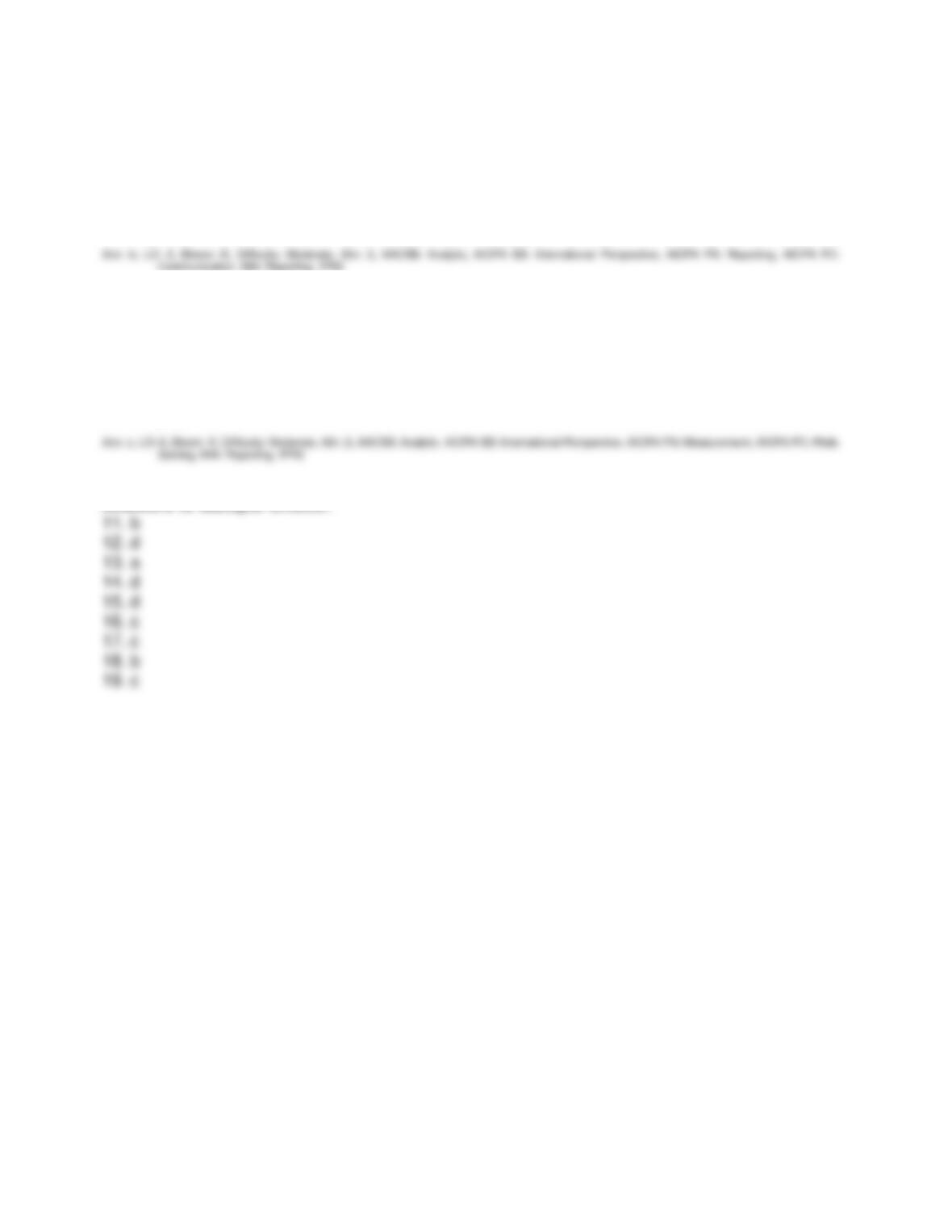
Answers to Multiple Choice:
Intangible Assets
12 – 57
Short Answer
20. Briefly describe some of the similarities and differences between GAAP and IFRS with
respect to the accounting for intangible assets.