Managerial Accounting, 16e (Garrison)
Chapter 12: Differential Analysis: The Key to Decision Making
1) A cost that can be avoided by choosing one alternative over another is relevant for decision
purposes.
2) Sunk costs are never relevant in decision making.
3) Future costs that do not differ between the alternatives in a decision are avoidable costs.
4) It may be a good decision to replace an asset before its original cost has been fully recovered
through increased revenues or decreased costs.
5) Consistency demands that a cost that is relevant in one decision be regarded as relevant in other
decisions as well.
6) Sunk costs and future costs that do not differ between the alternatives may or may not be
relevant in a decision.
7) Fixed costs are sunk costs.
8) A cost that is traceable to a segment through activity-based costing is always an avoidable cost
for decision making.
9) Variable costs are always relevant costs in decisions.
10) A cost that is assigned to a product using activity-based costing may or may not be a relevant
cost in a decision involving that product.
11) Opportunity costs represent costs that can be reduced by effective management of operations.
12) Future costs that do differ among the alternatives are not relevant in a decision.
13) Sunk costs are costs that have proven to be unproductive.
14) Fixed costs may be relevant in a decision.
15) Avoidable costs are irrelevant costs in decisions.
16) The book value of an old machine is always considered an opportunity cost in a decision.
17) A cost that will be incurred regardless of which alternative is selected is not relevant when
choosing between the alternatives.
18) A complete income statement need not be prepared as part of a differential cost analysis.
19) An avoidable cost is a sunk cost that can be eliminated (in whole or in part) as a result of
choosing one alternative over another.
20) The variable costs of a product are relevant in a decision concerning whether to eliminate the
product.
21) Fixed costs are irrelevant in decisions about whether a product should be dropped.
22) A product whose revenues do not cover its variable costs and its traceable fixed costs should
usually be dropped.
23) In a decision to drop a product, the product should be charged for rent in proportion to the
space it occupies even if the space has no alternative use and the rental payment is unavoidable.
24) When a company is involved in more than one activity in the entire value chain, it is vertically
integrated.
25) A vertically integrated company is less dependent on its suppliers than a company that is not
vertically integrated.
26) A disadvantage of vertical integration is that by pooling demand for parts from a number of
companies, a supplier may be able to enjoy economies of scale that result in higher quality and
lower cost than if every company makes its own parts.
27) In a special order situation that involves using capacity that is not idle, opportunity costs are
zero.
28) In a special order situation, any fixed cost associated with the order would be irrelevant.
29) When a company has a production constraint, total contribution margin will be maximized by
emphasizing the products with the highest contribution margin per unit of the constrained
resource.
30) When a company has a production constraint, the product with the lowest contribution margin
per unit of the constrained resource should usually be given highest priority.
31) In a factory operating at capacity, every machine and person should be working at the
maximum possible rate.
32) One way to increase the effective utilization of a bottleneck is to reduce the number of
defective units.
33) Eliminating nonproductive processing time is particularly important in a bottleneck operation.
34) Payment of overtime to a worker in order to relax a production constraint could increase the
profits of a company.
35) The term joint cost is used to describe the costs incurred up to the split-off point in a process
involving joint products.
36) The split-off point in a process that produces joint products is the point in the manufacturing
process at which the joint products can be recognized as separate products.
37) An avoidable fixed production cost incurred before the split-off point in a joint process is
relevant in a sell or process further decision.
38) Two or more products that are produced from a common input are known as joint products.
39) It is profitable to continue processing joint products after the split-off point if their total
revenues exceed the joint costs.
40) Which of the following would be relevant in the decision to sell or throw out obsolete
inventory?
Direct material
cost assigned
to the inventory
Fixed overhead
cost assigned
to the inventory
A)
Yes
Yes
B)
Yes
No
C)
No
Yes
D)
No
No
A) Choice A
B) Choice B
C) Choice C
D) Choice D
41) The opportunity cost of making a component part in a factory with excess capacity for which
there is no alternative use is:
A) the variable manufacturing cost of the component.
B) the total manufacturing cost of the component.
C) the fixed manufacturing cost of the component.
D) zero.
42) Which of the following costs are always irrelevant in decision making?
A) avoidable costs
B) sunk costs
C) opportunity costs
D) fixed costs
43) Costs that can be eliminated in whole or in part if a particular business segment is discontinued
are called:
A) sunk costs.
B) opportunity costs.
C) avoidable costs.
D) irrelevant costs.
44) The Jabba Corporation manufactures the “Snack Buster” which consists of a wooden snack
chip bowl with an attached porcelain dip bowl. Which of the following would be relevant in
Jabba’s decision to make the dip bowls or buy them from an outside supplier?
Fixed overhead cost
that can be eliminated if
the bowls are purchased
from the outside supplier
The variable
selling
cost of the
Snack Buster
A)
Yes
Yes
B)
Yes
No
C)
No
Yes
D)
No
No
A) Choice A
B) Choice B
C) Choice C
D) Choice D
45) Accepting a special order will improve overall net operating income if the revenue from the
special order exceeds:
A) the contribution margin on the order.
B) the incremental costs associated with the order.
C) the variable costs associated with the order.
D) the sunk costs associated with the order.
46) Kinsi Corporation manufactures five different products. All five of these products must pass
through a stamping machine in its fabrication department. This machine is Kinsi’s constrained
resource. Kinsi would make the most profit if it produces the product that:
A) uses the least amount of stamping time.
B) generates the highest contribution margin per unit.
C) generates the highest contribution margin ratio.
D) generates the highest contribution margin per stamping machine hour.
47) United Industries manufactures a number of products at its highly automated factory. The
products are very popular, with demand far exceeding the factory’s capacity. To maximize profit,
management should rank products based on their:
A) gross margin
B) contribution margin
C) selling price
D) contribution margin per unit of the constrained resource
48) A joint product is:
A) any product which consists of several parts.
B) any product produced by a company with more than one product line.
C) any product involved in a make or buy decision.
D) one of several products produced from a common input.
49) In a sell or process further decision, consider the following costs:
I. A variable production cost incurred prior to split-off.
II. A variable production cost incurred after split-off.
III. An avoidable fixed production cost incurred after split-off.
Which of the above costs is (are) not relevant in a decision regarding whether the product should
be processed further?
A) Only I
B) Only III
C) Only I and II
D) Only I and III
50) Product X-547 is one of the joint products in a joint manufacturing process. Management is
considering whether to sell X-547 at the split-off point or to process X-547 further into Xylene.
The following data have been gathered:
I. Selling price of X-547
II. Variable cost of processing X-547 into Xylene.
III. The avoidable fixed costs of processing X-547 into Xylene.
IV. The selling price of Xylene.
V. The joint cost of the process from which X-547 is produced.
Which of the above items are relevant in a decision of whether to sell the X-547 as is or process it
further into Xylene?
A) I, II, and IV.
B) I, II, III, and IV.
C) II, III, and V.
D) I, II, III, and V.
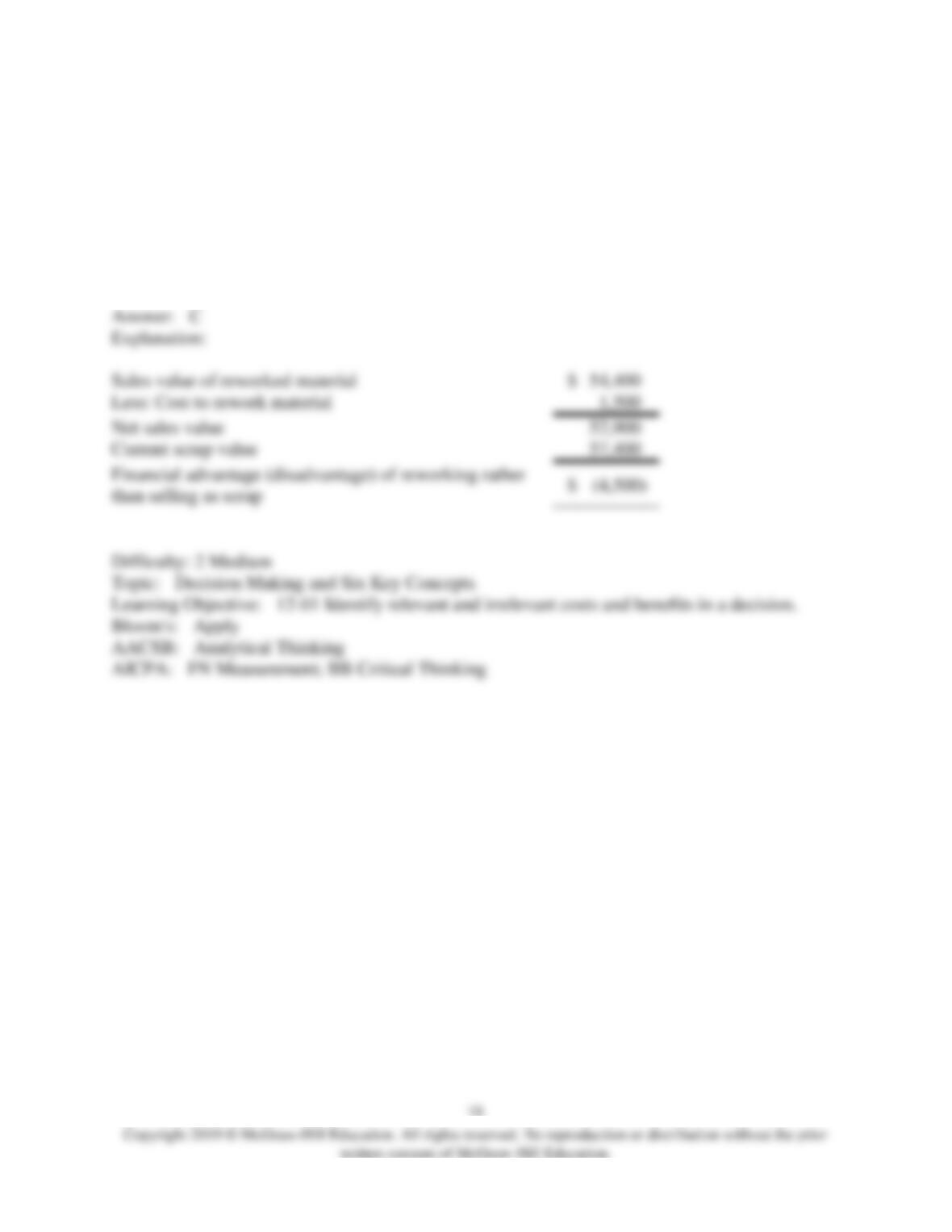
51) Hodge Inc. has some material that originally cost $74,600. The material has a scrap value of
$57,400 as is, but if reworked at a cost of $1,500, it could be sold for $54,400. What would be the
financial advantage (disadvantage) of reworking and selling the material rather than selling it as is
as scrap?
A) ($79,100)
B) ($21,700)
C) ($4,500)
D) $52,900
52) Hamby Corporation is preparing a bid for a special order that would require 780 liters of
material W34C. The company already has 640 liters of this raw material in stock that originally
cost $8.30 per liter. Material W34C is used in the company’s main product and is replenished on a
periodic basis. The resale value of the existing stock of the material is $7.60 per liter. New stocks
of the material can be readily purchased for $8.35 per liter. What is the relevant cost of the 780
liters of the raw material when deciding how much to bid on the special order?
A) $6,481
B) $6,376
C) $6,513
D) $5,928
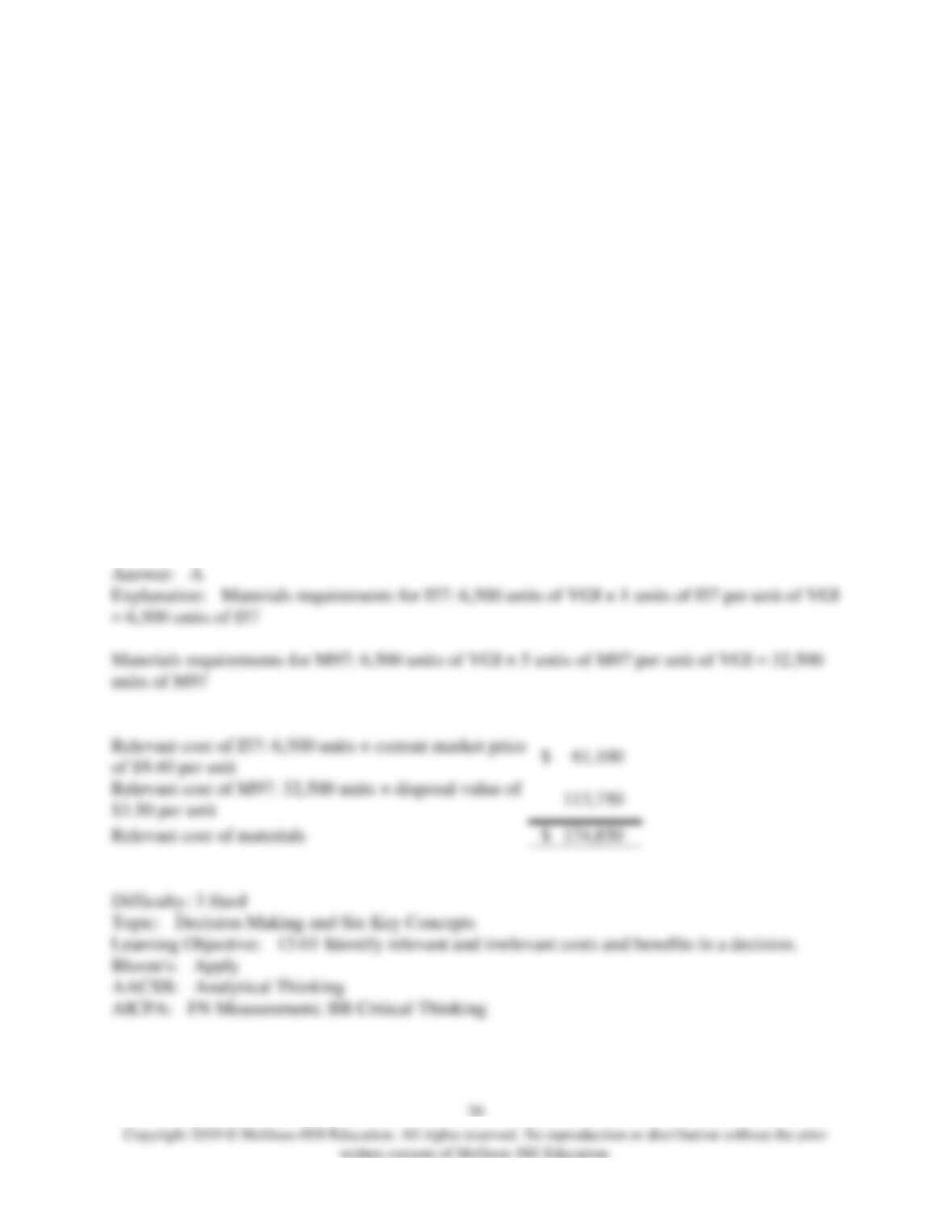
53) Munafo Corporation is a specialty component manufacturer with idle capacity. Management
would like to use its extra capacity to generate additional profits. A potential customer has offered
to buy 6,500 units of component VGI. Each unit of VGI requires 1 unit of material I57 and 5 units
of material M97. Data concerning these two materials follow:
Material
Units in
Stock
Original Cost Per
Unit
Current Market
Price Per Unit
Disposal Value Per
Unit
I57
2,400
$
9.10
$
9.40
$
8.95
M97
33,960
$
4.70
$
4.70
$
3.50
Material I57 is in use in many of the company’s products and is routinely replenished. Material
M97 is no longer used by the company in any of its normal products and existing stocks would not
be replenished once they are used up.
What would be the relevant cost of the materials, in total, for purposes of determining a minimum
acceptable price for the order for product VGI?
A) $174,850
B) $213,130
C) $213,850
D) $171,925
of $9.40 per unit
$3.50 per unit
Relevant cost of materials