Chapter 12
113. Elizabeth Myers invested in a project that required an initial amount of $1,560, and returned one cash inflow of
$12,000 at the end of the 18th year. A partial table of the present value of an annuity of $1 in arrears is as follows:
Year 2% 4% 6% 8% 10% 12% 14% 16%
18 0.700 0.494 0.350 0.250 0.180 0.130 0.095 0.069
What is the internal rate of return for this investment?
a. 8%
b. 10%
c. 12%
d. 14%
e. 16%
114. Jerry Hall invested in a project that required an initial amount of $52,160, and returned cash inflows of $10,000 per
year for 10 years. A partial table of the present value of an annuity of $1 in arrears is as follows:
Year 2% 4% 6% 8% 10% 12% 14% 16%
10 7.983 8.111 7.360 6.710 6.145 5.650 5.216 4.833
What is the internal rate of return for this investment?
a. 8%
b. 10%
Chapter 12
c. 12%
d. 14%
e. 16%
115. Amatra Inc., has the opportunity to invest in new equipment that will cost $113,000. The net cash inflows for ten
years equal $20,000 per year. What is the internal rate of return for the investment? A partial table of the present value of
an annuity of $1 in arrears is as follows:
Year 2% 4% 6% 8% 10% 12% 14% 16%
10 7.983 8.111 7.360 6.710 6.145 5.650 5.216 4.833
a. 8%
b. 10%
c. 12%
d. 14%
e. 16%
Chapter 12
116. Tangarine Company is considering a project with an internal rate of return of 12%. Tangarine requires a minimum
rate of return of 10%. The net present value of the project is:
a. negative.
b. infinite.
c. equal to zero.
d. positive.
e. None of these
117. Which of the following defines internal rate of return (IRR)?
a. IRR is the total variable cost incurred in a project.
b. IRR is the maximum return achievable on investments.
c. IRR is the difference between the present value of the cash inflows and outflows associated with a project.
d. IRR is the interest rate that sets the present value of a project’s cash inflows equal to the present value of a
project’s cost.
Chapter 12
118. Diamond Company is considering the purchase of a new machine for $80,000. The machine would generate an
annual cash flow of $14,767 for 6 years. At the end of six years, the machine would have no salvage value. The
company’s cost of capital is 10%. The company uses straight-line depreciation.
What is the internal rate of return for the machine rounded to the nearest percent? (Note: Round the discount factor to
three decimal places.)
a. 7%
b. 9%
c. 5%
d. 3%
119. A firm is considering a project requiring an investment of $40,000. The project would generate an annual cash flow
of $10,858 for the next six years. The company uses the straight-line method of depreciation. Which of the following is
the approximate internal rate of return for the project? (Note: Round the discount factor to three decimal places.)
a. 11%
b. 18%
c. 12%.
d. 16%
Chapter 12
120. Cooper Industries is considering a project that would require an initial investment of $101,000. The project would
result in cost savings of $62,000 in year 1 and $70,000 in year two. The internal rate of return is
a. between 16% and 17%.
b. between 18% and 20%.
c. under 15%.
d. none of these.
Chapter 12
121. Present value of an Annuity of $1 in Arrears
Periods 4% 6% 8% 10% 12% 14%
1 0.962 0.943 0.926 0.909 0.893 0.877
2 1.886 1.833 1.783 1.736 1.690 1.647
3 2.775 2.673 2.577 2.487 2.402 2.322
4 3.630 3.465 3.312 3.170 3.037 2.914
5 4.452 4.212 3.993 3.791 3.605 4.433
6 5.242 4.917 4.623 4.355 4.111 3.889
7 6.002 5.582 5.206 4.868 4.564 4.288
8 6.733 6.210 5.747 5.335 4.968 4.639
9 7.435 6.802 6.247 5.759 5.328 4.946
10 8.111 7.360 6.710 6.145 5.650 5.216
Lucas Company is considering a project with an initial investment of $530,250 in new equipment that will yield annual
net cash flows of $95,000, and will be depreciated at $75,750 per year over its seven year life. What is the internal rate of
return?
a. 8%
b. 6%
c. 12%
d. 10%
e. 14%
122. Present value of an Annuity of $1 in Arrears
Periods 4% 6% 8% 10% 12% 14%
1 0.962 0.943 0.926 0.909 0.893 0.877
2 1.886 1.833 1.783 1.736 1.690 1.647
3 2.775 2.673 2.577 2.487 2.402 2.322
4 3.630 3.465 3.312 3.170 3.037 2.914
5 4.452 4.212 3.993 3.791 3.605 4.433
6 5.242 4.917 4.623 4.355 4.111 3.889
Chapter 12
7 6.002 5.582 5.206 4.868 4.564 4.288
8 6.733 6.210 5.747 5.335 4.968 4.639
9 7.435 6.802 6.247 5.759 5.328 4.946
10 8.111 7.360 6.710 6.145 5.650 5.216
Ruby Company is considering a project with an initial investment of $300,000 that will yield annual net cash flows of
$90,580 and will be depreciated at $75,000 per year over its 4 year life. What is the internal rate of return? (Note: Round
the discount factor to three decimal places.)
a. 6%
b. 8%
c. 10%
d. 12%
e. 14%
123. Kenner Company is considering two projects.
Project A Project B
Initial investment $85,000 $24,000
Annual cash flows $20,676 $ 6,011
Life of the project 6 years 5 years
Depreciation per year $14,167 $ 4,800
Present value of an Annuity of $1 in Arrears
Periods 8% 10% 12% 14%
1 0.926 0.909 0.893 0.877
2 1.783 1.736 1.690 1.647
3 2.577 2.487 2.402 2.322
4 3.312 3.170 3.037 2.914
Chapter 12
5 3.993 3.791 3.605 4.433
6 4.623 4.355 4.111 3.889
7 5.206 4.868 4.564 4.288
8 5.747 5.335 4.968 4.639
9 6.247 5.759 5.328 4.946
10 6.710 6.145 5.650 5.216
Which of the two projects, A or B, is better in terms of internal rate of return?
a. project A with an IRR of 12%
b. project B with an IRR of 14%
c. project A with an IRR of 10%
d. project B with an IRR of 10%
e. both projects have the same IRR
124. Kenner Company is considering two projects.
Project A Project B
Initial investment $85,000 $24,000
Annual cash flows $20,676 $ 6,011
Life of the project 6 years 5 years
Depreciation per year $14,167 $ 4,800
Present value of an Annuity of $1 in Arrears
Periods 8% 10% 12% 14%
1 0.926 0.909 0.893 0.877
2 1.783 1.736 1.690 1.647
3 2.577 2.487 2.402 2.322
4 3.312 3.170 3.037 2.914
5 3.993 3.791 3.605 4.433
6 4.623 4.355 4.111 3.889
Chapter 12
7 5.206 4.868 4.564 4.288
8 5.747 5.335 4.968 4.639
9 6.247 5.759 5.328 4.946
10 6.710 6.145 5.650 5.216
Suppose that Kenner Company requires a minimum rate of return of 8%. Which project is better in terms of net present
value?
a. project A with NPV of $10,585
b. project B with NPV of $7,756
c. project A with NPV of $4,210
d. project B with NPV of $1,212
e. both projects have the same NPV
125. Which of the following evaluates the actual performance of a project in relation to its expected performance?
a. The accounting rate of return
b. The average returns
c. The postaudit
d. The payback period
e. The internal rate of return
Chapter 12
126. Which of the following is a disadvantage of postaudits?
a. They evaluate profitability rather than cash flows.
b. They may point to the need for additional funding for the project.
c. They tend to hold managers accountable for capital investment decision making.
d. The assumptions driving the original analysis may be invalidated by changes in the actual operating environment.
e. All of these.
127. Which of the following is not a benefit of postaudits of capital investments?
a. Considers changes in the actual operating environment.
b. Guides managers to make capital investment in the best interests of the firm.
c. Ensures that resources are used wisely by evaluating profitability.
d. Supplies feedback to managers that should help improve decision making.
e. All of these are benefits.
Chapter 12
128. Which of the following refers to a follow-up analysis of a capital project once it is implemented?
a. Capital Budgeting
b. Restructuring
c. Postaudit
d. Peer review
129. Which of the following members of a company is the best choice for postaudit activities?
a. A shareholder
b. A trade union member
c. An investor
d. An internal auditor
e. An external auditor
Chapter 12
130. The _____ method of capital investment decision making assumes that each cash inflow received is reinvested at the
required rate of return.
a. net present value
b. average rate of return
c. payback period
d. ratio analysis
e. None of these
131. Which of the following methods assumes that each cash inflow is reinvested at the rate at which the present value of
a project’s cash inflows equal the present value of its cash outflows?
a. The net present value
b. The average rate of return
c. The ratio analysis
d. The internal rate of return
e. None of these
Chapter 12
132. Which of the following methods helps in choosing the project that maximizes the wealth of shareholders?
a. The net present value
b. The accounting rate of return
c. The payback period
d. The variance analysis
e. None of these
133. When investing in automated systems, which of the following intangible or indirect benefits may be important?
a. improved customer satisfaction
b. improved market share
c. reduced support labor cost
d. reduced lead time
e. All of these.
Chapter 12
134. Which of the following is true regarding the measurement and use of indirect and intangible benefits in capital
investment decision making?
a. ABC has made identifying indirect benefits easier.
b. Intangible benefits cannot be measured.
c. Indirect and intangible benefits should not be considered, only direct costs and benefits are considered.
d. Actions by competitors are not considered.
e. None of these.
135. A division manager is choosing between two mutually exclusive projects.
Project A Project B
Net present value $235,000 $210,000
Internal rate of return 13% 15%
The company requires any project to earn at least 12%. The manager believes that cash inflows from the project can be
reinvested at the rate of 12%. Which project will the manager likely choose?
a. Project B
b. Project A
c. both Projects A and B
d. neither Project A nor B
Chapter 12
136. How do NPV and IRR differ?
a. NPV measures profitability in absolute terms, whereas the IRR method measures profitability in relative terms.
b. IRR should be used for choosing among competing, mutually exclusive projects.
c. NPV considers the time value of money and IRR does not.
d. Both NPV and IRR will generate the same decisions.
137. Five mutually exclusive projects had the following information:
V W X Y Z
NPV $(3,000) $56,000 $23,000 $14,000 $28,000
IRR 7% 10% 15% 13% 6%
Which project is preferred?
a. Project V
b. Project W
c. Project X
d. Project Y
Chapter 12
138. Which of the following refers to the earning of interest on interest?
a. Earning of time value
b. Recurring of future value
c. Discounting of annuity factor
d. Compounding of interest
e. Competing of project returns
139. Which of the following refers to a series of equal future cash flows?
a. Overhead
b. Future earning
c. Annuity
d. The discount factor
e. Insurance
Chapter 12
140. The reason that a discount factor in Year 3 is less than a discount factor in Year 2 is that
a. cash flows are uneven.
b. compounding does not occur.
c. cash flows are even.
d. present value is positive.
e. a dollar received in 3 years is worth less than a dollar received in 2 years.
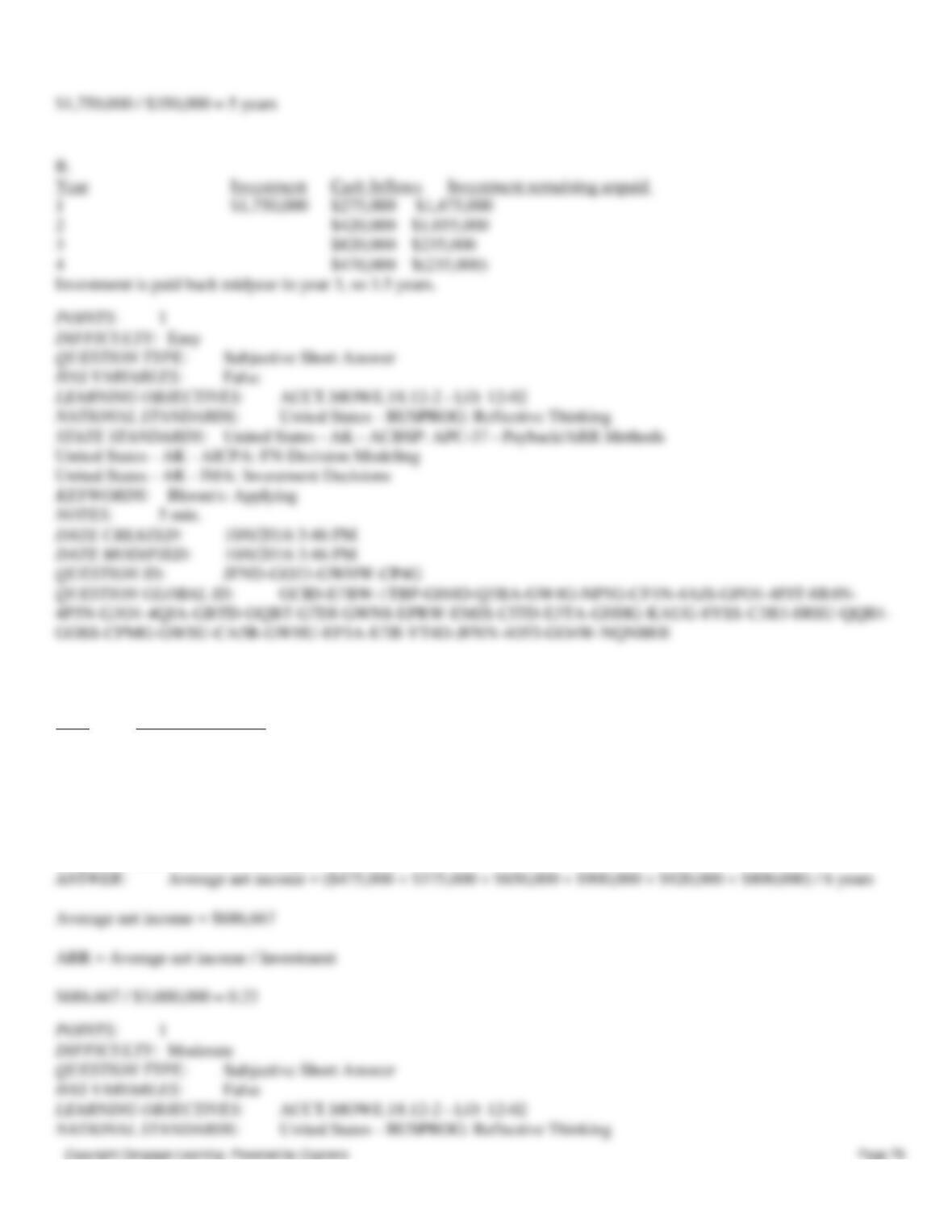
141. Mistral Manufacturing is considering an investment in a new, high-efficiency machine. The new machine requires an
initial investment of $1,750,000 and generates cash flows of either:
a. Even cash flows of $350,000 per year or
b. The following expected annual cash flows: $275,000, $420,000, $820,000, $470,000, and $150,000
Required: Calculate the payback period for each case.
Chapter 12
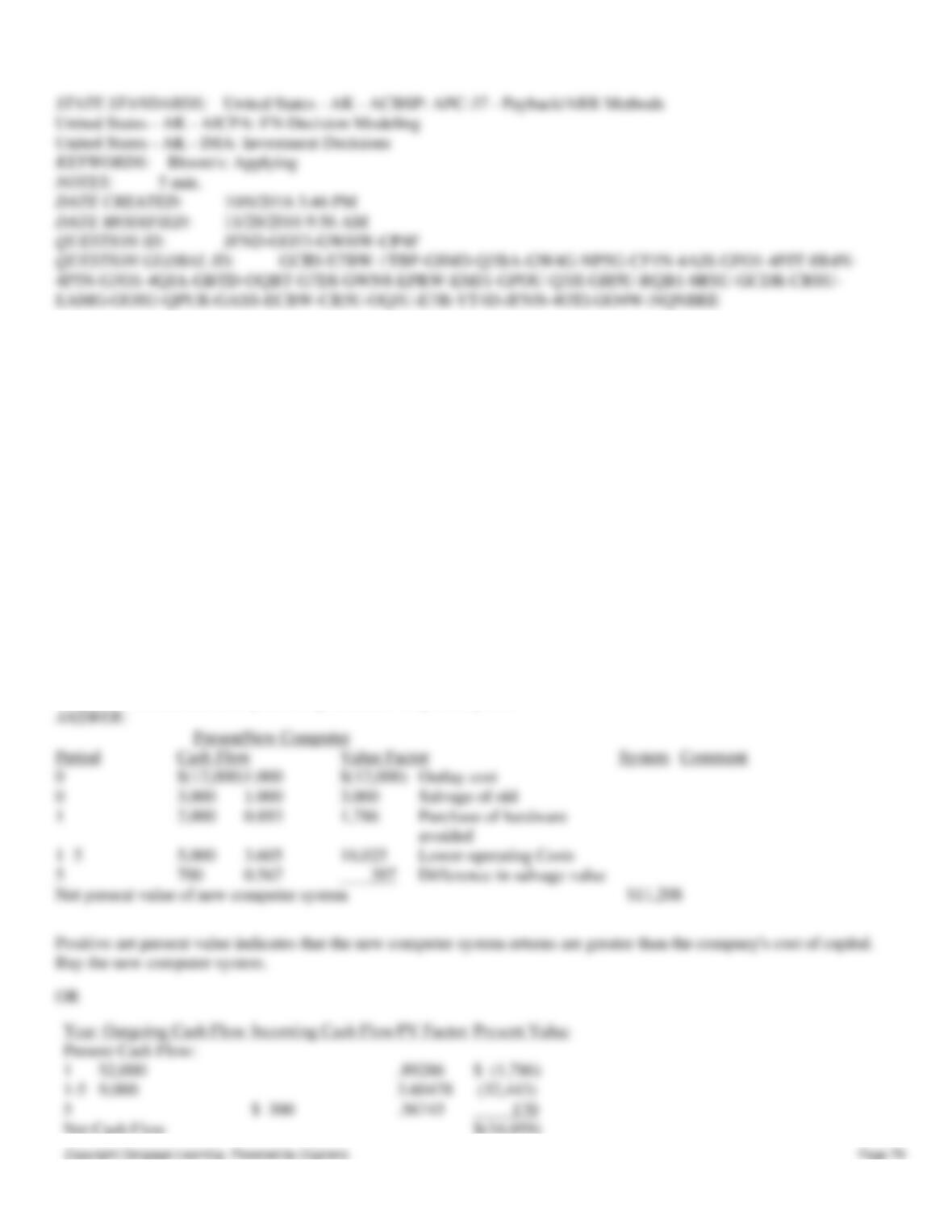
142. Brenning Company invested $3,000,000 in a new computer system. The following is the net income stream:
Year Net income stream
1 $475,000
2 $375,000
3 $650,000
4 $900,000
5 $920,000
6 $800,000
Required: Calculate the accounting rate of return.
Chapter 12
143. Billings Office Services is considering the purchase of a new computer system to replace the one in operation. Data
on the new computer system are:
Cost $12,000
Salvage value at the end of 5 years $1,000
Useful life, in years 5
Annual operating cost $4,000
If the existing computer system is kept and used, it would require the purchase of additional hardware a year from now
costing $2,000. After using the system for five years, the salvage value would be $300. Additional information on the
existing system is:
Additional years of use 5
Annual operating costs $9,000
Remaining book value $12,000
Current salvage value $3,000
Cost of capital 12%
The company uses the straight-line method of depreciation.
Required: Should the new system be purchased? Why or why not?