Chapter 12: Differential Analysis and Product Pricing
64. The condensed income statement for a business for the past year is as follows:
Product
A
B
Sales
$800,000
$550,000
Less variable costs
720,000
430,000
Contribution margin
$ 80,000
$120,000
Less fixed costs
125,000
45,000
Income (loss) from operations
$ (45,000)
$ 75,000
Management is considering the discontinuance of the manufacture and sale of Product A at the
beginning of the current year. The discontinuance would have no effect on the total fixed costs
and expenses or on the sales of Product B. What is the amount of change in net income for the
current year that will result from the discontinuance of Product A?
a. $80,000 increase
b. $45,000 increase
c. $45,000 decrease
d. $80,000 decrease
65. Granger Co. can further process Product B to produce Product C. Product B is currently
selling for $55 per pound and costs $42 per pound to produce. Product C would sell for $82
per pound and would require an additional cost of $13 per pound to produce. What is the
differential revenue of producing and selling Product C?
a. $15 per pound
b. $42 per pound
c. $45 per pound
d. $27 per pound
66. A business is considering a cash outlay of $500,000 for the purchase of land, which it could
lease for $40,000 per year. If alternative investments are available that yield a 21% return, the
opportunity cost of the purchase of the land is:
a. $105,000.
b. $40,000.
c. $65,000.
d. $8,400.

Chapter 12: Differential Analysis and Product Pricing
67. A business received an offer from an exporter for 10,000 units of product at $13.50 per unit.
The acceptance of the offer will not affect normal production or domestic sales prices. The
following data are available:
Domestic unit sales price
$21
Unit manufacturing costs:
Variable
12
Fixed
5
What is the amount of the gain or loss from acceptance of the offer?
a. $75,000 loss
b. $40,000 gain
c. $15,000 gain
d. $85,000 gain
68. A practical approach that is frequently used by managers when setting normal selling price is
the:
a. cost-plus approach.
b. economic theory approach.
c. price graph approach.
d. market price approach.
69. is a method of setting prices that combines market-based pricing with a cost-reduction
emphasis.
a. Product costing
b. Target costing
c. Markup costing
d. Activity-based costing
70. Target costing is arrived at by:
a. taking the selling price and subtracting desired profit.
b. taking the selling price and adding desired profit.
c. taking the selling price and subtracting the budget standard cost.
d. taking the budget standard cost and reducing it by 10%.

Chapter 12: Differential Analysis and Product Pricing
Bythel Corporation uses the product cost concept of product pricing. Below is cost information
for the production and sale of 45,000 units of its sole product. Bythel desires a profit equal to a
10.8% rate of return on invested assets of $900,000.
Fixed factory overhead cost
$72,000
Fixed selling and administrative costs
45,000
Variable direct materials cost per unit
4.50
Variable direct labor cost per unit
7.65
Variable factory overhead cost per unit
2.25
Variable selling and administrative cost per unit
0.90
71. Refer to the information provided for Bythel Corporation. The dollar amount of desired profit
from the production and sale of the company’s product is:
a. $97,200.
b. $67,200.
c. $73,500.
d. $96,000.
72. Refer to the information provided for Bythel Corporation. The markup percentage for the
company’s product is:
a. 21.0%.
b. 25.4%.
c. 15.7%.
d. 24.0%.
73. Refer to the information provided for Bythel Corporation. The unit selling price for the
company’s product is:
a. $17.00.
b. $13.94.
c. $20.06.
d. $20.96.
74. In using the total cost concept of applying the cost-plus approach to product pricing, what is
included in the markup?
a. Total selling and administrative expenses plus desired profit
b. Total fixed manufacturing costs, total fixed selling and administrative expenses, and desired
profit
c. Total costs plus desired profit
d. Desired profit

Chapter 12: Differential Analysis and Product Pricing
75. In which of the following pricing methods is the markup added to manufacturing cots and
selling and expenses to determine the selling price?
a. Total cost method
b. Product cost method
c. Variable cost method
d. Fixed cost method
76. Which equation better describes target costing?
a. Selling Price – Desired Profit = Target Costs
b. Selling Price + Desired Profit = Target Costs
c. Total Costs – Desired Profit = Target Costs
d. Target Variable Cost + Desired Costs = Target costs
77. What pricing method is most likely to be used if there are several providers in the same market
and there is sufficient demand for the product?
a. Demand-based method
b. Total cost method
c. Cost-plus method
d. Competition-based method
78. In using the total cost concept of applying the cost-plus approach to product pricing, what is
included in the cost amount to which the markup is added?
a. Total selling and administrative expenses plus desired profit
b. Total fixed manufacturing costs, total fixed selling and administrative expenses, and desired
profit
c. Total costs of manufacturing a product plus selling and administrative expenses
d. Total variable manufacturing costs, total variable selling and administrative expenses, and
desired profit
79. In using the variable cost concept of applying the cost-plus approach to product pricing, what
is included in the markup?
a. Total variable manufacturing costs, total variable selling and administrative expenses, and
desired profit
b. Opportunity costs plus desired profit
c. Total sunk costs plus desired profit
d. Total fixed manufacturing costs, total fixed selling and administrative expenses, and desired
profit

Chapter 12: Differential Analysis and Product Pricing
80. Target cost is computed by:
a. adding desired profit and expected selling price.
b. subtracting desired profit from expected selling price.
c. subtracting net income from expected selling price.
d. adding net income and expected selling price.
81. What cost concept used in applying the cost-plus approach to product pricing includes only
total manufacturing costs in the “cost” amount to which the markup is added?
a. Variable cost concept
b. Total cost concept
c. Product cost concept
d. Opportunity cost concept
82. What cost concept used in applying the cost-plus approach to product pricing includes total
manufacturing costs and total selling and administrative expenses in the “cost” amount to
which the markup is added?
a. Variable cost concept
b. Total cost concept
c. Product cost concept
d. Opportunity cost concept
83. Managers who often make special pricing decisions are more likely to use which of the
following cost concepts in their work?
a. Total cost
b. Product cost
c. Variable cost
d. Fixed cost
84. Defense contractors would be more likely to use which of the following cost concepts in
pricing their product?
a. Variable cost
b. Product cost
c. Total cost
d. Fixed cost
85. In contrast to the total product and variable cost concepts used in setting selling prices, the
target cost approach assumes that:
a. a markup is added to total cost.
b. selling price is set by the market price.
c. a markup is added to variable cost.
d. a markup is added to product cost.
Apope Corporation uses the product cost concept of product pricing. Below is cost information
for the production and sale of 25,000 units of its sole product. Apope desires a profit equal to a
15% rate of return on invested assets of $800,000.
Fixed factory overhead cost
$75,000.00
Fixed selling and administrative costs
40,000.00
Variable direct materials cost per unit
6.00
Variable direct labor cost per unit
8.00
Variable factory overhead cost per unit
3.00
Variable selling and administrative cost per unit
2.00
86. Refer to the information provided for Apope Corporation. The dollar amount of desired profit
from the production and sale of the company’s product is:
a. $117,600.
b. $250,000.
c. $120,000.
d. $245,000.
87. Refer to the information provided for Apope Corporation. The markup percentage for the
company’s product is:
a. 20.3%.
b. 42.0%.
c. 49.0%.
d. 20.0%.
88. Refer to the information provided for Apope Corporation. The unit selling price for the
company’s product is:
a. $19.70.
b. $17.50.
c. $24.50.
d. $28.40.
Chapter 12: Differential Analysis and Product Pricing
89. Soap Company manufactures Soap X and Soap Y and can sell all it can make of either. Hours
available to produce the products is the constrained resources.Based on the following data,
which statement is true?
X
Y
Sales Price
$20
$25
Variable Cost
14
15
Hours needed to process
3
5
a. X is more profitable than Y.
b. Y is more profitable than X.
c. Neither X nor Y have a positive contribution margin.
d. X and Y are equally profitable.
90. Soap Company manufactures Soap X and Soap Y and can sell all it can make of either. Hours
available to produce the products is the constrained resources. Based on the following data, if
Soap could reduce the processing time for X by 10%, which of the following statements is
true?
X
Y
Sales Price
$20
$25
Variable Cost
14
15
Hours needed to process
3
5
a. It would take 162 minutes to process one unit of X.
b. There would be no difference in the contribution margin per hour as compared to it before
the processing time reduction.
c. The contribution margin per hour for X would be $2.
d. Soap Y would still be the most profitable.
91. What is a bottleneck?
a. A narrow area in the plant layout often causing the production process to slow due to the
inability of production workers to move the product from station to station.
b. A manufacturing strategy used to reduce production cost by eliminating waste of inventory.
c. The point in the manufacturing process where production exceeds demand.
d. The point in the manufacturing process where total variable costs and total fixed costs
equals total revenues.
Chapter 12: Differential Analysis and Product Pricing
92. Wyandott Co. produces two products. Both products pass through a firing process that is
operating at full capacity and is a production bottleneck. Product A requires 2 hours of
processing and has a contribution margin per unit of $60. Product B requires 1 hour of
processing and has a contribution margin of $40. Which of the following provides the most
accurate assessment of the situation assuming unlimited demand for each product?
a. Production of Product B rather than Product A will generate the maximum profitability for
Wyandotte.
b. Production of Product A rather than Product B will generate the maximum profitability for
Wyandotte.
c. Raising the selling price of Product B by $20 will cause management to be indifferent
between producing Product A or Product B.
d. Raising the selling price of Product A by $10 will cause management to be indifferent
between producing Product A or Product B.
93. In attempting to improve profitability when faced with a bottleneck related to hours that is
involved in the production of two or more products, which of the following is most important
for management to consider?
a. Contribution margin per unit for each product
b. Time required for each different product passing through the bottleneck
c. Selling price or sales revenue generated by each product produced through the bottleneck
d. Contribution margin per bottleneck hour for each product
94. Brickman’s Pharmacy sells a variety of products. The business is divided into four segments
or departments for reporting purposes. The departments and their operating results are shown
below:
Pharmaceuticals
Cosmetics
Grocery
Household
Sales Revenue
$600,000
$300,000
$200,000
$400,000
Variable Costs
425,000
200,000
170,000
250,000
Contribution Margin
$175,000
$100,000
$ 30,000
$150,000
Fixed Costs
80,000
60,000
40,000
80,000
Net Income (Loss)
$ 95,000
$ 40,000
$(10,000)
$ 70,000
The fixed costs consist of insurance, property taxes, interest, and other costs that will not be
eliminated if a department is discontinued.
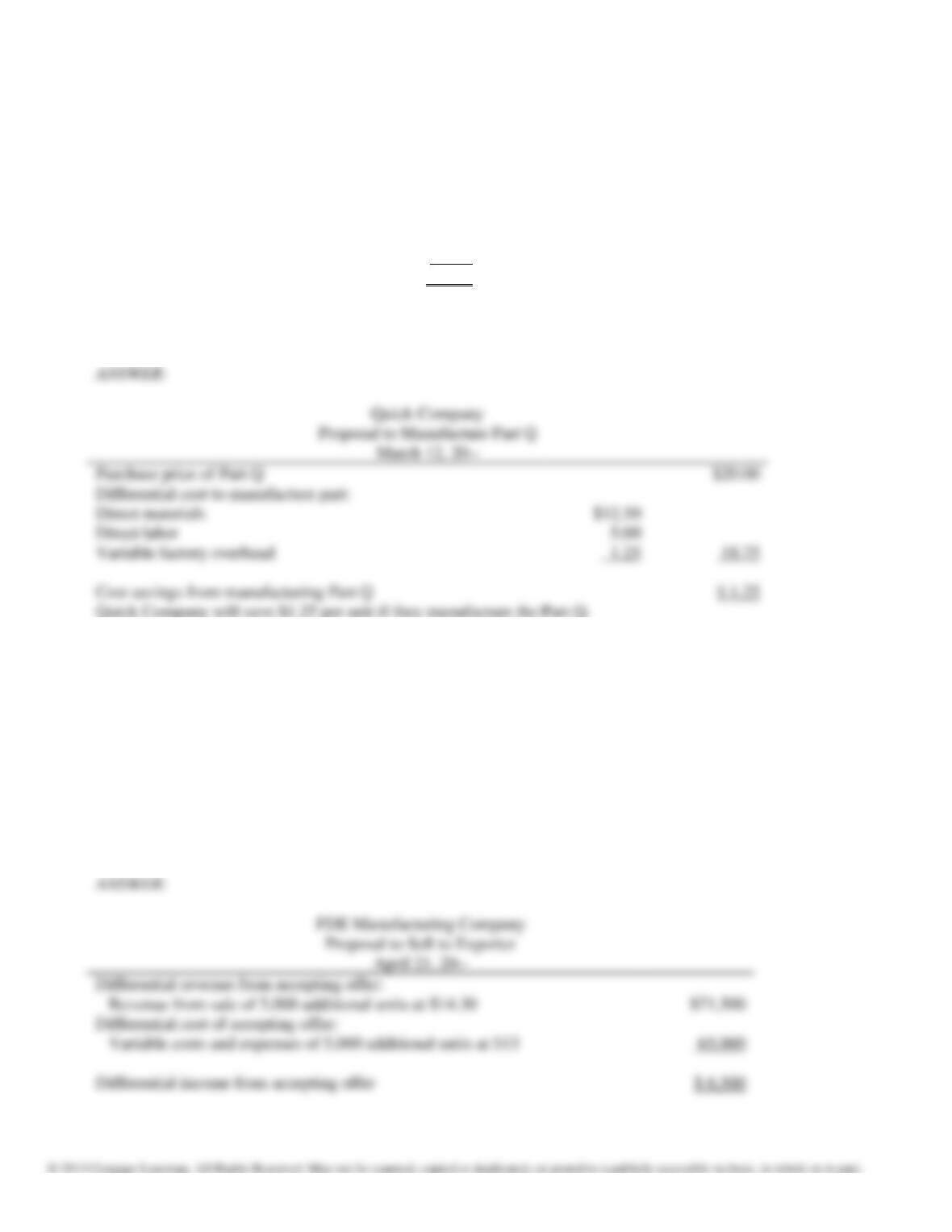
Brickman’s management is considering eliminating the grocery department. Assuming sales in
the other departments will not be affected by dropping the grocery department, what will be
the effect on the company’s total operating income?
Chapter 12: Differential Analysis and Product Pricing
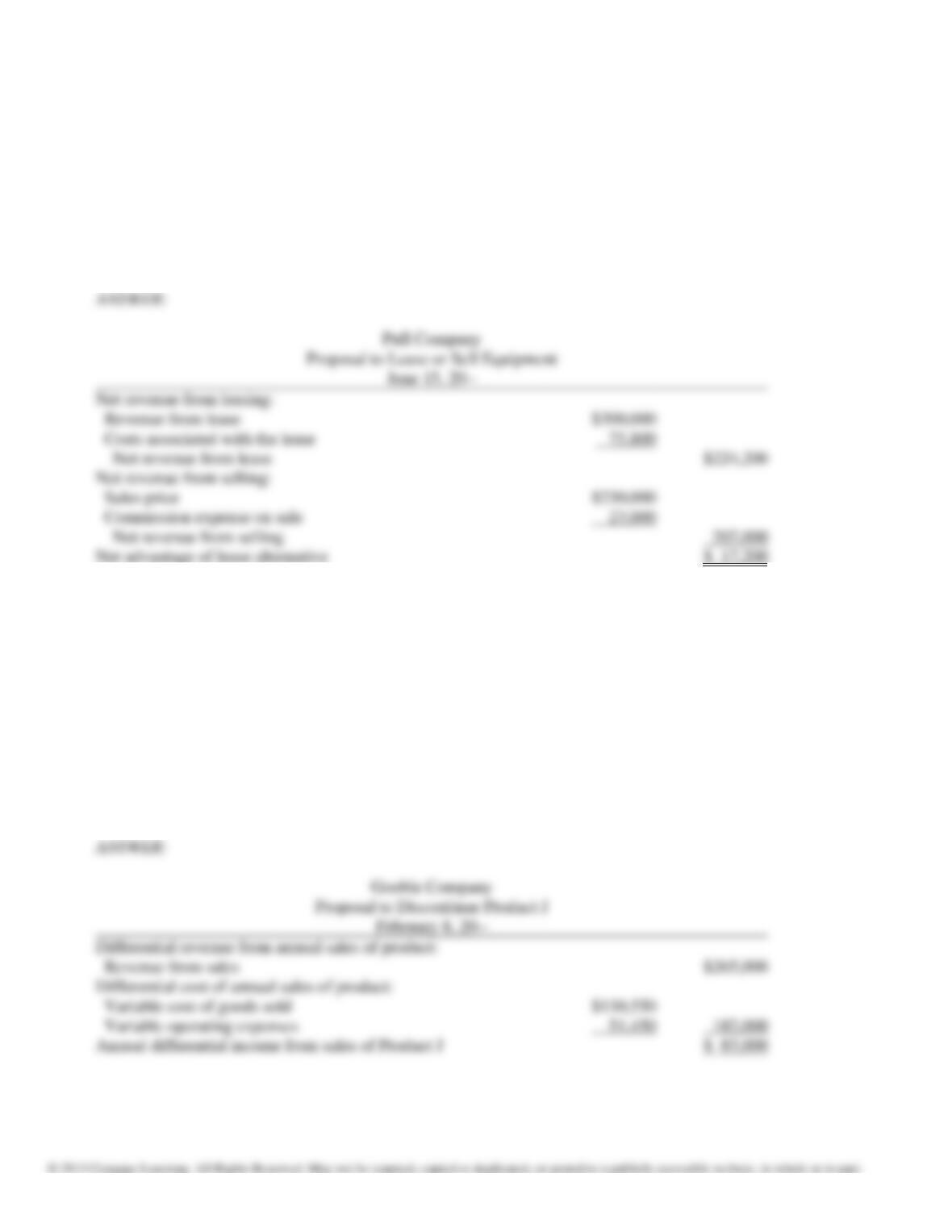
95. Quick Company has been purchasing a component, Part Q, for $20 a unit. Quick is currently
operating at 70% of capacity and no significant increase in production is anticipated in the
near future. The cost of manufacturing a unit of Part Q, determined by absorption costing
method, is estimated as follows:
Direct materials
$12.50
Direct labor
5.00
Variable factory overhead
1.25
Fixed factory overhead
3.15
Total
$21.90
Prepare a differential analysis report, dated March 12 of the current year, on the decision to
make or buy Part Q.
96. FDE Manufacturing Company has a normal plant capacity of 75,000 units per month. Because
of an extra large quantity of inventory on hand, it expects to produce only 60,000 units in May.
Monthly fixed costs and expenses are $150,000 ($2 per unit at normal plant capacity), and
variable costs and expenses are $13 per unit. The present selling price is $25 per unit. The
company has an opportunity to sell 5,000 additional units at $14.30 per unit to an exporter who
plans to market the product under its own brand name in a foreign market. The additional
business is therefore not expected to affect the regular selling price or quantity of sales of FDE
Manufacturing Company.
Prepare a differential analysis report, dated April 21 of the current year, on the proposal to sell
at the special price.
Chapter 12: Differential Analysis and Product Pricing
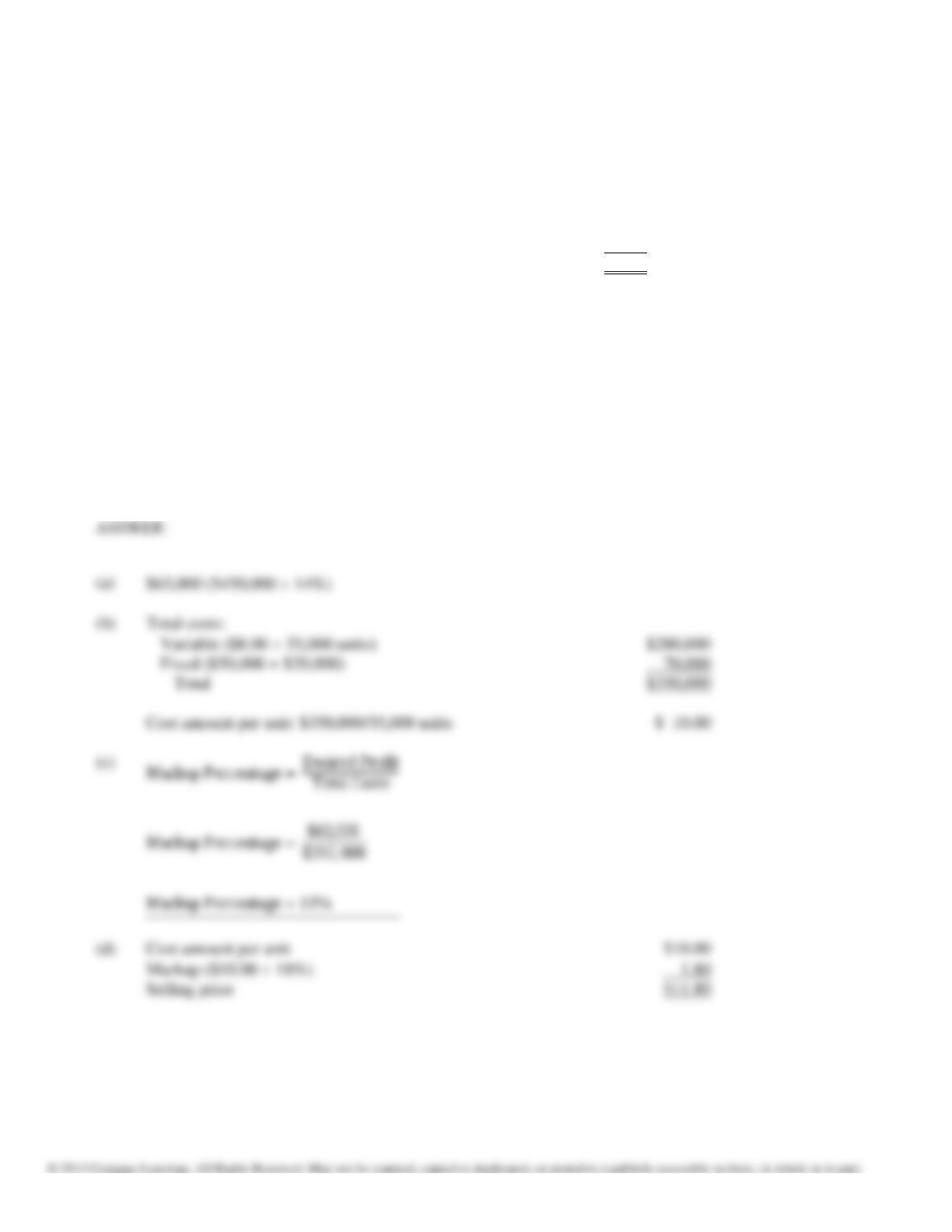
97. Pull Company is considering the disposal of equipment that is no longer needed for operations.
The equipment originally cost $600,000, and accumulated depreciation to date totals
$460,000. An offer has been received to lease the machine for its remaining useful life for a
total of $300,000, after which the equipment will have no salvage value. The repair, insurance,
and property tax expenses during the period of the lease are estimated at $75,800.
Alternatively, the equipment can be sold through a broker for $230,000 less a 10%
commission.
Prepare a differential analysis report, dated June 15 of the current year, on whether the
equipment should be leased or sold.
98. Product J is one of the many products manufactured and sold by Gooble Company. An income
statement by product line for the past year indicated a net loss for Product J of $7,250. This net
loss resulted from sales of $265,000, cost of goods sold of $186,500, and operating expenses
of $85,750. It is estimated that 30% of the cost of goods sold represents fixed factory overhead
costs and that 40% of the operating expense is fixed. If Product J is retained, the revenue,
costs, and expenses are not expected to change significantly from those of the current year.
However, because of the net loss, management is considering the elimination of the
unprofitable endeavor. Because of the large number of products manufactured, the total fixed
costs and expenses are not expected to decline significantly if Product J is discontinued.
Prepare a differential analysis report, dated February 8 of the current year, on the proposal to
discontinue Product J.
Chapter 12: Differential Analysis and Product Pricing
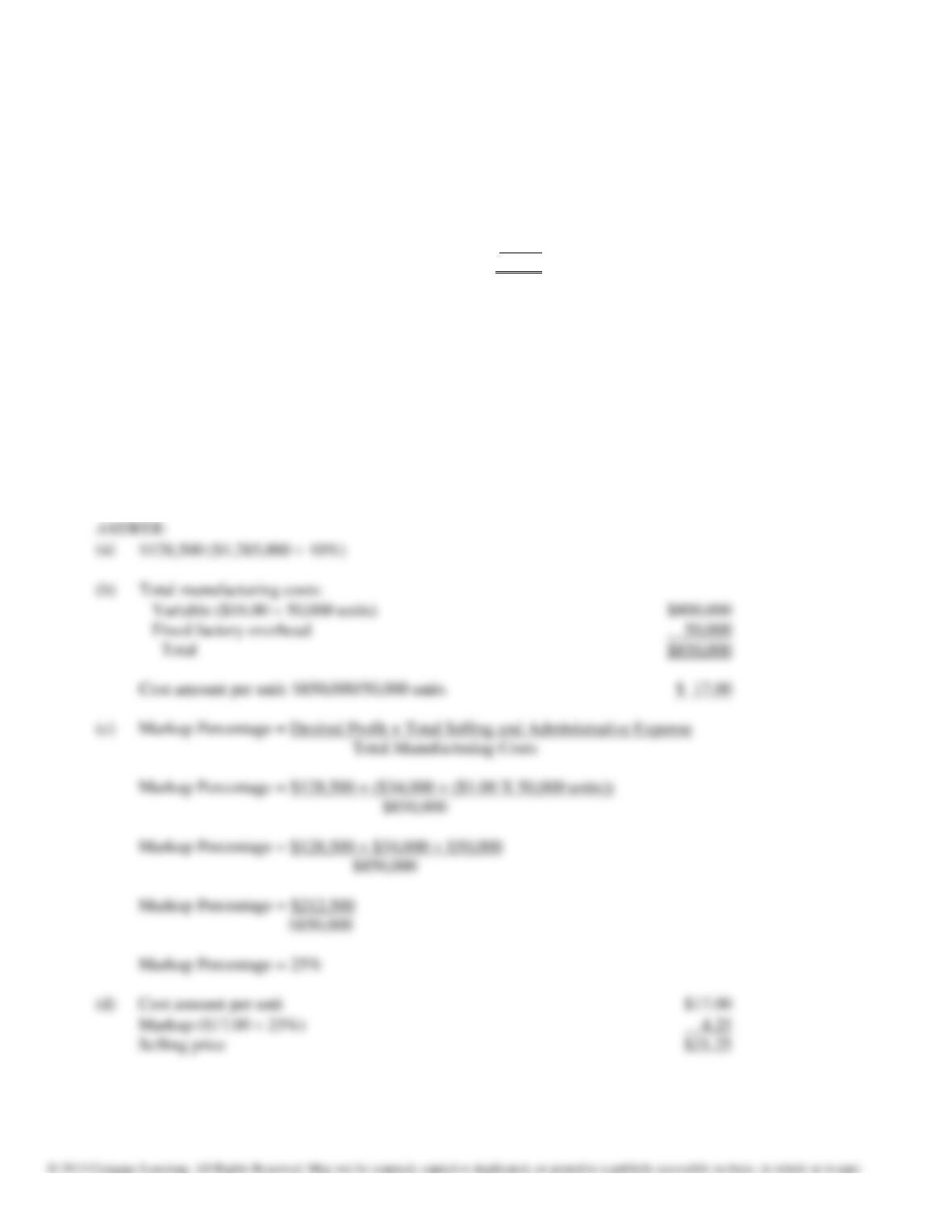
99. Jarvis Company uses the total cost concept of applying the cost-plus approach to product
pricing. The costs and expenses of producing and selling 35,000 units of Product E are as
follows:
Variable costs:
Direct materials
$ 3.00
Direct labor
1.25
Factory overhead
0.75
Selling and administrative expenses
3.00
Total
$ 8.00
Fixed costs:
Factory overhead
$50,000
Selling and administrative expenses
20,000
Jarvis desires a profit equal to a 14% rate of return on invested assets of $450,000.
(a) Determine the amount of desired profit from the production and sale of Product E.
(b) Determine the total costs and the cost amount per unit for the production and sale of
35,000 units of Product E.
(c) Determine the markup percentage for Product E.
(d) Determine the selling price of Product E.
$63,000 ($450,000 14%)
(b)
Total costs:
Fixed ($50,000 + $20,000)
Total
Cost amount per unit: $350,000/35,000 units
$ 10.00
(d)
Cost amount per unit
Markup ($10.00 18%)
Selling price
Chapter 12: Differential Analysis and Product Pricing
100. Tidewater Company uses the product cost concept of applying the cost-plus approach to
product pricing. The cost and expenses of producing and selling 50,000 units of Product K are
as follows:
Variable costs:
Direct materials
$ 5.00
Direct labor
8.50
Factory overhead
2.50
Selling and administrative expenses
1.00
Total
$17.00
Fixed costs:
Factory overhead
$50,000
Selling and administrative expenses
34,000
Tidewater desires a profit equal to a 10% rate of return on invested assets of $1,285,000.
(a) Determine the amount of desired profit from the production and sale of Product K.
(b) Determine the total manufacturing costs and the cost amount per unit for the production
and sale of 50,000 units of Product K.
(c) Determine the markup percentage for Product K.
(d) Determine the selling price of Product K.
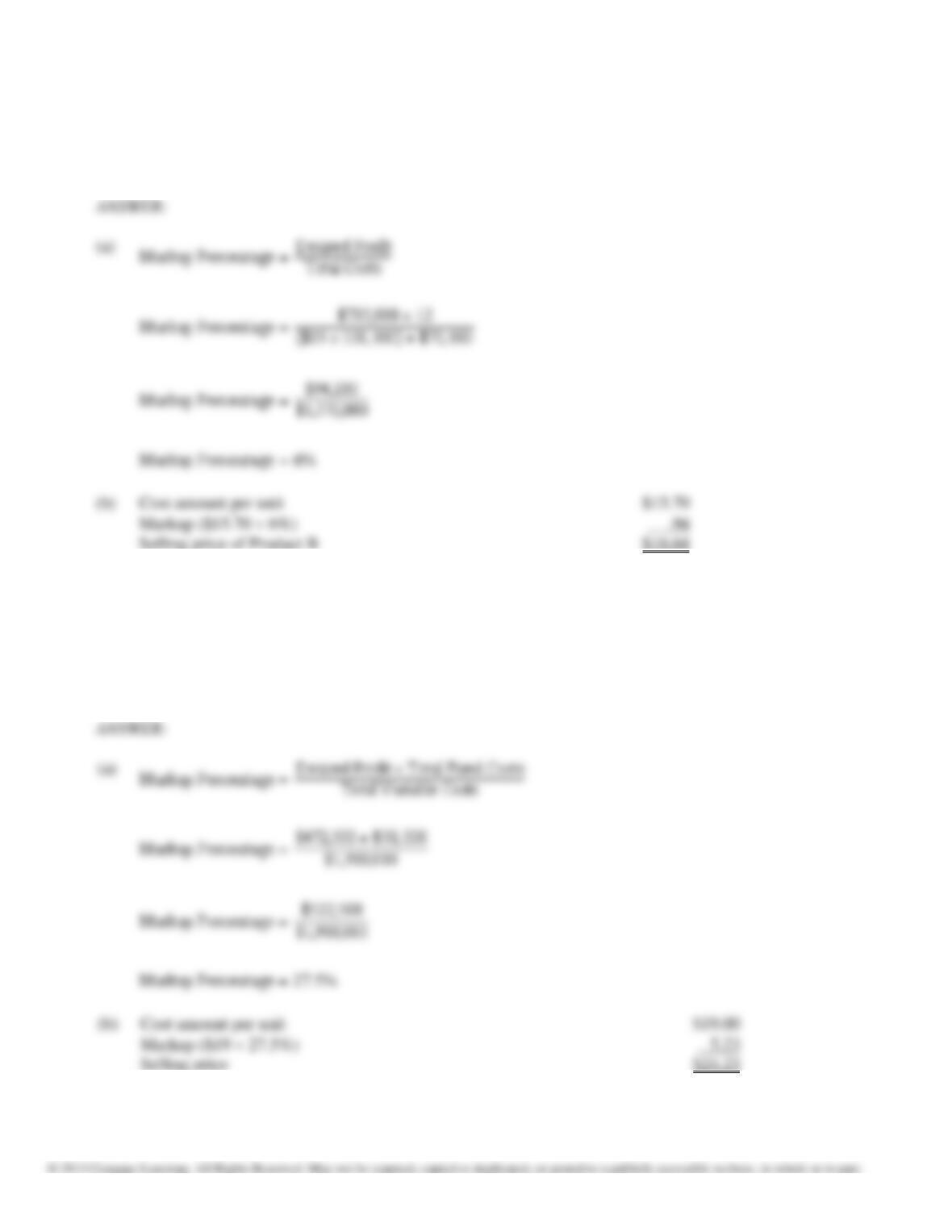
$128,500 ($1,285,000 10%)
(b)
Total manufacturing costs:
Variable ($16.00 50,000 units)
Fixed factory overhead
Total
Cost amount per unit: $850,000/50,000 units
(d)
Chapter 12: Differential Analysis and Product Pricing
101. Glover Inc. manufactures Product B, incurring variable costs of $15.00 per unit and fixed costs
of $70,000. Glover desires a profit equal to a 12% rate of return on assets. Assets of $785,000
are devoted to producing Product B, and 100,000 units are expected to be produced and sold.
(a) Compute the markup percentage using the total cost concept.
(b) Compute the selling price of Product B.
102. Kirk Co. manufactures mobile cellular equipment and develops a price for the product by
using a variable cost concept. Kirk incurs variable costs of $1,900,000 in the production of
100,000 units. Fixed costs total $50,000. The company employs $4,725,000 of assets and
wishes to earn a profit equal to a 10% rate of return on assets.
(a) Compute a markup percentage based on the variable costs concept.
(b) Determine a selling price.