85.
The cash flow on total assets ratio is calculated by:
86.
A company had net cash flows from operations of $341,000, net income of $286,000 and
average total assets of $1,850,000. The cash flow on total assets ratio equals:
87.
A company had net cash flows from operations of $120,000, cash flows from financing of
$330,000, total cash flows of $500,000, and average total assets of $2,500,000. The cash
flow on total assets ratio equals:
88.
A company had average total assets of $1,660,000, total cash flows of $1,320,000, cash
flows from operations of $205,000, and cash flows from financing of $750,000. The cash
flow on total assets ratio equals:
89.
Preparation of the statement of cash flows does not involve:
90.
The reporting of net cash provided or used by operating activities that lists the major
items of operating cash receipts, such as receipts from customers, and subtracts the
major items of operating cash disbursements, such as cash paid for merchandise, is
referred to as the:
91.
A statement of cash flows explains the differences between the beginning and ending
balances of:
92.
The direct method for the preparation of the operating activities section of the statement
of cash flows:
93.
The indirect method for the preparation of the operating activities section of the statement
of cash flows:
94.
The direct method of reporting operating cash flows:
95.
Of the following, which one affects cash during a period?
96.
When using the indirect method to calculate and report the net cash provided or used by
operating activities, net income is adjusted for all but which of the following?
97.
When using the indirect method to calculate and report net cash provided or used by
operating activities, which of the following is subtracted from net income?
98.
The first line item in the operating activities section of a spreadsheet for a statement of
cash flows prepared using the indirect method is:
99.
When preparing a statement of cash flows using the indirect method, each of the following
should be classified as an operating cash flow except:
100.
A company’s Inventory balance at 12/31/17 was $188,000 and $200,000 at 12/31/16. Its
Accounts Payable balance at 12/31/17 was $84,000 and $80,000 at 12/31/16, and its cost
of goods sold for 2017 was $720,000. The company’s total amount of cash payments for
merchandise in 2017 equals:
101.
Use the following information to calculate cash paid for wages and salaries:
Salaries expense
$168,000
Salaries payable, January 1
6,400
Salaries payable, December 31
10,600
102.
Use the following information to calculate cash paid for income taxes:
Income tax expense
$43,000
Income tax payable, January 1
9,100
Income tax payable, December 31
10,200
103.
Use the following information about the current year’s operations of a company to
calculate the cash paid for merchandise.
Cost of goods sold
$226,000
Merchandise inventory, January 1
54,800
Merchandise inventory, December 31
57,400
Accounts payable, January 1
54,400
Accounts payable, December 31
59,800
104.
Use the following information about the current year’s operations of a company to
calculate the cash paid for merchandise.
Cost of goods sold
$735,000
Merchandise inventory, January 1
84,700
Merchandise inventory, December 31
82,400
Accounts payable, January 1
54,500
Accounts payable, December 31
60,200
105.
When preparing a statement of cash flows using the indirect method, which of the
following is correct?
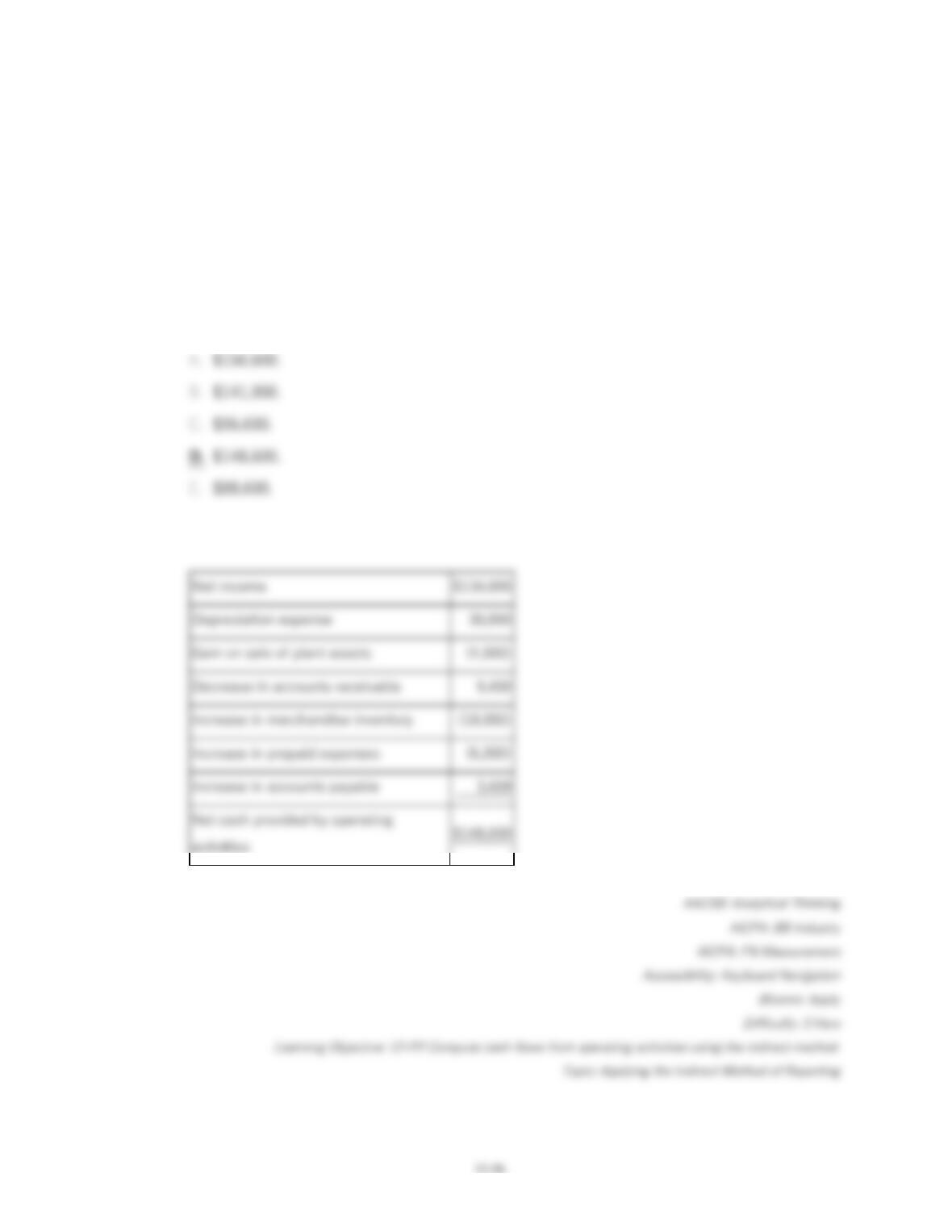
106.
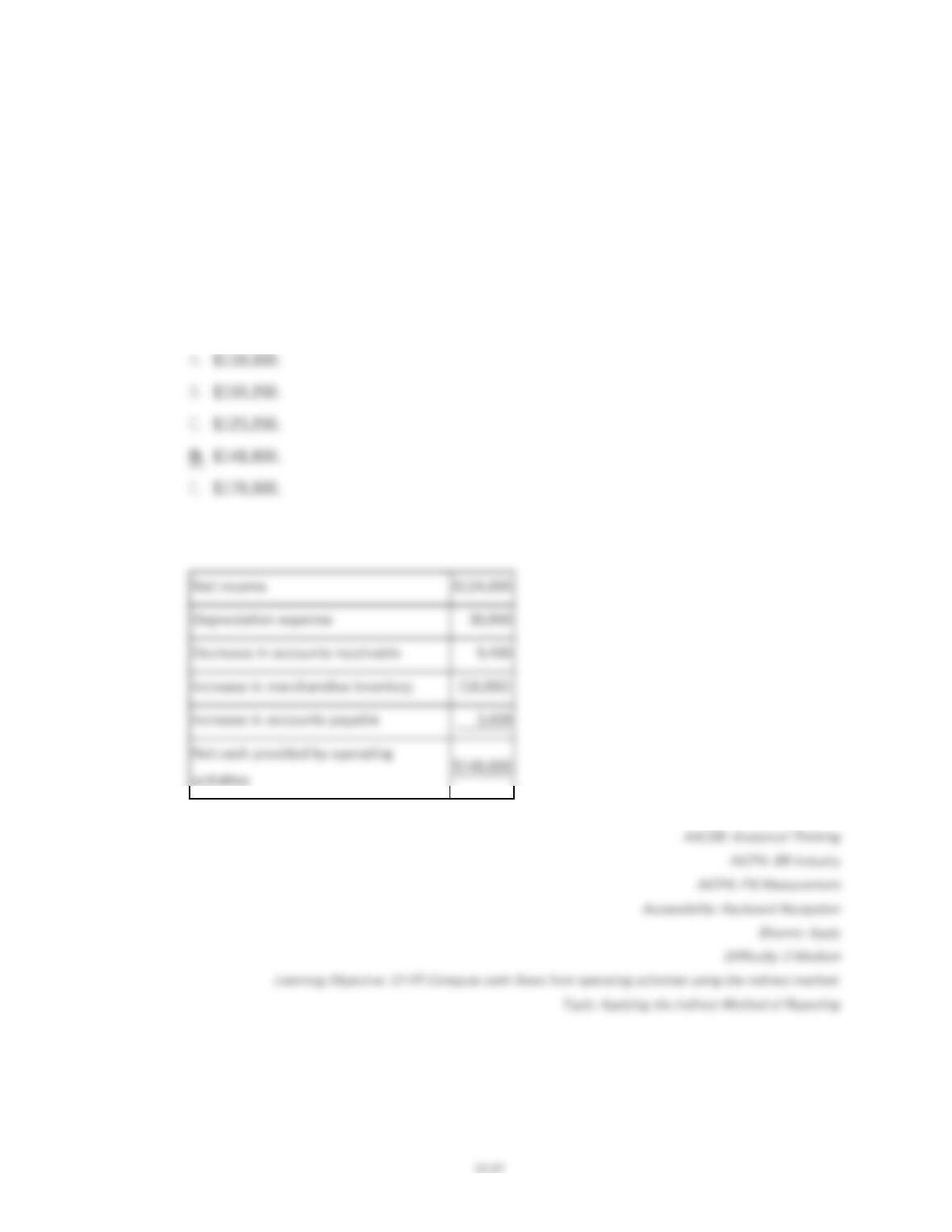
A company’s income statement showed the following: net income, $134,000; depreciation
expense, $30,000; and gain on sale of plant assets, $4,000. An examination of the
company’s current assets and current liabilities showed the following changes as a result
of operating activities: accounts receivable decreased $9,400; merchandise inventory
increased $18,000; prepaid expenses increased $6,200; accounts payable increased
$3,400. Calculate the net cash provided or used by operating activities.
107.
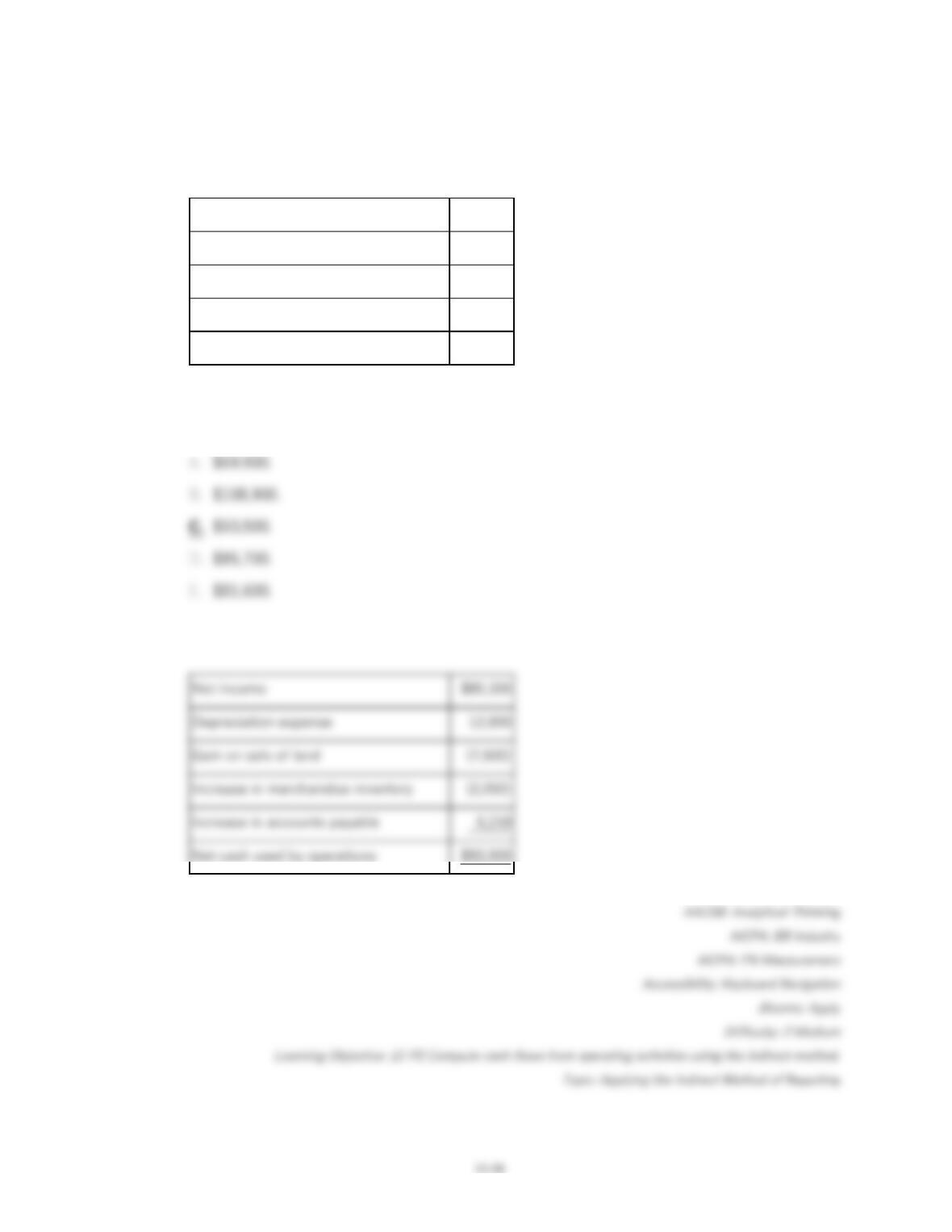
A company’s income statement showed the following: net income, $124,000 and
depreciation expense, $30,000. An examination of the company’s current assets and
current liabilities showed the following changes as a result of operating activities:
accounts receivable decreased $9,400; merchandise inventory increased $18,000; and
accounts payable increased $3,400. Calculate the net cash provided or used by operating
activities.
108.
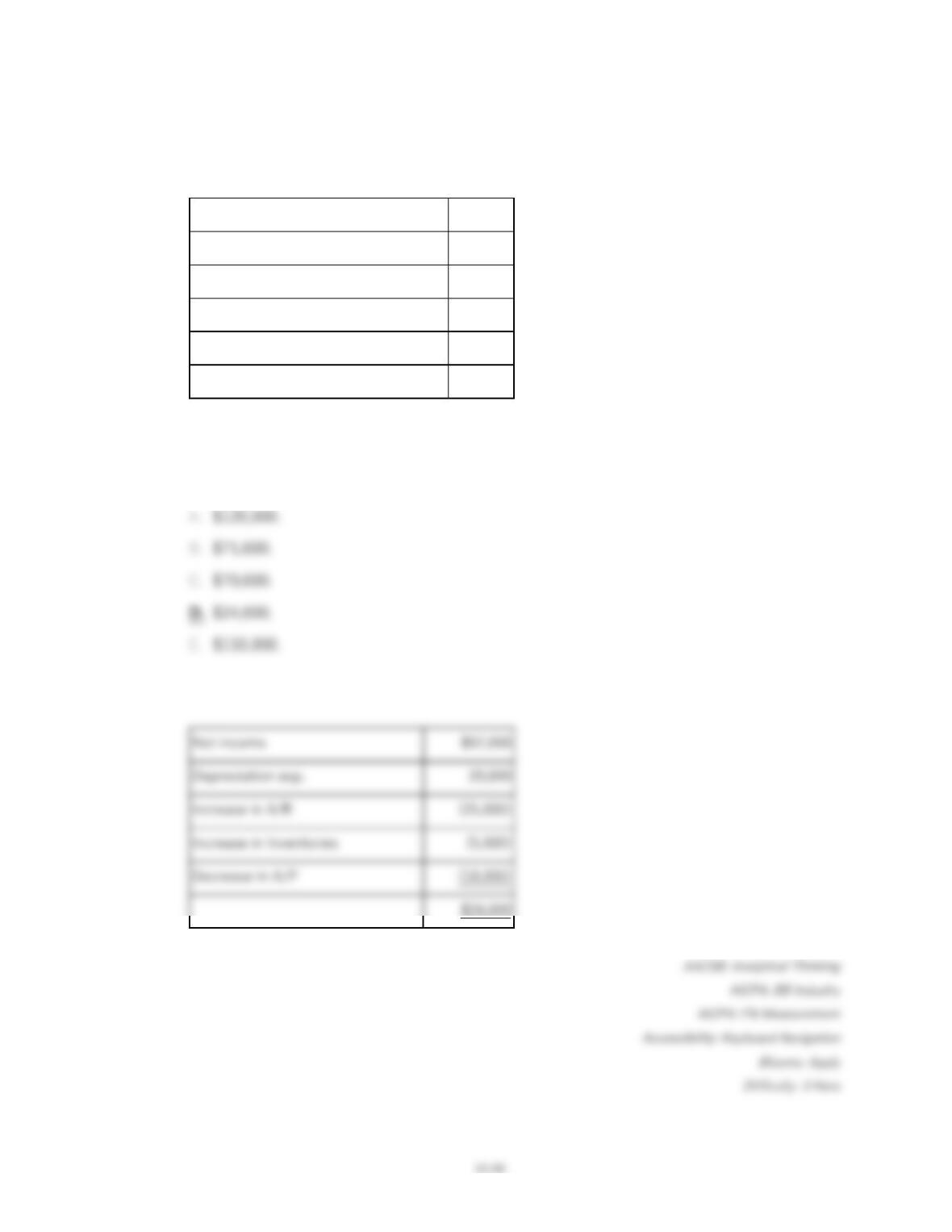
Use the following information and the indirect method to calculate the net cash provided
or used by operating activities:
Net income
$85,300
Depreciation expense
12,000
Gain on sale of land
7,500
Increase in merchandise inventory
2,050
Increase in accounts payable
6,150
Net income
$85,300
Depreciation expense
Gain on sale of land
Increase in merchandise inventory
Increase in accounts payable
Net cash used by operations
109.
In preparing a company’s statement of cash flows for the most recent year using the
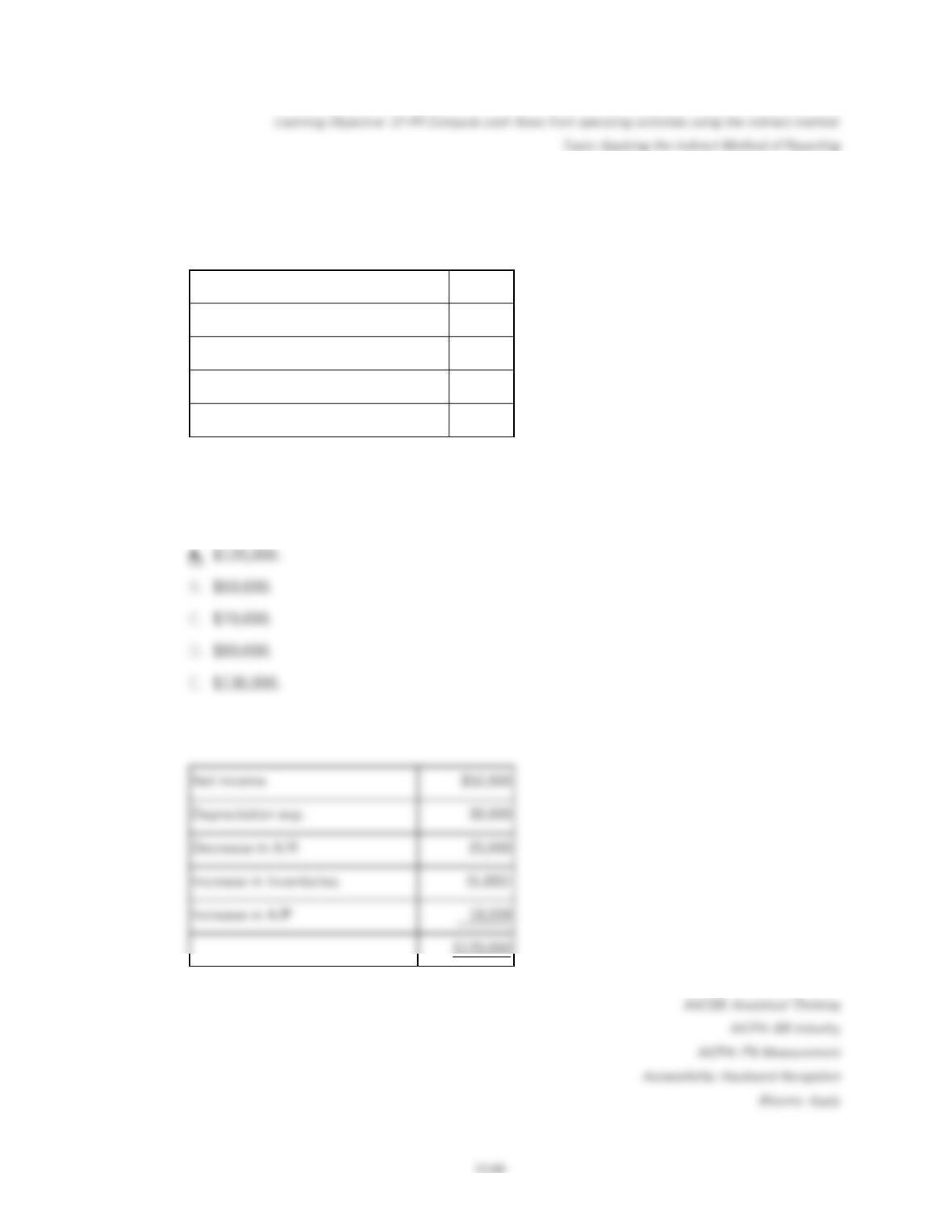
indirect method, the following information is available:
Net income for the year was
$52,000
Accounts payable decreased by
$18,000
Accounts receivable increased by
$25,000
Inventories increased by
$5,000
Cash dividends paid were
$14,000
Depreciation expense was
$20,000
Net cash provided by operating activities was:
Net income
Depreciation exp.
Increase in A/R
Increase in Inventories
Decrease in A/P
110.
In preparing a company’s statement of cash flows for the most recent year using the
indirect method, the following information is available:
Net income for the year was
$52,000
Accounts payable increased by
$18,000
Accounts receivable decreased by
$25,000
Inventories increased by
$5,000
Depreciation expense was
$30,000
Net cash provided by operating activities was:
Depreciation exp.
Decrease in A/R
Increase in Inventories
Increase in A/P