
Intermediate Accounting, 9e (Spiceland)
Chapter 12 Investments
1) Securities classified as held to maturity could be reported as either current or long-term in a
classified balance sheet, depending upon their maturity dates.
2) All investments in debt securities whose fair values are not readily determinable are carried at
historical cost.
3) Both debt and equity securities can be categorized as trading securities.
4) Net unrealized holding gains (losses) are reported in the income statement for trading
securities.
5) Purchases and sales of securities are always reported as investing activities in a statement of
cash flows.
6) Routine transfers of debt investments among the trading, available for sale, and held to
maturity portfolios need not be disclosed in the financial statements.
7) Both trading securities and securities available for sale are reported at their fair values.
8) All securities considered available for sale should be reported as current assets in a classified
balance sheet.

9) Unrealized holding gains and losses are included in other comprehensive income for securities
that are classified as available for sale.
10) When available-for-sale securities are sold, the amount of unrealized holding gain or loss
realized from the date of purchase is included in before-tax net income.
11) Companies must always use the equity method when they hold between 25% and 50% of the
common stock of an investee.
12) The equity method is in many ways a partial consolidation.

13) Under the equity method of accounting for a stock investment, cash dividends received are
considered a reduction of the investee’s net assets.
14) When an equity method investment is sold, a gain or loss is recognized for the difference
between its selling price and its cost.
15) If an investment is accounted for under the equity method, the investor reduces investment
income and the investment account for amortization of goodwill acquired in the investment.
16) Selecting the fair value option for an available-for-sale investment is equivalent to
reclassifying that investment as a trading security.

17) The fair value option cannot be elected for significant-influence investments because those
must be accounted for under the equity method.
18) Under IAS No. 39, investments for which the investor lacks significant influence use
basically the same reporting classifications as those used under U.S. GAAP.
19) Under IFRS No. 9, investments for which the investor lacks significant influence use
basically the same reporting classifications as those used under U.S. GAAP.
20) Under IFRS No. 9, debt investments are classified as either “available for sale” or “fair value
through profit and loss (FVPL).”
21) Under IFRS No. 9, debt investments are classified as either “amortized cost,” or “fair value
through profit and loss (FVPL),” or “fair value through other comprehensive income (FVOCI).”

22) Under IFRS No. 9, equity investments are classified as either “fair value through other
comprehensive income (FVOCI)” or “fair value through profit and loss (FVPL).”
23) Under IFRS No. 9, a debt investment can be accounted for at amortized cost if the debt
agreement includes only interest and principal and the investor intends to hold it to collect
contractual cash flows.
24) Under IAS No. 39, transfers of debt investments out of the FVPL category into AFS or HTM
are permitted under “rare circumstances.”
25) The cash surrender value of a life insurance policy decreases each year by the portion of the
premium paid that is related to the additional year that the insured person is still alive.

26) The investment category for which the investor’s “positive intent and ability to hold” is
important is:
A) Securities reported under the equity method.
B) Trading securities.
C) Securities classified as held to maturity.
D) Securities available for sale.
27) Which of the following investment securities held by Zoogle Inc. may be classified as held–
to-maturity securities in its balance sheet?
A) Long-term debenture bonds.
B) Common stock.
C) Callable preferred stock.
D) All of these answer choices are correct.
28) Which of the following investment securities held by Zoogle Inc. are not reported at fair
value in its balance sheet?
A) Debt securities held as available for sale securities.
B) Debt securities held to maturity.
C) Bonds held as trading securities.
D) All of these answer choices are reported at fair value.

29) In which investment category are fair values and subsequent growth of an investee not
relevant for reporting?
A) Securities reported under the equity method.
B) Trading securities.
C) Held-to-maturity securities.
D) Securities available for sale.
30) Which category of securities is presented on the balance sheet at amortized cost?
A) Securities available for sale.
B) Equity investments of less than 20 percent ownership
C) Held-to-maturity securities.
D) Trading securities.
31) In 2016, Osgood Corporation purchased $4 million of 10-year municipal bonds at face value.
On December 31, 2018, the bonds had a fair value of $3,600,000 and Osgood reclassified the
bonds from held to maturity to trading securities. Osgood’s December 31, 2018, balance sheet
and the 2018 income statement would show the following:
Investment in
municipal bonds
Income
statement loss
on investments
a.
3,600,000
0
b.
3,600,000
400,000
c.
4,000,000
400,000
d.
4,000,000
0
A) Option a
B) Option b
C) Option c
D) Option d

32) Beresford Inc. purchased several investments in debt securities during 2018, its first year of
operations. The following information pertains to these securities. The fluctuations in their fair
values are not considered permanent.
Held to Maturity
Securities:
Fair Value
12/31/2017
Fair Value
12/31/2018
Amortized Cost
12/31/2017
Amortized
Cost
12/31/2018
ABC Co. Bonds
$
375,000
$
400,000
$
367,500
$
360,000
Trading Securities:
Fair Value
12/31/2017
Fair Value
12/31/2018
Cost
DEF Co. Bonds
$
48,000
$
59,500
$
66,000
GEH Inc. Bonds
$
47,000
$
77,000
$
39,000
IJK Inc. Bonds
$
44,000
$
38,500
$
32,900
Available for Sale
Securities:
Fair Value
12/31/2017
Fair Value
12/31/2018
Cost
LMN Co. Bonds
$
130,500
$
150,400
$
140,000
What balance sheet amount would Beresford report for the total of its investments in debt
securities at 12/31/2017?
A) $637,000.
B) $644,500.
C) $645,400.
D) None of these answer choices are correct.

33) Beresford Inc. purchased several investments in debt securities during 2018, its first year of
operations. The following information pertains to these securities. The fluctuations in their fair
values are not considered permanent.
Held to Maturity
Securities:
Fair Value
12/31/2017
Fair Value
12/31/2018
Amortized Cost
12/31/2017
Amortized
Cost
12/31/2018
ABC Co. Bonds
$
375,000
$
400,000
$
367,500
$
360,000
Trading Securities:
Fair Value
12/31/2017
Fair Value
12/31/2018
Cost
DEF Co. Bonds
$
48,000
$
59,500
$
66,000
GEH Inc. Bonds
$
47,000
$
77,000
$
39,000
IJK Inc. Bonds
$
44,000
$
38,500
$
32,900
Available for Sale
Securities:
Fair Value
12/31/2017
Fair Value
12/31/2018
Cost
LMN Co. Bonds
$
130,500
$
150,400
$
140,000
What would be the balance in Beresford’s accumulated other comprehensive income with respect
to these investments in its 12/31/2019 balance sheet (ignore taxes)?
A) $55,100.
B) $26,500.
C) $10,400.
D) None of these answer choices are correct.

34) Beresford Inc. purchased several investments in debt securities during 2018, its first year of
operations. The following information pertains to these securities. The fluctuations in their fair
values are not considered permanent.
Held to Maturity
Securities:
Fair Value
12/31/2017
Fair Value
12/31/2018
Amortized Cost
12/31/2017
Amortized
Cost
12/31/2018
ABC Co. Bonds
$
375,000
$
400,000
$
367,500
$
360,000
Trading Securities:
Fair Value
12/31/2017
Fair Value
12/31/2018
Cost
DEF Co. Bonds
$
48,000
$
59,500
$
66,000
GEH Inc. Bonds
$
47,000
$
77,000
$
39,000
IJK Inc. Bonds
$
44,000
$
38,500
$
32,900
Available for Sale
Securities:
Fair Value
12/31/2017
Fair Value
12/31/2018
Cost
LMN Co. Bonds
$
130,500
$
150,400
$
140,000
What total unrealized holding gain would Beresford report in its 2019 income statement relative
to its investments in debt securities?
A) $55,900.
B) $36,000.
C) $80,900.
D) $48,200.
35) On January 1, 2018, Rupar Retailers purchased $100,000 of Anand Company bonds at a
discount of $5,000. The Anand bonds pay 6% interest but were purchased when the market
interest rate was 7% for bonds of similar risk and maturity. The bonds pay interest semiannually
on January 1 and July 1 of each year. Rupar accounts for the bonds as a held-to-maturity
investment, and uses the effective interest method. In Rupar’s December 31, 2018 journal entry
to record the second period of interest, Rupar would record a credit to interest revenue of:
A) $3,336.
B) $3,325.
C) $3,000.
D) $3,500.
36) If Dinsburry Company concluded that an investment originally classified as a trading
security would now more appropriately be classified as held to maturity, Dinsburry would:
A) Not reclassify the investment, as original classifications are irrevocable.
B) Reclassify the investment as held to maturity and immediately recognize in net income all
unrealized holding gains and losses that have not already been recognized as of the
reclassification date.
C) Reclassify the investment as held to maturity and treat the fair value as of the date of
reclassification as the investment’s amortized cost basis for future amortization.
D) Reclassify the investment as held to maturity, but there would be no income effect.

37) If Ziggy Company concluded that an investment originally classified as held to maturity
would now more appropriately be classified as available for sale, Ziggy would:
A) Not reclassify the investment, as original classifications are irrevocable.
B) Reclassify the investment as available for sale and immediately recognize in net income any
unrealized holding gain or loss on the reclassification date.
C) Reclassify the investment as available for sale and immediately recognize in accumulated
other comprehensive income any unrealized holding gain or loss on the reclassification date.
D) Need to restate earnings, as the original classification was in error.
38) If Dizbert Company concluded that an investment originally classified as available for sale
would now more appropriately be classified as held to maturity, Dizbert would:
A) Not reclassify the investment, as original classifications are irrevocable.
B) Reclassify the investment as held to maturity and immediately recognize in net income any
unrealized holding gain or loss on the reclassification date.
C) Reclassify the investment as held to maturity and treat the fair value as of the date of
reclassification as the investment’s amortized cost basis for future amortization.
D) Need to restate earnings, as the original classification was in error.
39) Bonds that are purchased with the intent of selling them in the near future to take advantage
of short-term price changes are classified as:
A) Securities available for sale.
B) Consolidating securities.
C) Held-to-maturity securities.
D) Trading securities.
40) The income statement reports changes in fair value for which type of investment securities?
A) Securities reported under the equity method.
B) Trading securities.
C) Held-to-maturity securities.
D) Available-for-sale securities.
41) Trading securities are most commonly found on the books of:
A) Oil companies.
B) Manufacturing companies.
C) Banks.
D) Foreign subsidiaries.

42) For trading securities, unrealized holding gains and losses are included in earnings:
A) Only at the end of the fiscal year.
B) On each reporting date.
C) Only when they exceed 10% of the underlying investment.
D) Based on a vote of the board of directors.
43) Trading securities, by definition, are properly classified in the balance sheet as:
A) Shareholders’ equity.
B) Intangibles.
C) Current assets.
D) Other assets.
44) Unrealized holding gains and losses on trading securities are included in earnings because:
A) They measure the success or failure of taking advantage of short-term price changes.
B) The IRS mandates the inclusion.
C) The SEC mandates the inclusion.
D) They measure the book value of the securities in the balance sheet date.

45) In the statement of cash flows, inflows and outflows of cash from buying and selling trading
securities typically are considered:
A) Investing activities.
B) Operating activities.
C) Financing activities.
D) Noncash financing activities.
46) Dyckman Dealers has an investment in Thomas Corporation bonds which Dyckman accounts
for as a trading security. Thomas Corporation’s bonds are publicly traded and the prevailing
market price indicates that Dyckman’s investment is worth $20,000. However, Dyckman
management believes that the bond market is generally overvalued, and their analysis of the
Thomas investment suggests to them that it is worth $18,000. Dyckman should carry the Thomas
investment on its balance sheet at:
A) $20,000.
B) $18,000.
C) Either $18,000 or $20,000, as either are defensible valuations.
D) $19,000, the midpoint of Dyckman’s range of reasonably likely valuations of Thomas.

47) Nichols Enterprises has an investment in 250 bonds of Elliott Electronics that Nichols
accounts for as a security available for sale. Elliott bonds are publicly traded, and The Wall Street
Journal quotes a price for those bonds of $1,000 per bond, but Nichols believes the market has
not appreciated the full value of the Elliott bonds and that a more accurate price is $1,200 per
bond. Nichols should carry the Elliott investment on its balance sheet at:
A) $300,000.
B) $250,000.
C) Either $250,000 or $300,000, as either are defensible valuations.
D) $275,000, the midpoint of Nichols’ range of reasonably likely valuations of Elliott.
48) Anthers Inc. bought the following portfolio of trading securities near the end of 2018.
Security
Cost
Fair value 12/31/2018
A
$
80,000
$
84,000
B
60,000
54,000
C
22,000
22,000
What amount will be reported in the balance sheet for this portfolio at December 31, 2018, and
how will it be classified?
Amount
Classification
a.
$
162,000
Noncurrent Asset
b.
$
162,000
Current Asset
c.
$
160,000
Noncurrent Asset
d.
$
160,000
Current Asset
A) Option a
B) Option b
C) Option c
D) Option d
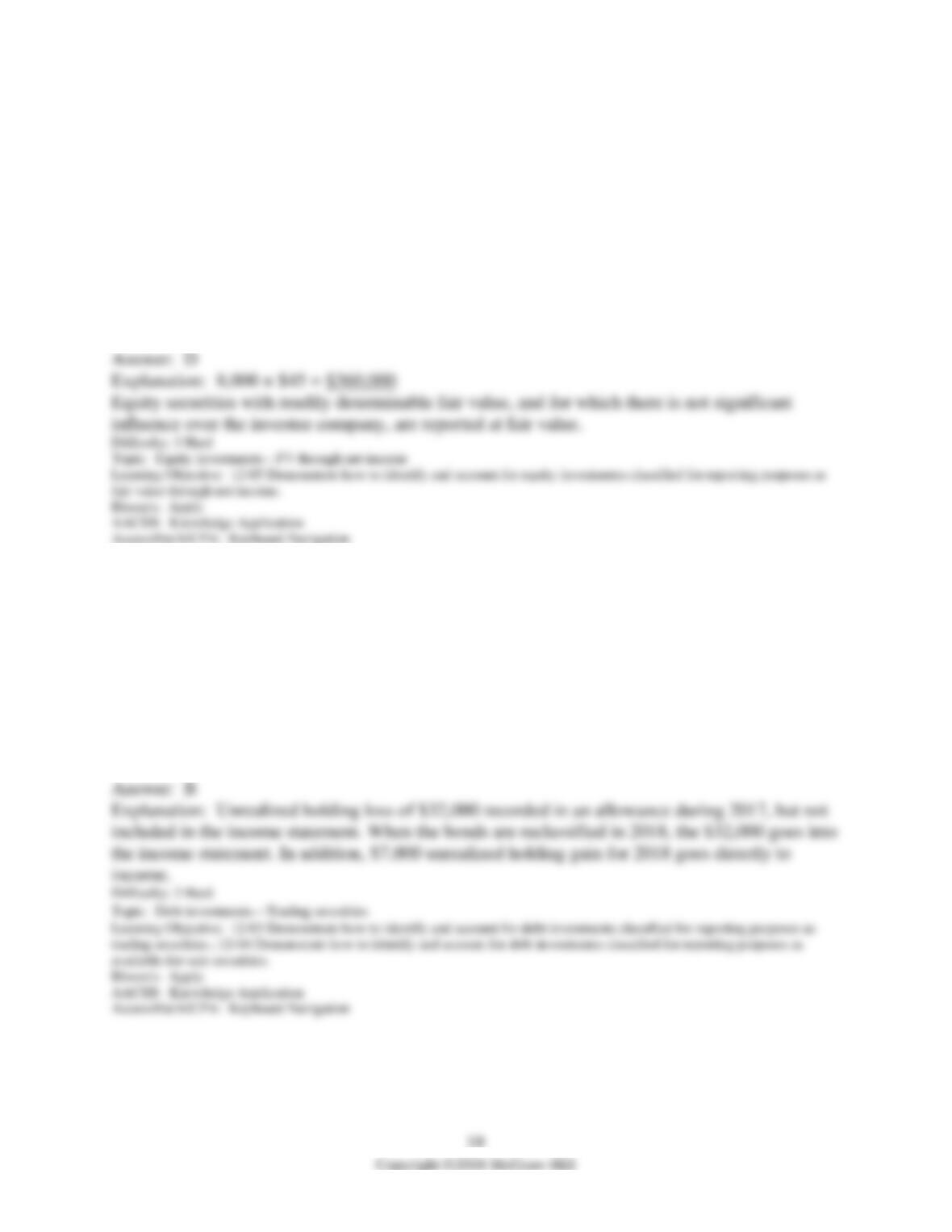
49) On January 1, 2018, Nana Company paid $100,000 for 8,000 shares of Papa Company
common stock. The ownership in Papa Company is 10%. Nana Company does not have
significant influence over Papa Company. Papa reported net income of $52,000 for the year
ended December 31, 2018. The fair value of the Papa stock on that date was $45 per share. What
amount will be reported in the balance sheet of Nana Company for the investment in Papa at
December 31, 2018?
A) $284,400.
B) $300,000.
C) $315,600.
D) $360,000.
50) Goofy Inc. bought a sizeable amount of Crazy Co.’s bonds for $150,000 on May 5, 2017, and
classified the investment as available for sale. The market value of the bonds declined to
$118,000 by December 31, 2017. Goofy reclassified this investment as trading securities in
December of 2018 when the market value had risen to $125,000. What effect on 2018 income
should be reported by Goofy for the Crazy Co. bonds?
A) $0.
B) $25,000 net unrealized holding loss.
C) $7,000 net unrealized holding gain.
D) $32,000 net unrealized holding loss.
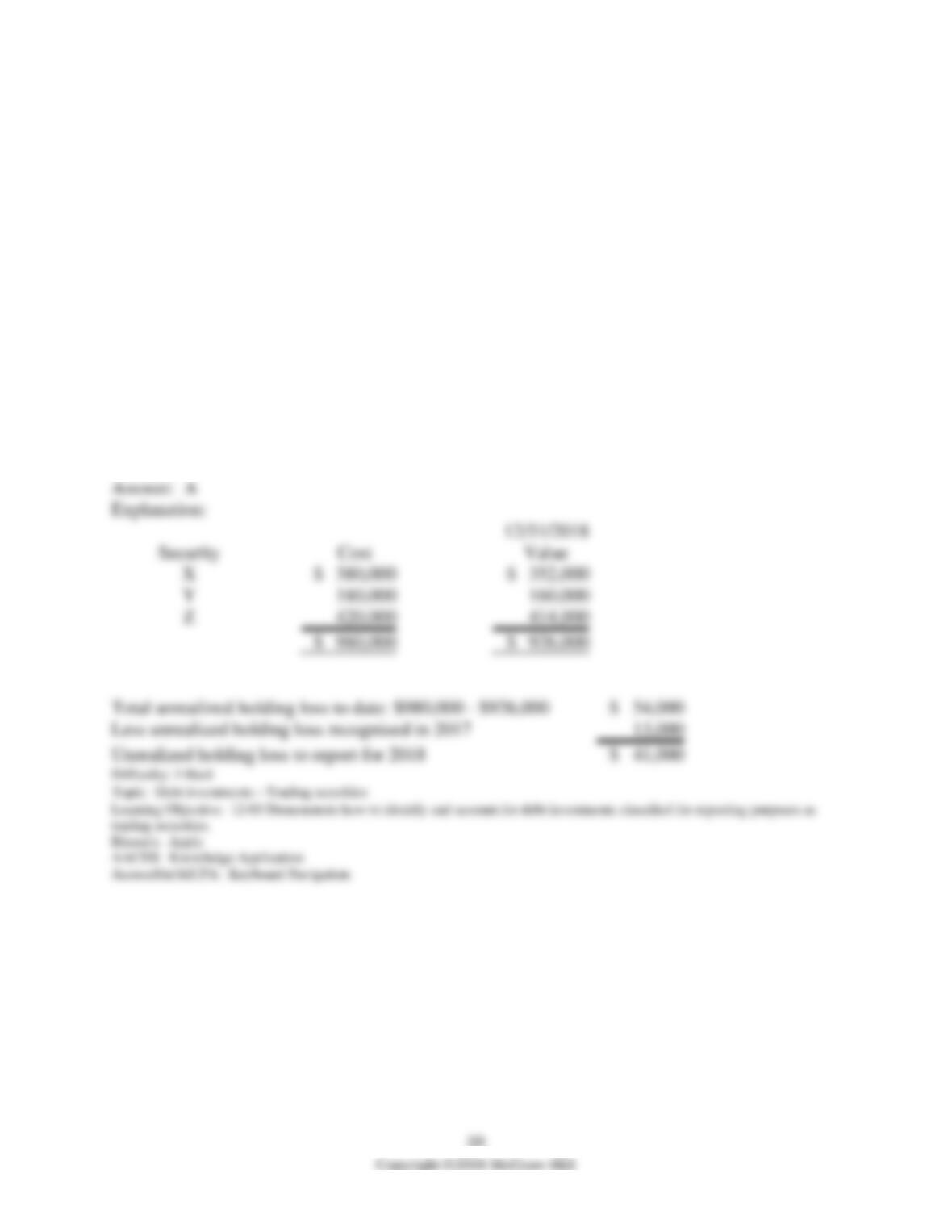
51) Hobson Company bought the securities listed below during 2017. These securities were
classified as trading securities. In its December 31, 2017, income statement Hobson reported a
net unrealized holding loss of $13,000 on these securities. Pertinent data at the end of June, 2018
is as follows:
Security
Cost
Fair Value
X
$
380,000
$
352,000
Y
180,000
160,000
Z
420,000
414,000
What amount of unrealized holding loss on these securities should Hobson include in its income
statement for the six months ended June 30, 2018?
A) $41,000.
B) $54,000.
C) $13,000.
D) $0.
$
380,000
$
352,000
180,000
160,000
420,000
414,000
$
54,000
13,000
$
41,000