67. The following costs were incurred by Mark Corporation during 2010:
·
Legal fees paid to attorneys in connection with a patent application related to a new invention developed by the company’s laboratory
personnel: $40,000.
·
Salaries of personnel involved in searching for applications of new research findings: $150,000.
·
Cost of machinery acquired on January 1, 2010: $355,000. The machinery will be used in a current research and development project,
as well as several other R&D projects over the next eight years, after which the machine is expected to be sold for $15,000. Mark
Corporation uses straight-line depreciation.
·
Costs of design, construction, and testing of preproduction prototypes of potential new product lines for the company: $70,000.
·
Cost of developing a valuable new product that was successfully patented: $100,000.
·
Cost of marketing research to promote the new product: $60,000.
Required:
a.
Calculate the total research and development expense that should appear in Mark’s 2010 income statement.
b.
For any of the above items you exclude from the 2010 expense amount, indicate the proper accounting treatment.
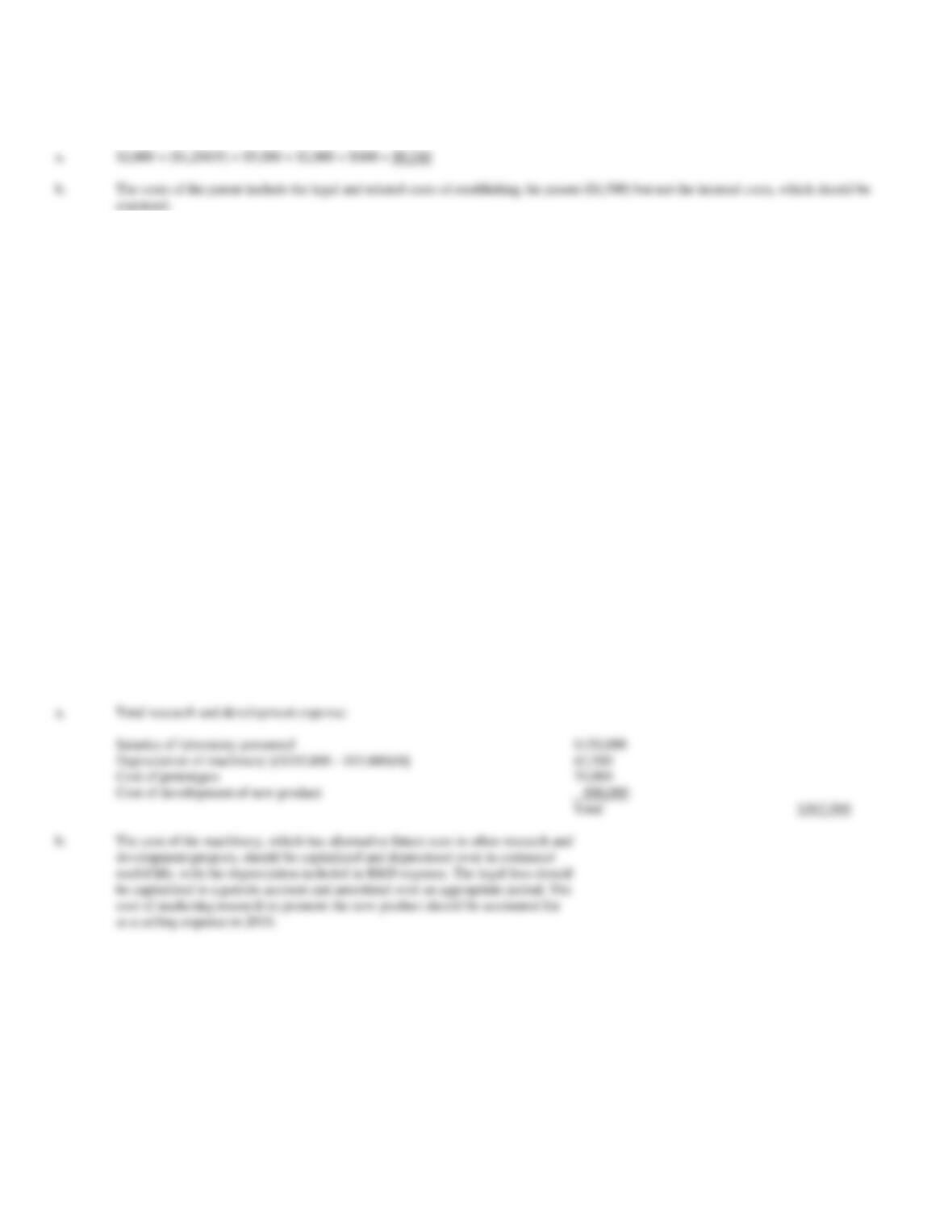
a.
Total research and development expense:
Salaries of laboratory personnel
$150,000
Depreciation of machinery [($355,000 – $15,000)/8]
42,500
Cost of prototypes
70,000
Cost of development of new product
100,000
Total
$362,500
as a selling expense in 2010.
a.
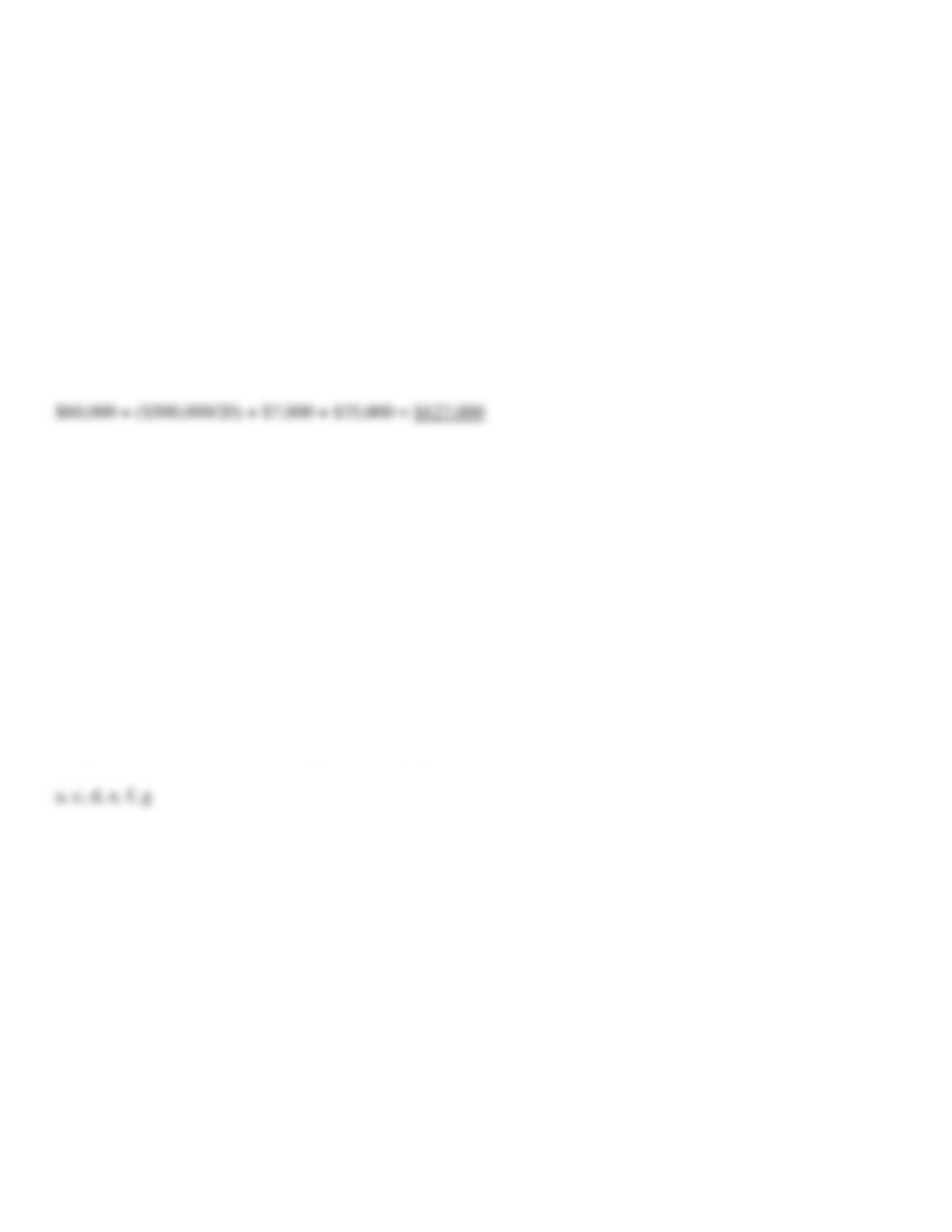
$2,000 + ($1,200/5) + $5,000 + $2,000 + $100 = $9,340
68. Consider the following information from a company’s records for 2010:
Feb. 11
Purchased materials exclusively for use in R&D projects. Of these materials, 30% are left at the end of
the year and will be used in the same project next year (they have no alternative use).
$ 60,000
Aug. 28
Construction costs for a new research facility that has been placed in use on this date and is expected
to be used for 20 years. The facility has no expected salvage value.
500,000
Aug. 29
Purchased an experimental machine from an inventor. The machine is expected to be used for a
particular R&D activity for two years, after which it will have no residual value.
14,000
Nov. 26
Salaries paid to employees involved in R&D.
35,000
Required:
Compute the amount of R&D expense for 2010. The company normally uses straight-line depreciation for plant assets.
69. Certain activities are listed below.
a.
Testing a new type of machine to evaluate its potential usefulness in production
b.
Engineering follow-through in an early phase of commercial production
c.
Totalcost of an R&D building-No alternative use
d.
Salary of director of R&D
e.
Current period depreciation on a building housing R&D activities (alternative future use)
f.
General and administrative costs reasonably allocated to R&D projects
g.
Patent acquired solely for use in a specific R&D project
Required:
List by letter the activities that would be considered in determining R&D costs.
70. Costs associated with various intangibles of a company may either be expensed when incurred or capitalized
and amortized. Such costs might be recorded in any of the following ways:
a.
charged to the patent account and amortized
b.
charged to the franchise account and amortized
c.
charged to other appropriate asset accounts and amortized or depreciated
d.
charged to expense when incurred
Required:
Indicate how each of the following costs should be recorded by placing the appropriate letter (a-d) in the space provided.
____
1.
Initial fee to acquire a franchise.
____
2.
Design, construction, and testing of preproduction prototypes and models.
____
3.
Legal costs incurred in connection with a successful patent application.
____
4.
Laboratory research aimed at discovery of new knowledge.
____
5.
Cost of purchased equipment that will be used in a series of R&D projects over a ten-year period.
____
6.
Legal costs of the initial incorporation of a business.
____
7.
Cost of a long-term lease of land containing mineral deposits.
____
8.
Annual service fee paid to the franchiser’s headquarters for administrative services rendered to the franchisee.
71. Young Co. received a patent on a new type of machine. The legal costs and the patent application costs
totaled $80,000. R&D costs incurred to create the machine were $120,000. In the year in which the company
received the patent, $20,000 was spent in the successful defense of a patent infringement suit.
Required:
At what amount should the patent be capitalized?
72. The Lopez Company was organized at the end of 2010. The following items acquired on January 1, 2011,
were listed by the company as intangible assets at the end of 2011:
Legal fees for registration of a trademark with an anticipated indefinite life
$ 20,000
Patent purchased (newly issued)
80,000
Goodwill (resulting from the purchase of a supplier early in 2011)
240,000
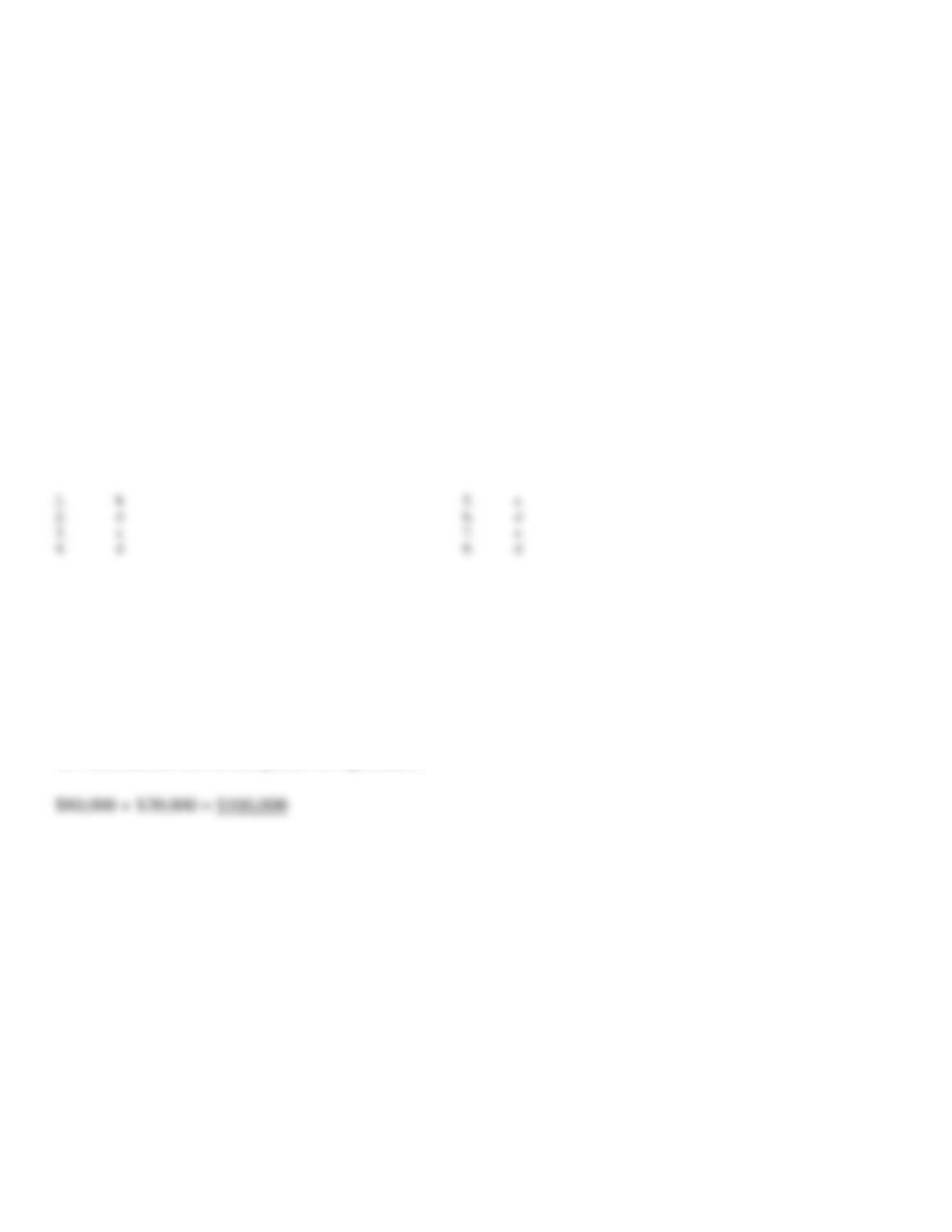
1.
b
5.
c
2.
d
6.
d
3.
a
7.
c
d
d
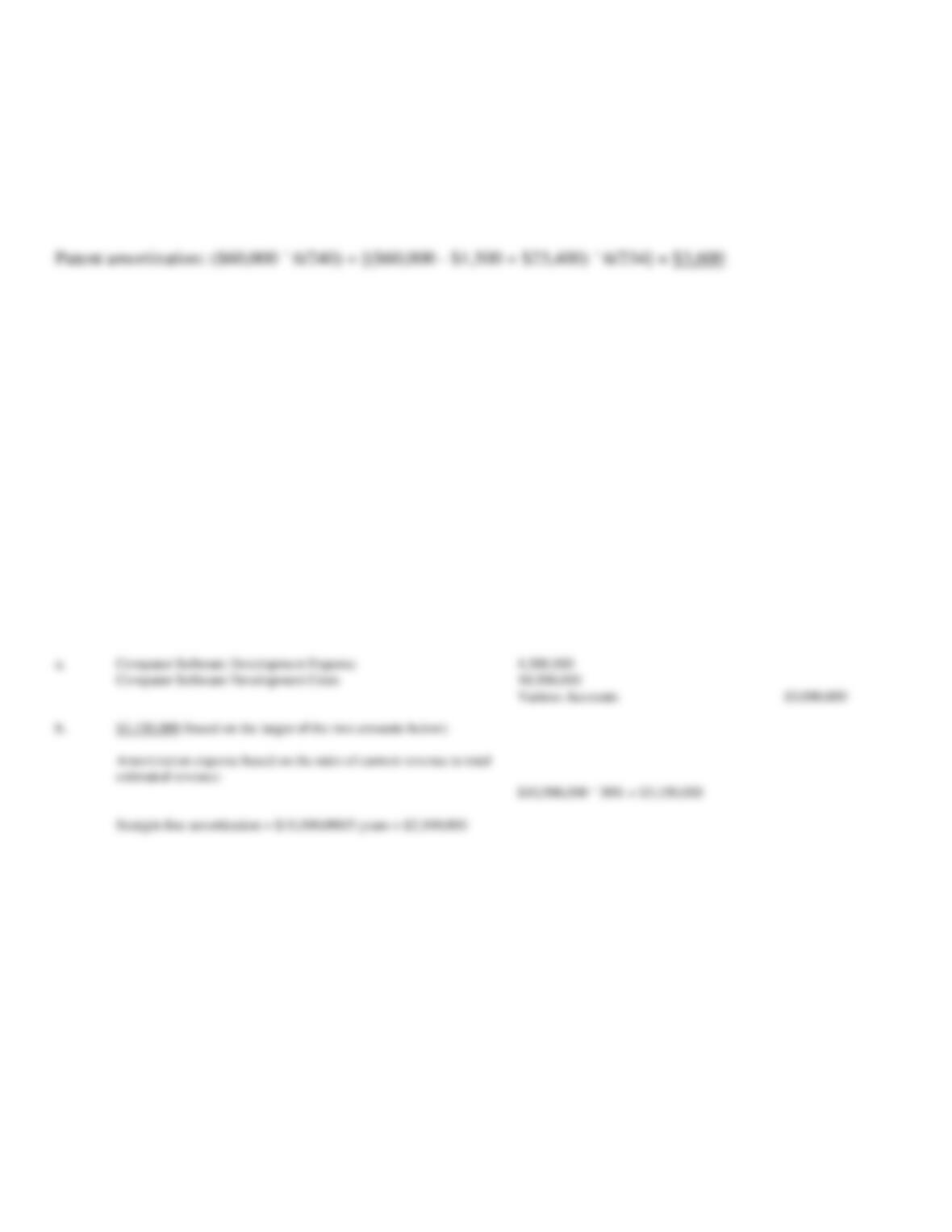
At the beginning of 2011, Lopez also purchased a research building at a cost of $275,000. The company estimates that the building will be used in
numerous projects over a 20-year period. During the year, Lopez spent $75,000 on research and development materials and salaries. In early January
2011, Lopez purchased a patent for $60,000 that was used exclusively for a single research project conducted during 2011. Lopez uses straight-line
amortization over the maximum allowable periods. In addition, on July 1, 2011, Lopez incurred legal fees of $23,400 to defend the new patent that
had been acquired for $60,000. Lopez’s lawyers were successful in the defense of the patent.
Required:
Determine the amortization expense for intangibles for 2011. Lopez calculates amortization expense to the nearest month.
73. During 2010, Quaker, Inc. developed a new financial accounting software package for sale. The company
spent $15,000,000 on the system, 30% of which was incurred prior to technological feasibility being
established. The package was put on sale January 1, 2011, and the company estimates that over the five-year
life of the package it will generate $100 million in sales. During 2011, sales amounted to $30 million.
Required:
a.
Prepare the journal entry to record the development costs incurred in 2010.
b.
Compute the amortization expense of the capitalized software costs for 2011.
Computer Software Development Costs
10,500,000
Various Accounts
15,000,000
$10,500,000 ´ 30% = $3,150,000
Straight-line amortization = $10,500,000/5 years = $2,100,000
74. Melissa Company, which was organized in January 2010, recorded the following transactions during 2010
in a single account called Intangible Assets:
Intangible Assets
2010
January
2
State incorporation fees
$ 10,000
January
2
Legal fee to incorporate
20,000
January
3
Underwriter fees for handling stock issue
45,000
March
1
Patent acquired from Laura Company
240,000
June
1
Employee training costs-see note
20,000
December
1
Legal costs incurred to defend patent acquired on Feb. 1
(Melissa Co. won the lawsuit)
110,000
December
1
Discount on bonds payable
450,000
January–
December
R&D costs incurred for new product development
180,000
December
31
Catering costs for board of directors’ meeting
12,000
December
31
Ending balance
$1,087,000
Note: The president of Melissa has stated that she believes the employee training costs have resulted in goodwill.
Required:
a.
Prepare an entry as of December 31, 2010, to reclassify the items from the intangible assets account to the appropriate accounts.
b.
Prepare the adjusting entry or entries required to amortize any intangible assets recorded or remaining from requirement a. Patents are
estimated to have a ten-year economic life. Any other intangible assets recognized should be amortized over their legal life. Record
amortization to the nearest month, using the straight-line method.
75. Early in 2010, Nebulon Company entered into the following cash transactions:
a.
Registered a patent. Research and development costs for the patent were $50,000. Legal fees incurred in registration were $8,500.
b.
Purchased a franchise with an unlimited life with payment of a $25,000 initial franchise fee and a $5,000 operating fee.
c.
Purchased laboratory equipment costing $150,000. The equipment, with an estimated life of ten years and no residual value, will be
used in a variety of research projects.
d.
Purchased a patent from Asteroid Company at a cost of $40,000. The patent is believed to have an estimated useful life of ten years.
e.
Registered a trademark that was developed by Nebulon’s advertising department at a cost of $11,000. Registration fees were $500, and
the legal fees incurred were $1,500. The trademark is expected to last indefinitely.
a.
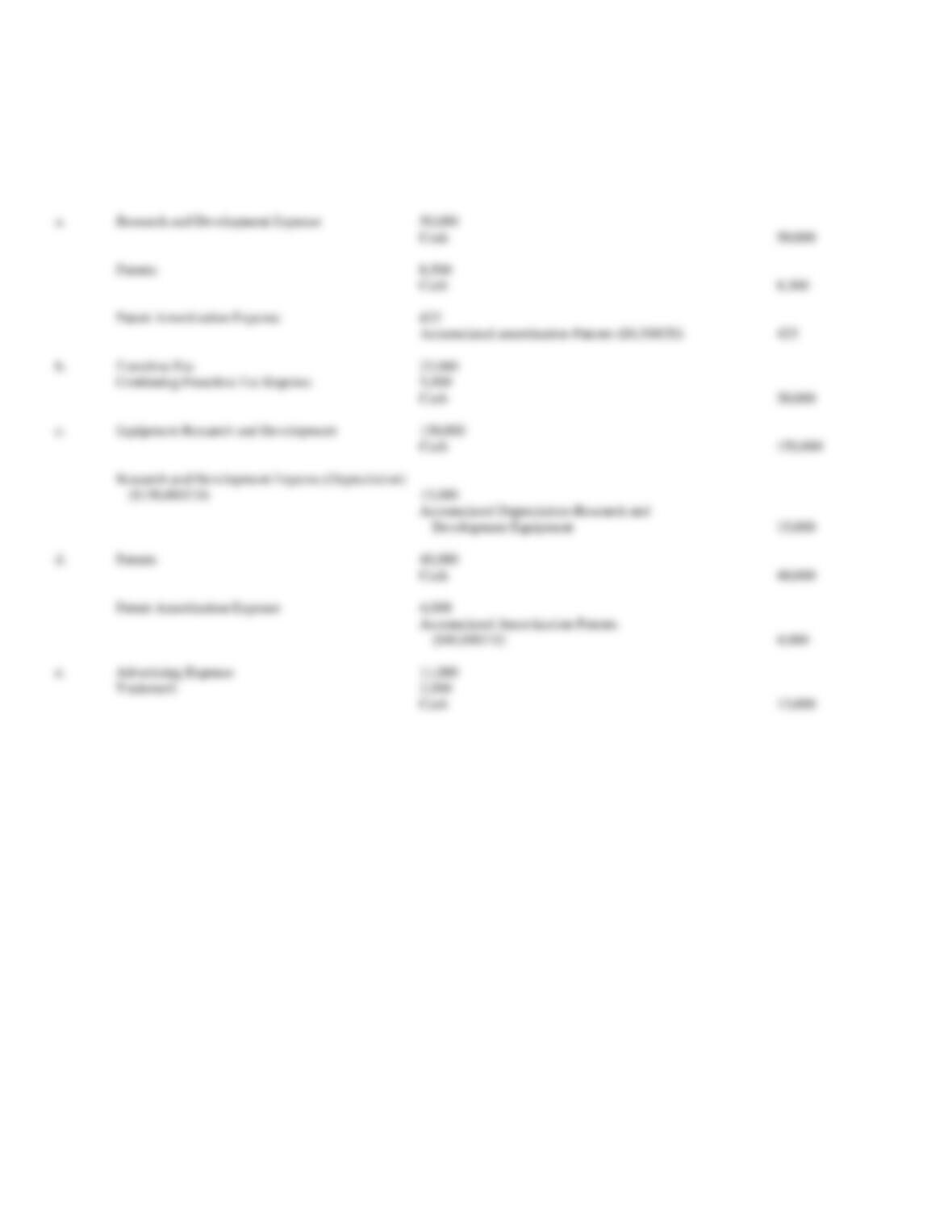
Organization Expense
($10,000 + $20,000 + $45,000)
75,000
Patents ($240,000 + $110,000)
350,000
R&D Expense
180,000
Employee Training Expense
20,000
Miscellaneous Expense
12,000
Discount on Bonds Payable
450,000
Intangible Assets
1,087,000
b.
Amortization Expense-Patents
($240,000 ´ 10/120) +
[($350,000 – $20,000) ´ 1/110]
23,000
Patents
23,000
Required:
Prepare journal entries to record each transaction, including appropriate amortization for the year. Unless a better alternative is indicated, amortize
the intangibles over their legal lives.
76. The CS Co. began operations in January 2010. Listed below are selected transactions for 2010 and 2011:
·
During 2010, $125,000 in R&D expenditures were made to develop a new product that was patented on July 1, 2010. CS believes the
patent will provide benefits for ten years. Legal fees incurred were $24,000.
·
On September 1, 2010, CS paid EZ Company $180,000 for its patent on a successful product. The patent has six remaining years in its
legal life.
·
On October 1, 2010, CS applied for and received a trade name from the government. The legal costs associated with filing for the trade
name were $10,000. In addition, during September, the company incurred $50,000 in advertising its name. Benefits are expected
indefinitely.
·
In early January 2011, CS paid $20,000 in legal fees to defend the patent acquired from EZ. CS’s attorneys were successful in the
lawsuit.
·
During 2011, R&D expenditures of $90,000 were incurred in the development of a product. A patent was received on December 1,
2011. Legal fees paid in connection with the patent were $15,000. The economic life of the product is expected to be five years.
Required:
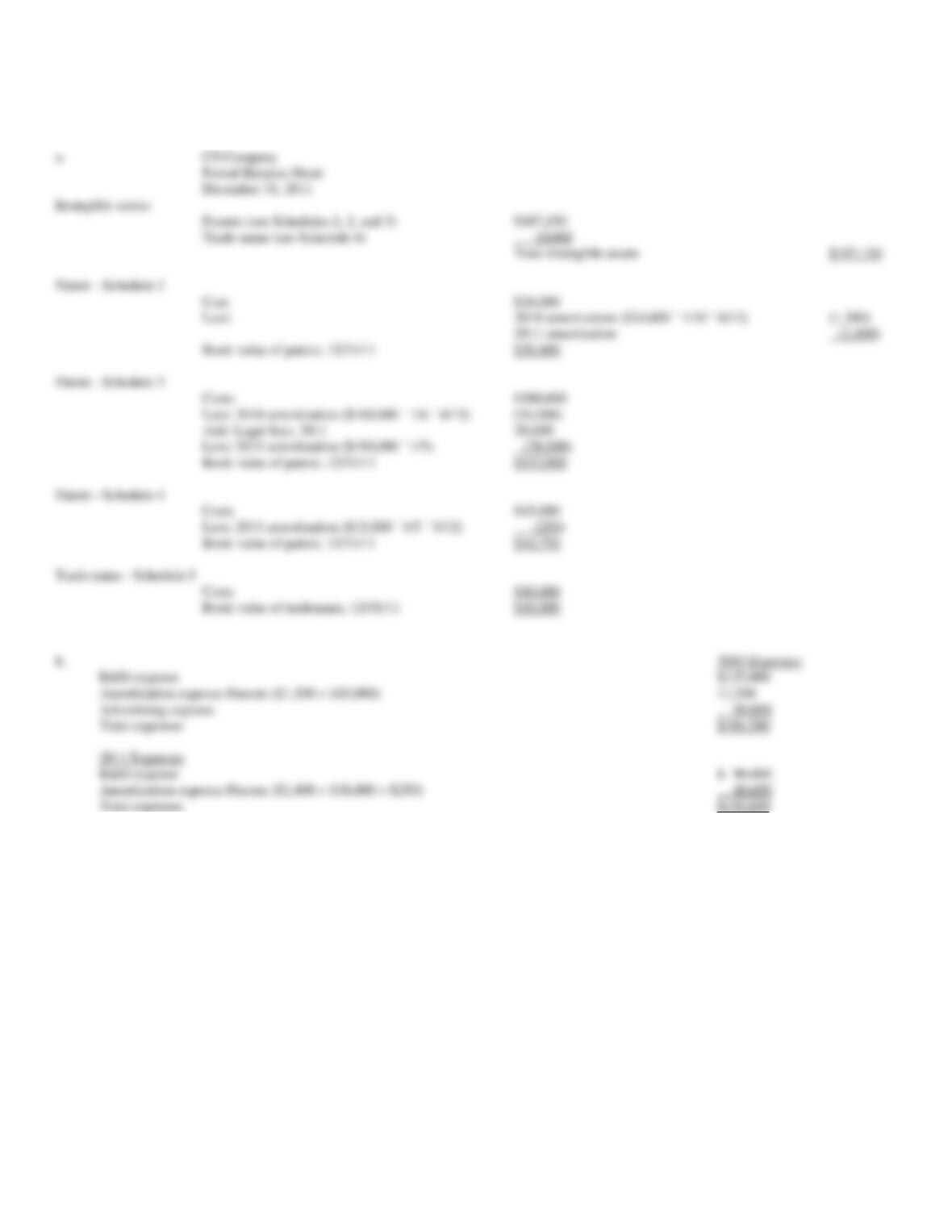
a.
Prepare a partial balance sheet for CS Company as of December 31, 2011, showing the intangible assets. In support of your answer,
prepare a separate schedule for each intangible asset. The company amortizes its intangible assets using the straight-line method and
recognizes amortization to the nearest month.
b.
Prepare a schedule to calculate CS’s expenses related to the above transactions for both 2010 and 2011.
77. The Ripon Corporation was organized and began to operate on January 1, 2010, to manufacture and sell
children’s clothes. During 2010, the following expenditures were recorded in the company’s goodwill account:
Goodwill
2010
January
2
Corporate registration legal fees
$ 5,000
January
2
Underwriter’s fee for the issuance of common stock
7,500
January
2
Discount on bond issue
40,000
January
2
Cost of a major advertising campaign to promote the company’s name and merchandise
75,000
January
14
Cost of employee training program
25,000
January
14
Excess of purchase price over market value of Mannekin’s net identifiable assets paid in
acquiring Mannekin Corporation
150,000
January
14
Cost of a patent purchased from a competitor with an expected life of ten years
25,000
July
1
Operating loss for first six months
45,000
July
1
Legal fees for the successful defense of patent acquired on January 14
10,000
December
20
Cost of Christmas party
12,000
Total
$394,500
The above transactions were recorded by an inexperienced data entry clerk.
Required:
a.
Prepare an entry as of December 31, 2010, to reclassify the appropriate items from the goodwill account to appropriate accounts.
b.
Prepare the adjusting entry or entries required to amortize the intangible assets using the straight-line method. Calculate amortization to
the nearest month.
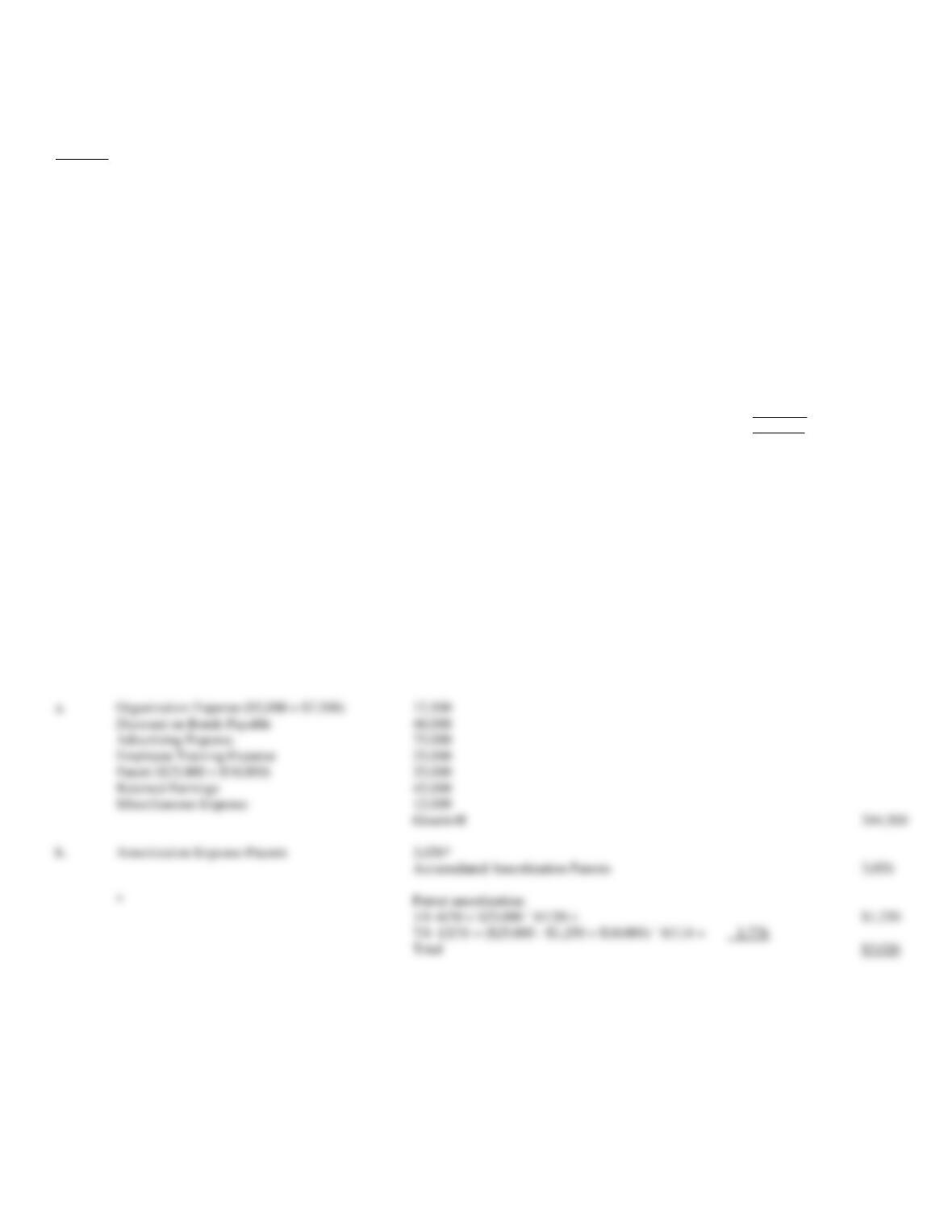
Organization Expense ($5,000 + $7,500)
12,500
Discount on Bonds Payable
40,000
Advertising Expense
75,000
Employee Training Expense
25,000
Patent ($25,000 + $10,000)
35,000
Retained Earnings
45,000
Miscellaneous Expense
12,000
Goodwill
b.
Amortization Expense-Patents
3,026*
Accumulated Amortization-Patents
*
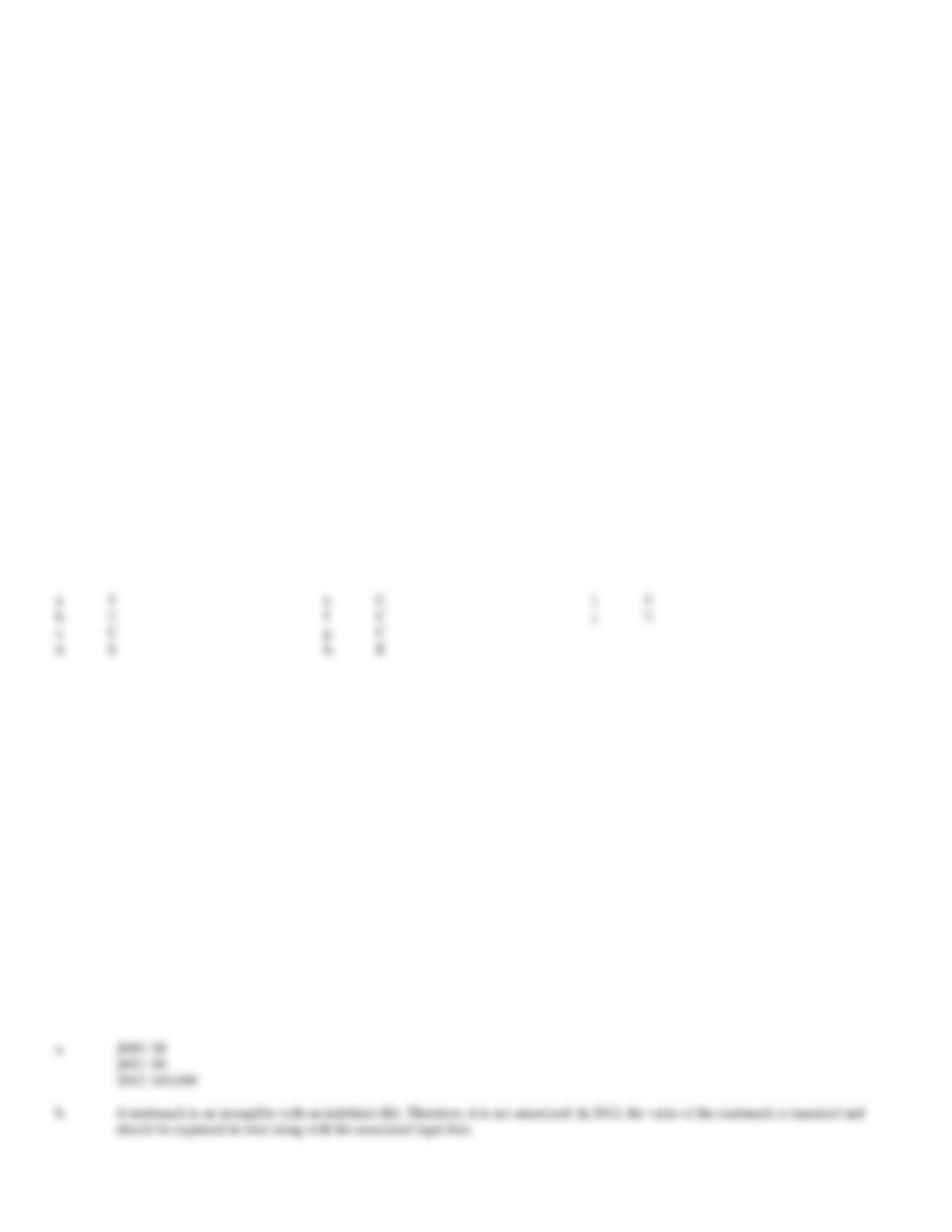
Patent amortization:
1,776
Total
78. Listed below is a series of statements about various costs associated with intangibles.
____
a.
Software production costs incurred prior to technological feasibility being established.
____
b.
Continuing franchise costs.
____
c.
The cost paid over the fair value of an acquired company’s net assets.
____
d.
Maintenance and customer support costs incurred after a software package is released for sale.
____
e.
Legal costs incurred on the successful defense of a patent infringement suit.
____
f.
The cost of acquiring a copyright.
____
g.
Software production costs incurred after technological feasibility is established.
____
h.
Costs of improving the software used in a company’s management information system.
____
i.
Legal fees incurred in conjunction with the unsuccessful defense of a patent infringement lawsuit.
____
j.
Employee training costs associated with training employees to run new software.
Required:
Indicate whether each of these costs should be expensed (E) or capitalized (C) in the space provided.
79. In March of 2010, Xeon Corp. applied for a trade name. Legal costs associated with the application were
$25,000. At the time of filing the application, the company projected extra annual income to be generated
through having the trade name to be $100,000. On Feb. 5, 2012, the company incurred $20,000 in an
unsuccessful defense of the trade name.
Required:
a.
What is the amount of income or expense associated with the trade name for the year 2010? For the year 2011? For the year 2012?
b.
What is the accounting rationale for the amounts recorded in each year?
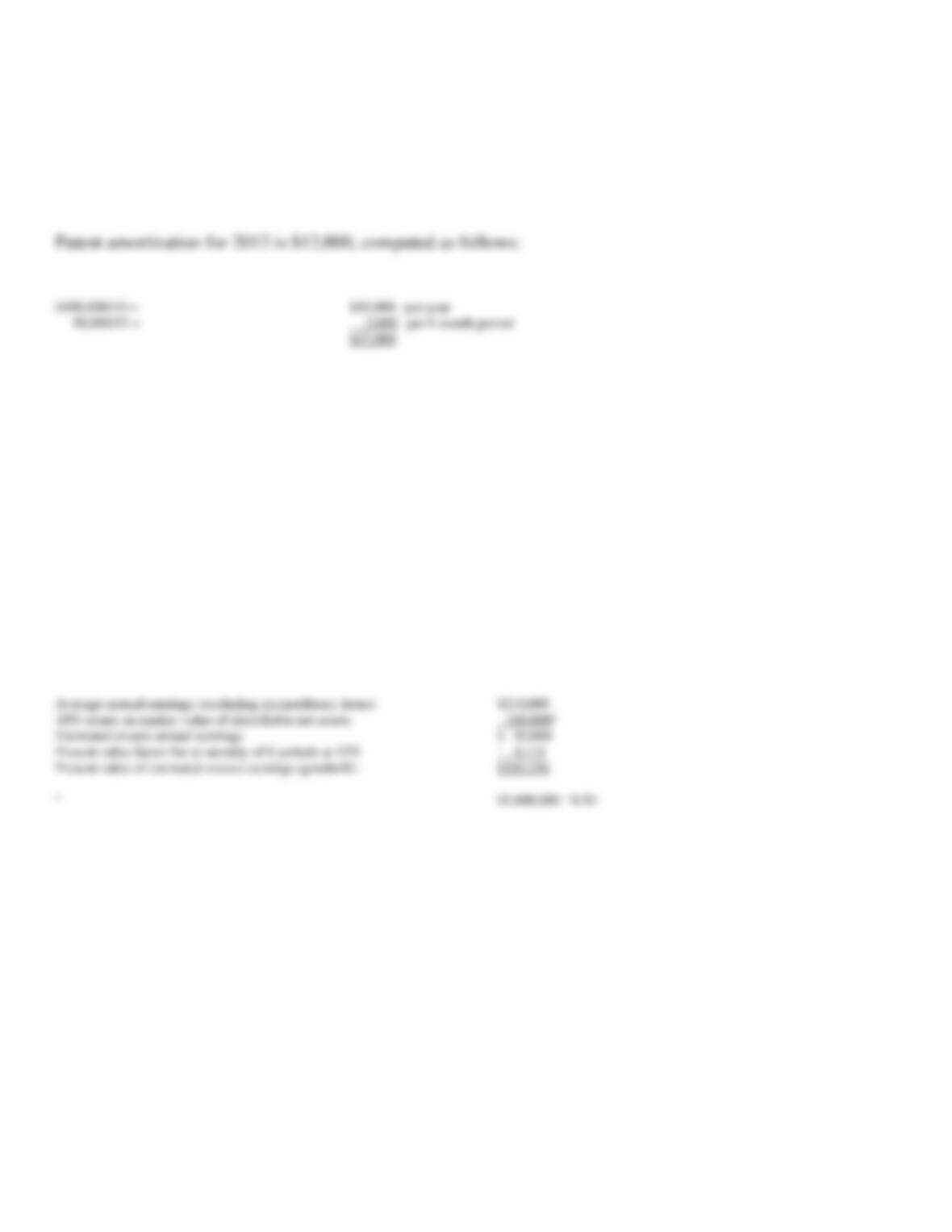
2010: $0
2011: $0
a.
E
e.
C
i.
E
b.
E
f.
C
j.
E
c.
C
g.
C
d.
E
h.
E
80. On January 1, 2010, Sable, Inc. bought a patent for $100,000. There were ten years left of the patent’s legal
life. On July 1, 2012, the company successfully defended the patent in court at a cost of $30,000.
Required:
Compute the amount of patent amortization expense for 2012. Assume Sable calculates amortization to the
nearest month and uses the straight-line method.
81. Bob Corporation desires to acquire the Debbie Company. Debbie has earned an average of $210,000 of net
income for the last five years. The market value of Debbie’s identifiable net assets is $1.6 million. The normal
rate of return earned by a company in Debbie’s industry is 10%. The excess earnings of Debbie are expected to
last six years and are to be capitalized using a discount rate of 12%. The present value factor for an annuity for
six periods at 12% is 4.111.
Required:
Calculate the value of goodwill associated with the expected purchase of Debbie Company based on average
earnings for the past five years. Show all computations in good form.
Average annual earnings (excluding extraordinary items)
$210,000
10% return on market value of identifiable net assets
Estimated excess annual earnings
$ 50,000
Present value factor for an annuity of 6 periods at 12%
´ 4.111
Present value of estimated excess earnings (goodwill)
$205,550
$1,600,000 ´ 0.10
82. Smith Corporation is interested in acquiring Dawson Company and has obtained the following information
about Dawson:
·
Dawson’s net income has averaged $180,000 for the past five years. This average is expected to continue in perpetuity.
·
The book value of Dawson’s recorded net assets is $600,000.
·
Dawson owns a fully depreciated building with a market value of $150,000.
·
Dawson has title to a patent with a market value of $40,000, which is not included in Dawson’s recorded net assets.
·
The market value of Dawson’s recorded net assets (excluding c and d above) is $1,000,000.
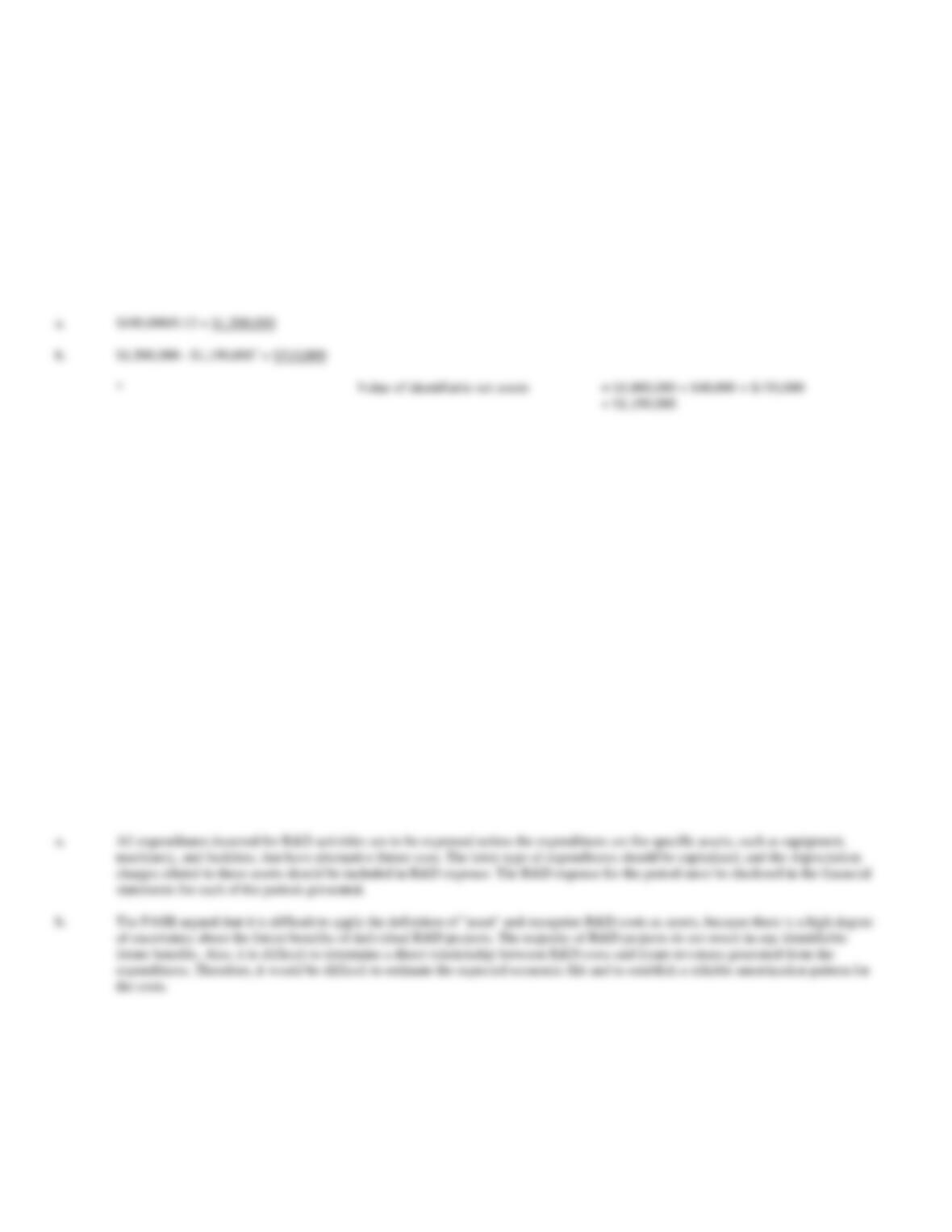
$100,000/10 =
$10,000 per year
30,000/15 =
2,000 per 6 month period
$12,000
In evaluating the Dawson data, Smith believes that a 12% discount rate is appropriate.
Required:
Calculate each of the following and provide all necessary computations to support your answer:
a.
Based on the information provided, what price should Smith be willing to pay to acquire Dawson?
b.
What portion of the purchase price should Smith capitalize as purchased goodwill?
83. The Arnao Corporation is contemplating building a research and development facility and performing R&D
activities in the area of robotics. The president of the company is interested in the accounting required for R&D
costs such as materials, facilities, personnel costs, equipment, intangibles purchased from others, and any
indirect costs. Arnao’s president has asked the company’s controller to describe current GAAP requirements
with respect to R&D expenditures.
Required:
a.
Based on current GAAP, describe the accounting and reporting requirements for R&D expenditures such as the ones listed above.
b.
Describe the rationale that was used by the FASB in its decision to account for R&D costs as prescribed in your answer to requirement
a.
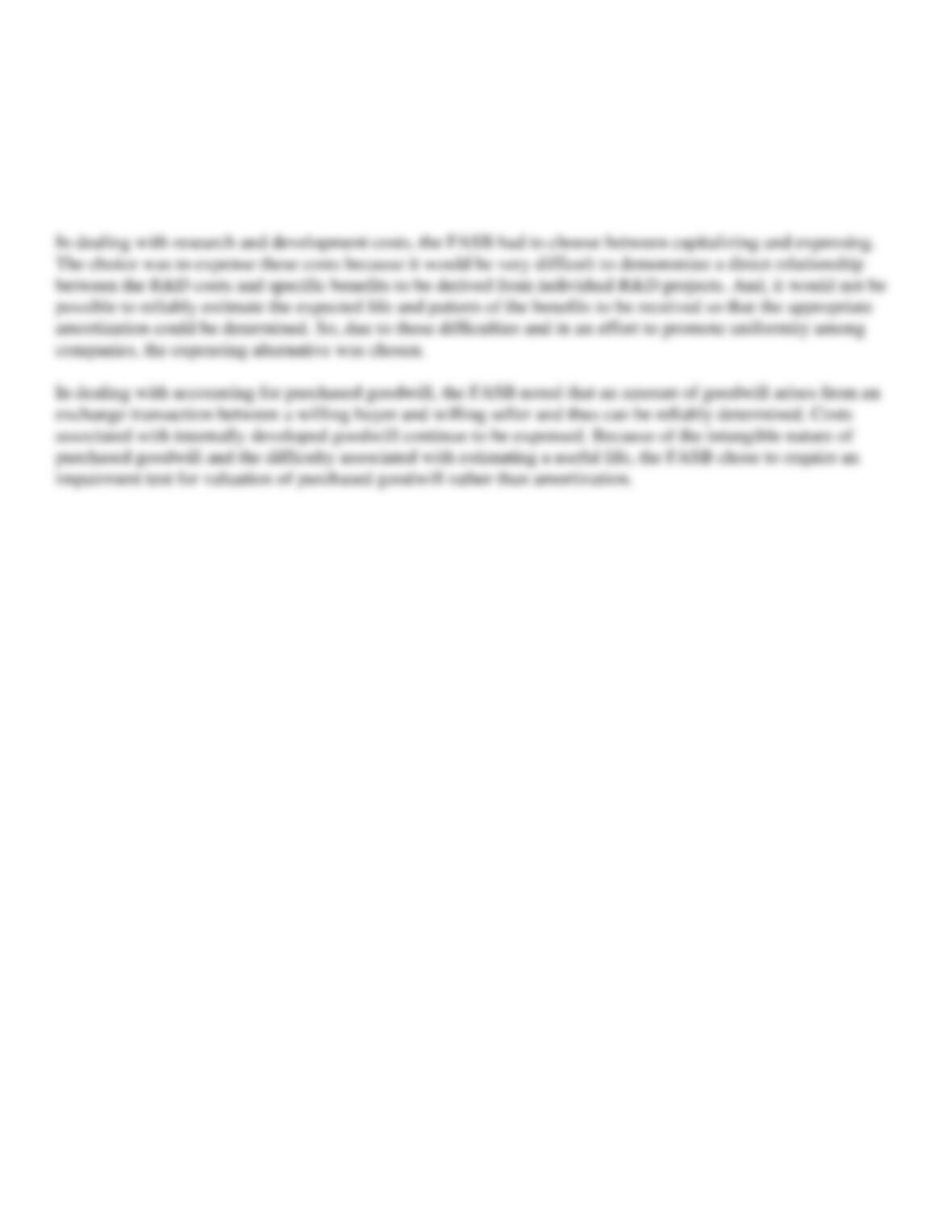
statements for each of the periods presented.
expenditures. Therefore, it would be difficult to estimate the expected economic life and to establish a reliable amortization pattern for
a.
$180,000/0.12 = $1,500,000
*
Value of identifiable net assets
84. GAAP requires that research and development costs be expensed and that purchased goodwill be capitalized
and not be amortized.
Required:
From a conceptual viewpoint, discuss the validity of the different treatments for these two types of
expenditures.
85. The Jessie Company acquired a competitor company in January 2010. When Jessie’s accountant recorded
the purchase, she correctly recorded an amount for goodwill based on the expectation of the acquired company’s
earning a rate of return on its assets that was in excess of the industry’s rate of return. In fact, the acquired
company doubled the expected rate of return in 2010 and 2011. As a result of these increased earnings, in early
2012 the president of the Jessie Company asked the company’s accountant to increase the amount recognized as
goodwill.
Required:
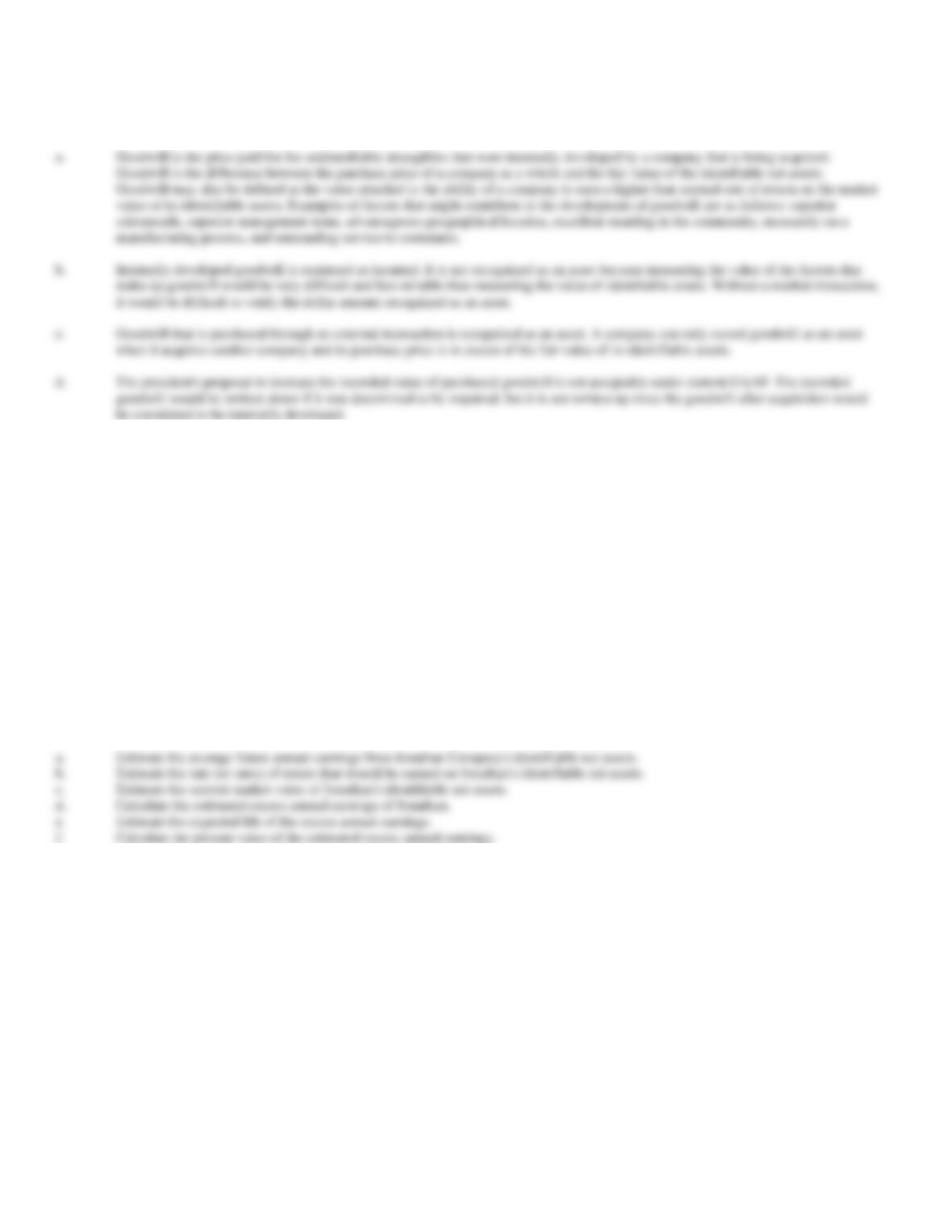
a.
Define the term “goodwill.” In addition, discuss several possible factors that might contribute to a company having goodwill.
b.
Discuss the accounting treatment under current GAAP for goodwill that is internally developed. Discuss the rationale for this treatment.
c.
Discuss the accounting treatment under current GAAP for goodwill that is acquired through an external transaction.
d.
Discuss the appropriateness of the president’s request to increase the recorded amount of goodwill.
86. The Jared Corporation is contemplating the acquisition of the Jonathan Company. Jared believes that
Jonathan has goodwill, but Jared is not clear as to how to determine a value of Jonathan Company’s goodwill.
Required:
Describe briefly the series of steps that should be used by Jared Corporation in calculating an estimate of the
value of Jonathan Company’s goodwill.
Jared Corporation should use the following procedures in order to calculate an estimate of the value of Jonathan
Company’s goodwill:
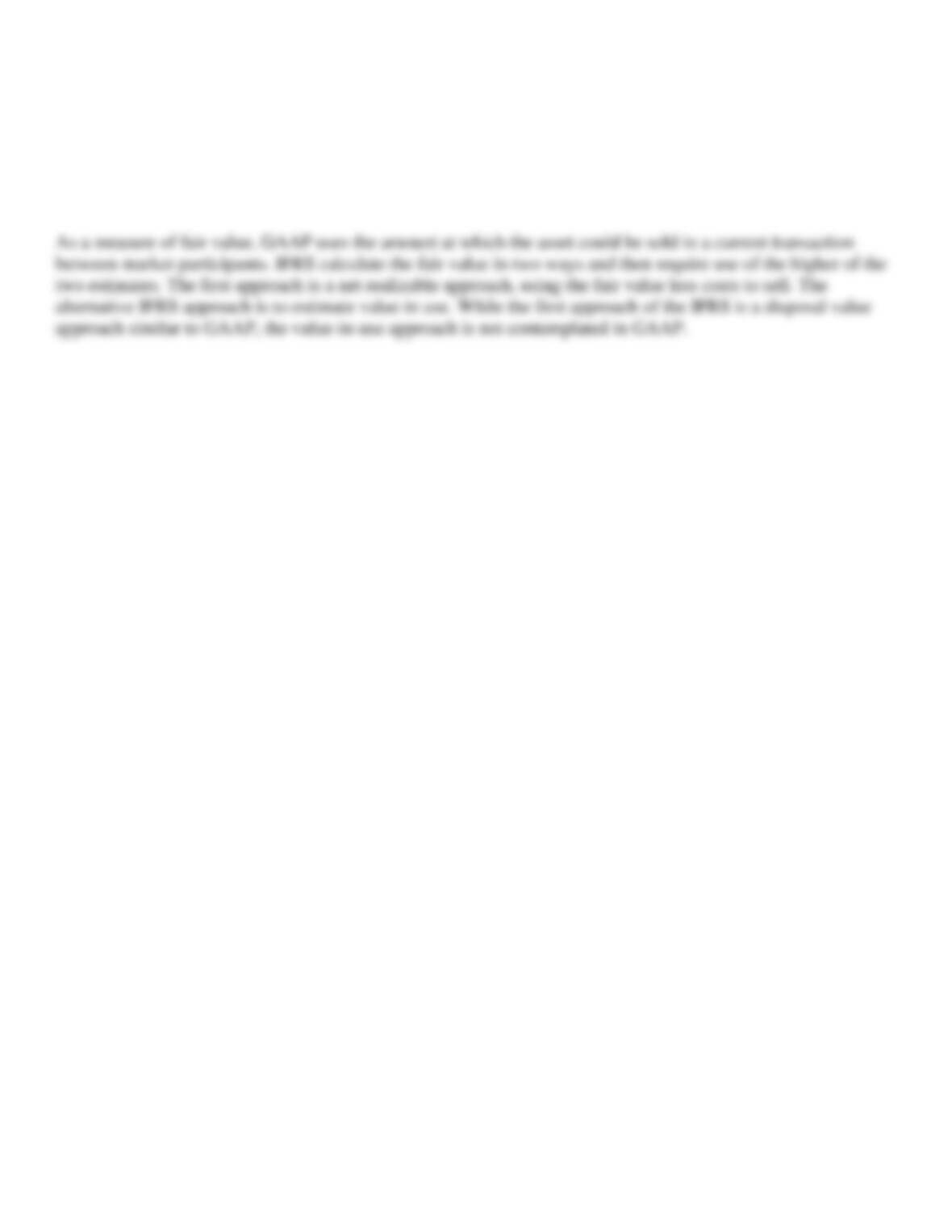
87. IFRS and GAAP differ in the application of the fair value concept for impairment tests applied to intangible
assets.
Required:
Describe the fair value concept as it is applied for impairment tests in IFRS and GAAP, highlighting the
differences.