Payment of bonds at maturity
100,000
Purchase of land
200,000
Issuance of common stock
300,000
Increase in merchandise
inventory
35,400
Decrease in accounts
receivable
28,800
Increase in accounts payable
23,700
Payment of cash dividends
32,000
156.
Holly Oaks, Inc. is preparing the company’s statement of cash flows for the fiscal year just
ended. Using the following information, determine the amount of cash flows from
operating activities using the indirect method:
Net income
$231,000
Depreciation expense–equipment
43,000
Gain on the sale of equipment
5,500
Increase in merchandise inventory
53,100
Decrease in accounts receivable
18,900
Increase in accounts payable
21,700
Purchase of land
300,000
Proceeds from sale of equipment
93,000
Issuance of common stock
150,000
Payment of cash dividends
37,000
157.
Holly Oaks, Inc. is preparing the company’s statement of cash flows for the fiscal year just
ended. Using the following information, determine the amount of cash flows from investing
activities:
Net income
$231,000
Depreciation expense–equipment
43,000
Gain on the sale of equipment
5,500
Increase in merchandise inventory
53,100
Decrease in accounts receivable
18,900
Increase in accounts payable
21,700
Purchase of land
300,000
Proceeds from sale of equipment
93,000
Issuance of common stock
150,000
Payment of cash dividends
37,000
158.
Holly Oaks, Inc. is preparing the company’s statement of cash flows for the fiscal year just
ended. Using the following information, determine the amount of cash flows from
financing activities:
Net income
$231,000
Depreciation expense–equipment
43,000
Gain on the sale of equipment
5,500
Increase in merchandise inventory
53,100
Decrease in accounts receivable
18,900
Increase in accounts payable
21,700
Purchase of land
300,000
Proceeds from sale of equipment
93,000
Issuance of common stock
150,000
Payment of cash dividends
37,000
12-105
159.
A company had average total assets of $3,216,000, total cash flows of $1,320,000, cash
flows from operations of $554,000, and cash flows for plant assets of $850,000. The cash
flow on total assets ratio equals:
Matching Questions
160.
Match each of the following items with the appropriate definitions.
1. Operating
Transactions with a company’s owners and
creditors that include obtaining cash from
issuing debt and repaying the amounts
borrowed, and obtaining cash from or
2. Statement
Transactions that include making and
collecting notes receivable or purchasing and
selling plant assets, or investments in other than
3. Direct
A financial statement that reports the cash
inflows and cash outflows for an accounting
period, and classifies those cash flows as
4. Indirect
A method of computing and reporting that
involves adjusting the net income amount by
adding and subtracting items that are necessary
to yield net cash provided (used) by operating
5. Financing
A method of computing and reporting the net
cash provided (used) by operating activities that
lists the major items of operating cash receipts,
and then subtracts the major items of operating
6. Investing
Activities that involve the production or
purchase of merchandise and the sale of goods
or services to customers, including expenditures
Short Answer Questions
161.
For each of the following items, indicate whether it would be classified as an (O) operating
activity, an (I) investing activity, a (F) financing activity, or a significant (N) noncash
financing and investing activity.
__________ (1) Received cash dividends from investments in trading securities.
__________ (2) Collected accounts receivable from customers.
__________ (3) Issued bonds payable for cash.
__________ (4) Paid wages to employees.
__________ (5) Issued stock for cash.
__________ (6) Sold equipment for cash.
__________ (7) Purchased land in exchange for a note payable.
__________ (8) Paid cash dividends.
__________ (9) Received interest from investments in trading securities.
_________ (10) Purchases of land for cash.
162.
For each of the following items, indicate whether it would be classified as either an (O)
operating activity, an (I) investing activity, a (F) financial activity, or a significant (N)
noncash financing and investing activity.
__________ (1) Cash sales of merchandise.
__________ (2) Sale of land for cash.
__________ (3) Signed a note payable in exchange for cash.
__________ (4) Purchased supplies for cash.
__________ (5) Paid cash to settle an account payable.
__________ (6) Purchased a warehouse in exchange for shares of its stock.
__________ (7) Paid interest on a note payable.
__________ (8) Reissued treasury stock.
__________ (9) Purchased equipment for cash.
_________ (10) Purchased equipment in exchange for a 6-month note payable.
163.
Explain the purpose and format of the statement of cash flows. Also describe its relevance
to decision makers.
164.
Define and discuss the differences between operating, investing, and financing activities.
165.
Define and explain significant noncash investing and financing activities and the method
of reporting them on the statement of cash flows.
166.
Describe the format of the statement of cash flows, including the reporting of significant
noncash investing and financing activities.
167.
Explain the value of separating cash flows into operating activities, investing activities, and
financing activities to financial statement users in analyzing cash flows and the company’s
financial performance and condition.
168.
Define the cash flow on total assets ratio and explain how it is used to evaluate cash flows
and to assess company performance.
169.
What are the five usual steps involved in the preparation of the statement of cash flows?
170.
Explain how the cash flows from operating activities section of the statement of cash
flows is prepared using the indirect method.
171.
Explain how cash flows from investing and financing activities are determined.
172.
Explain the use of a spreadsheet in the preparation of the statement of cash flows.
12-116
173.
Explain how the cash flows from operating activities section of the statement of cash
flows is prepared using the direct method.
Essay Questions
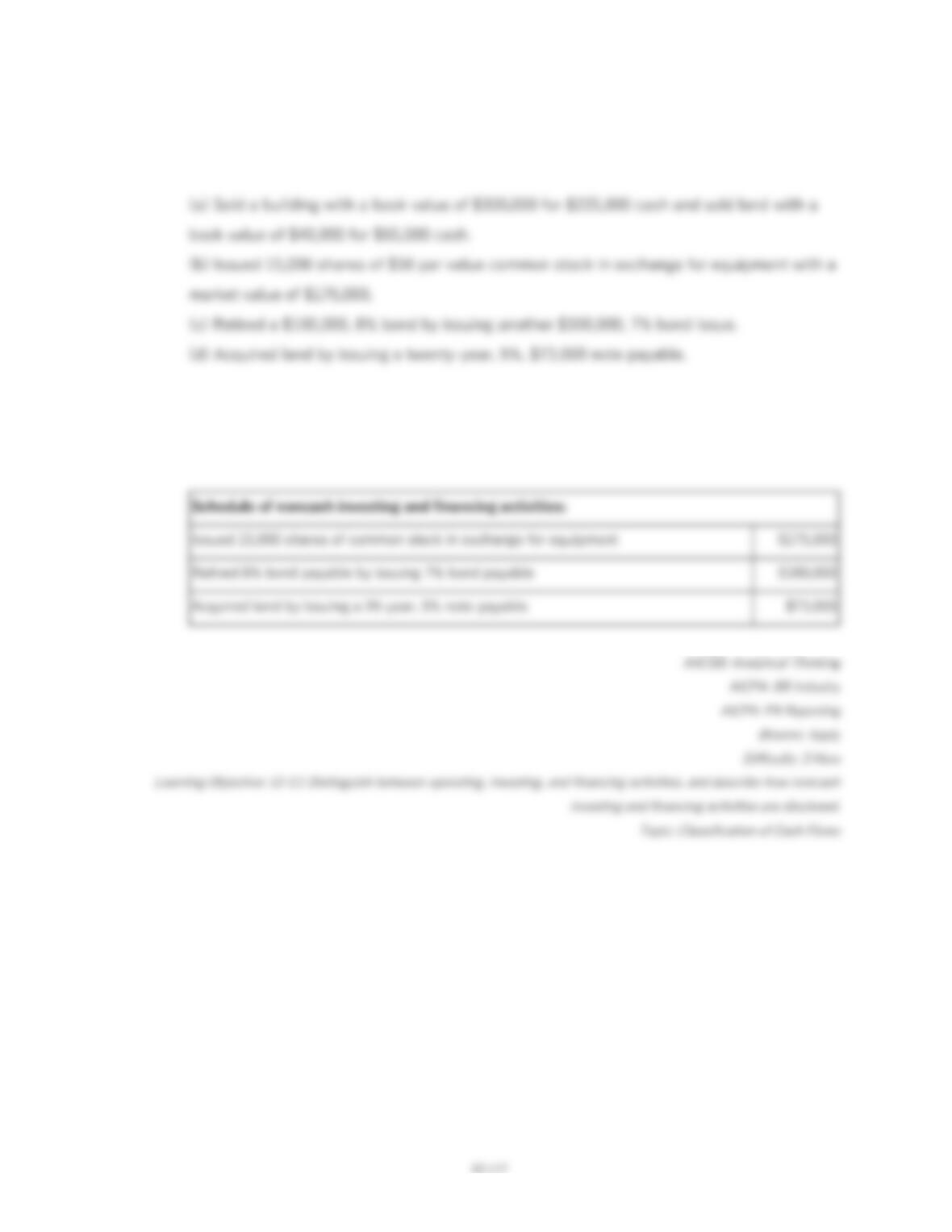
174.
Use the following company information to prepare a schedule of significant noncash
investing and financing activities:
175.
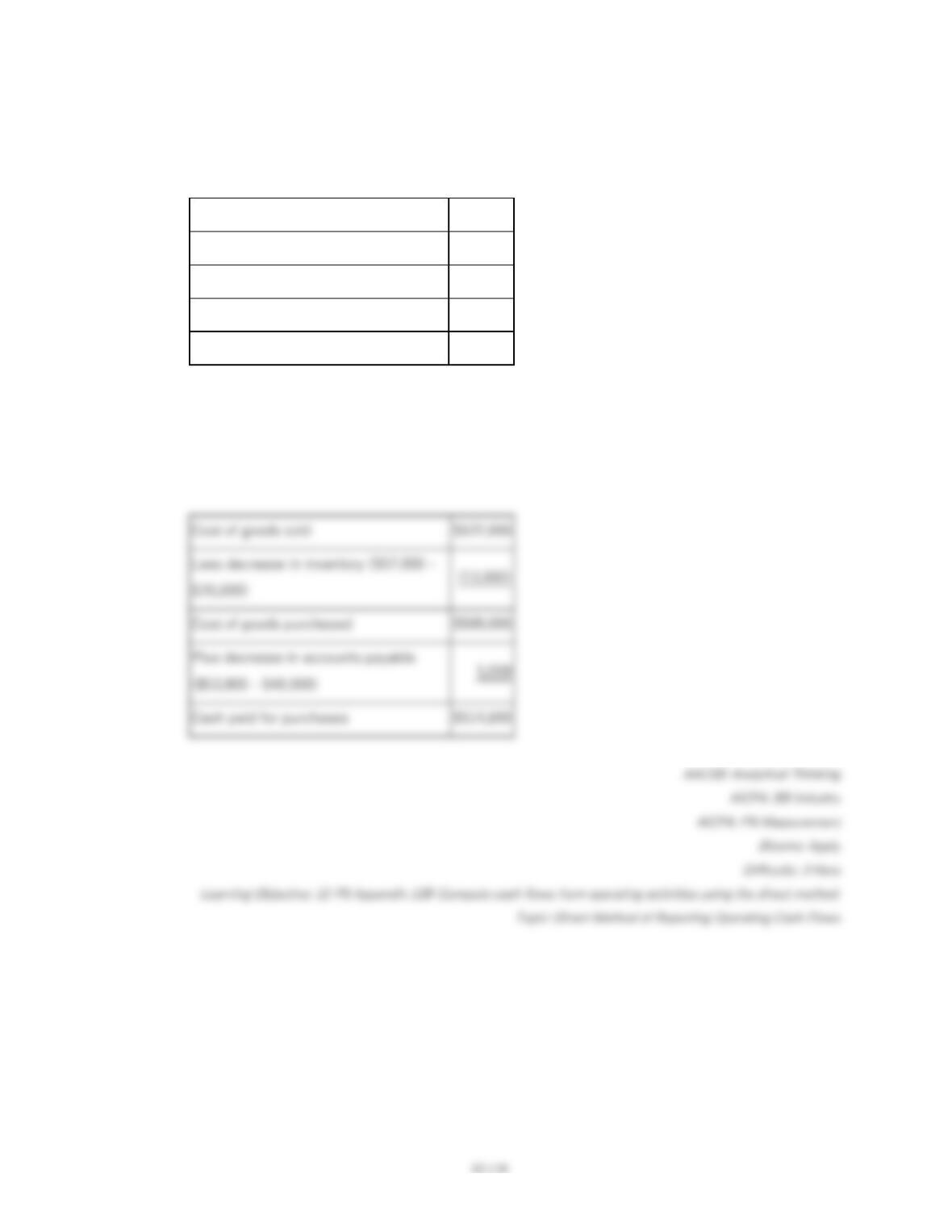
Based on the following information provided about a company’s operations, calculate its
cost of goods purchased and its cash paid for merchandise.
Cost of goods sold
$522,000
Merchandise inventory, beginning year
70,000
Accounts payable, beginning year
53,000
Merchandise inventory, end-of–year
57,000
Accounts payable, end-of-year
48,000
Cost of goods sold
Cost of goods purchased
Cash paid for purchases
12-119
176.
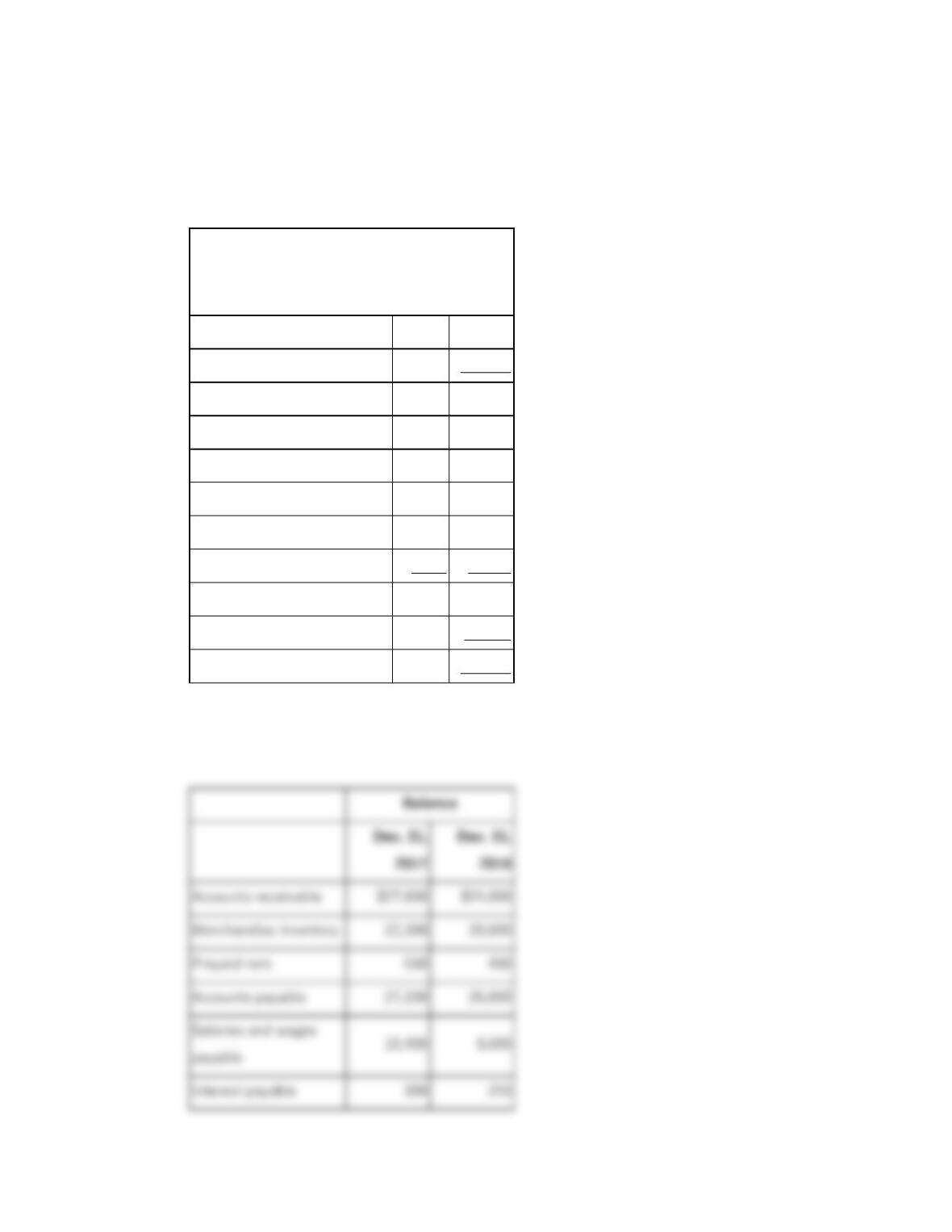
Use the following income statement and information about selected current assets and
current liabilities to calculate the net cash provided or used by operating activities using
the indirect method.
PULLMAN COMPANY
Income Statement
For Year Ended December 31, 2017
Sales
$180,000
Cost of goods sold
104,000
Gross profit from sales
$76,000
Operating expenses:
Salaries and wages expense
$25,000
Depreciation expense
7,000
Rent expense
7,200
Interest expense
1,900
41,100
Income from operations
$34,900
Loss on sale of land
3,500
Net income
$31,400
Selected beginning and ending balances of current asset and current liability accounts, all
of which relate to operating activities, are as follows:
Merchandise inventory
Prepaid rent
Accounts payable