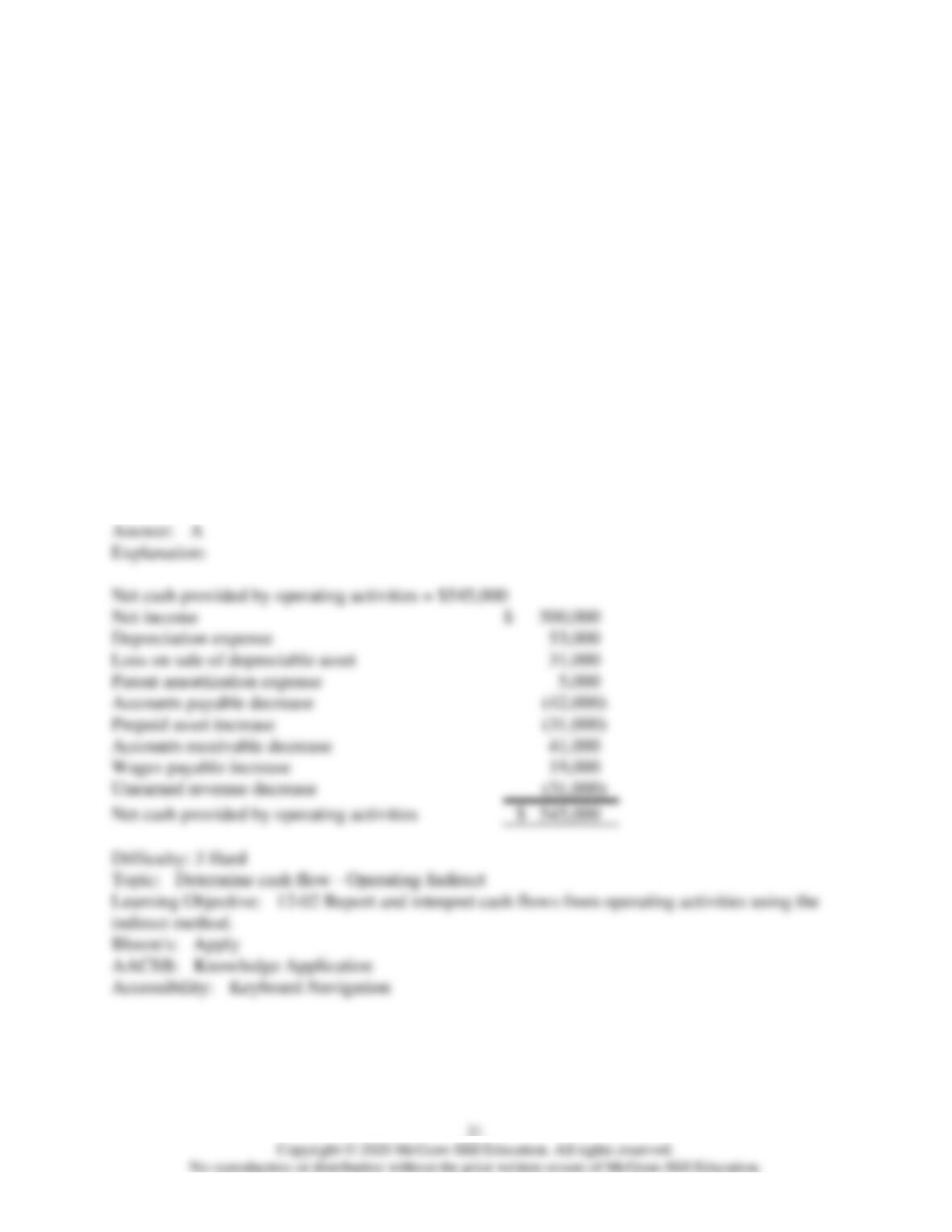
46) GJ Company, a manufacturer, has provided the following information pertaining to its recent
year of operation:
• Net income, $500,000
• Accounts payable decreased $42,000
• Prepaid assets increased $31,000
• Depreciation expense was $53,000
• Accounts receivable decreased $41,000
• Loss on sale of a depreciable asset was $31,000
• Wages payable increased $19,000
• Unearned revenue decreased $31,000
• Patent amortization expense was $5,000
Using the indirect method, how much was GJ’s net cash provided by operating activities?
A) $545,000.
B) $607,000.
C) $514,000.
D) $463,000.
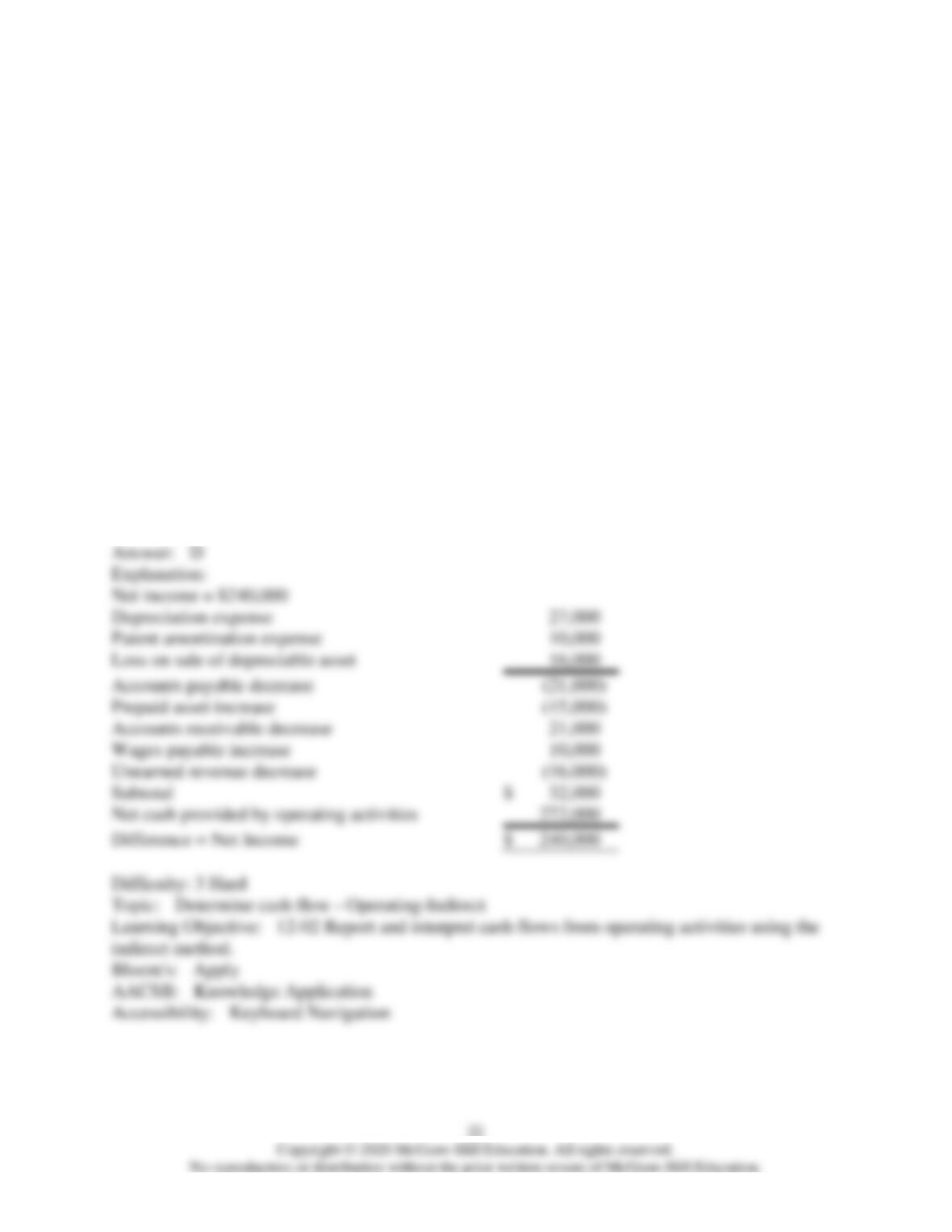
47) DJ Company, a manufacturer, uses the indirect method for preparing its statement of cash
flows. The company has provided the following information pertaining to its recent year of
operation:
• Cash flow from operating activities, $272,000
• Accounts payable decreased $21,000
• Prepaid assets increased $15,000
• Depreciation expense was $27,000
• Accounts receivable decreased $21,000
• Loss on sale of a depreciable asset was $16,000
• Wages payable increased $10,000
• Unearned revenue decreased $16,000
• Patent amortization expense was $10,000
How much was DJ’s net income?
A) $256,000.
B) $210,000.
C) $198,000.
D) $240,000.
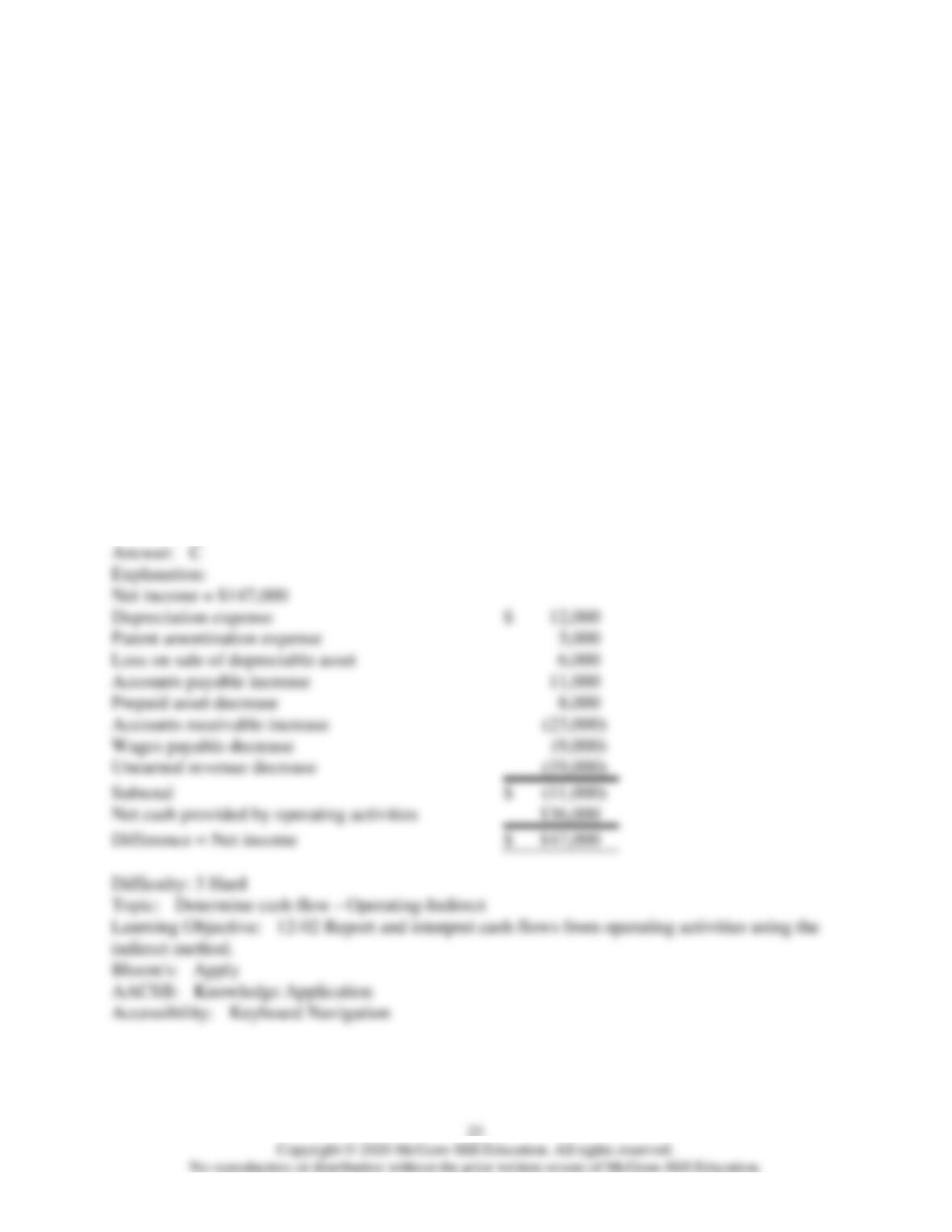
48) KJ Company, a manufacturer, uses the indirect method for preparing its statement of cash
flows. The company has provided the following information pertaining to its recent year of
operation:
• Cash flow from operating activities, $136,000
• Accounts payable increased $11,000
• Prepaid assets decreased $8,000
• Depreciation expense was $12,000
• Accounts receivable increased $23,000
• Loss on sale of a depreciable asset was $6,000
• Wages payable decreased $9,000
• Unearned revenue decreased $19,000
• Patent amortization expense was $3,000
How much was KJ’s net income?
A) $185,000.
B) $135,000.
C) $147,000.
D) $131,000.
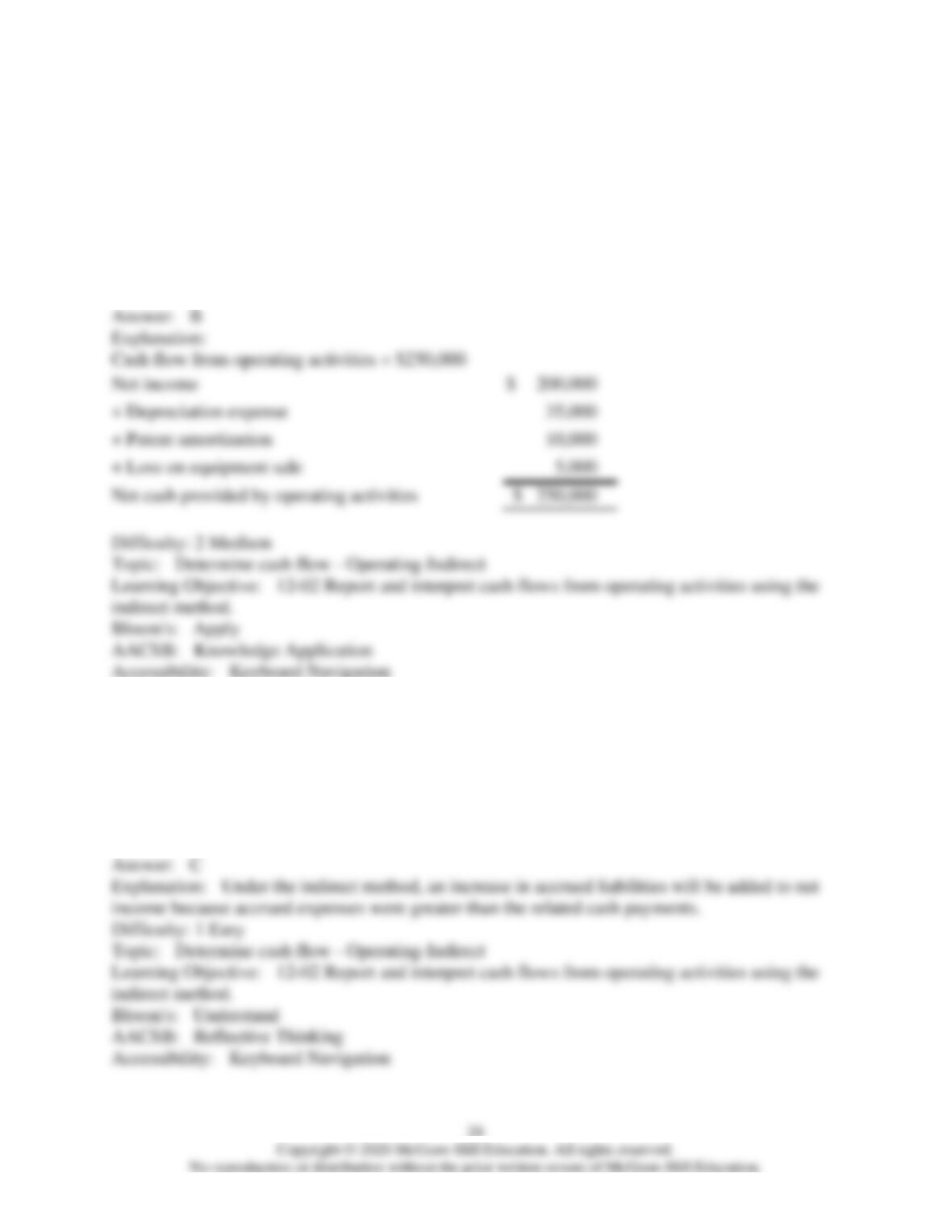
49) A company reported net income of $200,000 during 2019. The company reported
depreciation expense of $35,000, patent amortization of $10,000 and a $5,000 loss on the sale of
equipment. Using the indirect method, how much is the company’s net cash flow from operating
activities?
A) $245,000.
B) $250,000.
C) $240,000.
D) $235,000.
50) Which of the following statements does not correctly describe an adjustment to net income
when determining cash flows from operating activities using the indirect method?
A) An increase in accounts receivable will be subtracted from net income.
B) A loss on the sale of a depreciable asset will be added to net income.
C) An increase in accrued liabilities will be subtracted from net income.
D) An increase in accounts payable will be added to net income.
51) The following information has been provided to you by RKJ Company:
Net income
$
300,000
Decrease in accounts payable
$
114,000
Increase in inventory
$
22,000
Increase in accounts receivable
$
24,000
Decrease in bonds payable
$
25,000
Loss on sale of a depreciable asset
$
19,000
Depreciation expense
$
40,000
Decrease in income taxes payable
$
12,000
Using the indirect method, what is the net cash provided by operating activities?
A) $231,000.
B) $187,000.
C) $206,000.
D) $168,000.
Cash flow from operating activities $187,000
Net income
Depreciation expense
Loss on sale of depreciable asset
Decrease in accounts payable
)
Increase in inventory
)
Increase in accounts receivable
)
Decrease in income taxes payable
)
Net cash provided by operating activities
52) Which of the following statements does not correctly describe an adjustment to net income
when determining cash flows from operating activities using the indirect method?
A) An increase in wages payable will be added to net income.
B) A gain on the sale of a depreciable asset will be subtracted from net income.
C) An increase in prepaid expenses will be subtracted from net income.
D) An increase in income taxes payable will be subtracted from net income.
53) Reliance Corporation has provided the following information for the year ended December
31, 2019:
• The equipment account balance increased $200,000.
• The equipment accumulated depreciation account balance increased $35,000.
• Equipment costing $50,000 was sold during the year resulting in a $10,000 gain.
• Depreciation expense recorded on the equipment during the year was $65,000.
Which of the following statements is correct with respect to determining cash flow from
operating activities?
A) Using the indirect method, net income is increased by the $30,000 increase in the
accumulated depreciation account balance.
B) Using the indirect method, net income is decreased by the $30,000 sales price of the
equipment.
C) Using the indirect method, net income is increased by the $65,000 depreciation expense.
D) Using the indirect method, net income is increased by the $10,000 gain on the sale of the
equipment.
54) Allen Company’s 2019 income statement reported total revenues, $850,000 and total
expenses (including $40,000 depreciation) of $720,000. The company’s accounting records
showed the following: accounts receivable—beginning balance, $50,000 and ending balance,
$40,000; accounts payable—beginning balance, $22,000 and ending balance, $28,000.
Therefore, based only on this information, how much was the 2019 net cash provided by
operating activities?
A) $126,000.
B) $166,000.
C) $174,000.
D) $186,000.
55) Which statement regarding the indirect method is false?
A) Depreciation expense is added to net income.
B) An increase in accounts receivable is added to net income.
C) An increase in accounts payable is added to net income.
D) An increase in merchandise inventory is subtracted from net income.
56) Which of the following statements about the quality of income ratio is correct?
A) When sales are growing, receivables and inventory normally increase faster than accounts
payable so the ratio increases.
B) Seasonal variations in sales have no impact on the quality of income ratio.
C) Failure to accrue appropriate expenses will inflate net income and reduce the quality of
income ratio.
D) The quality of income ratio is computed by dividing net income by cash flow from operating
activities.
57) Which of the following statements about the quality of income ratio is incorrect?
A) An increase in operating assets and a decrease in liabilities will reduce operating cash flows
and thereby reduce the quality of income ratio.
B) Seasonal variations in sales and purchases of inventory can cause wide deviations in the
quality of income ratio.
C) When sales are growing, receivables and inventory normally increase at a faster rate than
accounts payable, which often causes cash flows from operating activities to be less than net
income.
D) Aggressive revenue recognition tends to increase the quality of income ratio.
58) During 2019, Boogle reported net income of $785 million and net cash inflow from
operating activities of $1,196 million. During 2018, Boogle’s net income was $563 million and
net cash inflow from operations was $1,237 million. Which of the following is incorrect about
the quality of income ratios?
A) In 2018 the ratio was 2.2 and in 2019 it was 1.5.
B) The ratio in 2018 was better than the ratio in 2019.
C) Boogle’s quality of income ratios indicate poor performance because net income is less than
cash flow.
D) The ratio in both years shows the company’s ability to generate positive cash flow from its
operating activities.
59) Which of the following transactions increases the quality of income ratio?
A) The accrual of revenue.
B) The accrual of an expense.
C) The cash payment of an account payable.
D) The payment of a cash dividend.
60) Which of the following transactions increases the quality of income ratio?
A) The cash payment of an account payable.
B) The payment of a cash dividend.
C) A decrease in receivables.
D) The accrual of revenue.
61) Which of the following transactions decreases the quality of income ratio?
A) The cash purchase of equipment.
B) The issue of stock in exchange for cash.
C) Collecting cash for services to be provided in the future.
D) Earning revenue that was previously recorded as unearned revenue.
62) Which of the following transactions would not be reported within the investing section of the
cash flow statement?
A) The cash sale of land at a gain.
B) The purchase of a building for cash.
C) The purchase of a stock investment for cash.
D) The cash receipt of a dividend from a stock investment.
63) Which of the following is reported as a cash flow from investing activities?
A) Cash received from dividends on investments.
B) Purchasing land in exchange for common stock.
C) Selling a long-term investment at a loss for cash.
D) Cash received from interest earned.
64) Which of the following transactions would be reported within the investing section of the
cash flow statement?
A) The cash purchase of land at a price in excess of appraised value.
B) The purchase of a building in exchange for common stock.
C) The receipt of a stock dividend from a stock investment.
D) The cash receipt of a dividend from a stock investment.
65) Canadian Beer reported equipment sold for $222 million cash and new equipment purchased
$1,515 million cash. The equipment sold had a net book value of $150 million. Cash flow from
investing activities would show:
A) An inflow of $222 million and outflow of $1,515 million.
B) An inflow of $222 million and outflow of $150 million.
C) Cash paid for equipment of $1,293 million.
D) A net outflow of $1,365 million.
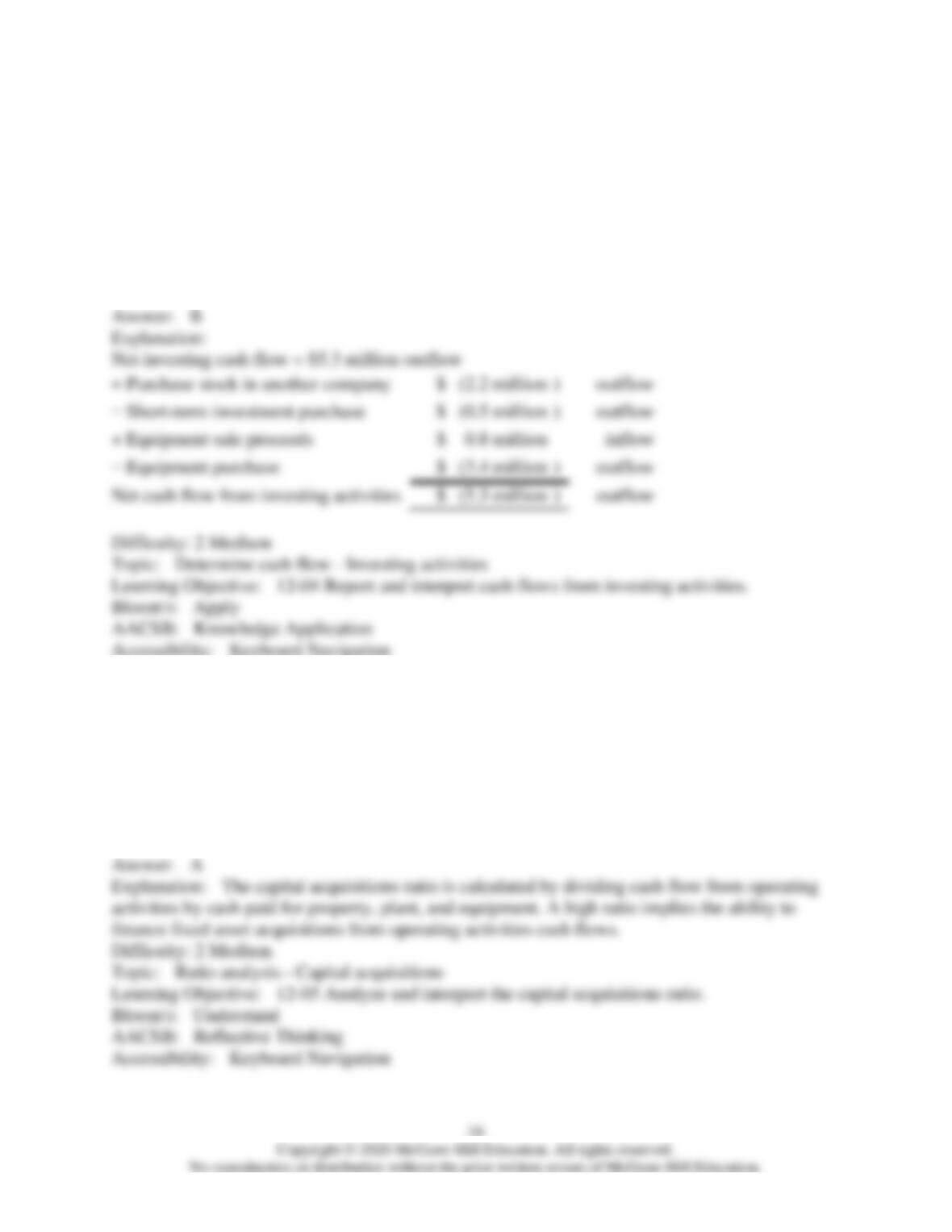
66) Milliken Company paid $2.2 million to purchase stock in another company, $1.0 million to
repurchase treasury shares, $0.5 million to buy short-term investments, sold used equipment for
$0.8 million when its book value was $0.6 million, and purchased new equipment for $3.4
million. What was the net cash flow from investing activities?
A) $6.3 million net cash outflow.
B) $5.3 million net cash outflow.
C) $5.1 million net cash outflow.
D) $4.8 million net cash outflow.
67) Which of the following statements about the capital acquisitions ratio is correct?
A) A high ratio indicates less need for outside financing of property, plant and equipment.
B) The ratio is computed by dividing cash flow from operating activities by the average net
property, plant, and equipment.
C) A low ratio may indicate a failure to update property, plant, and equipment, which can limit a
company’s ability to compete in the future.
D) The ratio is comparable across industries.
68) Which of the following statements about the capital acquisitions ratio is incorrect?
A) The ratio is computed by dividing cash flow from operating activities by cash paid for
property, plant, and equipment.
B) Because the need for investment in property, plant, and equipment differs dramatically across
industries, a firm’s ratio should only be compared with its prior years’ ratio or with firms in the
same industry.
C) A high ratio indicates more need for outside financing of current and future purchases of
property, plant, and equipment.
D) The ratio increases when an account receivable is collected.
69) During 2019, Eva’s Enterprises cash paid for property, plant and equipment was $755 million
and cash flow from operating activities was $5,968 million. The average property, plant, and
equipment from the comparative balance sheets were $6,094 million. Eva’s capital acquisitions
ratio for 2019 is closest to:
A) 1.0
B) 5.3
C) 7.9
D) 6.0
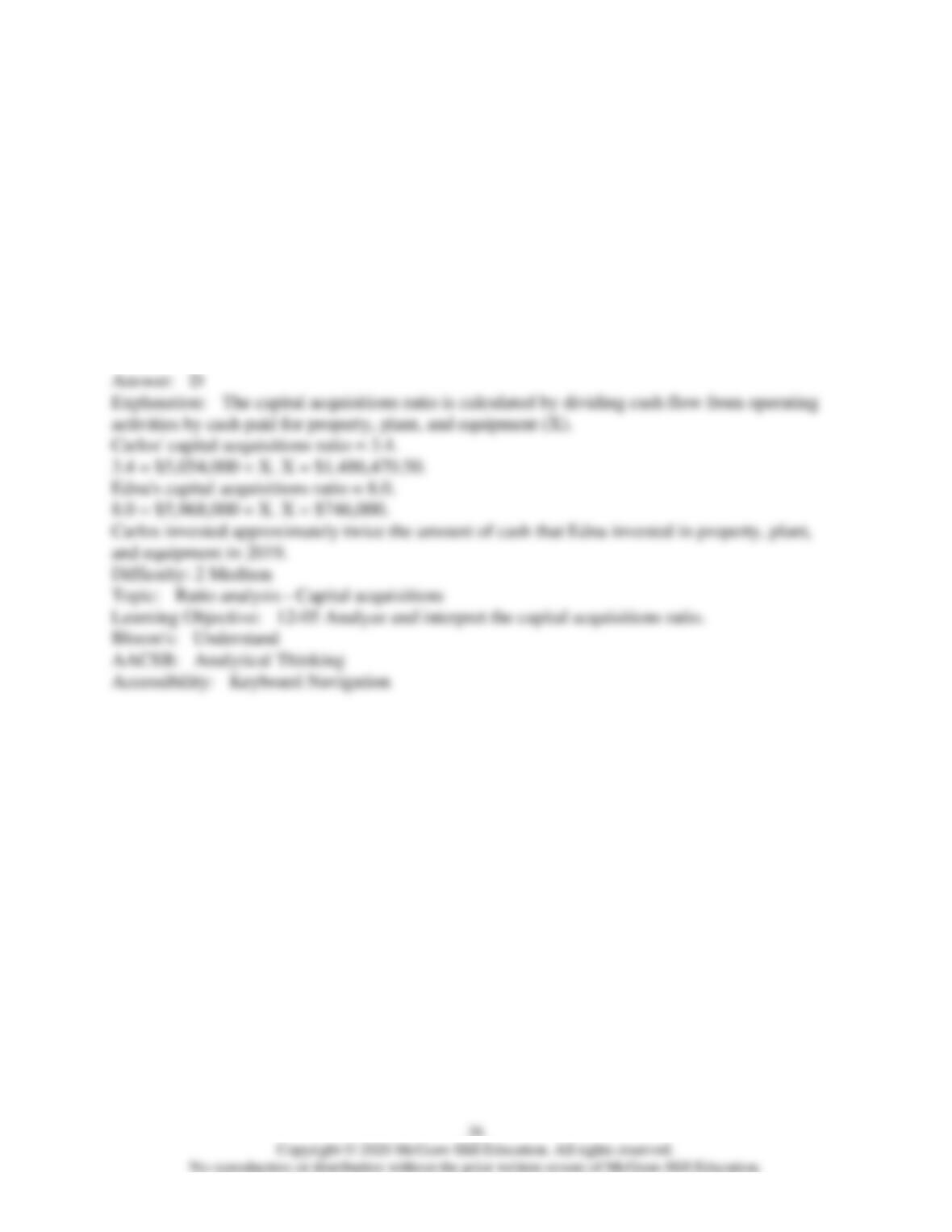
70) During 2019, Edna Enterprises had a capital acquisitions ratio of 8.0. During 2019, Carlos
Corporation had a capital acquisitions ratio of 3.4. The amount of cash flow from operating
activities was $5,968,000 for Edna and $5,054,000 for Carlos. Which of the following statements
is incorrect?
A) Edna used less cash for investments in property, plant and equipment during 2019 than did
Carlos.
B) Compared to Carlos, Edna’s capital acquisitions ratio is higher which indicates that Edna has
less need for external financing of its investments in property, plant, and equipment.
C) Edna invested approximately $746,000 in property, plant, and equipment during 2019.
D) Carlos invested approximately one-half the amount that Edna invested in property, plant, and
equipment during 2019.
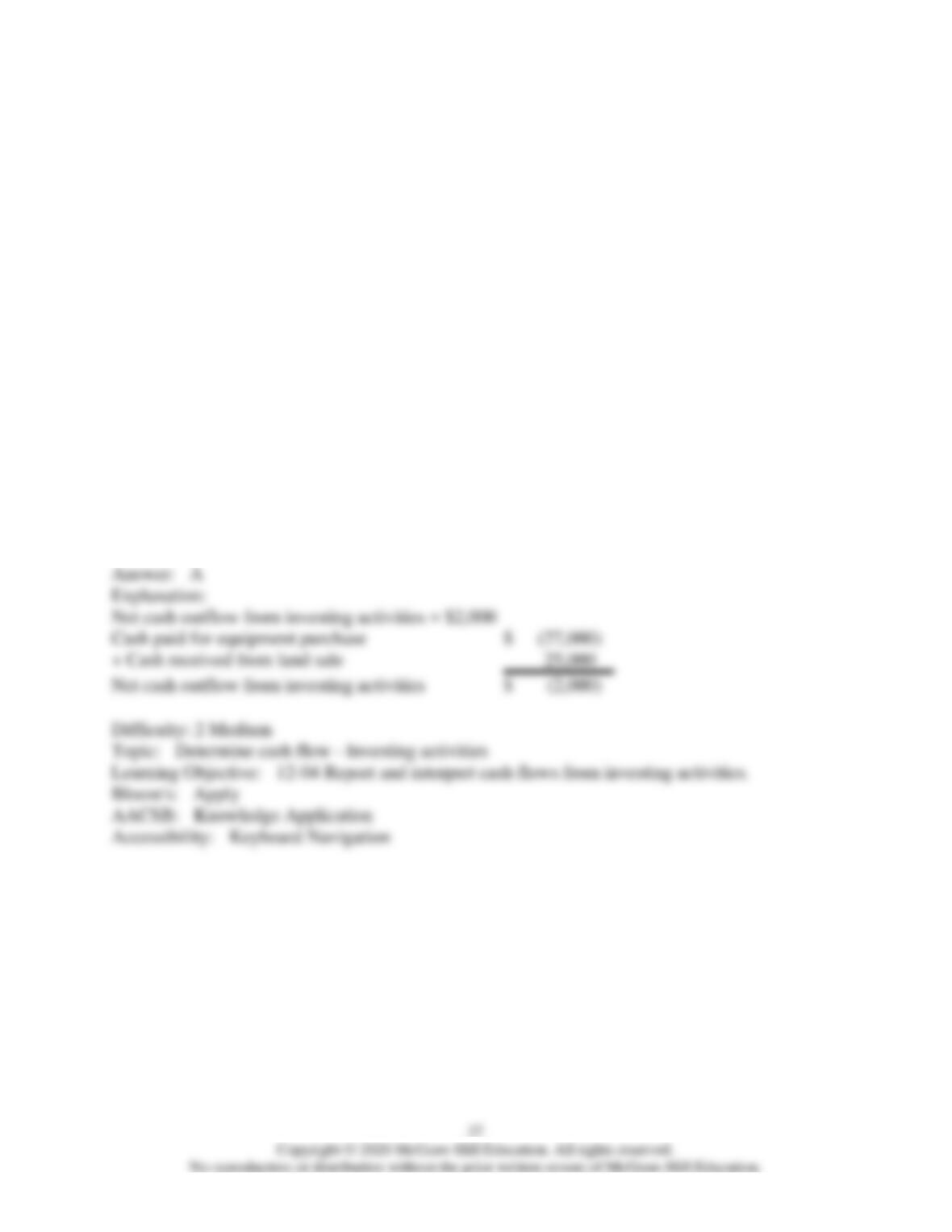
71) Flow Company has provided the following information for the year ended December 31,
2019:
• Cash paid for interest, $20,000
• Cash paid for dividends, $6,000
• Cash dividends received, $4,000
• Cash proceeds from bank loan, $29,000
• Cash purchase of treasury stock, $11,000
• Cash paid for equipment purchase, $27,000
• Cash received from issuance of common stock, $37,000
• Cash received from sale of land with a $32,000 book value, $25,000
• Acquisition of land costing $51,000 in exchange for preferred stock issuance
• Payment of a $100,000 note payable by exchanging used machinery with a $77,000 book value
and $100,000 fair value
How much was Flow’s net cash flow from investing activities?
A) A net outflow of $2,000.
B) A net inflow of $2,000.
C) A net outflow of $53,000.
D) A net inflow of $49,000.
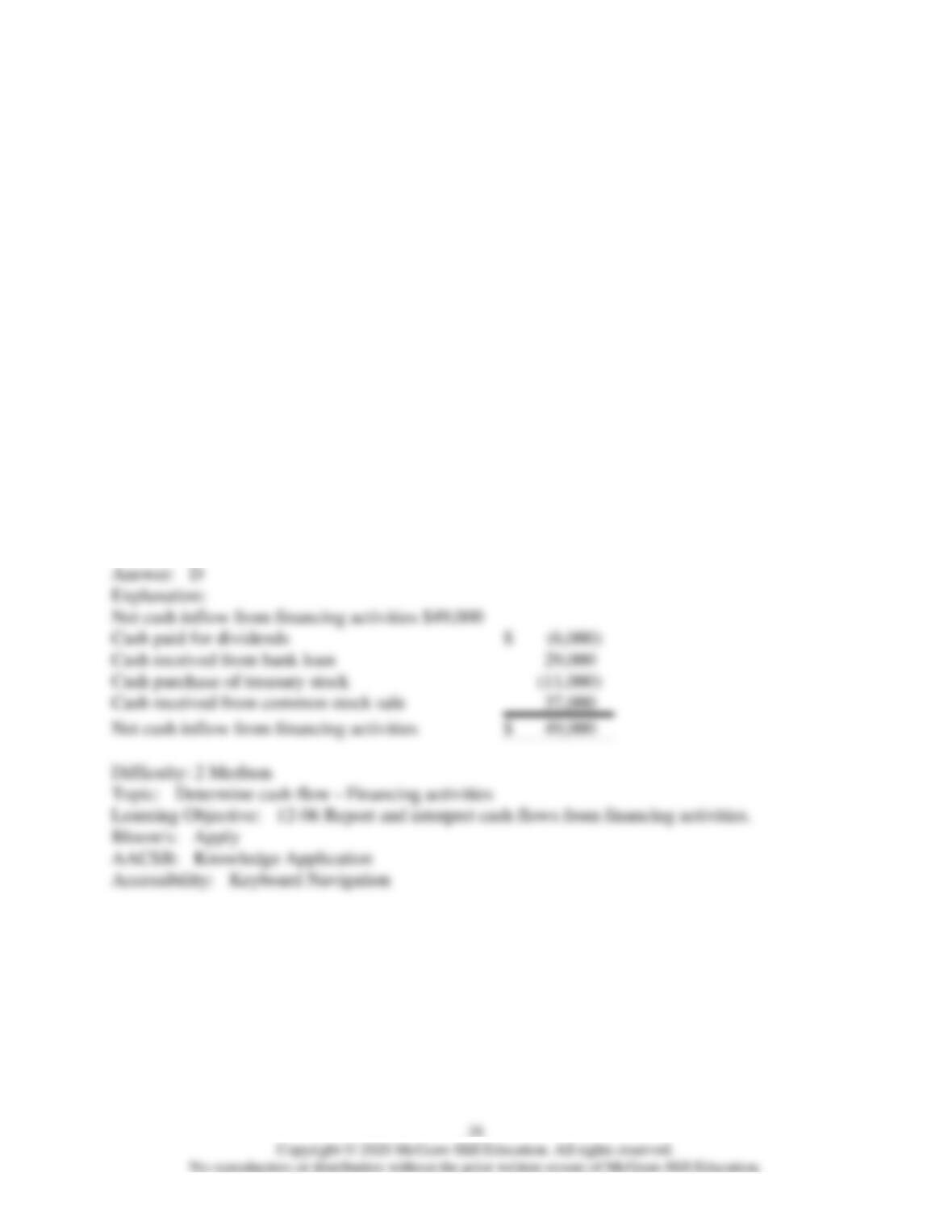
72) Flow Company has provided the following information for the year ended December 31,
2019:
• Cash paid for interest, $20,000
• Cash paid for dividends, $6,000
• Cash dividends received, $4,000
• Cash proceeds from bank loan, $29,000
• Cash purchase of treasury stock, $11,000
• Cash paid for equipment purchase, $27,000
• Cash received from issuance of common stock, $37,000
• Cash received from sale of land with a $32,000 book value, $25,000
• Acquisition of land costing $51,000 in exchange for preferred stock issuance
• Payment of a $100,000 note payable by exchanging used machinery with a $77,000 book value
and $100,000 fair value
How much was Flow’s net cash flow from financing activities?
A) A net outflow of $51,000.
B) A net inflow of $29,000.
C) A net outflow of $53,000.
D) A net inflow of $49,000.
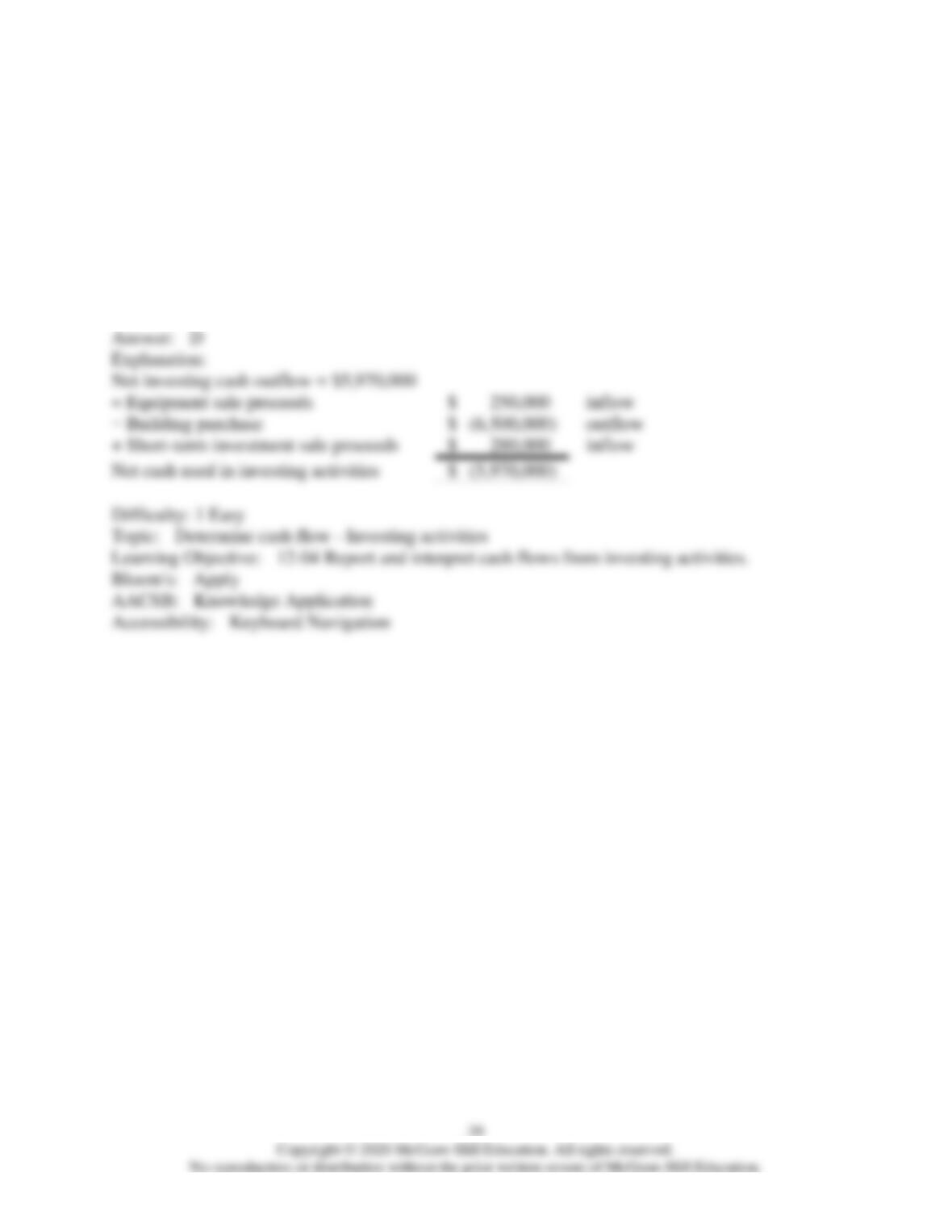
73) Roberts Company sold equipment for $250,000, purchased a building for $6,500,000, sold
short-term investments for $280,000, repaid principal on a note payable for $2,300,000 plus
$230,000 of interest, and paid cash dividends of $20,000.
What was the net cash flow from investing activities?
A) $6,250,000 outflow.
B) $8,320,000 outflow.
C) $8,270,000 outflow.
D) $5,970,000 outflow.
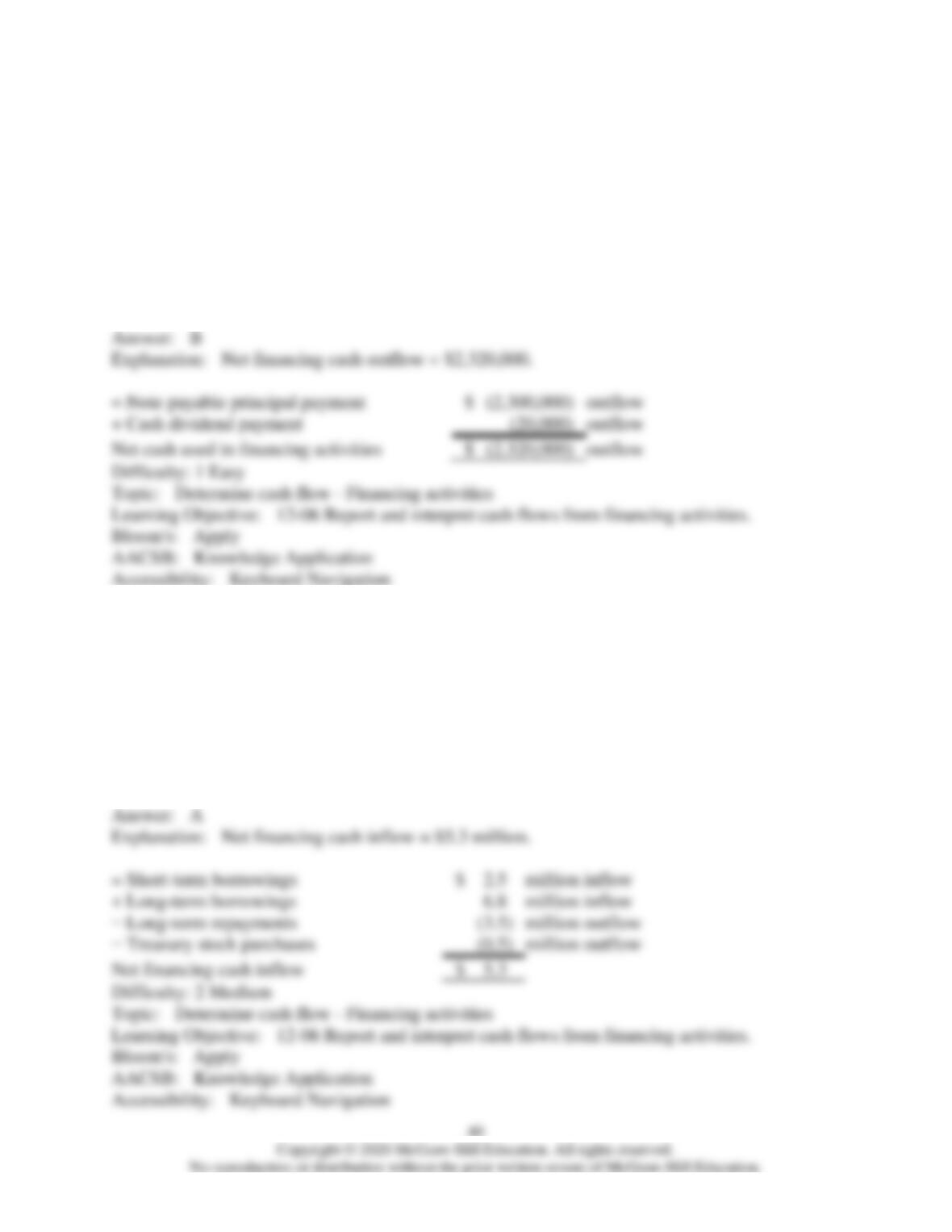
74) Roberts Company sold equipment for $250,000, purchased a building for $6,500,000, sold
short-term investments for $280,000, repaid principal on a note payable for $2,300,000 plus
$230,000 of interest, and paid cash dividends of $20,000.
What was the net cash flow from financing activities?
A) $2,300,000 outflow.
B) $2,320,000 outflow.
C) $2,530,000 outflow.
D) $2,550,000 outflow.
75) Burich Co. reported short-term borrowings of $2.5 million, long-term borrowings of $6.8
million, repayments of long-term borrowings of $3.5 million, interest payments of $780,000,
purchase of common stock shares for treasury of $.5 million, and cash dividends declared of $1.1
million. What is the cash flow from financing activities?
A) $5,300,000 net cash inflow.
B) $4,200,000 net cash inflow.
C) $1,700,000 net cash inflow.
D) $2,800,000 net cash inflow.