Financial Accounting, 10e (Libby)
Chapter 12 Statement of Cash Flows
1) The statement of cash flows explains how the cash balance changed during a particular period
of time.
2) Only highly liquid investments with original maturities of less than six months at the date of
purchase qualify as cash equivalents.
3) The payment of interest on a note payable is a cash flow from a financing activity.
4) Collection of principal on a note receivable is a cash flow from financing activities.
5) Most companies use the direct method for disclosing their cash flows from operating activities
rather than the indirect method.
6) The difference between the direct and indirect methods of cash flow statement preparation
only affects the determination of cash flows from investing activities.
7) Cash collected from customers is a cash flow from operating activities and is calculated when
using the indirect method for preparing the statement of cash flows.
8) Cash flows associated with property, plant, and equipment acquisition and disposition are
reported as cash flows from investing activities.
9) Cash flows associated with issuance and retirement of long-term debt and equity are reported
as cash flows from investing activities.
10) When accrued liabilities increase from the beginning to the end of the year, it means accrued
expenses were greater than cash payments of such expenses, and, under the indirect method, the
increase in accrued liabilities would be added to net income to convert to cash flow from
operating activities.
11) Under the indirect method, an increase in accounts receivable during the year will be added
to net income.
12) If sales revenue was $1,800,000 and accounts receivable decreased $40,000 during the year,
then cash collected from customers equals $1,840,000.
13) Under the indirect method, depreciation expense is added to net income because it decreases
net income but does not affect cash flow.
14) Under the indirect method, a decrease in inventory is subtracted from net income because
inventory purchases are less than cost of goods sold.
15) Under the indirect method, an increase in prepaid expenses is subtracted from net income,
because the cash prepayments exceed the related expenses.
16) The quality of income ratio can only be interpreted based on knowledge of a company’s
business operations and strategies.
17) The quality of income ratio increases when depreciation expense is recorded.
18) The quality of income ratio decreases when cash is used to pay accounts payable.
19) A higher quality of income ratio implies that operations tend to be financed internally
without having to rely on external financing sources.
20) The quality of income ratio measures the portion of net income that was generated by cash
flow from operating activities.
21) When a company purchases equipment using common stock, the equipment purchase is
reported as a financing activity.
22) When a company sells equipment for cash at a loss, cash flows from investing activities
decreases.
23) Amortization of a patent reduces cash flows from investing activities.
24) Free cash flow measures the sufficiency of cash flow from operating activities to cover both
capital expenditures for property, plant and equipment as well as the payment of dividends.
25) Canadian Beer had a capital acquisitions ratio of 7.49, which means its net income exceeded
its cash investment in property, plant and equipment by almost 7.5 times.
26) The capital acquisitions ratio represents the portion of property, plant, and equipment
purchases which could have been financed with cash flow from operating activities.
27) When a company borrows $150 million during the year and also repays $120 million of debt,
the company reports the $30 million net amount as excess of borrowings over repayments in the
financing activities section of the statement of cash flows.
28) Cash flows from financing activities include those cash flows with respect to issuing and
retiring long-term debt and equity.
29) While repaying principal on long-term debt is reported as part of cash flows from financing
activities, repaying principal on short-term debt (notes payable) is reported as part of cash flows
from operating activities.
30) Wish Corporation acquired a computer for $15,000 and paid for it in full by issuing 1,000
shares of its own common stock, par $10 (current market price $15 share). This transaction
should not be reported within the statement of cash flows because cash was neither received nor
disbursed.
31) Which of the following transactions does not result in either a cash inflow or a cash outflow?
A) A company purchased some of its own stock from a stockholder.
B) Amortization of a patent.
C) Payment of a cash dividend.
D) Sale of equipment at book value.
32) Which of the following transactions would not create a cash flow from operating activities?
A) Collecting cash from a customer.
B) Paying cash to a supplier.
C) Paying cash to stockholders for dividends.
D) Paying cash for a utility bill.
33) Which of the following transactions would be reported in the cash flow statement as a cash
flow from financing activities?
A) The cash payment of interest expense.
B) Acquiring land by signing a note payable.
C) Paying cash to stockholders for dividends.
D) Purchasing shares of stock of another company using cash.
34) Which of the following statements regarding use of the direct and indirect methods of
determining cash flows from operating activities is incorrect?
A) The indirect method starts with net income.
B) The direct method calculates cash collected from customers.
C) The majority of U.S. companies use the indirect method.
D) The FASB recommends use of the indirect method.
35) Which of the following would not be a cash flow from investing activities?
A) Purchase of long-term investments.
B) Sale of a patent.
C) Collection of principal on a long-term note receivable.
D) Collection of interest revenue on a long-term note receivable.
36) Which of the following would not be a cash flow from financing activities?
A) Issuance of common stock for cash.
B) Borrowing cash on a long-term note payable.
C) Collection of a cash dividend.
D) Repayment of principal on a long-term note payable.
37) Which of the following would not be considered a cash equivalent?
A) A 30-day certificate of deposit.
B) A ten-year Treasury note purchased over nine years ago, which matures in two months.
C) A three-month Treasury bill.
D) A money market fund held at the local bank.
38) Which of the following statements about the statement of cash flows is correct?
A) A company with a net loss on the income statement will always have a net cash outflow from
operating activities.
B) A purchase of equipment is classified as a cash inflow from investing activities.
C) Cash dividends received on stock investments are classified as cash flows from operating
activities.
D) Cash dividends paid are classified as cash flows from operating activities.
39) Which of the following items about the statement of cash flows is correct?
A) Noncash expenses such as depreciation are subtracted from net income when using the
indirect method for computing cash flows from operating activities.
B) Cash equivalents are highly liquid investments with original maturities of less than three
months.
C) Repurchasing stock from owners would be classified as an investing cash outflow.
D) Cash paid for interest would be classified as a financing cash outflow.
40) Which of the following would be subtracted from net income when determining cash flows
from operating activities under the indirect method?
A) An increase in accounts payable.
B) Depreciation expense.
C) A decrease in prepaid insurance.
D) A gain on the sale of a depreciable asset.
41) Which of the following would be added to net income when determining cash flows from
operating activities under the indirect method?
A) A decrease in accounts payable.
B) Patent amortization expense.
C) An increase in prepaid insurance.
D) A gain on the sale of a depreciable asset.
42) Which of the following would be subtracted from net income when determining cash flows
from operating activities under the indirect method?
A) A decrease in utilities payable.
B) Patent amortization expense.
C) A decrease in prepaid rent.
D) A loss on the sale of a depreciable asset.
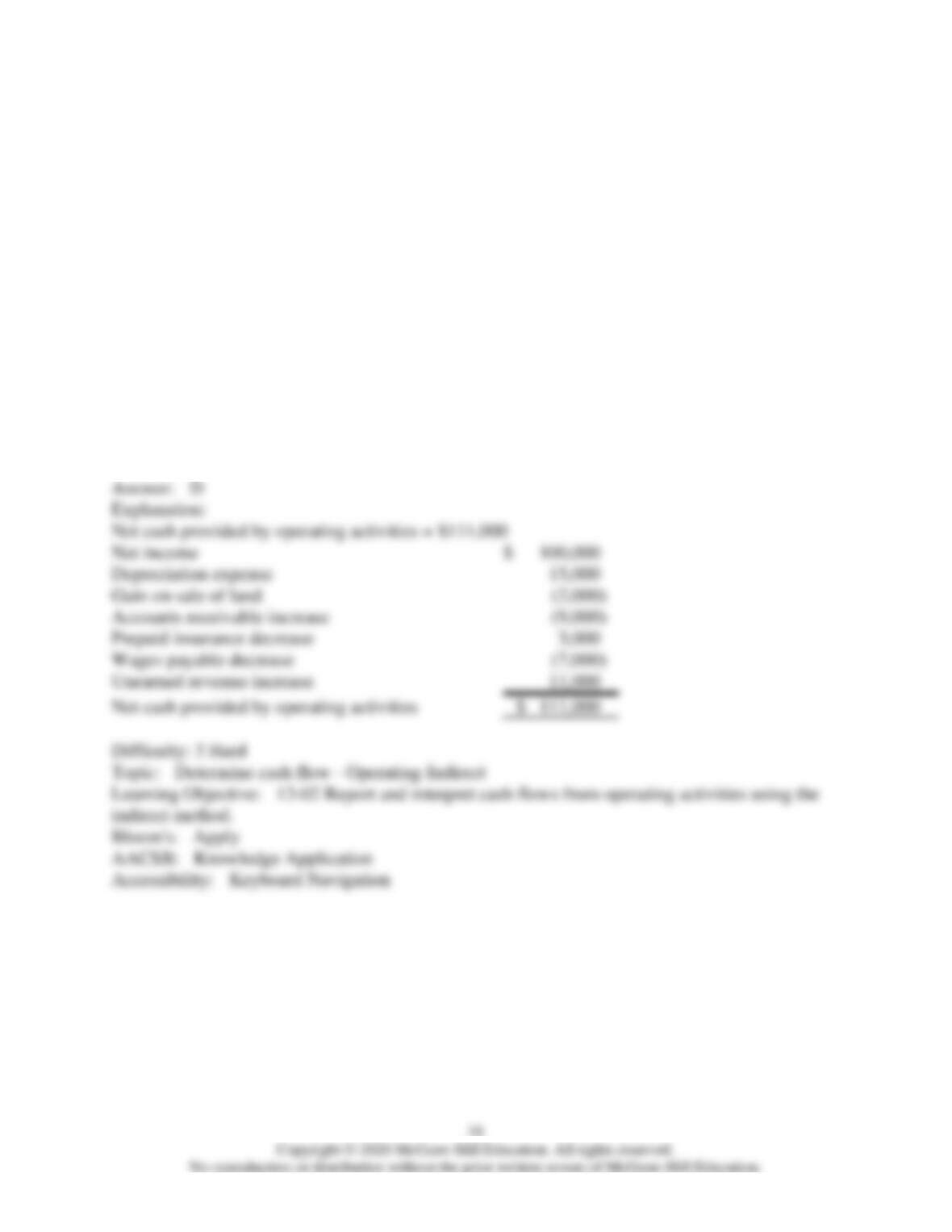
43) Rice Company, a retailer, has provided the following information pertaining to its recent year
of operation:
• Net income, $100,000
• Accounts receivable increased $9,000
• Prepaid insurance decreased $3,000
• Depreciation expense was $15,000
• Gain on sale of land, $2,000
• Wages payable decreased $7,000
• Unearned revenue increased $11,000
Using the indirect method, how much was Rice’s net cash provided by operating activities?
A) $89,000.
B) $115,000.
C) $125,000.
D) $111,000.
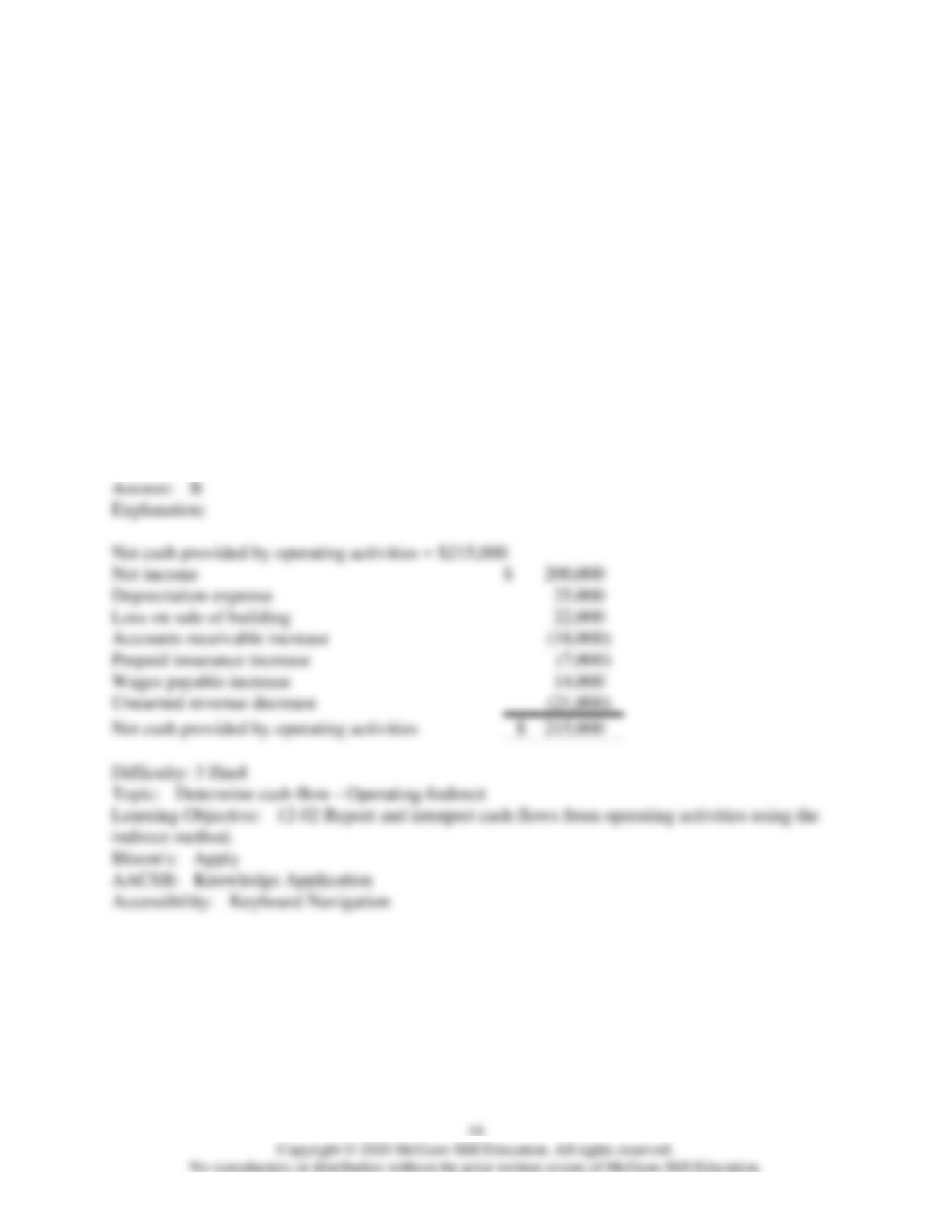
44) Darwin Company, a manufacturer, has provided the following information pertaining to its
recent year of operation:
• Net income, $200,000
• Accounts receivable increased $18,000
• Prepaid insurance increased $7,000
• Depreciation expense was $25,000
• Loss on sale of a building was $22,000
• Wages payable increased $14,000
• Unearned revenue decreased $21,000
Using the indirect method, how much was Darwin’s net cash provided by operating activities?
A) $227,000.
B) $215,000.
C) $171,000.
D) $257,000.
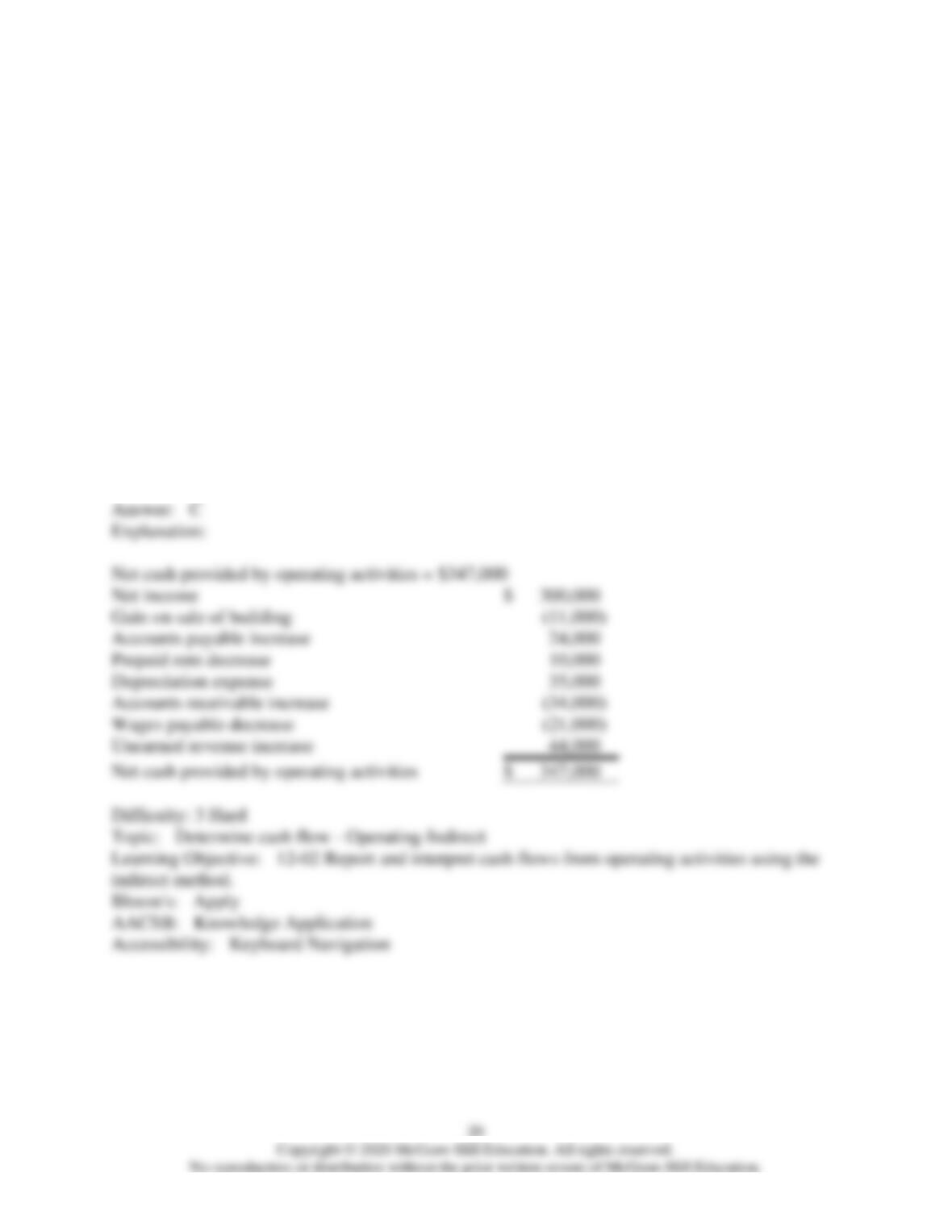
45) RM Company, a manufacturer, has provided the following information pertaining to its
recent year of operation:
• Net income, $300,000
• Accounts payable increased $24,000
• Prepaid rent decreased $10,000
• Depreciation expense was $35,000
• Accounts receivable increased $34,000
• Gain on sale of a building was $11,000
• Wages payable decreased $21,000
• Unearned revenue increased $44,000
Using the indirect method, how much was RM’s net cash provided by operating activities?
A) $259,000.
B) $327,000.
C) $347,000.
D) $358,000.