128) Dicker Furriers purchased 1,000 bonds of Loose Corporation on January 10, 2017, for $800
per bond and classified the investment as securities available for sale. Loose’s market value was
$400 per bond on December 31, 2017, and the decline in value was viewed as temporary. As of
December 31, 2018, Dicker still owned the Loose bonds whose market value had declined to
$100 per share. The decline is due to a reason that’s judged to be other than temporary. Dicker’s
December 31, 2018, balance sheet and the 2018 income statement would show the following:
Investment in
Loose stock
Income statement loss
on investments
a.
100,000
700,000
b.
100,000
300,000
c.
400,000
0
d.
100,000
300,000
A) Option a
B) Option b
C) Option c
D) Option d
129) Which of the following is not an example of a derivative?
A) Interest rate swap.
B) Cash.
C) Stock option.
D) Forward contract.
130) Which of the following is not true about derivatives?
A) Large losses on derivative investments have been reported in the press.
B) Derivatives are so named because their value is derived from some underlying measure.
C) Derivatives are useful instruments for managing risk.
D) Accounting for derivatives is fully resolved and no additional rules or interpretations are
likely.
131) On January 12th, 2018 Jefferson Corporation purchased bonds of Rose Corporation for $73
million and classified the securities as available-for-sale. On December 31st, 2018 these bonds
were valued at $67 million. Eight months later, on October 3rd, 2019 Jefferson Corporation sold
these bonds for $87 million.
As part of the multi-step approach to record the 2019 transaction, Jefferson Corporation should
first update the fair value adjustment on the date of sale by recording:
A) An unrealized holding gain of $20 million in 2019.
B) A gain of $20 million in 2019.
C) An unrealized holding gain of $26 million in 2019.
D) A gain of $14 million in 2019.
132) On January 12th, 2018 Jefferson Corporation purchased bonds of Rose Corporation for $73
million and classified the securities as available-for-sale. On December 31st, 2018 these bonds
were valued at $67 million. Eight months later, on October 3rd, 2019 Jefferson Corporation sold
these bonds for $87 million.
As part of the multi-step approach to record the 2019 transaction, Jefferson Corporation should
next take the second step of:
A) Reversing total accumulated unrealized holding gains of $20 million.
B) Reversing total accumulated unrealized holding gains of $6 million.
C) Reversing total accumulated unrealized holding gains of $14 million.
D) Reversing total accumulated unrealized holding gains of $26 million.
133) On January 12th, 2018 Jefferson Corporation purchased bonds of Rose Corporation for $73
million and classified the securities as available-for-sale. On December 31st, 2018 these bonds
were valued at $67 million. Eight months later, on October 3rd, 2019 Jefferson Corporation sold
these bonds for $87 million.
As part of the multi-step approach to record 2019 transaction, Jefferson Corporation should
finally take the third step of recording a sales transaction with a gain of:
A) $20 million
B) $26 million
C) $6 million
D) $14 million
134) On March 25th, 2018 Phillips Corporation purchased bonds of Atlas Corporation for $132
million and classified the securities as trading securities. On December 31st, 2018 these bonds
were valued at $150 million. Four months later, on April 3rd, 2019 Phillips Corporation sold
these bonds for $140 million.
As part of the multi-step approach to record the 2019 transaction, Phillips Corporation should
first update the fair value adjustment by recording:
A) An unrealized holding gain of $28 million in 2019.
B) A unrealized holding loss of $10 million in 2019.
C) An unrealized holding gain of $8 million in 2019.
D) A gain of $8 million in 2019.
135) On March 25th, 2018 Phillips Corporation purchased bonds of Atlas Corporation for $132
million and classified the securities as trading securities. On December 31st, 2018 these bonds
were valued at $150 million. Four months later, on April 3rd, 2019 Phillips Corporation sold
these bonds for $140 million.
As part of the multi-step approach to record the 2019 transaction, Jefferson Corporation should
next take the second step of recording a sales transaction where it:
A) Credits a fair value adjustment of $18 million.
B) Debits a fair value adjustment of $18 million.
C) Debits a fair value adjustment of $8 million.
D) Credits a fair value adjustment of $8 million.
Match the number for the level of stock ownership that most frequently relates to each concept
listed below.
A) The reporting of the investment depends on whether there is a readily determinable fair value
for it.; The investment is reported at fair value.; Unrealized holding gains and losses are recorded
at each reporting date.
B) The investor can significantly influence, but not control, the investee’s operating and financial
policies.; The investment is reported at cost, adjusted for subsequent growth in the investee.
C) Financial statements are combined as if a single company.; The investor controls the
investee.; The investee is a subsidiary of the investor.; Assets and liabilities of the investee are
combined with those of the investor for reporting purposes.; The investor does not include an
investment account for the investee in the balance sheet.
136) Less than 20%
137) 20% – 50%
138) More than 50%
Listed below are 5 terms followed by a list of phrases that describe or characterize each of the
terms. Match each phrase with the correct term to indicate the way each of the investments
usually should be accounted for under U.S. GAAP based on the information provided.
A) Accounts Receivable.
B) 85% of the voting common stock of ABC Corporation.
C) Treasury bonds held for short-term profit.; Corporate bonds held for immediate resale.
D) Treasury bonds held for their entire life.; Corporate bonds to be held for full term of 10 years.
E) 40% of the voting common stock of XYZ Company.; 25% of the voting common stock of
DEF Corporation.; 50% of the voting common stock of JMG Corporation.; 18% of voting
common stock of Griggs Corporation; investor’s CEO on the board of directors of Griggs
Corporation; no other investor owns more than 1%.
139) None of these choices apply
140) Trading Securities
141) Consolidation
142) Securities Held to Maturity
143) Equity Method
Listed below are five terms followed by a list of phrases that describe or characterize each of the
terms. Match each phrase with the correct term.
A) Changes in market value affect comprehensive income, but not net income.
B) Changes in market value affect net income.
C) Reduces the investment account balance under the equity method.
D) Reported at fair value.
E) Temporary declines in the fair value of an available for sale security.
144) Trading securities only
145) Securities available for sale only
146) Unrealized holding losses
147) Dividends received
148) Trading securities and securities available for sale
Listed below are five terms followed by a list of phrases that describe or characterize each of the
terms with respect to accounting for investments under IFRS. Match each phrase with the correct
term by placing the number designating the best term in the space provided by the phrase.
A) One of the criteria that must be met under IFRS No. 9 to qualify for use of the amortized cost
method.
B) Similar to available for sale investments, except realized gains and losses are not reclassified
into net income.
C) Can be accounted for as “fair value through profit and loss (FVPL)” or as “fair value through
other comprehensive income (FVOCI)” under IFRS No. 9.
D) One of the circumstances in which the fair-value option can be used under IFRS.
E) Does not allow the “held-to-maturity” approach for debt investments.
149) Business purpose test
150) IFRS No. 9
151) Debt investments
152) Fair value through other comprehensive income
153) Accounting mismatch
Listed below are five terms followed by a list of phrases that describe or characterize each of the
terms. Match each phrase with the correct term.
A) Change accounted for prospectively.
B) Result from a decline in fair value prior to sale.
C) When related to trading securities, they increase net income.
D) Method used for small ownership percentage equity investments.
E) Encompass cash, equity securities, and debt securities.
154) Change from the equity method
155) Financial instruments
156) Unrealized holding losses
157) Fair value through net income
158) Unrealized holding gains
Listed below are five terms followed by a list of phrases that describe or characterize each of the
terms. Match each phrase with the correct term.
A) Recognized only to the extent of carrying value under the equity method.
B) Reduces investment account under the equity method if its fair value is higher than its book
value.
C) Requires positive intent and ability.
D) Reported in the income statement for trading securities.
E) Requires recognition in the income statement if judged to be other than temporary.
159) Securities held to maturity
160) Unrealized holding gains and losses
161) Impairment of securities available for sale
162) Losses of investee
163) Amortization of a patent that was obtained in a business acquisition
Listed below are five terms followed by a list of phrases that describe or characterize each of the
terms. Match each phrase with the correct term.
A) Can be required in the future when, at the time an equity-method investment is made, the fair
value of investee’s identifiable net assets exceeds their carrying value.
B) Used when investor can significantly influence investee.
C) Recognized as revenue for equity-method investments.
D) Not recognized as revenue in equity-method investments.
E) Used when investor has effective control of investee.
164) Investor’s share of investee income
165) Additional depreciation
166) Equity method
167) Consolidation
168) Dividends
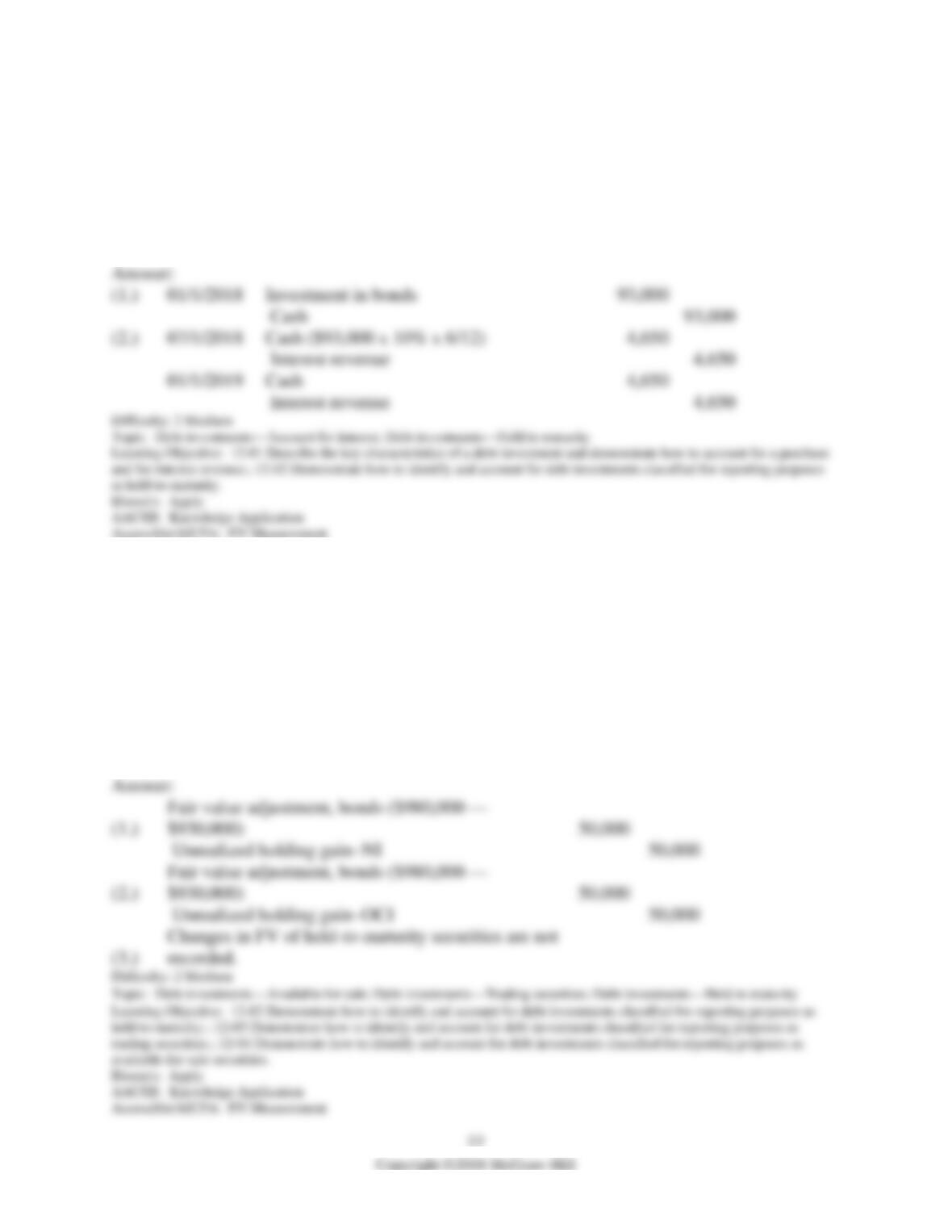
169) On March 1, 2018, Navy Corporation used excess cash to purchase U.S. Treasury bonds for
$103,000 plus accrued interest. The bonds were purchased at face value. The appropriate interest
rate is 6%. Interest on these bonds is payable on January 1 and July 1 of each year. Navy’s
investment is accounted for as held to maturity. The fair value of the Treasury bonds is $104,000
at year-end.
Required:
Prepare the appropriate journal entries to record the transactions for the year, including any year-
end adjustments. Show calculations, rounded to the nearest dollar.
170) On January 1, 2018, Wildcat Company purchased $93,000 of 10% bonds at face value. The
bonds are to be held to maturity. The bonds pay interest semiannually on January 1 and July 1.
Required:
(1.) Prepare the appropriate journal entry to record the acquisition of the bonds.
(2.) Record the first two interest payments (ignore year-end accruals).
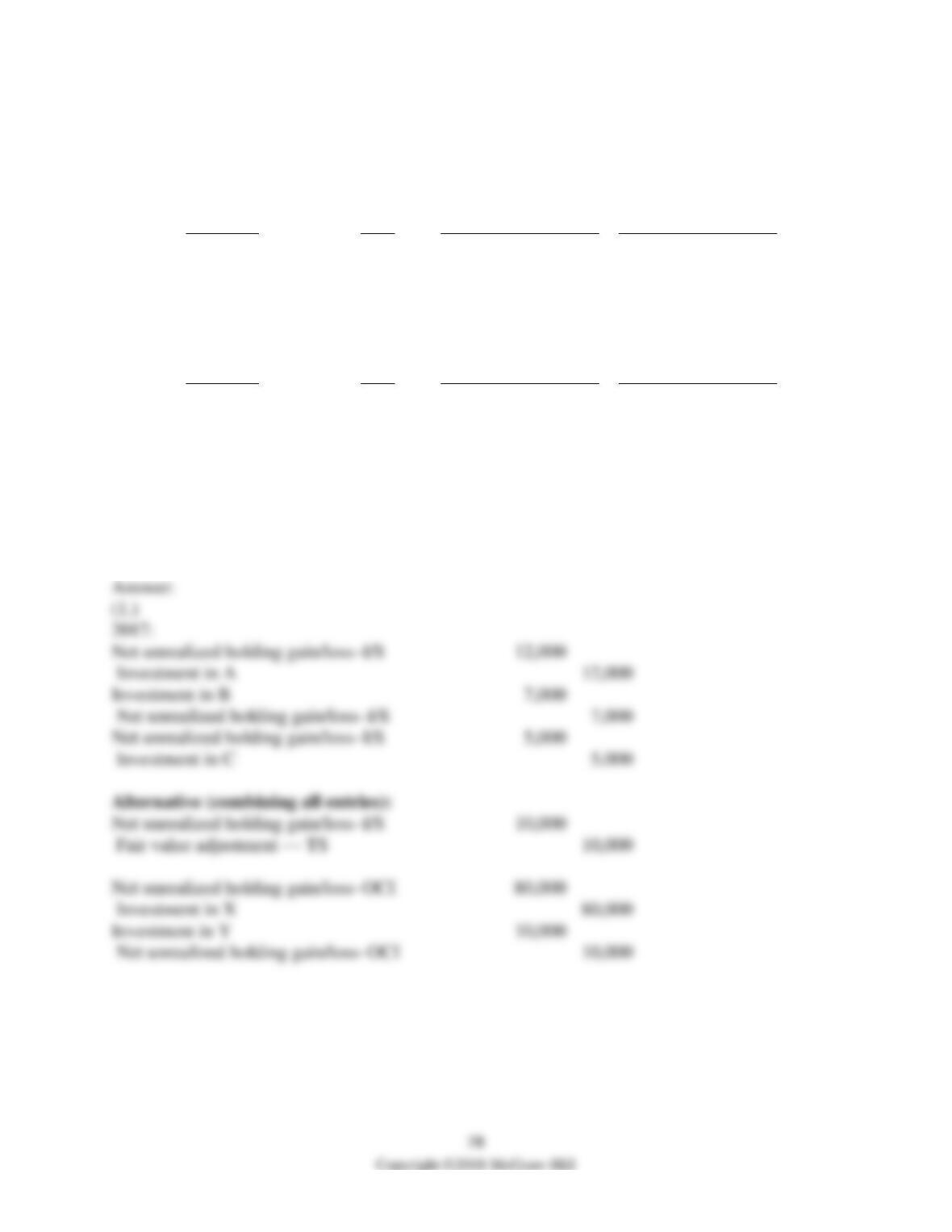
171) On January 1, 2018, Hoosier Company purchased $930,000 of 10% bonds at face value.
The bond market value was $980,000 on December 31, 2018.
Required:
Prepare the appropriate journal entry on December 31, 2018, to properly value the bonds
assuming the bonds are classified as:
(1.) Trading securities.
(2.) Securities available for sale.
(3.) Held-to-maturity securities.
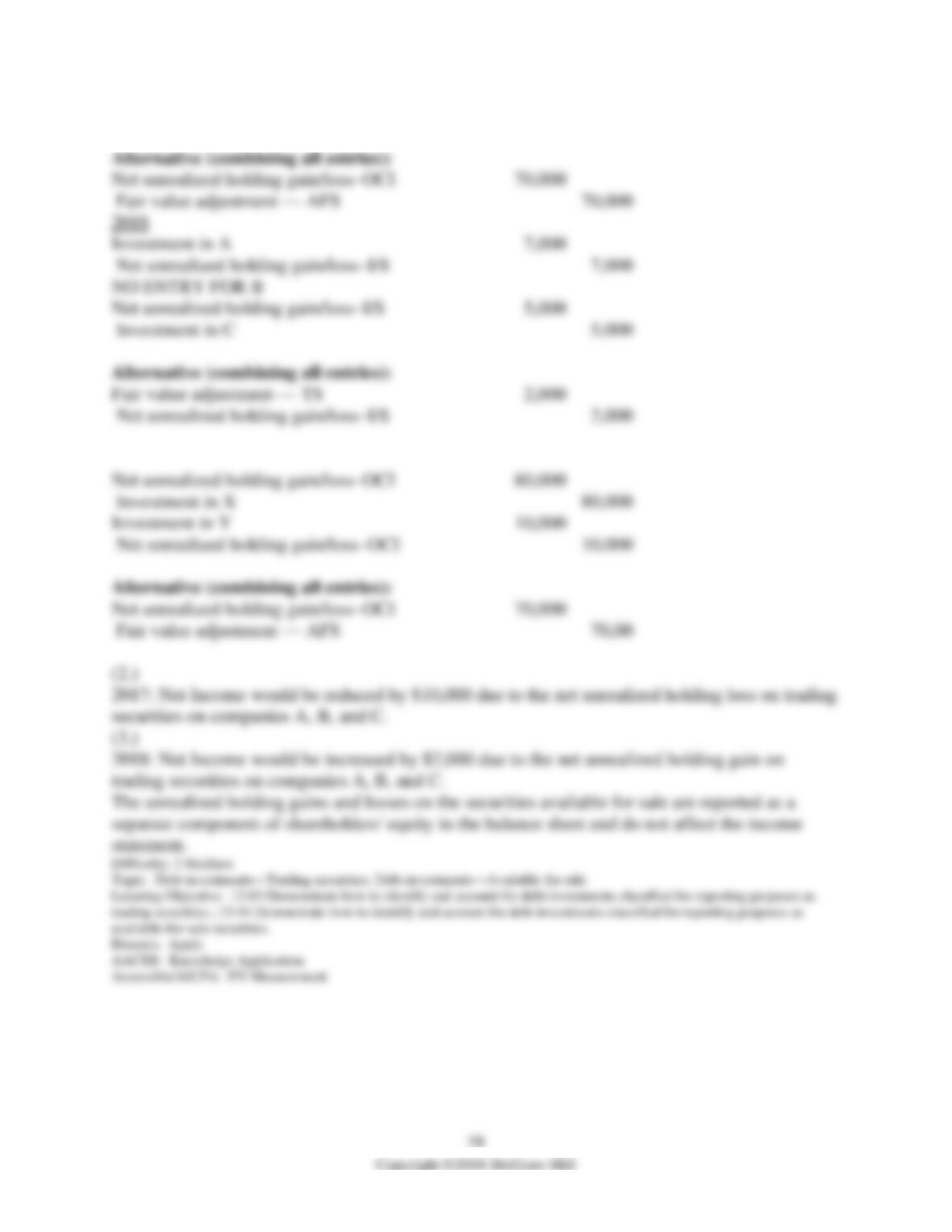
172) FKG Inc. carries the following debt investments on its books at December 31, 2017, and
December 31, 2018. All securities were purchased during 2017.
Trading Securities:
Company
Cost
Value, Dec. 31, 2017
Value, Dec. 31, 2018
A Company
$25,000
$13,000
$20,000
B Company
$13,000
$20,000
$20,000
C Company
$35,000
$30,000
$25,000
Available for Sale
Securities:
Company
Cost
Value, Dec. 31, 2017
Value, Dec. 31, 2018
X Company
$210,000
$130,000
$50,000
Y Company
$ 50,000
$ 60,000
$70,000
Required:
(1.) Prepare the necessary journal entries for FKG on December 31, 2017, and December 31,
2018.
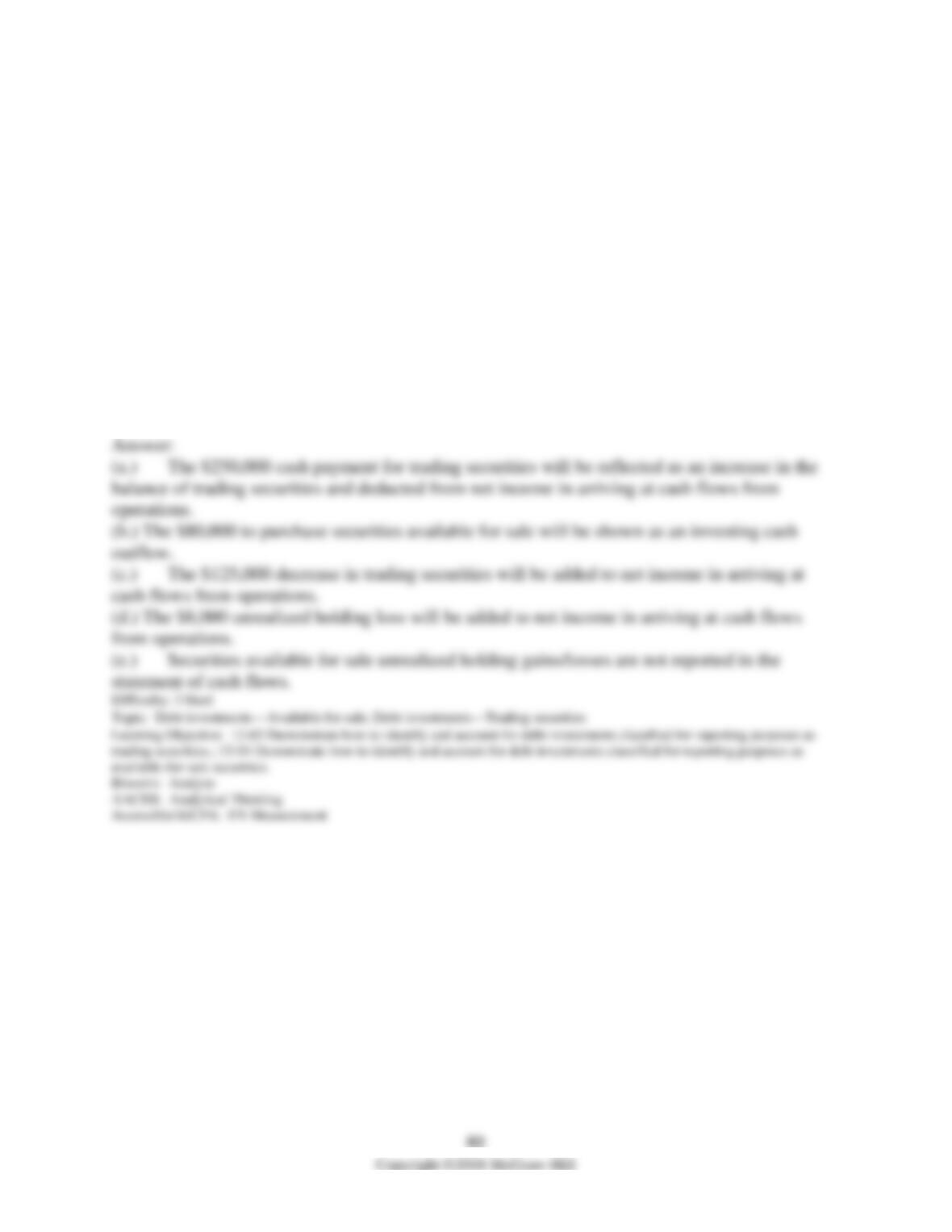
(2.) What net effect would the valuation of these debt investments have on 2017 net income?
(3.) What net effect would the valuation of these debt investments have on 2018 net income?
2017:
Net unrealized holding gain/loss–I/S
Investment in A
12,000
Investment in B
Net unrealized holding gain/loss–I/S
Net unrealized holding gain/loss–I/S
Investment in C
Net unrealized holding gain/loss–I/S
Net unrealized holding gain/loss–OCI
Investment in X
80,000
Investment in Y
Net unrealized holding gain/loss–OCI
10,000
173) The following transactions occurred during the year for XYZ Corporation:
(a.) During the year, trading securities were purchased for $250,000.
(b.) During the year, securities available for sale were purchased for $80,000.
(c.) During the year, trading securities that are carried on the balance sheet at their fair value of
$125,000 were sold for $125,000 cash.
(d.) At the end of the year, the trading securities portfolio has an aggregate fair value of $142,000
and an aggregate cost of $150,000.
(e.) At the end of the year the securities available for sale portfolio has an aggregate fair value of
$95,000.
Required:
Indicate how each of these transactions would affect the statement of cash flows for a
corporation. Assume the statement of cash flows is prepared using the indirect method. Each
transaction is assumed to be independent of the other transactions.