89) Holden Corporation produces three products, with costs and selling prices as follows:
Product A
Product B
Product C
Selling price per unit
$
30
100
%
$
20
100
%
$
15
100
%
Variable costs per unit
18
60
%
15
75
%
6
40
%
Contribution margin per unit
$
12
40
%
$
5
25
%
$
9
60
%
A particular machine is the bottleneck. On that machine, 3 machine hours are required to produce
each unit of Product A, 1 hour is required to produce each unit of Product B, and 2 hours are
required to produce each unit of Product C. Rank the products from the most profitable to the least
profitable use of the constrained resource (bottleneck).
A) C, A, B
B) A, C, B
C) B, C, A
D) B, A, C
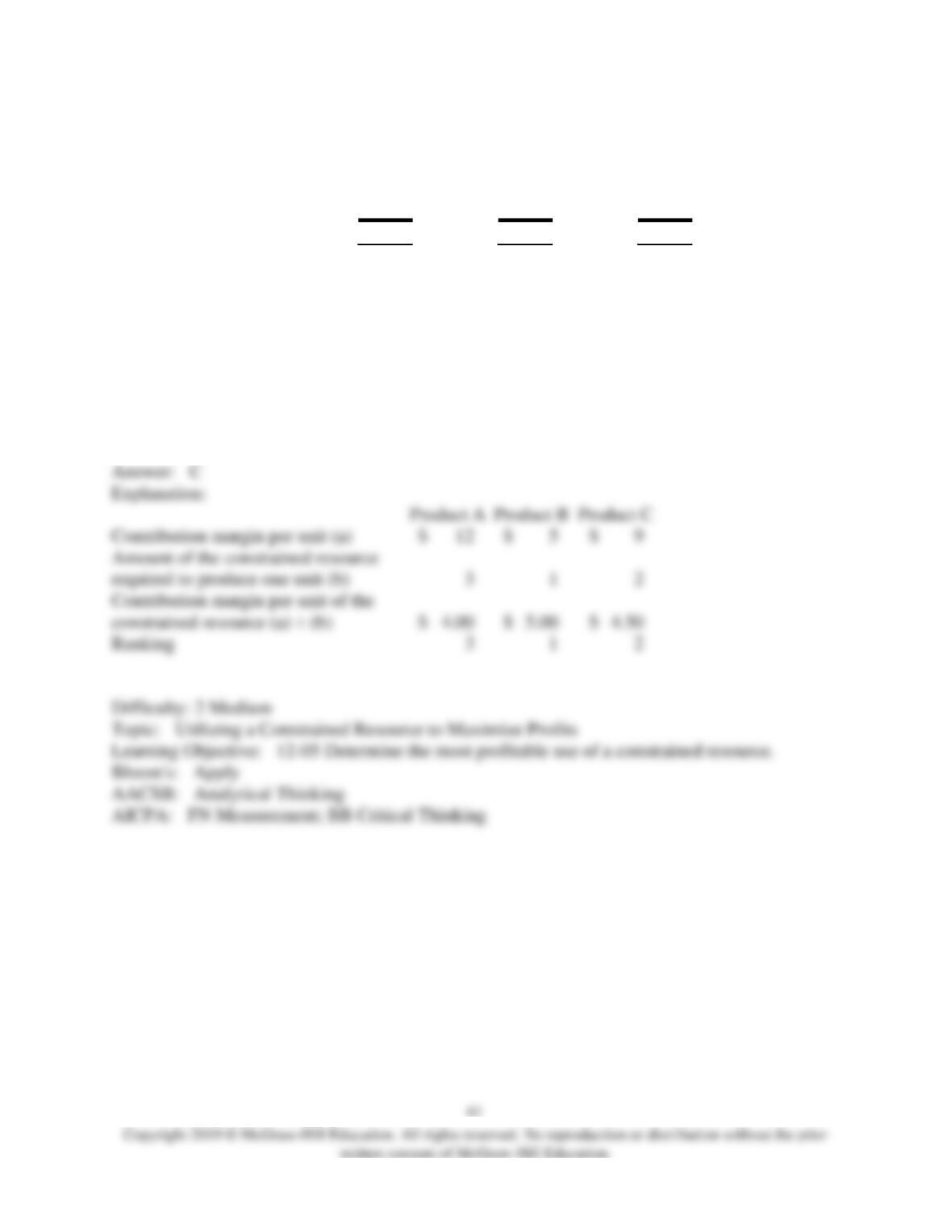
Contribution margin per unit (a)
required to produce one unit (b)
constrained resource (a) ÷ (b)
90) Consider the following production and cost data for two products, L and C:
Product L
Product C
Contribution margin per unit
$
120
$
112
Machine minutes needed per unit
10
minutes
8
minutes
A total of 60,000 machine minutes are available each period and there is unlimited demand for
each product. What is the largest possible total contribution margin that can be realized each
period?
A) $720,000
B) $840,000
C) $780,000
D) $1,560,000
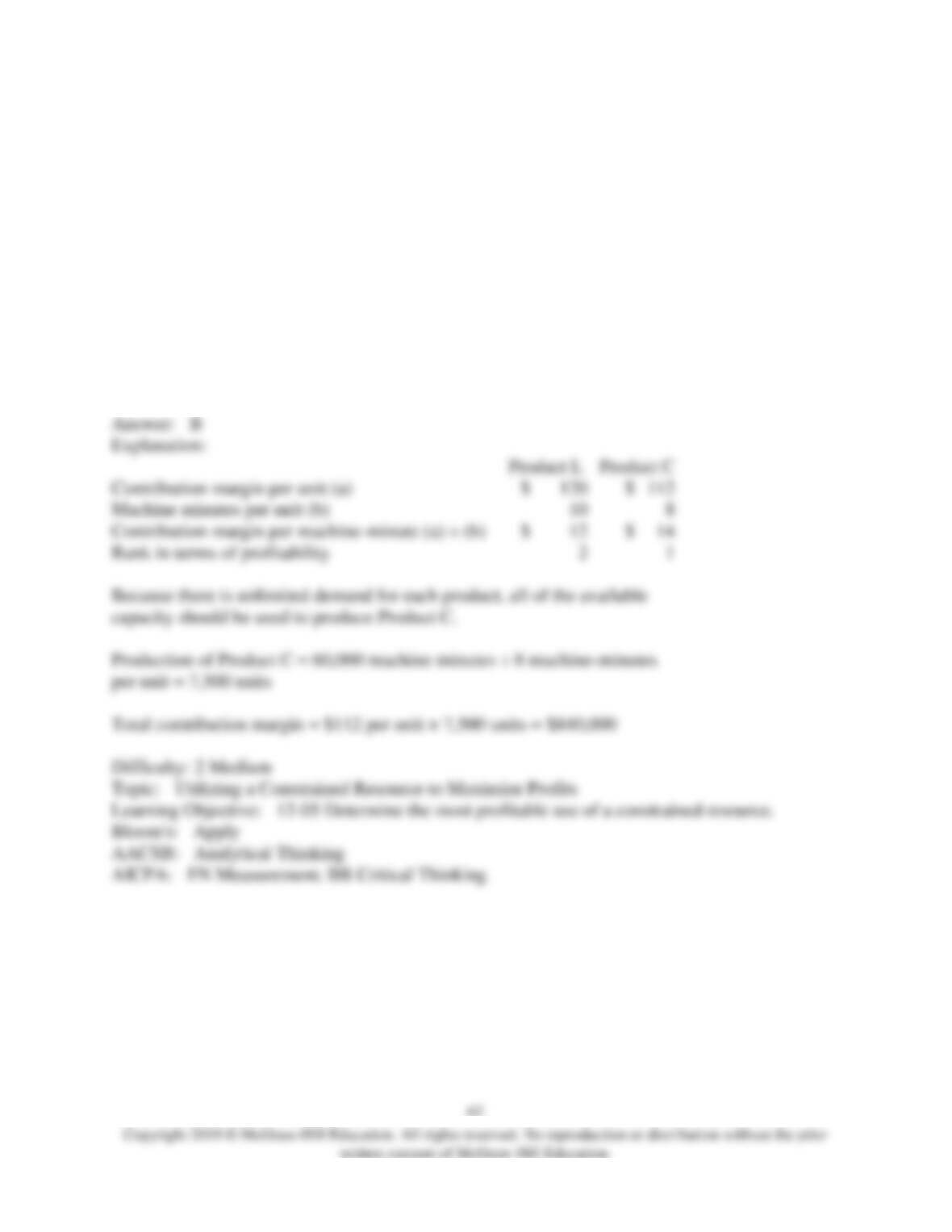
Product C
Contribution margin per unit (a)
$
112
Machine minutes per unit (b)
10
Contribution margin per machine-minute (a) ÷ (b)
12
$
14
Rank in terms of profitability
2
capacity should be used to produce Product C.
per unit = 7,500 units
Total contribution margin = $112 per unit × 7,500 units = $840,000
91) The constraint at Rauchwerger Corporation is time on a particular machine. The company
makes three products that use this machine. Data concerning those products appear below:
WX
KD
FS
Selling price per unit
$
192.00
$
542.66
$
222.84
Variable cost per unit
$
158.72
$
420.54
$
167.76
Minutes on the constraint
3.20
8.60
3.60
Assume that sufficient time is available on the constrained machine to satisfy demand for all but
the least profitable product. Up to how much should the company be willing to pay to acquire more
of the constrained resource?
A) $33.28 per unit
B) $10.40 per minute
C) $122.12 per unit
D) $15.30 per minute
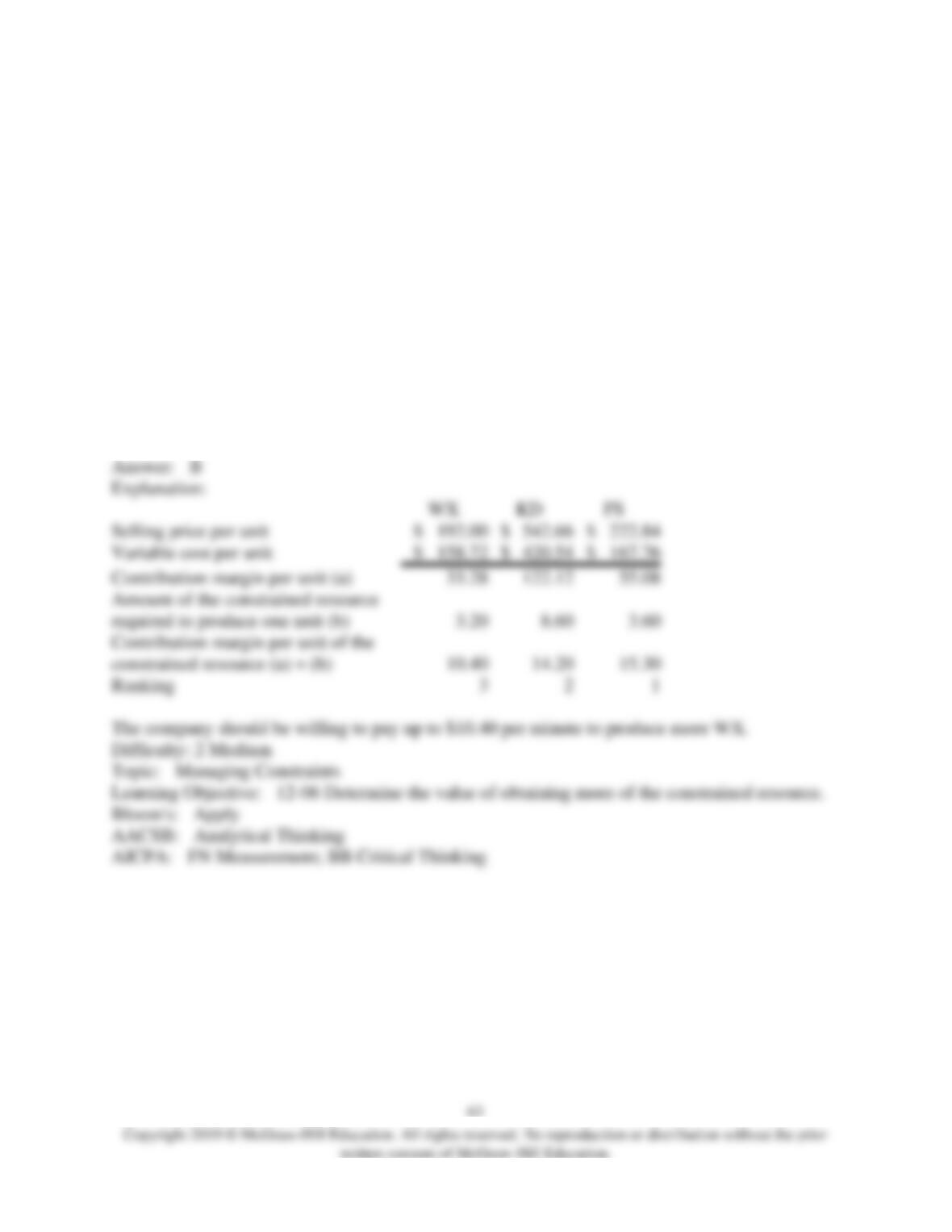
WX
KD
FS
Selling price per unit
$
192.00
$
542.66
$
222.84
Variable cost per unit
$
158.72
$
420.54
$
167.76
Contribution margin per unit (a)
122.12
required to produce one unit (b)
3.20
8.60
3.60
Ranking
92) Paine Corporation processes sugar beets in batches that it purchases from farmers for $72 a
batch. A batch of sugar beets costs $11 to crush in the company’s plant. Two intermediate
products, beet fiber and beet juice, emerge from the crushing process. The beet fiber can be sold as
is for $27 or processed further for $16 to make the end product industrial fiber that is sold for $40.
The beet juice can be sold as is for $43 or processed further for $28 to make the end product refined
sugar that is sold for $100. Which of the intermediate products should be processed further?
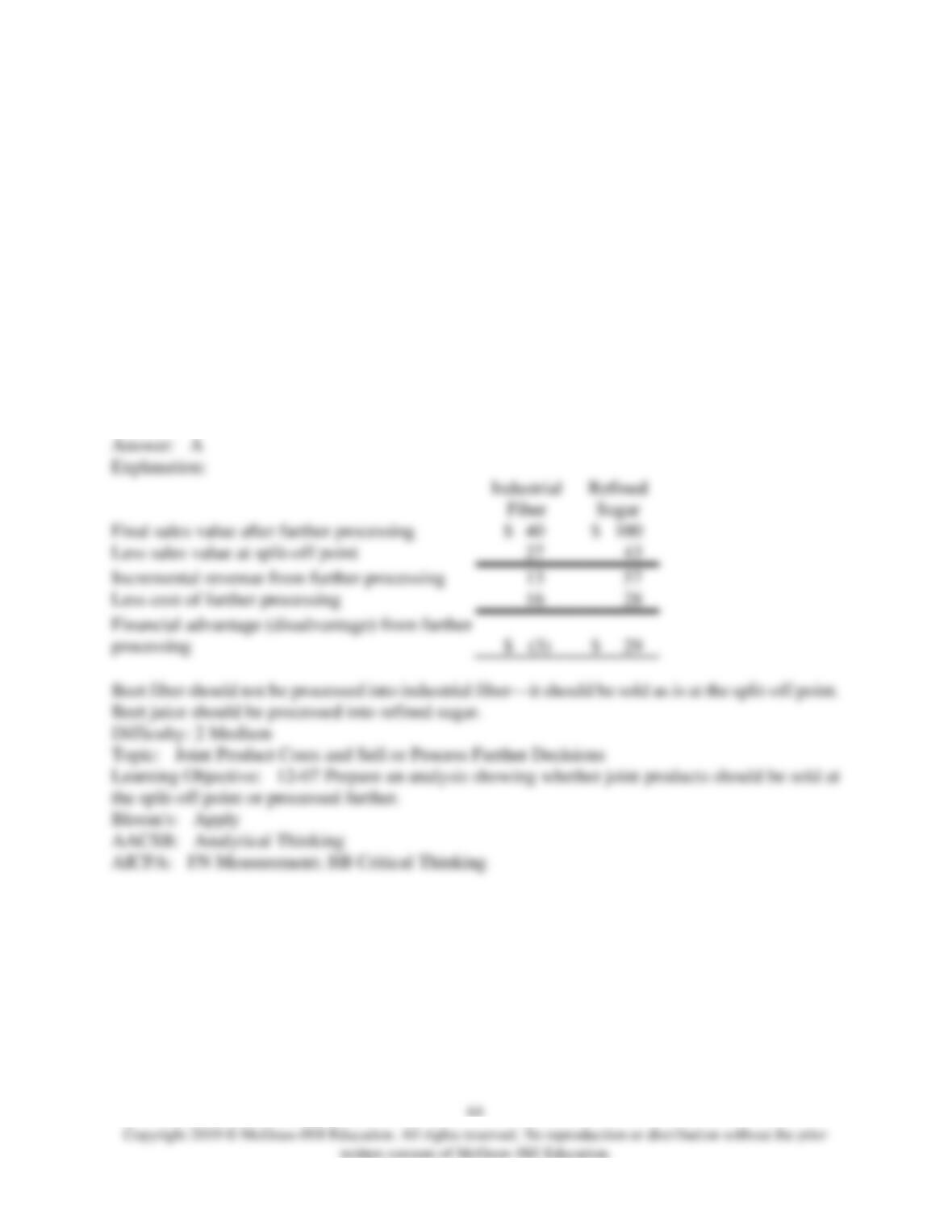
A) beet fiber should NOT be processed into industrial fiber; beet juice should be processed into
refined sugar
B) beet fiber should NOT be processed into industrial fiber; beet juice should NOT be processed
into refined sugar
C) beet fiber should be processed into industrial fiber; beet juice should NOT be processed into
refined sugar
D) beet fiber should be processed into industrial fiber; beet juice should be processed into refined
sugar
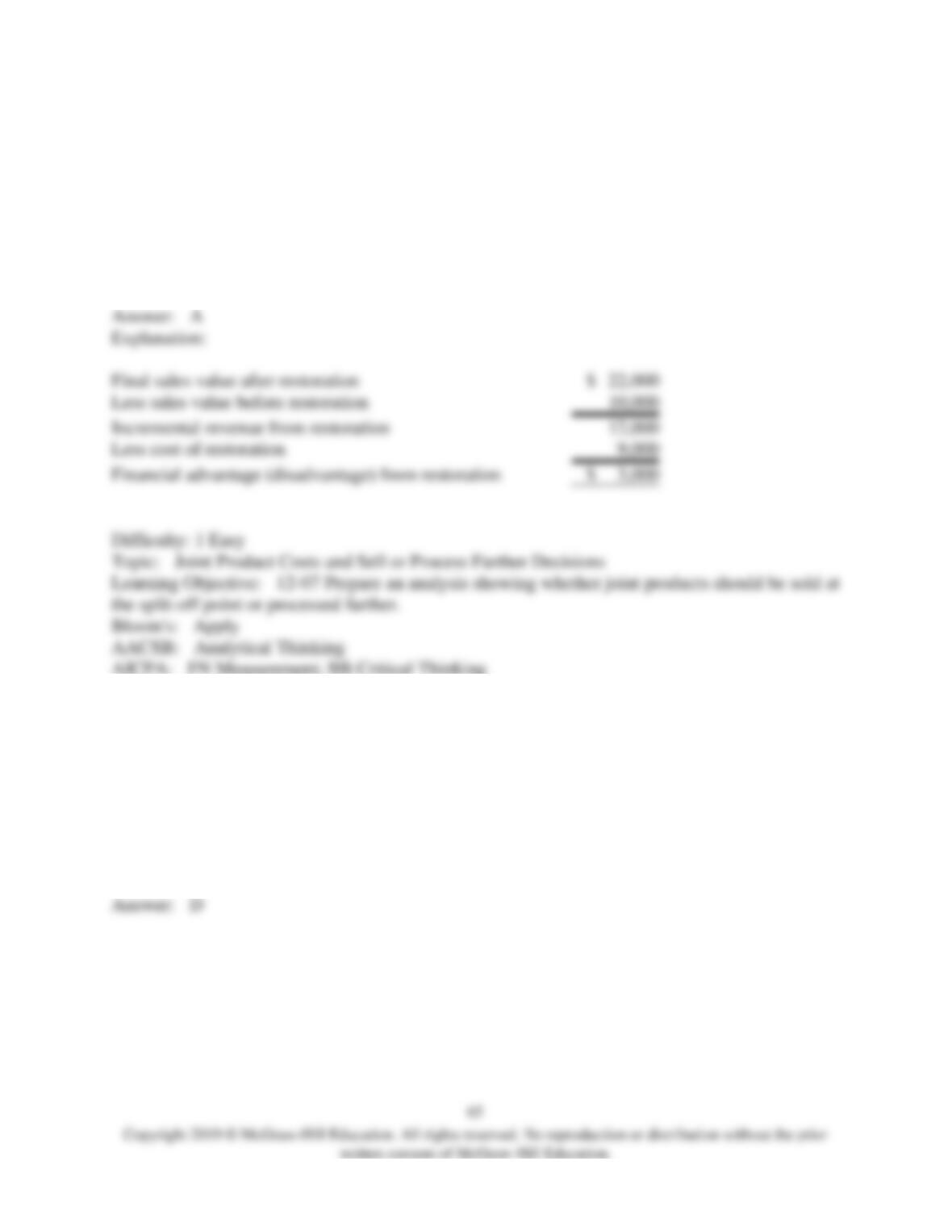
93) Cybil Baunt just inherited a 1958 Chevy Impala from her late Aunt Joop. Aunt Joop purchased
the car 40 years ago for $8,000. Cybil is either going to sell the car for $10,000 or have it restored
and then sell it for $22,000. The restoration will cost $9,000. Cybil would be financially better off
by:
A) $3,000 to have the vehicle restored
B) $6,000 to have the vehicle restored
C) $9,000 to have the vehicle restored
D) $11,000 to have the vehicle restored
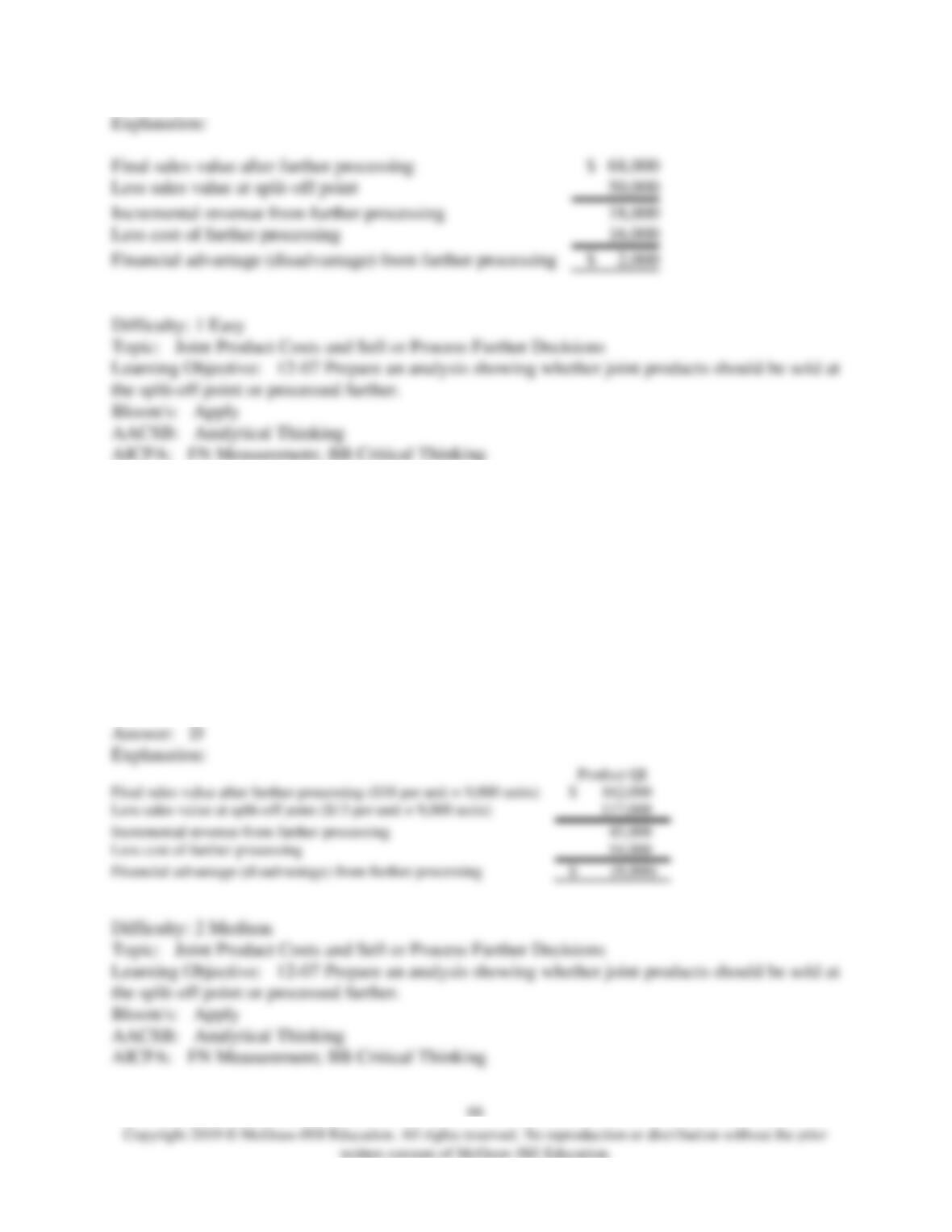
94) The Freed Corporation produces three products, X, Y, Z, from a single raw material input.
Product Y can be sold at the split-off point for total annual revenues of $50,000, or it can be
processed further at a total annual cost of $16,000 and then sold for $68,000. Which of the
following statements is true concerning Product Y?
A) Product Y should be sold at the split-off point rather than processed further.
B) The annual financial advantage from processing Product Y further is $18,000.
C) The annual financial advantage from processing Product Y further is $68,000.
D) The annual financial advantage from processing Product Y further is $2,000.
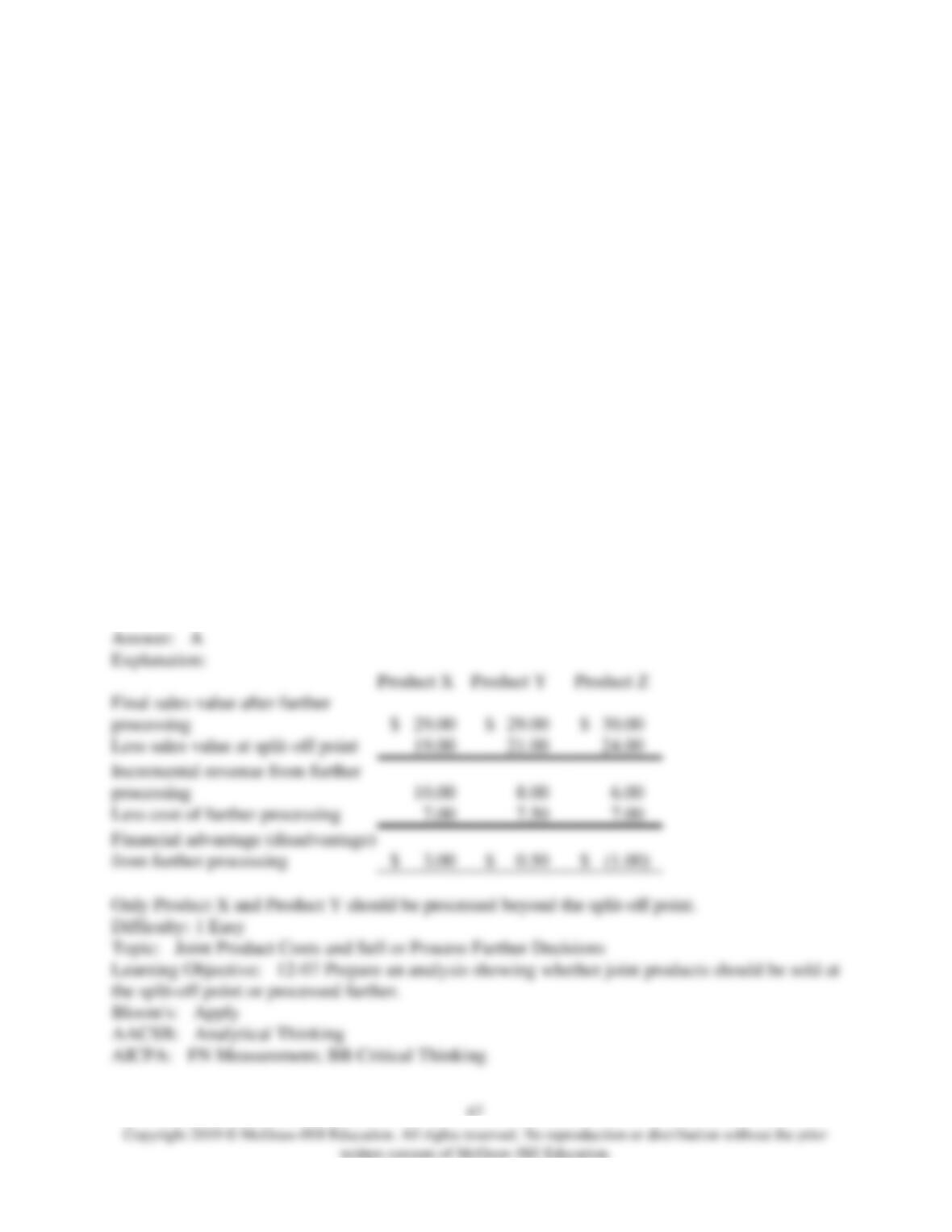
95) Two products, QI and VH, emerge from a joint process. Product QI has been allocated $9,600
of the total joint costs of $12,000. A total of 9,000 units of product QI are produced from the joint
process. Product QI can be sold at the split-off point for $13 per unit, or it can be processed further
for an additional total cost of $54,000 and then sold for $18 per unit. If product QI is processed
further and sold, what would be the financial advantage (disadvantage) for the company compared
with sale in its unprocessed form directly after the split-off point?
A) ($18,600)
B) $108,000
C) $600
D) ($9,000)
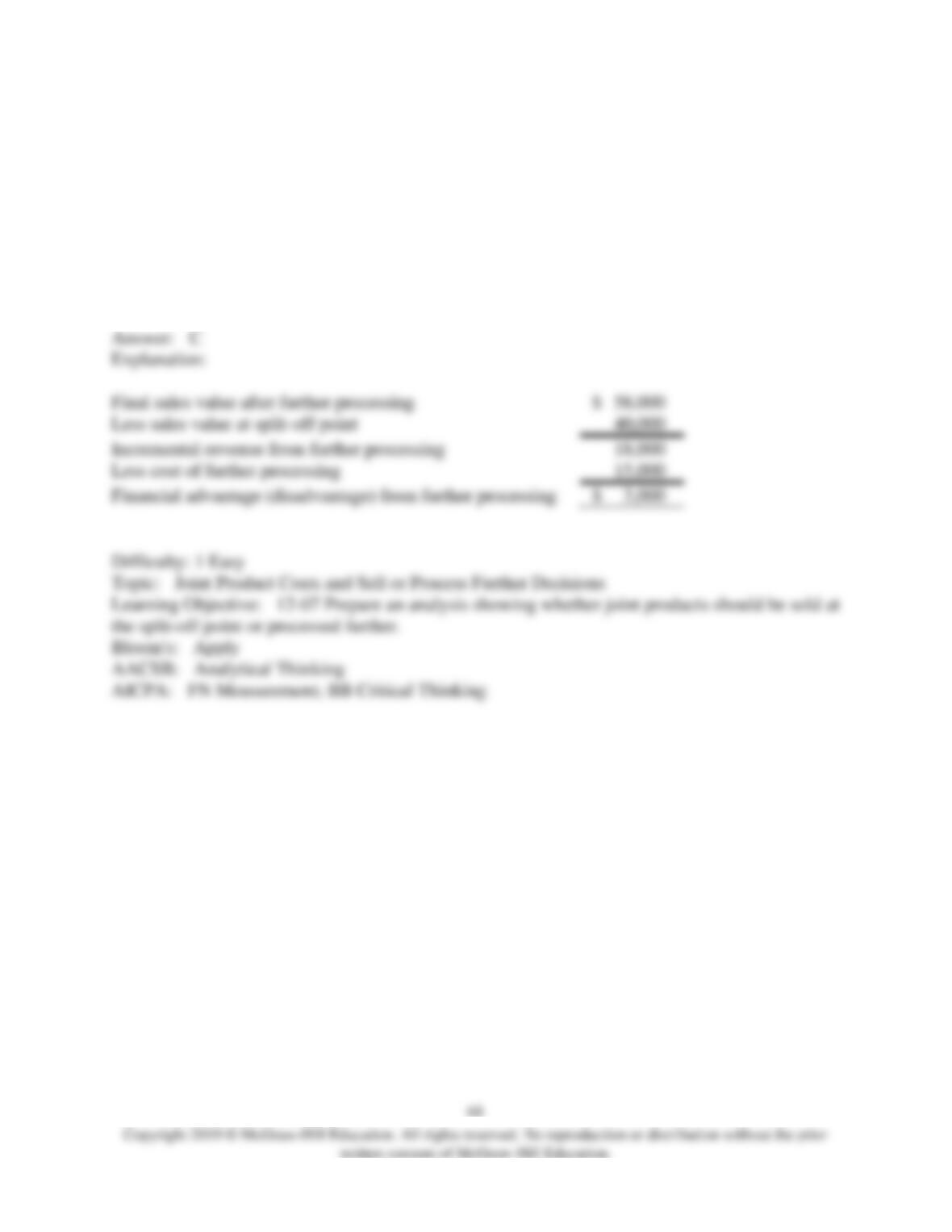
96) WP Corporation produces products X, Y, and Z from a single raw material input in a joint
production process. Budgeted data for the next month is as follows:
Product X
Product Y
Product Z
Units produced
1,500
2,000
3,000
Per unit sales value at split-off
$
19.00
$
21.00
$
24.00
Added processing costs per unit
$
7.00
$
7.50
$
7.00
Per unit sales value if processed further
$
29.00
$
29.00
$
30.00
The cost of the joint raw material input is $149,000. Which of the products should be processed
beyond the split-off point?
Product X
Product Y
Product Z
A)
Yes
Yes
No
B)
No
Yes
No
C)
Yes
No
Yes
D)
No
Yes
Yes
A) Choice A
B) Choice B
C) Choice C
D) Choice D
Product X
Product Y
Product Z
processing
$
29.00
$
29.00
$
30.00
Less sales value at split-off point
19.00
21.00
24.00
processing
10.00
8.00
6.00
Less cost of further processing
7.00
7.50
7.00
from further processing
$
3.00
$
0.50
$
)
97) The Wyeth Corporation produces three products, A, B, and C, from a single raw material
input. Product A can be sold at the splitoff point for $40,000, or it can be processed further at a
total cost of $15,000 and then sold for $58,000. Joint costs total $60,000 annually. Product A
should be:
A) discontinued because revenues after further processing are less than total joint costs.
B) sold at the split-off point.
C) processed further and then sold.
D) processed further only if its share of the total joint costs is less than the incremental revenues
from further processing.
98) Vannorman Corporation processes sugar beets in batches. A batch of sugar beets costs $78 to
buy from farmers and $18 to crush in the company’s plant. Two intermediate products, beet fiber
and beet juice, emerge from the crushing process. The beet fiber can be sold as is for $25 or
processed further for $16 to make the end product industrial fiber that is sold for $57. The beet
juice can be sold as is for $39 or processed further for $22 to make the end product refined sugar
that is sold for $84. How much profit (loss) does the company make by processing one batch of
sugar beets into the end products industrial fiber and refined sugar rather than not processing that
batch at all?
A) ($134)
B) ($32)
C) $7
D) $39
99) Priddy Corporation processes sugar cane in batches. The company purchases a batch of sugar
cane for $62 from farmers and then crushes the cane in the company’s plant at the cost of $18. Two
intermediate products, cane fiber and cane juice, emerge from the crushing process. The cane fiber
can be sold as is for $28 or processed further for $13 to make the end product industrial fiber that is
sold for $36. The cane juice can be sold as is for $43 or processed further for $23 to make the end
product molasses that is sold for $85. Which of the intermediate products should be processed
further?
A) Cane fiber should NOT be processed into industrial fiber; Cane juice should be processed into
molasses
B) Cane fiber should be processed into industrial fiber; Cane juice should NOT be processed into
molasses
C) Cane fiber should be processed into industrial fiber; Cane juice should be processed into
molasses
D) Cane fiber should NOT be processed into industrial fiber; Cane juice should NOT be processed
into molasses
100) Stinehelfer Beet Processors, Inc., processes sugar beets in batches. A batch of sugar beets
costs $56 to buy from farmers and $13 to crush in the company’s plant. Two intermediate products,
beet fiber and beet juice, emerge from the crushing process. The beet fiber can be sold as is for $24
or processed further for $12 to make the end product industrial fiber that is sold for $31. The beet
juice can be sold as is for $43 or processed further for $29 to make the end product refined sugar
that is sold for $91. What is the financial advantage (disadvantage) for the company from
processing the intermediate product beet juice into refined sugar rather than selling it as is?
A) $19
B) $6
C) ($50)
D) ($16)
101) Drew Cane Products, Inc., processes sugar cane in batches. The company buys a batch of
sugar cane from farmers for $90 which is then crushed in the company’s plant at a cost of $11. Two
intermediate products, cane fiber and cane juice, emerge from the crushing process. The cane fiber
can be sold as is for $21 or processed further for $13 to make the end product industrial fiber that is
sold for $45. The cane juice can be sold as is for $41 or processed further for $29 to make the end
product molasses that is sold for $103. What is the financial advantage (disadvantage) for the
company from processing one batch of sugar cane into the end products industrial fiber and
molasses rather than not processing that batch at all?
A) $44
B) ($143)
C) ($39)
D) $5
102) Faustina Chemical Corporation manufactures three chemicals (TX14, NJ35, and KS63) from
a joint process. The three chemicals are in industrial grade form at the split-off point. They can
either be sold at that point or processed further into premium grade. Costs related to each batch of
this chemical process is as follows:
TX14
NJ35
KS63
Sales value at split-off point
$
16,000
$
12,000
$
5,000
Allocated joint costs
$
6,000
$
6,000
$
6,000
Sales value after further processing
$
20,000
$
18,000
$
9,000
Cost of further processing
$
5,000
$
3,000
$
2,000
For which product(s) above would it be more profitable for Faustina to sell at the split-off point
rather than process further?
A) TX14 only
B) KS63 only
C) TX14 and KS63 only
D) NJ35 and KS63 only
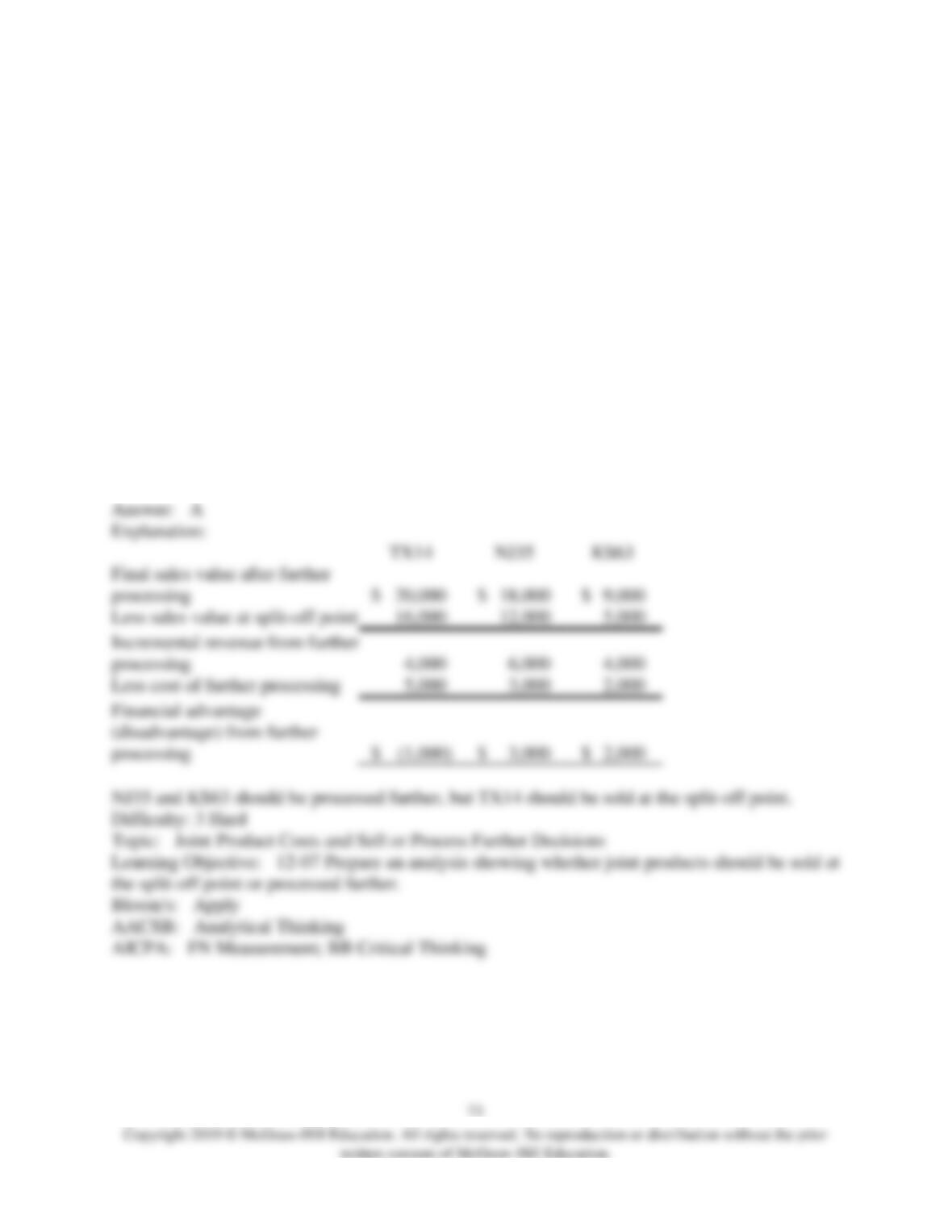
processing
$
20,000
$
18,000
$
9,000
Less sales value at split-off point
16,000
12,000
5,000
4,000
6,000
4,000
Less cost of further processing
5,000
3,000
2,000
processing
$
)
$
3,000
$
2,000
103) Ouzts Corporation is considering Alternative A and Alternative B. Costs associated with the
alternatives are listed below:
Alternative
A
Alternative
B
Materials costs
$
40,000
$
56,000
Processing costs
$
37,000
$
37,000
Equipment rental
$
13,000
$
13,000
Occupancy costs
$
15,000
$
22,000
Are the materials costs and processing costs relevant in the choice between alternatives A and B?
A) Both materials costs and processing costs are relevant
B) Neither materials costs nor processing costs are relevant
C) Only processing costs are relevant
D) Only materials costs are relevant
104) Ouzts Corporation is considering Alternative A and Alternative B. Costs associated with the
alternatives are listed below:
Alternative
A
Alternative
B
Materials costs
$
40,000
$
56,000
Processing costs
$
37,000
$
37,000
Equipment rental
$
13,000
$
13,000
Occupancy costs
$
15,000
$
22,000
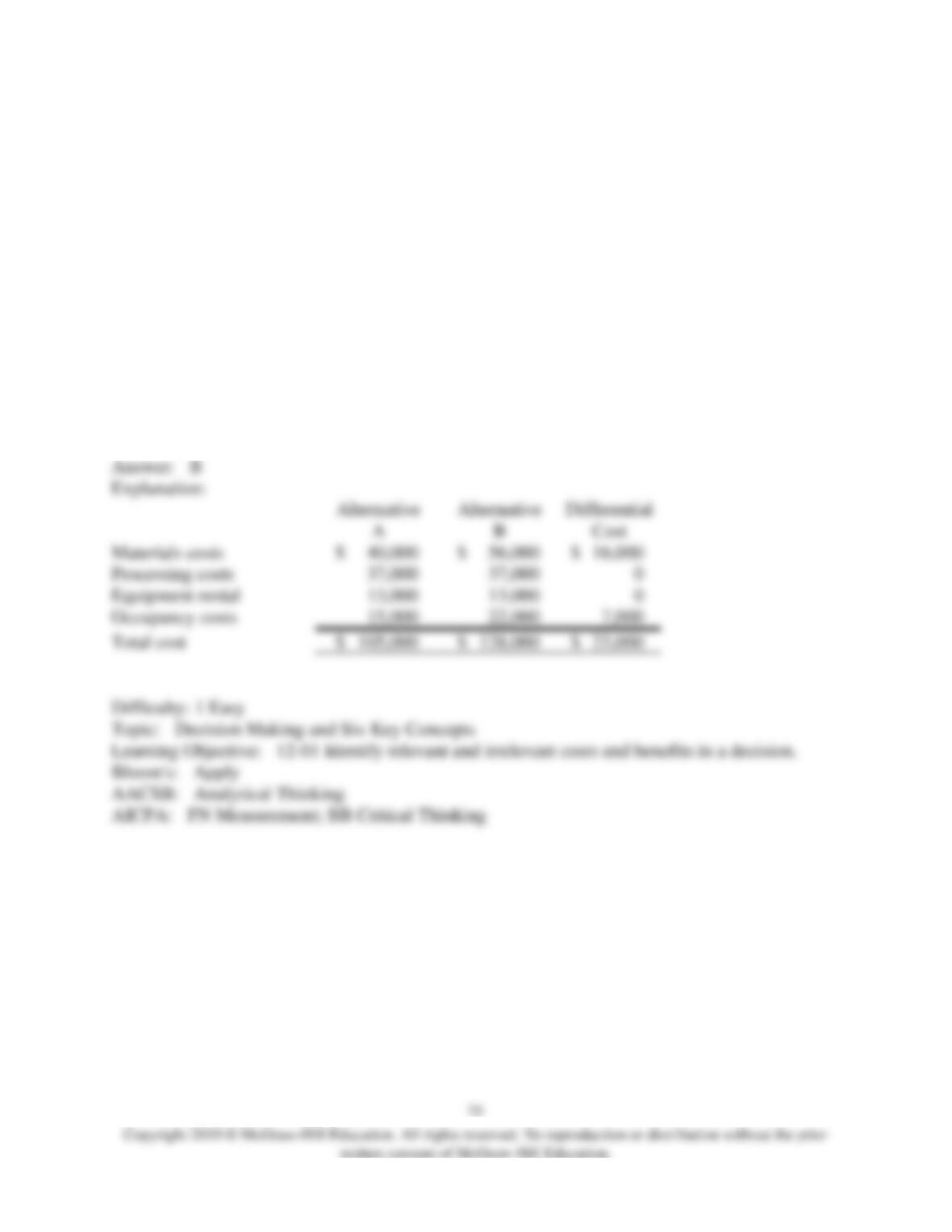
What is the financial advantage (disadvantage) of Alternative B over Alternative A?
A) $105,000
B) $23,000
C) $128,000
D) $116,500
Materials costs
40,000
56,000
$
Processing costs
37,000
37,000
Equipment rental
13,000
13,000
Occupancy costs
15,000
22,000
7,000
Total cost
$
105) Two alternatives, code-named X and Y, are under consideration at Guyer Corporation. Costs
associated with the alternatives are listed below.
Alternative
X
Alternative
Y
Materials costs
$
41,000
$
59,000
Processing costs
$
45,000
$
45,000
Equipment rental
$
17,000
$
17,000
Occupancy costs
$
16,000
$
24,000
Are the materials costs and processing costs relevant in the choice between alternatives X and Y?
A) Neither materials costs nor processing costs are relevant
B) Only processing costs are relevant
C) Only materials costs are relevant
D) Both materials costs and processing costs are relevant
106) Two alternatives, code-named X and Y, are under consideration at Guyer Corporation. Costs
associated with the alternatives are listed below.
Alternative
X
Alternative
Y
Materials costs
$
41,000
$
59,000
Processing costs
$
45,000
$
45,000
Equipment rental
$
17,000
$
17,000
Occupancy costs
$
16,000
$
24,000
What is the financial advantage (disadvantage) of Alternative Y over Alternative X?
A) $132,000
B) $119,000
C) $145,000
D) $26,000
Materials costs
$
59,000
Processing costs
45,000
Equipment rental
17,000
Occupancy costs
24,000
8,000
Total cost
$
145,000
107) The sunk cost in this situation is:
A) $10,000
B) $26,800
C) $11,200
D) $0
108) What is the financial advantage (disadvantage) to the company from upgrading the
calculators?
A) $8,800
B) ($18,000)
C) $20,000
D) ($8,000)
109) Assume that Tolar decides to upgrade the calculators. At what selling price per unit would the
company be as well off as if it just sold the calculators in their present condition?
A) $8 per calculator
B) $30 per calculator
C) $53 per calculator
D) $67 per calculator
110) The management of Bonga Corporation is considering dropping product D74F. Data from the
company’s accounting system for this product for last year appear below:
Sales
$830,000
Variable expenses
$390,000
Fixed manufacturing expenses
$266,000
Fixed selling and administrative expenses
$232,000
All fixed expenses of the company are fully allocated to products in the company’s accounting
system. Further investigation has revealed that $111,000 of the fixed manufacturing expenses and
$103,000 of the fixed selling and administrative expenses are avoidable if product D74F is
discontinued.
According to the company’s accounting system, what is the net operating income earned by
product D74F? Include all costs in this calculation—whether relevant or not.
A) ($58,000)
B) ($440,000)
C) $58,000
D) $440,000
Sales
Less expenses:
Variable expenses
Fixed manufacturing expenses
Fixed selling and administrative expenses
Net operating income (loss)
)