
89) When the investor’s level of influence changes, it may be necessary to change from the
equity method to another method. When the level of ownership falls from a range of 20% to 50%
to less than 20%, the equity method typically would be discontinued and the investment account
balance would be carried over at:
A) Amortized cost on the date of ownership change.
B) Fair value on the date of ownership change.
C) Discounted present value on the date of ownership change.
D) The current balance, and this balance would serve as the new “cost.”
90) When the investor’s level of influence changes, it may be necessary to change to the equity
method from another method. When the level of ownership rises from less than 20% to a range
of 20% to 50%, the equity method typically would become appropriate and the investment
account balance should be:
A) Retrospectively adjusted to the balance that would have existed if the equity method had been
in effect for prior years.
B) Carried over as is with no adjustment necessary.
C) Carried over at the fair value that exists on date of transfer.
D) Adjusted to reflect amortized cost.
91) On July 1, 2018, Tremen Corporation acquired 40% of the shares of Delany Company.
Tremen paid $3,000,000 for the investment, and that amount is exactly equal to 40% of the book
value of identifiable net assets on Delany’s balance sheet. Delany recognized net income of
$1,000,000 for 2018, and paid $150,000 of dividends each quarter to its shareholders. After all
closing entries are made, Tremen’s “Investment in Delany Company” account would have a
balance of:
A) $3,200,000.
B) $3,160,000.
C) $3,000,000.
D) $3,080,000.
92) Which of the following is not true about accounting for investments using the equity method
under IFRS?
A) IFRS requires the equity method when the investor exercises significant influence over the
investee.
B) IFRS is more restrictive than U.S. GAAP concerning when an investor can elect the fair value
option.
C) IFRS requires that the accounting policies of an investee be adjusted to correspond to those of
the investor when applying the equity method.
D) IFRS does not allow use of the equity method where two or more investors have joint control.
93) Bloomfield Bakers accounts for its investment in Clor Confectionary under the equity
method. Bloomfield carried the Clor investment at $150,000 and $165,000 at December 31, 2017
and 2018, respectively. During 2018 Clor recognized $80,000 of net income and paid dividends
of $30,000. Assuming that Bloomfield owned the same percentage of Clor throughout 2018,
their percentage ownership must have been:
A) 15%.
B) 18.75%.
C) 30%.
D) 50%.
94) Jack Corporation purchased a 20% interest in Jill Corporation for $1,500,000 on January 1,
2018. Jack can significantly influence Jill. On December 10, 2018, Jill declared and paid $1
million in dividends. Jill reported a net loss of $6 million for the year. What amount of loss
should Jack report in its income statement for 2018 relative to its investment in Jill?
A) $1,000,000.
B) $1,200,000.
C) $1,400,000.
D) $1,500,000.
95) Hope Company bought 30% of Faith Corporation in the beginning of 2018. Hope’s purchase
price equaled 30% of the book value of Faith’s net identifiable assets, which also equaled 30% of
the fair value of Faith. During 2018, Faith reported net income in the amount of $4,000,000 and
declared and paid dividends in the amount of $500,000. Hope mistakenly accounted for the
investment using the fair value through net income method instead of using the equity method.
What effect would this error have on the investment account and net income, respectively, for
2018?
A) Overstated by $1,050,000; understated by $1,050,000.
B) Understated by $1,050,000; understated by $1,050,000.
C) Understated by $1,200,000; overstated by $1,050,000.
D) Overstated by $1,200,000; overstated by $1,200,000.
96) Sox Corporation purchased a 40% interest in Hack Corporation for $1,500,000 on January 1,
2018. On November 1, 2018, Hack declared and paid $1 million in dividends. On December 31,
Hack reported a net loss of $6 million for the year. What amount of loss should Sox report on its
income statement for 2018 relative to its investment in Hack?
A) $1,100,000.
B) $2,400,000.
C) $1,500,000.
D) $1,600,000.
97) Assume that, on January 1, 2018, Matsui Co. paid $1,200,000 for its investment in 60,000
shares of Yankee Inc. Further, assume that Yankee has 200,000 total shares of stock issued. The
book value and fair value of Yankee’s identifiable net assets were both $4,000,000 at January 1,
2018. The following information pertains to Yankee during 2018:
Net Income
$
200,000
Dividends declared and paid
$
60,000
Market price of common stock on 12/31/2018
$
22
/share
What amount would Matsui report in its year-end 2018 balance sheet for its investment in
Yankee?
A) $1,320,000.
B) $1,260,000.
C) $1,242,000.
D) None of these answer choices are correct.
98) Gerken Company concluded at the beginning of 2018 that the company’s ownership interest
in DillCo had increased to the point that it became appropriate to begin using the equity method
to account for the investment. The balance in the investment account is $50,000 at the time of the
change, and accountants working with company records determined that the balance would have
been $75,000 if the account had been adjusted for investee net income and dividends as
prescribed by the equity method. After implementing the change to the equity method, if
financial statements were prepared:
A) Net income and retained earnings will be higher by $25,000.
B) Net income will be unchanged, and retained earnings will be higher by $25,000.
C) Net income and retained earnings will be higher by $75,000.
D) The accounts will be unchanged, because no adjustment is necessary.
99) On April 1, 2018, BigBen Company acquired 30% of the shares of LittleTick, Inc. BigBen
paid $100,000 for the investment, which is $40,000 more than 30% of the book value of
LittleTick’s identifiable net assets. BigBen attributed $15,000 of the $40,000 difference to
inventory that will be sold in the remainder of 2018, and the rest to goodwill. LittleTick
recognized a total of $20,000 of net income for 2018, and paid total dividends for the year
$10,000; these dividends were issued quarterly. BigBen’s investment in LittleTick will affect
BigBen’s 2018 net income by:
A) A loss of $10,500.
B) Earnings of $4,500.
C) Earnings of $1,125.
D) Earnings of $3,450.
100) Cucumber Company concluded at the beginning of 2018 that the company’s ownership
interest in PickelCo had decreased to the point that it became appropriate to begin accounting for
its investment under the fair value through net income method, rather than using the equity
method as it had been doing. The balance in the investment account is $75,000 at the time of the
change, and accountants working with company records determined that the balance would have
been $50,000 if the investment had been accounted for as fair value through net income. At the
time of implementing the change to the fair value through net income method, if financial
statements were prepared:
A) Net income and retained earnings will be lower by $25,000.
B) Net income will be unchanged, and retained earnings will be lower by $25,000.
C) The accounts will be unchanged, because no adjustment is necessary.
D) Other comprehensive income and accumulated other comprehensive income will be lower by
$25,000.
101) When the equity method of accounting for investments is used by the investor, the
amortization of additional depreciation due to differences between book values and fair values of
investee assets on the date of acquisition:
A) Reduces the investment account and increases investment revenue.
B) Increases the investment account and increases investment revenue.
C) Reduces the investment account and reduces investment revenue.
D) Increases the investment account and reduces investment revenue.
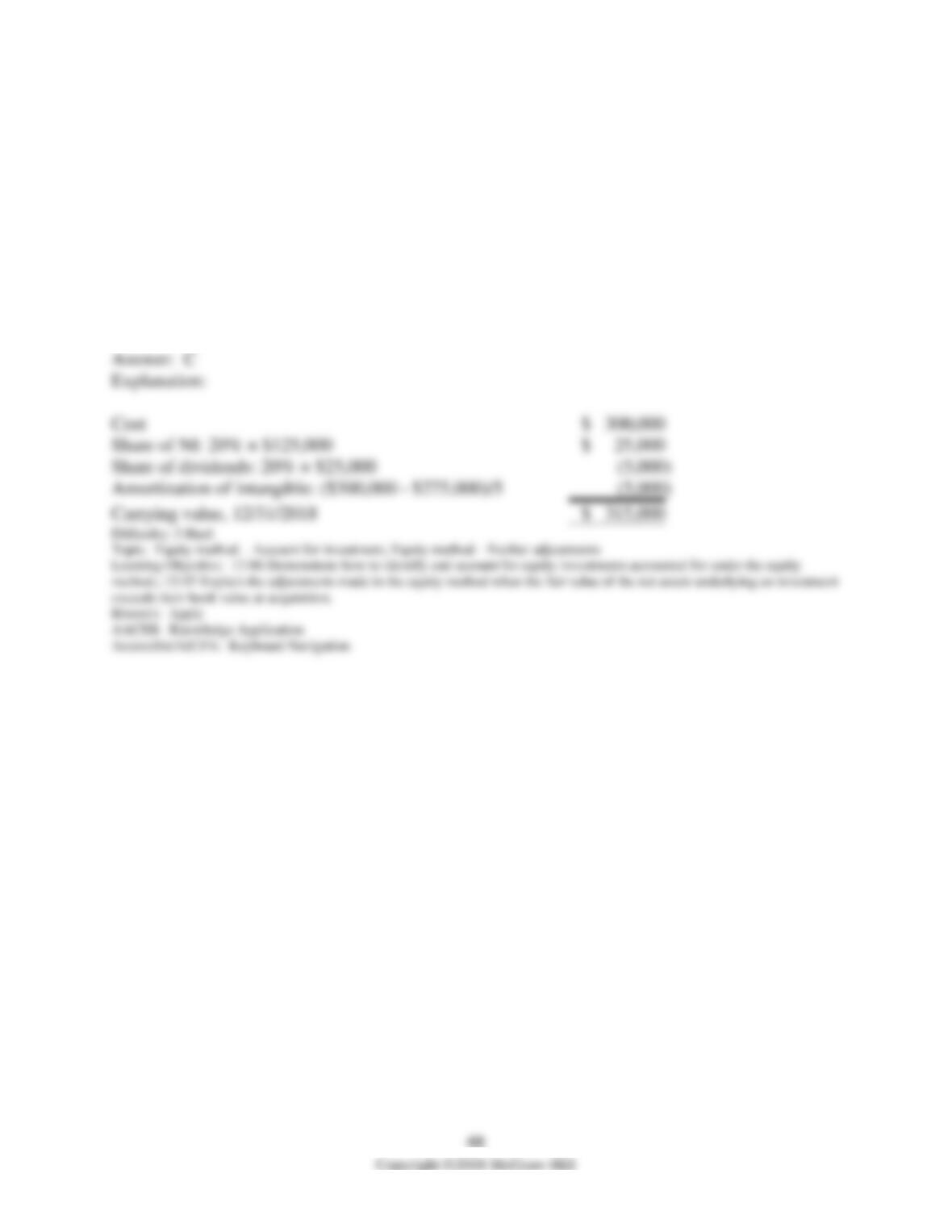
102) On January 1, 2018, Green Corporation purchased 20% of the outstanding voting common
stock of Gold Company for $300,000. The book value of the acquired shares was $275,000. The
excess of cost over book value is attributable to an intangible asset on Gold’s books that was
undervalued and had a remaining useful life of five years. For the year ended December 31,
2018, Gold reported net income of $125,000 and paid cash dividends of $25,000. What is the
carrying value of Green’s investment in Gold at December 31, 2018?
A) $295,000.
B) $300,000.
C) $315,000.
D) $320,000.
103) At the start of the current year, SBC Corp. purchased 30% of Sky Tech Inc. for $45 million.
At the time of purchase, the carrying value of Sky Tech’s net assets was $75 million. The fair
value of Sky Tech’s depreciable assets was $15 million in excess of their book value. For this
year, Sky Tech reported a net income of $75 million and declared and paid $15 million in
dividends.
The amount of purchased goodwill is:
A) $18 million.
B) $30 million.
C) $60 million.
D) None of the above are correct.
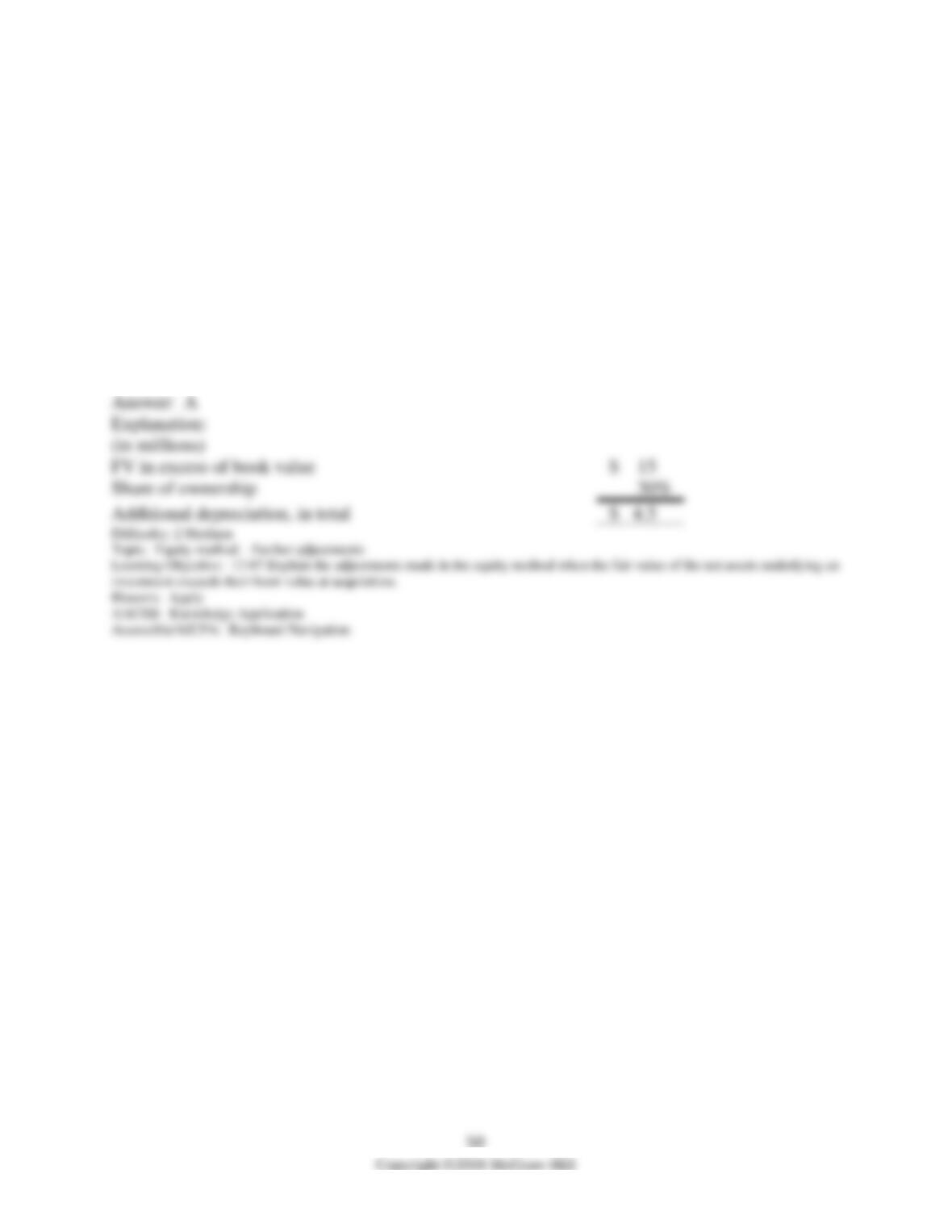
104) At the start of the current year, SBC Corp. purchased 30% of Sky Tech Inc. for $45 million.
At the time of purchase, the carrying value of Sky Tech’s net assets was $75 million. The fair
value of Sky Tech’s depreciable assets was $15 million in excess of their book value. For this
year, Sky Tech reported a net income of $75 million and declared and paid $15 million in
dividends.
The total amount of additional depreciation to be recognized by SBC over the remaining life of
the assets is:
A) $4.5 million.
B) $15 million.
C) $27 million.
D) None of these answer choices are correct.

105) Assume that, on January 1, 2018, Sosa Enterprises paid $3,000,000 for its investment in
36,000 shares of Orioles Co. Further, assume that Orioles has 120,000 total shares of stock
issued and estimates an eight-year remaining useful life and straight-line depreciation with no
residual value for its depreciable assets.
At January 1, 2018, the book value of Orioles’ identifiable net assets was $7,000,000, and the fair
value of Orioles was $10,000,000. The difference between Orioles’ fair value and the book value
of its identifiable net assets is attributable to $1,800,000 of land and the remainder to depreciable
assets. Goodwill was not part of this transaction.
The following information pertains to Orioles during 2018:
Net Income
$
600,000
Dividends declared and paid
$
360,000
Market price of common stock on 12/31/2018
$
80
/share
What amount would Sosa Enterprises report in its year-end 2018 balance sheet for its investment
in Orioles Co.?
A) $3,200,000.
B) $3,180,000.
C) $3,135,000.
D) $3,027,000.
106) Smith buys and sells securities. On December 15, 2018, Smith purchased $500,000 of Jones
shares and elected the fair value option to account for the Jones investment. As of December 31,
2018, the Jones shares had a fair value of $525,000. In the 2018 financial statements, Smith will
report (ignore taxes):
A) Investment income of $25,000 in its income statement.
B) Other comprehensive income of $25,000.
C) Accumulated other comprehensive income of $525,000.
D) An investment in Jones of $500,000.
107) Which of the following is not true about the fair value option?
A) The fair value option is irrevocable.
B) The fair value option must be elected for all shares of an investment in a particular company.
C) Electing the fair value option for held-to-maturity investments simply reclassifies those
investments as trading securities.
D) All of these answer choices are true.
108) Which of the following is not true when the fair value option is elected for an investment
that would normally be accounted for under the equity method?
A) No journal entry need be made to recognize the investor’s portion of the investee’s net
income.
B) Unrealized holding gains and losses on that investment are recognized in net income.
C) No journal entry need be made to recognize the investor’s portion of dividends paid by the
investee.
D) All of these answer choices are true.
109) Under IAS No. 39, which is not a category for accounting for investments?
A) Fair value through profit and loss.
B) Fair value through other comprehensive income.
C) Held-to-maturity.
D) Available-for-sale.
110) Under IFRS No. 9, which is not a category for accounting for investments?
A) Fair value through profit and loss.
B) Fair value through other comprehensive income.
C) Held-to-maturity.
D) Amortized cost.
111) Which of the following is not true about the “fair value through profit and loss” approach
for accounting for investments under IFRS?
A) Allowed under both IAS No. 39 and IFRS No. 9.
B) Includes unrealized holding gains in earnings.
C) Requires reclassification of realized gains from other comprehensive income.
D) Not vulnerable to other-than-temporary impairments.

112) Under IFRS No. 9, an investment can be accounted for at amortized cost if:
A) The debt consists of interest and principal, and the investor is holding the debt to collect those
cash flows.
B) The investor elects amortized cost.
C) The investor owns between 20% and 50% of outstanding shares.
D) The debt is not in technical default.
113) Which of the following is not true about accounting for an equity investment under IFRS
No. 9?
A) The investor can elect to account for the investment as FVOCI.
B) Unrealized holding gains and losses on the investment will be recognized in income unless
the investor elects to account for the investment as FVOCI.
C) If the investor elects to account for the investment as FVOCI, gains and losses will be
recognized in net income when the investment is sold.
D) Unrealized holding gains and losses are recognized in net income if the investor accounts for
the investments as FVPL.
114) Which of the following is not true about the “fair value through other comprehensive
income” approach for accounting for investments under IFRS No. 9?
A) Is allowed for equity method investments.
B) Includes unrealized holding gains in other comprehensive income.
C) Does not require reclassification of realized gains from other comprehensive income.
D) Is allowed for equity investments.

115) Wang Corporation purchased $100,000 of Hales Inc. 6% bonds at par with the intent and
ability to hold the bonds until they matured in 2022, so Wang classifies its investment as held to
maturity. Unfortunately, a combination of problems at Hales and in the debt market caused the
fair value of the Hales investment to decline to $70,000 during 2018. Wang views this decline as
an other-than-temporary (OTT) impairment. Wang calculates that, of the $30,000 drop in fair
value, $10,000 of it relates to credit losses and $20,000 relates to non-credit losses. If Wang
accounts for the Hales bonds under IAS No. 39, before-tax net income for 2018 will be reduced
by:
A) $0.
B) $10,000.
C) $20,000.
D) $30,000.
116) Espana Corporation purchased $100,000 of Hales Inc. 6% bonds at par and classifies its
investment as available for sale. Unfortunately, a combination of problems at Hales and in the
debt market caused the fair value of the Hales investment to decline to $70,000 during 2018.
Espana views this decline as an other-than-temporary impairment. Espana calculates that, of the
$30,000 drop in fair value, $10,000 of it relates to credit losses and $20,000 relates to non-credit
losses. If Espana accounts for the Hales bonds under IAS No. 39, before-tax net income for 2018
will be reduced by:
A) $0.
B) $10,000.
C) $20,000.
D) $30,000.

117) If the fair value of a held-to-maturity investment declines for a reason that is viewed as
“other than temporary” because the company intends to sell the investment:
A) The investment is not written down to fair value.
B) The investment is written down to fair value, and the entire impairment loss is recognized in
net income.
C) The investment is written down to fair value, and the entire impairment loss is recognized in
accumulated other comprehensive income.
D) The investment is treated the same way it would be treated if the decline in fair value was
viewed as temporary.
118) If the fair value of a held-to-maturity investment declines for a reason that is viewed as
“other than temporary” because the company has incurred a credit loss on the investment:
A) The investment is written down to fair value, and only the noncredit-loss component of the
impairment loss is recognized in net income.
B) The investment is written down to fair value, and the entire impairment loss is recognized in
net income.
C) The investment is written down to fair value, and only the credit-loss component of the
impairment loss is recognized in net income.
D) The investment is written down to fair value, but none of the impairment loss is recognized in
net income.

119) If the fair value of a trading security declines for a reason that is viewed as “other than
temporary”:
A) The investment is not written down to fair value.
B) The investment is written down to fair value, and an “impairment loss” is recognized in net
income.
C) The investment is written down to fair value, and the impairment loss is recognized in
accumulated other comprehensive income.
D) The investment is treated the same way it would be treated if the decline in fair value was
viewed as temporary.
120) When an impairment of an investment that is classified as available for sale occurs for a
reason that is judged to be “other than temporary,” the investment is written down to its fair
value and the amount of the write-down is:
A) Recorded as a deferred credit.
B) Included in net income.
C) Recorded as deferred asset.
D) Treated as unrealized.
121) An OTT impairment for a debt investment is recognized in net income if fair value declines
below the investment’s cost and:
A) The company has incurred noncredit losses.
B) The company does not have the intent and ability to hold the investment until fair value
recovers.
C) The company lacks intent to hold the investment until fair value recovers.
D) The company has incurred credit losses.

122) If the fair value of a debt investment that is classified as an available-for-sale investment
declines for a reason that is viewed as “other than temporary” because it is viewed as “more
likely than not” that the investor will be required to sell the investment prior to recovering the
amortized cost of the investment less any credit losses arising in the current year:
A) The investment is not written down to fair value.
B) The investment is written down to fair value, and the impairment loss is recognized in net
income.
C) The investment is written down to fair value, and the impairment loss is recognized in
accumulated other comprehensive income.
D) The investment is written down to fair value, and only the noncredit loss is included in net
income.
123) If the fair value of a debt investment that is classified as an available-for-sale investment
declines for a reason that is viewed as “other than temporary” because the company has incurred
a credit loss on the investment:
A) The investment is written down to fair value, and only the noncredit-loss component of the
impairment loss is recognized in net income.
B) The investment is written down to fair value, and the entire impairment loss is recognized in
net income.
C) The investment is written down to fair value, and only the credit-loss component of the
impairment loss is recognized in net income.
D) The investment is written down to fair value, but none of the impairment loss is recognized in
net income.

124) Which of the following is not a reason to consider a decline in the fair value of a debt
investment to be “other than temporary”?
A) The investor determines that a credit loss exists on the investment.
B) The investor intends to sell the investment.
C) The investor believes it is “more likely than not” that the investor will be required to sell the
investment prior to recovering the amortized cost of the investment less any credit losses arising
in the current year.
D) The investor intends to hold the investment to maturity.
125) Nichols Corporation purchased $100,000 of Holly Inc. 6% bonds at par with the intent and
ability to hold the bonds until they matured in 2022, so Nichols classifies its investment as held
to maturity. Unfortunately, a combination of problems at Holly and in the debt market caused the
fair value of the Holly investment to decline to $70,000 during 2018. Nichols calculates that, of
the $30,000 decrease in fair value, $10,000 of it relates to credit losses and $20,000 relates to
noncredit losses.
Assume that Nichols concludes that the Holly bonds are other-than-temporarily impaired
because Nichols is planning to sell the bonds in the near future. Before-tax net income for 2018
will be reduced by:
A) $0.
B) $10,000.
C) $20,000.
D) $30,000.

126) Nichols Corporation purchased $100,000 of Holly Inc. 6% bonds at par with the intent and
ability to hold the bonds until they matured in 2022, so Nichols classifies its investment as held
to maturity. Unfortunately, a combination of problems at Holly and in the debt market caused the
fair value of the Holly investment to decline to $70,000 during 2018. Nichols calculates that, of
the $30,000 decrease in fair value, $10,000 of it relates to credit losses and $20,000 relates to
noncredit losses.
Assume that Nichols concludes that the Holly bonds are other-than-temporarily impaired
because Nichols believes it is more likely than not that it will have to sell the Holly bonds before
the bonds have a chance to recover their fair value. Before-tax net income for 2018 will be
reduced by:
A) $0.
B) $10,000.
C) $20,000.
D) $30,000.
127) Nichols Corporation purchased $100,000 of Holly Inc. 6% bonds at par with the intent and
ability to hold the bonds until they matured in 2022, so Nichols classifies its investment as held
to maturity. Unfortunately, a combination of problems at Holly and in the debt market caused the
fair value of the Holly investment to decline to $70,000 during 2018. Nichols calculates that, of
the $30,000 decrease in fair value, $10,000 of it relates to credit losses and $20,000 relates to
noncredit losses.
Assume that Nichols concludes that the Holly bonds are other-than-temporarily impaired
because Nichols calculates that the bonds have incurred credit losses. Before-tax net income for
2018 will be reduced by:
A) $0.
B) $10,000.
C) $20,000.
D) $30,000.