Financial and Managerial Accounting, 8e (Wild)
Chapter 12 Reporting Cash Flows
1) The primary purpose of the statement of cash flows is to report all major cash receipts
(inflows) and cash payments (outflows) during a period.
2) The statement of cash flows reports and proves the net change in cash for a reporting period.
3) To be classified as a cash equivalent, the only criterion an item must meet is that it must be
readily convertible to a liquid asset.
4) The statement of cash flows explains the difference between the beginning and ending
balances of cash and cash equivalents.
5) Cash flow statements help users decide whether a company has enough cash to pay its debts.
6) A cash equivalent must be readily convertible to a known amount of cash, and must be
sufficiently close to its maturity so its market value is unaffected by interest rate changes.
7) Cash receipts and cash payments are classified as operating, investing, or financing activities
on the statement of cash flows.
8) Financing activities include (a) the purchase and sale of long-term assets, (b) the purchase and
sale of short-term investments, and (c) lending and collecting on loans.
9) Investing activities include (a) the purchase and sale of long-term assets, (b) the purchase and
sale of short-term investments, and (c) loaning money.
10) Cash paid for merchandise is an operating activity.
11) The purchase of equity securities is classified as a financing activity.
12) The purchase of equity securities is classified as an investing activity.
13) Receipts of cash dividends and interest earned on loans are classified as investing activities.
14) The payment of cash dividends to shareholders is classified as a financing activity.
15) The purchase of a long-term asset using a long-term note payable is an example of a noncash
investing and financing activity, which should be disclosed in a note or separate schedule.
16) Conversion of preferred stock to common stock is disclosed in the financing section of the
statement of cash flows.
17) A purchase of land in exchange for a long-term note payable is reported in the investing
section of the statement of cash flows.
18) A purchase of land in exchange for a long-term note payable must be disclosed as a noncash
investing and financing activity.
19) A noncash investing activity should be disclosed in a note to the statement of cash flows or
on a separate schedule.
20) A company purchased equipment for $150,000 by paying $50,000 and signing a $100,000
note payable. The entire $150,000 is reported as a cash outflow in the financing section of the
statement of cash flows.
21) A purchase of land in exchange for shares of stock is disclosed at the bottom of the statement
of cash flows or in a note to the statement.
22) Information about cash flows influences decisions made by both internal and external users.
23) The statement of cash flows explains how transactions and events impact the end-of-period
cash balance to produce the end-of-period net income.
24) Managers review the statement of cash flows before making business decisions.
25) Managers primarily use the statement of cash flows to determine the amount of the
company’s assets relative to the amount of its debt.
26) A cash-based measure to help business decision makers estimate the amount and timing of
cash flows from operating activities is the cash flow on total assets ratio.
27) The cash flow on total assets ratio is not affected by accounting recognition and
measurement.
28) Cash flow amounts and their timing should be considered when planning and analyzing
operating activities.
29) The cash flow on total assets ratio is computed by dividing cash flows from operations by
average total assets.
30) The cash flow on total assets ratio is computed by dividing average total assets by operating
income.
31) The cash flow on total assets ratio is affected by income recognition and measurement.
32) To effectively evaluate cash flows, we separately analyze investing, financing, and operating
activities.
33) The cash flows from operating activities section of an indirect method of cash flows begins
with net income or loss.
34) Both the direct and indirect methods yield the identical net cash flow amount provided or
used by operating activities.
35) The reporting of financing activities in the statement of cash flows is identical under the
direct method and indirect method.
36) The reporting of investing activities in the statement of cash flows is identical under the
direct method and indirect method.
37) The direct method separately lists operating cash receipts, such as cash received from
customers.
38) Because the direct method of preparing the statement of cash flows starts with net income, it
is the method most frequently used.
39) Information to prepare the statement of cash flows usually comes from (a) comparative
balance sheets, (b) current income statement, and (c) additional information.
40) The direct method for computing and reporting net cash flows from operating activities
involves adjusting the net income figure to obtain net cash provided or used by operating
activities.
41) The indirect method separately lists each major item of operating cash receipts and cash
payments.
42) The indirect method for computing and reporting net cash flows from operating activities
involves adjusting the net income figure to obtain net cash provided or used by operating
activities.
43) The direct method separately lists each major item of operating cash receipts and cash
payments.
44) Companies can use either the direct or indirect method to prepare the operating section of the
statement of cash flows.
45) Cash flows are essentially the same as net income because they are both measured using
accrual accounting principles.
46) When preparing the operating activities section of the statement of cash flows using the
indirect method, expenses with no cash outflows are added back to net income.
47) When preparing the operating activities section of the statement of cash flows using the
indirect method, non-operating gains are added to net income.
48) When preparing the operating activities section of the statement of cash flows using the
indirect method, expenses and losses with no cash outflows are added back to net income.
49) When preparing the operating activities section of the statement of cash flows using the
direct method, revenues and gains with no cash inflows are added back to net income.
50) When preparing the operating activities section of the statement of cash flows using the
direct method, expenses and losses with no cash outflows are added back to net income.
51) When preparing the operating activities section of the statement of cash flows using the
indirect method, a decrease in accounts receivable is subtracted from net income.
52) When preparing the operating activities section of the statement of cash flows using the
indirect method, decreases in current assets are subtracted from net income.
53) When preparing the operating activities section of the statement of cash flows using the
indirect method, decreases in current assets are added back to net income.
54) When preparing the operating activities section of the statement of cash flows using the
indirect method, an increase in income taxes payable is added back to net income.
55) When preparing the operating activities section of the statement of cash flows using the
indirect method, decreases in current operating liabilities are added back to net income.
56) When preparing the operating activities section of the statement of cash flows using the
indirect method, decreases in current liabilities are subtracted from net income.
57) When preparing the operating activities section of the statement of cash flows using the
indirect method, depreciation is subtracted from net income.
58) When preparing the operating activities section of the statement of cash flows using the
indirect method, depreciation is added back to net income.
59) The gain or loss from retirement of notes payable is reported under cash flows from
operating activities on the statement of cash flows using the indirect method.
60) Financing activities include receiving cash dividends from investments in equity securities.
61) Investing activities include receiving cash dividends from stock investments.
62) Investing activities include: (a) the purchase and sale of long-term assets, (b) loaning money
in return for notes receivable, and (c) the purchase and sale of short-term investments.
63) Financing activities include receiving cash from issuing debt and receiving cash dividends
from investments in other companies’ stocks.
64) Financing activities include receiving cash from issuing debt and paying cash dividends to
shareholders.
65) The payment of cash dividends never changes the balance of retained earnings.
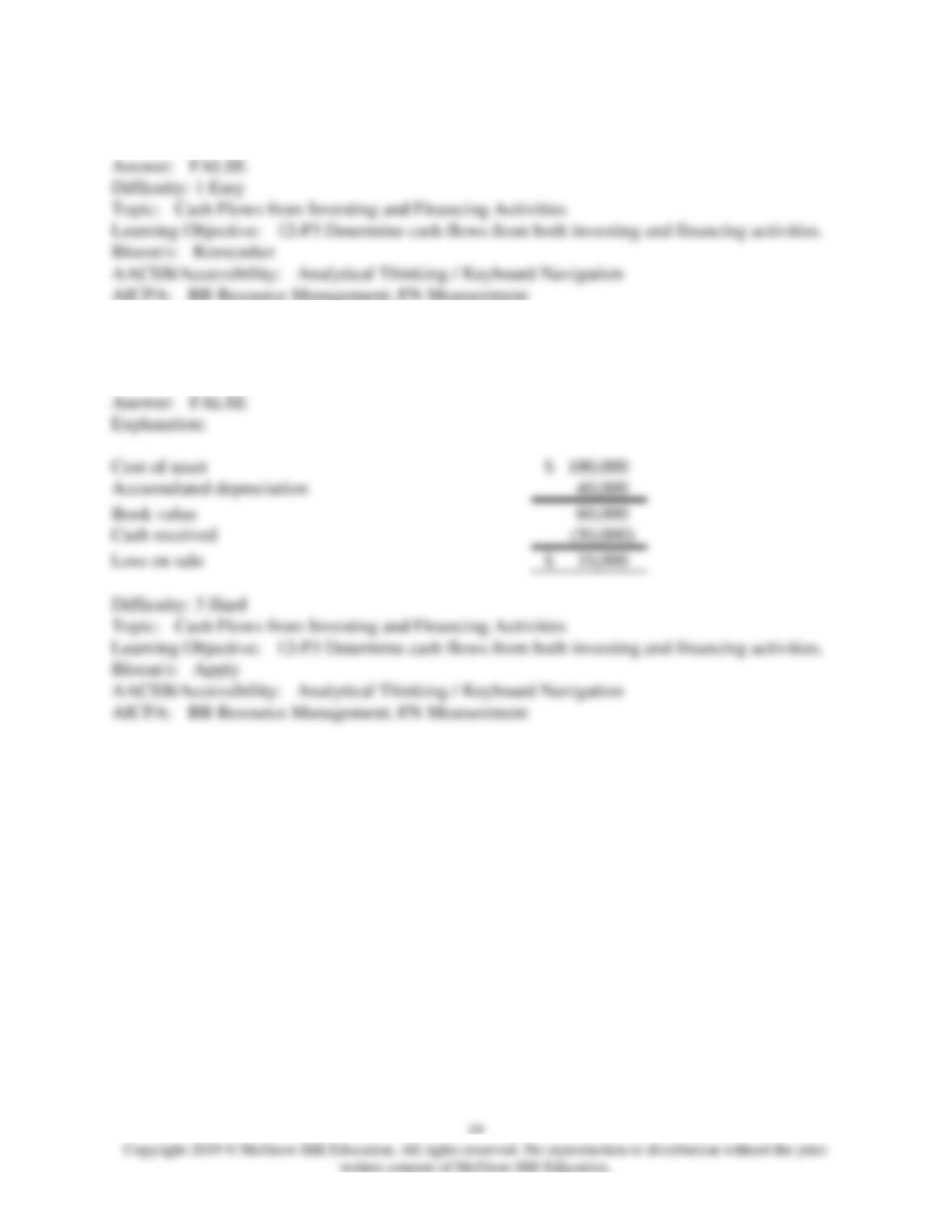
66) Equipment costing $100,000 with accumulated depreciation of $40,000 is sold at a loss of
$10,000. This implies that $40,000 cash was received from the sale.
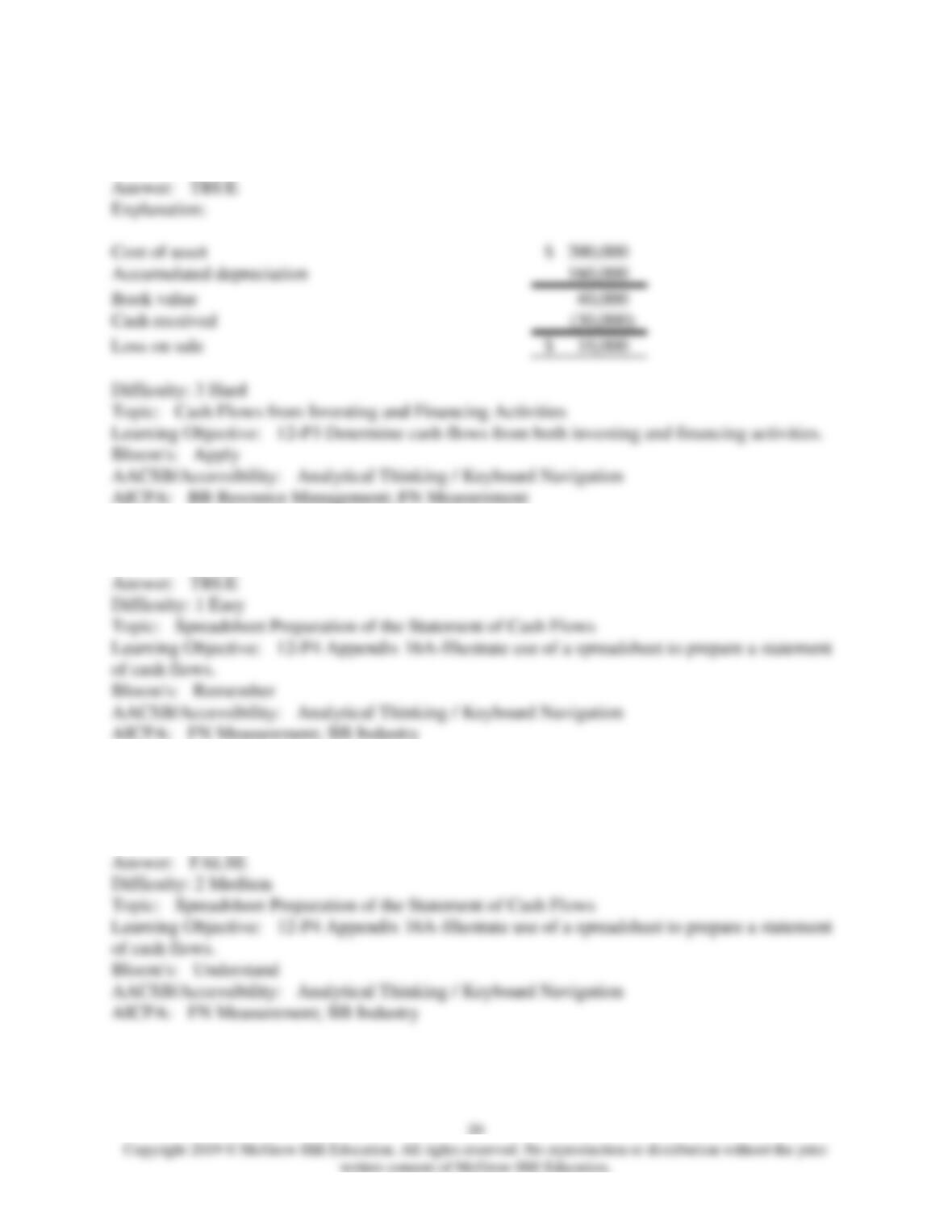
67) Equipment costing $200,000 with accumulated depreciation of $160,000 is sold at a loss of
$10,000. This implies that $30,000 cash was received from the sale.
68) A spreadsheet can help organize the information needed to prepare a statement of cash flows.
69) On a spreadsheet used to prepare the operating activities section of the statement of cash
flows, depreciation expense does not require an entry in the Analysis of Changes columns
because it is a noncash item.