193) On July 1, 2018, Clearwater Inc. purchased 6,000 shares of the outstanding common stock
of Mountain Corporation at a cost of $140,000. Mountain had 30,000 shares of outstanding
common stock. The total book value and total fair value of Mountain’s individual net assets on
July 1, 2018, are both $700,000. The total fair value of the 30,000 shares of Mountain’s common
stock on December 31, 2018, is $760,000. Both companies have a January through December
fiscal year. The following data pertains to Mountain Corporation during 2018:
Dividends declared and paid, Jan. 1—Jun. 30
$12,000
Dividends declared and paid, Jul. 1—Dec. 31
$12,000
Net income, January 1—June 30
$14,000
Net income, July 1—December 31
$18,000
Required:
(1.) Prepare the necessary entries for 2018 under the equity method (other than for the purchase).
(2.) Prepare any necessary entries for 2018 (other than for the purchase) that would be required if
the securities were accounted for under the fair value through net income method.
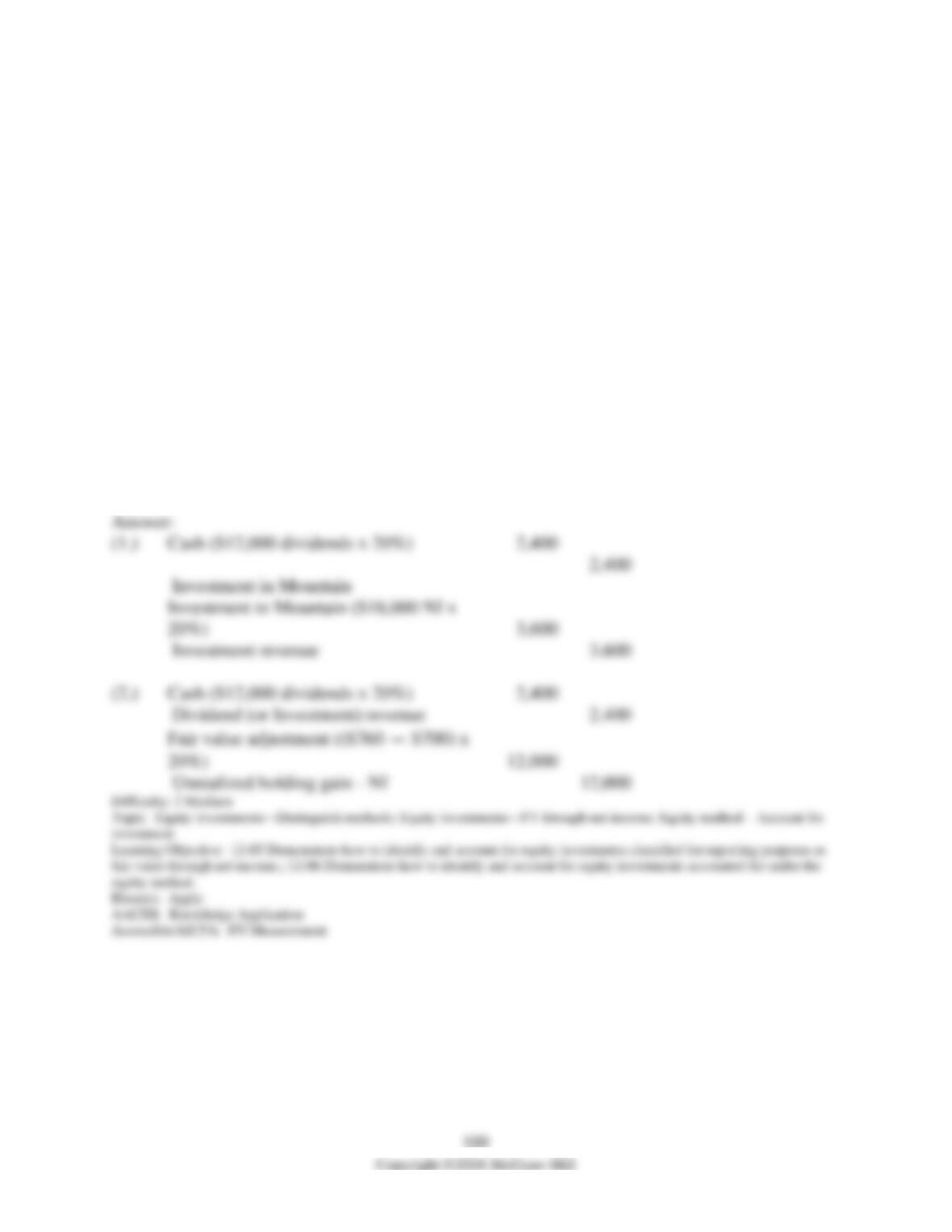
(1.)
Cash ($12,000 dividends x 20%)
Investment in Mountain
20%)
Investment revenue
(2.)
Cash ($12,000 dividends x 20%)
Dividend (or Investment) revenue
20%)
Unrealized holding gain – NI
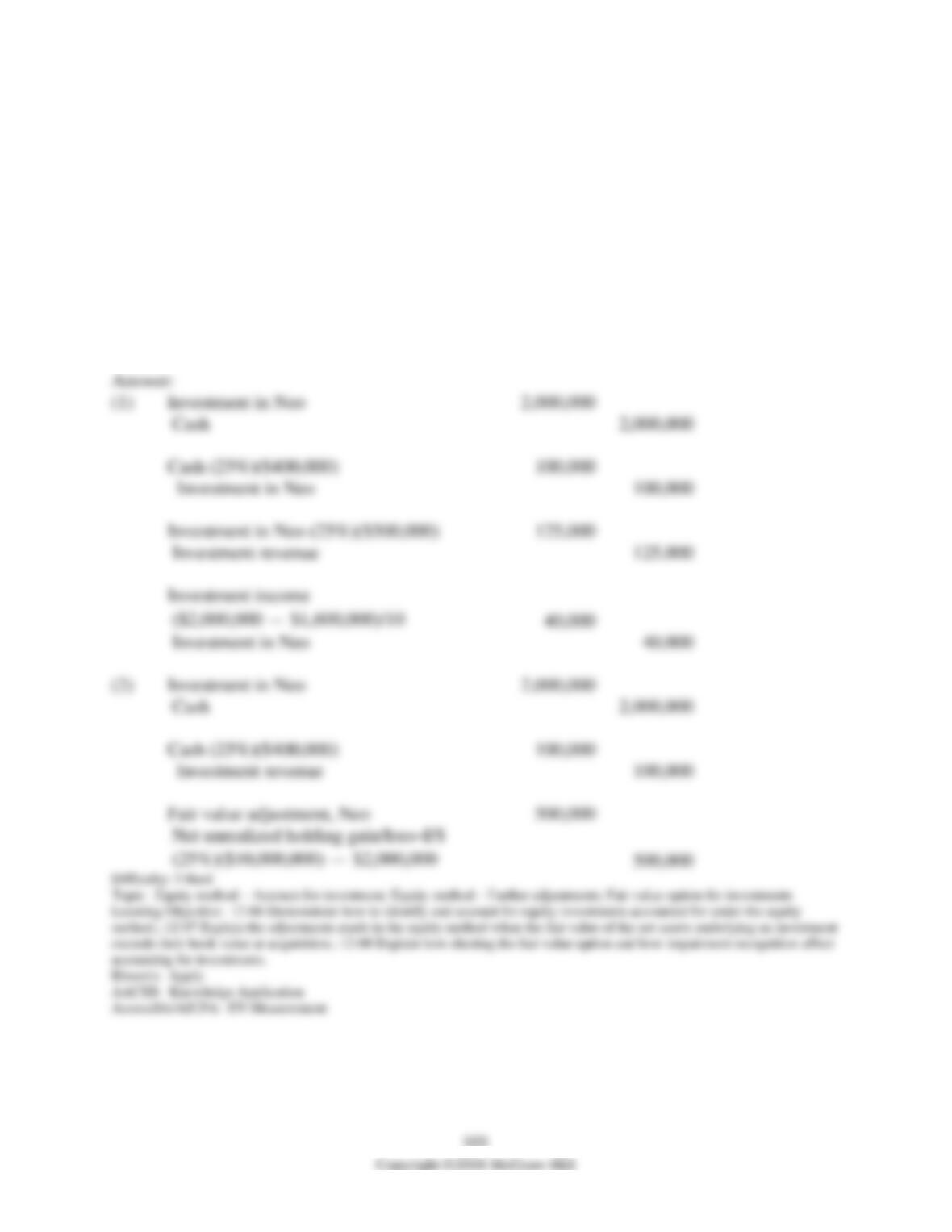
194) Matrix, Inc., acquired 25% of Neo Enterprises for $2,000,000 on January 1, 2018. The fair
value and book value of 25% of Neo’s identifiable net assets was $2,000,000 and $1,600,000 on
that date, and the difference was attributable to assets that would be depreciated over 10 years.
During 2018 Neo recognized net income of $500,000 and paid dividends of $400,000. Neo had a
total fair value of $10,000,000 as of December 31, 2018.
Required:
(1.) Prepare the journal entries necessary to account for the Neo investment, assuming that
Matrix accounts for that investment as an equity method investment
(2.) Prepare the journal entries necessary to account for the Neo investment, assuming that
Matrix elects the fair-value option.
195) Bourne, Inc. acquired 50% of David Webb Enterprises for $5,000,000 on January 1, 2018.
The total fair value and book value of Webb’s identifiable net assets was $8,000,000 on that date.
During 2018 Webb recognized net income of $1,000,000 and paid dividends of $1,200,000.
Webb had a fair value of $11,000,000 as of December 31, 2018.
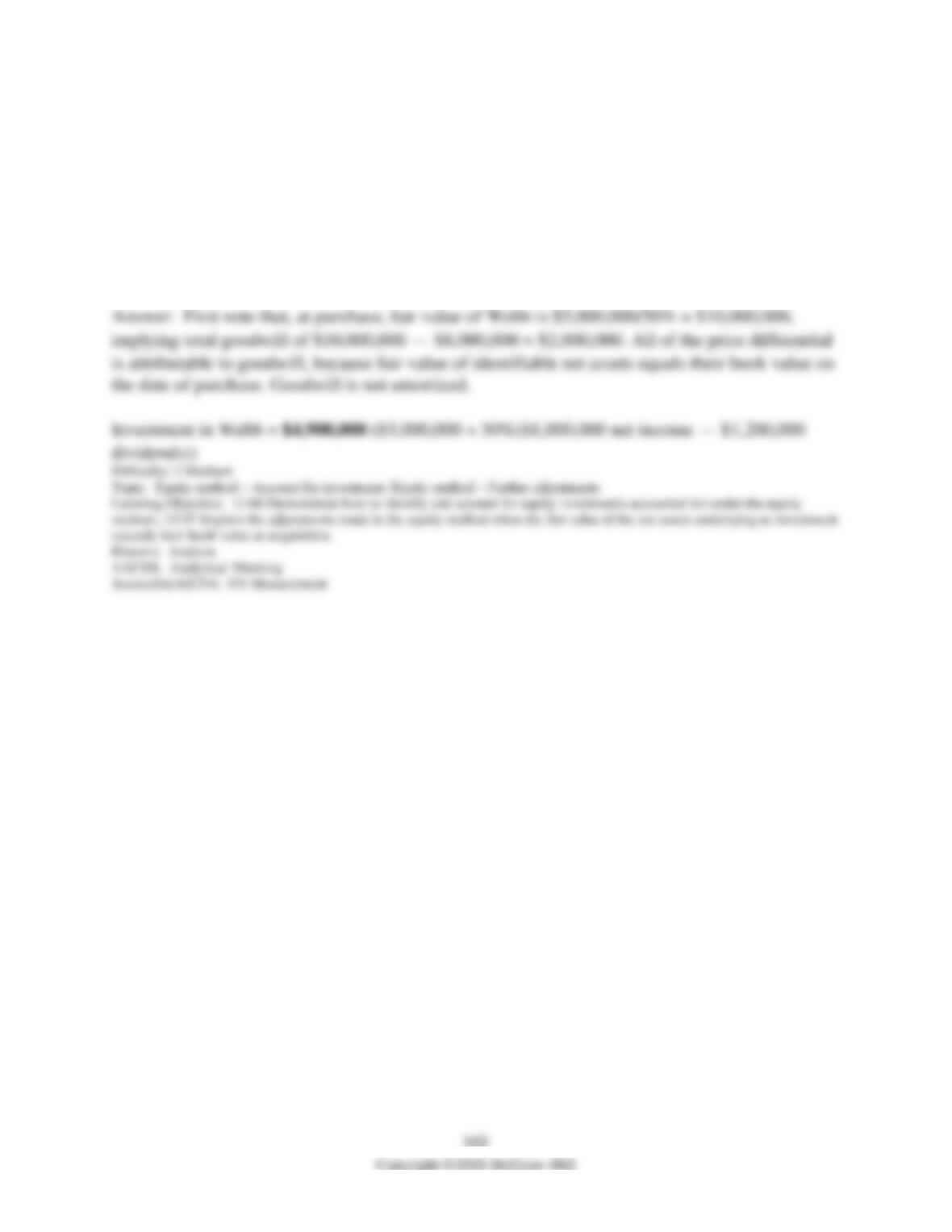
Required: Determine the amounts that will be associated with the Investment in Webb account
and the Goodwill calculated upon the purchase of Webb’s stock, assuming Bourne accounts for
the Webb investment under the equity method.
103
196) Damon, Inc., acquired 25% of Jolie Enterprises for $8,000,000 on October 1, 2018. The
total fair value of Jolie’s identifiable net assets was $27,000,000 on that date, and the total book
value of those net assets was $23,000,000. The difference between fair value and book value is
attributed to equipment that has a remaining useful life of 4 years. During 2018 Jolie recognized
net income of $2,000,000 and paid dividends of $1,200,000 ($300,000 per quarter). Jolie had a
fair value of $36,000,000 as of December 31, 2018.
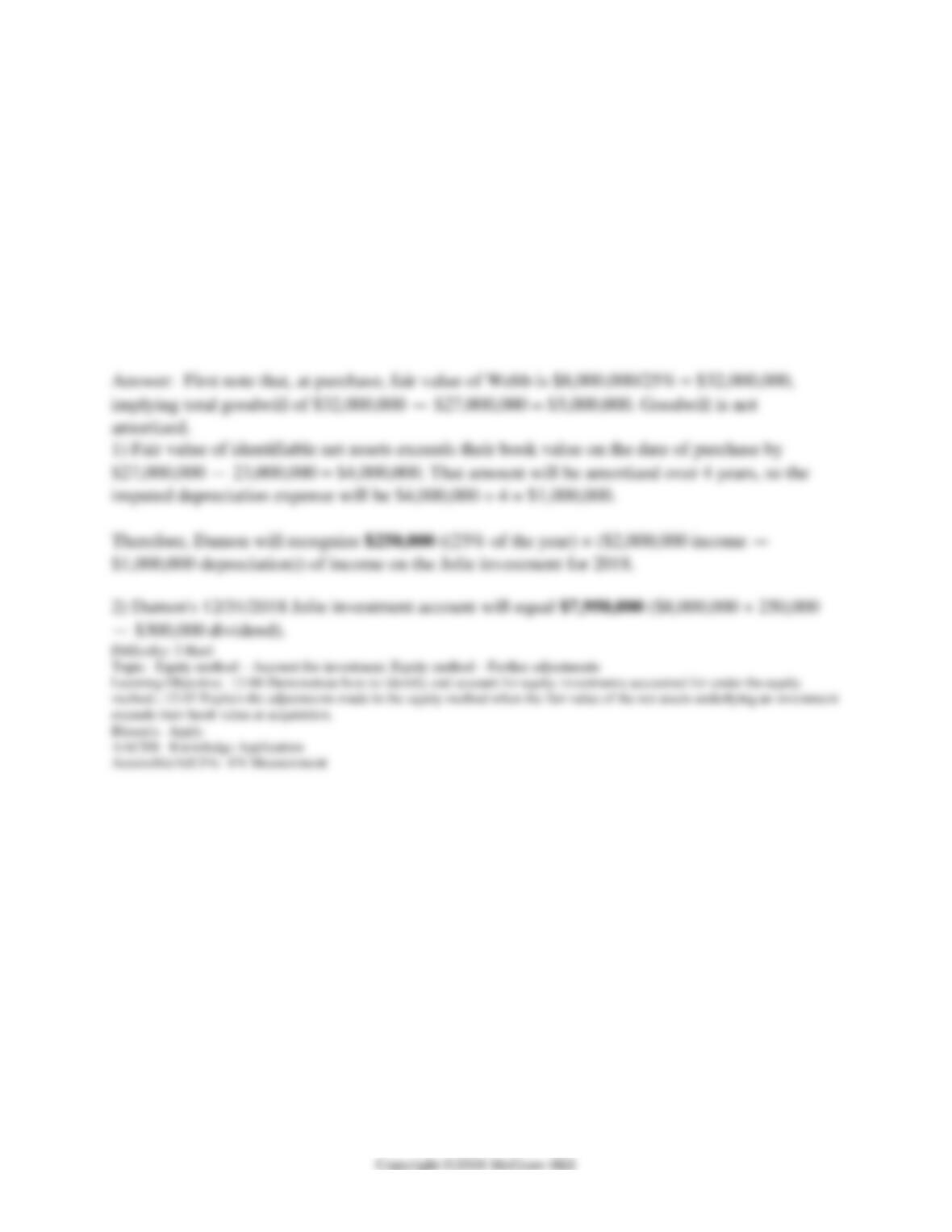
Required: Assume Damon accounts for the Jolie investment under the equity method. Indicate
the total effect of the Jolie investment on Damon’s:
1) net income for 2018.
2) the balance in Damon’s investment account on December 31, 2018.
197) On July 1, 2018, Clearwater Inc. purchased 6,000 shares of the outstanding common stock
of Mountain Corporation at a cost of $140,000. Clearwater will have significant influence over
the financial and operating policies of Mountain. Mountain had 30,000 shares of outstanding
common stock. Assume the total book value and fair value of net assets is $650,000. Both
companies have a January through December fiscal year. The following data pertains to
Mountain Corporation during 2018:
Dividends declared and paid, Jan. 1—June 30
$12,000
Dividends declared and paid, Jul. 1—Dec. 31
$12,000
Net Income, January 1—June 30
$14,000
Net Income, July 1—December 31
$18,000
Required:
(1.) Prepare the entry to record the original investment in Mountain.
(2.) Compute the goodwill (if any) on the acquisition.
(3.) Prepare the necessary entries (other than acquisition) for 2018 under the equity method.
(1.)
Investment in Mountain
Cash
(2.)
Purchase price
Fair value of assets purchased
($650,000 x 20%)
(3.)
Cash ($12,000 x 20%)
Investment in Mountain
Investment in Mountain ($18,000 x 20%)
Investment revenue
198) On January 1, 2017, Bactin Corporation acquired 10% of Oakton Company for $100,000.
On that date, the total book value and fair value of Oakton’s net assets was $900,000. Any
difference between cost and fair value is attributable to goodwill. In 2017, Oakton reported net
income of $60,000 and paid dividends of $30,000. On January 1, 2018, Bactin Corporation
bought another 10% of Oakton for $100,000, and on that date, the book value and fair value of
Oakton’s net assets still was $900,000 (the fair value of Oakton did not change during 2017).
Bactin concluded that its 20% ownership now allowed it to significantly influence Oakton’s
operations. In 2018, Oakton reported net income of $80,000 and paid dividends of $40,000.
Required:
Prepare all journal entries for Bactin for 2017 and 2018, assuming no change in fair value of the
Oakton stock during that time period.
106
199) LaBelle Corporation owns a $6 million whole life insurance policy on the life of its CEO,
naming LaBelle as beneficiary. The annual premiums are $95,000 and are payable at the
beginning of each year. The cash surrender value of the policy was $56,000 at the beginning of
2018.
Required:
(1.) Prepare the appropriate 2018 journal entry to record insurance expense and the increase in
the investment, assuming the cash surrender value of the policy increased according to the
contract to $70,000.
(2.) The CEO died at the end of 2018. Prepare the appropriate journal entry.
Use the following to answer the question(s) below:
In early December of 2018, Blue Corp. purchased $40,000 of Yellow Company bonds, which
constitutes less than 3% of Yellow’s outstanding debt. Blue accounts for the Yellow investment
as available for sale. By December 31, 2018, the value of the Yellow investment had fallen to
$30,000, and Blue recorded an unrealized holding loss. By December 31, 2019, the value of the
Yellow investment had fallen to $15,000, and Blue determined that it is more likely than not that
it will need to sell the bonds before their fair value recovers, so Blue recorded an OTT
impairment. By December 31, 2020, fair value had recovered to $20,000.
200) Prepare appropriate entry(s) at December 31, 2018, and indicate how the scenario will
affect net income, OCI, and comprehensive income.
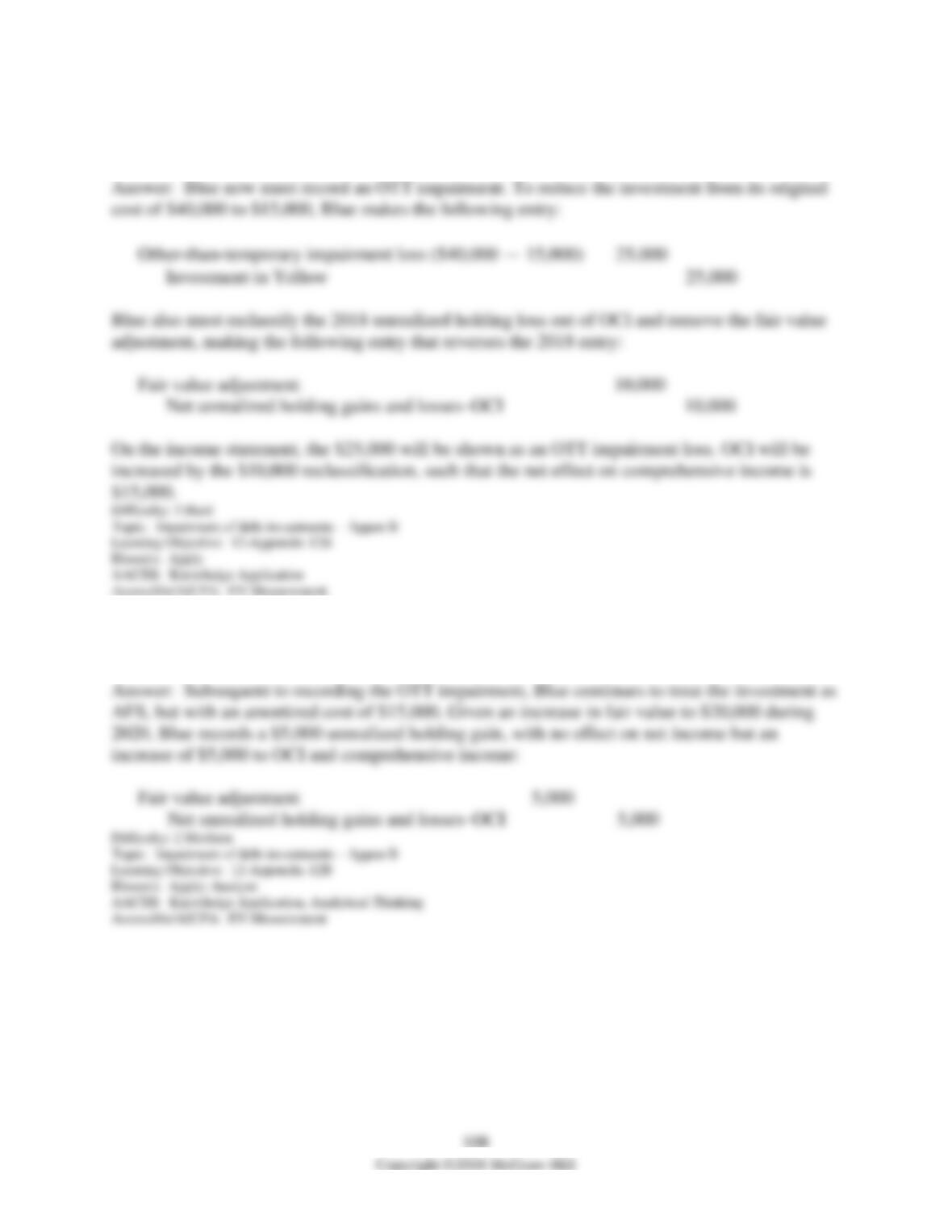
201) Prepare appropriate entry(s) at December 31, 2019, and indicate how the scenario will
affect net income, OCI, and comprehensive income.
202) Prepare appropriate entry(s) at December 31, 2020, and indicate how the scenario will
affect net income, OCI, and comprehensive income.
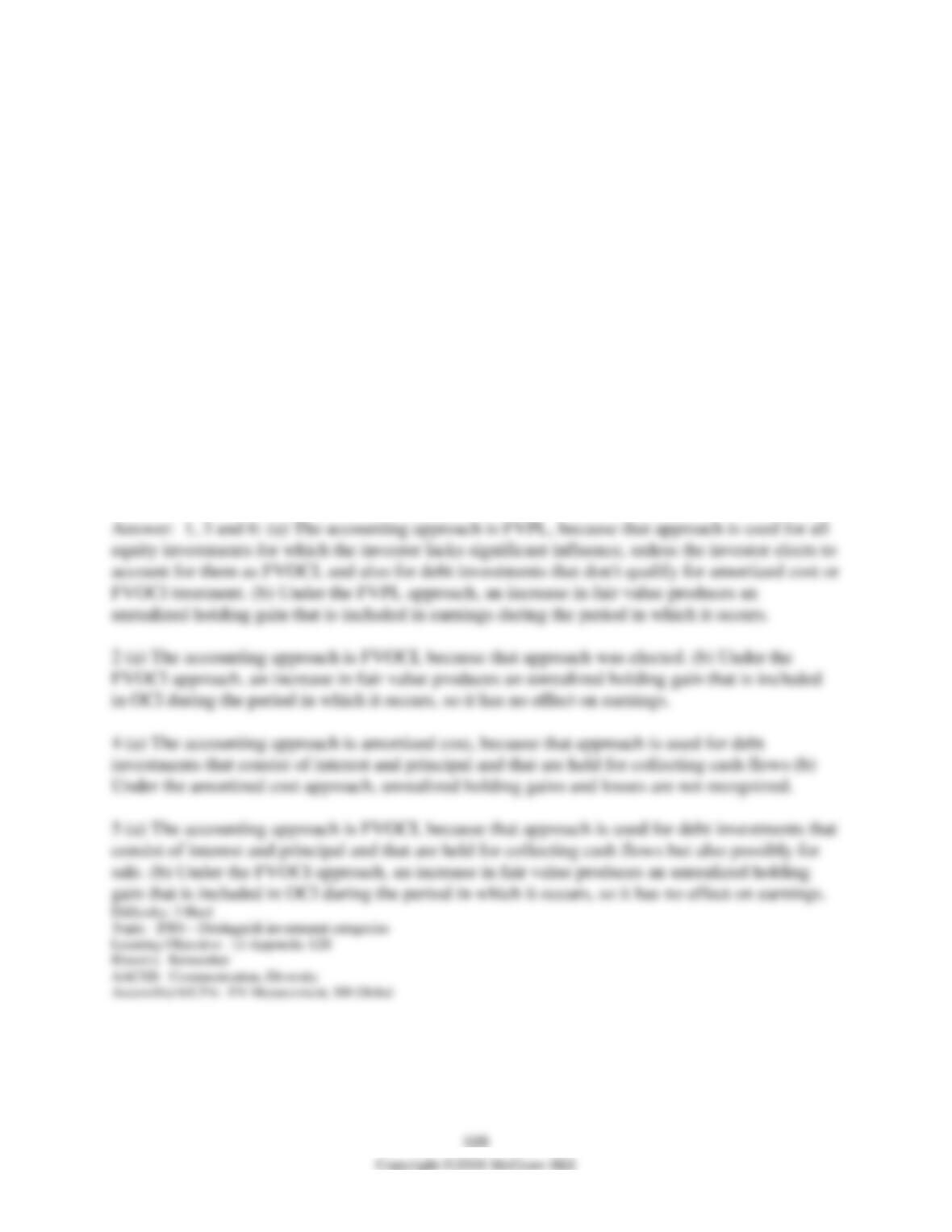
203) Stanhope Associates accounts for the following investments under IFRS No. 9:
1. 10 shares of Blackstone equity, held for long-term investment, no election of FVOCI.
2. 10 shares of Erickson equity, held for risk management, election to classify as FVOCI.
3. 10 shares of AT&E equity, held for immediate resale.
4. 10 bonds (consisting of only interest and principal) issued by Filo Inc., held for long-term
collection of cash flows.
5. 10 bonds (consisting of only interest and principal) of SimSung, held for risk management
but also might be sold
6. 10 bonds (consisting of only interest and principal) issued by Attachi, held for immediate
resale.
Required:
For each investment, indicate: (a) the accounting approach that will be used to account for the
investment, and briefly explain why that approach is appropriate, and (b) the effect on earnings
of an increase in the fair value of the investment in the period following acquisition of the
investment, assuming that Stanhope does not sell the investment. You may group the specific
investments if they have the same answers. Identify the investments you are including in the
group.
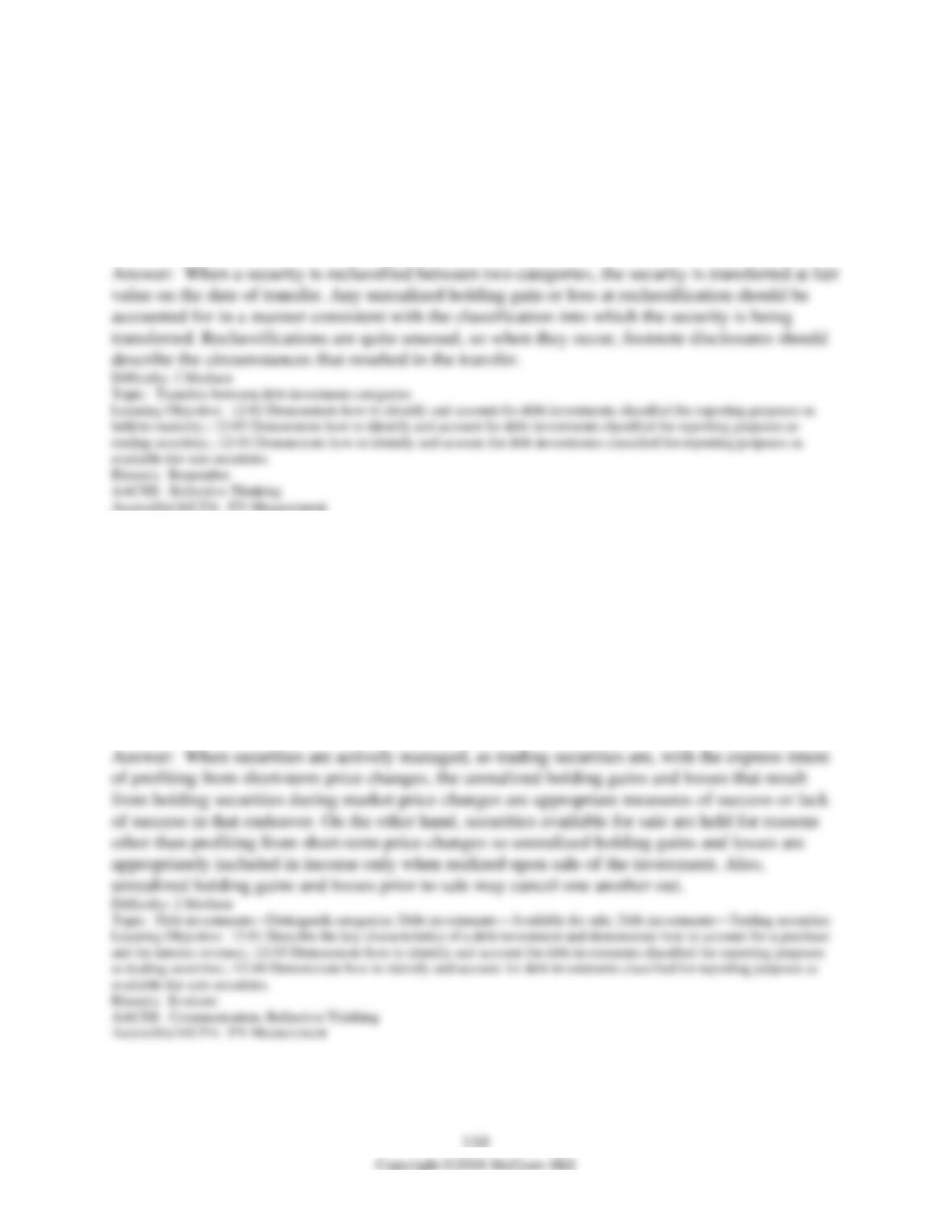
204) From time to time, debt securities must be reclassified when conditions and circumstances
surrounding the investment change.
Required:
Describe the general accounting procedures for reclassifying securities from one category to
another–held to maturity, available for sale, or trading.
205) The current accounting standards require fair value reporting for trading securities and
securities available for sale. Some accountants believe that the FASB was inconsistent when
GAAP was issued requiring changes in the value of trading securities to be reported in the
income statement and balance sheet, while changes in the value of securities available for sale
are reported only in the balance sheet.
Required:
Evaluate the rationale for these two diverse reporting requirements for marketable securities.
What arguments could be made to support each treatment?
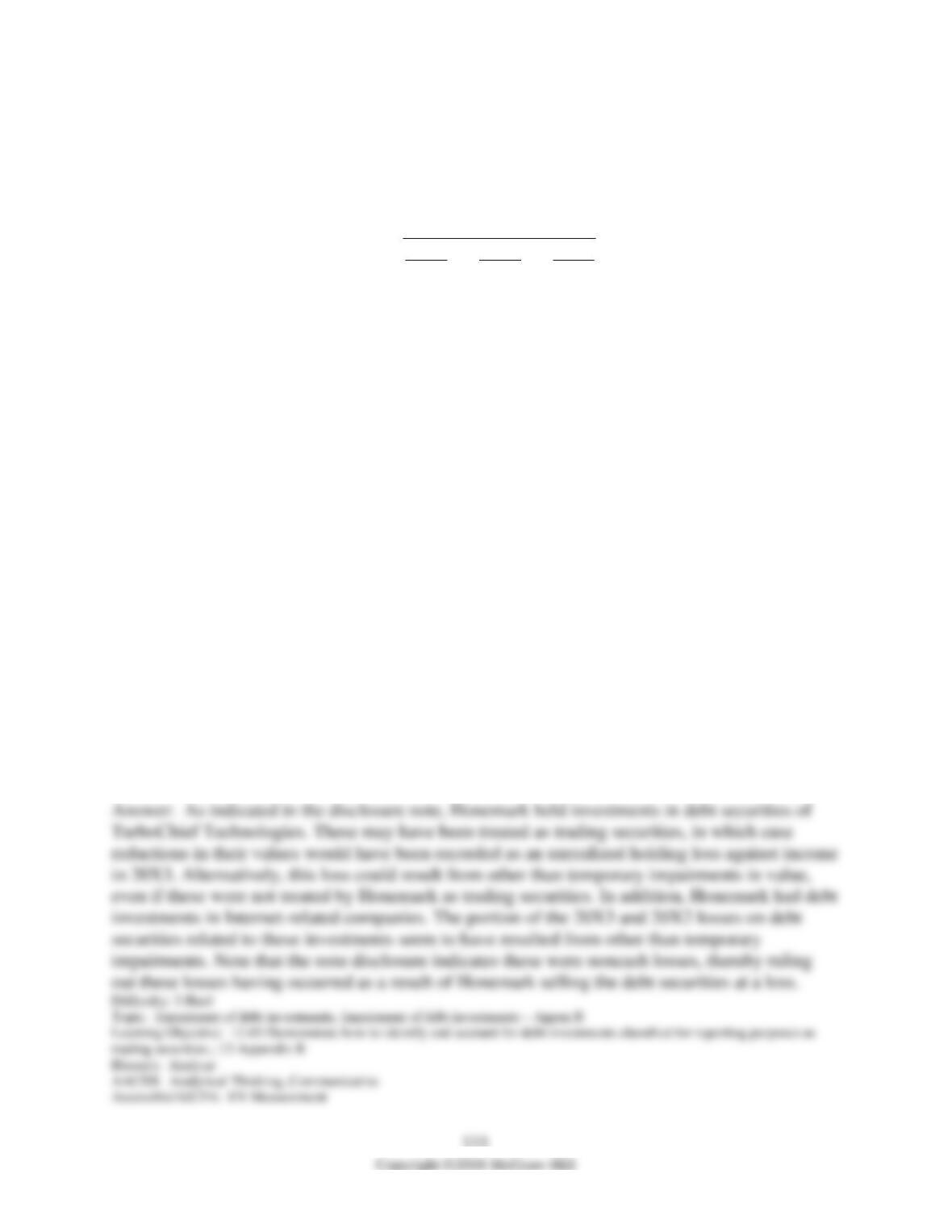
206) In its 20X4 annual report to shareholders, Honemark Corporation included the following
disclosures in its income statement and related footnotes:
CONSOLIDATED STATEMENTS OF INCOME
Year Ended December 31
20X4
20X3
20X2
(In thousands)
Loss on debt securities
(7,230)
(17,600)
—
Special Charges and Loss on Securities
During the fourth quarter of 20X4, the Company recorded special charges and loss on debt
securities totaling $17.0 million, or $13.5 million after-tax. Special charges of $9.8 million, or
$6.2 million after-tax, were associated with a salaried workforce reduction of approximately 250
employees. Cash expenditures for 20X4 related to this charge were $3.7 million. Loss on debt
securities of $7.2 million resulted from the write-down of the remaining investment in bonds of
an Internet-related company.
During the fourth quarter of 20X3, the Company recorded special charges and loss on debt
securities totaling $57.5 million, or $36.5 million after-tax. Special charges of $39.9 million, or
$25.3 million after-tax, were associated with terminated product initiatives, asset write-downs,
and executive severance costs related to management changes. Loss on debt securities of $17.6
million, or $11.2 million after-tax, resulted from a lower market valuation of debt securities of
TurboChief Technologies, Inc., and debt investments in bonds of Internet-related Companies …..
The loss on debt securities charge of $17.6 million was noncash.
Required:
Discuss the possible rationale behind the losses on securities reported by Maytag in 20X3 and
20X4.
207) Companies need to consider GAAP regarding fair value measurements when determining
the fair value of an investment that distinguishes between various levels of inputs to fair value
determination.
Required:
Describe the various levels of inputs, explaining key aspects that distinguish them, and indicate
which level is most preferred and which is least preferred.
208) Jaycom Enterprises has invested its excess cash in the bonds of several different companies
and desires to maximize income over the short run. Jaycom is unsure about the appropriate
investment policy and thus what reporting practice to follow.
Required:
What classification procedure and subsequent classification could Jaycom follow in order to
meet its objective? How will Jaycom justify its choice to the Jaycom auditors?
209) Newjohn Company owns stock in several affiliated companies. Investments in some of
these affiliates are accounted for as fair value through net income while some are accounted for
using the equity method.
Required:
(1.) What factors determine which method should be used?
(2.) What events are recorded when the equity method is used?
(3.) What events are recorded when the securities are accounted for as fair value through net
income?
210) Discuss the following questions.
Required:
What securities must be classified within one of the three categories of held to maturity,
available for sale, and trading? (Do not describe how to determine how securities are classified
among these three categories.) Identify the four primary recording activities related to
investments in securities.
211) When an investor owns 20% to 50% of the voting stock of an investee company, the
investor is presumed to exercise significant influence over the investee unless there is evidence
to the contrary.
Required:
(1.) What factors could be evidence of significant influence?
(2.) What factors could be evidence of lack of significant influence?
212) Many corporations own more than 50% of the voting stock in other corporations.
Sometimes these affiliated companies operate within the same industry, and many times the
companies are in unrelated industries.
Required:
What is the significance of owning more than 50% of the voting common stock of another
company?
213) Sometimes companies change the extent to which they can significantly influence an
investee, such that they have to change to the equity method or from the equity method of
accounting for the investment.
Required:
Describe the adjustments necessary when a company (1) changes to the equity method from
another method, and (2) when a company changes from the equity method to another method.
214) Assume Gibson Company is an equal partner in a joint venture with Glover Company. Each
company owns 50% of Pesci Company, and equally shares decision-making authority.
Required:
Describe how U.S. GAAP and IFRS differ in how they would have Gibson account for this
investment.
215) According to GAAP, companies can elect the fair value option when accounting for many
investments.
Required:
Describe how accounting for a held-to-maturity investment, an available-for-sale investment, and
an equity-method investment is affected by a company electing the fair value option.
216) IFRS No. 9 is a standard that indicates accounting for investments when the investor does
not have significant influence under the investee.
Required:
Explain how debt investments are accounted for under IFRS No. 9. What alternative accounting
approaches are available, what determines whether an investment qualifies for each approach,
and what are the key features of each approach with respect to accounting for unrealized holding
gains and losses?
217) IFRS No. 9 is a standard that indicates accounting for investments when the investor does
not have significant influence over the investee.
Required:
Explain how equity investments are accounted for under IFRS No. 9. What alternative
accounting approaches are available, what determines whether an investment qualifies for each
approach, and what are the key features of each approach with respect to accounting for
unrealized holding gains and losses?