142) Cost allocation bases are factors that cost management analysts use to assign indirect costs
to cost objects. Ideally, cost-allocation bases should reflect a cause-and-effect relationship
between resource spending and use. Ideally, an Activity-Based-Costing (ABC) approach will
provide a more accurate and useful accounting for an organization’s resources. Recent studies
have found that, in spite of increasing costs and diminishing resources, very few Higher
Education Institutions use the tools and techniques of an ABC cost allocation system to assign
costs to academic departments. While direct costs, such as faculty salaries, are traceable to
individual academic departments or courses, many indirect costs, such as facility use, computer
use, and student support services, are more difficult to assign. In a traditional approach, many
higher education institutions assign such costs based on a single factor, such as the number of
courses taught in the university. (Source: Activity-Based Costing for Higher Education
Institutions, Management Accounting Quarterly, Winter, 2001)
Required:
(a) Explain why the use of a single-cost driver such as the number of courses may result in
inaccurate management information as to the cost of running courses in individual academic
departments.
(b) For each of the indirect costs listed below, identify an appropriate cost-driver that might be
used to allocate costs to determine the cost of offering a single course in an academic department
if an Activity-Based-Costing model were used.
∙ Computer use
∙ Facility use
∙ Student services
∙ Course design
∙ Lecturing/class meeting time
∙ Assignment grading
143) Affordable Credit Checks produces two styles of credit reports: personal and corporate. The
difference between the two is the amount of background information and data collection
required. The corporate report uses more skilled personnel because additional checking and data
are required. Total support service costs to be allocated are $3,200,000. The relevant figures for
the year just completed follow:
Allocation base Individual Corporate
Data purchased $ 40,000 $ 80,000
Research hours 24,000 30,000
Interview hours 1,000 10,000
Number of reports 16,000 3,000
Required:
(a) Which allocation base would be preferred by each manager? Which allocation base would be
least preferred?
(b) Provide arguments that each manager would make for his/her preferred allocation base. How
would each manager argue against his/her least preferred allocation base?
144) Rainier Company has a purchasing department that provides services to two factories
located in Carbondale and the other in Peoria. Budgeted costs for the purchasing department
consist of $55,000 per year of fixed costs and $8 per purchase order for variable costs. The level
of budgeted fixed costs is determined by the peak-period requirements. The Carbondale factory
requires 40% of the peak-period capacity and the Peoria factory requires 60%.
During the current year, 1,800 purchase orders were processed for the Carbondale factory and
2,700 purchase orders for the Peoria factory.
Required:
Compute the amount of purchasing department cost that should be charged to each factory for
the year.
145) Koski Corporation’s Maintenance Department provides services to the company’s two
operating divisions – the Paints Division and the Stains Division. The variable costs of the
Maintenance Department are budgeted based on the number of cases produced by the operating
departments. The fixed costs of the Maintenance Department are determined based on the
number of cases produced by the operating departments during the peak period. Data appear
below:
Maintenance Department:
Budgeted variable cost $ 4 per case
Budgeted total fixed cost $ 870,000
Actual total variable cost $ 382,756
Actual total fixed cost $ 871,590
Paints Division:
Percentage of peak period capacity required 40 %
Budgeted cases 26,000
Actual cases 26,010
Stains Division:
Percentage of peak period capacity required 60 %
Budgeted cases 61,000
Actual cases 60,980
Required:
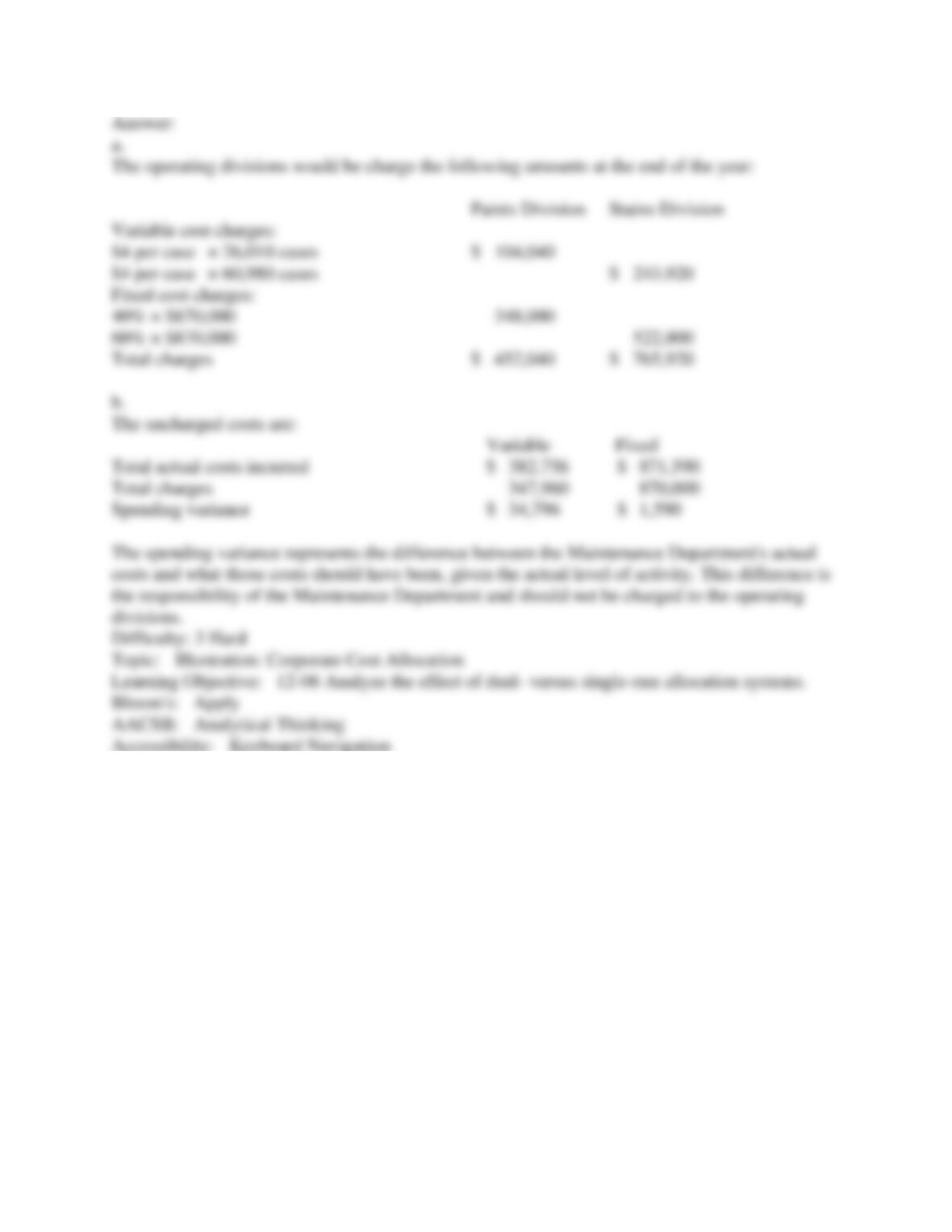
a. Prepare a report showing how much of the Maintenance Department’s costs should be charged
to each of the operating divisions at the end of the year.
b. How much of the actual Maintenance Department costs should not be charged to the operating
divisions at the end of the year? Who should be held responsible for these uncharged costs?
146) Decentralization is the delegation of decision-making authority to subordinates in the
organization’s name. A key part of this is the principal-agent relationship. Explain what this
relationship is and give examples.
147) Describe five advantages of decentralization.
148) Describe two disadvantages of decentralization.
149) Logistics Services Company has recently expanded by acquiring two smaller companies in
the transportation industry. Prior to these acquisitions, Logistics Services used a centralized style
of organization because it was small enough that the top management team was heavily involved
in the day-to-day activities of the firm. Ms. Trane, the CEO, feels that this style is no longer
suitable for the larger, more diverse organization.
She has hired a consultant to help her and her management team create a new structure which,
when developed on paper, will be described to the affected employees and their inputs will be
sought. Since no one in the company knows much about management styles, Ms. Trane felt this
would be an efficient way to get the ball rolling, but realized the consultants would not have the
specialized knowledge about her company and the two acquisitions.
One of the first things she feels she will need to do is to explain the benefits of decentralization
that will accrue to both the company and the affected employees.
Required:
Ms. Trane has asked you, as the consultant, to provide her with a general list of advantages of
decentralization that she will tailor to her company before presenting it to the executives and
other affected employees.
150) Langsam, Inc. has used a decentralized form of organizational structure for the past five
years. The controller, Ms. Terrance, has noticed that some of the divisions are still using fixed
assets that are fully depreciated and that there has been little acquisition activity in these
divisions. Coupled with this are very high ROIs, especially when compared to the other divisions
that seem to have a regular program of disposition and replacement of fixed assets.
She takes her concerns and observations to the Financial Vice President who says he will review
her findings and look into the problem.
Required:
What are the potential negative effects of decentralization?
151) Describe the three main elements of a management control system.
152) Describe the five basic types of decentralized units in responsibility accounting.
153) There are five common types of responsibility centers listed below.
Required:
Briefly describe each of the following terms and provide an example of each term.
(a) Cost Center
(b) Discretionary Cost Center
(c) Revenue Center
(d) Profit Center
(e) Investment Center
154) Explain the difference between fixed compensation and contingent compensation. Give an
example of each.
155) The order entry department of Dano Associated Industries is considering improvements in
the order entry process, which includes preparing quotations based on customers’ requests (via
the sales representative) and processing orders received from customers.
A typical sequence of events might begin with a sales representative meeting with a customer to
discuss the type of system desired. The sales representative then fills out a paper form and faxes
it or phones it in to an order entry associate, who might make several subsequent phone calls to
the sales representative, the potential customer, or the manufacturing department to prepare the
quote properly. These phone calls deal with such questions as exchangeability of parts, part
numbers, current prices for parts, or allowable sales discounts. Order entry staff then keys in the
configuration of the desired system, including part numbers, and informs the sales representative
of the quoted price. Each quote is assigned a quotation number. To smooth production,
manufacturing often produces systems with standard configurations in anticipation of obtaining
orders from recent quotes for systems. The systems usually involve adding on special features to
the standard configuration. Production in advance of orders sometimes results in duplication in
manufacturing; however, because customers often fail to put the assigned quotation numbers on
their orders. When order entry receives an order, the information on the order is reentered into
the computer to produce an order acknowledgement. This order acknowledgement is sent to the
manufacturing department, which produces the system ordered by customer. When the order
acknowledgement is sent to the invoicing department, the information is reviewed again to
generate an invoice to send to the customer.
Enrique Ramos, the order entry manager, has received many complaints from the order entry
department’s internal customers regarding quality and timeliness problems, and is considering
ways to improve the efficiency and quality of the order entry process.
Required:
(a) Develop some indicators that Ramos could use to assess the performance of the order entry
process.
(b) List four possible errors that might be found in the quote and/or the order acknowledgement
(i.e., the outputs of the order entry process).
(c) What do you think are the likely causes of delays and quality problems?
156) The manager of a business unit of a large corporation made some projections regarding
sales and profits for the upcoming final quarter of the year. The manager’s performance
evaluation and compensation depended significantly on his ability to meet budget goals. The
manager discovered that the final quarter would have to be a particularly good quarter in order to
meet these goals. He decided to implement a sales program offering liberal payment terms in
order to pull some sales that would normally occur next year into the current year. Customers
accepting delivery in the fourth quarter would not have to pay the invoice for 140 days. Also, he
sold some equipment that was not being used and realized a significant profit on the sale.
Required:
Are these actions ethical? Why or why not?
157) The controller of one division of a large diversified firm is compensated by salary plus
bonus. The bonus is a significant part of total compensation and is based directly on the profits of
the division. Thus, the controller has an incentive to find ways to increase profits, including the
delay of discretionary expenses such as research and development, delay of maintenance and
repair of manufacturing equipment, and delay of sales promotions.
Required:
Is finding ways to increase profits as described above unethical? Why or why not? Who is to
blame, if anyone?
158) How does the separation of duties help prevent financial fraud?
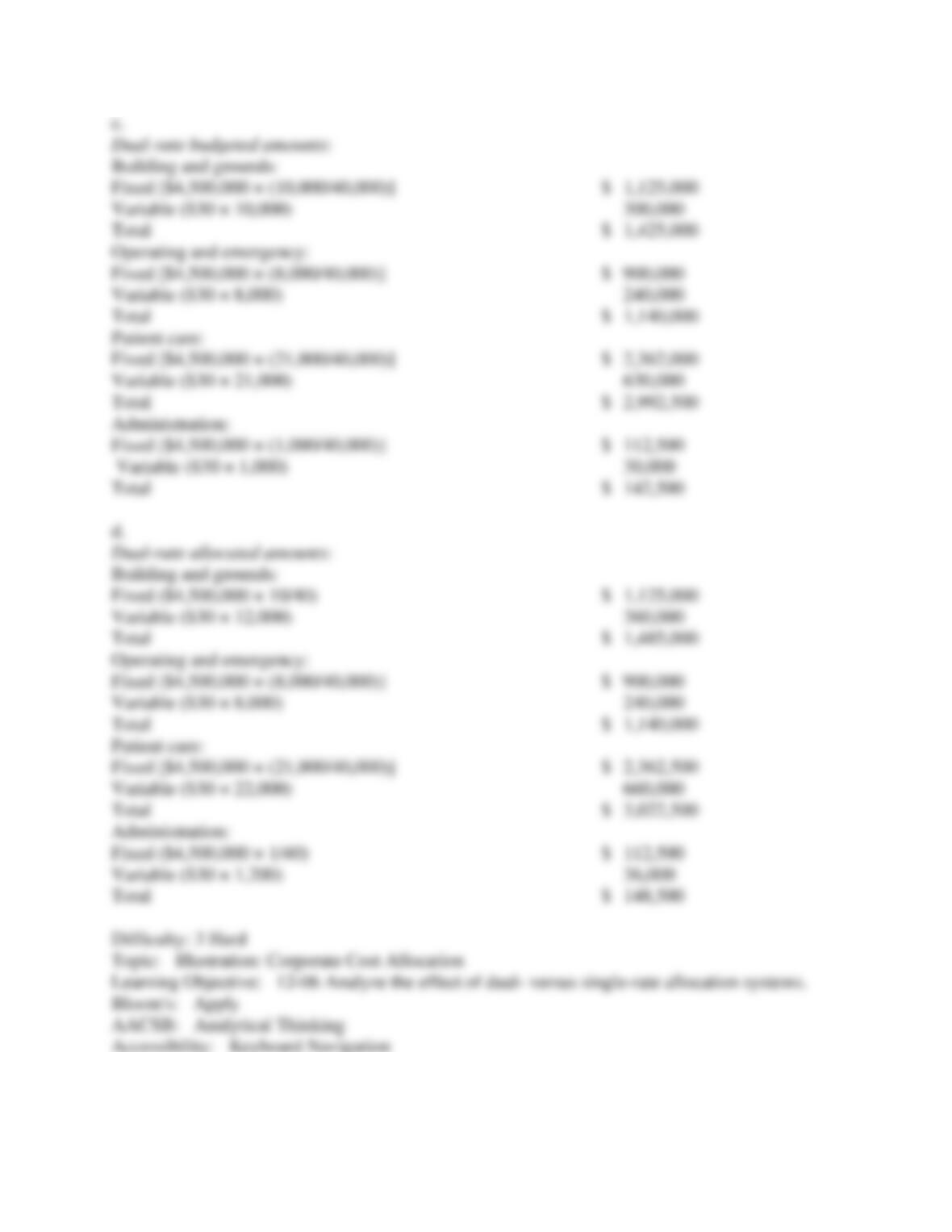
159) The fixed costs of operating the maintenance facility of Indian River Hospital are
$4,500,000 annually. Variable costs are incurred at the rate of $30 per maintenance hour. The
facility averages 40,000 maintenance hours a year. Budgeted and actual hours for 2020 are as
follows:
Budgeted hours Actual hours
Building and grounds 10,000 12,000
Operating and emergency 8,000 8,000
Patient care 21,000 22,000
Administration 1,000 1,200
Total 40,000 43,200
Assume that budgeted maintenance hours are used to calculate the allocation rates.
Required:
a. If a single-rate cost allocation method is used, what amount of maintenance cost will be
budgeted for each department?
b. If a single-rate cost allocation method is used, what amount of maintenance cost will be
allocated to each department based on actual usage?
c. If a dual-rate cost allocation method is used, what amount of maintenance cost will be
budgeted for each department?
d. If a dual-rate cost allocation method is used, what amount of maintenance cost will be
allocated to each department based on actual usage?
160) The Michael Vamosi Corporation operates one central plant that has two divisions, the
Lamp Division and the Flashlight Division. The following data apply to the coming budget year:
Budgeted costs of operating the plant for 10,000 to 20,000 hours:
Fixed operating costs per year $ 240,000
Variable operating costs $ 10 per hour
Practical capacity 20,000 hours per year
Budgeted long-run usage per year:
Lamp Division 800 hours × 12 months = 9,600 hours per year
Flashlight Division 450 hours × 12 months = 5,400 hours per year
Assume that practical capacity is used to calculate the allocation rates. Further assume that actual
usage of the Lamp Division was 700 hours and the Flashlight Division was 400 hours for the
month of June.
Required:
a. If a single-rate cost allocation method is used, what amount of operating costs will be
budgeted for the Lamp Division each month? For the Flashlight Division each month?
b. For the month of June, if a single-rate cost allocation method is used, what amount of cost will
be allocated to the Lamp Division? To the Flashlight Division? Assume actual usage is used to
allocate operating costs.
c. If a dual-rate cost allocation method is used, what amount of operating costs will be budgeted
for the Lamp Division each month? For the Flashlight Division each month?
d. For the month of June, if a dual-rate cost allocation method is used, what amount of cost will
be allocated to the Lamp Division? To the Flashlight Division?