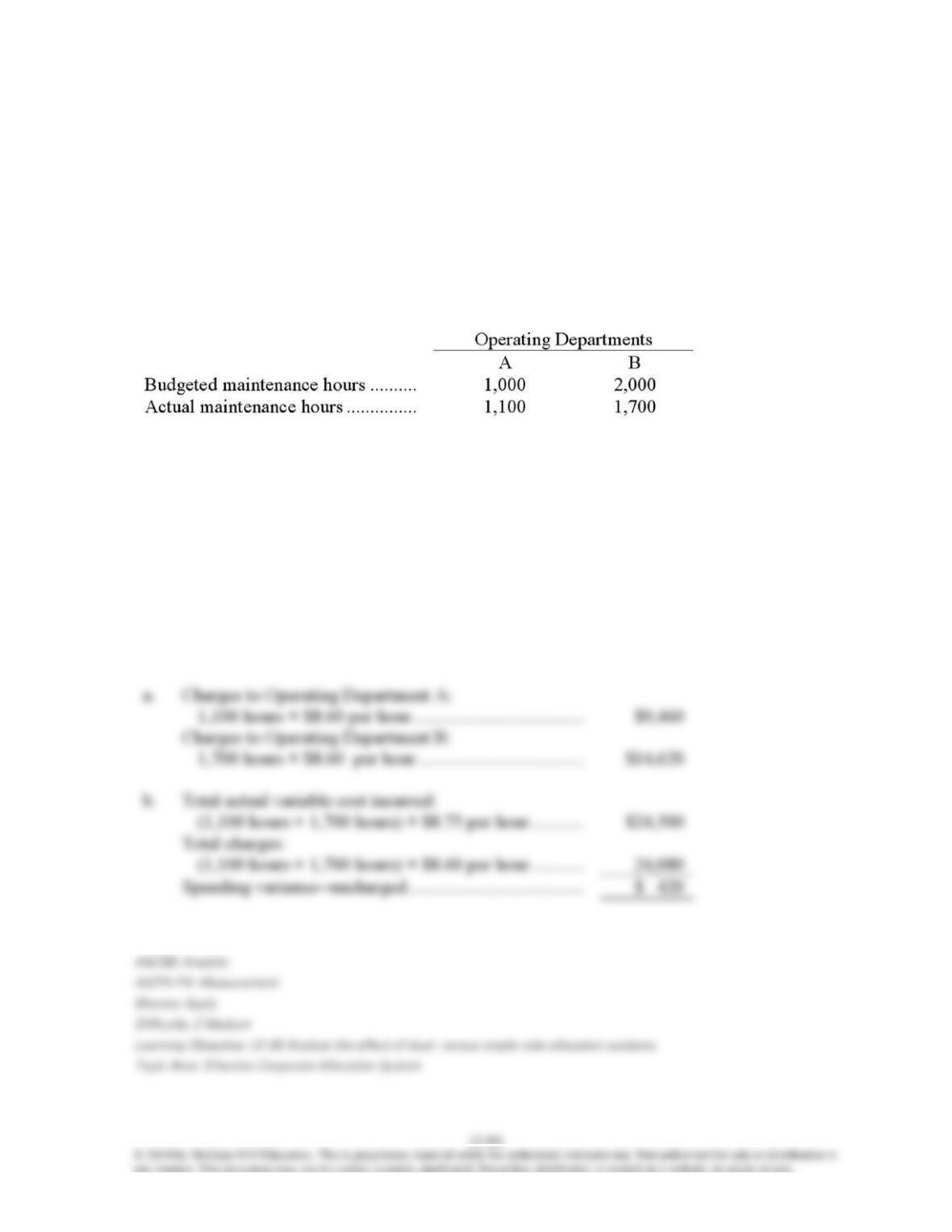
128. Trenron, Inc. has a maintenance department that provides services to the company’s two
operating departments. The variable costs of the maintenance department are charged on the
basis of the number of maintenance hours logged in each department. Last year, budgeted
variable maintenance costs were $8.60 per maintenance hour and actual variable maintenance
costs were $8.75 per maintenance hour.
The budgeted and actual maintenance hours for each operating department for last year appear
below:
Required:
a. Compute the amount of variable maintenance department cost that should have been charged
to each operating department at the end of the year for performance evaluation purposes.
b. Compute the amount of actual variable maintenance department cost that should not have
been charged to the operating departments at the end of the year for performance evaluation
purposes.
12-102
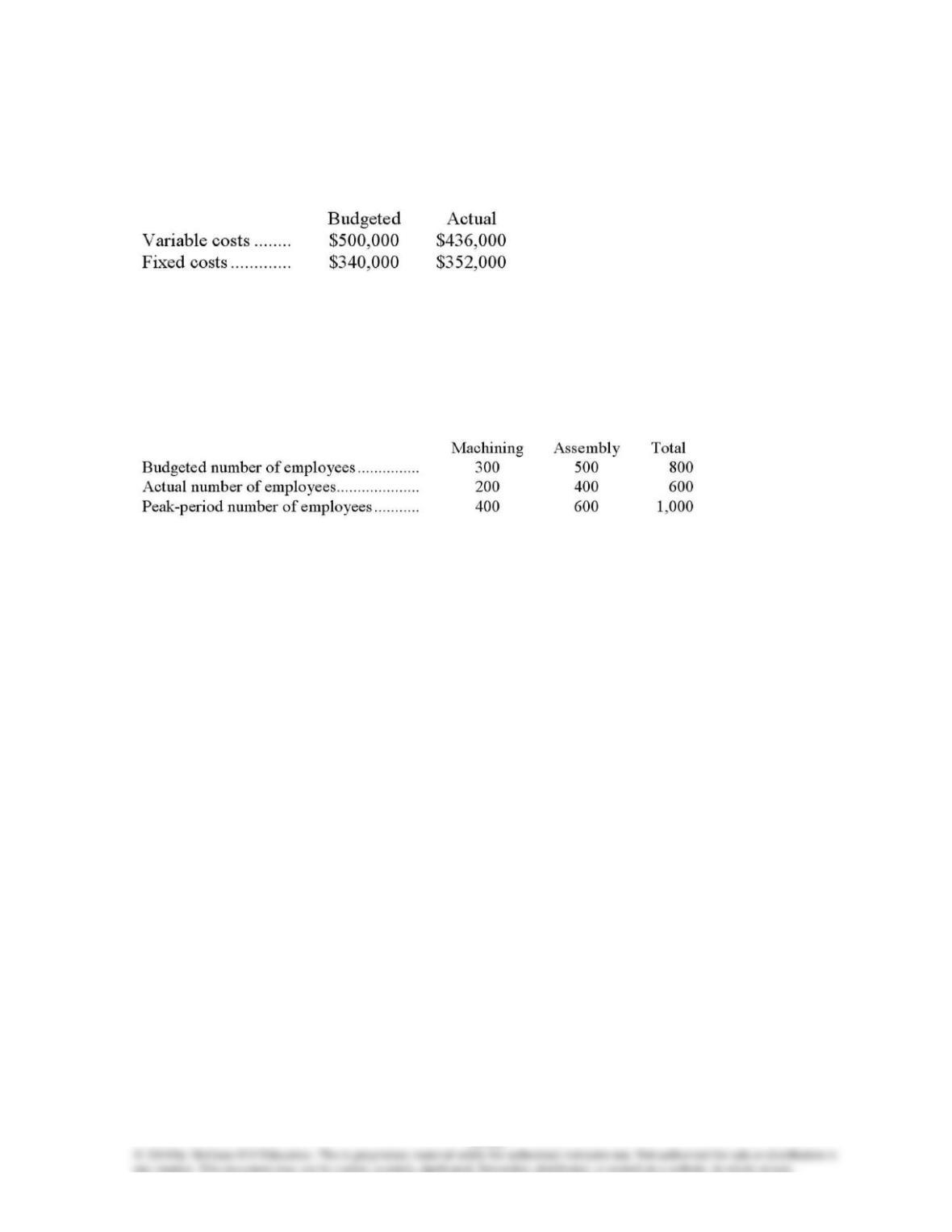
129. Leslie Company operates a cafeteria for the benefit of its employees. The company
subsidizes the cafeteria heavily by allowing employees to purchase meals at greatly reduced
prices. Budgeted and actual costs in the cafeteria for the year just ended are as follows:
*Unrecovered cost after deducting amounts received from employees.
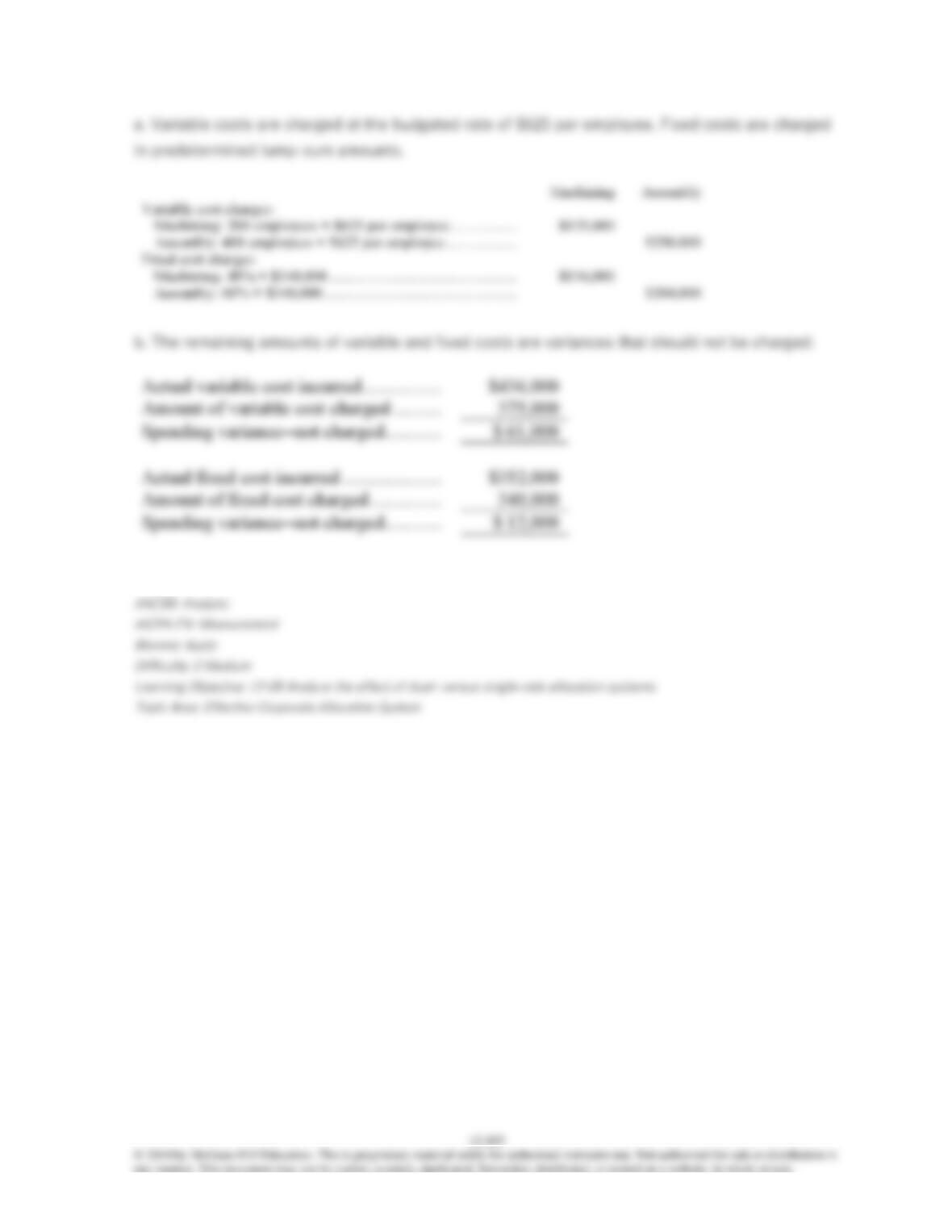
Costs of the cafeteria are charged to producing departments on the basis of the number of
employees in these departments. Fixed costs are charged on the basis of the peak-period number
of employees. Data on employees in the company’s producing departments follows:
Required:
a. Compute the dollar amount of variable and fixed costs that should be charged to each of the
producing departments at the end of the year for purposes of evaluating performance.
b. Identify the amount, if any, of actual costs that should not be charged to the operating
departments.
12-104
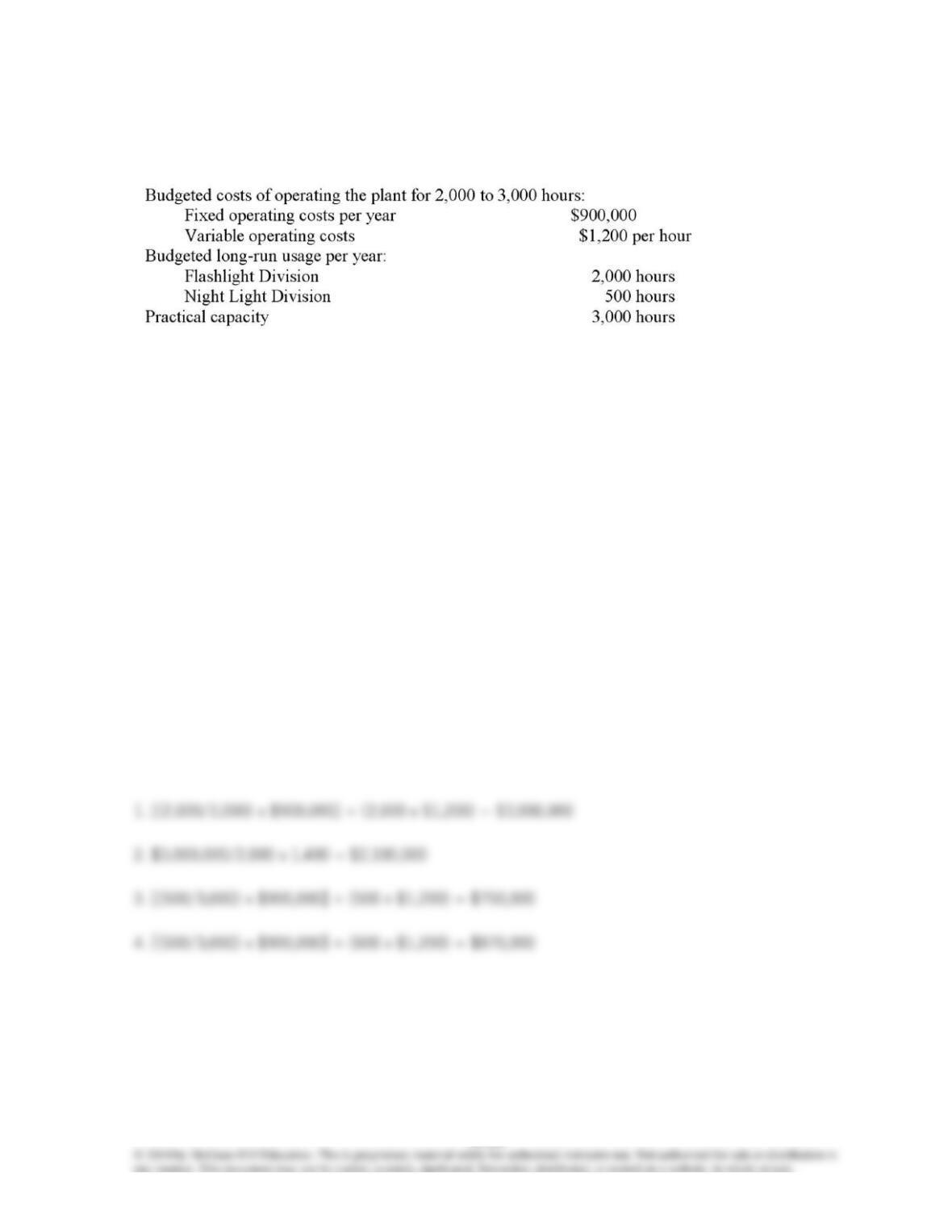
130. The Borders Corporation operates one central plant that has two divisions, the Flashlight
Division and the Night Light Division. The following data apply to the coming budget year.
Assume that practical capacity is used to calculate the allocation rates. Actual usage for the year
by the Flashlight Division was 1,400 hours and by the Night Light Division was 600 hours.
Required:
1. If a single-rate cost-allocation method is used, what amount of operating costs will be
2. If a single-rate cost-allocation method is used, what amount of cost will be
allocated
to the
Flashlight Division? Assume actual usage is used to allocate operating costs.
3. If a dual-rate cost-allocation method is used, what amount of operating costs will be
budgeted
for the Night Light Division?
4. If a dual-rate cost-allocation method is used, what amount of cost will be
allocated
to the Night
Light Division? Assume budgeted usage is used to allocate fixed operating costs and actual usage
is used to allocate variable operating costs.
12-105
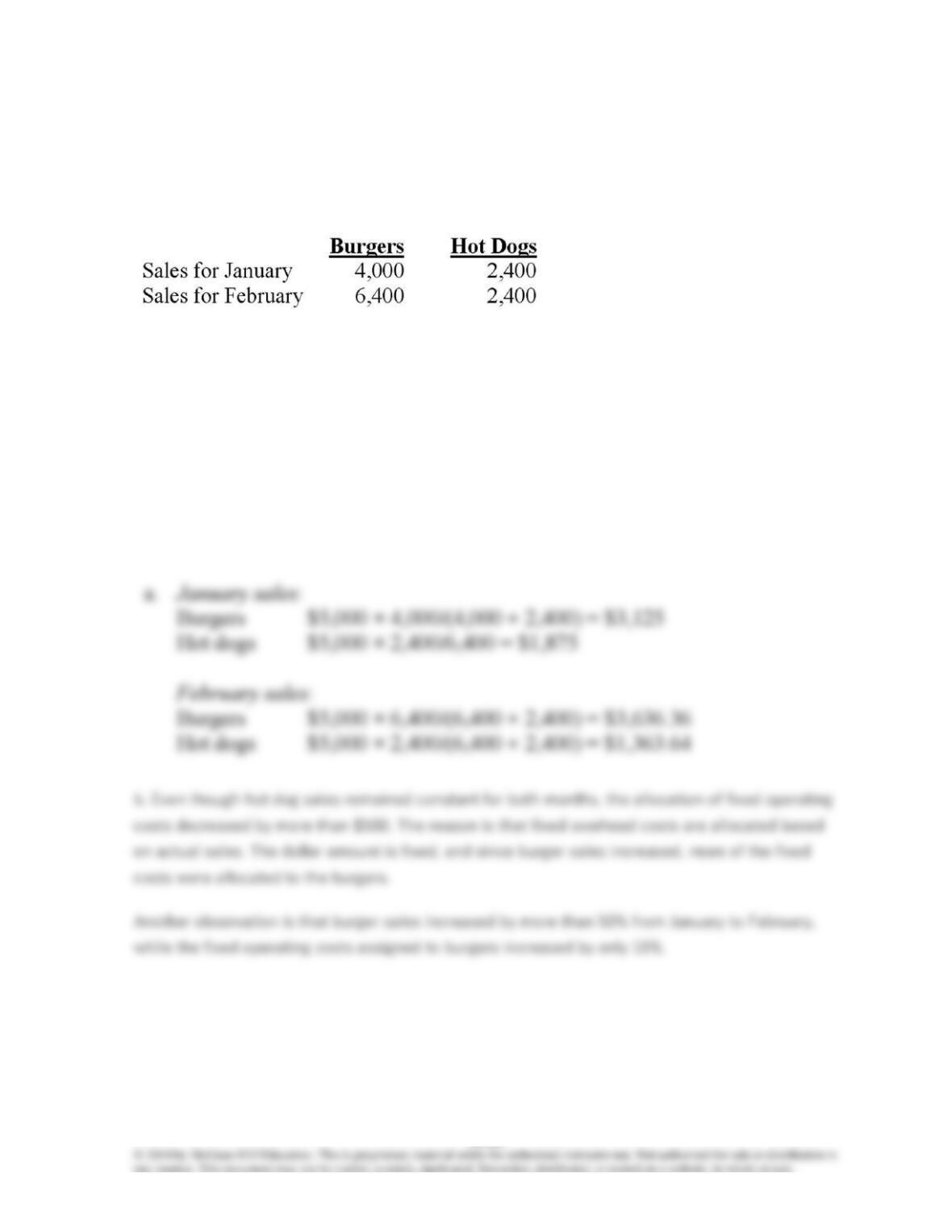
131. Blaster Drive-In is a fast-food restaurant that sells burgers and hot dogs in a 1950s
environment. The fixed operating costs of the company are $5,000 per month. The controlling
shareholder, interested in product profitability and pricing, wants all costs allocated to either the
burgers or the hot dogs. The following information is provided for the operations of the company:
Required:
a. What amount of fixed operating costs is assigned to the burgers and hot dogs when actual
sales are used as the allocation base for January? For February?
b. Hot dog sales for January and February remained constant. Did the amount of fixed operating
costs allocated to hot dogs also remain constant for January and February? Explain why or why
not. Comment on any other observations.

12-106
132. Cost allocation bases are factors that cost management analysts use to assign indirect
costs to cost objects. Ideally, cost-allocation bases should reflect a cause-and-effect relationship
between resource spending and use. Ideally, an Activity-Based-Costing (ABC. approach will
provide a more accurate and useful accounting for an organization’s resources. Recent studies
have found that, in spite of increasing costs and diminishing resources, very few Higher Education
Institutions use the tools and techniques of an ABC cost allocation system to assign costs to
academic departments. While direct costs, such as faculty salaries, are traceable to individual
academic departments or courses, many indirect costs, such as facility use, computer use, and
student support services, are more difficult to assign. In a traditional approach, many higher
education institutions assign such costs based on a single factor, such as the number of courses
taught in the university. (Source: Activity-Based Costing for Higher Education Institutions,
Management Accounting Quarterly, Winter, 2001)
Required:
(a) Explain why the use of a single-cost driver such as the number of courses may result in
inaccurate management information as to the cost of running courses in individual academic
departments.
(b) For each of the indirect costs listed below, identify an appropriate cost-driver that might be
used to allocate costs to determine the cost of offering a single course in an academic department
if an Activity-Based-Costing model were used.
• Computer use
• Facility use
• Student services
• Course design
• Lecturing/class meeting time
• Assignment grading
12-108
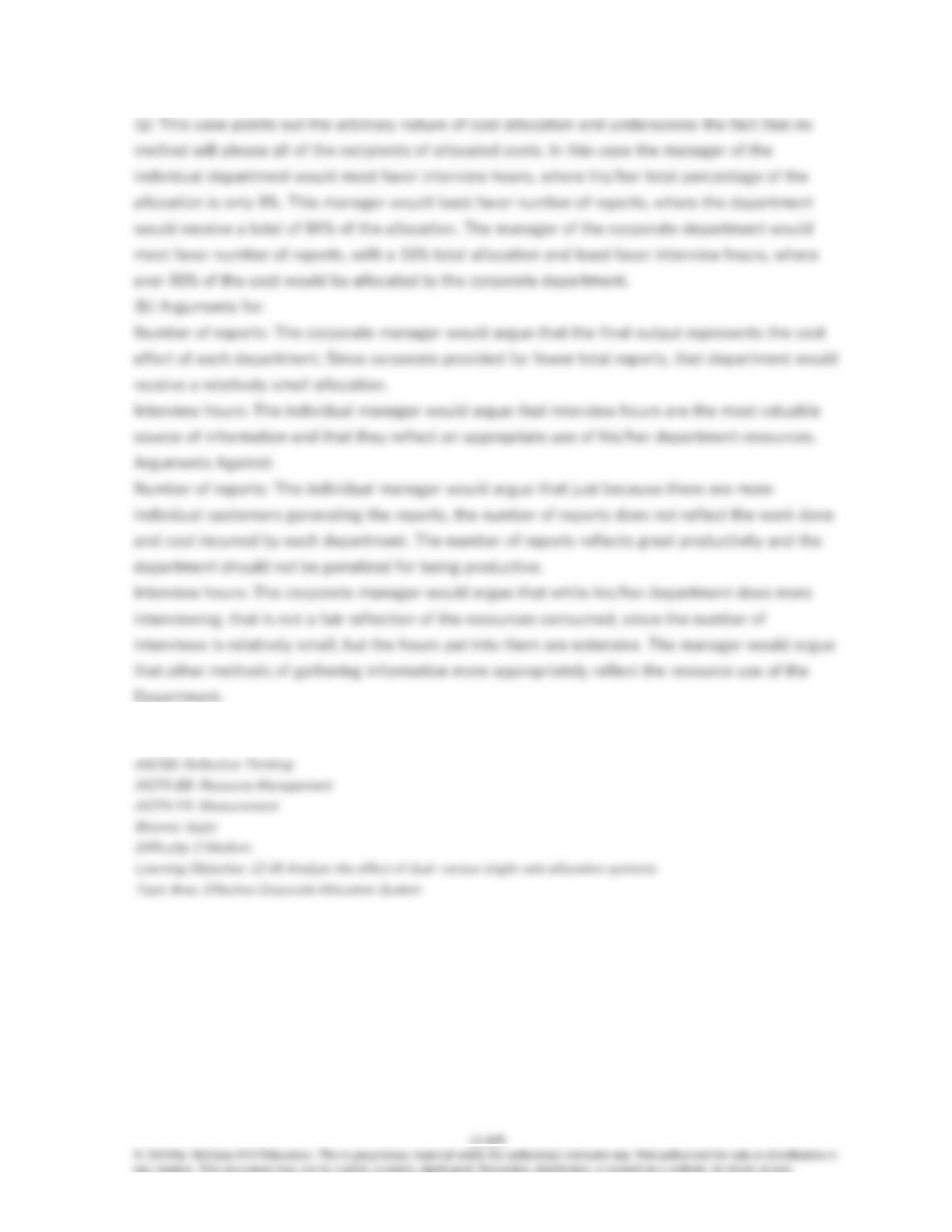
133. Quick Credit Checks produces two styles of credit reports: personal and corporate. The
difference between the two is the amount of background information and data collection required.
The corporate report uses more skilled personnel because additional checking and data are
required. The relevant figures for the year just completed follow: Total support service costs to be
allocated are $3,200,000.
Required:
(a) Which method would be preferred by each manager? Which method would be least preferred?
(b) Provide arguments that each manager would make for his/her preferred method. How would
each manager argue against his/her least preferred method?
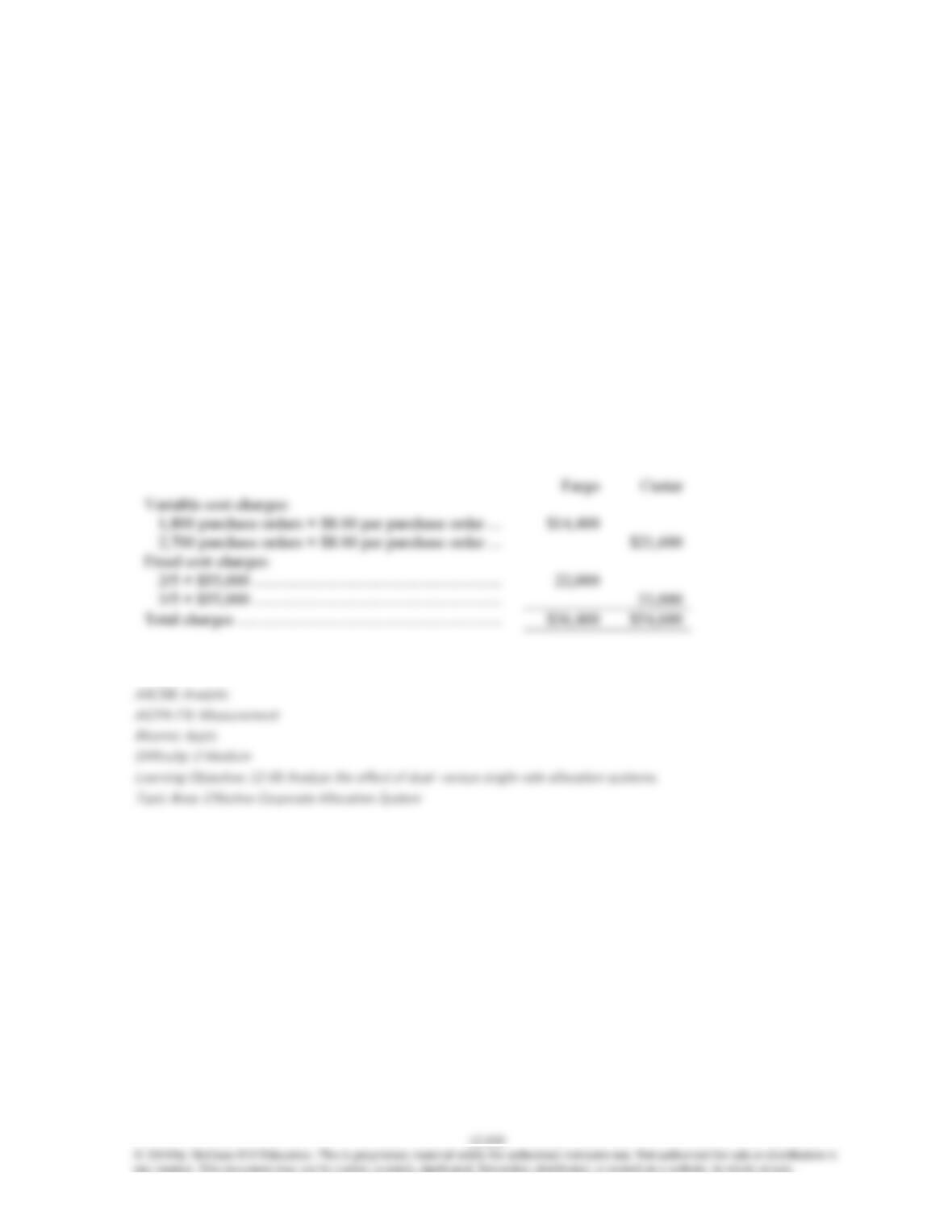
134. Redder Company has a purchasing department that provides services to two factories
located in Fargo and the other in Custer. Budgeted costs for the purchasing department consist of
$55,000 per year of fixed costs and $8 per purchase order for variable costs. The level of budgeted
fixed costs is determined by the peak-period requirements. The Fargo factory requires 40% of the
peak-period capacity and the Custer factory requires 60%.
During the coming year, 1,800 purchase orders were processed for the Fargo factory and 2,700
purchase orders for the Custer factory.
Required:
Compute the amount of purchasing department cost that should be charged to each factory for
the year.
12-111
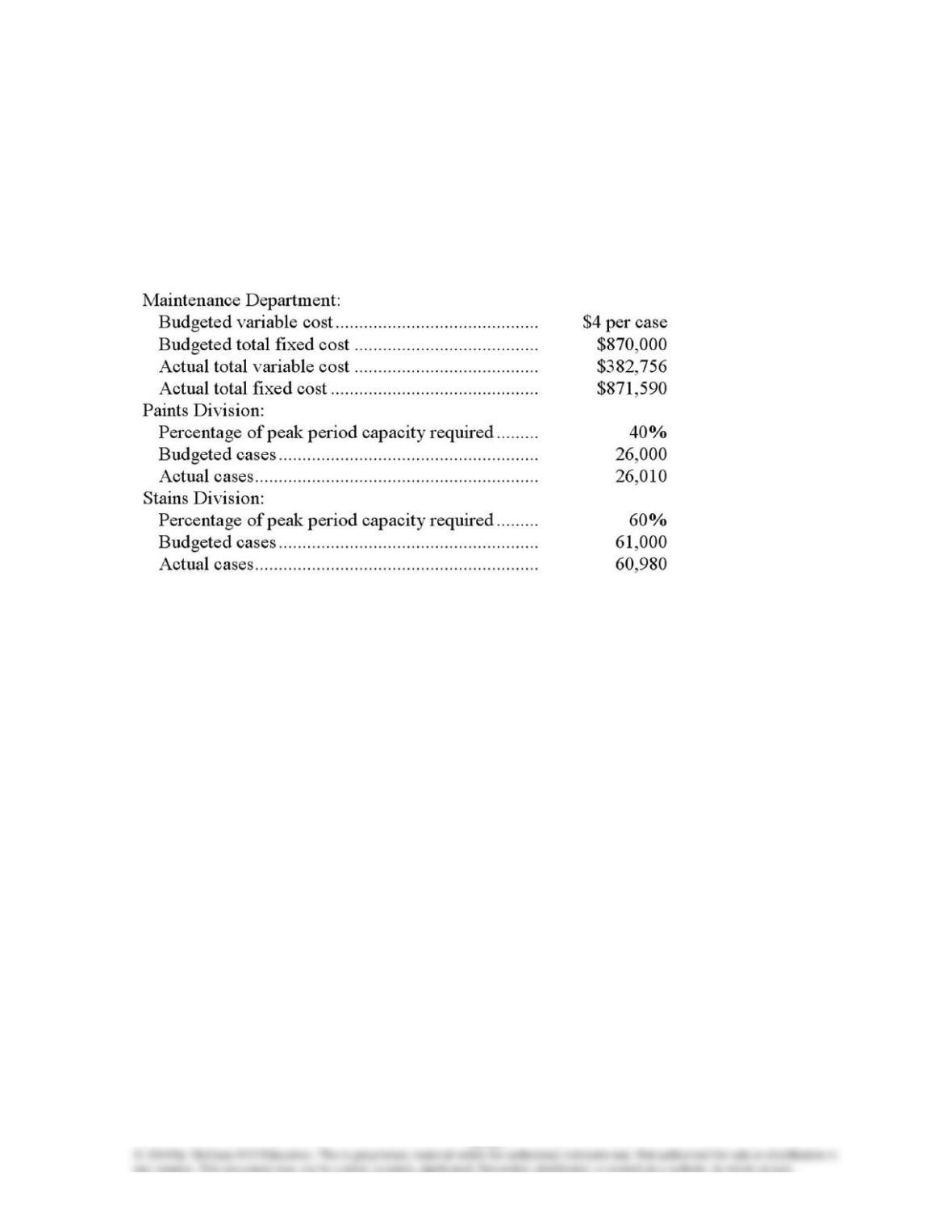
135. Kosek Corporation’s Maintenance Department provides services to the company’s two
operating divisions – the Paints Division and the Stains Division. The variable costs of the
Maintenance Department are budgeted based on the number of cases produced by the operating
departments. The fixed costs of the Maintenance Department are determined based on the
number of cases produced by the operating departments during the peak period. Data appear
below:
Required:
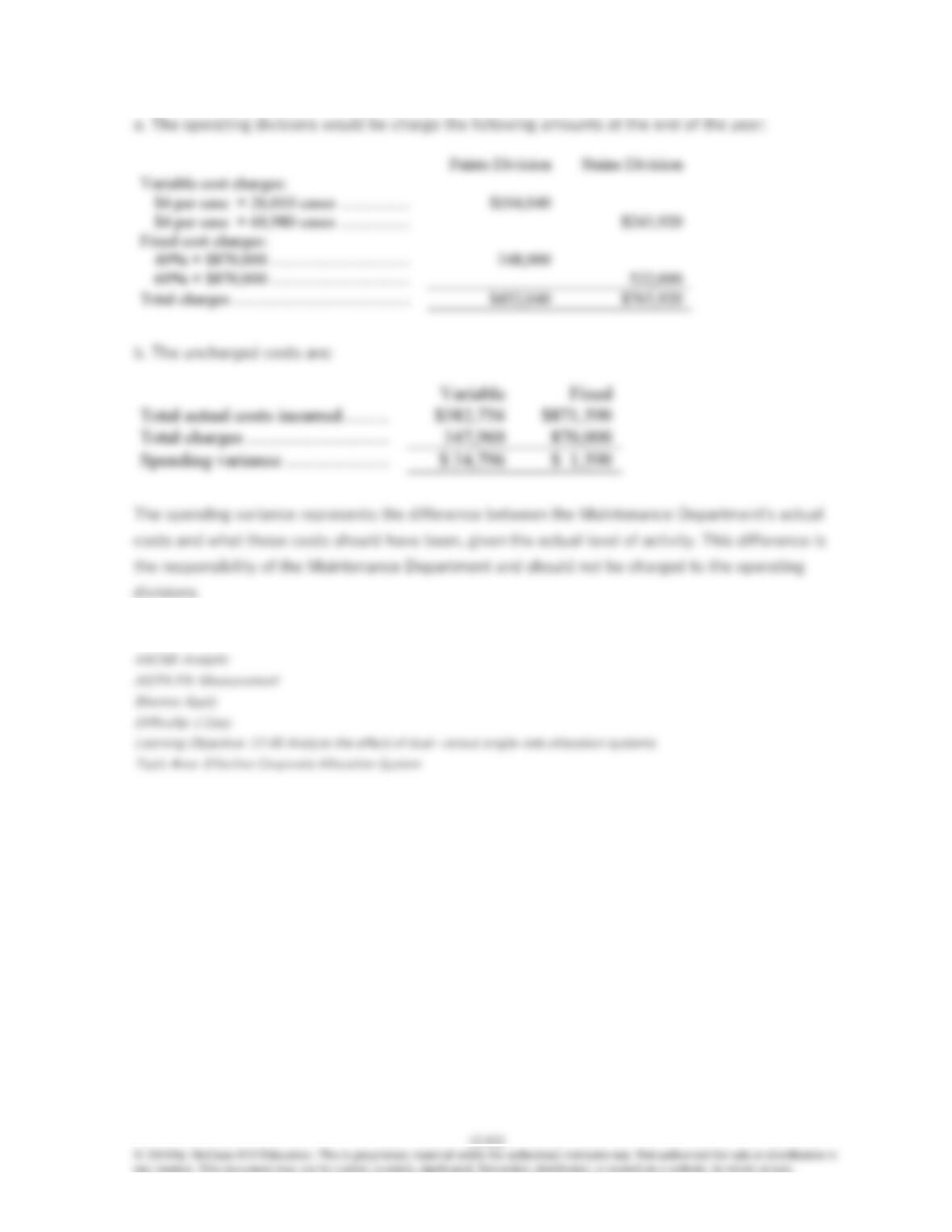
a. Prepare a report showing how much of the Maintenance Department’s costs should be charged
to each of the operating divisions at the end of the year.
b. How much of the actual Maintenance Department costs should not be charged to the operating
divisions at the end of the year? Who should be held responsible for these uncharged costs?
136. Describe five advantages of decentralization.
137. Describe two disadvantages of decentralization.
138. Describe the three main elements of a management control system.
139. Describe the five basic types of decentralized units in responsibility accounting.
140. Explain the difference between fixed compensation and contingent compensation. Give an
example of each.