128) Sumner Corporation has four divisions, commercial, retail, research, and consumer, that
share the common costs of the company’s computer server network. The annual common costs
are $3,500,000. You have been provided with the following information for the upcoming year:
Connections Time on Network (hours)
Commercial 70,000 120,000
Retail 90,000 150,000
Research 20,000 100,000
Consumer 100,000 330,000
Required:
(Use three decimal places in your calculations.)
a. What is the allocation rate for the upcoming year assuming Sumner uses the single-rate
method and allocates common costs based on the number of connections?
b. What is the allocation rate for the upcoming year assuming Sumner uses the single-rate
method and allocates common costs based on the time on network? Calculate the allocated
amount for each division.
129) Kingston Industries has four divisions, commercial, retail, research, and consumer, that
share the common costs of the company’s computer server network. The annual common costs
are $3,600,000. You have been provided with the following information for the upcoming year:
Connections Time on Network (hours)
Commercial 60,000 100,000
Retail 70,000 150,000
Research 20,000 70,000
Consumer 100,000 330,000
Required:
a. The cost accountant determined $2,300,000 of the server network’s costs were fixed and
should be allocated based on the number of connections. The remaining costs should be allocated
based on the time on the network. What is the total server network costs allocated to each
division? (Use three decimal places in your calculations.)
130) Roadways Enterprises has two divisions, Production and Support, that share the common
costs of the company’s communications network. The annual common costs are $4,500,000. You
have been provided with the following information for the upcoming year:
Calls Time on Network (hours)
Production 200,000 240,000
Support 160,000 660,000
Required:
(Use three decimal places in your calculations.)
a. What is the allocation rate for the upcoming year assuming Roadways uses the single-rate
method and allocates common costs based on the number of calls? Calculate the costs allocated
to each division.
b. What is the allocation rate for the upcoming year assuming Roadways uses the single-rate
method and allocates common costs based on the time on the network? Calculate the costs
allocated to each division.
c. The cost accountant determined $2,700,000 of the communication network’s costs were fixed
and should be allocated based on the number of calls. The remaining costs should be allocated
based on the time on the network. What is the total communication network costs allocated to
each division?
131) Santa Fe Industries has two divisions, Marketing and Finance, that share the common costs
of the company’s communications network. The annual common costs are $2,250,000. You have
been provided with the following information for the upcoming year:
Calls Time on Network (hours)
Marketing 50,000 120,000
Finance 40,000 330,000
Required:
(Use three decimal places in your calculations.)
a. What is the allocation rate for the upcoming year assuming Santa Fe uses the single-rate
method and allocates common costs based on the number of calls? Calculate the costs allocated
to each division.
b. What is the allocation rate for the upcoming year assuming Santa Fe uses the single-rate
method and allocates common costs based on the time on the network? Calculate the costs
allocated to each division.
132) Talent Engineering has two divisions, Research and Sales, that share the common costs of
the company’s communications network. The annual common costs are $2,250,000. You have
been provided with the following information for the upcoming year:
Calls Time on Network (hours)
Research 50,000 60,000
Sales 40,000 165,000
Required:
The cost accountant determined $1,350,000 of the communication network’s costs were fixed
and should be allocated based on the number of calls. The remaining costs should be allocated
based on the time on the network. What is the total communication network costs allocated to
each division? (Use three decimal places in your calculations.)
133) The Barton Creek Company has three client-contact departments: Market Research,
Branding, and Promotion. Each department requires the services of the Legal Department for the
contracts that each undertakes. The size of the Legal Department was based on long-run
estimates of contracts. Information on the Legal Department’s budgeted and actual costs is as
follows:
The budget for the Legal Department is $300,000 + $10/contract. The budgeted volume of
contracts is as follows:
Market Research 300
Branding 500
Promotion 700
The actual number of contracts for Market Research was 315, for Branding was 450, and for
Promotion was 720.
Required:
(Use three decimal places in your calculations.)
a. If a single charging rate based on budgeted usage is used, how much of the cost of the Legal
Department would be allocated to each of the producing departments?
b. If a dual charging rate is used, how much of the cost of the Legal Department would be
allocated to each of the producing departments?
134) The Barton Creek Company has three client-contact departments: Market Research,
Branding, and Promotion. Each department requires the services of the Legal Department for the
contracts that each undertakes. The size of the Legal Department was based on long-run
estimates of contracts. Information on the Legal Department’s budgeted and actual costs is as
follows:
The budget for the Legal Department is $200,000 + $7.50/contract. The budgeted volume of
contracts is as follows:
Market Research 300
Branding 500
Promotion 700
The actual number of contracts for Market Research was 286, for Branding was 450, and for
Promotion was 675.
Required:
(Use three decimal places in your calculations.)
a. If a single charging rate based on budgeted usage is used, how much of the cost of the Legal
Department would be allocated to each of the producing departments?
b. If a dual charging rate is used, how much of the cost of the Legal Department would be
allocated to each of the producing departments?
135) The Barton Creek Company has three client-contact departments: Market Research,
Branding, and Promotion. Each department requires the services of the Legal Department for the
contracts that each undertakes. The size of the Legal Department was based on long-run
estimates of contracts. Information on the Legal Department’s budgeted and actual costs is as
follows:
The budget for the Legal Department is $400,000 + $15/contract. The budgeted volume of
contracts is as follows:
Market Research 200
Branding 400
Promotion 800
The actual number of contracts for Market Research was 207, for Branding was 512, and for
Promotion was 820.
Required:
(Use four decimal places in your calculations.)
a. If a single charging rate based on budgeted usage is used, how much of the cost of the Legal
Department would be allocated to each of the producing departments?
b. If a dual charging rate is used, how much of the cost of the Legal Department would be
allocated to each of the producing departments?
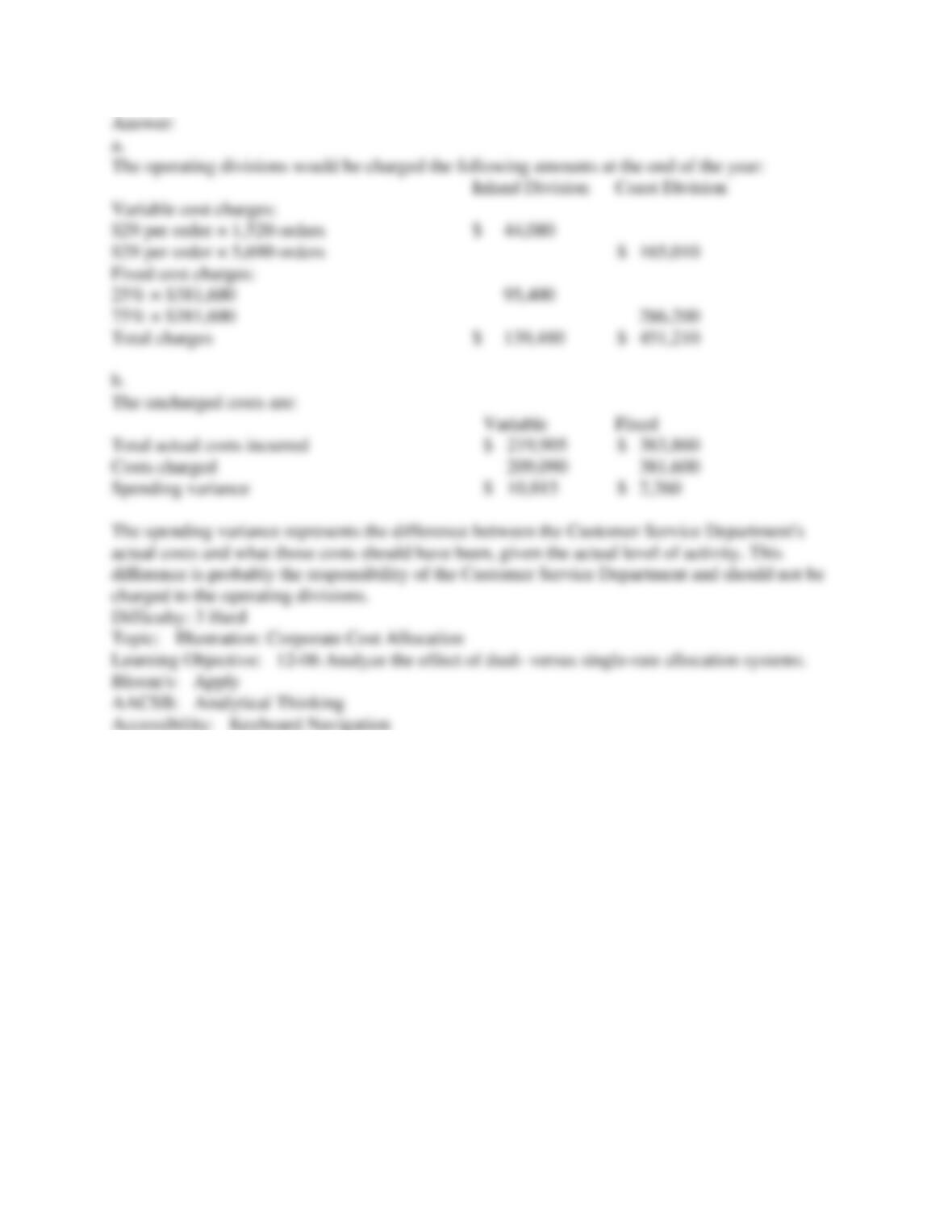
136) Seattle Corporation has two operating divisions – Inland Division and Coast Division. The
company’s Customer Service Department provides services to both divisions. The variable costs
of the Customer Service Department are budgeted at $29 per order. The Customer Service
Department’s fixed costs are budgeted at $381,600 for the year. The fixed costs of the Customer
Service Department are determined based on the peak period orders.
Percentage of Peak
Period Capacity Required Budgeted Orders
Inland Division 25 % 1,500
Coast Division 75 % 5,700
At the end of the year, actual Customer Service Department variable costs totaled $219,905 and
fixed costs totaled $383,860. The Inland Division had a total of 1,520 orders and the Coast
Division had a total of 5,690 orders for the year.
Required:
a. Prepare a report showing how much of the Customer Service Department’s costs should be
charged to each of the operating divisions at the end of the year.
b. How much of the actual Customer Service Department costs should not be charged to the
operating divisions at the end of the year? Who should be held responsible for these uncharged
costs?
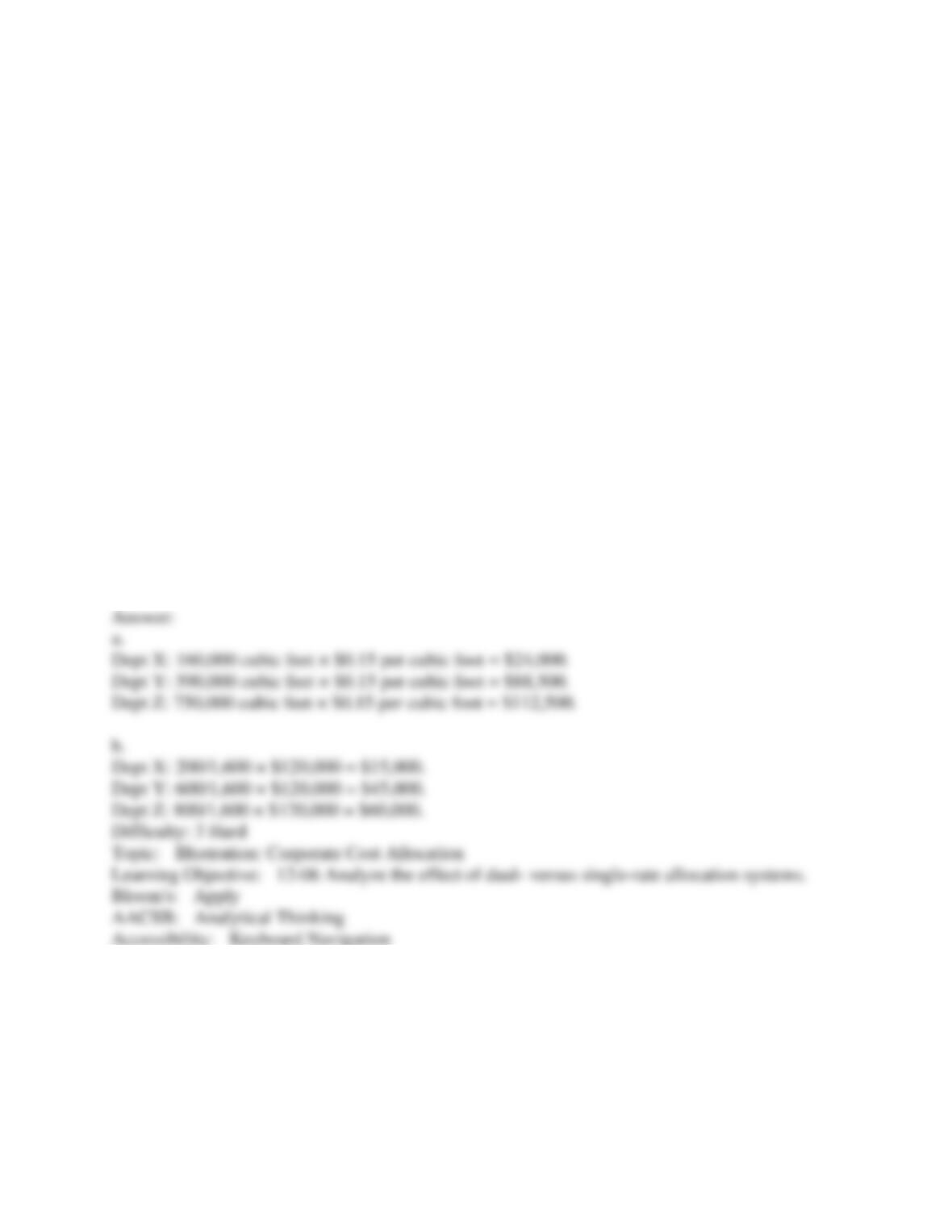
137) Warehouse Services is a service department in the Vancouver Company, providing storage
service to three operating departments. The company charges the costs of this department to
operating departments on the basis of cubic feet occupied.
Last year, Warehouse Services budgeted variable storage cost of $0.15 per cubic foot occupied.
The budgeted total fixed cost was $120,000 and was determined by the long-term storage needs
of the operating departments. Actual storage space occupied during the year, along with long-
term storage needs of operating departments, is given below:
Operating Department
X Y Z
Long-term storage needs in cubic feet 200,000 600,000 800,000
Actual storage space used 160,000 590,000 750,000
Actual variable storage costs amounted to $0.16 per cubic foot occupied. Actual fixed storage
costs were $123,000.
Required:
a. Compute the amount of variable storage cost that should be charged to each operating
department at the end of the year for performance evaluation purposes.
b. Compute the amount of fixed storage cost that should be charged to each operating department
at the end of the year for performance evaluation purposes.
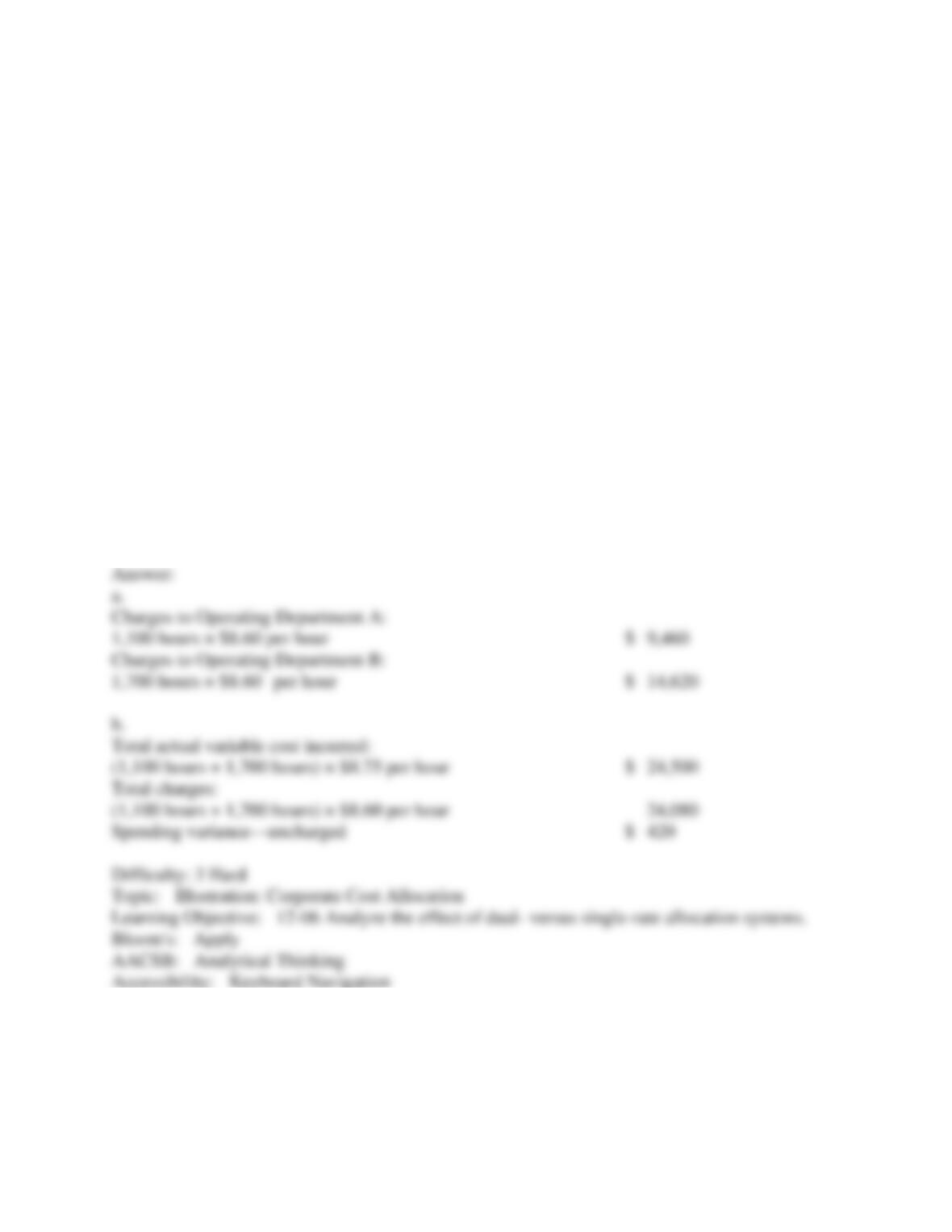
138) Terrain, Inc. has a maintenance department that provides services to the company’s two
operating departments. The variable costs of the maintenance department are charged on the
basis of the number of maintenance hours logged in each department. Last year, budgeted
variable maintenance costs were $8.60 per maintenance hour and actual variable maintenance
costs were $8.75 per maintenance hour.
The budgeted and actual maintenance hours for each operating department for last year appear
below:
Operating Departments
A B
Budgeted maintenance hours 1,000 2,000
Actual maintenance hours 1,100 1,700
Required:
a. Compute the amount of variable maintenance department cost that should have been charged
to each operating department at the end of the year for performance evaluation purposes.
b. Compute the amount of actual variable maintenance department cost that should not have
been charged to the operating departments at the end of the year for performance evaluation
purposes.
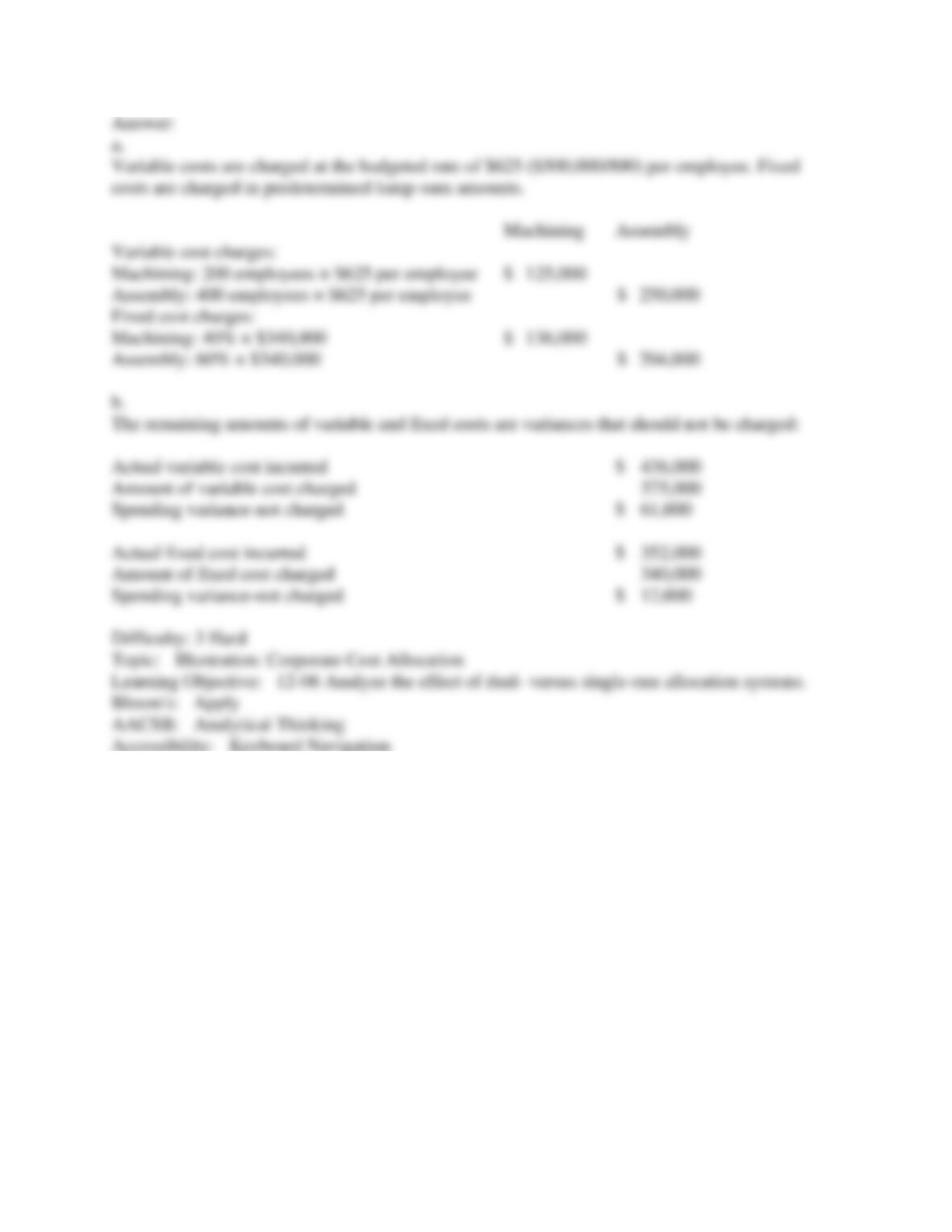
139) Layton Company operates a cafeteria for the benefit of its employees. The company
subsidizes the cafeteria heavily by allowing employees to purchase meals at greatly reduced
prices. Budgeted and actual costs in the cafeteria for the year just ended are as follows:
Budgeted Actual
Variable costs $ 500,000 $ 436,000
Fixed costs $ 340,000 $ 352,000
Costs of the cafeteria are charged to producing departments on the basis of the number of
employees in these departments. Fixed costs are charged on the basis of the peak-period number
of employees. Data on employees in the company’s producing departments follows:
Machining Assembly Total
Budgeted number of employees 300 500 800
Actual number of employees 200 400 600
Peak-period number of employees 400 600 1,000
Required:
a. Compute the dollar amount of variable and fixed costs that should be charged to each of the
producing departments at the end of the year for purposes of evaluating performance.
b. Identify the amount, if any, of actual costs that should not be charged to the operating
departments.
140) The Sunset Corporation operates one central plant that has two divisions, the Flashlight
Division and the Night Light Division. The following data apply to the coming budget year.
Budgeted costs of operating the plant for 2,000 to 3,000 hours:
Fixed operating costs per year $ 900,000
Variable operating costs $1,200 per hour
Budgeted long-run usage per year:
Flashlight Division 2,000 hours
Night Light Division 500 hours
Practical capacity 3,000 hours
Assume that practical capacity is used to calculate the allocation rates. Actual usage for the year
by the Flashlight Division was 1,400 hours and by the Night Light Division was 600 hours.
Required:
1. If a single-rate cost-allocation method is used, what amount of cost will be allocated to the
Flashlight Division? Assume actual usage is used to allocate operating costs.
2. If a dual-rate cost-allocation method is used, what amount of operating costs will be budgeted
for the Night Light Division?
3. If a dual-rate cost-allocation method is used, what amount of cost will be allocated to the
Night Light Division? Assume budgeted usage is used to allocate fixed operating costs and
actual usage is used to allocate variable operating costs.
141) Smash Burgers is a fast-food restaurant that sells vegetarian burgers and hot dogs in a 1950s
environment. The fixed operating costs of the company are $5,000 per month. The controlling
shareholder, interested in product profitability and pricing, wants all costs allocated to either the
burgers or the hot dogs. The following information is provided for the operations of the
company:
Burgers Hot Dogs
Sales for January 4,000 2,400
Sales for February 6,400 2,400
Required:
a. What amount of fixed operating costs is assigned to the burgers and hot dogs when actual sales
are used as the allocation base for January? For February?
b. Hot dog sales for January and February remained constant. Did the amount of fixed operating
costs allocated to hot dogs also remain constant for January and February? Explain why or why
not. Comment on any other observations.