Chapter 12 – Responsibility Accounting, Operational Performance Measures, and the Balanced Scorecard
Essay Questions
76. Startup, Inc. provides a variety of telecommunications services to residential and
commercial customers from its massive campus-like headquarters in suburban Tampa. For a
number of years the firm’s maintenance group has been organized as a cost center, rendering
services free of charge to the company’s user departments (sales, billing, accounting,
marketing, research, and so forth).
Requests for maintenance have grown considerably, and demand is approaching the point
where quality and timeliness of services provided are becoming an issue. As a result,
management is studying whether the maintenance operation should be converted from a cost
center to a profit center, with users to be billed for services performed.
Required:
A. Differentiate between a cost center and a profit center. How is each of these centers
evaluated?
B. What will likely happen to the number of user service requests if the company makes the
switch to a profit-center form of organization? Why?
C. Assume that a user department has requested a particular service, one that is time
consuming and costly to perform. The maintenance group’s actual cost incurred in providing
this service is $17,800, and the user has agreed to pay $20,800 if the switch to a profit center
is made. If this case is fairly typical within the firm, which of the two forms of organization
(cost center or profit center) will result in a more responsive, service-oriented maintenance
group for Startup? Why?
Solution:
77. Brilliant Stone Corporation (BSC) manufactures decorative, sculpted accessories that are
sold by interior decorators and home furnishing stores. The following situation concerns two
BSC employees: Mika George, head of the company’s Billing Department, and Frank Merser,
the firm’s general manager.
George’s Billing Department makes heavy use of hourly employees and is evaluated as a cost
center. Understanding the need for prompt collection of receivables, George strives to run a
first-class operation. George also understands the need to contribute in a big way to BSC’s
financial performance so she continually strives to minimize Billing Department expenses.
Unfortunately, George experienced a heated discussion with Merser several weeks ago, the
subject being the shoddy operation that she is running. Merser complained loudly about the
lack of timely billings to customers and the general lack of attention to detail, as many
complaints have surfaced about erroneous invoices and customer statements.
Required:
A. What is meant by the term “responsibility accounting?”
B. What measure(s) of performance would companies normally use to evaluate a cost-center
manager?
C. Does Merser have a valid reason to be upset with George? Given the nature of the Billing
Department, did George err in her quest to minimize expenses? Explain.
D. Is it likely that the Billing Department could be evaluated as a profit center? Why?
Solution:
78. Consider the following situation:
The marketing manager of Gramblin, Inc. accepted a rush order for a nonstock item from a
valued customer. The manager filed the necessary paperwork with the production department,
and a production manager did the same with purchasing for needed raw materials.
Unfortunately, a purchasing clerk temporarily lost the paperwork; by the time it was found, it
was too late to order from Gramblin’s regular supplier. A new supplier was located that
quoted a very attractive price.
The materials soon arrived and were found to be of poor quality, thus giving rise to a
favorable materials price variance, an unfavorable materials quantity variance, and an
unfavorable labor efficiency variance. These latter two variances, based on normal practice,
appeared on the production manager’s performance report for the period just ended.
Required:
A. Given that the company uses a responsibility accounting system, should the production
manager be penalized for poor performance? Briefly discuss, keeping in mind that a
production manager is generally in a very good position to control material usage and labor
efficiency.
B. Should anything be done to correct the situation? If “yes,” briefly explain.
Solution:
79. The performance reports generated by a responsibility accounting system often form a
“hierarchy of performance reports.” Explain what is meant by this term.
Solution:
80. The allocation of costs gives rise to several unique terms. Briefly discuss the following:
cost object, cost allocation base, and cost allocation.
12–44
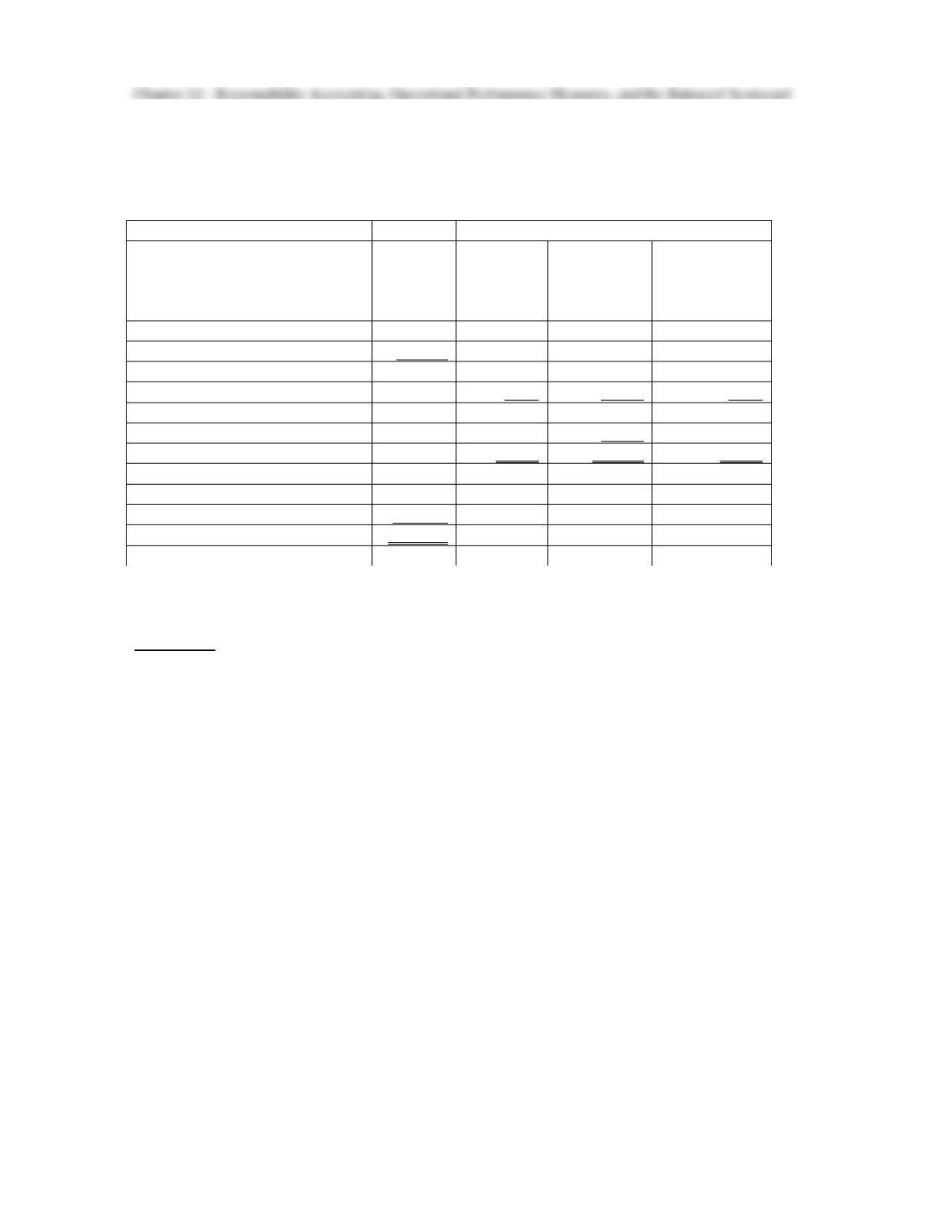
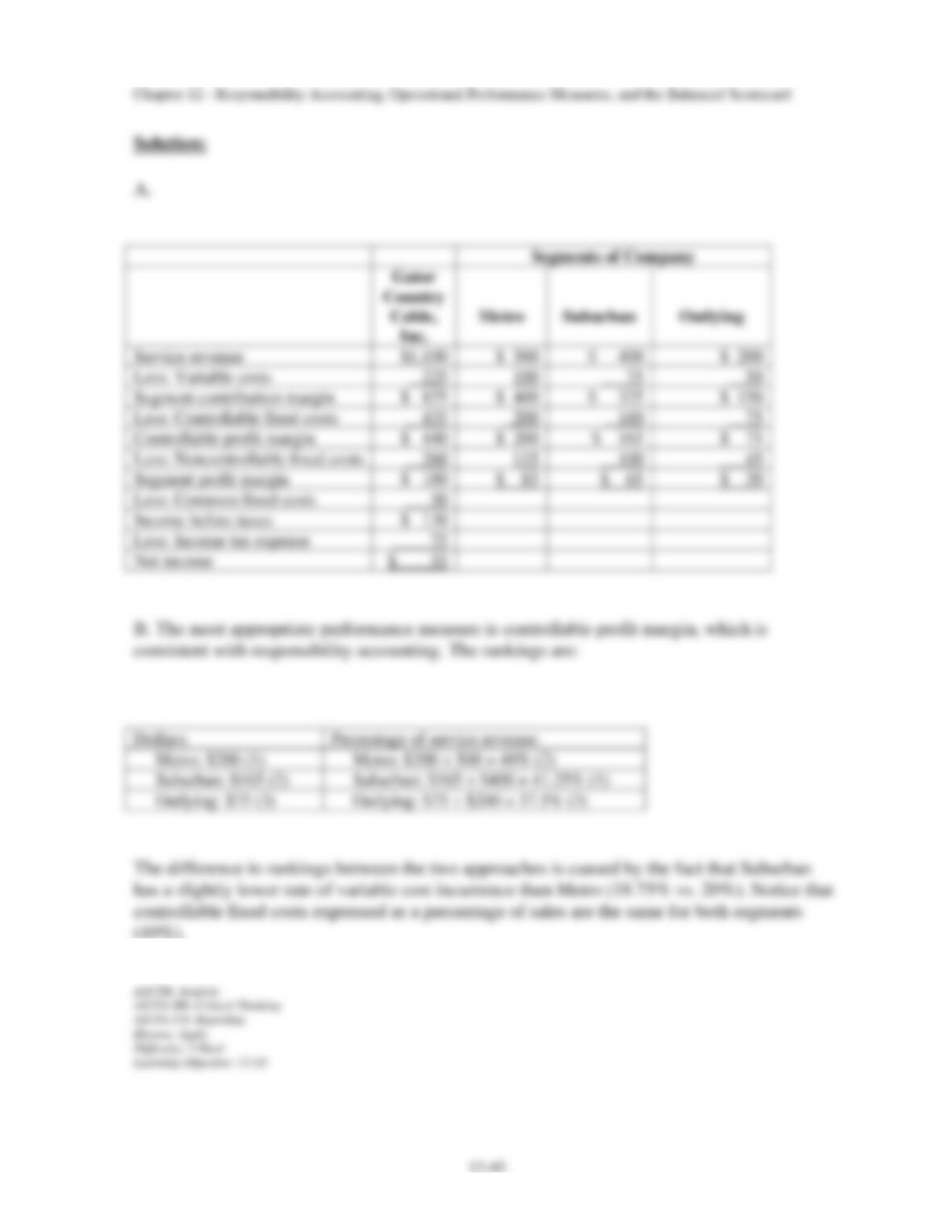
81. Gator Country Cable, Inc. is organized in three segments: Metro, Suburban, and Outlying.
Data for the company and for these segments follow.
Segments of Company
Gator
Country
Cable,
Inc.
Metro
Suburban
Outlying
Service revenue
$______
$ 500
$ 400
$ 200
Less: Variable costs
225
____
_____
____
Segment contribution margin
$______
$____
$_____
$____
Less: Controllable fixed costs
______
200
160
75
Controllable profit margin
$ 440
$ 200
$_____
$ 75
Less: Noncontrollable fixed costs
______
____
100
____
Segment profit margin
$ 180
$ 85
$_____
$ 30
Less: Common fixed costs
______
Income before taxes
$______
Less: Income tax expense
75
Net income
$ 55
Variable costs as a percentage of service revenue are: Metro, 20%; Suburban,
18.75%; and Outlying, 25.0%.
Required:
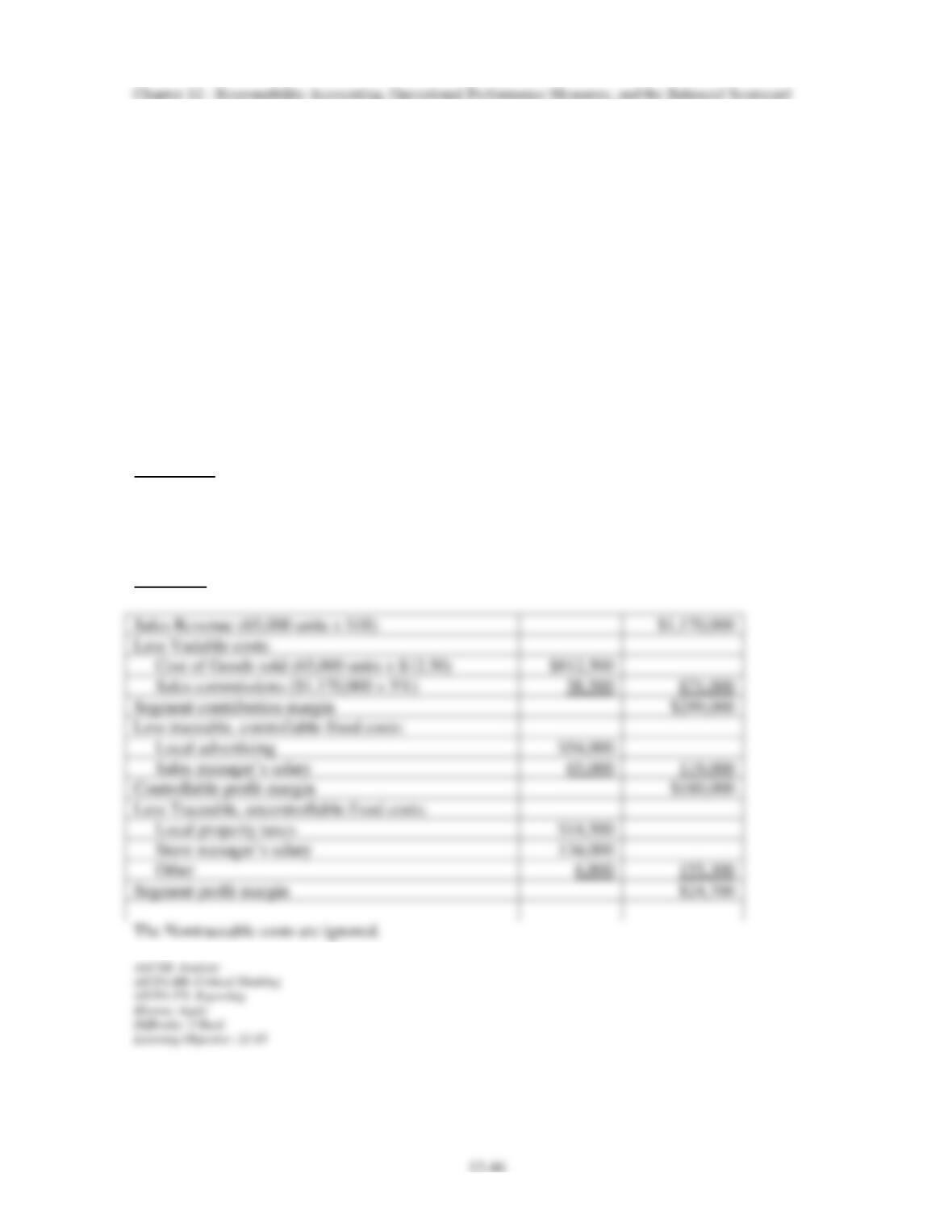
A. Complete the segmented income statement for Gator Country Cable.
B. Evaluate the three segment managers for consideration of a pay raise. Base the
managers’ performance on (1) absolute dollars of the appropriate profit measure,
and (2) the appropriate profit measure as a percentage of service revenue. What
causes any difference in rankings between the two approaches?
82. Midtown Retail operates a retail store in Kansas City, MO., and St. Louis, MO. The
following information relates to the Kansas City facility:
· The store sold 65,000 units at $18.00 each, after having purchased the units from various
suppliers for $12.50. Kansas City salespeople are paid a 5% commission based on gross sales
dollars.
· Kansas City’s sales manager oversees the placement of local advertising contracts, which
totaled $54,000 for the year. Local property taxes amounted to $14,500.
· The sales manager’s $65,000 salary is set by Kansas City’s store manager. In contrast, the
store manager’s $134,000 salary is determined by Midtown’s vice president.
· Kansas City incurred $6,800 of other noncontrollable costs.
· Nontraceable (common) corporate overhead totaled $68,000.
Midtown’s corporate headquarters is located in St. Louis, and the company uses responsibility
accounting to evaluate performance.
Required:
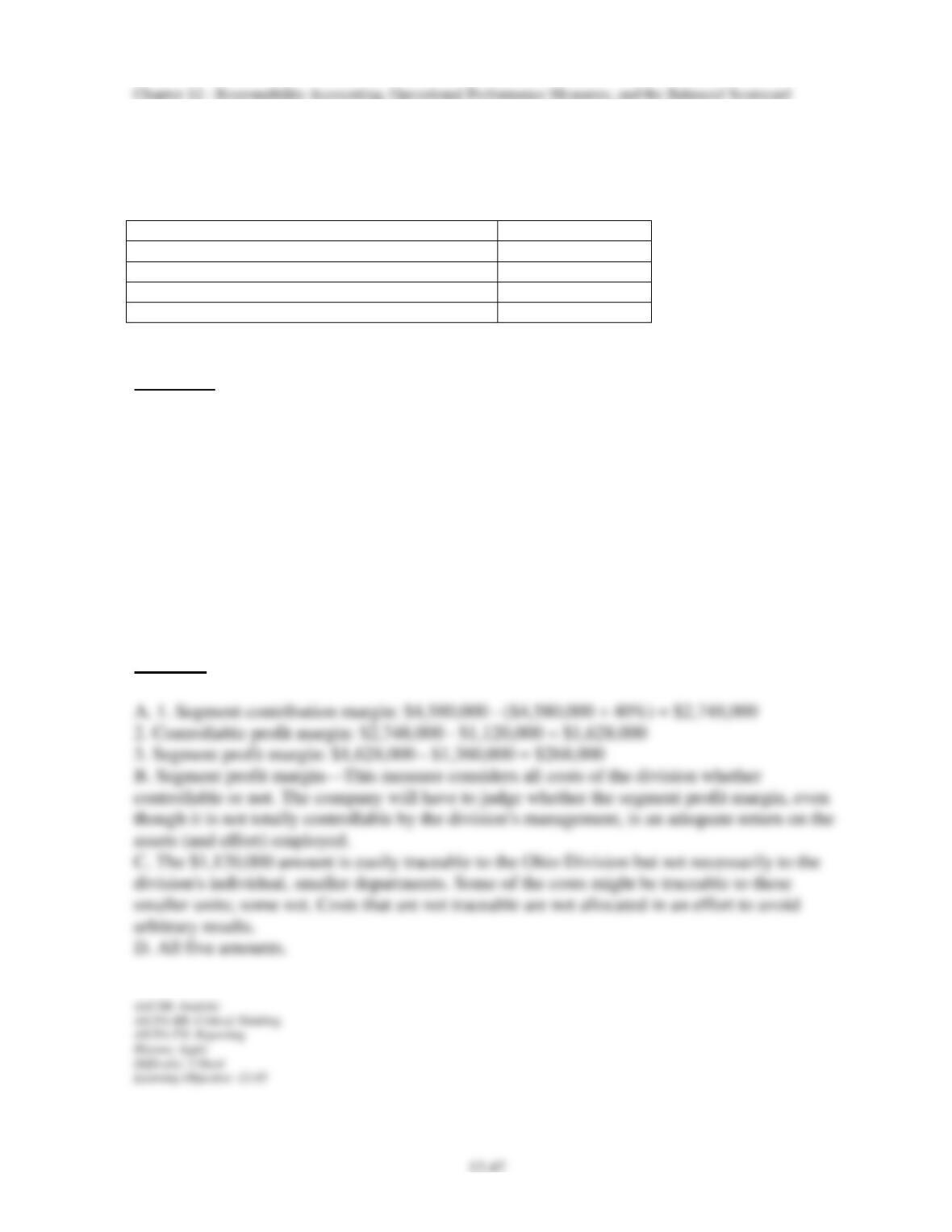
Prepare a segmented income statement for the Kansas City store, being sure to disclose the
segment contribution margin, the segment controllable profit margin, and segment profit
margin.
Solution:
83. The following selected data relate to the Ohio Division of Midwest Industries (MWI):
Sales revenue
$4,580,000
Uncontrollable fixed costs traceable to the division
1,360,000
Allocated corporate overhead
590,000
Controllable fixed costs traceable to the division
1,120,000
Variable costs
40% of revenue
Required:
A. Compute the following for the Ohio Division:
1. Segment contribution margin.
2. Controllable profit margin.
3. Segment profit margin.
B. Which of the three preceding measures should be used when evaluating the Ohio Division
as an investment of MWI’s resources? Why?
C. Assume that management made the decision to prepare a segmented income statement that
reflected Ohio’s five operating departments. Would all $1,120,000 of the controllable fixed
costs be easily traced to the departments? Briefly explain.
D. Which of the five-dollar amounts presented in the body of the problem would be used in
computing the income before taxes of MWI?
Solution:
84. Parson, Inc. operates a chain of 80 retail stores throughout the Southeast that specializes in
the sale of sports equipment. The following costs relate to store no. 19 in Atlanta, Georgia:
1. Salary of store manager: $58,000
2. Allocated corporate overhead: $55,000
3. Cost of goods sold: $2,560,000
4. Landscaping and grounds costs (yearly contract): $6,800
5. Hourly wages of sales clerks: $343,000
6. Local advertising (negotiated by store manager): $76,000
7. Property taxes: $25,800
8. Sales commissions: $221,000
Required:
Which of the preceding costs would be used in computing:
A. Store no. 19’s segment contribution margin?
B. Store no. 19’s controllable profit margin?
C. Store no. 19’s segment profit margin?
D. The net income of Parson, Inc.?
12–49
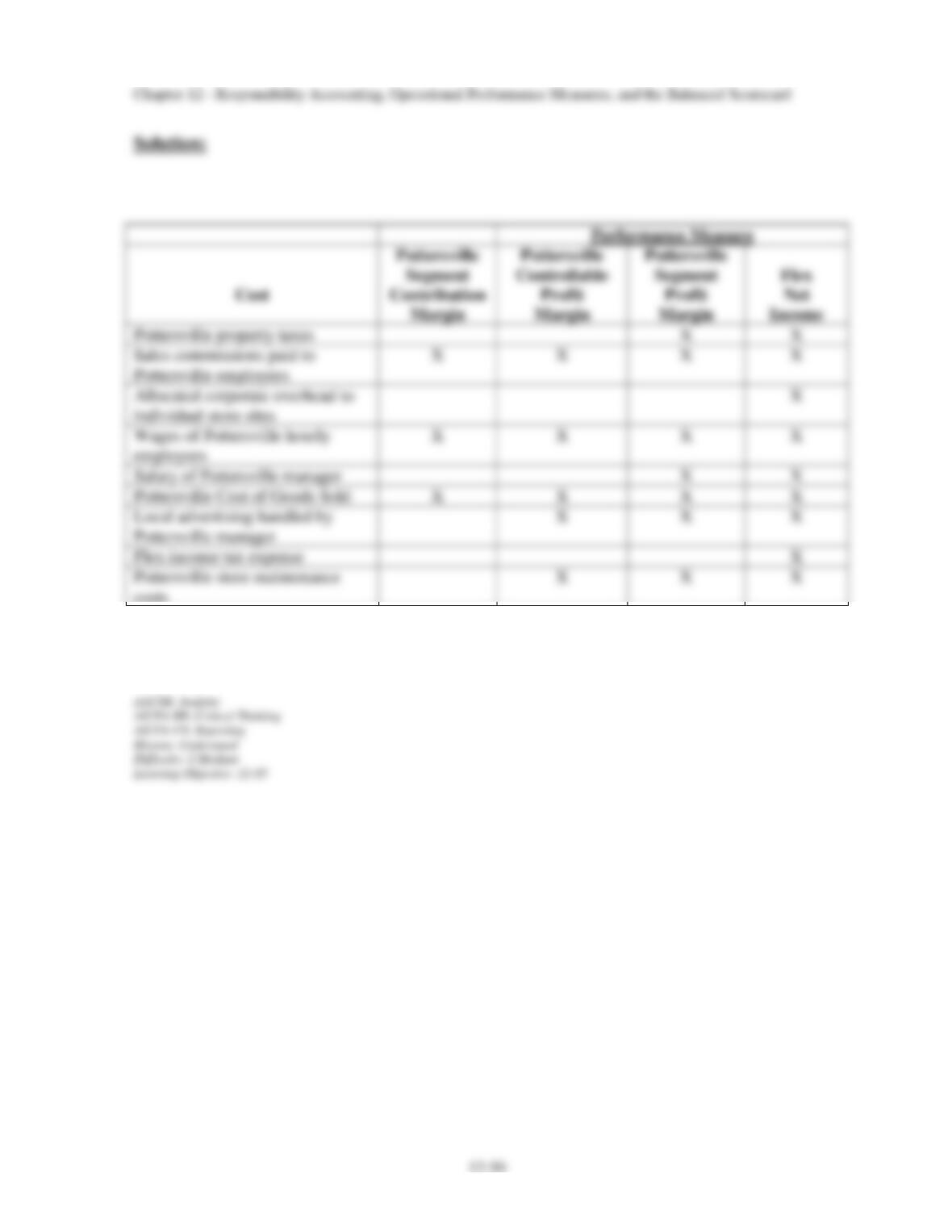
85. Flex, Inc., which is headquartered in Hoboken, New Jersey, operates a chain of 125 shoe
stores throughout the United States. Consider the costs that appear in the following table,
many of which pertain to the company’s sole operation in Pottersville, New Jersey:
Performance Measure
Cost
Pottersville
Segment
Contribution
Margin
Pottersville
Controllable
Profit
Margin
Pottersville
Segment
Profit
Margin
Flex
Net
Income
Pottersville property taxes
Sales commissions paid to
Pottersville employees
Allocated corporate overhead to
individual store sites
Wages of Pottersville hourly
employees
Salary of Pottersville manager
Pottersville Cost of Goods Sold
Local advertising handled by
Pottersville manager
Flex income tax expense
Pottersville store maintenance
costs
Specify store maintenance as a fixed costs. Adopt the following language. “Pottersville store
maintenance costs as agreed upon in yearly maintenance contract negotiated by Pottersville
manager.”
Required:
Analyze each of the costs and determine whether the cost affects Pottersville segment
contribution margin, controllable profit margin, and segment profit margin, and/or the net
income of Flex, Inc. Place an “X” in the appropriate cell(s).
12–51
86. Terrific Threads is an upscale boutique that operates various stores throughout Florida.
The company, which has three divisions (Miami, Naples, and Tampa), reported the following
information for the year just ended (in thousands):
Miami
Naples
Tampa
Sales Revenue
$9,000
$6,000
$5,000
Divisional contribution margin
6,400
4,400
3,500
Profit margin controllable by division manager
1,500
1,900
1,000
Divisional profit margin
1,000
700
200
Terrific Threads also reported $600 of common fixed expenses that top management wants to
allocate to the divisions on the basis of sales revenue. As the company’s chief executive
officer notes, “Each division helped to incur a portion of these costs and, as a result, each
should absorb its fair share.” The firm has adopted various responsibility accounting
procedures to evaluate division personnel.
Required:
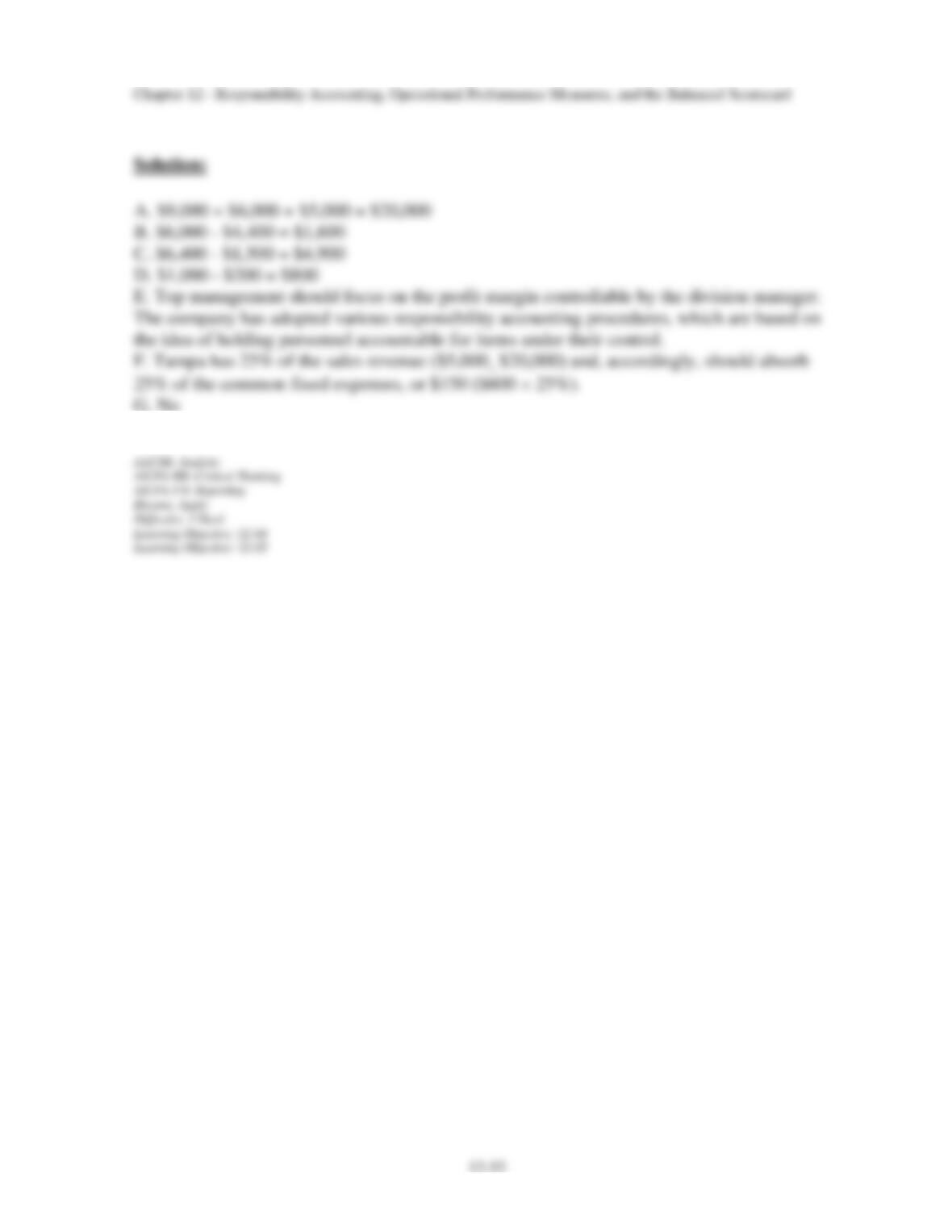
A. Compute the company’s total sales revenue.
B. Calculate the amount of variable operating expense incurred by the Naples Division.
C. Calculate the fixed costs controllable by Miami’s management.
D. Calculate the fixed costs traceable to the Tampa Division but controllable by others.
E. Terrific Threads desires to promote a division manager to the corporate office to oversee
selected operations. In determining which individual to promote, should Terrific Threads’ top
management focus on the profit margin controllable by the division manager or the overall
divisional profit margin? Briefly explain.
F. If the company follows the desires of top management, how much of the common fixed
expenses would be allocated to the Tampa Division?
G. Do cost allocations such as those in part “F” typically appear on a segmented income
statement?
87. Segmented income statements are used to show revenues, expenses, and income for major
parts of an organization.
Required:
A. Consider a regional chain of department stores that has two or three stores in each of
several cities. One way to segment this business is geographically. Describe another way of
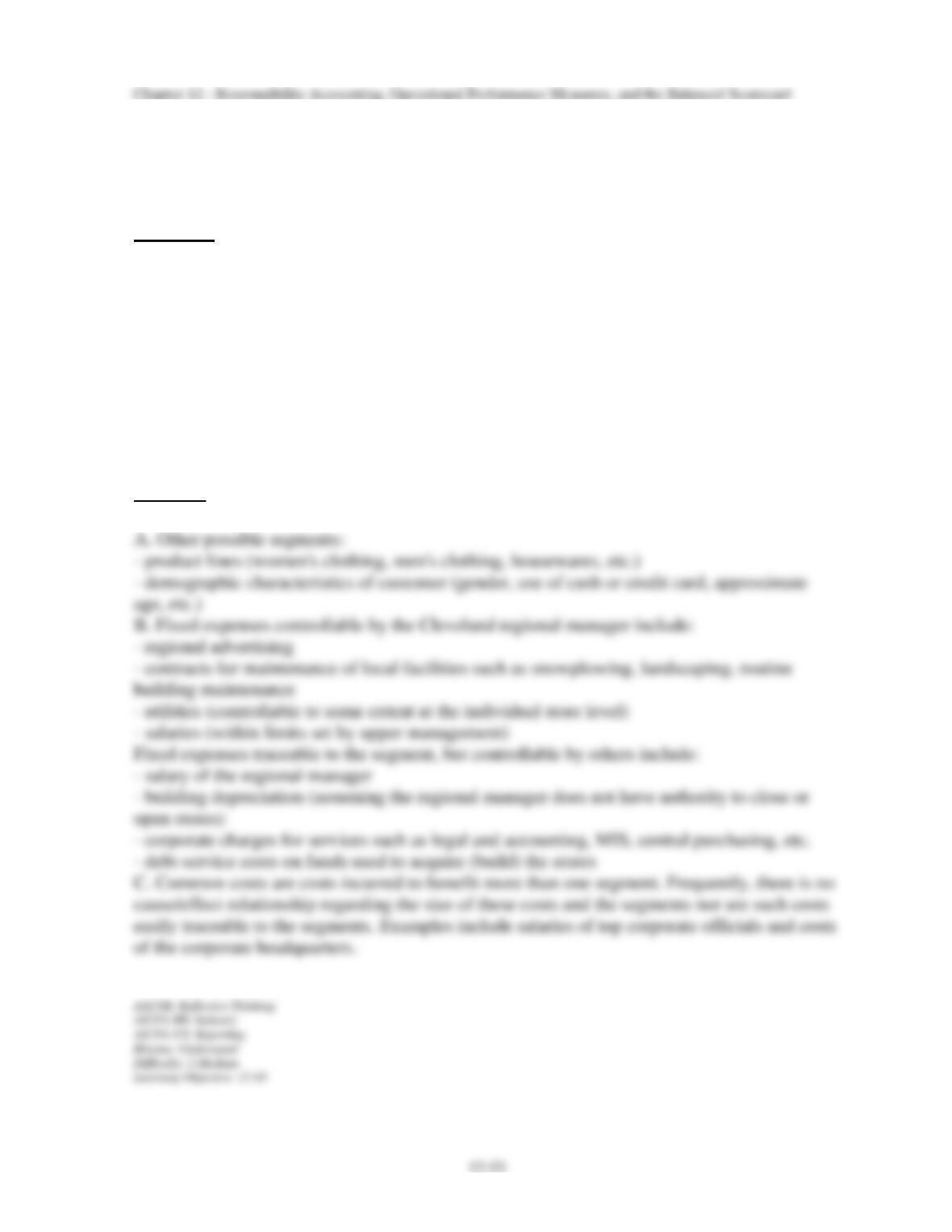
segmenting the firm.
B. Segmented income statements often distinguish between “fixed expenses controllable by
the segment manager” and “fixed expenses traceable to the segment, but controllable by
others.” Assume that the Cleveland district has three retail stores. Give two examples of each
type of fixed cost.
C. Common costs create difficulties when preparing segmented income statements. Define
“common costs,” give an example for the regional chain of department stores, and explain in
general terms why such costs create a problem.
Solution:
88. Air Comfort manufactures air conditioning compressors in St. Louis, Missouri. The
following information pertains to operations in March:
Processing time (average per batch)
8.5 hours
Inspection time (average per batch)
.5 hour
Waiting time (average per batch)
.5 hour
Move time (average per batch)
.5 hour
Units per batch
20 units
Required:
Compute the following operational measures:
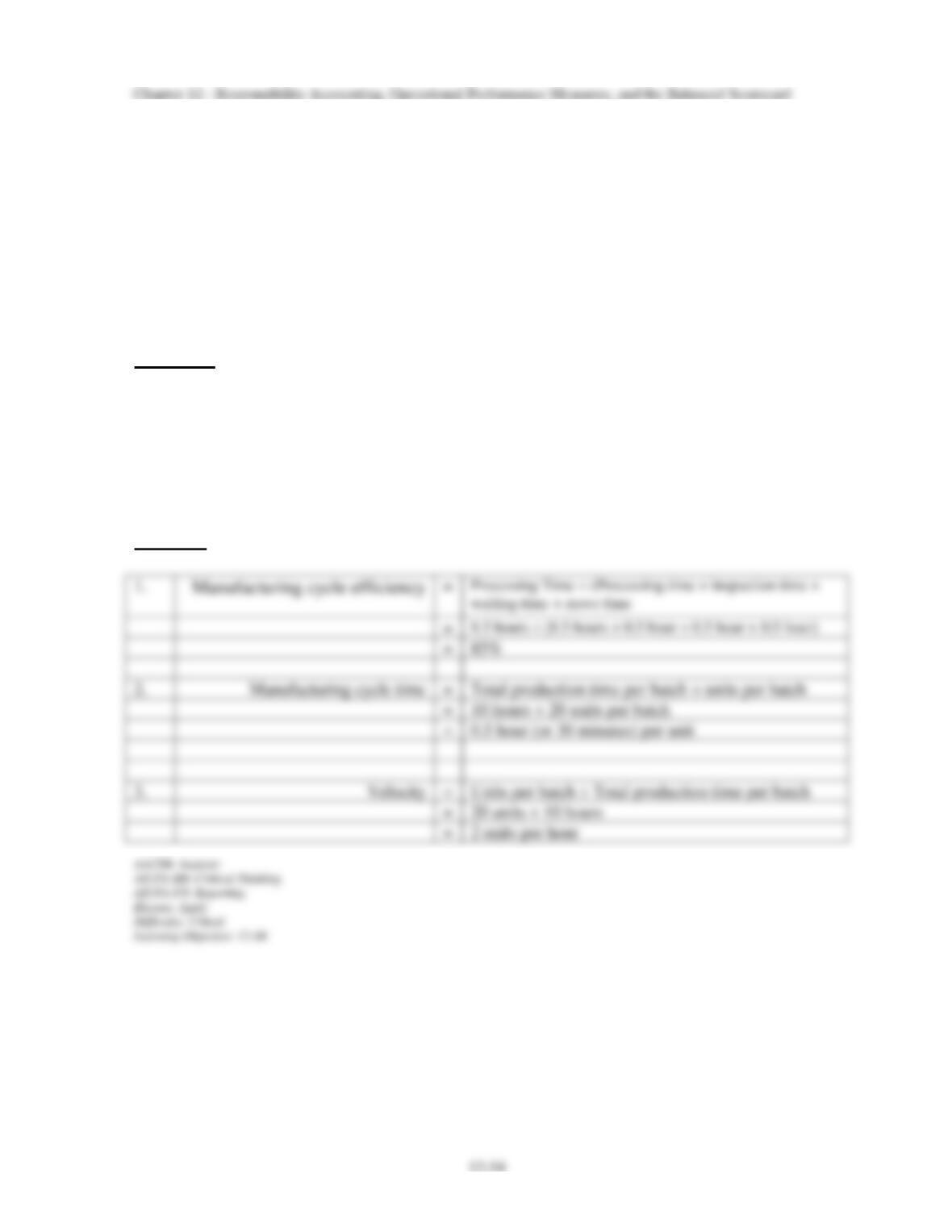
(1) manufacturing cycle efficiency;
(2) manufacturing cycle time;
(3) velocity.
Solution:
12–55
89. Technologistic Enterprises is a highly automated manufacturing firm. The CFO has
decided that traditional standards are inappropriate for performance measures in this
automated environment. Labor is insignificant in terms of the total cost of production and
tends to be fixed, material quality is considered more important than minimizing material
cost, and customer satisfaction is the number one priority. As a result, production and delivery
performance measures have been chosen to evaluate performance. The following information
is considered typical of the time involved to complete and ship orders.
Waiting time:
From order being placed to start of production
8.0 days
From start of production to completion
7.0 days
Inspection time
1.5 days
Processing time
3.0 days
Move time
2.5 days
Required:
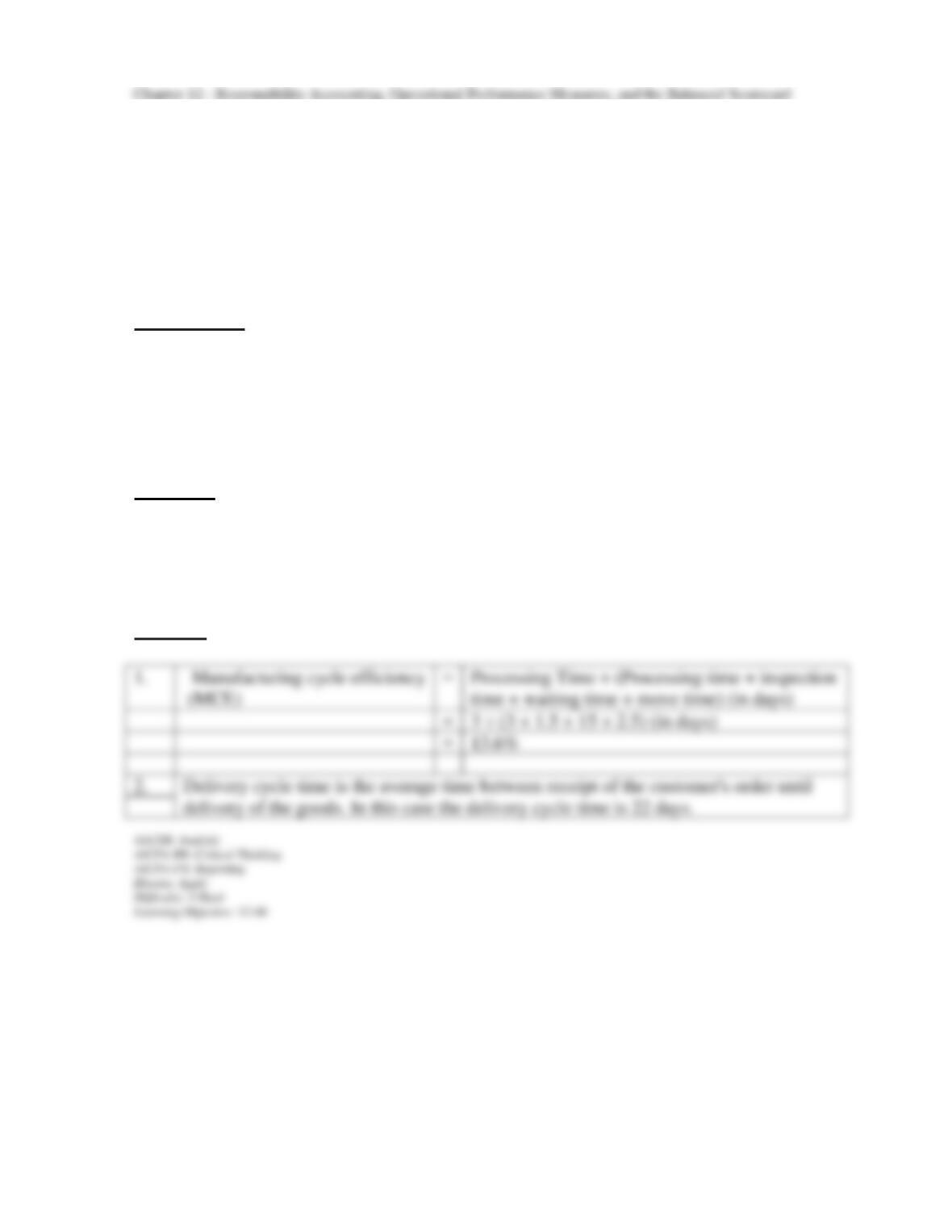
1. Calculate the manufacturing cycle efficiency.
2. Calculate the delivery cycle time.
Solution:
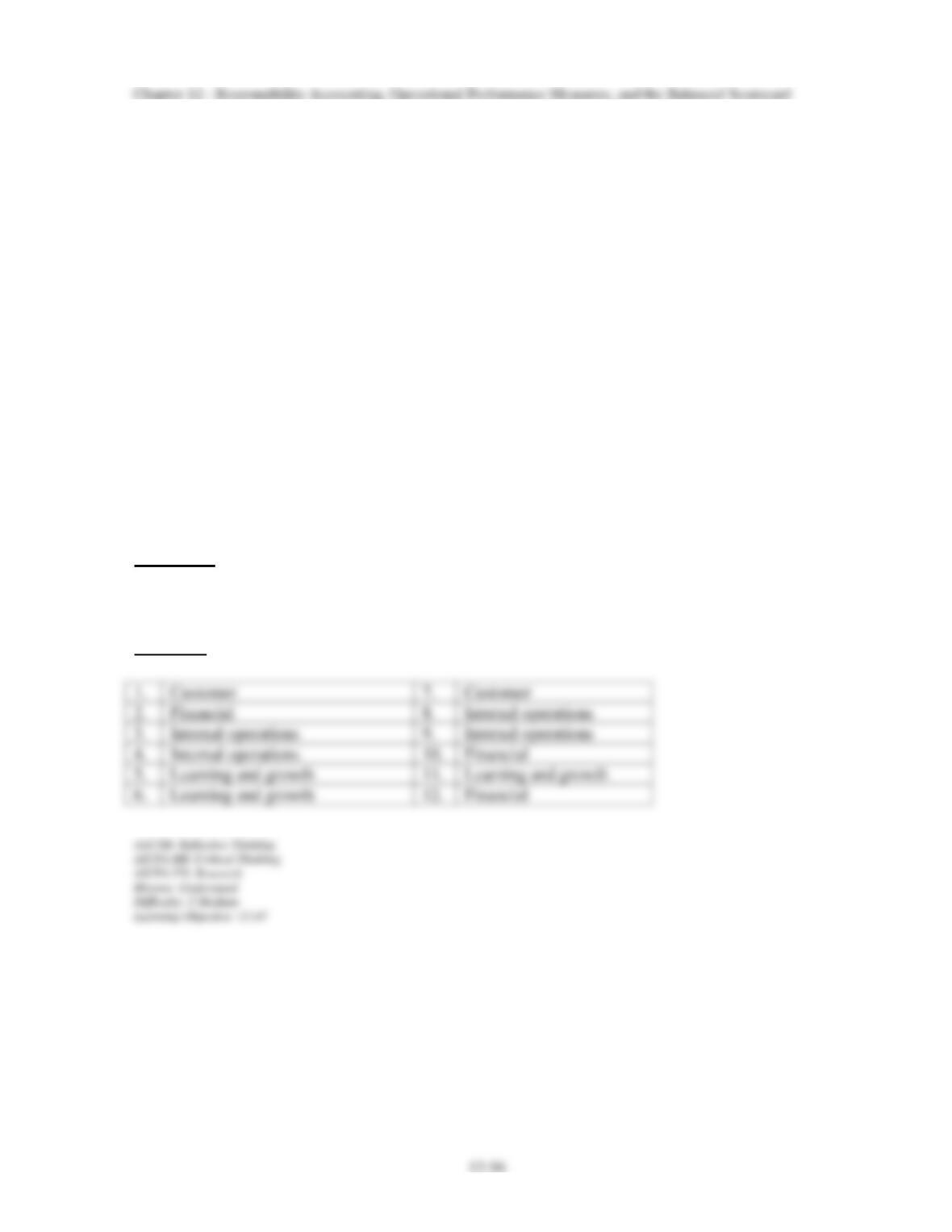
90. Balanced scorecards contain a number of factors that are important to the success of a
business. These factors are often divided into four categories: financial, internal operations,
customer, and learning and growth?
Consider the twelve factors that follow.
1. Market share
2. Earnings per share
3. Manufacturing cycle efficiency
4. Machine downtime
5. Number of patents held
6. Employee suggestions
7. Number of repeat sales
8. Levels of inventories held
9. Number of vendors used
10. Cash flow from operations
11. Employee training hours
12. Gross margin
Required:
Determine the proper classification (financial, internal operations, customer, and learning and
growth?) for each of the twelve factors listed.
Solution:
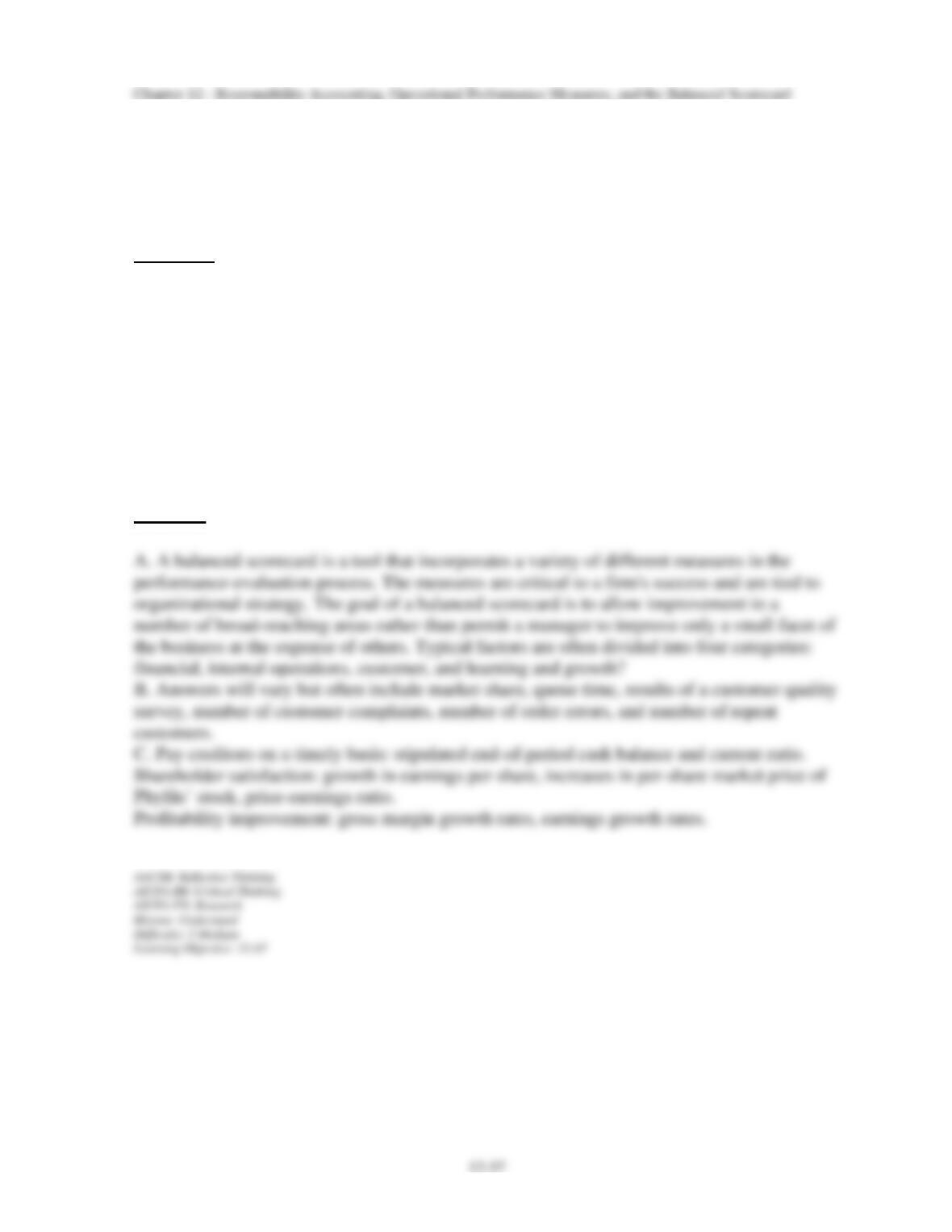
91. Phyllis’ Philly Steaks, a national fast-food chain, has experienced a number of problems in
the past few years, and management is considering the adoption of a balanced scorecard as
part of a turnaround effort.
Required:
A. Briefly explain the concept of a balanced scorecard. What general factors are included in a
typical balanced scorecard?
B. Independent of your answer in requirement “A,” assume that Phyllis’ is very concerned
about customer satisfaction. List four different (and specific) customer-satisfaction measures
that may be appropriate for the firm (and for other fast-food providers).
C. Independent of requirement “A,” assume that Phyllis’ wants to return to former levels of
profitability. List several financial measures that would allow management to assess success
or failure with respect to the following goals: (1) pay creditors on a timely basis, (2) keep
shareholders happy, and (3) improve profitability over time at stores that have been open at
least one year.
Solution: