101. Return on assets is calculated as net income divided by ending total assets.
102. Profit margin measures the income earned on each dollar of sales, and is calculated by
dividing net income by net sales.
103. Asset turnover measures sales volume in relation to the investment in assets, and is
calculated as net sales divided by average total assets.
104. Return on equity is calculated by dividing the stock return by average stockholders’
equity.
105. The price-earnings (PE) ratio compares a company’s share price with its earnings per
share.
106. Growth stocks have high expectations of future earnings growth, and therefore, usually
trade at higher PE ratios.
107. Value stocks have lower share prices in relationship to their fundamental ratios, and
therefore, trade at lower PE ratios.
108. A discontinued operation is the sale or disposal of any long-term asset.
109. We report any profits or losses on discontinued operations in the current year, separately
from profits and losses on the portion of the business that will continue.
110. To be an extraordinary item, an event that produces a gain or loss must be either unusual
in nature or infrequent in occurrence.
111. We report extraordinary items separately, net of taxes, near the bottom of the income
statement just below discontinued operations.
112. If an item meets one but not both criteria for extraordinary item treatment, it is correctly
excluded from extraordinary items and included with other revenue and expenses.
113. The location where a loss is reported in the income statement does not really matter as
long as the loss is reported.
114. When using a company’s current earnings to estimate future earnings performance,
investors normally should exclude discontinued operations and extraordinary items.
115. Conservative accounting practices are those that result in reporting higher income, higher
assets, and lower liabilities.
116. Conservative accounting practices are those that result in reporting lower income, lower
assets, and higher liabilities.
117. A larger estimation of the allowance for uncollectible accounts, the write-down of
overvalued inventory and the use of a shorter useful life for depreciation are all examples of
conservative accounting.
118. Aggressive accounting practices result in reporting higher income, higher assets, and
lower liabilities.
119. Changes in accounting estimates usually have no effect on a company’s underlying cash
flows.

120. Listed below are seven terms followed by a list of phrases that describe or characterize
the terms. Match each phrase with the best term placing the number designating the term in
the space provided.
1. Vertical
analysis
2. Horizontal
analysis
3. Liquidity
4. Value Stocks
5. Growth stocks
6. Solvency
7. Profitability
ratios
(A)Analyzes trends in financial statement data for a
single company over time.
(B) Have lower share prices in relationship to their
fundamental ratios and therefore trade at lower PE ratios.
(C) Expresses each item in a financial statement as a
percentage of the same base amount.
(D) Refers to a company’s ability to pay its current
liabilities.
(E) Refers to a company’s ability to pay its long-term
liabilities.
(F) Have high expectations of future earnings and
therefore usually trade at higher P/E ratios.
(G) Measure the earnings or operating effectiveness of a
company.
121. Listed below are eight terms followed by a list of phrases that describe or characterize
the terms. Match each phrase with the best term placing the number designating the term in
the space provided.
1. Liquidity
2. Conservative
accounting practices
3. Solvency
4. Extraordinary item
5. Discontinued operation
6. Horizontal analysis
7. Vertical analysis
8. Aggressive accounting
practices
(A)A company’s ability to pay its current
liabilities.
(B)Accounting choices that result in reporting
lower income, lower assets, and higher liabilities.
(C)A profit or loss unusual in nature and
infrequent in occurrence.
(D)Accounting choices that result in reporting
higher income, higher assets, and lower liabilities.
(E)A tool to analyze trends in financial statement
data for a single company over time.
(F)The sale or disposal of a significant
component of a company’s operations.
(G)A means to express each item in a financial
statement as a percentage of a base amount.
(H)A company’s ability to pay its long-term
liabilities.

122. Listed below are eight risk ratios followed by a list of phrases that describe or
characterize the ratios. Match each phrase with the correct ratio placing the number
designating the ratio in the space provided.
1. Debt to equity
ratio
2. Acid-test ratio
3. Receivables
turnover ratio
4. Times interest
earned ratio
5. Inventory
turnover ratio
6. Average
collection period
7. Average days in
inventory
8. Current ratio
(A)Cost of goods sold divided by average inventory; the
number of times the firm sells its average inventory balance
during a reporting period.
(B)Total liabilities divided by total stockholders’ equity;
measure a company’s solvency risk.
(C)Approximate number of days the average inventory
is held.
(D) Ratio that compares interest expense with income
available to pay those charges.
(E)Net sales divided by average accounts receivable; the
number of times during a year that the average accounts
receivable balance is collected.
(F)Cash, short-term investments, and accounts
receivable divided by current liabilities; measures the
availability of liquid current assets to pay current liabilities.
(G) Current assets divided by current liabilities; measures
the availability of current assets to pay current liabilities.
(H)Approximate number of days the average accounts
receivable balance is outstanding.
Answer:
1(B); 2(F); 3(E); 4(D); 5(A); 6(H); 7(C); 8(G)


123. Listed below are six profitability ratios followed by a list of phrases that describe or
characterize the ratios. Match each phrase with the correct ratio placing the number
designating the ratio in the space provided.
1. Price-earnings
(PE) ratio
2. Return on equity
3. Asset turnover
4. Profit margin
5. Return on assets
6. Gross profit ratio
(A) Net income divided by average total assets;
measures the amount of net income generated for each
dollar invested in assets.
(B) Compares a company’s share price with its earnings
per share.
(C) Net income divided by average stockholders’
equity; measures the income generated per dollar of
equity.
(D)Gross profit divided by net sales; measures the
amount by which the sale price of inventory exceeds its
cost per dollar of sales.
(E)Net sales divided by average total assets; which
measures the sales per dollar of assets invested.
(F)Net income divided by net sales; indicates the
earnings per dollar of sales.
124. Listed below are five terms followed by a list of phrases that describe or characterize the
terms. Match each phrase with the best term placing the number designating the term in the
space provided.
1. Quality of earnings
2. Aggressive
accounting practices
3. Discontinued
operation
4. Extraordinary item
5. Conservative
accounting practices
(A) An event that is (1) unusual in nature and (2)
infrequent in occurrence.
(B) The sale or disposal of a significant component of
a company’s operations.
(C) Refers to the ability of reported earnings to reflect
the company’s true earnings, as well as the usefulness of
reported earnings to predict future earnings.
(D)Practices that result in reporting lower income,
lower assets, and higher liabilities.
(E)Practices that result in reporting higher income,
higher assets, and lower liabilities.
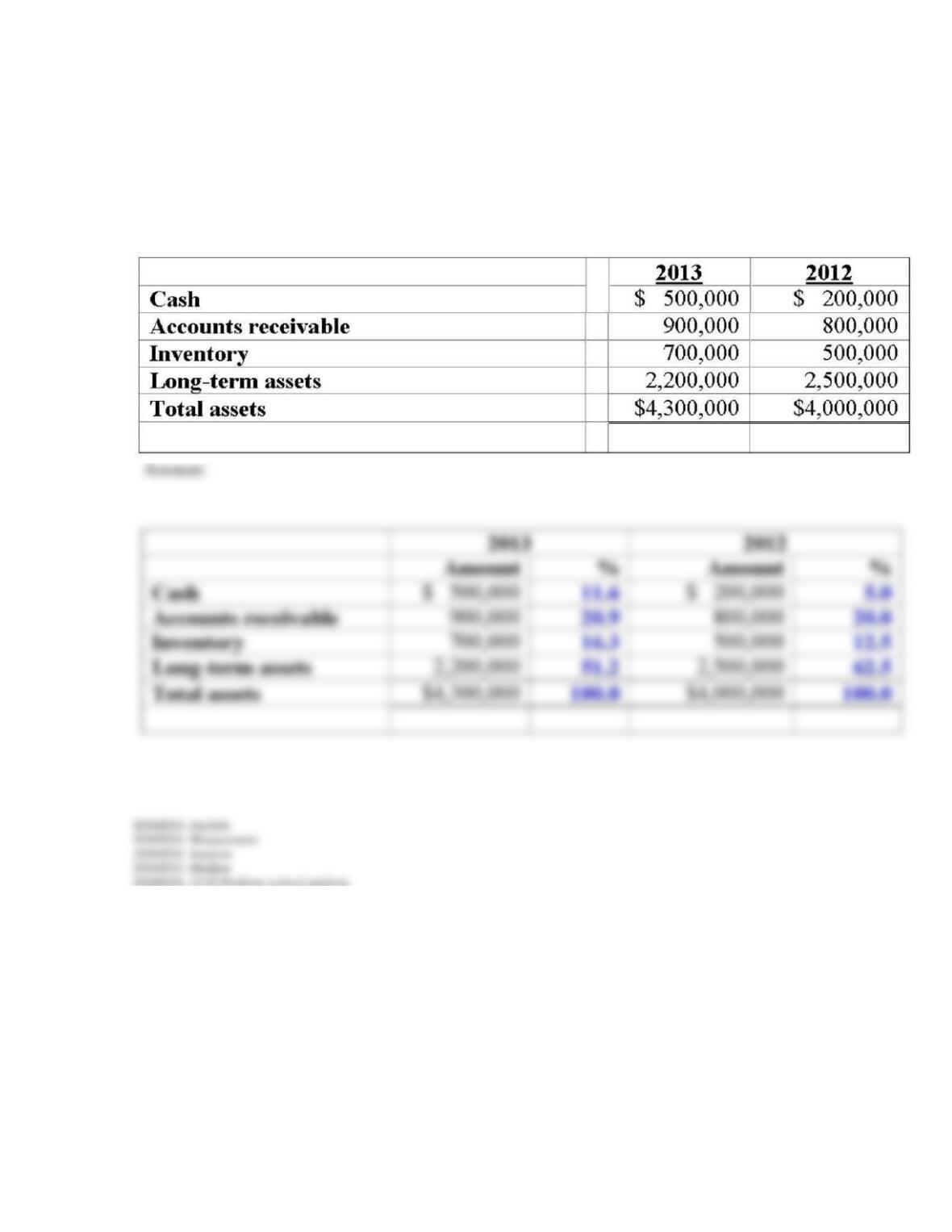
125. Perform a vertical analysis on the following information:
126. Explain the difference between vertical and horizontal analysis.
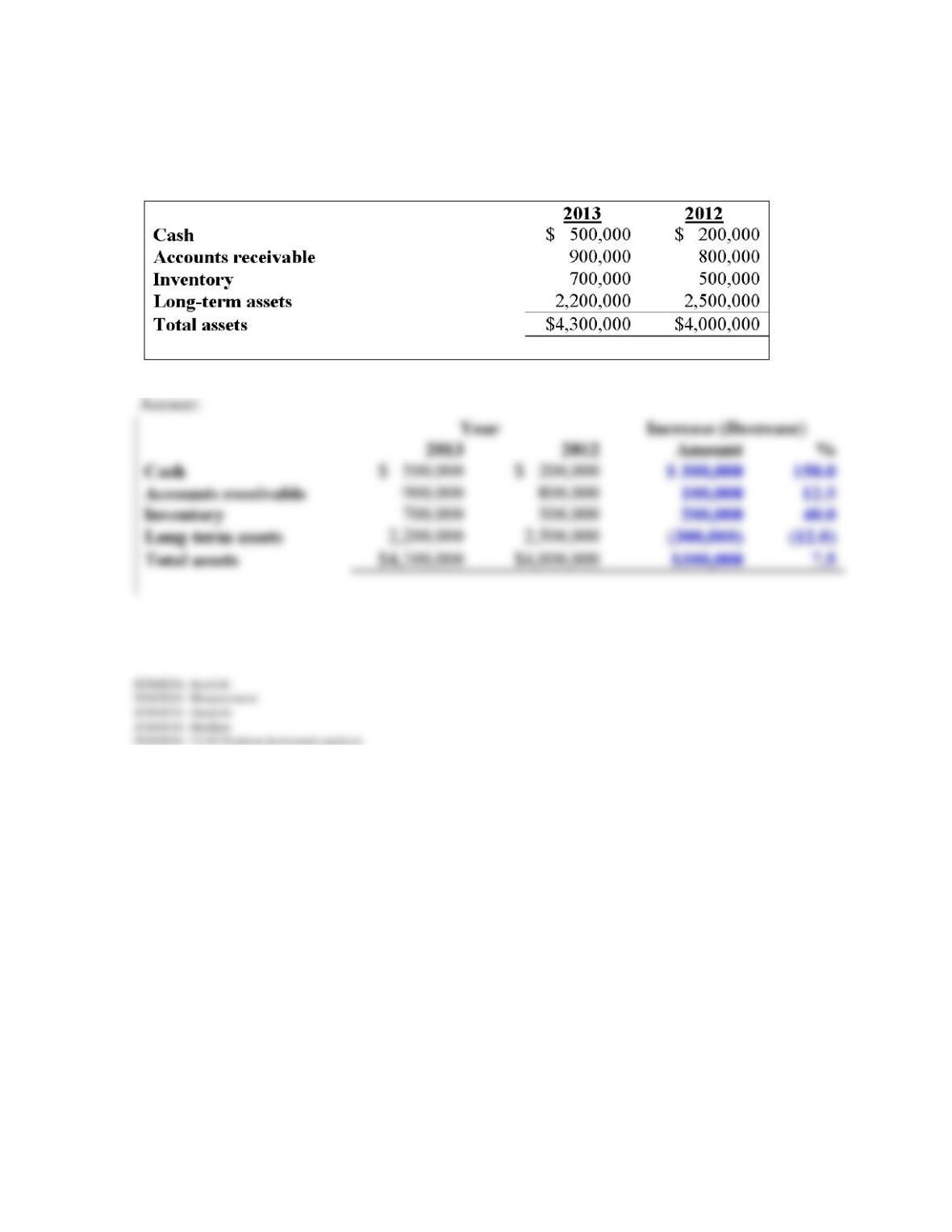
127. Perform a horizontal analysis on the following information providing both the dollar
amount and percentage change:
128. Assume a company’s sales are $1.6 million in 2011, $1.8 million in 2012, and $1.7
million in 2013. What is the percentage change from 2011 to 2012? What is the percentage
change from 2012 to 2013? Be sure to indicate whether the percentage change is an increase
or a decrease.
129. If a company’s sales are $648,000 in 2012, and this represents an 8% increase over sales
in 2011, what were sales in 2011?
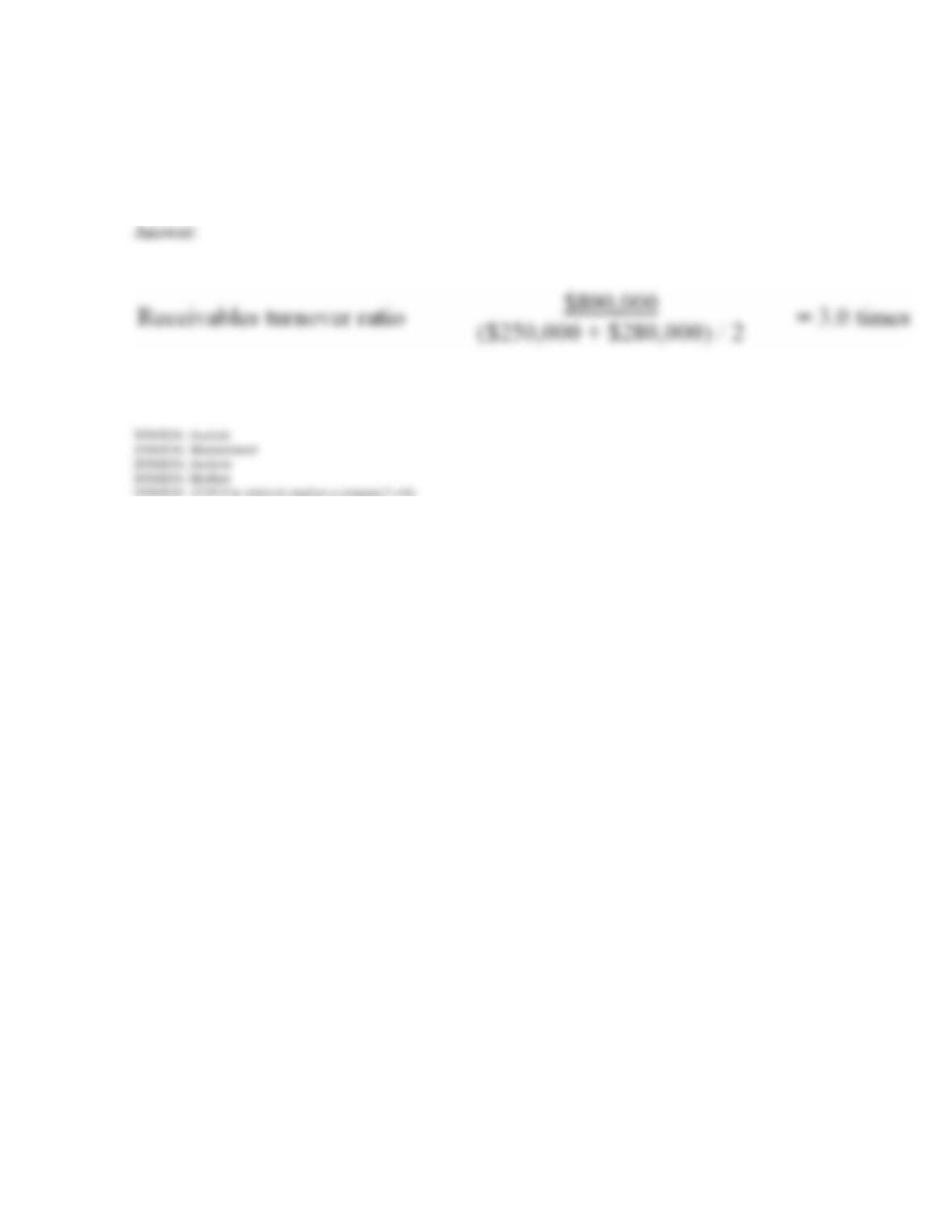
130. United Products began the year with an Accounts Receivable balance of $250,000, and
had a year-end balance of $280,000. Credit sales of $800,000 generated a gross profit of
$150,000. Calculate the receivables turnover ratio for the year.