24) Occidental Produce Company has 40,000 shares of common stock outstanding and 2,000 shares of preferred
stock outstanding. The common stock is $0.01 par value; the preferred stock is 4% non-cumulative, with $100 par
value. On October 15, 2014, the company declares a total dividend payment of $40,000. How much dividend will
be paid to the preferred shareholders?
A) $40,000
B) $2,000
C) $8,000
D) $4,500
25) Occidental Produce Company has 40,000 shares of common stock outstanding and 2,000 shares of preferred
stock outstanding. The common stock is $0.01 par value; the preferred stock is 4% non-cumulative, with $100 par
value. On October 15, 2014, the company declares a total dividend payment of $40,000. What is the total amount
of dividends that will be paid to the common shareholders?
A) $40,000
B) $32,000
C) $400
D) $4,500
26) Occidental Produce Company has 40,000 shares of common stock outstanding and 2,000 shares of preferred
stock outstanding. The common stock is $0.01 par value; the preferred stock is 4% non-cumulative, with $100 par
value. On October 15, 2014, the company declares a total dividend payment of $40,000. What is the amount of
dividend which will be paid for each share of common stock?
A) $0.80
B) $400.00
C) $4.00
D) $1.00
27) Which of the following is the correct description of dividends in arrears, as it applies to cumulative preferred
stock?
A) The cumulative amount of dividends which were not paid in previous years
B) The cumulative amount of dividends that were paid in previous years
C) The amount of dividends that were paid late
D) The amount of dividends that will be paid in the coming year
28) Orleans Company was incorporated on January 1, 2012. Orleans issued 4,000 shares of common stock and 500
shares of preferred stock on that date. The preferred shares are cumulative, $100 par, with an 8% dividend rate.
Orleans has not paid any dividends yet. In 2015, Orleans had its first profitable year, and on November 1, 2015,
Orleans declared a total dividend of $28,000. What is the total amount that will be paid out to preferred
shareholders?
A) $4,000
B) $16,000
C) $3,200
D) $28,000
29) Orleans Company was incorporated on January 1, 2012. Orleans issued 4,000 shares of common stock and 500
shares of preferred stock on that date. The preferred shares are cumulative, $100 par, with an 8% dividend rate.
Orleans has not paid any dividends yet. In 2015, Orleans had its first profitable year, and on November 1, 2015,
Orleans declared a total dividend of $28,000. What is the total amount that will be paid out to common
shareholders?
A) $4,000
B) $16,000
C) $12,000
D) $28,000
30) From its inception through the year of 2014, Quicksales Company was profitable and made strong dividend
payments each year. In the year 2015, Quicksales had major losses and paid no dividends. In 2016, the company
started making large profits again, and they were able to pay dividends to all shareholders—both common and
preferred. There are 1,500 shares of cumulative, 7% preferred stock outstanding. The preferred stock has a par
value of $100. What is the total amount of dividends which should be paid to the preferred shareholders in
December, 2016?
A) $210
B) $22,000
C) $10,500
D) $21,000
31) A corporation has 15,000 shares of 10%, $50 par cumulative preferred stock outstanding and 25,000 shares of
no-par common stock outstanding. Dividends of $37,500 are in arrears. At the end of the current year, the
corporation declares a dividend of $120,000.
How is the dividend allocated between preferred and common shareholders?
A) The dividend is allocated $7,500 to preferred shareholders and $112,500 to common shareholders.
B) The dividend is allocated $112,500 to preferred shareholders and $7,500 to common shareholders.
C) The dividend is allocated $120,000 to preferred shareholders and $0 to common shareholders.
D) The dividend is allocated $75,000 to preferred shareholders and $45,000 to common shareholders.
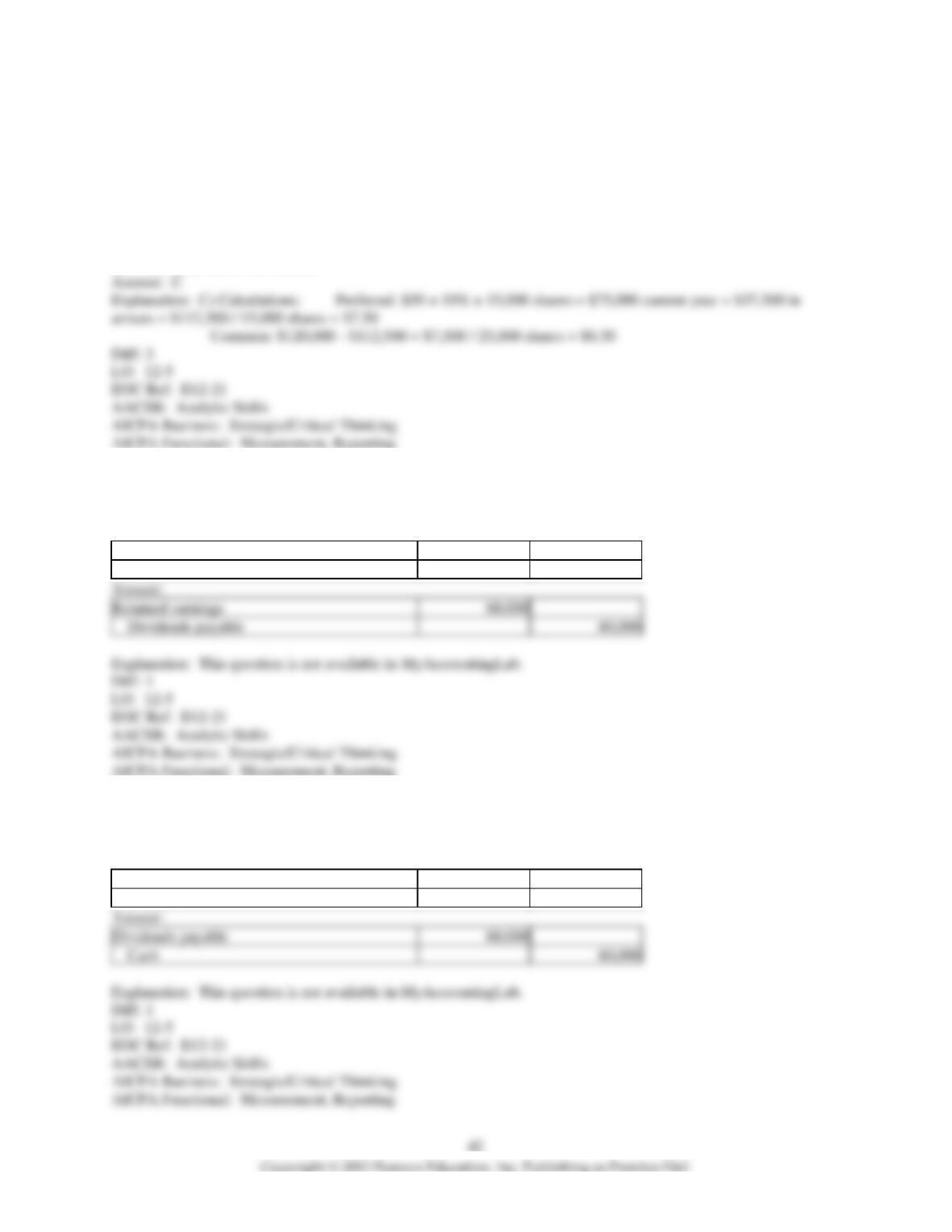
32) A corporation has 15,000 shares of 10%, $50 par cumulative preferred stock outstanding and 25,000 shares of
no-par common stock outstanding. Dividends of $37,500 are in arrears. At the end of the current year, the
corporation declares a dividend of $120,000.
What is the dividend per share for preferred shares and for common shares?
A) The dividend per share is $.50 to preferred shares and $4.60 to common shares.
B) The dividend per share is $8.00 to preferred shares and $0 to common shares.
C) The dividend per share is $7.50 to preferred shares and $.30 to common shares.
D) None of the above are correct.
33) On November 1, 2014, Oster Company declared a dividend of $3.00 per share. Oster Company has 20,000
shares of common stock outstanding and no preferred stock. Please provide the journal entry for the declaration of
dividends.
Retained earnings
34) On November 1, 2014, Oster Company declared a dividend of $3.00 per share. Oster Company has 20,000
shares of common stock outstanding and no preferred stock. The date of record is November 15, and the payment
date is November 30, 2014. Please provide the journal entry needed on November 30.
Dividends payable
35) Pearland Company has 50,000 shares of common stock outstanding and 2,000 shares of preferred stock
outstanding. The common stock is $1.00 par value. The preferred stock has a $100 par value, a 5% dividend rate,
and is non-cumulative. On October 31, 2013, the company declares dividends of $0.25 per share for common stock
and $5.00 per share for preferred stock. Please provide the journal entry for the declaration of dividends.
Retained earnings
Dividends payable, preferred
Dividends payable, common
Learning Objective 12-6
1) The book value of common stock is equal to the total equity less the book value of preferred stock, divided by the
number or common shares outstanding.
2) Which of the following is the price for which a person can buy or sell a share of stock?
A) Book value
B) Market value
C) Liquidation value
D) Amortized value
3) Which of the following is the amount guaranteed to preferred shareholders in the event the company goes out of
business?
A) Book value
B) Market value
C) Liquidation value
D) Amortized value
4) Which of the following is the amount of stockholders’ equity on the company’s ledger for each share of stock?
A) Book value
B) Market value
C) Liquidation value
D) Amortized value
5) Please refer to the equity section shown below:
Preferred stock, $100 par, 4% non-cumulative
$20,000
1,000 shares authorized, 200 shares outstanding
Common stock, $0.01 par
400
1,000,000 shares authorized, 40,000 shares outstanding
Paid-in capital in excess of par
359,600
Retained earnings
820,000
Total stockholders’ equity
$1,200,000
Assume the preferred shares have no stated liquidation value. The preferred shares are non-cumulative, so there are
no dividends in arrears.
Please calculate the book value per share of common stock.
A) $30.00 per share
B) $8.99 per share
C) $9.00 per share
D) $29.50 per share
6) Please refer to the equity section of the balance sheet, below:
Common stock, $0.01 par
$500
1,000,000 shares authorized, 50,000 shares outstanding
Paid-in capital in excess of par
399,500
Retained earnings
150,000
Total stockholders’ equity
$550,000
Please calculate the book value per share of common stock.
A) $3.00 per share
B) $8.00 per share
C) $11.00 per share
D) $29.50 per share
7) Porpoise Company has the following balances:
• Common stock: $2,000
• Paid-in capital in excess of par: $298,000
• Retained earnings: $420,000
The company has no preferred stock and has 24,000 shares of common stock outstanding.
How much is the book value per share of common stock?
A) $12.50 per share
B) $30.00 per share
C) $12.42 per share
D) $29.80 per share
8) Please refer to the equity section of the balance sheet, below:
Preferred stock, $50 par, 4%, cumulative
$5,000
1,000 shares authorized, 100 shares outstanding
Common stock, $0.01 par
120
1,000,000 shares authorized, 12,000 shares outstanding
Paid-in capital in excess of par
359,600
Retained earnings
153,280
Total stockholders’ equity
$518,000
Assume there are no dividends in arrears. What is the book value per share of preferred stock?
A) $50.00 per share
B) $42.75 per share
C) $52.00 per share
D) $41.00 per share
9) Please refer to the equity section of the balance sheet, below:
Preferred stock, $50 par, 4%, cumulative
$5,000
1,000 shares authorized, 100 shares outstanding
Common stock, $0.01 par
120
1,000,000 shares authorized, 12,000 shares outstanding
Paid-in capital in excess of par
359,600
Retained earnings
153,280
Total stockholders’ equity
$518,000
Assume there are no dividends in arrears. What is the book value per share of common stock?
A) $50.00 per share
B) $42.75 per share
C) $52.00 per share
D) $41.00 per share
10) Please refer to the equity section of the balance sheet, below:
Preferred stock, $50 par, 4%, cumulative
$5,000
1,000 shares authorized, 100 shares outstanding
Common stock, $0.01 par
120
1,000,000 shares authorized, 12,000 shares outstanding
Paid-in capital in excess of par
359,600
Retained earnings
153,280
Total stockholders’ equity
$518,000
Assume there are $600 of preferred dividends in arrears which includes the current year. What is the book value per
share of preferred stock?
A) $42.70 per share
B) $43.17 per share
C) $56.00 per share
D) $41.00 per share
11) Please refer to the equity section of the balance sheet, below:
Preferred stock, $50 par, 4%, cumulative
$5,000
1,000 shares authorized, 100 shares outstanding
Common stock, $0.01 par
120
1,000,000 shares authorized, 12,000 shares outstanding
Paid-in capital in excess of par
359,600
Retained earnings
153,280
Total stockholders’ equity
$518,000
Assume there are $600 of preferred dividends in arrears which includes the current year. What is the book value per
share of common stock?
A) $42.70 per share
B) $43.17 per share
C) $56.00 per share
D) $41.00 per share
Learning Objective 12-7
1) If a company has a strong rate of return on common stockholders’ equity, that is an indication of strong
profitability.
2) If a company has a strong rate of return on total assets, that shows that they can easily pay off their current
liabilities with their current assets.
3) If a company has a strong rate of return on common stockholders’ equity, that is an indication of good cash flow.
4) Which of the following measures a company’s success in using assets to earn income?
A) The rate of return on stockholders’ equity
B) Days sales in receivables
C) Inventory turnover
D) The rate of return on total assets
5) Which of the following shows the relationship between net income available to common shareholders and
average common equity?
A) Net income
B) The rate of return on total assets
C) Inventory turnover
D) The rate of return on common stockholders’ equity
6) The rate of return on total assets and the rate of return on common stockholders’ equity are used to evaluate the:
A) profitability of the business.
B) liquidity of the business.
C) ability to pay current liabilities with current assets.
D) cash flow of the business.
7) Rattner Company has the following information available for the year 2014:
Total assets, January 1
$420,000
Total assets, December 31
500,000
Net income
37,400
Interest expense
4,000
How much is the return on total assets? (Please round to two decimal places.)
A) 0.10
B) 0.04
C) 0.09
D) 0.12
8) Quad Sales has the following information for the year 2015:
Total assets, January 1
$102,000
Total assets, December 31
108,000
Net income
2,100
Interest expense
0
How much is the return on total assets? (Please round to two decimal places.)
A) 0.10
B) 0.02
C) 0.09
D) 0.12
9) Reed Company reports the following information for the year 2013:
Net income
$46,000
Preferred dividends
12,000
Common equity, Jan 1
800,000
Common equity, Dec 31
900,000
Please calculate the rate of return on common stockholders’ equity. Please round to 3 decimal places.
A) 0.054
B) 0.040
C) 0.043
D) 0.014
10) Sheffield Company had $42,000 of net income in 2013. Equity at the beginning of the year was $1,200,000 and
at the end of the year was $1,600,000. Sheffield has no preferred stock. Please calculate the rate of return on
common stockholders’ equity. (Round to 3 decimal places.)
A) 0.035
B) 0.026
C) 0.030
D) 0.032
Learning Objective 12-8
1) Normally, a company’s book income and tax income should be the same.
2) Deferred tax can either be an asset or a liability.
3) Origami Company is considering a new project and needs to raise $800,000 of capital. Their after-tax net income
would be $75,000 if they do not implement the new project. If the new project is implemented, it will add an
additional $50,000 of profits before tax and interest. Origami’s income tax rate is 40%. If they use debt financing,
the interest will be at 5%. Origami has 25,000 shares of common stock outstanding and no preferred stock. They
would have to issue an additional 10,000 shares of common stock to finance the project with equity capital.
If Origami decides to use equity financing, their earnings per share will be higher than if they use debt.
4) A company‘s income tax expense is calculated on the basis of book income, but the income tax payable amount is
based on the:
A) sales tax rate applied to sales revenues.
B) amount of payroll tax that has not been paid yet.
C) amount of taxable income, as calculated on the income tax return.
D) amount of dividends paid to shareholders.
5) Which of the following factors may cause a difference between book income and taxable income?
A) The company uses straight-line depreciation for books and accelerated depreciation for tax.
B) The company pays its federal income taxes quarterly as opposed to annually.
C) The company sells stock right before the end of the year.
D) The company has a deposit in transit at year-end.
6) Deferred tax would normally arise from which of the following situations?
A) When a company pays income tax quarterly versus yearly
B) When a company pays off all of its debts at the end of the year
C) When a company makes a different choice for its tax return versus its book net income
D) When a company withholds income tax from its employees’ payroll
7) Onyx Company’s income statement shows net income before income tax of $38,000. The company‘s tax return
shows taxable income of $34,000. Company’s tax rate is 40%. Which of the following entries would be used to
record tax expense and tax payable?
A) Debit Income tax expense $15,200 and credit Cash $15,200.
B) Debit Deferred tax liability $13,600 and credit Income tax payable $13,600.
C) Debit Income tax expense $15,200, credit Deferred tax liability $1,600 and credit Income tax payable $13,600.
D) Debit Deferred tax liability $1,600, debit Income tax expense $13,600 and credit Income tax payable $15,200.
Learning Objective 12-9
1) Which one of the following describes financial leverage?
A) To pay off all long-term debt in order to reduce interest expense
B) To finance with equity capital
C) To offer discounts to customers for early payment of invoices
D) To earn more income on borrowed money than the related interest expense
2) Origami Company is considering a new project and needs to raise $800,000 of capital. Their after-tax net income
would be $75,000 if they do not implement the new project. If the new project is implemented, it will add an
additional $50,000 of profits before tax and interest. Origami’s income tax rate is 40%. If they use debt financing,
the interest will be at 5%. Origami has 25,000 shares of common stock outstanding and no preferred stock.
If Origami decides to implement the project using debt financing, what will be the earnings per share amount?
(Please round to the nearest cent.)
A) $3.24
B) $4.14
C) $3.40
D) $4.20
3) Origami Company is considering a new project and needs to raise $800,000 of capital. Their after-tax net income
would be $75,000 if they do not implement the new project. If the new project is implemented, it will add an
additional $50,000 of profits before tax and interest. Origami’s income tax rate is 40%. If they use debt financing,
the interest will be at 5%. Origami has 25,000 shares of common stock outstanding, and no preferred stock. They
would have to issue an additional 10,000 shares of common stock to finance the project with equity capital.
If Origami decides to implement the project using equity financing, what will be the earnings per share amount?
(Please round to the nearest cent.)
A) $3.24
B) $4.14
C) $3.40
D) $3.00
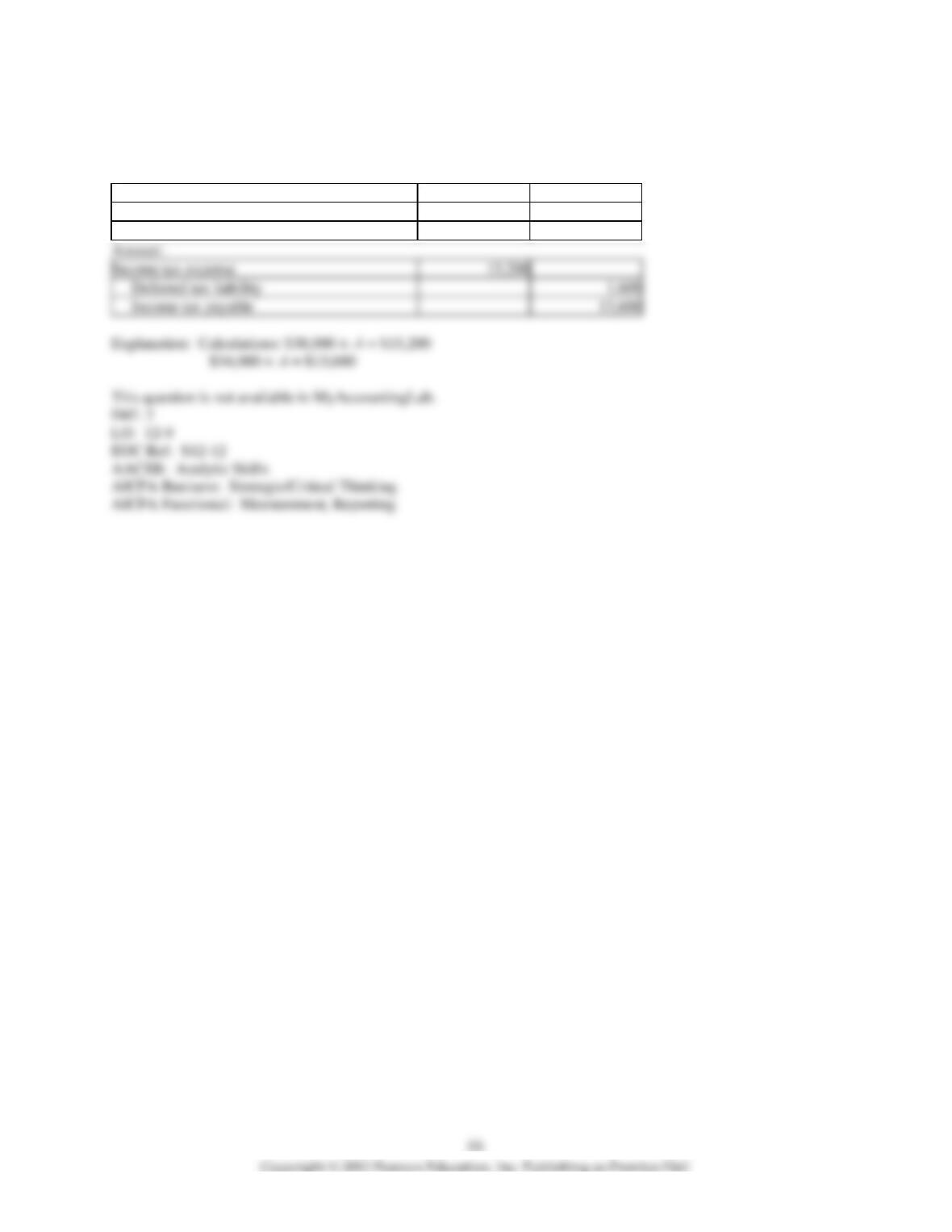
4) Onyx Company’s income statement shows net income before income tax of $38,000. The company’s tax return
shows taxable income of $34,000. Company’s tax rate is 40%. What journal entry is needed to record income tax
expense and tax payable?
Income tax expense