Version 1 12
A) Measures of service efforts, or input measures, relate to the amount of financial and
nonfinancial resources (such as money and materials) used in a program or process.
B) Effort measures relate service efforts to outputs of service and to outcomes or results
of services.
C) Output measures are quantity measures that reflect either the quantity of a service
provided or the quantity of service provided that meets a specified quality requirement.
D) Outcome measures gauge accomplishments, or the results of services provided.
53) State and local governments and not-for-profit organizations that receive grants or
contracts from the federal government should charge costs of these grants or contracts in
conformity with guidance from the:
A) Government Accountability Office.
B) Office of Management and Budget.
C) Financial Accounting Standards Board.
D) Governmental Accounting Standards Board.
54) Which of the following statements regarding costs under federal awards is not true?
A) Only items of cost specifically mentioned in a grant, contract, or other agreement
document are allowable.
B) Several costs are allowable under highly restrictive conditions and generally require
the explicit approval of the grantor agency.
C) For major not-for-profit organizations and institutions of higher learning, indirect
costs must be classified within two broad categories termed “facilities” and “administration”.
D) Direct costs are those that can be identified specifically with a particular cost
objective.
55) Which of the following is not one of the criteria for an allowable cost under a federal
grant?
Version 1 13
A) A cost that is necessary and reasonable for the performance of the federal award and
allocable thereto under the OMB cost principles.
B) A cost that conforms to any limitations or exclusions set forth in the OMB cost
principles or in the federal award as to types or amount of cost items.
C) A cost that has been approved by the FASB or the GASB as an allowable cost.
D) A cost that is adequately documented.
ESSAY. Write your answer in the space provided or on a separate sheet of paper.
56) For each of the following definitions, indicate the key term from the list that best matches
by placing the appropriate letter in the space before the definition.
A.Efficiency measures
B.Effectiveness measures
C.Planning-programming-budgeting system
D.Zero-based budgeting
E.Program budgeting
F.Flexible budgeting
G.Incremental budgeting
H.Budget calendar
_____ 1. A budget in which each activity and the amounts of resources requested for each
activity must be justified each year.
_____ 2. A budget that is derived from the current year budget by adding or subtracting amounts
expected to be required by line-items.
_____ 3. A budgeting approach that integrates various elements of planning for programs.
_____ 4. Measures that relate efforts to accomplishments.
_____ 5. A budget in which resource inputs and service outputs are identified by programs.
Version 1 14
57) For each of the following definitions, indicate the key term from the list that best matches
by placing the appropriate letter in the space before the definition.
A.Allowable costs
B.Cost principle
C.Cost objective
D.Indirect costs
E.Direct costs
F.Activity-based costing
_____ 1. A system that identifies specific costs that drive the cost of service or production
activities.
_____ 2. Costs incurred that cannot be identified specifically with a cost objective.
_____ 3. Costs that meet specific criteria determined by the resource provider.
_____ 4. A program, function, activity, award, organizational subdivision, contract, or work unit
established for the accumulation of costs.
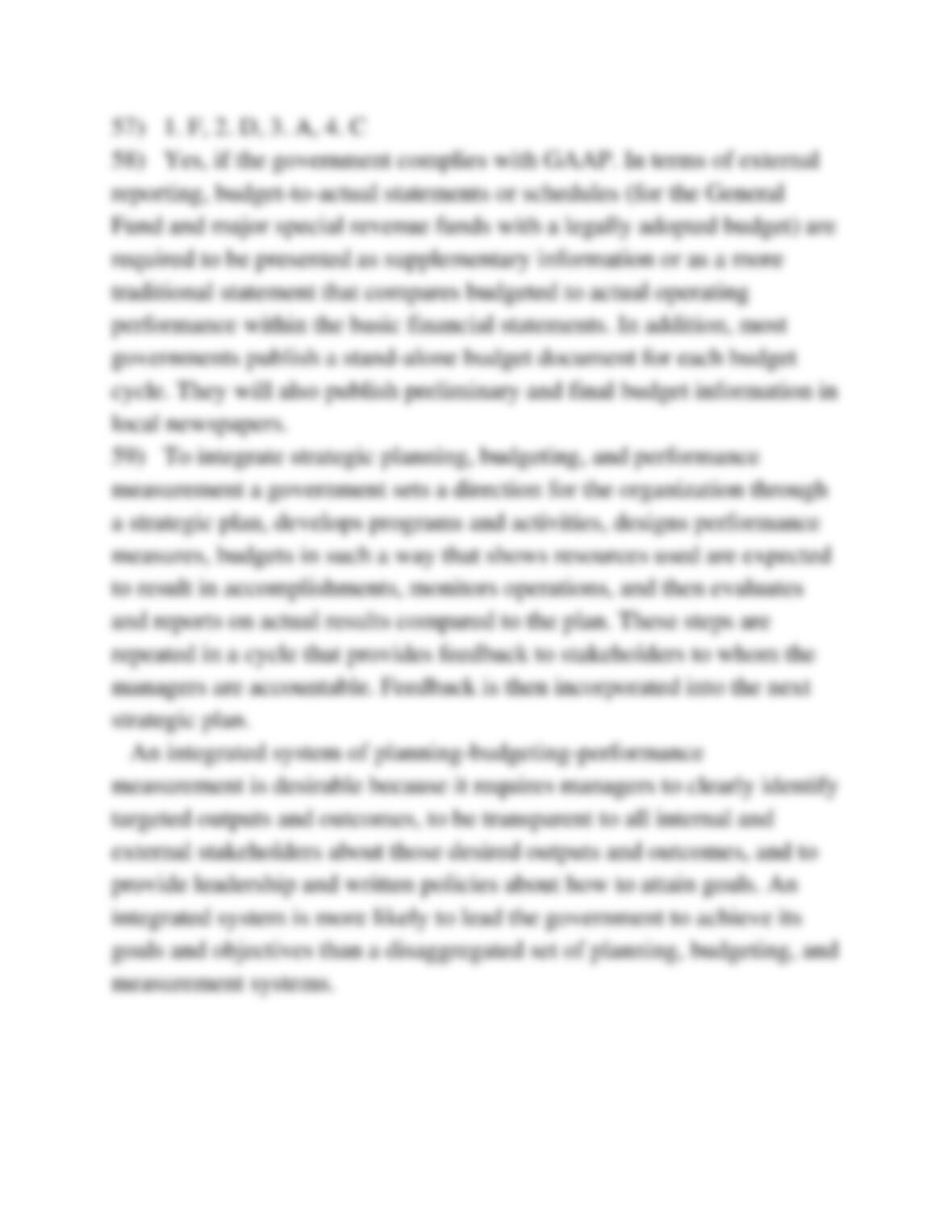
58) Are governments required to report their budgets externally? Explain.
59) Explain how strategic planning, budgeting, and performance measurement can be
integrated in a government and why this integration is desirable.
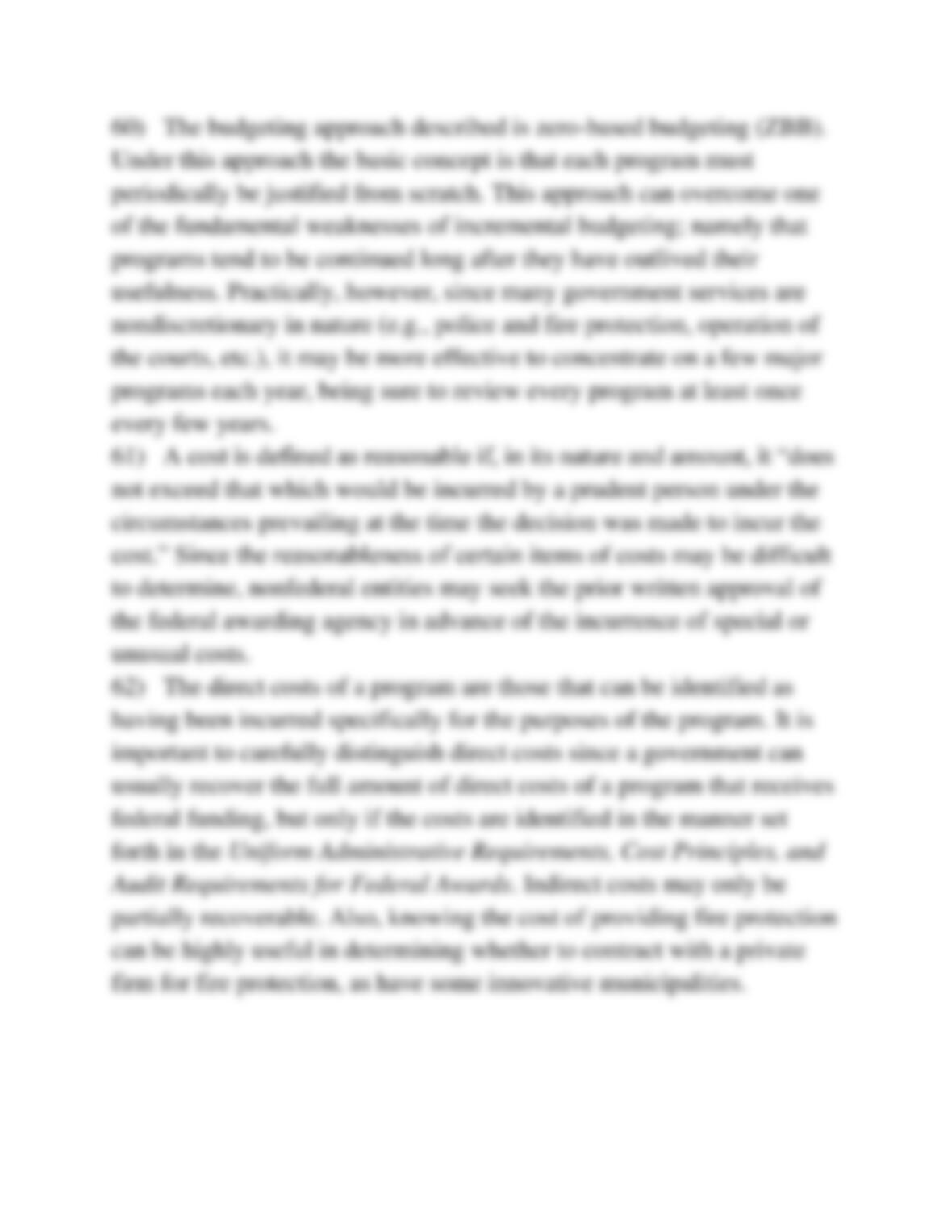
60) What budgeting approach requires justification for the inclusion of every activity each
year? Briefly describe this method and how it can be effective.
Version 1 15
61) Under federal guidelines, when is a cost considered reasonable?
62) Describe what is meant by the direct costs of a program (for example, a fire prevention
program) and why it is important to distinguish direct costs from indirect costs.
63) Identify and define the three broad categories of service efforts and accomplishments
(SEA) measures.
64) The finance officer of a small city has heard that certain items of cost may be allowable
under federal grants, even though they were not incurred specifically for the grant. To what
source could the finance officer go to determine what costs are allowable under federal grants?
Why do you think the federal government specifies the allowability of costs?
Version 1 16
65) What is the difference between two types of line item budgeting approaches—
incremental budgeting and zero-based budgeting (ZBB)?
Version 1 17
Answer Key
Test name: chapter 12
Version 1 18
Version 1 19
Version 1 20
Version 1 21
Version 1 22