12.4-16 In business, return refers to profitability.
12.4-17 Companies strive for the rate of return on sales to decrease from year to year.
12.4-18 It is a good sign when a company’s return on equity is higher than its return on assets.
12.4-19 Leverage always increases profitability.
12.4-20 The acid-test ratio uses a broader base to measure liquidity than the current ratio does.
12.4-21 The current ratio is calculated as:
A) current assets divided by total liabilities.
B) current assets divided by current liabilities.
C) current assets times current liabilities.
D) total assets divided by total liabilities.
12.4-22 Which of the following current assets is excluded when calculating the acid-test ratio?
A) Prepaid assets
B) Inventory
C) Accounts receivable
D) Both A and B
12.4-23 A measure of a company’s ability to collect cash from credit customers is the:
A) acid-test ratio.
B) accounts receivable turnover.
C) inventory turnover.
D) earnings per share.
12.4-24 The ratio that tells whether the entity can pay all its current liabilities if they come due
immediately is the:
A) acid-test ratio.
B) accounts receivable turnover.
C) inventory turnover.
D) earnings per share.
12.4-25 The ratio that measures a company’s ability to pay current liabilities with current assets is the:
A) acid-test ratio.
B) accounts receivable turnover.
C) inventory turnover.
D) current ratio.
12.4-26 The ratio that provides an estimate of the number of days, on average, that it takes for customers
to pay their account is the:
A) acid-test ratio.
B) accounts receivable turnover.
C) days’ sales in receivables.
D) current ratio.
12.4-27 The ratio that states the proportion of a company’s assets that is financed with debt is the:
A) debt ratio.
B) leverage.
C) times-interest-earned ratio.
D) rate of return on total assets.
12.4-28 The ratio that measures a company’s success in using its assets to earn income for the persons
who finance the business is the:
A) debt ratio.
B) leverage.
C) times-interest-earned ratio.
D) rate of return on total assets.
12.4-29 The ratio that measures the number of times that operating income can cover interest expense is
the:
A) debt ratio.
B) leverage.
C) times-interest-earned ratio.
D) rate of return on total assets.
12.4-30 Earning more income on borrowed money than the related interest expense, thereby increasing
the earnings for the owners of the business, is termed:
A) debt ratio.
B) leverage.
C) times-interest-earned ratio.
D) rate of return on total assets.
12.4-31 The ratio that measures how rapidly inventory is sold is the:
A) cost of goods sold.
B) inventory turnover.
C) days’ sales in inventory.
D) current ratio.
12.4-32 The amount of a company’s net income earned for each share of its outstanding ordinary shares is
termed the:
A) dividend yield.
B) return on equity.
C) price/earnings ratio.
D) earnings per share.
12.4-33 Which of the following groups of ratios measure a company’s ability to pay its current liabilities?
A) Current ratio, acid-test ratio and the times-interest-earned ratio
B) Current ratio and acid-test ratio
C) Current ratio and times-interest-earned
D) Current ration and debt ratio
12.4-34 Working capital is defined as:
A) current liabilities less current assets.
B) current assets less current liabilities.
C) current assets plus current liabilities.
D) total assets less total liabilities.
12.4-35 Compute working capital using the following data:
Current assets
$ 185,000
Current liabilities
105,000
Total assets
495,000
Total liabilities
275,000
A) $770,000
B) $ 80,000
C) $290,000
D) $295,000
12.4-36 Assume a company has a current ratio of 1.8 and working capital equal to $48,000. If the
company’s current liabilities are equal to $60,000, its total current assets are:
A) $ 10,800.
B) $ 54,000.
C) $ 6,000.
D) $108,000.
12.4-37 Assume a company has working capital equal to $23,000 and total current liabilities equal to
$75,000. The current ratio:
A) is 0.31.
B) is 1.31.
C) is 3.26.
D) cannot be determined from this information.
12.4-38 Spaceship Enterprises has a current ratio of 1.9 and working capital equal to $75,000. Total
current liabilities are equal to:
A) $ 75,000.
B) $ 39,474.
C) $142,500.
D) $ 83,333.
12.4-39 Compute the current ratio using the following data:
Current assets
$190,000
Current liabilities
110,000
Total assets
550,000
Total liabilities
305,000
A) 1.73
B) 1.8
C) 0.35
D) 0.55
12.4.-40 Compute the acid-test ratio using the following data:
Cash
$115,000
Inventory
105,000
Accounts Receivable
55,000
Current ratio
2.00
A) 1.15
B) 1.24
C) 1.33
D) 1.86
12.4-41 Which of the following two items is NOT included in the calculation of the numerator in the acid-
test ratio?
A) Short-term investments and net current receivables
B) Inventory and net current receivables
C) Prepaid expenses and inventory
D) Cash and prepaid expenses
12.4-42 Which of the following would be useful in determining whether a company can pay its current
liabilities?
A) Quick ratio
B) Current ratio
C) Debt ratio
D) Both A and B
12.4-43 Which of the following is the best measure of a firm’s ability to pay its long-term debt?
A) Debt ratio
B) Net income
C) Cash flows from financing activities
D) Current ratio
12.4-44 Inventory turnover is calculated as:
A) average inventory for the period divided by gross profit for the period.
B) gross profit for the period divided by average inventory for the period.
C) average inventory for the period divided by cost of goods sold.
D) cost of goods sold divided by average inventory for the period.
12.4-45 Which of the following statements is NOT true regarding inventory turnover?
A) Too high of an inventory turnover can mean that the company is not keeping enough
inventory on hand.
B) A low inventory turnover may indicate a problem selling inventory.
C) A business strives for the most profitable rate of turnover.
D) A business strives for the highest inventory turnover.
12.4-46 Beginning inventory was $28,000 and ending inventory was $22,000. Cost of goods sold was
$190,000 and net sales were $360,000. Inventory turnover for the year was closest to:
A) 7.6.
B) 8.64.
C) 6.79.
D) 14.4.
12.4-47 If the ending inventory balance was overstated on the financial statements and the beginning
inventory balance was understated, but all other items were properly reported, the calculated
inventory turnover ratio:
A) could not be determined from the information given.
B) would be too high.
C) would be unaffected by these errors.
D) would be too low.
12.4-48 Accounts receivable turnover is calculated as:
A) total net credit sales divided by average net accounts receivable.
B) average net accounts receivable divided by 365 days.
C) total cost of goods sold divided by 365 days.
D) total net credit sales divided by cost of goods sold.
12.4-49 Which of the following statements is NOT true regarding accounts receivable turnover?
A) In general, the higher the ratio, the better.
B) If the accounts receivable turnover ratio is too high, this may indicate that credit is too tight
and the company may be losing sales to good customers.
C) Accounts receivable turnover is computed by dividing net sales by end of the year
receivables.
D) Accounts receivable turnover is computed by dividing net sales by average accounts
receivable.
12.4-50 In order to keep receivables low and receivable turnover high, companies can sell their
receivables to:
A) a subsidiary.
B) a factor.
C) a receiver.
D) none of the above.
12.4-51 Which of the following groups of ratios measure a company’s ability to sell inventory and collect
receivables?
A) Current ratio, inventory turnover and accounts receivable turnover
B) Inventory turnover, accounts receivable turnover and rate of return on net sales
C) Inventory turnover, accounts receivable turnover and days’ sales in receivables
D) Days’ sales in receivables and rate of return on net sales
12.4-52 Streyna Company reported net sales of $95,000 for the current year. Accounts Receivable at the
beginning of the year was $11,000 and $9,000 at the end of year. The accounts receivable
turnover is closest to:
A) 9.5.
B) 10.56.
C) 8.64.
D) 4.75.
12.4-53 Guliana Company reported net sales of $150,000 for the current year. Accounts Receivable at the
beginning of the year was $17,000 and $15,000 at the end of year. The days’ sales in average
receivables was closest to:
A) 41.4 days.
B) 75.4 days.
C) 36.5 days.
D) 38.9 days.
12.4-54 Total revenues and net income for 20X7 for Smith Lake Corporation is $3,500,000 and $280,000,
respectively. Smith Lake Corporation has had 400,000 ordinary shares outstanding for all of
20X7. The selling price of Smith Lake Corporation ordinary shares on December 31, 20X7, is
$18. Earnings per share for 20X7 is:
A) $ 8.75.
B) $12.50.
C) $ 0.70.
D) $35.00.
12.4-55 The times-interest-earned ratio is calculated as:
A) income from operations divided by interest expense.
B) (income from operations minus interest expense) divided by interest expense.
C) (net income after taxes plus interest expense) divided by interest expense.
D) net income divided by interest expense.
12.4-56 Which of the following groups of ratios measure a company’s ability to pay its long-term debt?
A) Current ratio and debt ratio
B) Debt ratio, times-interest-earned ratio and rate of return on total assets
C) Current ratio and acid-test ratio
D) Debt ratio and times-interest earned ratio
12.4-57 Which statement regarding debt is NOT true?
A) A debt ratio of .50 means that debt finances half of the assets.
B) The debt ratio measures the proportion of assets financed with debt.
C) The higher the debt ratio, the lower the risk.
D) The higher the debt ratio, the greater the pressure to pay interest and principal.
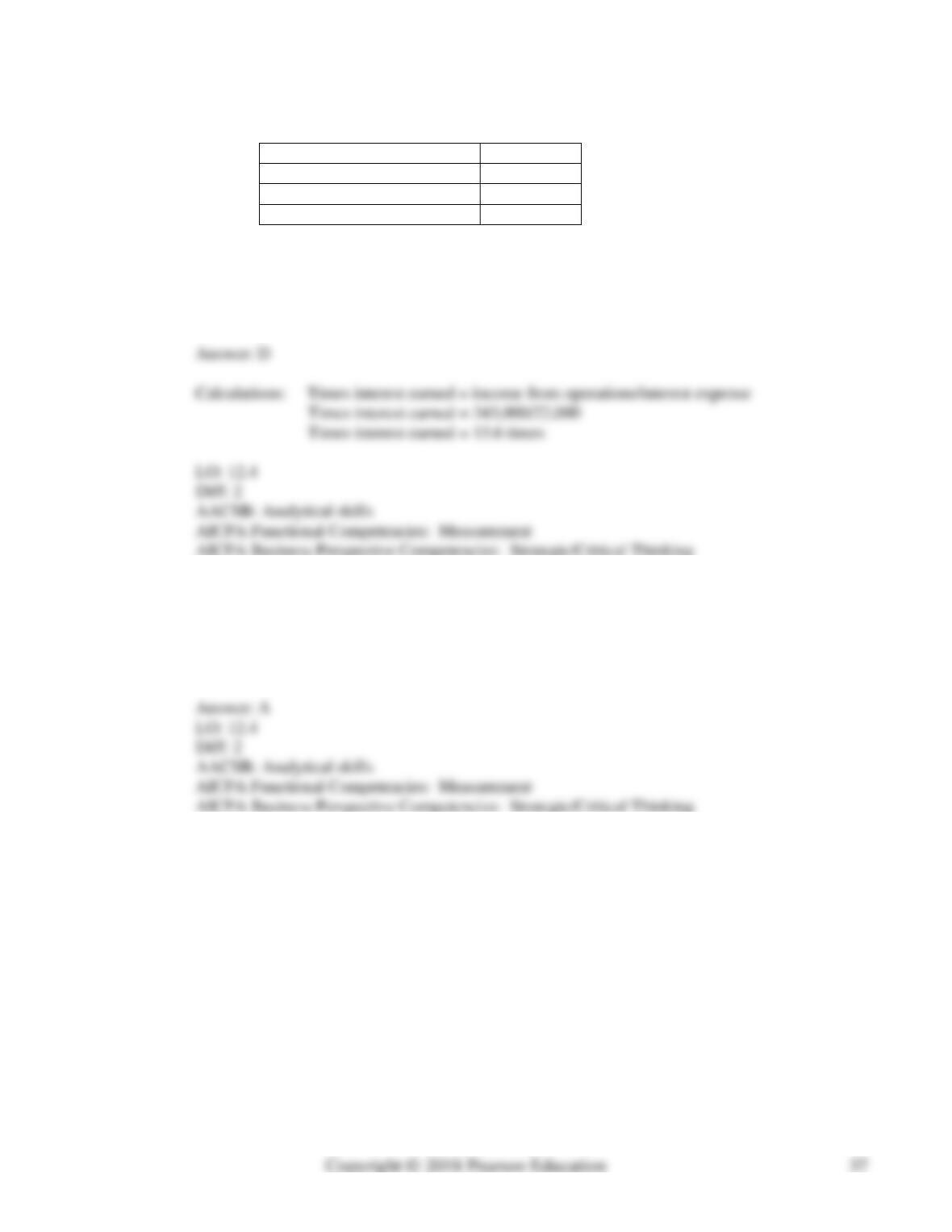
12.4-58 Compute the times-interest-earned ratio given the following data:
Net income
$275,000
Income from operations
343,000
Interest expense
22,000
Income tax expense
59,000
A) 12.5 times
B) 12.9 times
C) 9.8 times
D) 15.6 times
12.4-59 The rate of return on net sales is calculated as:
A) net income divided by net sales.
B) operating income divided by net sales.
C) dividends paid during the year divided by net sales.
D) gross profit divided by net sales.
12.4-60 Which of the following ratios is NOT used to measure the profitability of a company?
A) Rate of return on net sales
B) Rate of return on total assets
C) Price/earnings ratio
D) Rate of return on ordinary shareholders’ equity
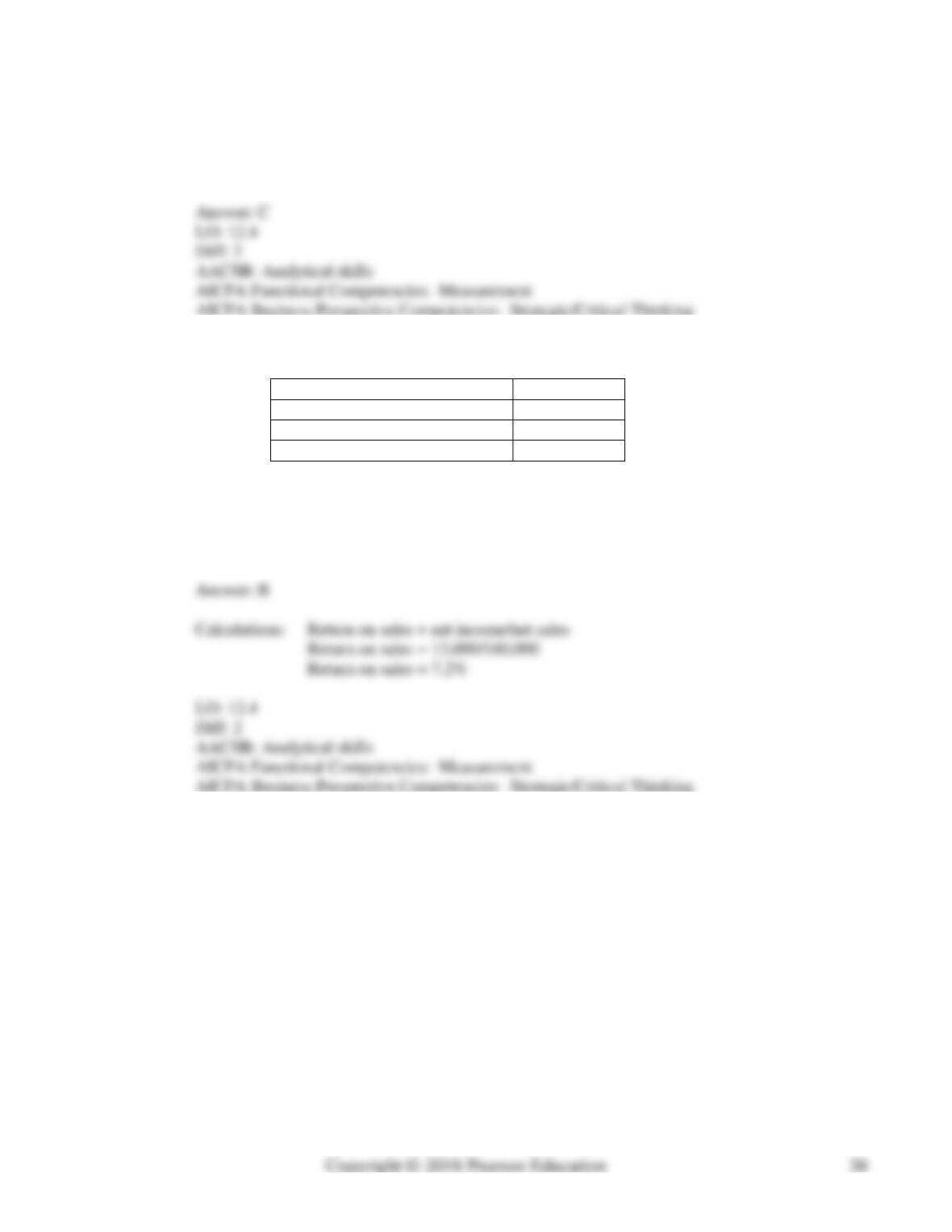
12.4-61 Compute the return on sales given the following data:
Net sales
$180,000
Net income
13,000
Gross profit
85,000
Total shareholders’ equity
72,000
A) 47.20%
B) 7.22%
C) 18.06%
D) 40.00%
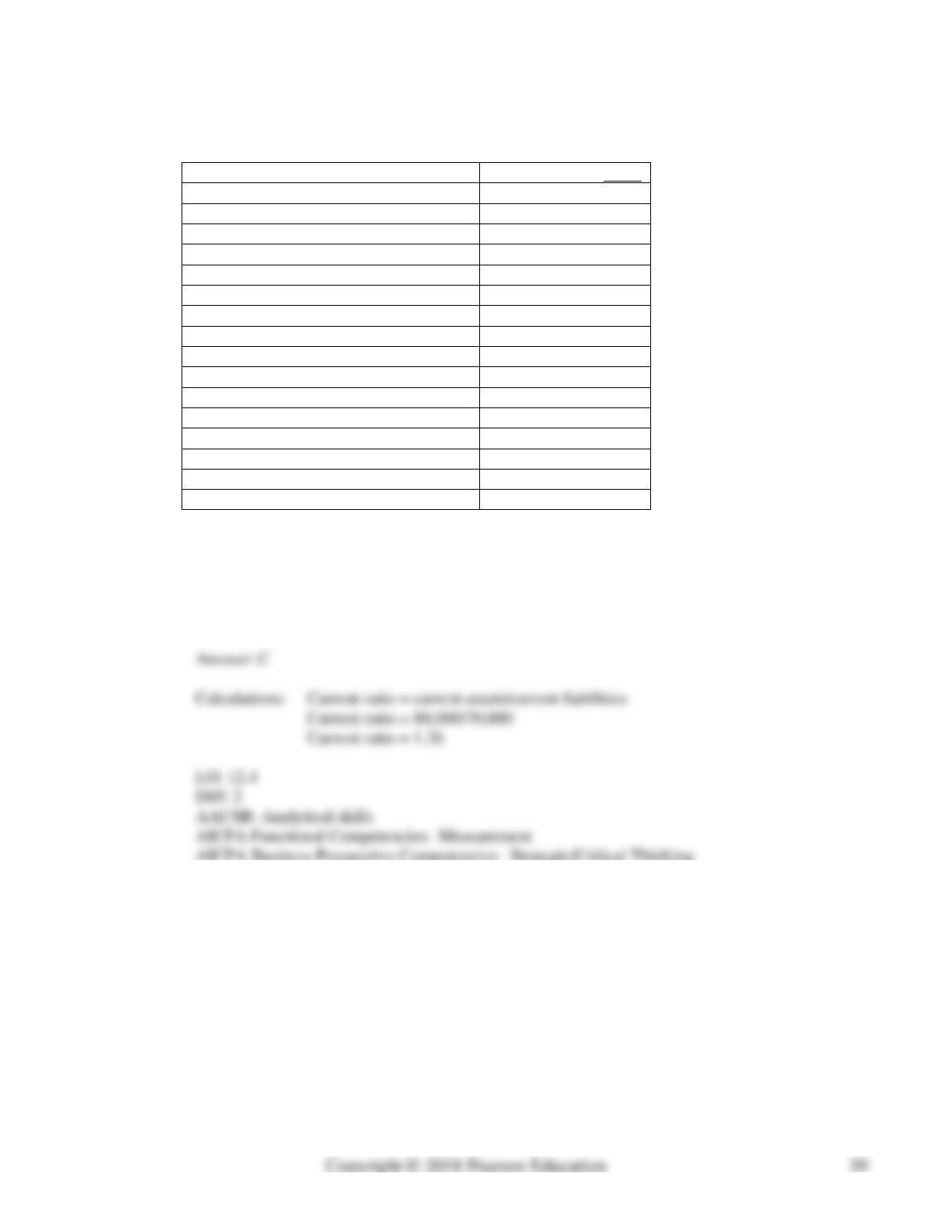
12.4-62 The following data represent selected information from the income statement and balance sheet for
Duenke Company for the year ended December 31, 20X7:
20X7
Cash
$10,000
Net accounts receivable
30,000
Inventory
43,000
Prepaid expenses
5,000
Total current assets
88,000
Total noncurrent assets
112,000
Total current liabilities
70,000
Total noncurrent liabilities
40,000
Share capital, no-par
60,000
Retained earnings
30,000
Net credit sales
370,000
Cost of goods sold
150,000
Gross profit
220,000
Income from operations
95,000
Interest expense
8,000
Net income
70,000
The current ratio for Duenke Company on December 31, 20X7, was:
A) 0.57.
B) 0.67.
C) 1.26.
D) 1.45.
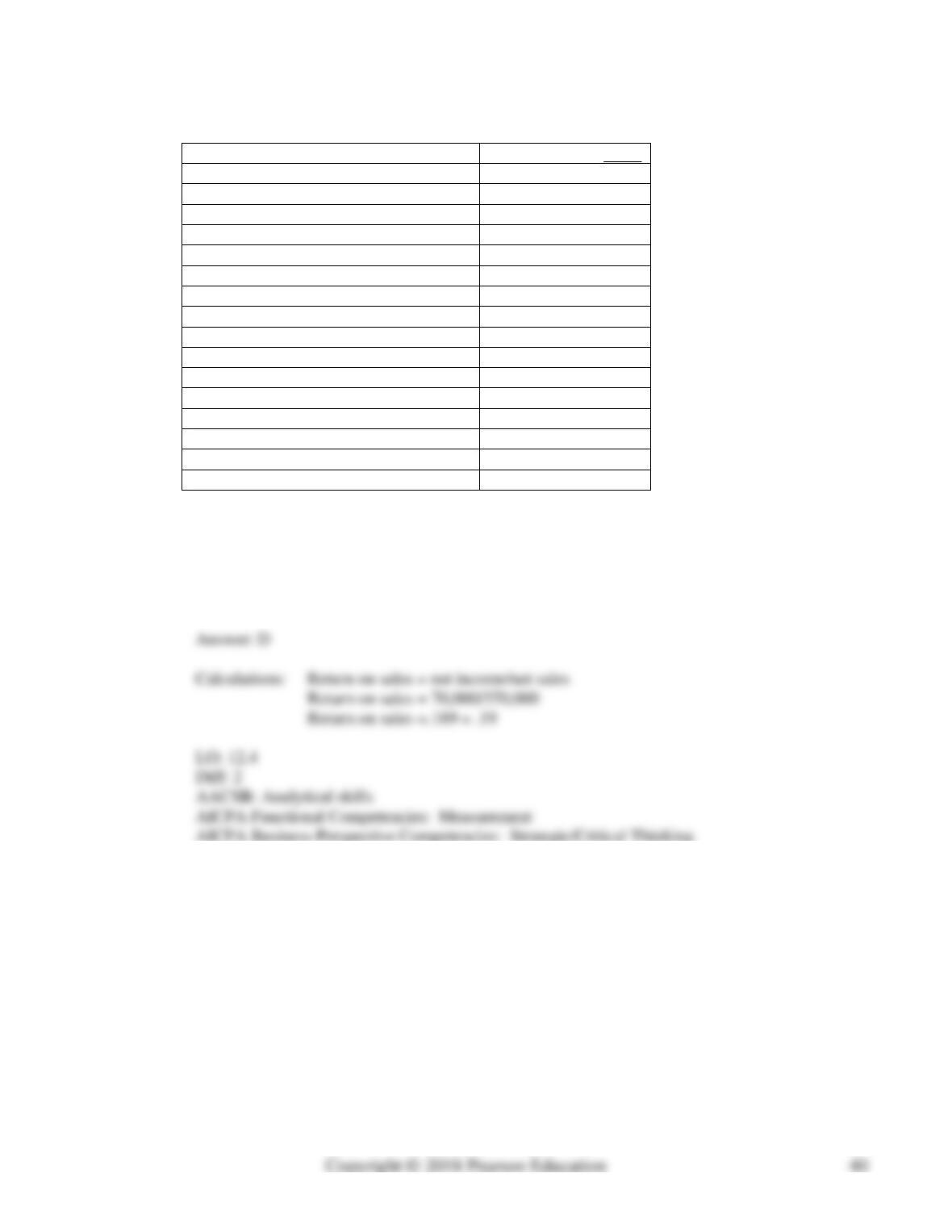
12.4-63 The following data represent selected information from the income statement and balance sheet
for Duenke Company for the year ended December 31, 20X7:
20X7
Cash
$10,000
Net accounts receivable
30,000
Inventory
43,000
Prepaid expenses
5,000
Total current assets
88,000
Total noncurrent assets
112,000
Total current liabilities
70,000
Total noncurrent liabilities
40,000
Share capital, no-par
60,000
Retained earnings
30,000
Net credit sales
370,000
Cost of goods sold
150,000
Gross profit
220,000
Income from operations
95,000
Interest expense
8,000
Net income
70,000
For the year ending on December 31, 20X7, Duenke Company’s rate of return on net sales was:
A) 0.21.
B) 0.18.
C) 0.17.
D) 0.19.