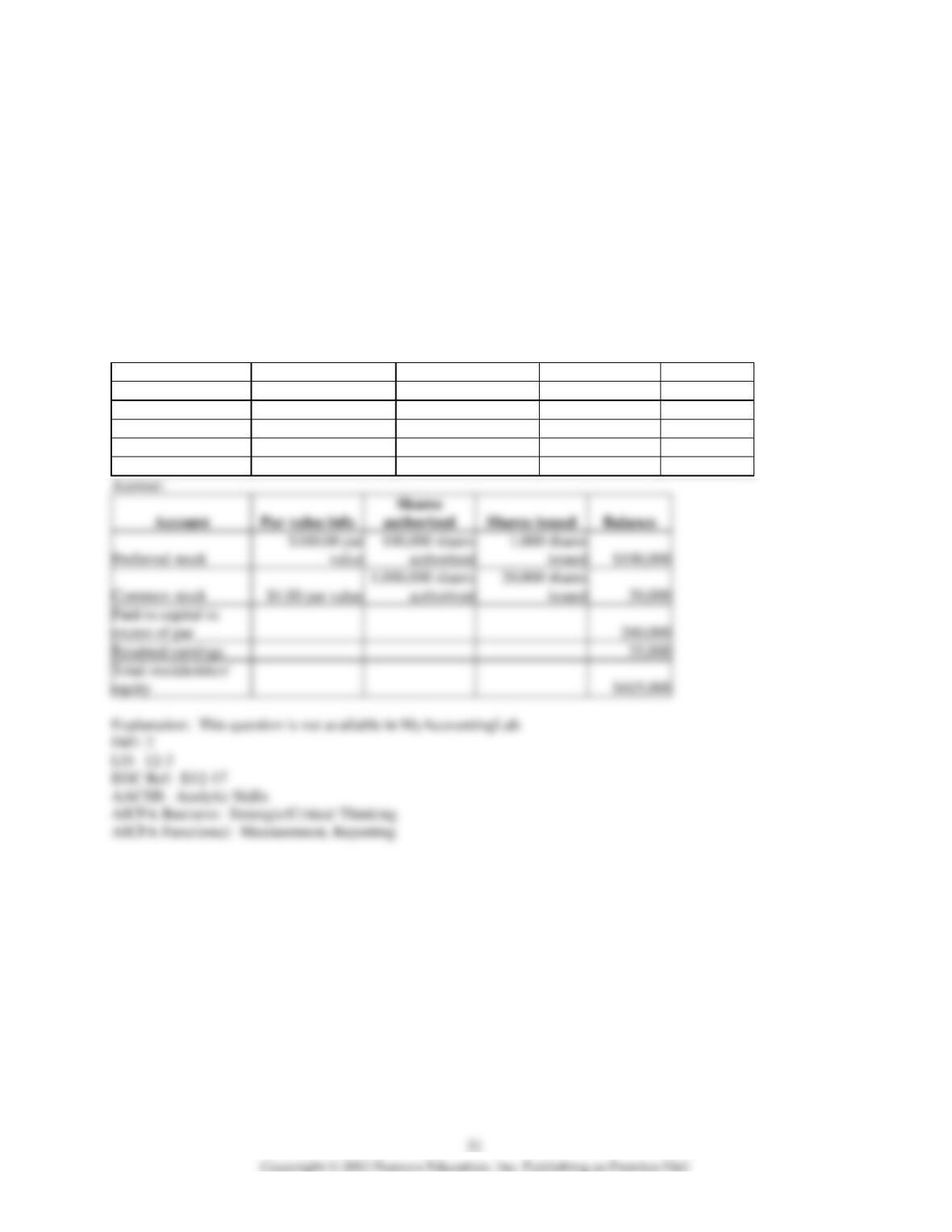
37) Lerner Company had the following transactions in 2013, its first year of operations.
• Issued 20,000 shares of common stock. Stock has par value of $1.00 per share and was issued at $14.00 per
share.
• Issued 1,000 shares of $100 par value preferred stock. Shares were issued at par.
• Earned net income of $35,000.
• Paid no dividends.
The company charter authorizes 1,000,000 shares of common stock and 100,000 shares of preferred stock.
Please provide the stockholders’ equity section of the balance sheet at December 31, 2013. Include information on
par values, and the number of shares authorized and issued, where necessary. No subtotals are needed for total paid–
in capital, but please show total stockholders’ equity on the bottom line.
Account
Par value info
Shares authorized
Shares issued
Balance
Account
authorized
Shares issued
Balance
Preferred stock
Common stock
excess of par
Retained earnings
equity
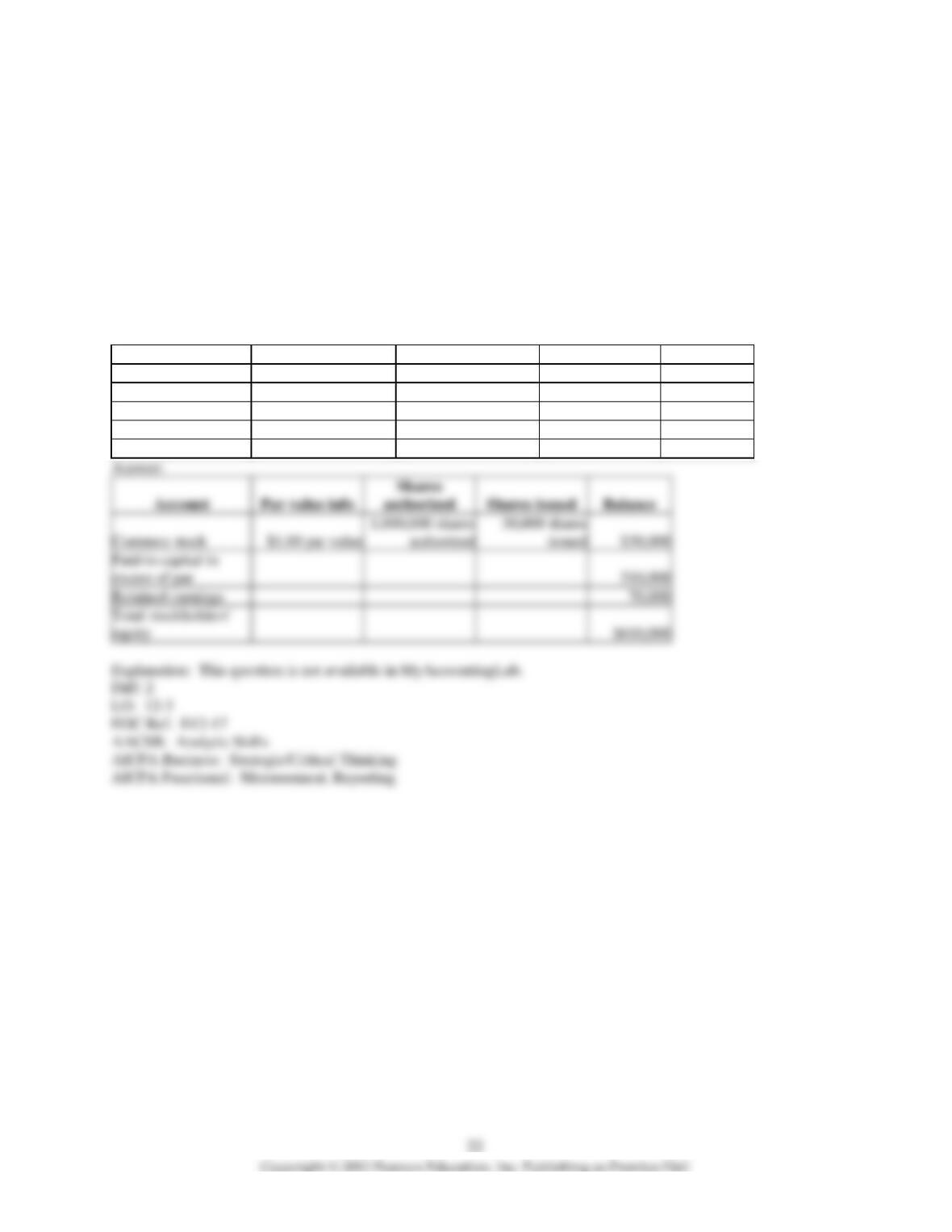
38) Moretown Company had the following transactions in 2013, its first year of operations.
• Issued 30,000 shares of common stock. Stock has par value of $1.00 per share and was issued at $18.00
per share.
• Earned net income of $70,000.
• Paid no dividends.
The company charter authorizes 1,000,000 shares of common stock and 100,000 shares of preferred stock.
Please provide the stockholders’ equity section of the balance sheet at December 31, 2013. Include information on
par values, and the number of shares authorized and issued, where necessary. No subtotals are needed for total paid–
in capital, but please show total stockholders’ equity on the bottom line.
Account
Par value info
Shares authorized
Shares issued
Balance
Account
authorized
Shares issued
Balance
Common stock
excess of par
Retained earnings
equity
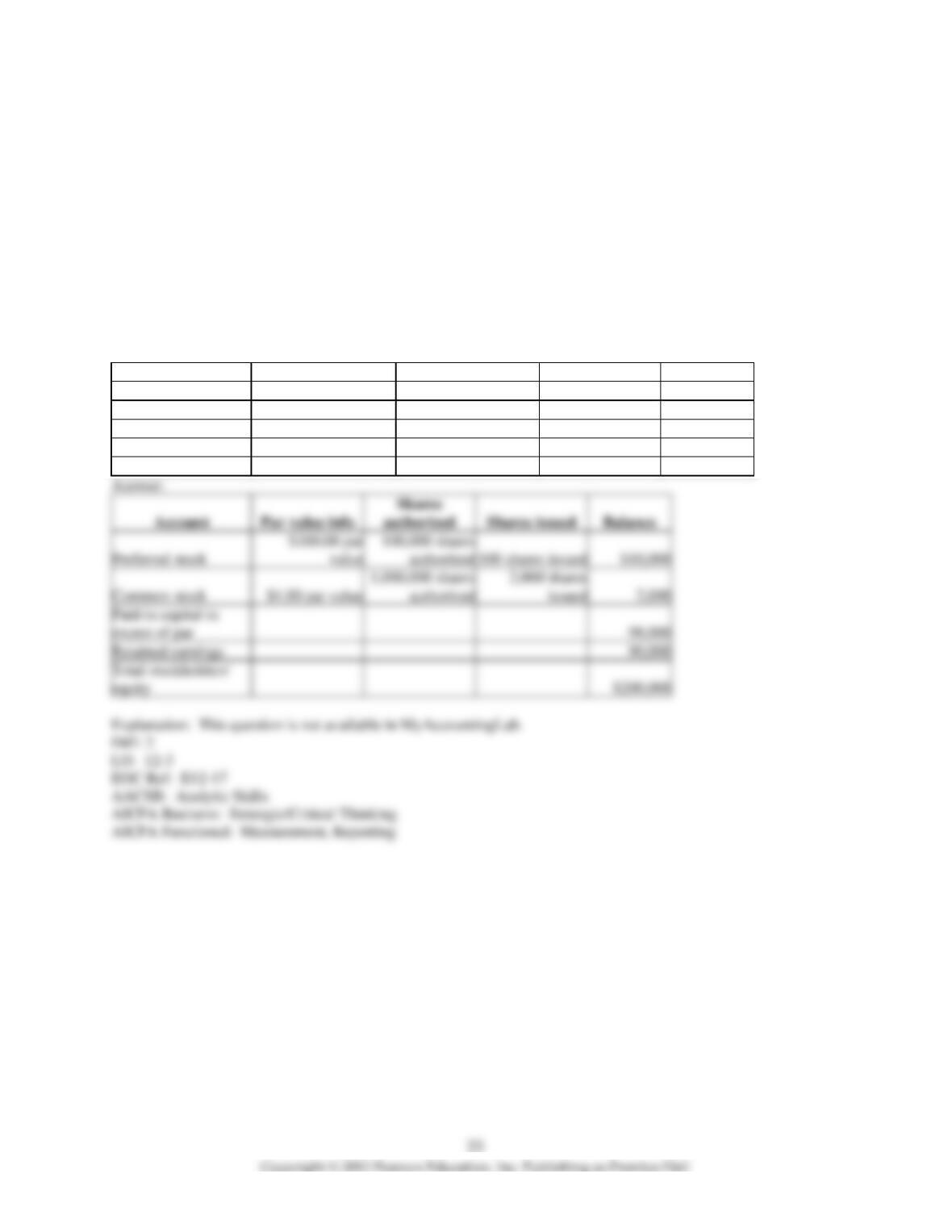
39) Notebook Company had the following transactions in 2014, its first year of operations.
• Issued 2,000 shares of common stock. Stock has par value of $1.00 per share and was issued at $50.00
per share.
• Issued 100 shares of $100 par value preferred stock. Shares were issued at par.
• Earned net income of $95,000.
• Paid dividends of $5,000.
The company charter authorizes 1,000,000 shares of common stock and 100,000 shares of preferred stock.
Please provide the stockholders’ equity section of the balance sheet at December 31, 2014. Include information on
par values, and the number of shares authorized and issued, where necessary. No subtotals are needed for total paid–
in capital, but please show total stockholders’ equity on the bottom line.
Account
Par value info
Shares authorized
Shares issued
Balance
Account
authorized
Shares issued
Balance
Preferred stock
Common stock
excess of par
Retained earnings
equity
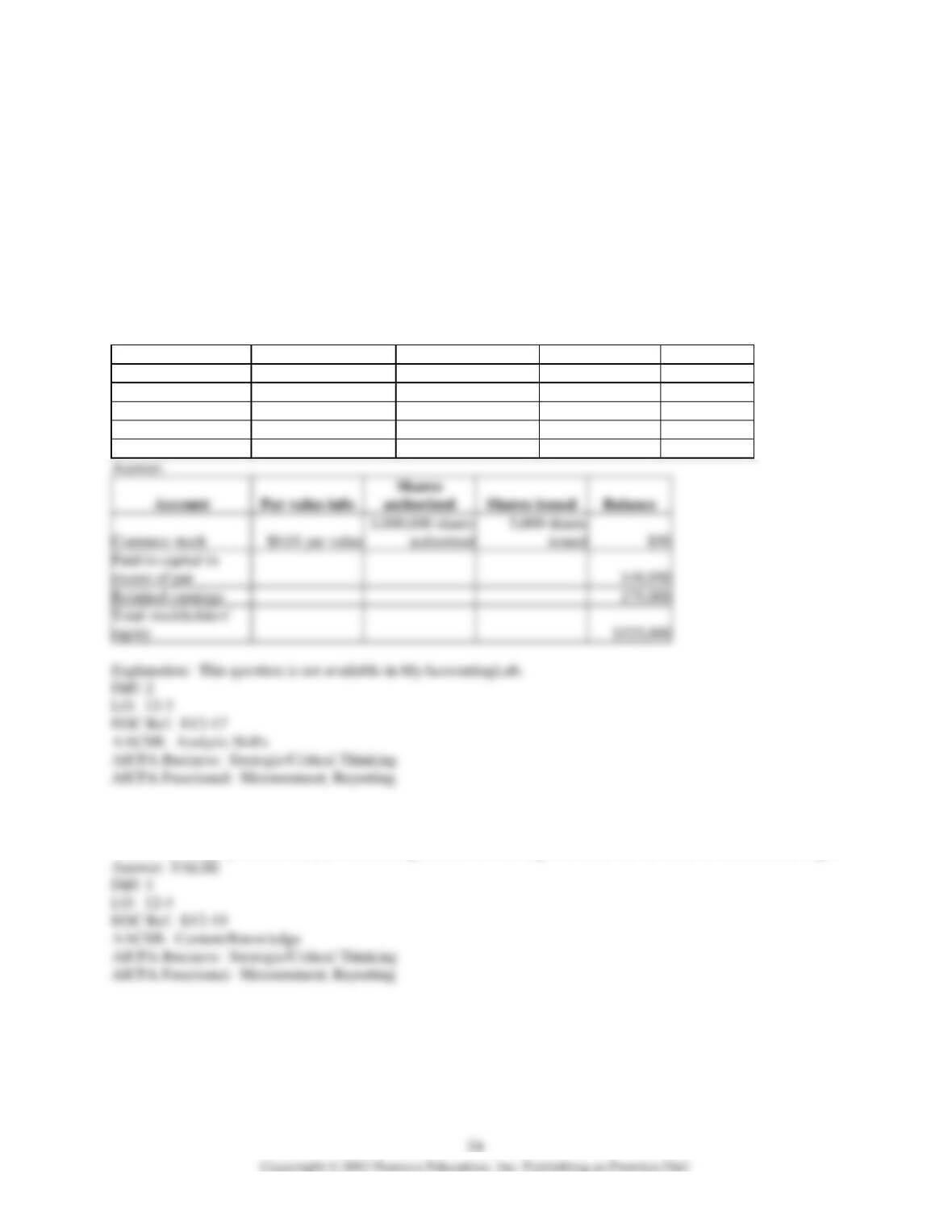
40) Overton Company had the following transactions in 2013, its first year of operations.
• Issued 5,000 shares of common stock. Stock has par value of $0.01 per share and was issued at $30.00
per share.
• Earned net income of $200,000.
• Paid dividends of $5.00 per share.
The company charter authorizes 1,000,000 shares of common stock and 100,000 shares of preferred stock.
Please provide the stockholders’ equity section of the balance sheet at December 31, 2013. Include information on
par values, and the number of shares authorized and issued, where necessary. No subtotals are needed for total paid–
in capital, but please show total stockholders’ equity on the bottom line.
Account
Par value info
Shares authorized
Shares issued
Balance
Account
authorized
Shares issued
Balance
Common stock
excess of par
Retained earnings
equity
Learning Objective 12-4
1) When a company records the year-end closing entries, the first step is to close the Revenues to Retained earnings.
2) When a company records the year-end closing entries, the Income summary balance, before it is closed to
Retained earnings, should be equal to the Net income or Net loss for the year.
3) A net loss for the year increases the balance in Retained earnings.
4) Ajax Company was founded in 2009. Its yearly earnings are shown here:
2012: Net income of $4,000
2013: Net income of $23,000
2014: Net income of $2,000
2015: Net loss of $30,000
No dividends were paid. At the end of the year 2015, Ajax would have a Retained earnings deficit of $1,000.
5) Retained earnings as shown on the balance sheet can, under certain circumstances, show a negative balance.
6) Which of the following describes the correct sequence of year-end closing entries?
A) Close Revenues to Income summary; close Expenses to Income summary; close Income summary to Retained
earnings.
B) Close Expenses to Income summary; close Revenues to Income summary; close Income summary to Retained
earnings.
C) Close Revenues to Income summary; close Income summary to Retained earnings; close Expenses to Retained
earnings.
D) Close Revenues to Retained earnings; close Expenses to Retained earnings; close Income summary to Retained
earnings.
7) A company had $80,000 of Sales revenue and $75,000 of Expenses. Which of the following would be the first of
three year-end closing entries?
A) Debit Retained earnings $5,000 and credit Income summary $5,000.
B) Debit Expenses $75,000 and credit Income summary $75,000.
C) Debit Income summary $5,000 and credit Retained earnings $5,000.
D) Debit Revenues $80,000 and credit Income summary $80,000.
8) A company had $80,000 of Sales revenue and $75,000 of Expenses. Which of the following would be the second
of three year-end closing entries?
A) Debit Income summary $75,000 and credit Expenses $75,000.
B) Debit Expenses $75,000 and credit Income summary $75,000.
C) Debit Income summary $5,000 and credit Retained earnings $5,000.
D) Debit Revenues $80,000 and credit Income summary $80,000.
9) A company had $80,000 of Sales revenue and $75,000 of Expenses. Which of the following would be the third
of three year-end closing entries? (Assume no dividends were paid.)
A) Debit Income summary $75,000 and credit Expenses $75,000.
B) Debit Expenses $75,000 and credit Income summary $75,000.
C) Debit Income summary $5,000 and credit Retained earnings $5,000.
D) Debit Revenues $80,000 and credit Income summary $80,000.
10) Hot Tamale Company had $120,000 of revenues and $125,000 of expenses. No dividends were paid. The first
of the year-end closing entries should include which of the following line items?
A) Credit Retained earnings $120,000.
B) Debit Retained earnings $120,000.
C) Debit Income summary $120,000.
D) Credit Income summary $120,000.
11) Hot Tamale Company had $120,000 of revenues and $125,000 of expenses. No dividends were paid. The
second of the year-end closing entries should include which of the following line items?
A) Credit Retained earnings $125,000.
B) Debit Retained earnings $125,000.
C) Debit Income summary $125,000.
D) Credit Income summary $125,000.
12) Hot Tamale Company had $120,000 of revenues and $125,000 of expenses. No dividends were paid. The third
of the year-end closing entries should include which of the following line items?
A) Credit Retained earnings $5,000.
B) Debit Retained earnings $5,000.
C) Debit Income summary $5,000.
D) Credit Income summary $125,000.
13) Hot Tamale Company had $120,000 of revenues and $125,000 of expenses. No dividends were paid. These
factors will result in which of the following?
A) Retained earnings will go down.
B) Retained earnings will go up.
C) Paid-in capital will go down.
D) Paid-in capital will go up.
14) Hot Tamale Company had $120,000 of revenues and $113,000 of expenses. No dividends were paid. These
factors will result in which of the following?
A) Retained earnings will go down.
B) Retained earnings will go up.
C) Paid-in capital will go down.
D) Paid-in capital will go up.
15) Which of the following describes a retained earnings deficit?
A) When the company records a net loss for the year
B) When the retained earnings is less than the total paid-in capital
C) When the retained earnings is a negative amount
D) When the company does not pay out any dividends
16) Please refer to the equity section of the balance sheet shown below:
Preferred stock
$100 par, 10,000 shares authorized, 1,000
shares issued
$100,000
Common stock
$1 par, 500,000 shares authorized, 20,000
shares issued
20,000
Paid-in capital in excess of par
350,000
Retained earnings
(74,000)
Total stockholders’ equity
$396,000
The amount shown for Retained earnings would be called a(n):
A) net loss.
B) earnings shortfall.
C) retained earnings deficit.
D) loss on sale of stock.
17) Ajax Company was founded in 2012. Its yearly earnings are shown here:
2012: Net income of $4,000
2013: Net income of $23,000
2014: Net income of $2,000
2015: Net loss of $30,000
No dividends were paid. At the end of the year 2015, what amount would be shown on the balance sheet for
Retained earnings?
A) Negative $1,000
B) Positive $29,000
C) Positive $31,000
D) Negative $30,000
18) Beta Company was founded in 20013. Its yearly earnings and dividend payments are shown here:
2013: Net income of $4,000, paid zero dividends
2014: Net income of $20,000, paid $10,000 dividends
2015: Net income of $8,000, paid $5,000 dividends
2016: Net loss of $22,000, paid zero dividends
At the end of 2016, what would be the balance in Retained earnings?
A) Negative $22,000
B) Positive $32,000
C) Negative $5,000
D) Positive $1,000
19) Beta Company was founded in 2012. Its yearly earnings and dividend payments are shown here:
2012: Net income $4,000, paid zero dividends
2013: Net income $20,000, paid $10,000 dividends
2014: Net income of $8,000, paid $5,000 dividends
2015: Net loss of $22,000, paid zero dividends
At the end of 2015, which of the following statements would be accurate?
A) Beta has a cumulative operating loss.
B) Beta has a retained earnings deficit.
C) Beta has retained earnings surplus.
D) Beta has negative contributed capital.
20) A company had $90,000 of Sales revenue and $55,000 of Expenses. Please provide the first of three year-end
closing entries.
Sales revenues
21) A company had $90,000 of Sales revenue and $55,000 of Expenses. Please provide the second of three year-end
closing entries.
Income summary
22) A company had $90,000 of Sales revenue and $55,000 of Expenses. Please provide the third of three year-end
closing entries. (Assume no dividends were paid.)
Answer: Income summary
23) Hot Tamale Company had $120,000 of Revenues and $125,000 of Expenses. No dividends were paid. Please
provide the first of the year-end closing entries.
Revenues
24) Hot Tamale Company had $120,000 of Revenues and $125,000 of Expenses. No dividends were paid. Please
provide the second of the year-end closing entries.
Income summary
25) Hot Tamale Company had $120,000 of Revenues and $125,000 of Expenses. No dividends were paid. Please
provide the third of the year-end closing entries.
Retained earnings
Learning Objective 12-5
1) Declaring and paying dividends causes a decrease in both assets and equity.
2) Paying dividends causes a decrease in total paid-in capital.
3) If preferred stock is non-cumulative, then the company does NOT need to pay dividends that were passed in
previous years.
4) If preferred stock is cumulative, then the company does NOT need to pay dividends that were passed in previous
years.
5) A dividend’s declaration date is the date the board of directors announces the intention to pay the dividend.
6) The journal entry to record the declaration of a dividend includes a credit to Cash.
7) When a company has issued both preferred and common stock, the preferred stockholders are allocated their
dividends first.
8) On November 1, 2013, Oster Company declared a dividend of $3.00 per share. Oster Company has 20,000 shares
of common stock outstanding, and no preferred stock. The date of record is November 15, and the payment date is
November 30, 2013. No journal entry is made on the date of record.
9) Most preferred stock is non-cumulative.
10) Which of the following is TRUE of dividends?
A) Dividends are a distribution of cash or other assets to the stockholders.
B) Dividends increase assets and decrease total stockholders’ equity of a corporation.
C) Dividends decrease paid-in capital.
D) Dividends increase stockholders’ equity.
11) A corporation declares a dividend of $.75 per share on 12,500 shares of common stock. Which of the following
would be included in the entry to record the declaration?
A) Retained earnings would be debited for $9,375.
B) Paid-in capital in excess of par would be credited for $9,375.
C) Retained earnings would be credited for $9,375.
D) Dividends payable would be debited for $9,375.
12) On which of the following dates do dividends become a liability of a corporation?
A) On the declaration date
B) On the date of record
C) At the end of the fiscal year
D) On the payment date
13) Which of the following would be included in the entry to record the payment of a previously declared dividend
of $.25 per share on 12,500 shares of common stock?
A) Retained earnings would be debited for $3,125.
B) Cash would be debited for $3,125.
C) Dividends payable would be credited for $3,125.
D) Dividends payable would be debited for $3,125.
14) Which of the following occurs when a previously declared dividend is paid?
A) Assets increase.
B) Equity increases.
C) Liabilities decrease.
D) Liabilities increase.
15) Which of the following occurs when a dividend is declared?
A) Liabilities increase.
B) Equity increases.
C) Liabilities decrease.
D) Assets increase.
16) Which of the following is TRUE of dividends in arrears?
A) Dividends in arrears are a liability on the balance sheet.
B) Dividends in arrears are passed dividends on noncumulative preferred stock.
C) Dividends in arrears are passed dividends on cumulative preferred stock.
D) Dividends in arrears are passed dividends on common stock.
17) A corporation has 10,000 shares of 10%, $50 par noncumulative preferred stock outstanding and 20,000 shares
of no-par common stock outstanding. At the end of the current year, the corporation declares a dividend of
$120,000.
How is the dividend allocated between preferred and common stockholders?
A) The dividend is allocated $5,000 to preferred shareholders and $115,000 to common shareholders.
B) The dividend is allocated $50,000 to preferred shareholders and $70,000 to common shareholders.
C) The dividend is allocated $60,000 to preferred shareholders and $60,000 to common shareholders.
D) The dividend is allocated $12,000 to preferred shareholders and $108,000 to common shareholders.
18) A corporation has 10,000 shares of 10%, $50 par noncumulative preferred stock outstanding and 20,000 shares
of no-par common stock outstanding. At the end of the current year, the corporation declares a dividend of
$120,000.
What is the dividend per share for preferred shares and for common shares?
A) The dividend per share is $5.00 to preferred shares and $3.50 to common shares.
B) The dividend per share is $6.67 to preferred shares and $1.50 to common shares.
C) The dividend per share is $1.00 to preferred shares and $6.75 to common shares.
D) The dividend per share is $50.00 to preferred shares and $1.00 to common shares.
19) On November 1, 2014, Oster Company declared a dividend of $3.00 per share. Oster Company has 20,000
shares of common stock outstanding and no preferred stock. Which of the following is the journal entry needed to
record the declaration of dividends?
A) Debit Dividends payable $60,000 and credit Retained earnings $60,000.
B) Debit Retained earnings $60,000 and credit Cash $60,000.
C) Debit Retained earnings $60,000 and credit Dividends payable $60,000.
D) Debit Cash $60,000 and credit Dividends payable $60,000.
20) On November 1, 2014, Oster Company declared a dividend of $3.00 per share. Oster Company has 20,000
shares of common stock outstanding and no preferred stock. The date of record is November 15, and the payment
date is November 30, 2014. Which of the following statements is TRUE about the date of record?
A) No journal entry is made on the date of record.
B) The liability must be recorded on the date of record.
C) Cash is disbursed to shareholders on the date of record.
D) The company transfers cash to a brokerage firm on the date of record.
21) On November 1, 2014, Oster Company declared a dividend of $3.00 per share. Oster Company has 20,000
shares of common stock outstanding and no preferred stock. The date of record is November 15, and the payment
date is November 30, 2014. Which of the following is the journal entry needed on November 30?
A) Debit Retained earnings $60,000 and credit Dividends payable $60,000.
B) Debit Dividends payable $60,000 and credit Cash $60,000.
C) Debit Cash $60,000 and credit Dividends payable $60,000.
D) Debit Retained earnings $60,000 and credit Cash $60,000.
22) Pearland Company has 2,000 shares of preferred stock outstanding. The preferred stock has a $100 par value, a
5% dividend rate, and is non-cumulative. If Pearland has sufficient funds to pay dividends, what is the total amount
of dividends that will be paid out to preferred shareholders?
A) $10,000
B) $2,000
C) $1,000
D) $5,000
23) Which of the following is TRUE about the date of record?
A) On the date of record, the company issues new shares of stock.
B) On the date of record, the company disburses dividend payments to shareholders.
C) On the date of record, the company records the dividend payable amount.
D) On the date of record, the company determines who owns the shares of stock as of that date.